
INTRODUCTION
Type 2 diabetes mellitus (T2DM), a metabolic disorder, is characterized by insulin resistance followed by pancreatic beta cell dysfunction (Dilworth et al., 2021). In the last decade, the incidence of diabetes mellitus had been linked to morbidity, mortality, and healthcare costs in different countries (Ely, 2016; Li et al., 2019; Nishimura et al., 2018; Wahidin et al., 2024). In 2021, the global prevalence of T2DM in adults was 536.6 million people (10.5%) and was predicted to increase up to 783.2 million people (12.2%) by 2045 worldwide (Yan et al., 2022). The prevalence of T2DM varies depending on the geographic region, with more than 80% of patients living in low-to-middle-income countries (Galicia-Garcia et al., 2020).
Dipeptidyl peptidase IV (DPP4) is a transmembrane protein widely present on the surface of numerous cell types. The expression of DPP4 is significantly dysregulated across various pathological conditions such as obesity and diabetes. The significance of DPP4 has greatly increased in the scientific and medical fields since DPP4 inhibitors have been approved for treating T2DM (Röhrborn et al., 2015). In addition, DPP4 inhibitors are frequently used for treating T2DM because they are well tolerated and have a low incidence of adverse effects such as hypoglycemia (Kang & Park, 2021).
Utilization of natural products for diabetes mellitus treatment has been highlighted and well-studied, and they might ultimately improve the healthcare of patients with diabetic complications in marginalized low-to-middle-income countries (Usai et al., 2022; Vivó-Barrachina et al., 2022). Previous in vitro studies targeting DPP4 reported the antidiabetic activity of traditional medicinal plant extracts (Ansari et al., 2021). In addition, several classes of natural compounds, including alkaloids, flavonoids, phenolics, and terpenoids, have also been reported and reviewed for their inhibitory effects on DPP4 (Lin et al., 2019), highlighting the potential of using natural products as alternative treatments for T2DM through DPP4 inhibition.
Coffee consumption has been linked to a decrease in the risk of T2DM as reported by several studies (Carlström & Larsson, 2018; Yang et al., 2022). The potential mechanism behind this effect may involve thermogenesis, antioxidant properties, and anti-inflammatory actions (Carlström & Larsson, 2018). These studies were further supported by earlier research which suggested that the high concentration of bioactive compounds in coffee beans may be responsible for these properties (Makiso et al., 2024). Our previous study also suggested the potency of caffeic acid in spent coffee grounds as a DPP4 inhibitor, based on vitro and in silico analyses (Istyastono et al., 2023).
Variations in the chemical composition of coffee could arise from differences between species since there are various coffee species, including Coffea arabica (arabica) and Coffea canephora (robusta), which are the most widely demanded coffee varieties (Konieczka et al., 2020; Makiso et al., 2024; D. Zhang et al., 2020). Coffea liberica, though less popular compared to arabica and robusta varieties, holds a unique appeal due to its rarity (Buyong & Nillian, 2023). Previous studies have identified bioactive compounds in C. liberica, such as phenolics, flavonoids, and alkaloids (Herawati et al., 2022; Insanu et al., 2021). These findings highlight its potential as a subject of scientific investigation, which is comparable to the extensive research conducted on arabica and robusta coffee. Due to the high interest in natural products consumption, coffee handling and adulteration practices are increasing (Aurum et al., 2023). Adulteration and manipulation of food products are practiced by illegal parties to fool the consumers by replacing partial contents of food with those of lower quality and price. This process has not only resulted in economic consequences, but also has proved harmful on human health (Núñez et al., 2020).
Over the last few years, liquid chromatography/mass spectrometry-based (LC/MS-based) and liquid chromatography–high-resolution mass spectrometry-based (LC–HRMS-based) research on metabolite identification have shown impressive progress by offering an excellent combination of selectivity and sensitivity (Farag et al., 2022; Lebeau-Roche et al., 2021). These techniques are becoming highly indispensable in several applications like biomarker discovery, disease diagnosis, and elucidation of metabolic pathways because they enable detection and quantification of a wide range of compounds with precision and accuracy (Al-Sulaiti et al., 2023; Núñez et al., 2021; Qiu et al., 2023).
This study aimed to perform a comprehensive evaluation of C. liberica. In this study, in vitro evaluation was performed to prove the DPP4 inhibitory activity of ground-roasted coffee beans (GRCB) from C. liberica. An LC–HRMS-based metabolite identification was conducted to explore the potential metabolites contained in GRCB. Furthermore, an authentication study using Fourier transform infrared (FTIR) spectroscopy was performed.
METHODS
Chemicals and Reagents
A sample of GRCB of C. liberica (roasting date 10-16-2023) was obtained from Kursus Pertanian Taman Tani (KPTT), Salatiga, Central Java, Indonesia. Starch was obtained from local supplier in Yogyakarta, Indonesia. The solvents used in this study were methanol (Merck Millipore, Darmstadt, Germany) and dimethyl sulfoxide (DMSO) (Sigma-Aldrich, St. Louis, USA). The DPP4 Inhibitor Screening Assay Kit item No. 700210 (Cayman Chemical, Ann Arbor, MI, USA) includes DPP assay buffer, DPP4 (human recombinant), DPP substrate, and sitagliptin-positive control inhibitor was used to evaluate the inhibitory activity of samples against the DPP4 enzyme.
Instrumentation and Software
Metabolite analysis was performed using liquid chromatography (Thermo Scientific™ Vanquish™ UHPLC Binary Pump) and Orbitrap high-resolution mass spectrometry (Thermo Scientific™ Q Exactive™ Hybrid Quadrupole-Orbitrap™ High-Resolution Mass Spectrometer). Liquid chromatography was performed using an analytical column of Thermo Scientific™ Accucore™ Phenyl-Hexyl with dimensions 100 mm × 2.1 mm inner diameter (ID) × 2.6 µm. The column temperature was set to 40 °C, and the injection volume was 3 µL. The mobile phases used were MS-grade water containing 0.1% formic acid (A) and MS-grade methanol containing 0.1% formic acid (B), and the gradient technique was employed with a flow rate of 0.3 mL/min. The mobile phase B was set at 5% and increased gradually to 90% in 16 min. Then, it was held at 90% for 4 min and continued in the initial condition (5% B) until 25 min. Metabolite screening was performed using full MS/dd-MS2 acquisition at positive ionization modes. Scanning was performed at 66.7–1000 m/z, and the resolution used was 70,000 for full MS and 17,500 for dd-MS2, both in positive ionization modes. Compound Discoverer™ 3.2 software with filter peak extraction using the databases of MzCloud and Chemspider with annotation masses ranging from −5 to 5 ppm was used in metabolite evaluation. A set of FTIR spectrophotometer (VERTEX 80; Bruker, Karlsruhe, Germany) equipped with OPUS Software version 8.5 was utilized in this study. The FTIR data spectra in .dpt format were exported into Excel 2021 (Microsoft Inc., Washington, USA) and saved as .csv files. BioTek Synergy HTX Multimode Reader (Agilent, Santa Clara, CA, USA) was utilized to measure the fluorescence intensity in the in vitro study. In this study, principal component analysis (PCA) was performed using R statistical software version 4.4.1 supported with “factoextra” and “FactoMineR” packages. The sparse partial least squares-discriminant analysis (PLS-DA) model was generated by implementing “mixOmics” package.
Sample Collection and Preparation
GRCB of C. liberica from KPTT, Salatiga, Central Java, Indonesia was collected. GRCB solution for the evaluation of DPP4 inhibitory activity was prepared by accurately weighing 50 mg of GRCB followed by dilution in 4 mL DMSO and centrifugation at 300 rpm. The supernatant was filtered, transferred into 5 mL volumetric flask, and diluted to achieve the final concentration of 10 mg/mL. Sitagliptin, used as a positive control, was obtained from a DPP4 inhibitor screening assay kit and prepared as a 100 µM solution by dissolving in DMSO. Five hundred milligrams of GRCB was accurately weighed for metabolite identification using LC-HRMS method. Five different concentrations in the range of 20%–100% (w/w) of GRCB were prepared as mixture powders with starch for authentication study using FTIR spectroscopy method. The mixture powders were homogenized and stored at room temperature before subsequent analysis.
DPP4 Inhibitory Assay
DPP4 inhibitory activities of the GRCB solution and 100 µM sitagliptin as the positive control from the assay kit were evaluated using the DPP4 Inhibitor Screening Assay Kit (Cayman Chemical). The assay protocol was performed according to the manufacturer’s instructions, and 96-well plates were prepared. Each well was added with 30 μL of diluted assay buffer, 10 μL of diluted DPP4, and 10 μL of the negative control (DMSO) or sample inhibitor. For the background measurements, 40 μL of the diluted assay buffer was added to the wells with no addition of diluted DPP4, and 10 μL of DMSO was then added. The reaction was initiated by adding 50 μL of a substrate solution followed by incubation for 30 min at 37 °C. All wells of background measurements, negative control, positive control, and GRCB solution were conducted in triplicate as suggested in the assay protocol. Fluorescence intensity was measured using BioTek Synergy HTX Multimode Reader at 350/450 nm. The inhibition percentage was calculated using Equation (1) as follows:
Percentage inhibition data obtained from the calculation was statistically analyzed using t-test. Data comparison between GRCB and sitagliptin was then performed.
LC-HRMS Data Acquisition
The identification of metabolites was performed using an LC-HRMS consisting of an ultra-high performance liquid chromatography equipped with binary pumps and a high-resolution mass spectrometer. The elution of metabolites was performed using a combination of mobile phases consisting of water (A) and acetonitrile (B), both added with 0.1% formic acid. Elution was performed at 25 min with a gradient technique as follows: 5% B (0–5 min), 5% B–90% B (5.1–15 min), 90% B (15.1–20 min), and 90% B–5% B (20.1–25 min). Sample was injected at a volume of 5 µL and passed through the column which was maintained at 40°C during elution. The compounds were detected in an HRMS with electrospray ionization (ESI) operated in positive ionization mode. The flow rate of sheath gas, auxiliary gas, and sweep gas was set at 32, 8, and 4 arbitrary units (AUs), respectively. Metabolites were scanned in the range of 66.7–1000 m/z with MS1 resolution of 70,000 followed by MS2 resolution of 17,500. The applied collision energy was 10 normalized collision energy (NCE) with a spray voltage of 3300 V. During detection, the temperature of capillary was set at 320°C, whereas the temperature of gas heater was set at 30°C. Compound Discoverer software (Thermo Scientific, Rockford, IL, USA) was used to identify the metabolite compositions. The total ion chromatogram (TIC) imported from X-Calibur was analyzed using Compound Discoverer software for metabolite identification, which involved the following steps: spectrum selection, background correction, baseline correction, retention time alignment, peak detection, database matching, and compounds annotation. Compounds with mass error between −5 and 5 ppm and compounds with full match tandem Mass Spectrometry (MS/MS) (fragmentation) spectra were selected. The identified compounds were analyzed using the mzCloud and ChemSpider databases to extract specific peaks. The peak intensities were normalized according to the total spectra intensity. The TIC image was exported as .jpeg image. Data of the identified compounds, along with chemical formula, calc. molecular weight (MW), retention time, and obtained area information were stored in .xlsx formatted files for further identification purposes. Identified metabolites were then verified by systematic identification. Repetitive and synthetic compounds were removed from the list, which was followed by investigation according to the LOTUS database (https://lotus.naturalproducts.net/) and Google Scholar information. Only the metabolites from plants were verified for further identification.
FTIR Spectroscopy Data Acquisition
An FTIR spectrophotometer equipped with attenuated total reflectance (ATR) was used in spectral data acquisition. Sample of GRCB with different concentrations was placed on ATR crystal, followed by measurement at the mid-infrared region (4000–600 cm−1). The scanning was set in absorbance mode with a resolution of 4 cm−1. Air spectra were chosen as background spectra in the measurement. All the samples were scanned in five replications. The ATR crystal cleansing used analytical grade ethanol after each sample measurement.
Data Analysis and Metabolite Identification
Chemometric analysis of PCA and PLS-DA was implemented in this study. The FTIR spectra achieved from the data acquisition stage were then evaluated. Ten dominant peaks were selected and used to generate PCA model. Scree plots, variable plots, and individual plots were displayed to visualize the model. The PLS-DA model utilized the FTIR spectrum of 10 coffee samples in different concentrations at the range of 4000–600 cm−1. PLS-DA model performance was evaluated using the area under the curve-receiver operating characteristic (AUC-ROC) analysis. PLS-DA plot was displayed, followed by evaluation of variable contribution in the first two components. Variables with high contribution to the PLS-DA model were observed. Classification error rate analysis was performed to ensure the model prediction quality. Dominant functional groups were identified and utilized for further metabolite identification related to compounds obtained from LC-HRMS analysis.
RESULTS
This study was initiated with the evaluation of DPP4 inhibitory assay of GRCB. The DPP4 inhibitor screening assay kit was used to evaluate the inhibitory activity of GRCB compared to sitagliptin as a positive control. According to the manufacturer’s instructions, the assay must be executed in three replications followed by fluorescence measurement. The mean of the fluorescence intensity was calculated according to Equation (1) to obtain the inhibition percentage, as shown in Fig. 1. GRCB of C. liberica from KPTT, Salatiga, Central Java, Indonesia was further observed. The metabolites contained in GRCB were identified using liquid chromatography and Orbitrap high-resolution mass spectrometry.
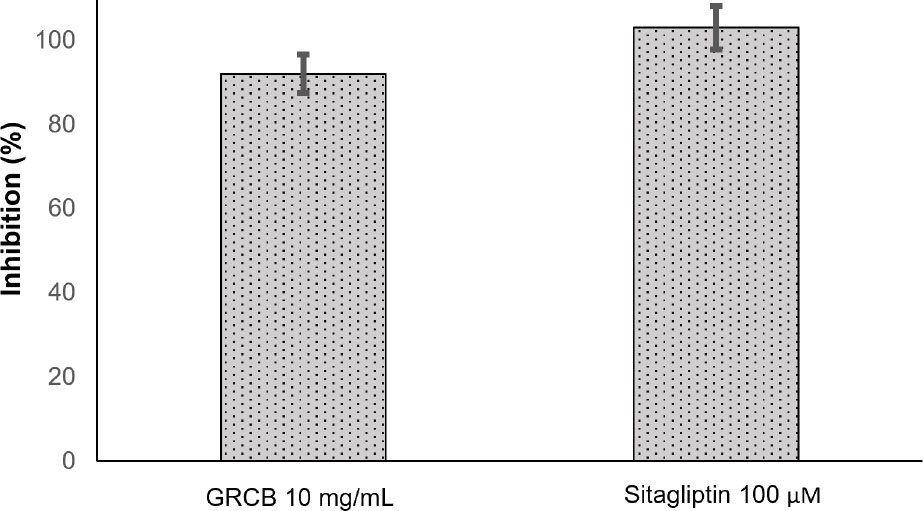
Figure 1.
Inhibition percentage of GRCB solution and sitagliptin.
Fig. 2 depicts the TIC obtained from the LC-HRMS analysis. The LC-HRMS analysis revealed 24 metabolites in GRCB. Table 1 presents the 24 major metabolites which corresponded to the chromatogram area of verified metabolites. More detailed information regarding the 62 metabolites observed, including their 2D and 3D structures, names, formulas, retention times, and areas, are provided in supplementary materials 1 and 2. Authentication analysis of GRCB with starch as an adulterant was conducted by FTIR spectroscopy. In addition, Table 2 shows the spectral and functional group identification of GRCB samples by FTIR.
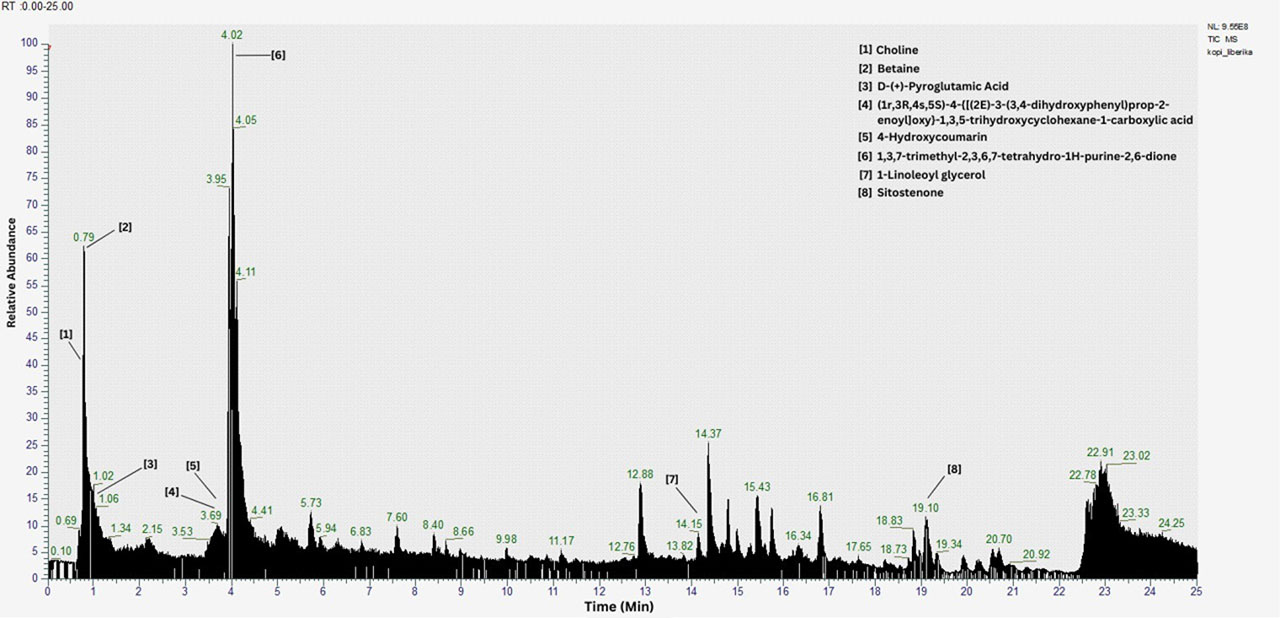
Figure 2.
Total ion chromatogram of GRCB of Coffea liberica obtained from LC-HRMS analysis.
Table 1.
Major metabolite compounds identified using LC-HRMS analysis.
| No. | Name | Formula | Calc. MW | RT (min) | Area (%) | References |
|---|---|---|---|---|---|---|
| 1 | 1,3,7-Trimethyl-2,3,6,7-tetrahydro-1H-purine-2,6-dione | C8H10N4O2 | 194.080 | 4.027 | 61.344 | Mazzafera et al., 1994 |
| 2 | Methyl isonicotinate | C7H7NO2 | 137.048 | 0.809 | 13.210 | Liu et al., 2009 |
| 3 | 1-Stearoylglycerol | C21H42O4 | 358.307 | 15.438 | 3.910 | Ma et al., 2002 |
| 4 | 4-Hydroxycoumarin | C9H6O3 | 162.032 | 3.712 | 2.356 | Vezzulli et al., 2022 |
| 5 | 3-Hydroxy-2-methylpyridine | C6H7NO | 109.053 | 0.803 | 2.138 | Subarnas et al., 1991 |
| 6 | Maltol | C6H6O3 | 126.032 | 2.245 | 1.922 | Stoffelsma et al., 1968 |
| 7 | Choline | C5H13NO | 103.100 | 0.764 | 1.561 | Shirley & Chapple, 2003 |
| 8 | (1R,3R,4S,5S)-4-{[(2E)-3-(3,4-dihydroxyphenyl)prop-2-enoyl]oxy}-1,3,5-trihydroxycyclohexane-1-carboxylic acid | C16H18O9 | 354.095 | 3.705 | 1.369 | Moreira et al., 2005 |
| 9 | 1-Linoleoyl glycerol | C21H38O4 | 354.276 | 14.165 | 0.887 | Tran et al., 2023 |
| 10 | Picolinic acid | C6H5NO2 | 123.032 | 1.014 | 0.589 | Du et al., 2007 |
| 11 | NP-011220 | C11H18N2O2 | 210.137 | 5.313 | 0.585 | Zhang et al., 2007 |
| 12 | 3-[(19Z)-15,16-dihydroxy-19-dotriaconten-1-yl]-5-methyl-2(5H)-furanone | C37H68O4 | 576.511 | 21.305 | 0.522 | Gleye et al., 2000 |
| 13 | d-(+)-Pyroglutamic acid | C5H7NO3 | 129.043 | 1.053 | 0.512 | Osborne et al., 1994 |
| 14 | Ethyl palmitoleate | C18H34O2 | 282.255 | 15.606 | 0.465 | Ekpendu et al., 1993 |
| 15 | 2,2,6,6-Tetramethyl-1-piperidinol (TEMPO) | C9H19NO | 157.147 | 8.994 | 0.442 | Aprilia et al., 2025 |
| 16 | N,N-dimethylaniline | C8H11N | 121.089 | 1.135 | 0.435 | Thomas & Bassols, 1992 |
| 17 | (1S,3R,4R,5R)-1,3,4-trihydroxy-5-{[(2E)-3-(4-hydroxy-3-methoxyphenyl)prop-2-enoyl]oxy}cyclohexane-1-carboxylic acid | C17H20O9 | 368.111 | 5.053 | 0.428 | Moreira et al., 2005 |
| 18 | Guvacoline | C7H11NO2 | 141.079 | 1.766 | 0.402 | Holdsworth et al., 1998 |
| 19 | 3-Hydroxypyridine | C5H5NO | 95.037 | 0.801 | 0.384 | Miyazawa et al., 1983 |
| 20 | Monoolein | C21H40O4 | 356.292 | 14.781 | 0.362 | Okuyama et al., 2001 |
| 21 | 7-Hydroxy-6-methoxy-2H-chromen-2-one | C10H8O4 | 192.042 | 5.690 | 0.329 | Komissarenko & Kovalev, 1992 |
| 22 | NP-019811 | C6H7NO2 | 125.048 | 1.035 | 0.325 | Zheng et al., 2018 |
| 23 | Sitostenone | C29H48O | 412.370 | 19.156 | 0.282 | Xie et al., 2007 |
| 24 | o-Toluidine | C7H9N | 107.074 | 1.133 | 0.273 | Vitzthum et al., 1975 |
Fig. 3 shows the FTIR spectral profiles of GRCB, starch as an adulterant, and adulterated GRCB. The FTIR spectroscopy method was coupled with chemometric techniques to strengthen the authentication analysis. Chemometric techniques, namely PCA and PLS-DA, were used in this study. Individual and variables plots obtained from PCA techniques are presented in Fig. 4. The AUC-ROC graph and individual background plot visualization obtained from the PLS-DA techniques are presented in Fig. 5.
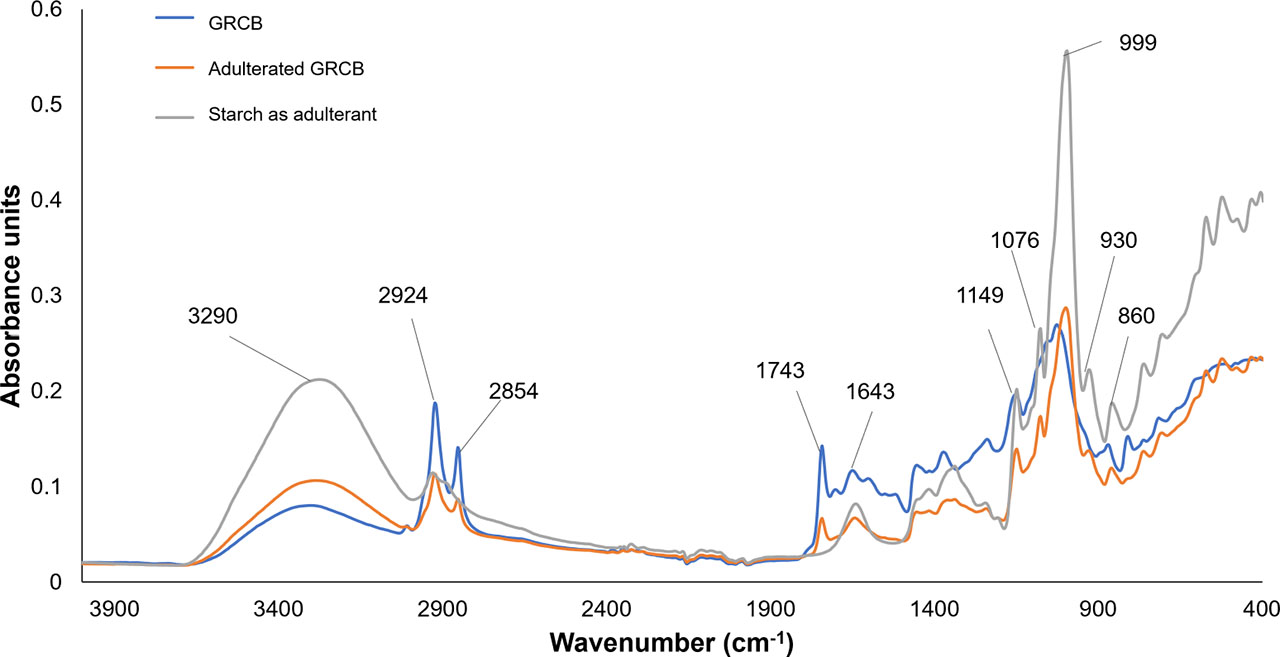
Figure 3.
FTIR spectral profiles of GRCB, starch as an adulterant, and adulterated GRCB. Annotated peaks indicate selected peaks for generating the PCA model.
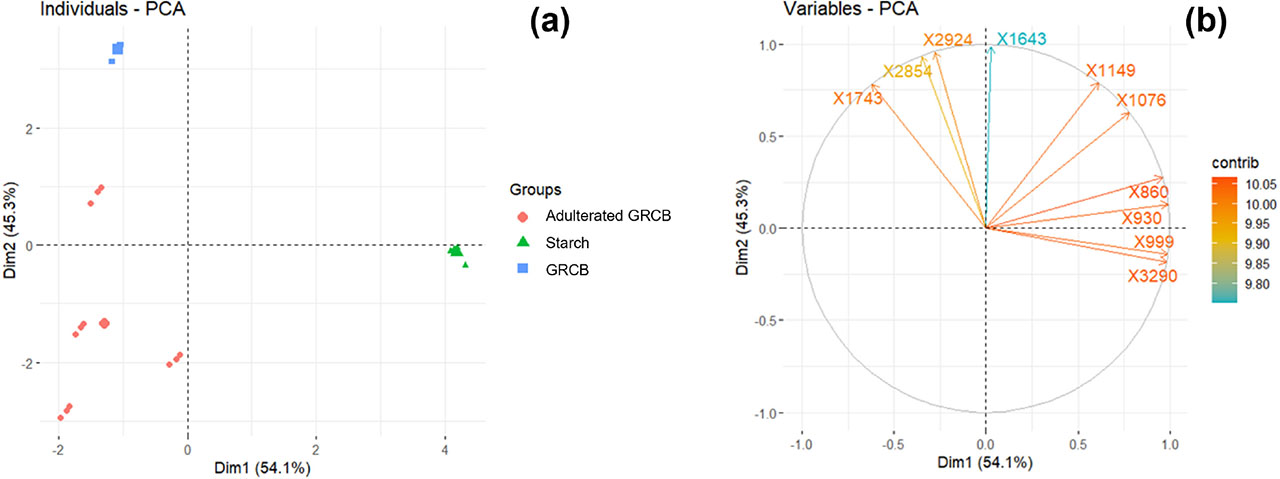
Figure 4.
Individual plot (a) and variables plot (b) resulting from the principal component analysis.
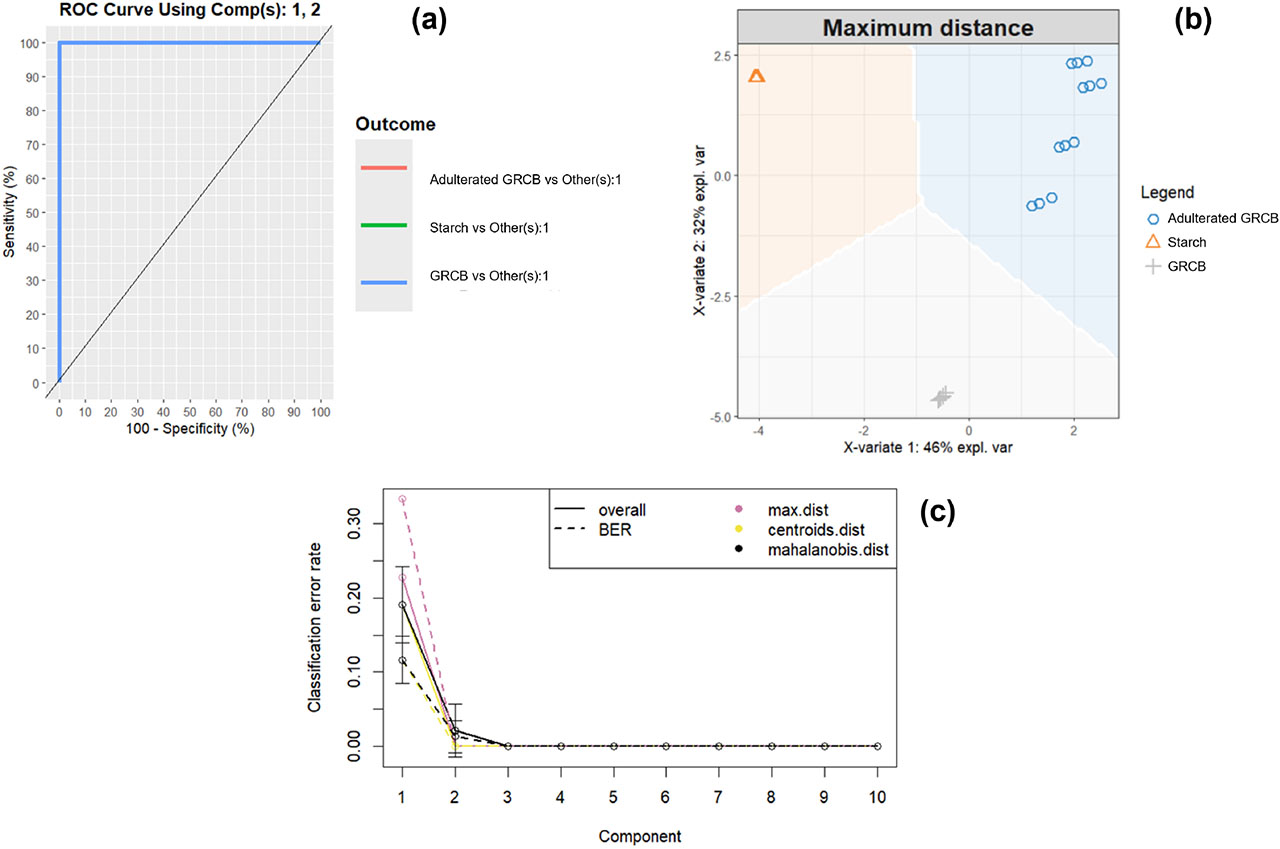
Figure 5.
AUC-ROC graph (a), individual background plot which was obtained using the maximum distance approach (b), and classification error rate analysis (c) of the partial least-squares discriminant analysis.
DISCUSSION
The DPP4 inhibitory activity of GRCB solution and sitagliptin was evaluated. Our results revealed that the GRCB solution possessed inhibition percentage of 92.09% ± 22.03% against DPP4 enzyme. The inhibitory activity test results were analyzed statistically using t-test. The p-value obtained was 0.493, indicating that the inhibition percentages of both GRCB and sitagliptin were not significantly different. Thus, our findings highlighted the remarkable potential of GRCB as a natural DPP4 inhibitor, with just 10 mg/mL offering benefits relatively comparable to 100 µM of sitagliptin, which therefore presents an innovative, plant-based approach to reduce T2DM risk.
Our LC-HRMS interpretations also confirmed the presence of several phenol-containing compounds, which are listed in the supplementary materials. These findings indicate the potency of these compounds to inhibit DPP4 activity, which is supported by previous research showing that the phenol-containing compounds could inhibit DPP4 enzyme (Fan et al., 2013). Furthermore, the inhibitory activity might also be due to the presence of caffeine (1,3,7-trimethyl-2,3,6,7-tetrahydro-1H-purine-2,6-dione) in the sample, as this compound was also reported to have an inhibitory activity against DPP4 (Ansari et al., 2021). Caffeine was identified in TIC (Fig. 2) and LC-HRMS analysis results (Table 1) as the major compound with the largest chromatogram peak area at a retention time of 4.027 min. However, LC-HRMS data revealed the presence of compounds capable of undergoing hydrolysis to yield caffeic acid, namely cryptochlorogenic acid or (1R,3R,4S,5S)-4-{[(2E)-3-(3,4-dihydroxyphenyl)prop-2-enoyl]oxy}-1,3,5-trihydroxycyclohexane-1-carboxylic acid and isochlorogenic acid or (1S,3R,4S,5R)-3,5-bis({[(2E)-3-(3,4-dihydroxyphenyl) prop-2-enoyl]oxy})-1,4-dihydroxycyclohexane-1-carboxylic acid, indicating that the addition of water could facilitate their conversion into caffeic acid. These chlorogenic acid isomers were successfully identified with the molecular formula of C16H18O9 at 3.705 min and C25H24O12 at 6.632 min (Chang et al., 2022).
Several metabolite compounds listed in Table 1 have been shown to be effective in lowering diabetes risk. For instance, it was reported that guvacoline, a compound obtained from Areca catechu seed extract, showed antidiabetic properties in diabetic rats (Musdja et al., 2020). Maltol was assessed for its protective action against diabetic peripheral neuropathy in streptozotocin-induced diabetic rats (Guo et al., 2018). In addition, pyroglutamic acid potentially assisted in lowering the risk of T2DM (Yoshinari & Igarashi, 2011). Furthermore, sitostenone was reported to effectively restore insulin sensitivity in hepatic cells (Kumar et al., 2021). It was also observed that increased choline consumption was related to a lower risk of T2DM in men; however, this relationship might differ by sex (Al-Sulaiti et al., 2024; Virtanen et al., 2020). Our findings, as presented in Table 1, may, therefore, be of significant interest in the exploration of bioactive compounds identified in GRCB from C. liberica.
This study involved the authentication analysis of GRCB with the presence of starch as an adulterant. Previous study revealed that coffee adulteration has been widely practiced since coffee is considered as the second largest commodity in international trade (Martins et al., 2018). Fraud practice by blending different species and adding lower-cost materials into coffee, such as starch, can be done by irresponsible coffee distributors to gain economic profits (Domingues et al., 2014). However, a previous study reported that coffee practically contains no starch (Thao et al., 2014). FTIR spectroscopy method was applied to provide fingerprinting profiles of functional groups related to metabolites contained in GRCB (Fig. 3). FTIR spectra evaluation revealed unexpected findings that caffeine, cryptochlorogenic acid, and isochlorogenic acid have been successfully identified to detect coffee adulteration and characterized several characteristic regions for authentication purposes (Barrios-Rodriguez et al., 2022).
This study identified and characterized 10 dominant peaks of GRCB, starch, and mixture/adulterated GRCB containing starch (Table 2). Strong bands near 3290 cm−1 indicated the presence of −OH vibration from the functional groups of phenol, alcohol, and carboxylic acid (Abreu et al., 2020). Lipid compounds contained in coffee, such as triglyceride, sterol, fatty acid, and pentacyclic diterpene compounds, were characterized by stretching vibration near 2925–2908 cm−1 (Sahachairungrueng et al., 2022). The presence of C–H methyl and carboxyl linkages derived from xanthine derivatives is linked to caffeine, the major compound in coffee, and is indicated by the presence of medium absorbance peaks at 2854 and 1743 cm−1, respectively (Silva et al., 2018; Wei-Lung Chou, 2012). Caffeic acid, a secondary metabolite in coffee with inhibitory activity against DPP4, was formed as a hydrolytic product cryptochlorogenic acid and isochlorogenic acid (Chaowuttikul et al., 2020; Istyastono et al., 2023). Different coffee production and treatment may affect the hydrolytic process of coffee production and keep the chlorogenic acid isomers in its form (Baraldi et al., 2016; Tantapakul et al., 2023). However, the FTIR spectroscopy analysis performed in this study was applied to coffee powder. Hence, it is possible to find the presence of cryptochlorogenic acid and isochlorogenic acid in their form at the retention time of 3.705 and 6.632 min, respectively. Several absorbances were identified at the fingerprint region (1500–400 cm−1) to characterize peaks from starch sample. Strong and medium bands at 1076, 999, 930, and 860 cm−1 indicated the presence of C–O–C of hydrogen bonds between starch molecules, C–O and C–C stretching with C-OH contributions, and C–O–C ring vibration of carbohydrate (Abdullah et al., 2018; Pozo et al., 2018).
Table 2.
FTIR spectral and functional groups identification.
| No | Wavenumbers (cm−1) | Functional groups | Related compounds/materials | References | |
|---|---|---|---|---|---|
| Identified | Literature | ||||
| 1 | 3290 | 3660–2970 | OH (phenol, alcohol, carboxylic acid) | Phenolic compound | Abreu et al., 2020 |
| 2 | 2924 | 2925–2908 | C=O and C–H | Lipid | Sahachairungrueng et al., 2022 |
| 3 | 2854 | 2858 | C–H methyl | Caffeine | Silva et al., 2018 |
| 4 | 1743 | 1745 | Carboxyl linkage derived from xanthine derivatives | Caffeine | Wei-Lung Chou, 2012 |
| 5 | 1643 | 1650–1580 | C=C phenyl ring | Chlorogenic acid isomers | Liang et al., 2016 several indices of browning and subsequent antioxidant values. Principal component analysis was used to interpret the correlations between physiochemical and antioxidant parameters of coffee. CGA isomer content was positively correlated (p < 0.001 Simatupang et al., 2023 |
| 6 | 1149 | 1176–1106 | C–OH cyclohexane | Chlorogenic acid isomers | Abreu et al., 2020 Simatupang et al., 2023 |
| 7 | 1076 | 1077 | C–O–C of hydrogen bonds between starch molecules | Starch | Abdullah et al., 2019 |
| 8 | 999 | 1157–982 | C–O and C–C stretching with COH contributions | Starch | Pozo et al., 2018 |
| 9 | 930 | 920 | C–O–C ring vibration of carbohydrate | Starch | Abdullah et al., 2018 |
| 10 | 860 | 856 | C–O–C ring vibration of carbohydrate | Starch | Abdullah et al., 2018 |
Absorbance data of 10 dominant peaks characterized in previous stage were further used to build PCA model. PCA model was generated for exploratory data analysis before performing subsequent supervised pattern recognition analysis (Irnawati et al., 2021). PCA enabled the construction of linear multivariate models from complex data sets to find intrinsic information related to the observed data (Prayoga et al., 2024). Individual plot and variables plot that resulted from PCA model are presented in Fig. 4. Two first principal components provided total variance information of 99.4% with the contribution of dimension 1 and dimension 2 being 54.1% and 45.5%, respectively. It can be observed from individual plot that GRCB, starch, and adulterated GRCB can be computationally separated. The vector positions in the new PCA projection were affected by the variables used in model building. In this study, selected wavenumbers were stated as model variables. Similar to FTIR spectra evaluation, from the variables plot evaluation, it can be found that variables 1643, 1743, 2854, and 2924 cm−1 contributed to GRCB positioning. This finding indicates an insightful correlation with FTIR spectral and functional groups identification (Table 2). Caffeine and caffeic acid played important roles not only due to their antidiabetic activity but also as chemical markers for coffee authentication. However, variables in the fingerprint regions affected the positioning of starch in the individual plot. Chemical bonds involving C–O–C, C–O, and C–C characterized the presence of starch and hydrogen interaction between the starch molecules (Abdullah et al., 2018).
Chemometric technique of PLS-DA was then applied for supervised pattern recognition to improve the sample classification with more advanced selectivity and specificity (Jiménez-Carvelo et al., 2021). PLS-DA model was generated using absorbance data ranging from 4000 to 400 cm−1 with the resolution setting of 4 cm−1. Raw spectral data was analyzed using a statistical package from R software, namely “mixOmics” (Rohart et al., 2017). Evaluation of PLS-DA model performance was done using the AUC-ROC analysis. The AUC curve contains information on the degree of model separation, whereas the ROC curve indicates the model discrimination probability (Narkhede, 2018). AUC-ROC graph and individual background plot were obtained from PLS-DA evaluation (Fig. 5). From the AUC-ROC graph, model outcome of 1 was obtained for GRCB versus others, starch versus others, and adulterated product versus others. This finding indicates that the chance of the discrimination model to differentiate each class of samples was 100%. Individual background plot constructed with the maximum distance approach proved and visualized the separability of the model to classify the samples. The selection of the optimal number of dimensions for PLS-DA models was carried out considering the analysis of classification error rate in cross-validation stage (Martín-Gómez et al., 2023). It was found that two dimensions of PLS-DA components provided low error rate with consideration of maximum distance, centroid distance, and Mahalanobis distance.
More advanced research involving metabolomics using both targeted and untargeted approaches enables the implementation of powerful tools in analysis and metabolite identification related to biological properties (Aurum et al., 2023; Windarsih et al., 2022). GRCB also contained coumarin and its derivatives, which possibly contributed to its observed DPP4 inhibitory activity, as supported by previous studies (Durgapal & Soman, 2019; Singh et al., 2020; Soni et al., 2019). Several studies also exposed the potency of coffee extract as an alternative T2DM treatment, which is well correlated to our research. Previous research reported the potential of arabica coffee extract to have inhibitory activity against DPP4 (Tantapakul et al., 2023). In addition, robusta coffee extract was also found to lower blood sugar levels in an in vivo study, revealing the potency of the bioactive compounds such as alkaloids contained in the robusta coffee extract (Tandi et al., 2023), which were also found to be present in the studied GRCB extract. Although GRCB is less renowned than Arabica and Robusta coffee, our findings suggest that GRCB extract may serve as a promising alternative T2DM treatments through DPP4 inhibitory activity.
CONCLUSION
Results of this study confirmed the DPP4 inhibitory activity of GRCB, and it was found to be comparable to sitagliptin used as a positive control. Metabolite identification provided useful information to explore the potential chemical markers contained in GRCB. Caffeine was reported a as major compound with the largest peak area compared to other metabolites. Functional groups related to chlorogenic acid isomers, an ester form of caffeic acid and quinic acid, played important roles in characterizing the authenticity of GRCB with the presence of starch as an adulterant. FTIR spectroscopy combined with chemometric techniques of PCA and PLS-DA was successfully implemented in the authentication study of GRCB.
In our future studies, in-depth analysis should be carried out to discover bioactive natural products for T2DM treatment. The inhibitory activity of caffeine, caffeic acid, and other metabolites toward DPP4 can thus be studied.
ACKNOWLEDGEMENTS
This research was funded by The Institute for Research and Community Services, Universitas Sanata Dharma through their Universal Apostolic Preferences Research Grant scheme (Contract No. 019 Penel./LPPM-USD/III/2024). The authors acknowledge The Research Center for Food Technology and Processing (PRTPP), National Research and Innovation Agency (BRIN), Playen area, Gunungkidul, Yogyakarta for providing Fourier transform infrared (FTIR) spectroscopy and LC-HRMS utilized for metabolite analysis. The authors thank KPTT Salatiga, Central Java, Indonesia for providing ground-roasted coffee beans (GRCB) in this study.