
INTRODUCTION
Camellia sinensis from the family Theaceae is a plant primarily known for its leaves, which are used to make green tea, a globally popular beverage, especially in China, Korea, and Japan (Reygaert, 2017). Green tea is a natural source of fluoride, which is important for dental health as it helps protect teeth against cavities. After rinsing the mouth with green tea, approximately 34% of the fluoride remains on the tooth surface, where it can interact with oral tissues and provide protection (Awadalla et al., 2011). Among the older Japanese population, green tea consumption has been positively associated with oral health-related quality of life (Nanri et al., 2019). In addition to fluoride, green tea contains a variety of other compounds, such as polyphenols, flavonoids, catechins, and flavonols. The main catechins in green tea – (–)-epigallocatechin gallate (EGCG), epigallocatechin, and epicatechin-3-gallate – are important antibacterial agents against methicillin-resistant Staphylococcus aureus (MRSA), Helicobacter pylori, and α-hemolytic streptococcus (Venkateswara et al., 2011). Given the antibacterial potential of these compounds, it is reasonable to expect that green tea may also exhibit antibacterial effects against other pathogens, including those present in the oral cavity.
Mentha × piperita L. (peppermint) from the family Lamiaceae, a hybrid of Mentha aquatica L. and Mentha spicata L., is an important aromatic herb rich in volatile oils used in dental care. The leaves have a strong aromatic odor, a pungent taste, and a cooling sensation. For medicinal purposes, the most commonly used parts are the essential oil from the aerial parts, dried leaves, and the fresh flowering herbs (Fayed, 2019). Peppermint essential oil is well studied due to its menthol content; however, aqueous extracts of the aerial parts contain other promising molecules, including rosmarinic acid (RA), eriocitrin, luteolin glycosides, apigenin glycosides, and caffeic acid (CA) derivatives (Bittner et al., 2019). Peppermint has been acknowledged for its ability to control and alleviate oral malodor and halitosis, for instance, through breath mints, candies, and chewing gum (Carlson et al., 2021). Peppermint leaves are also used to make mouth rinses and gels to relieve gum inflammation (Taheri et al., 2011) and target periodontal bacteria (Petrović, 2015). Therefore, due to its rich medicinal properties and diverse bioactive compounds, it holds promising potential as a plant for the treatment of oral cavity diseases.
Enterococci are gram-positive bacteria, typically forming pairs or short chains, and are facultative anaerobes belonging to the family Enterococcaceae. The most commonly isolated species from clinical human samples are Enterococcus faecalis and Enterococcus faecium. Enterococci are significant pathogens in opportunistic infections, predominantly of nosocomial origin. They are the third most common cause of infectious endocarditis. Other associated diseases include urinary tract infections, abdominal infections, osteomyelitis, meningitis, sepsis, and skin and soft tissue infections (Liptáková, 2023). E. faecalis is frequently isolated from oral infections, such as marginal periodontitis, peri-radicular abscesses, and infected root canals (Kadhim et al., 2022). It is often associated with the failure of endodontic treatment due to its high resistance to endodontic medicaments and its ability to form resilient biofilms in both treated and untreated root canals. In recent decades, enterococci have shown increasing resistance to vancomycin, as well as to other antibiotics such as tetracycline, penicillin, cephalosporins, and aminoglycosides, raising significant concerns in healthcare settings (Komiyama et al., 2016). This highlights the urgent need to explore new, safe, and effective compounds. Promising potential lies in substances of natural origin, particularly polyphenols, a group of secondary metabolites from certain edible plants that have gained attention as potential agents for controlling the growth of oral bacteria (Ferrazzano et al., 2011).
MATERIAL AND METHODS
Plant material and preparation of extracts
The plant material included dried leaves from the genotypes Mentha × piperita L. and C. sinensis L. The dried peppermint leaves were obtained from the Medicinal Plant Garden of the Faculty of Pharmacy, Comenius University Bratislava. Approximately 20–30 1-year-old plants were harvested during their flowering period. The plant material was dried in the shade at room temperature (25°C). After drying, the leaves were separated from the stems and flowers and crushed to the required size. Commercial leaves of green tea (C. sinensis) was the Gunpowder type (Juvamed, Slovakia).
The water extracts were prepared as infusions according to the article “Decocta Infusa” in the Czech–Slovak Pharmacopoeia, 4th edition (PhBs, 1987), where 10 g of leaves (peppermint/green tea/mixture 1:1) was boiled for 5 min with 100 ml of hot, deionized water and cooled at room temperature for 45 min. Afterward, each infusion was filtered, frozen, and lyophilized. Lyophilization yielded 29.6% dry extract of peppermint (PLWE), 20.0% dry extract of green tea (GTWE), and 24.7% dry extract of peppermint and green tea mixture 1:1 (P + GTWE).
Standards and chemicals
RA, EGCG, (−)-epicatechin (EC), and caffeic acid (CA) were purchased from Sigma-Aldrich (St. Louis, MO, USA). Organic solvents (analytical purposes grade) for phytochemical determinations were purchased from Centralchem, s.r.o. (Slovakia).
Antibacterial testing
In the study, we used three clinical strains and one collection strain (CCM 4224) of E. faecalis. The collection strain was purchased from the Czech Collection of Microorganisms, Brno, Czech Republic (E. faecalis CCM 4224/ATCC 29212 ATM susceptibility QC strain); the clinical strains were isolated from teeth infections of patients treated at a private clinic of MUDr Ján Kováč, PhD., MPH. The antimicrobial activity of prepared lyophilizates was expressed as the minimal inhibitory concentration (MIC) and minimal bactericidal concentration (MBC) and was determined by broth microdilution assay according to the EUCAST (European Committee on Antimicrobial Susceptibility Testing) recommendations (EUCAST, 2019). Lyophilizates were dissolved in distilled water and sterilized by filtration (Merck Millipore Ltd., Burlington, USA). Antimicrobial activity testing was conducted in sterile U-shaped, 96-well microtiter plates (SARSTEDT AG & Co. KG, Nümbrecht, Germany). Samples at working concentration were added to the initial wells with a double-concentrated susceptibility testing medium (Mueller–Hinton Broth; OXOID Ltd., UK), following which serial geometric dilutions (0.0312–10 mg mL−1, 100 μL) were prepared. The bacterial inoculum was obtained from a culture grown on blood agar, with well-isolated colonies suspended in a sterile physiological solution, and adjusted to 1 × 10⁶ CFU mL−1 (CFU – colony-forming unit). Standardized microbial suspensions were added to each well (10 μL), except for sterility controls, and incubated for 24 h at 35°C. Growth controls contained microorganisms without the tested agent. The minimum inhibitory concentration (MIC) was defined as the lowest concentration that visibly inhibited microbial growth. The minimum bactericidal concentration (MBC) was determined by subculturing samples from wells without growth onto agar medium free of antimicrobial agents after 24 h incubation at 35°C. MBC was recorded as the lowest concentration, eliminating 99.9% of the inoculum.
Phytochemical determination
The quantification of selected secondary metabolites was performed using pharmacopoeial spectrophotometric methods (European Pharmacopoeia 11, 2025). The total hydroxycinnamic derivative (THD) content was determined using Arnow’s assay with Arnow’s reagent at λ = 505 nm measured in a spectrophotometer (Thermo Electron Corporation Genesys 6, Waltham, MA, USA). The percentage content of THD was calculated relative to the dried extract and expressed as RA. The total flavonoid content was determined using an aluminum chloride method measured in a spectrophotometer (Thermo Electron Corporation Genesys 6, Waltham, MA, USA). Absorbance measurements were taken at λ = 392 nm for flavonoids expressed as luteolin-7-O-glucoside (one of the major flavonoids in peppermint) and at λ = 420 nm for flavonoids expressed as quercetin (one of the major flavonoids in green tea). The percentage content was calculated relative to the dried extract. The total polyphenol and tannin contents were determined using the Folin–Ciocalteu reagent at λ = 760 nm measured in a spectrophotometer (Thermo Electron Corporation Genesys 6, Waltham, MA, USA). The percentage content was calculated relative to the dried extract and expressed as RA (major polyphenol in peppermint).
All determinations were performed in triplicate. The quantitative results of secondary metabolite contents were obtained from calibration curves and expressed as mean values with standard deviation (SD).
RESULTS AND DISCUSSION
Endodontic bacterial infections often lead to treatment failure in root canal therapy and contribute to chronic infections. As the infection progresses, endodontic pathogens, such as E. faecalis, spread to the periapical region, leading to further inflammation and tissue damage (Li et al., 2024). While E. faecalis is a part of the normal oral flora, it can act as an opportunistic pathogen, causing infections like periodontitis, root canal infections, and dental caries. It is also linked to treatment failures in root canals and can persist in these infections, contributing to chronic issues and tooth loss (Najafi et al., 2020). In recent decades, Enterococcus has emerged as a significant nosocomial pathogen worldwide, largely due to the growing concern of antimicrobial resistance (Komiyama et al., 2016). Given these challenges, the search for new, safe, and effective strategies for oral health is both urgent and necessary. Plant extracts and naturally derived substances continue to be a promising area of research, offering potential alternatives to combat the rapidly spreading bacterial resistances. In the study of the biological effects of naturally derived substances, chemical analysis of the investigated plants is crucial to identify which specific components are responsible for these effects and to further study their mechanisms of action.
The phytochemical analysis of aqueous green tea extract and aqueous peppermint leaf extract focused on determining the total content of hydroxycinnamic derivatives, total polyphenols, tannins (Fig. 1), and flavonoids (Fig. 2). The results clearly indicate distinct differences between peppermint and green tea. While peppermint exhibits a significantly higher content of hydroxycinnamic derivatives and flavonoids with an absorption maximum at 392 nm, green tea extract is primarily rich in tannins.
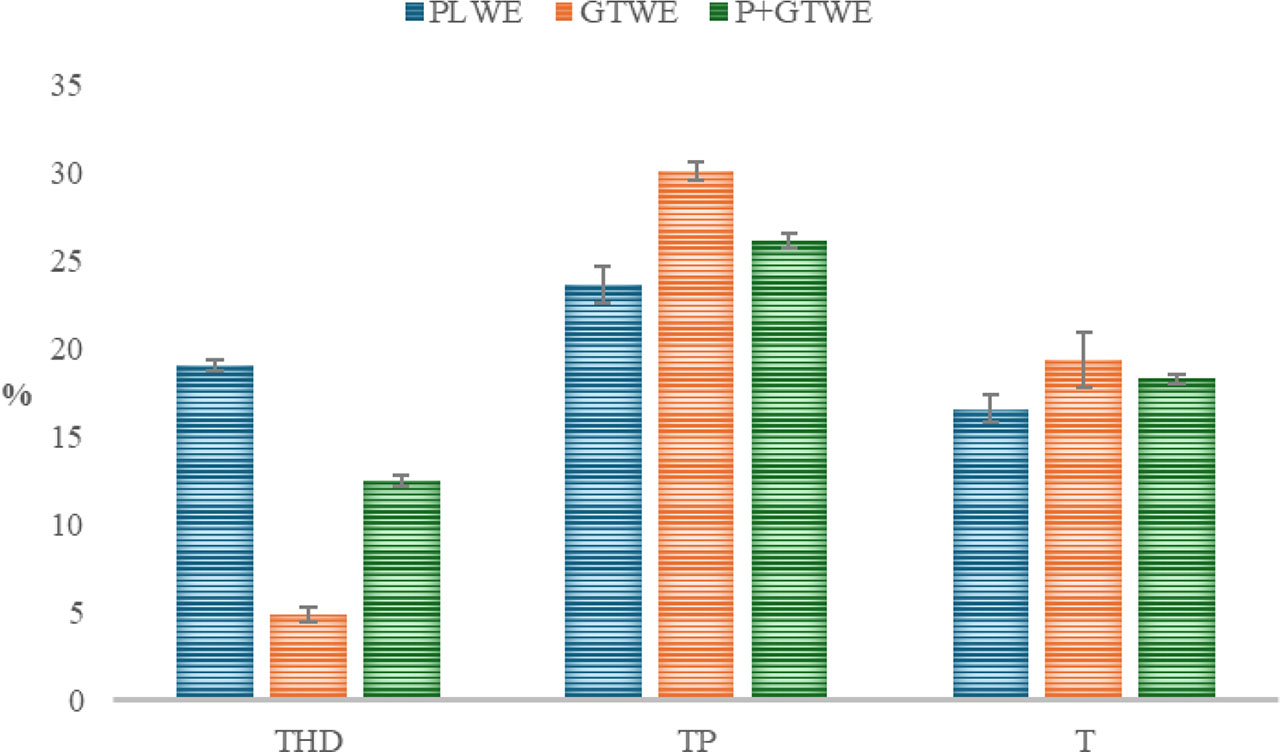
Figure 1.
Percentage contents (mean values) of total hydroxycinnamic derivatives (THDs), total polyphenols (TPs), and tannins (T) in tested lyophilizates.
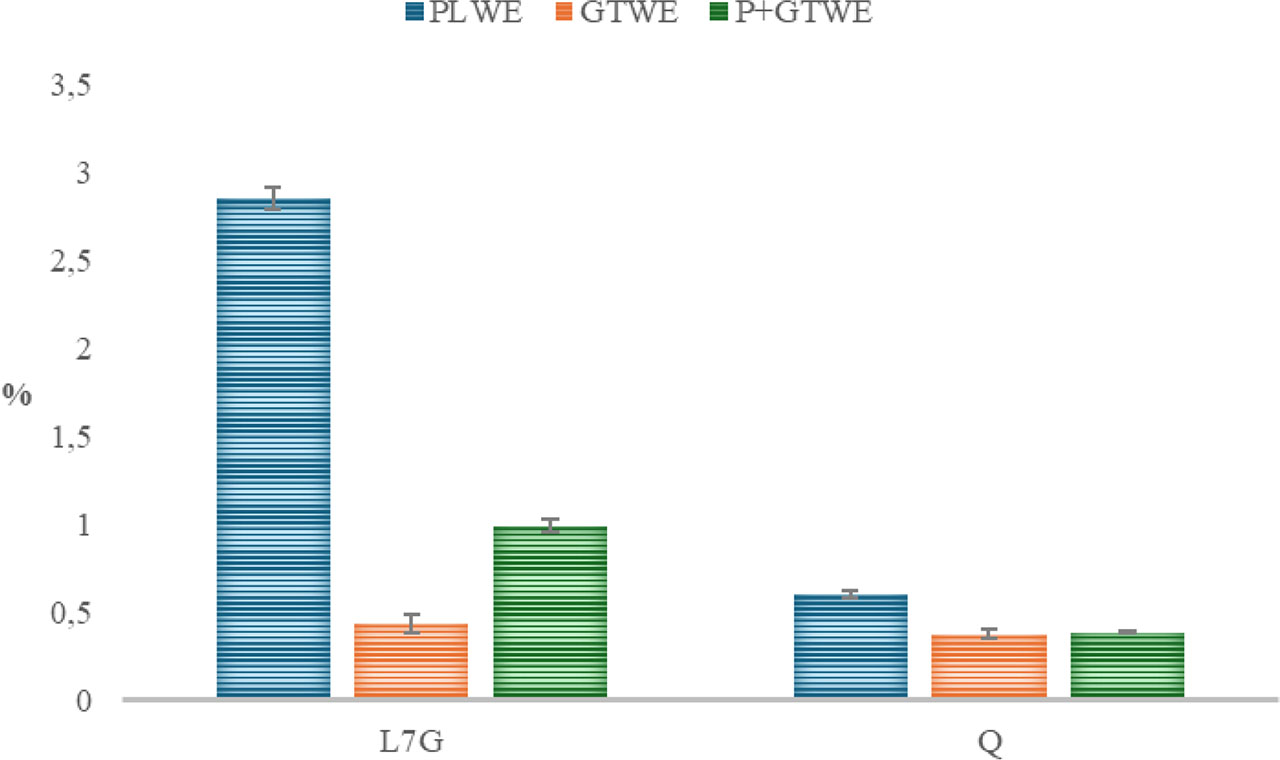
Figure 2.
Percentage contents (mean values) of total flavonoids expressed as luteolin-7-O-glucoside (L7G; λ = 392 nm) and quercetin (Q; λ = 420) in tested lyophilizates.
Given that both plants are well known, and their main bioactive compounds in polar extracts have been previously characterized, our findings align with existing literature. We propose that the dominant phenolic compounds in peppermint leaves are RA, a hydroxycinnamic acid derivative, and eriocitrin, a flavanone glycoside (Bittner et al., 2019). The percentage of THDs in peppermint was nearly four times higher than in green tea (19.1% ± 0.31% vs. 4.9% ± 0.38%). Similarly, the flavonoid content in peppermint extract exceeded that of green tea extract. When expressed as luteolin-7-O-glucoside, the flavonoid concentration was seven times higher (2.8% ± 0.06% vs. 0.4% ± 0.05%), whereas the difference was less pronounced when expressed as quercetin (0.6% ± 0.02% vs. 0.4% ± 0.01%).
Green tea extract predominantly contains catechin-type tannins, including EGCG, EC, epigallocatechin, and epicatechin-3-gallate (Venkateswara et al., 2011). Although the measured tannin content in peppermint and green tea extracts appears similar, it is well established that peppermint contains hydroxycinnamic acid derivatives, historically referred to as “labiate tannins” in older literature (Maier et al., 2017). However, these are low-molecular-weight compounds. Therefore, the applied method is not exclusively specific to “classical” tannins such as hydrolyzable or condensed tannins.
In terms of total polyphenol content, green tea exhibited a higher concentration (30%) compared to peppermint (23%). As expected, the results for the 1:1 mixture of both plants corresponded to approximately half of their individual values, further confirming the proportional contribution of each extract to the overall phytochemical composition.
The focus of our research was the antibacterial activity of water extracts from green tea and peppermint leaves, as well as their 1:1 mixture, along with four key polyphenols found in these plants. CA and RA represent the active compounds in peppermint, while EC and EGCG are the significant compounds in green tea leaves. To determine MIC of bacteria, we used the broth dilution method. Subsequently, the samples were cultured on fresh agar, and the concentration that led to the complete elimination of the bacteria was determined and expressed as MBC.
Collection reference strains may not accurately represent the behavior of clinical strains. The genetic flexibility of bacteria means that lab-adapted strains can differ significantly from clinical isolates, potentially missing important pathophysiological mechanisms. Therefore, research based on reference strains may overlook key aspects of bacterial response in real-world conditions (Fux et al., 2005). As a result, we chose to evaluate the antibacterial activity of our samples on three clinical strains and one reference collection strain to better reflect real-world effectiveness. As we anticipated, we observed slightly different antibacterial activity between the various strains. MBC of plant extracts (GTWE and GT + PLWE) was higher for selected E. faecalis clinical strains compared to the reference collection strain E. faecalis CCM 4224. Interestingly, it was observed that green tea had overall lower MIC and MBC values than the peppermint extract (evaluated only on the reference collection strain), while the mixture of green tea and peppermint acted almost antagonistically, showing significantly higher MIC and MBC values. The diverse composition of the mixture may explain the reduced activity compared to green tea alone. As can be seen in Tab. 1, the MIC/MBC of CA and RA (2.5/2.5 and 5/5 mg mL−1, respectively) were several times higher than the MIC/MBC of EC and EGCG (>1/>1 and 0.25–0.5/1 mg mL−1, respectively).
Table 1.
The activity of tested lyophilizates and selected secondary metabolites on the Enterococcus faecalis strains expressed as MIC and MBC in mg mL−1.
| E. faecalis strain | Clinical 1 | Clinical 2 | Clinical 3 | CCM 4224 | |||||||||
|---|---|---|---|---|---|---|---|---|---|---|---|---|---|
| GTWE | MIC | 2.5 | 1.25 | 1.25 | 2.5 | 2.5 | 2.5 | 2.5 | 1.25 | 2.5 | 2.5 | 2.5 | 2.5 |
| ~ | 1.25 | 2.5 | 2.5 | 2.5 | |||||||||
| MBC | 5 | 5 | 5 | 5 | 10 | 10 | 5 | 10 | 5 | 5 | 5 | 5 | |
| ~ | 5 | 10 | 5 | 5 | |||||||||
| PLWE | MIC | 2.5 | 2.5 | 2.5 | |||||||||
| ~ | ND | ND | ND | 2.5 | |||||||||
| MBC | >5 | >5 | >5 | ||||||||||
| ~ | >5 | ||||||||||||
| GT + PLWE | MIC | 5 | 10 | 10 | 2.5 | 10 | 10 | 5 | 10 | 10 | 5 | 10 | 10 |
| ~ | 10 | 10 | 10 | 10 | |||||||||
| MBC | 5 | >10 | >10 | 10 | >10 | >10 | 10 | >10 | >10 | 5 | 10 | 10 | |
| ~ | >10 | >10 | >10 | 10 | |||||||||
| RA | MIC | 5 | >5 | >5 | 5 | 5 | 5 | 5 | >5 | >5 | 2.5 | 5 | >5 |
| ~ | >5 | 5 | >5 | 5 | |||||||||
| MBC | >5 | >5 | >5 | >5 | 5 | 5 | >5 | >5 | >5 | >5 | 5 | >5 | |
| ~ | >5 | 5 | >5 | >5 | |||||||||
| EC | MIC | ||||||||||||
| >1 mg mL−1 | >1 mg mL−1 | >1 mg mL−1 | >1 mg mL−1 | ||||||||||
| MBC | |||||||||||||
| ~ | >1 mg mL−1 | >1 mg mL−1 | >1 mg mL−1 | >1 mg mL−1 | |||||||||
| ECGC | MIC | 0.25 | 0.5 | 0.25 | 0.125 | 0.5 | 0.5 | 0.25 | 0.5 | 0.5 | 0.25 | 0.25 | 0.5 |
| ~ | 0.25 | 0.5 | 0.5 | 0.25 | |||||||||
| MBC | 1 | >0.5 | >0.5 | 1 | >0.5 | >0.5 | 1 | >0.5 | >0.5 | 1 | >0.5 | >0.5 | |
| ~ | 1 | 1 | 1 | 1 | |||||||||
| CA | MIC | >1 | 2.5 | 2.5 | >1 | 2.5 | 2.5 | >1 | 1.25 | 2.5 | >1 | 1.25 | 2.5 |
| ~ | 2.5 | 2.5 | 2.5 | 2.5 | |||||||||
| MBC | >1 | 2.5 | 2.5 | >1 | 2.5 | 2.5 | >1 | 1.25 | 2.5 | >1 | 1.25 | 2.5 | |
| ~ | 2.5 | 2.5 | 2.5 | 2.5 | |||||||||
The phytochemical analysis demonstrated that green tea is richer in tannins, while peppermint has a higher concentration of hydroxycinnamic acid derivatives. The antibacterial activity of individual compounds revealed that EC and EGCG – substances classified as tannins – exhibited stronger antibacterial activity compared to CA and RA, which belong to the group of hydroxycinnamic acids. This suggests that green tea contains more active compounds, which contribute to its higher antibacterial activity.
In our experiments, EGCG demonstrated the highest antibacterial activity. It is known that EGCG inhibits major pathogens responsible for oral infections like caries, periodontal disease, and pulpal diseases. At low concentrations, it primarily acts by inhibiting virulence factors and biofilm formation. At higher concentrations, EGCG induces H2O2 production, disrupting microbial cell structures and exerting bactericidal effects (Li et al., 2024). This is also confirmed by our observation, as the MBC of EGCG was approximately twice as high as the MIC. However, the advantage of EGCG lies in its broader spectrum of effects on dental health, beyond just its antibacterial properties. For instance, in vivo studies have demonstrated that EGCG not only inhibits bacterial growth, but also helps prevent the spread of inflammation in pulp tissues (Li et al., 2021), protects against nitric oxide-induced apoptosis in human dental pulp cells (Young Park et al., 2013), and increases biomineralization of stem cells from dental apical papilla in the presence of mineralizing agents (Duque et al., 2022). Therefore, we hypothesize that EGCG is a compound with potential for application in oral health.
CONCLUSION
This study highlights the potential of green tea and peppermint extracts as antibacterial agents against E. faecalis, which is the major pathogen in endodontic infections. Phytochemical analysis revealed that green tea is rich in tannins, particularly catechins, while peppermint contains higher levels of hydroxycinnamic acid derivatives and flavonoids. Among the bioactive compounds, EGCG from green tea demonstrated the most potent antibacterial activity, followed by EC. Interestingly, the combination of both extracts exhibited antagonistic effects, leading to higher MIC and MBC. These findings suggest that green tea, particularly its key compound EGCG, could be a promising alternative for combating oral infections, especially in light of rising antimicrobial resistance. Therefore, green tea and its bioactive compounds, especially EGCG, offer significant therapeutic prospects for enhancing oral health and managing infections caused by E. faecalis.
Notes
ACKNOWLEDGMENTS
This work was supported by the Slovak Ministry of Education grant number VEGA 1/0170/24.