
INTRODUCTION
Frozen shoulder (FS) is a common yet complex musculoskeletal disorder (MSD) characterised by progressive shoulder pain and a substantial reduction in both active and passive range of motion. The condition significantly impairs daily functioning, work performance and quality of life, often resulting in prolonged disability and increased healthcare utilisation. Although traditionally considered as a self-limiting disorder, recent evidence suggests that symptoms may persist for several years, with a considerable proportion of patients experiencing residual pain and functional limitations despite treatment1,2,3. FS predominantly affects individuals between 40 years and 60 years of age and is more frequently observed among women, although epidemiological patterns vary across populations and clinical settings4,5,6.
The prevalence of FS in the general population is estimated to range from 2% to 5%; however, substantially higher rates have been reported among individuals with underlying metabolic disorders and pre-existing shoulder pathology4,7. Adhesive capsulitis may occur as a primary idiopathic condition or as a secondary disorder associated with systemic diseases, trauma, surgery or other shoulder MSDs6,8. Patients diagnosed with rotator cuff disorders, shoulder impingement syndrome, calcific tendinopathy, glenohumeral osteoarthritis and shoulder instability frequently present with symptoms that overlap with or predispose them to the development of FS8,9. Consequently, understanding the prevalence of FS among patients with shoulder MSDs is of considerable clinical importance for early diagnosis, treatment planning and prevention of long-term disability.
The pathophysiology of FS is multifactorial and involves chronic inflammation, fibroblastic proliferation, capsular thickening and excessive collagen deposition within the glenohumeral joint capsule2,3,10. Emerging evidence suggests that inflammatory cytokines, growth factors and immunological pathways play an important role in disease initiation and progression10,11. Ouyang and Dai demonstrated a significant causal relationship between systemic inflammatory cytokines and adhesive capsulitis, supporting the hypothesis that FS is influenced not only by local mechanical factors but also by systemic inflammatory mechanisms10. Recent molecular investigations have identified alterations in cytokine expression, extracellular matrix remodelling and fibrotic pathways that contribute to progressive joint stiffness and pain11,12.
Among the various factors associated with FS, diabetes mellitus has consistently emerged as one of the strongest predictors. Individuals with diabetes are considerably more likely to develop adhesive capsulitis than the general population, with prevalence estimates ranging from 10% to 20%7. A recent systematic review and meta-analysis confirmed that diabetes significantly increases the risk of developing FS, emphasising the role of chronic hyperglycaemia and glycosylation-related connective tissue changes in disease pathogenesis13. Recent reviews continue to identify diabetes as a major contributor to disease severity, prolonged recovery and poorer treatment outcomes14. In addition to diabetes, endocrine disorders such as hypothyroidism have also been associated with an increased risk of FS, possibly due to alterations in connective tissue metabolism and chronic low-grade inflammation15.
Previous studies have also highlighted the importance of demographic characteristics in the development of adhesive capsulitis. Age, sex and body mass index have frequently been examined as potential associated factors, although findings remain somewhat inconsistent across studies5,16. Several investigations have reported a higher prevalence among women and middle-aged adults, whereas others have suggested that metabolic and clinical variables may have a stronger influence than demographic characteristics alone5,16,17. Recent predictive modelling studies have further demonstrated that combinations of demographic, metabolic and clinical factors may improve the identification of individuals at high risk of developing FS16.
Clinical factors related to shoulder pathology also play an important role in the onset and progression of FS. Shoulder trauma, fractures, surgical procedures and prolonged immobilisation have been consistently associated with secondary adhesive capsulitis6,8. These conditions may trigger inflammatory responses within the shoulder capsule, leading to fibrosis, capsular contracture and progressive restriction of movement8. Likewise, patients with pre-existing shoulder MSDs often exhibit altered biomechanics and pain-related movement avoidance, factors that may contribute to the development of stiffness and functional impairment9,18.
Pain severity and range of motion limitation represent the hallmark clinical manifestations of FS and are frequently used to assess disease progression and treatment outcomes6. Shoulder pain is commonly evaluated using the Visual Analogue Scale (VAS), a validated instrument widely employed in musculoskeletal research and clinical practice19. Progressive restriction of shoulder movement, particularly external rotation, is considered to be a defining characteristic of adhesive capsulitis, and often correlates with disease severity and functional disability1,6. Several studies have reported that greater pain intensity and more pronounced limitations in range of motion are associated with poorer functional outcomes and prolonged recovery periods17,20.
Occupational and lifestyle factors have also gained increasing attention in recent years. Repetitive overhead activities, heavy manual labour and prolonged exposure to physically demanding occupational tasks have been associated with shoulder pain and dysfunction, potentially increasing the likelihood of developing adhesive capsulitis among susceptible individuals21. Sedentary lifestyle patterns, obesity and reduced physical activity have been proposed as additional contributors to shoulder dysfunction and chronic musculoskeletal conditions17,18. The interaction between occupational exposures, metabolic disorders and pre-existing shoulder pathology may therefore represent an important pathway in the development of FS.
Despite growing knowledge about the epidemiology and pathogenesis of FS, most available studies have focused on general populations, hospital-based cohorts or patients with specific metabolic disorders. Comparatively little evidence exists on the prevalence and associated risk factors of FS among patients presenting with various shoulder MSDs in private orthopaedic clinics, where referral patterns, clinical presentations and patient characteristics may differ substantially from those observed in other healthcare settings5,16,20. Addressing this knowledge gap may contribute to improved diagnostic accuracy, earlier identification of high-risk individuals, and the development of targeted preventive and therapeutic strategies.
The purpose of this study was to investigate the prevalence of FS among patients diagnosed with shoulder MSDs attending private orthopaedic clinics, and to identify the demographic, clinical and lifestyle factors associated with its development. The study also aimed to assess the relationship between pain severity, range of motion limitations and the likelihood of developing FS.
This research includes the following hypotheses:
Hypothesis 1 (H1): The prevalence of FS differs between patients diagnosed with different shoulder MSDs (rotator cuff injuries vs. impingement syndrome);
Hypothesis (H2): Demographic and clinical associated factors, such as age, gender, diabetes and history of shoulder trauma, have a significant impact on the presence of FS;
Hypothesis (H3): There is a relationship between the severity of shoulder pain and range of motion limitations and the presence of FS.
MATERIAL AND METHODS
A quantitative observational, cross-sectional design was used to determine the prevalence of FS and its associated risk factors among individuals with a diagnosis of shoulder MSD.
Three different orthopaedic clinics participated in this study (to collect the data), which specialise in diagnosing and rehabilitating patients with a variety of MSDs. These clinics receive referrals from both primary care physicians and orthopaedic specialists. The study sample included adult patients diagnosed with shoulder MSDs, using one of the three selected clinic databases as the source of potential subjects during the study timeframe. Participants in this study were recruited using a purposive sampling method to ensure that only patients meeting the previously established eligibility criteria were selected. Eligible participants included adults aged ≥18 years diagnosed by an orthopaedic specialist with a shoulder MSD (rotator cuff injury, shoulder impingement syndrome, tendinopathy or other clinically diagnosed shoulder disorders), and confirmed by clinical examination and/or imaging (radiography, MRI). Although the eligibility criteria allowed for a broader range of shoulder disorders, all 76 patients enrolled during the study period were diagnosed with either rotator cuff injury (n = 44) or impingement syndrome (n = 32); no patients with tendinopathy or other shoulder disorders met the inclusion criteria during this timeframe, and therefore the final analytic sample comprised only these two diagnostic groups. All diagnoses were established by orthopaedic specialists based on clinical examinations and/or imaging studies (plain X-rays, MRI).
The diagnosis of FS was established by a single reviewing orthopaedic physician using the standard clinical criteria consistent with current guidelines1,18: (1) persistent shoulder pain and (2) marked restriction of both active and passive range of motion of the glenohumeral joint, particularly external rotation. No additional standardised diagnostic instrument (structured diagnostic checklist) was applied, and diagnosis by a single assessor without inter-rater reliability testing is acknowledged as a limitation. Patients were excluded from the study if they experienced severe systemic or autoimmune diseases affecting one’s ability to perform an activity or inflammatory status, including those experiencing active malignancies. Neurological disorders affecting the upper extremities, severe cognitive impairment and inability to give informed consent were also a part of the exclusion criteria.
There were 76 patients who qualified for participation in the study according to eligibility criteria, and all agreed to participate and underwent testing as outlined in the protocol. Data were collected from visits by patients attending their previously scheduled outpatient visits. Participants were provided with verbal and written descriptions of the purpose of the study, and the procedures to be followed; they were informed that participation was voluntary and that they would be participating in a confidential study before proceeding with data collection; written informed consent was provided prior to data collection.
Structured questionnaires were completed by trained medical personnel administering to all participants. Standardised instructions on completing the questionnaire were given to ensure uniformity, and to reduce bias when obtaining information from participants. Some clinical information was confirmed when individual participant data was reviewed, including the information originally collected via medical record review, where deemed appropriate by investigator review.
The questionnaire comprised eight items designed to collect information on the demographic, clinical and lifestyle characteristics related to FS. Demographic characteristics included gender (male/female) and age category (18–30, 31–40, 41–50, 51–60, >60); clinical and lifestyle history included history of diabetes mellitus (Yes or No), history of shoulder trauma (Y or N) and classification of shoulder disease (rotator cuff tear, shoulder impingement syndrome, or other types of shoulder musculoskeletal disease). The presence of FS (as determined by an orthopaedic clinical assessment) was the primary outcome variable (Yes or No). Pain severity was assessed with the VAS, which is widely used for measuring pain; participants rated the average intensity of pain in their shoulders on a 10-point scale, with 0 = no pain and 10 = the worst pain imaginable. For the logistic regression model, variables were coded as follows: gender (0 = male, 1 = female), age group (treated as an ordinal/continuous variable from youngest to oldest category), history of diabetes (0 = no, 1 = yes) and history of shoulder trauma (0 = no, 1 = yes). FS presence (0 = no, 1 = yes) served as the reference outcome. Since the questionnaire combined separate demographic and clinical items rather than a unidimensional scale, Cronbach’s alpha was not an appropriate measure of internal consistency and was therefore not applied.
Shoulder range of motion (flexion and abduction) was assessed clinically and recorded using six ordinal categories (0°–30°, 31°–60°, 61°–90°, 91°–120°, 121°–150°, 151°–180°), consistent with the standard goniometric documentation practices used in orthopaedic clinical assessment. For analytic purposes, each category was assigned a sequential ordinal score (1–6, corresponding to increasing range of motion), and this composite ordinal ‘movement limitation’ score was used in the Pearson correlation analysis with pain severity (VAS) for H3.
This study adhered to the principles of the Declaration of Helsinki and the principles of good clinical practice as related to biomedical research involving human participants. Ethical approval for the study was obtained from the Kosovo Chamber of Physiotherapists review board under Protocol No. 384/25. Participation in this study was entirely voluntary, and participants were informed that they could withdraw from the study at any time without any consequence to their clinical care. Data obtained from participants were collected anonymously and kept secure to maintain confidentiality and privacy. All personal identifiers were removed prior to conducting the statistical analysis of this study.
The Statistical Package for the Social Sciences (SPSS), version 27.0, was used to conduct all statistical analyses. Descriptive statistics were utilised to describe the characteristics of participants; categorical variables were described by frequency or percentage, while continuous variables were described by mean and standard deviation. In testing H1, the association between the type of disorder of the shoulder and the prevalence of FS was evaluated using the Chi-Square Test of Independence. The association of demographic and clinical associated factors (age, sex, diabetes mellitus and history of shoulder trauma) with the likelihood of developing an FS was evaluated in a binary logistic regression analysis for H2. Odds ratios (ORs) with 95% confidence intervals (CIs) were reported. For H3, Pearson correlation analysis was used to examine the relationship between pain severity (VAS score) and range of motion limitations.
Prior to inferential statistics, data were reviewed for completeness, outliers and possible entry errors. Normality, multicollinearity and homoscedasticity were determined for each statistical assumption for which these assumptions were applicable. The p-value for statistical significance was set at p < 0.05. Statistical power was set at 80% (1 − β = 0.80) to allow for adequate sensitivity to detect important relationships between the study variables.
A formal a-priori sample size calculation was not performed for this study, as the primary aim was exploratory characterisation of FS prevalence and associated factors within this clinical population. To contextualise the precision of our regression estimates, we calculated the events-per-variable (EPV) ratio for the logistic regression model. With 5 non-FS cases among 76 participants and 4 predictors, the EPV was approximately 1.25, below the conventional heuristics suggested for standard maximum-likelihood logistic regression. This is a common feature of studies involving high-prevalence clinical outcomes, and we addressed it directly by applying Firth’s penalised logistic regression, a well-established correction for exactly this scenario, which produced stable and consistent estimates.
RESULTS
Table 1 presents the structure of the sample, detailing the distribution of participants by gender and age group. The sample consists of 76 individuals, with 64.5% (49) being female and 35.5% (27) male. Regarding age distribution, the largest group is the 41–50 age category, comprising 38.2% (29 participants), followed by the 31–40 age group with 27.6% (21 participants). The 51–60 age group accounts for 22.4% (17 participants), while the 18–30 and >60 age groups are the smallest, with 6.6% (5 participants) and 5.3% (4 participants), respectively. This distribution indicates a predominantly middle-aged and female sample.
Table 1.
Sample structure
| Question | Frequency | Percent |
|---|---|---|
| Gender | N | % |
| Male | 27 | 35.5 |
| Female | 49 | 64.5 |
| Age group | N | % |
| 18–30 | 5 | 6.6 |
| 31–40 | 21 | 27.6 |
| 41–50 | 29 | 38.2 |
| 51–60 | 17 | 22.4 |
| >60 | 4 | 5.3 |
Variations in the proportion of FS suffered by patients with various musculoskeletal shoulder disorders are important to gain a clear picture of the unique burden of these conditions within these diagnostic groups. The results allow us to statistically analyse the relationship between different shoulder musculoskeletal diagnoses and the frequency of FS, through chi-square testing; they also help tease out potential associated factors and may permit a more focused clinical response.
According to the results shown in Table 2, there is an increased prevalence of FS occurring in patients with shoulder MSDs. FS was present in 71 of 76 patients (93.4%); prevalence was 95.5% among patients with rotator cuff injury and 90.6% among those with impingement syndrome, with no significant difference between the groups (p = 0.402). Although both diagnostic categories presented high incidences of FS, the data suggest that there may be a slight difference in FS prevalence between the two categories.
Table 2.
Prevalence of FS according to type of shoulder MSD
| Type of shoulder disorder | FS yes | FS | Total |
|---|---|---|---|
| n (%) | n (%) | n (%) | |
| Rotator cuff injury | 42 (95.5) | 2 (4.5) | 44 (57.9) |
| Impingement syndrome | 29 (90.6) | 3 (9.4) | 32 (42.1) |
| Total | 71 (93.4) | 5 (6.6) | 76 (100) |
| Pearson χ2 | 0.703 | df = 1 | p = 0.402 |
| Fisher’s exact test | p = 0.644 |
The results from a chi-square test indicated that while FS is associated with MSDs, there was no statistically significant association between MSDs and FS (χ2 = 0.703, df = 1, p = 0.402), while Fisher’s exact test revealed that there is no statistically significant difference in the prevalence of FS between the two MSD classification groups (p = 0.644). Thus, the prevalence of FS appears relatively consistent among all types of shoulder MSDs studied.
These results indicate that FS does not appear to be greatly influenced by the MSD diagnosis but may instead be influenced by common underlying pathophysiologic mechanisms across all MSD conditions. The consistently high prevalence of FS in both groups supports the supposition that other factors, such as inflammation and limitations in functional capabilities, may be the primary contributors to increased prevalence of FS rather than differences in MSD diagnostic subgroup.
Table 3 displays the descriptive statistics for the levels of pain severity and functional limitations in the shoulders of patients in the study, as well as the correlation of those variables and an assessment of their degree of normality. The average pain severity (mean score of 6.53 (±2.32)) shows that the study population experiences a substantial amount of pain, exhibiting symptoms consistent with chronic conditions. Functional limitations of the shoulder also indicate moderate levels (mean score of 3.51 (±1.39)), which likely indicates an array of clinically significant functional impairment associated with the population of patients represented in this study.
Table 3.
Descriptive statistics and correlation between pain severity and movement limitations
| Variable | Mean | SD | Minimum | Maximum |
|---|---|---|---|---|
| Severity of shoulder pain | 6.53 | 2.32 | 1 | 10 |
| Movement limitations | 3.51 | 1.39 | 1 | 6 |
| Pearson correlation (r) | 0.685 | |||
| p-value | <0.001 | |||
| Normality test (Shapiro–Wilk p-value) | 0.542–0.866 (all subgroups, p > 0.05) | |||
The normality assessment utilising the Shapiro–Wilk test demonstrated that all variables were normally distributed in each of the subgroups of participants (with p-values between 0.542 and 0.866). Hence, parametric statistical tests could be used for additional analysis. As such, findings from the Pearson product–moment correlation analysis indicated that there is a substantial correlation between pain severity and shoulder movement restriction severity (r = 0.685, p < 0.001). Higher levels of pain were associated with higher degrees of restriction of shoulder movement. Clinically, this indicates that clinical practices to treat an individual with FS should simultaneously consider the relationship between the severity of pain and the degree of movement restrictions experienced by the patient, to improve overall clinical outcomes.
Table 4 summarises the results from the logistic regression analysis conducted to investigate the demographic and clinical factors associated with the occurrence of FS. The logistical model used to conduct this regression had a moderate amount of clarity (i.e. explained variance), with a Nagelkerke R2 value of 0.497, and a Cox & Snell R2 value of 0.320. This indicates that about one-half (i.e., 50%) of the variance in FS occurrence can be explained by the predictor variables in this regression model.
Table 4.
Logistic regression analysis of factors associated with FS: standard ML estimates and Firth penalised logistic regression estimates
| Predictor (reference category) | ML: B (SE) | ML p-value | Firth: B (SE) | OR (95% CI) | Firth p-value |
|---|---|---|---|---|---|
| Gender: female vs male (ref = male) | 18.52 (2.97) | 0.024 | 1.42 (0.63) | 4.14 (1.20–14.29) | 0.025 |
| Age (ordinal, per category increase, 18–30 → >60) | −18.23 (1.42) | <0.001 | −0.98 (0.23) | 0.38 (0.24–0.59) | <0.001 |
| History of diabetes: yes vs no (ref = no) | −16.15 (5218.97) | 0.998 | −0.78 (0.95) | 0.46 (0.07–2.97) | 0.412 |
| History of shoulder trauma: yes vs no (ref = no) | −3.76 (0.94) | <0.001 | −2.05 (0.54) | 0.13 (0.045–0.37) | <0.001 |
| Model fit | −2LL = 48.97 | Nagelkerke R2 = 0.497 | Firth − 2LL [nga rianaliza] | Firth pseudo-R2 [nga rianaliza] | |
| Multicollinearity | Tolerance 0.582–0.831 | VIF 1.203–1.718 | |||
Among the above demographic and clinical factor variables, gender, age and shoulder trauma history were significantly associated with the presence of FS: Gender (p=0.024; consistent with the Firth penalized model, p=0.025), age (p < 0.001, consistent across both the ML and Firth models), and shoulder trauma history (p < 0.001, consistent across both the ML and Firth models) all demonstrated statistically significant associations with the presence of Frozen Shoulder. Conversely, Diabetes Mellitus was not significantly associated with Frozen Shoulder based on the Firth penalized logistic regression model (B = −0.78, SE = 0.95, OR = 0.46, 95% CI 0.07–2.97, p = 0.412), which is the model used for interpretation of this predictor. The standard maximum-likelihood (ML) estimate for diabetes (B = −16.15, SE = 5218.97, p = 0.998) showed an extremely inflated standard error indicative of quasi-complete separation caused by sparse data, and is therefore not considered a reliable basis for inference; it is reported in Table 4 for transparency and comparison only..
The results of the multicollinearity diagnostics determined that the overall regression model was statistically stable (tolerance values ranged from 0.582 to 0.831; variance inflation factor (VIF) values ranged from 1.203 to 1.718; therefore, both are within accepted limits). Based on these findings, it appears that in the demographic and mechanical factors of age, shoulder trauma history may have a greater impact on the occurrence of FS than do metabolic factors for the current cohort.
Hypothesis testing demonstrated that H1 was not supported, as no statistically significant difference in FS prevalence was observed between patients with rotator cuff injuries and those with impingement syndrome. H2 was partially supported, with gender, age and history of shoulder trauma showing significant associations with FS, whereas diabetes history was not statistically significant. H3 was supported, indicating a significant positive relationship between shoulder pain severity and shoulder movement limitation. These findings collectively suggest that FS occurrence may be more strongly related to demographic and trauma-related factors, while greater pain severity is closely associated with increased functional restriction.
DISCUSSION
This study investigated the prevalence of FS among those who suffer from shoulder MSDs, as well as explored the factors that are associated with this condition, including demographic information, clinical information and functional information. Insights derived from this study indicate that FS is a common condition within a private orthopaedic clinical setting, and can have many different causes, but also highlights the implications surrounding early diagnosis and treatment of this condition.
In regard to H1, the results of this study indicate a very high prevalence of FS among both cohorts of patients, with no statistically significant difference between rotator cuff injury and impingement syndrome (χ2 = 0.703, p = 0.402). Patients who had a rotator cuff injury (intervention group) had a slightly higher prevalence of FS; however, the difference did not reach statistical significance. This suggests that the type of shoulder MSD would not be the sole variable that determines the presence of FS. These findings support the previous literature which states that FS often occurs as a complication in conjunction with other types of shoulder pathologies, as opposed to being caused by a specific disorder6,8,9. Cucchi et al.8 stated that stiffness of the shoulder is frequently the end product of inflammation and degeneration in different conditions of the shoulder. As such, due to lack of statistical significance with these findings, H1 was not supported. The findings from this study indicate that FS occurs with a comparable prevalence across different shoulder disorders; however, this does not establish a shared pathophysiological mechanism between these conditions. Further longitudinal studies incorporating imaging, biomarkers and other mechanistic assessments are warranted to clarify the underlying biological pathways and determine whether common mechanisms contribute to the development of FS across different shoulder disorders.
When examining H2, the results indicated that the model which included logistic regression identified three variables (age, gender and history of shoulder trauma) which were all considered significant factors associated with FS; however, diabetes mellitus did not yield any statistically significant results in this model. Firth penalized logistic regression: p = 0.412; the corresponding standard maximum-likelihood estimate, p = 0.998, reflected quasi-complete separation due to sparse data and was not used for interpretation Moderate explanatory power is demonstrated overall with an acceptable value for the model, Nagelkerke R2 = 0.497, showing that the selected variables explained some variance in the presence of FS. Supported by previous studies, the age group between 40 and 65 years is associated with a higher prevalence of developing FS due to degenerative and inflammatory changes to the connective tissue5,20. In addition, as established in previous research studies6,8, trauma from shoulder injury can initiate capsular inflammatory changes that lead to fibrosis. However, the finding that diabetes mellitus was not significantly associated with FS in the present sample should be interpreted cautiously, and should not be considered as evidence against diabetes as an established risk factor. Rather, diabetes mellitus was not detected as a significant predictor in this sample. Given the relatively small sample size and the potential for sparse-data effects in the logistic regression model, the absence of a statistically significant association may reflect limited statistical power rather than a true absence of an underlying relationship. This interpretation is particularly important in light of the well-established association between diabetes mellitus and FS reported in previous studies7,13,14. The discrepancy may be a consequence of small sample sizes, population-specific information, limitations of the sample describing diabetes as a metabolic comorbidity, as well as limitations in reported comorbidity in the present sample. Nonetheless, even though metabolic factors may influence FS development, there may be more influence from structural and demographic factors in the present patient sample. Therefore support exists for H2.
Regarding H3, there was a strong statistically significant positive correlation between Pain Severity and Movement Limitations (r = 0.685, p < 0.001), indicating higher pain intensity and greater functional impairment of the shoulder joint. There is established clinical evidence that pain and restricted motion are the key characteristics in the progression of FS1,2,6. The association between Pain Severity and Movement Limitations supports the biopsychomechanical model of adhesive capsulitis in that pain severity leads to restriction of movement that results in further capsular stiffness and functional decline. In addition, the reliability of pain measurement was substantiated by the use of VAS, which has been widely used within Musculoskeletal Research19. Therefore support exists for H3, demonstrating the interdependence of Pain Severity and Functional Disability in FS patients.
The findings from this study are consistent with the previous literature indicating that FS is a multifactorial disorder that is influenced by demographic, mechanical and functional variables, instead of one singular cause4,5,11. The increase in recent studies supporting the role of Inflammatory and Systemic Mechanisms in the development of the disease suggests that FS must be classified as both a Regional and a Systemic Musculoskeletal Disorder11,19. The high prevalence in patients participating in this study further substantiates the finding that adhesive capsulitis usually coincides with other shoulder pathologies, and may be one of the many common complications occurring within Orthopaedic Medicine11,17.
The extraordinarily high prevalence of FS observed in this cohort (93.4%) is considerably higher than population-based estimates (2%–20%) reported in the literature4,7, and should be interpreted with caution. This is likely attributable to selection effects inherent to a purposive, private-clinic-based sample, including referral bias (patients referred to specialist orthopaedic clinics may represent more advanced or complicated presentations), possible misclassification bias arising from diagnosis by a single assessor without a standardised diagnostic protocol and overrepresentation of more severe cases typical of private orthopaedic settings. Consequently, our prevalence estimate should not be interpreted as representative of the general population of patients with shoulder MSDs.
This study did not collect data on the timing or duration of the primary shoulder condition (rotator cuff injury or impingement syndrome) prior to assessment. As a result, we are unable to determine whether FS developed early or late in the course of the underlying disorder, which limits our ability to interpret the temporal relationship between the primary shoulder pathology and the onset of FS. Future prospective studies incorporating symptom-onset dating are needed to clarify this relationship.
CONCLUSIONS
FS was found to be common among patients with both rotator cuff injuries and impingement syndrome, with similar prevalence observed across the two groups. While this pattern is consistent with the hypothesis that these conditions may share underlying pathophysiological pathways (capsular fibrosis and inflammation), our cross-sectional design based solely on prevalence comparison cannot confirm a common mechanism. Given the similar prevalence of FS across both the diagnostic groups, future research could explore whether shared diagnostic or therapeutic approaches may be relevant for patients with rotator cuff injury and impingement syndrome who develop FS.
The demographic factors of age/gender and the clinical factor of shoulder trauma appear to be the primary associated factors for developing FS. In this cohort, there was no statistically significant effect from diabetes. Thus, clinicians should place emphasis on these demographic and clinical factors when identifying people at risk of developing FS and implementing preventative strategies to reduce their risk.
Shoulder pain severity was correlated with shoulder mobility limitations, indicating the need to incorporate pain management and mobility restoration as integral parts of treatment. A combined approach, utilising pain management and mobility restoration in conjunction with multiple disciplines, such as pain medications, injections and/or physical therapy, may improve overall outcomes.
While useful information has been provided, limitations underscore the need for additional research to further explore variables related to diabetes, pain-mobility dynamics in a longitudinal setting, use of objective outcome measures and the effects of other known associated factors such as occupational exposures and genetics, so as to optimise the development of evidence-based practices.
Notes
Appendices
APPENDIX
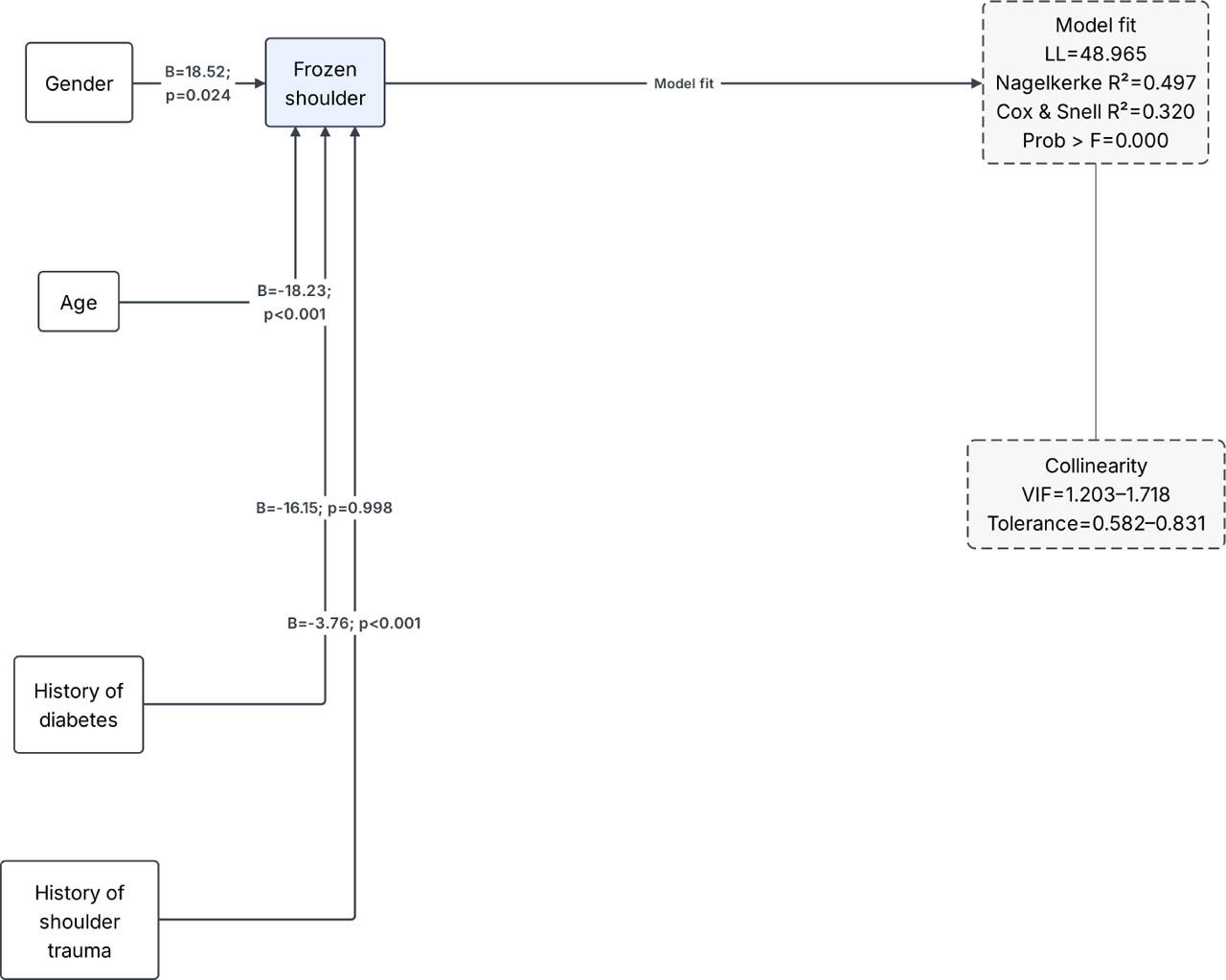
Appendix 1.
Results from regression analysis presented in visual form. VIF - variance inflation factor
Note: The regression coefficients and p-values displayed in this figure correspond to the standard maximum-likelihood (ML) model in Table 4 and are shown here for visualization purposes only. Because the ML estimate for diabetes mellitus was unstable due to quasi-complete separation (p = 0.998), interpretation of this predictor in the text and conclusions is based on the Firth penalized logistic regression estimate (p = 0.412; OR = 0.46, 95% CI 0.07–2.97). The previous “Prob > F” statistic has been removed from the figure, as it is an F-test measure applicable to linear regression and is not an appropriate or applicable statistic for a logistic regression model; see Table 4 for the corresponding model fit statistics.