
INTRODUCTION
This section concludes with a clear statement outlining the purpose of this study. The inclusion of every citizen in society is a fundamental goal of the European Union (EU), and equitable access to physical activity – and the many benefits it affords – should be universally available. Physical activity has been widely associated with improvements in physical fitness and functional ability1–3, as well as psychological and social benefits, such as enhanced self-esteem4, personal satisfaction5 and increased community integration6.
Despite these recognised benefits, the concept of inclusion in sport remains highly contested. Critics have highlighted how inclusive sport policies can sometimes reinforce dominant norms, such as ableism or heteronormativity, while overlooking the lived experiences of those they aim to serve7–9. Within Para sport and the Paralympic movement, additional complexities arise around identity, classification systems and the pressure to perform according to elite norms. These dynamics may inadvertently marginalise athletes, prompting critical questions about who is truly included, under what conditions and for whose benefit10,11.
Amidst this critical backdrop, adaptive or Para sports – sports modified or designed to meet the needs of people with disabilities12 – hold the potential to foster both empowerment and belonging. Among these, adaptive surfing offers a unique promise. Practiced in natural aquatic environments, surfing provides an immersive, embodied experience that fosters physical health, psychological resilience and emotional well-being13–15. Adaptive surfing – also known as Para Surfing by the International Surfing Association (ISA) – encompasses a variety of techniques and equipment adaptations designed to enable participation by individuals with physical or sensory impairment16.
Within the broader realm of adaptive surfing, surf therapy has emerged as a particularly meaningful practice. As a form of blue health – which refers to health and well-being benefits derived from aquatic environments – it offers a non-competitive, relationally supportive and emotionally safe space. These settings can create opportunities for personal transformation and healing, particularly for individuals who may have felt excluded or disempowered within the hierarchical and performative structures of competitive sport17. In contrast to the intense pressures and identity negotiations often reported by Paralympic athletes18, surf therapy’s focus on care, connection and enjoyment nurtures a stronger sense of self-worth, enhances social inclusion and promotes holistic well-being19.
Outdoor sports re linked to a wide range of benefits, including physical health, mental resilience, lifelong learning and community cohesion20. However, these spaces have not been immune to critique, particularly regarding their exclusionary and hegemonic cultures – often marked by whiteness, masculinity and able-bodied norms21–23. Adaptive surfing presents an opportunity to challenge these legacies by reimagining what inclusive, affirming and transformative sporting experiences can look like.
In recent years, adaptive surfing has grown significantly in popularity, yet empirical research on its practices, outcomes and best practices remains limited. Much of the existing literature focuses on general therapeutic or educational benefits of surfing, with few studies addressing the unique needs and experiences of people with physical or sensory disabilities. There is currently no consensus on how adaptive surfing programmes should be designed or evaluated, and a clear need exists for a structured synthesis of available evidence. These limitations and the emerging and diverse nature of research on adaptive surfing, a scoping review represents the most appropriate approach. The existing studies vary widely in population, intervention type and outcomes, encompassing qualitative, quantitative and mixed-method designs. Moreover, and to the authors’ knowledge, there is no standardised framework for evaluating adaptive surfing programmes, limiting the feasibility of a meta-analysis. Conducting a scoping review allows for systematic mapping of the evidence, identification of knowledge gaps and synthesis of key findings to inform future research, programme development and policy24,25. Considering this rationale, the objectives of this scoping review were: (1) to map the existing evidence of adaptive surfing interventions on individuals with physical or sensory disabilities; (2) to identify the range of physical, psychological, educational and social outcomes reported; (3) to examine the strategies and adaptations employed to facilitate inclusive participation; and (4) to highlight knowledge gaps and propose directions for future research. To address these objectives, the following research questions were considered: (i) What are the characteristics and aims of existing adaptive surfing interventions for people with physical or sensory disabilities? (ii) What health, well-being, and social outcomes have been reported? (iii) How are adaptive surfing programmes designed and delivered to promote inclusion and empowerment for people with physical or sensory disabilities?
Given this context, the present scoping review systematically maps and critically assesses the current state of research on adaptive surfing for people with physical or sensory disabilities, with particular attention to inclusion, empowerment and well-being. This review forms part of the EU Erasmus + INCLUSEA project (2021–2023), which aimed to identify and promote best practices in adaptive surfing across Europe. By synthesising existing evidence, this review seeks to inform future policy, practice and research, contributing to a more inclusive and socially just sporting environment.
MATERIALS AND METHODS
Terminology and conceptual surfing for people with physical or sensory disabilities
The literature on surfing interventions for people with physical or sensory disabilities uses heterogeneous terminology. For clarity, standardised terminology was used in this review to fulfil the research purpose and objectives.
Adaptive surfing refers to surfing modified for people with physical, sensory, cognitive or developmental disabilities. This broad category includes recreational, therapeutic and competitive activities, and may involve adaptive equipment as needed. Para surfing refers to performance and participation in formal adaptive surfing competitions governed by the International Surfing Association, including athlete classification. Surf therapy describes structured, non-competitive programmes designed to promote psychological, social and physical well-being. These interventions emphasise safety, group support, mindfulness and connection to the natural environment. Often, also target specific outcomes such as mental health, social inclusion and physical rehabilitation. Recreational adaptive surfing refers to participation-focused surfing without formal therapy or competition. This approach prioritises inclusion, skill development, enjoyment and social engagement.
All definitions underscore surfing as ‘gliding on the water’ using a floating device, in which the person harnesses the kinetic energy of moving water to propel themselves while maintaining balance and control26. This practice can serve multiple objectives and configurations. Representative examples of each type are found throughout the included literature, involving children with disabilities14,27, combat veterans28,29 and competitive Para surfers16,30.
Search strategy
In accordance with established scoping review methodology24,25, a comprehensive literature search was conducted across a range of scientific databases: BioMed, B-On, EBSCOhost, GreenFILE, MEDLINE, PEDro, PubMed, PubPsych, ScienceDirect, ScienceOpen, Scopus and Web of Science. The search strategy included keywords related to surfing, adaptive surfing, Para surfing, surf therapy and physical or sensory disabilities (see Table 1).
Table 1.
Keywords and search terms used in the search strategy
| Category | Search terms |
|---|---|
| Oriented Physical Activity | Surf OR Surfing OR Surfboarding OR Surf riding OR Adaptive Surf OR Adaptive Surfing OR Adapted Surf OR Adapted Surfing OR Para-surf OR para-surfing OR surf therapy |
| AND | |
| Disabilities | Disability OR Physical Disability OR Sensory Disability OR Wheelchair OR Wheelchair user OR Disabled OR cerebral palsy OR deaf OR hearing impairment OR visual impairment OR blind people OR epilepsy OR diabetes OR restricted growth OR short stature OR speech disability OR spinal cord injury OR amputee OR extremities loss OR hearing loss OR traumatic brain injury OR vision loss |
The primary search was conducted between 24 March and 30 June 2021, with an updated search in March 2024 to capture newly published literature. Search terms were combined using Boolean operators (AND/OR) and adapted to the requirements of each database. The results were imported into EndNote X7, and duplicates were removed using both automated and manual methods. In addition, a chain-referral sampling approach was employed – examining reference lists, citation networks and authors’ other publications – to identify additional relevant studies.
Studies were included if they met the following criteria: (a) published in English, French, German, Spanish, or Portuguese; (b) published between January 2000 and March 2024; (c) examined the impact or outcomes of adaptive surfing programmes, excluding virtual simulations; (d) included a structured physical activity component in conjunction with adaptive surfing interventions; and (e) were either reviews or empirical studies analysing the benefits of adaptive surfing. Studies were excluded if: (a) did not report on the impact or outcomes of adaptive surfing programmes; (b) lacked a structured physical activity element within the surfing intervention; (c) were published before January 2000 or after March 29, 2024; (e) involved only virtual or simulated exposure to surfing or (f) were reviews or commentaries that did not provide empirical data on adaptive surfing outcomes.
To ensure transparency and consistency in the application of the eligibility criteria, the Population–Concept–Context framework recommended for scoping reviews24 was defined as follows: population – individuals of any age with physical and/or sensory disabilities; concept – adaptive surfing interventions, including recreational, therapeutic (e.g., surf therapy) or competitive (e.g. Para surfing programmes) formats and context – any geographic location or setting.
Selection strategy and data collection
Following the removal of duplicate, two reviewers (E.B. and R.G.) independently screened the titles and abstracts to determine their relevance based on the inclusion and exclusion criteria. Before full screening, a calibration exercise was conducted on a subset of four records to ensure consistency between reviewers24. The screening was conducted using a custom-built spreadsheet, which was subsequently used to discuss discrepancies and summarise decisions before proceeding to the full screening.
Disagreements were resolved through discussion, and when necessary, a third reviewer (G.C.) provided input. Full texts of potentially eligible studies were then reviewed by four authors to confirm eligibility.
From the final set of included studies, the following data were extracted: author and publication year, country of study, study design, participant characteristics, detailed description of the intervention and activities, reported health benefits, core outcomes and key recommendations.
A total of 153 records were initially identified, with an additional 12 records retrieved from other sources. After removing 54 duplicates, 111 articles remained for screening. Following title and abstract screening – and full-text review when necessary – 76 studies were excluded for not meeting the eligibility criteria. Ultimately, 23 studies were included for detailed analysis (Figure 1).
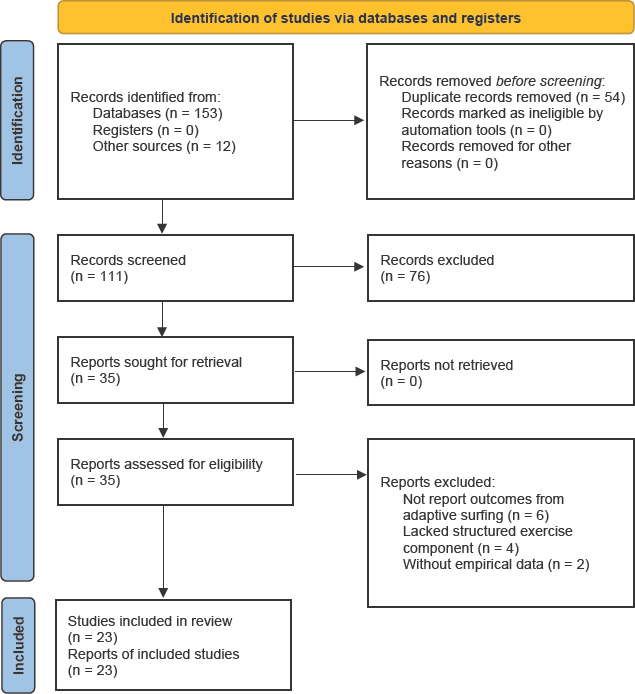
Figure 1.
PRISMA-ScR flow diagram of study selection
Data analysis
Data were categorised and analysed to assess the outcomes and impacts of adaptive surfing programmes. A narrative synthesis approach was employed, guided by a structured and iterative process of reading, note-taking and summarisation. The outcomes were grouped into five domains: physical, psychological, social and educational and others, to enable structured comparison across heterogeneous studies.
Each author independently reviewed the extracted data to ensure consistency and minimise potential bias. The structured spreadsheet facilitated systematic and consistent data extraction across reviewers, facilitating transparent recording and verification of extracted information. While methodological rigour was emphasised throughout, the authors acknowledge that, given the heterogeneous study designs, formal risk-of-bias tools were not applied. Instead, a narrative assessment of potential biases and methodological limitations was conducted for each study to inform the interpretation of findings.
A search strategy was established, including inclusion and exclusion criteria, selection strategy and data collection methods to systematically collect and analyse the existing literature.
RESULTS
Study design and aims
Twenty-three studies met the inclusion criteria and were assessed. The main characteristics and designs of the studies are illustrated in Table 2. The types of studies varied considerably, with the most prevalent using a mixed-methods approach (seven), followed by six quantitative, five qualitative and five review or theoretical approaches (Table 2).
Table 2.
Summary of studies on adaptive surfing interventions
| Intervention focus | Authors | Population | Key intervention, core outcomes & recommendations |
|---|---|---|---|
| Physical Health & Functional Outcomes | Fleischmann et al.28; Armitano et al.27; Clapham et al.14; Silva et al.31; Denneman et al.32; Cruz et al.16 | Participants with physical or intellectual disabilities and individuals with brain injury | Structured surf programmes (weekly sessions, 5 days–6 months) improved strength, balance, endurance, flexibility and coordination. Surfing was feasible and motivating; recommended for rehabilitation and long-term functional recovery. |
| Psychological & Mental Health Outcomes | Walter et al.40,41; Marshall et al.17; Chevrier et al.42 | Military personnel, adults with psychiatric disorders, or youth with mental health risks | Surf therapy programmes (1.5–4 hours, single to multi-week) led to decreased anxiety, depression, PTSD symptoms, and increased mood, resilience, self-esteem and mindfulness. Suggested inclusion of control groups and longitudinal follow-up to strengthen evidence. |
| Social Inclusion & Empowerment | Lopes33; Lopes et al.34; Schmid et al.35; Gibbs et al.36; Wilkie et al.37; Silva et al.30 | Children, youth and adults with various disabilities | Inclusive surf activities (weekly sessions, 4–12 weeks) promoted social connection, empowerment, autonomy and community participation. Emphasised peer support, accessibility and sustained programme opportunities. |
| Adaptive Surfing Techniques & Accessibility | Schvirtz et al.38; Santana-Santana et al.39 | Individuals with limb amputations or mobility limitations | Development of adapted surf prostheses and accessible beaches facilitated participation, reduced pain and anxiety and enhanced confidence. Recommended continuous innovation in adaptive equipment and inclusive infrastructure. |
| Reviews/Theoretical/Programme Mapping | Lemarchand43; Ponting44; Moreton et al.45; Brennan et al.19 | Populations with physical, cognitive and mental disabilities; programme overview studies | Narrative and theoretical analyses highlighted the physical, psychological and social benefits of adaptive surfing. Recommended establishing standard protocols, cross-sector collaboration and expanded research to define mechanisms of benefit. |
Studydesignsrangedfromcasestudiesandobservationalcohortstudies14,16,27,28,30–39 to randomised controlled trials29,40,41, qualitative investigations30,35,42, mixed-methods studies17,36,37, reviews or programme-mapping studies19,43–45.
An analysis of study locations shows that the majority of selected studies originated in the USA, including the Hawaiian Islands (n = 8). This is unsurprising, given the country’s long tradition of research in adaptive sports and the significant investment by the Naval Medical Centre in San Diego in exploring alternative health interventions for post-war veterans, including surf therapy. Six studies were conducted in Portugal, while the United Kingdom contributed two. Spain, Australia, France, Reunion Island, and the Netherlands each accounted for one study. Two studies are unclassified or unclear. The publication dates (Table 2) indicate that, although gaps remain, interest in the field of adaptive surfing has gradually increased over the past 11 years.
The primary aims of the studies varied widely, ranging from evaluating the physiological and psychological effects of surfing to assessing the human and material needs necessary for adaptive surfing – such as beach accessibility and the functionality of specific prostheses. Most studies focussed on surfing programmes, while three specifically examined the impact of participation in Para surfing events (competitions) on the daily lives of surfers.
Sample sizes varied from one to over 300 participants, with ages spanning from 5 to over 60 years, with interventions including weekly surf sessions, structured surf therapy programmes and competitive Para surfing events, with session durations ranging from one to six hours.
Impact and evaluation measures
The types of evaluation measures used in each study are presented in Table 2. More than one-third (n = 9) of the studies employed some validated measures to evaluate outcomes.
Physical outcomes included balance, strength and cardiovascular fitness, while psychological outcomes encompassed stress and anxiety, positive and negative affect and social functioning. Three of these studies were conducted by the Naval Medical Centre with US active-duty or post-war veterans and utilised an extensive number of validated survey measures.
Psychological outcomes were more consistently assessed using validated psychometric instruments, particularly in studies conducted with military and clinical populations. Walter et al.29,40,41 assessed anxiety using the Generalised Anxiety Disorder-7 (GAD-7), general well-being using the Warwick–Edinburgh Mental Wellbeing Scale, and physical and mental health-related quality of life using the Short Form-36 (SF-36). These enabled the authors to report statistically significant reductions in anxiety and negative affect, alongside increases in positive affect, well-being and resilience across repeated sessions and at post-intervention assessments in active-duty service members with post-traumatic stress disorder (PTSD) and major depressive disorder.
In psychiatric populations42, standardised instruments, such as the Rosenberg Self-Esteem Scale and the Hospital Anxiety and Depression Scale (HAD), were used to characterise participant’s baseline status. However, the research was qualitative, focused on participants’ lived experiences and perceptions, documenting improvements in self-esteem, reduced anxiety and enhanced confidence following an eight-week surf therapy programme delivered within a psychiatric day hospital setting.
In contrast, several qualitative and mixed-methods studies did not employ standardised psychometric instruments, relying instead on semi-structured interviews, thematic analysis and participant self-reports to explore psychological change. For example, Marshall et al.17 examined youth mental health outcomes using qualitative interviews within a grounded theory framework, identifying improvements in safety, mastery and emotional regulation without the use of validated scales. Similarly, Gibbs et al.36 and Wilkie et al.37 explored well-being in individuals with acquired brain injury primarily through qualitative feedback and mixed-methods approaches, reporting improvements in mindfulness, identity and emotional well-being without standardised quantitative measurement.
Overall, while a subset of studies employed well-established, validated instruments to quantify anxiety, depression, well-being and quality of life29,40,41, a substantial proportion of the literature relied on qualitative or non-validated self-report methods.
Physical outcomes were evaluated across studies using a wide range of clinical assessments, standardised fitness tests and validated functional instruments, reflecting substantial heterogeneity in both the constructs assessed and the measurement approaches.
Fleischmann28 evaluated physical outcomes primarily through clinical observation of walking ability, balance, core stability, overall muscular strength and pain, alongside functional progress in activities of daily living. In contrast, standardised physical fitness testing was employed in the paediatric population27, assessed using the Brockport Physical Fitness Test, based on the Fitness gram, which covered muscular strength, endurance, flexibility and cardiorespiratory fitness. The instruments used included grip strength (left and right hands), isometric push-up, modified curl-up, trunk lift, back saver sit-and-reach (left and right), Modified Apley’s Scratch test (left and right) and the 20-m PACER test.
In individuals with intellectual disability31, a quasi-experimental design was implemented in which physical outcomes were assessed using the Motor Competence Assessment battery and bioimpedance with a scale. The motor competence battery quantified changes in locomotor, manipulative and stability motor competence, while bioimpedance analysis was used to assess body composition, including fat mass and muscle mass.
Denneman et al.32 implemented a comprehensive physical outcome framework, in individuals with acquired brain injury. Baseline characterisation included the National Institutes of Health Stroke Scale, Modified Rankin Scale, Utrecht Communication Observation and Montreal Cognitive Assessment to profile neurological severity, disability, communication and cognition. Primary physical outcomes focused on functional mobility and self-perceived physical function, assessed via the Physical Function subdomain of the Stroke Impact Scale 3.0 and the Timed Up and Go test under single-and dual-task conditions, with relative dual-task cost (%) as the primary indicator. Secondary outcomes included functional balance (mini-BESTest), walking capacity (Six-Minute Walk Test) and self-perceived recovery (Visual Analogue Scale). Additional measures captured self-efficacy, quality of life (EQ-5D), participation (Stroke Impact Scale participation subscale) and global perceived effect at six-month follow-up. All instruments were selected for reliability and validity in stroke and traumatic brain injury populations according to international consensus recommendations.
Across the included studies, physical outcomes, therefore, encompassed a broad range of domains, including balance, functional mobility, gait and walking capacity, muscular strength, motor competence, aerobic endurance and body composition. However, the level of methodological rigour varied markedly. While several studies employed well-established standardised instruments and formal pre–post testing frameworks14,27,31,32, others relied primarily on clinical observation and descriptive follow-up without formal quantitative measurement28.
Generally, studies that applied validated objective physical and/or psychological instruments and compared pre-post or between group comparation tended to report statistically significant improvements.
It is unclear how well these measures would transfer into other settings involving groups with diverse needs and without strong clinical and/or professionally trained staff to deliver and analyse the data. Notably, the robust development of the novel ‘Beach Accessibility Index’, constructed based on various beach accessibility criteria and evaluated in the study by Santana-Santana et al.39, represents an important methodological advance. Qualitative methods, such as focus groups, helped to actively engage participants in the research process, eliciting context-rich data and insights into their lived experiences (see Schmid et al.35).
Key characteristics of the study participants
There was great variation in population size for each study, ranging from one individual to over three hundred participants. The age range also varied greatly, from as young as 5 years to over 60 years, although most studies focused exclusively on adults. In terms of gender, studies generally included both male and female participants, typically with a higher proportion of males. Notably, no studies focused exclusively on female participants, nor did they examine gender-based differences in experiences or outcomes.
The characteristics of participants varied as much as the design of the surfing activities and programmes (see Table 2). They ranged from children with a combination of mental and physical disabilities participating in surfing programmes, to Para surfing athletes competing in events, to post-war veterans involved in alternative health interventions, and even a shark attack survivor undergoing rehabilitation. Analysis of the primary health characteristics of participants included in the studies reveals that most programmes included a mix of participants with either or both physical and mental disabilities, or ‘polytrauma’. For two studies, it was not possible to determine the health characteristics.
Across the studies, a clear gap was evident in the reporting of participant gender, socio-economic background, and ethnicity. For example, U.S. veterans participating in surf therapy were well-characterised with validated measures, such as GAD-7 for anxiety and the Warwick–Edinburgh Mental Wellbeing Scale29. In contrast, youth and adult participants with acquired brain injury were often recruited via convenience sampling, and demographic details, such as socio-economic status and ethnicity, were rarely reported36,37. Similarly, although age ranges were broad, children and older adults were under-represented, leaving limited evidence for these groups14,27.
Multifaceted health outcomes
When evaluating the primary health-related outcomes across all studies, health outcomes were grouped into five categories20: physical health, education and learning, mental and psychological well-being, social (cohesion and connection), and other outcomes not foreseen in the research process (see Table 3). Although these health outcomes have been categorised for analytical purposes, it is important to emphasise how multifaceted and interdependent many of these health outcomes are. The ‘other outcomes’ category explicitly captures empowerment, identity development and environmental connection reported in multiple studies, emphasising transformative benefits beyond conventional health metrics.
Table 3.
Health outcomes identified in a review of adaptive surfing studies
| Physical health | Education + learning | Mental + psychological well-being | Social (cohesion + connection) | Other outcomes |
|---|---|---|---|---|
| + Improved: balance proprioception coordination muscle tone core strength upper and lower body strength cardiorespiratory fitness motor coordination flexibility active lifestyles prevention of sedentary behaviours physical function Body composition (reduced body fat and increased muscle mass) Motivation for physical activity. | Highly sensory experience – facilitating learning. + Enhanced: Surfing and water safety skills Resilience Teamwork. Environmental awareness and stewardship Development of adaptive surfing equipment and techniques Knowledge-sharing on best practices. | + Improved: Quality of life. General mood Self-esteem. Positive emotions e.g., pleasure, joy and happiness. Autonomy Feeling of freedom often repressed by disability. Problem-solving. Reduced anxiety. Less stress. Decreased depression symptoms. Attention and focus Emotional regulations (applicable in other life areas) Revitalising – sense of being alive Sense of achievement and purpose. | + Social inclusion facilitator: Opportunities to travel and meet people. Enhanced social connection between diverse groups Increased verbalisation. Improved family connection/interaction. Reduced social stigma. Social recognition and admiration. Feeling part of a community. Formation of meaningful social ties Increased sense of belonging. | Greater awareness of the need for improved access to beaches, etc. Status and recognition in a community (e.g. surfing and/or Para surfing) Transformational life experience. Overcoming perceived ‘barrier’ of disability. Increased connection to nature Promotion of a biopsychosocial ecological approach to well-being. |
The most frequently reported health outcomes were mental and psychological well-being (n = 16), followed by physical benefits (n = 16). Fourteen studies reported benefits related to social cohesion and connectedness, and eleven reported benefits in education and learning. Nine studies reported other benefits, highlighting areas, such as identity, empowerment, environmental connection, and systemic change, which do not fall under physical health, education, psychological well-being or social cohesion.
Physical health
There is evidence supporting the physical health promotion and restorative benefits of adaptive surfing for participants with diverse physical needs and abilities. The instruments used are presented in the Impact and Evaluation Measures subsection, presenting validated instruments.
However, the lack of common and consistent measures of physical health indicators tailored to the adaptive surfing context makes it difficult to determine the true impact and outcomes. Findings highlight that adaptive surfing helps prevent sedentary lifestyles and improves physical fitness.
Following structured surfing interventions, statistically significant increases in upper-body and core strength, as well as cardiorespiratory fitness, were reported27, along with significant improvements in body composition, motor competence and stability31. These findings indicate potential benefits for strength, endurance and motor competence, although balance improvements were not consistently observed. In addition to general improvement of body strength and cardiorespiratory endurance, modulation of muscle tone was also observed, facilitating adaptation to new positions and movement required to maintain balance while surfing28,32. In Fleischmann et al.28, a single-case study of a polytrauma patient, substantial gains in balance and physical performance were observed following six months of weekly surf therapy sessions. Although Denneman et al.32 demonstrated statistically significant improvements in functional mobility and postural control, and improvements in self-perceived physical function in a six-month programme for individuals with acquired brain injury. Proprioception was reported to significantly improve as a result of acquiring new motor patterns from immersion in a new changing, fluid and unstable environment – the sea and surf14. It is evident from a review of the outcomes that the ocean is an environment that also offers the physical body support and reduces pressure on limbs and joints during the practice of surfing38. In some cases, it was also reported that this could also contribute to the enhanced control and regulation of behaviour and emotions and increased autonomy28. These programmes also promoted active lifestyles and helped prevent sedentary behaviours, enabling participants to recognise their limitations and develop their physical potential14,27,28. Significant improvements in pain management32 were also reported, achieved through overcoming challenges related to physical and technical surfing achievements.
Education and learning
Evidence from the literature highlights adaptive surfing as a highly sensory, experiential activity that fosters learning and builds resilience. Participation in adaptive surfing programmes has been associated with observed improvements in self-esteem, teamwork skills and a deeper connection to and respect for the natural environment – factors that collectively contribute to an improved quality of life for participants27. These programmes also support the development of individual learning abilities through engagement with ocean literacy concepts and understanding of the technology and function of adaptive surfing equipment37,39. Involvement in the technical design and refinement of adaptive equipment further promotes knowledge creation and its dissemination into broader society30,38. Additionally, participants benefit from improvements in both surfing and ocean-related skills35. Importantly, adaptive surfing also facilitates skill development and experiential learning for staff and volunteers, particularly in areas related to equipment use and best practices. Though outcome assessment was primarily qualitative, via interviews, observation or programme-specific evaluations, with improvements in surf-related skills and staff and volunteer learning outcomes.
Mental health and psychological well-being
Adaptive surfing interventions are consistently associated with improvements in mental health and psychological well-being. The literature highlights several key benefits, including a sense of restoration and spiritual connection, the enjoyment of overcoming challenges and enhanced autonomy – all contributing to improved overall quality of life19,45. The instruments used are presented in the Impact and Evaluation Measures subsection and include only validated instruments. However, the evaluation was also achieved through qualitative outcomes, reported via interviews and thematic analysis17,19,35,42.
Participants commonly reported increased self-confidence, reduced anxiety, lower stress levels and greater independence and problem-solving abilities37,42. Notably, the intrinsic pleasure of ‘gliding on the water’ emerged as a recurring theme across studies17,35. Reported benefits also included fun, freedom and enjoyment35, as well as short-term psychological improvements for war veterans, though these effects may diminish within three months40. Therapeutic outcomes were further observed among individuals with a range of physical, sensory, mental and cognitive disorders45. This experience is often described as a central and recurring element of adaptive surfing sessions and may serve as a foundational mechanism underpinning the broader physical, social and psychological benefits associated with the activity.
Social cohesion and connection
The possibility to travel and meet people, along with improved self-esteem and confidence, contributed to enhanced social connectedness and inclusion33,34. The growing visibility and social development of adaptive surfing along with the integration and inclusion of family members during surfing programmes35,42, as well as encounters and positive exchanges with surfing mentors and leaders (elite athletes) at competitions30, factors that can contribute to a powerful sense of belonging to a community, through the shared bond of surfing and the sea, greatly reducing stigma within the sport36. Chevrier et al.42 have also supported adaptive surfing as a means of reintegration to the community and counteract stigma through connection to nature, mindfulness and a supportive environment, although sustaining long-term benefits remains challenging without encouraging autonomous practice. In this context, a key insight is that the social events linked to adaptive surfing – bringing together people with and without disabilities in an inclusive environment – create vital opportunities to challenge and demystify the concept of ‘disability.’ This shifts the perspective from viewing disability as an individual’s problem of adaptation to their environment towards recognising it as a higher level of sporting challenge16. All evaluations were achieved through qualitative outcomes, reported via interviews and thematic analysis.
Why water and waves?
While limited comparative research exists on the distinct benefits of blue spaces versus other natural environments, in a randomised controlled trial, Walter et al.29 compared the effects of surfing and hiking therapy over six weeks among 96 active-duty U.S. service members with major depressive disorder. Assessments conducted pre-intervention, post-intervention and at a three-month follow-up indicated statistically significant improvements in anxiety, negative affect and resilience across both groups, with outcomes positively correlated with session attendance. Notably, participants reported significantly greater increases in positive affect, lending support to the hypothesis that blue space environments may enhance psychological benefits beyond those associated with other outdoor activities.
Benefits beyond surfing
Reported benefits of adaptive surfing were also associated with increased participation and better performance in physical activity outside of adaptive surfing sessions32. Transformational life experiences and overcoming the perceived ‘barrier’ of disability were also evident37,42. Silva et al.30, using a mixed-methods approach (see Table 2), analysed the importance and impact of competitive Para surfing on the daily lives of visually impaired athletes. Their findings revealed that surfing extends beyond the usual benefits of sports participation for visually impaired individuals, becoming an integral part of their identity and lifestyle while enhancing their sense of belonging.
Recurrent mechanisms and methodological considerations
Several recurrent mechanisms were identified as underpinning the benefits of adaptive surfing. These include structured physical activity, skill acquisition and mastery, immersion in blue-space environments, social facilitation and peer support and mindfulness or sensory grounding14,16,17,27–29,31,32,36. For example, the research of Marshall17 highlighted sensory grounding and peer support as central to psychological well-being in youth participants, while Gibbs et al.36 emphasised connection to nature and empowerment as drivers of social and emotional outcomes in adults with acquired brain injury. These mechanisms were consistently associated with improvements across multiple domains, including physical health (balance, strength, endurance), mental and psychological well-being (mood, anxiety, self-esteem), social cohesion and inclusion and educational/learning outcomes29,31,32,37. Methodological limitations were apparent across the analyses with many studies presenting small sample sizes17,32,36,37 along with limited demographic reporting, particularly regarding gender, socio-economic background, ethnicity and disability type, which reduces the clarity and generalisability of findings17,37. Self-selection bias was also evident with studies recruiting participants who were already engaged with surfing programmes36,42, and geographic representation was predominantly from the USA and Portugal, limiting broader applicability. Furthermore, included studies were heterogeneous in design and outcomes, ranging from single-case studies, qualitative research, randomised controlled trials, to literature reviews. Outcome measurement tools were inconsistently reported, with some studies using validated instruments (e.g., GAD-7, Warwick–Edinburgh Mental Wellbeing Scale, SF-36, Rosenberg Self-Esteem Scale, HAD, MCA), while others relied on qualitative self-reports or non-validated measures, along with follow-up periods generally short, limiting the assessment of long-term sustainability of benefits.
DISCUSSION
The data from the reviewed studies clearly demonstrates that adaptive surfing programmes offer substantial benefits for health, well-being and social inclusion for individuals with physical and/or sensory disabilities. Findings highlighted how adaptive surfing programmes not only enhance physical health but also play a critical role in integrating individuals with disabilities into broader social and recreational activities, providing them with the skills, recognition and community support needed to succeed. The analyses also identified substantial benefits that arise from educational, psychological and social domains.
Physical health outcomes
Physical outcomes underpin overall well-being, as improvements in physical fitness can positively influence various health markers and reduce the risk of non-communicable diseases. Additionally, physical health is linked to a more favourable subjective perception of overall health20. Across the included studies, adaptive surfing demonstrated significant physical health benefits. First, the development of motor patterns and physical fitness outcomes such as balance, proprioception, muscle strength, cardiorespiratory fitness, motor coordination and flexibility, aligns with other research that demonstrates the benefits of outdoor sports for improving physical fitness in the general population46–49, but also for people with disability1,3,50,51.
The adaptive surfing programmes also promoted active lifestyles and helped prevent sedentary behaviours, with participants being able to recognise their limits and develop their physical potential by overcoming challenges related to physical and technical surfing achievements29,33,34,38,40,43. Besides, other research highlights that when people with disability engage in outdoor water sports activities demonstrate higher levels of accomplishment and growth compared to those without disabilities52. Moreover, the studies demonstrate that participants in adaptive surfing were able to overcome challenges related to physical and technical surfing achievements, demonstrating resilience and active learning27–30,40,43. Specifically, fitness assessments in youth with disabilities showed significant improvements in grip strength, modified curl-ups, isometric push-ups and 20-m PACER laps14, while adults with acquired brain injury reported 70.4% improvement in self-reported physical function and 59.3% improvement in functional balance six months post-intervention32. Youth adults with intellectual disabilities also significantly improve body composition (decrease in body fat and increase in muscle mass), increase in the horizontal jump distance (locomotor task) and increase in motor competence after regular surfing practice31.
These findings are consistent with the need to increase autonomy and transfers between the surf spot and the surrounding environment, adaptation to the surfing positions and consequent acquisition of new motor patterns during adaptive surfing, alongside control of behaviours and emotions.
Educational outcomes
Participation in outdoor sports, including adaptive surfing, fosters both interpersonal and intrapersonal development by encouraging meaningful self-engagement and direct interaction with natural environments. These experiences have been shown to positively influence educational outcomes and cognitive functions such as attention, memory, intellectual flexibility and problem-solving abilities20.
Adaptive surfing programmes, in particular, offer highly sensory and embodied learning experiences that contribute to the development of resilience, teamwork and environmental awareness. These programmes require participants to engage with specialised equipment, develop ocean-based competencies and adapt to dynamic and often unpredictable conditions – factors that collectively promote what has been described as ‘surfing literacy’47,49,53,54. The inherent challenges of the sport not only require cognitive adaptability and emotional regulation but also foster collaboration and mutual support among participants.
Due to the technical and safety demands of adaptive surfing, the involvement of trained professionals and volunteers is essential. These collaborative dynamics support the transfer of knowledge, lived experiences and best practices between staff and participants, enhancing both the educational and therapeutic impact of the programmes14,16,27,29,30,33,34,38,40. Furthermore, participants who engage in the technical development of adaptive surfing equipment contribute to innovation and knowledge dissemination within their communities. Cognitive and educational gains, including improved problem-solving, memory and attentional skills, were evident in individuals with acquired brain injury participating in surf ability programmes36,37. Participation in adapted surfing events additionally fostered environmental awareness, social integration and empowerment33,34. This process not only enhances their own learning but also enables the transfer of valuable insights to peers and society at large28,30,33,34,38.
Mental and psychological well-being outcomes
Mental and psychological well-being is a dynamic state of internal balance that enables individuals to utilise their abilities in accordance with societal values. It encompasses fundamental cognitive and social competencies, emotional awareness and regulation, empathy, adaptability and the maintenance of a healthy connection between body and mind55. All of the studies analysed in this review reported a positive impact of adaptive surfing programmes on participants’ mental and psychological well-being. Quantitative measures also support these findings, with significant reductions in anxiety and negative affect and increases in positive affect observed in veterans and active-duty service members following surf therapy programmes29,40. Additionally, youth with disabilities improved body perception, self-confidence and overall satisfaction following surf-based interventions14. These improvements were primarily observed in areas such as quality of life, self-esteem and autonomy. Participants frequently described the experience of overcoming physical and emotional challenges as deeply gratifying, contributing to increased feelings of pleasure, freedom and happiness. These emotional outcomes were linked to enhanced self-confidence, greater independence in decision-making, and reductions in symptoms of anxiety, stress and depression.
Moreover, adaptive surfing facilitated improvements in emotional regulation, empathy and resilience. Participants reported an increased ability to manage their own emotions, better understand the emotional experiences of others, and adapt to life’s challenges – all of which are key components of psychological well-being. These findings are consistent with a broader body of evidence demonstrating that engagement in outdoor physical activity significantly enhances mental health, regardless of age, gender or disability status13,49,50,56–58.
Social outcomes
Physical activity and sport are widely recognised for their positive social impacts on individuals and communities. Participation has been associated with increased resilience, enhanced social skills, higher self-confidence and greater perceived competence compared to non-participants59. Adaptive surfing programmes are no exception. These initiatives foster meaningful social connections between individuals with and without disabilities, promoting social development and encouraging increased verbal communication. Such interactions contribute to greater social inclusion by creating opportunities for participants to travel, engage with diverse groups and expand their social networks.
Additionally, participants often report strengthened social and familial relationships as a result of their involvement in adaptive surfing. Encounters with elite adaptive surfing athletes – often seen as role models – during competitions can further reinforce a sense of community and belonging. Visually impaired Para surfers, for example, reported improved interaction with guides and peers, increased social engagement, and inclusion in the local surfing culture30. Surf therapy programmes also consistently documented enhanced peer support, community connection and social inclusion among adolescents and adults across multiple settings19.
These experiences help to reduce stigma surrounding disability and adaptive sport, encouraging broader acceptance and recognition of athletes with disabilities.
Adaptive surfing as a multidimensional intervention
Adaptive surfing programmes offer a broad spectrum of benefits that extend beyond physical and mental health, contributing to greater social inclusion and accessibility. These programmes help promote greater inclusivity in beaches and ocean-based activities, enabling individuals with disabilities to fully participate in recreational spaces. Participants often report increased motivation to be physically active, enhanced overall participation and a deeper sense of empowerment. This empowerment fosters integration into local surf culture, supports transformative life changes and helps overcome perceived limitations associated with disability.
Importantly, several studies often suggest that adaptive surfing can also facilitate the pursuit of competitive goals, indicating that it serves not only therapeutic and recreational purposes but also athletic development16,27,30,34 often report. Contrary to findings by Côte-Leclers et al.60, participation in competitive adaptive surfing does not appear to negatively affect social well-being30. This may be due to the unique characteristics of surfing as both a sport and a lifestyle, which emphasises community, connection to nature and shared culture61.
However, caution is warranted. Emerging critiques within para sport literature highlight potential negative consequences associated with competitive frameworks, such as exclusionary classification systems62,63, increased performance pressure and the risk of reinforcing ableist norms by privileging elite-level outcomes over inclusive participation64,65. These dynamics may inadvertently marginalise individuals whose impairments do not align neatly with classification categories or who prioritise therapeutic over competitive engagement. In the context of adaptive surfing, further research is needed to explore how these tensions play out, particularly as the sport evolves towards greater formalisation and possible Paralympic inclusion18. A clearer distinction between therapeutic and competitive contexts within adaptive surfing is crucial. While both offer meaningful benefits, their goals, structures and participant experiences may differ significantly. Comparative studies that examine the psychosocial, physical and cultural impacts of surfing in recreational, therapeutic and competitive settings would help clarify these distinctions and inform more inclusive programme design and policy development.
The outcomes can also be interpreted according to the different terminology and conceptual definition of adaptive surfing (surf therapy, recreational adaptive surfing and Para surfing) for people with physical or sensory disabilities. Surf therapy programmes consistently reported improvements in psychological well-being, including reductions in anxiety, increased positive affect, enhanced resilience and greater mindfulness17,29,36,40. Physical outcomes included improved strength, flexibility, balance and cardiorespiratory fitness14,27,29. Social outcomes were also prominent, with participants reporting greater inclusion, peer support and community connection17,36. Recreational adaptive surfing primarily contributed to improvements in balance, vestibular function and motor competence, along with enjoyment and mood enhancement28,31. Social benefits included awareness-raising, integration and engagement with disability identity33,43. Competitive Para Surfing was associated with the development of athletic identity, motivation and skill mastery, as well as performance improvements based on training and competition experience16,30. Social interactions and recognition within the surfing community were also identified as important benefits in competitive settings30.
Overall, adaptive surfing represents a multidimensional intervention that offers physical, psychological and social benefits that traditional models of therapy or inclusion may not fully address. The reviewed studies consistently highlight its capacity to improve physical fitness, enhance mental health, promote educational outcomes and foster social belonging for individuals with a range of physical and/or sensory disabilities.
Across all outcomes, recurrent mechanisms identified in the literature include structured physical activity, immersion in blue space environments, social facilitation, skill acquisition/mastery and mindfulness/sensory grounding. Many studies had small sample sizes, heterogeneous designs (single-case, qualitative, RCT and literature reviews), and relied on non-validated outcome measures or qualitative self-reports, which limit comparability across studies. Short follow-up periods, limited reporting on participant diversity like gender, age, ethnicity, socio-economic status and disability type and potential self-selection bias (e.g. recruiting participants that already were engaged with surfing programmes) further restrict the generalisability of findings. Additionally, female participants, intersectional factors (race, sexuality, socio-economic status, geographic location) and inclusion of participants not previously engaged in surfing were underrepresented in the literature.
Although, a major limitation across the current literature is the lack of methodological consistency. Studies differ widely in design, sample size and focus, some examine the dose–response relationship of participation, while others investigate mechanisms of change through qualitative methods. Future research should prioritise experimental designs, including randomised controlled trials and mixed-method approaches, to strengthen the evidence base and deepen our understanding of adaptive surfing as an effective intervention for people with disabilities.
This review affirms the potential of adaptive surfing programmes to positively transform the lives of individuals with disabilities and underscores the need for further research to guide best practices, ensure sustainability and promote wider accessibility.
Several limitations should be acknowledged, as they may affect the interpretation and generalisability of the findings. First, the selection of studies was based on the authors’ judgement, which may have resulted in the exclusion of relevant research and limited the diversity of perspectives and methodologies represented. Second, publication bias may have influenced the dataset, as studies reporting positive outcomes are more likely to be published than those with null or negative results. Third, there was substantial heterogeneity among the included studies in terms of participant characteristics, research designs, outcome measures and intervention protocols, making cross-study comparisons difficult.
Additionally, as is common with scoping reviews, the interpretation of findings may be influenced by the authors’ perspectives and potential biases. Methodological limitations within the included studies – such as small sample sizes, self-selection bias, the absence of control groups and limited long-term follow-up – further reduce the reliability and transferability of the findings. With the exception of Walter et al.29,40,41, most studies were assessed as having a moderate to high risk of bias.
It is important to note that adaptive surfing remains an emerging area of study, with all included research published within the past decade. As such, the evidence base is still developing, and it is also important to acknowledge that this scoping review has several other restrictions. First, a prospective protocol was not registered, though it is not mandatory24, and it is recommended for scoping reviews. Second, the outcomes were inconsistently reported across studies, with variable use of validated measures and limited statistical detail. Third, grey literature was not screened, which may limit the representation of programme evaluations or practice-based reports and can carry publication bias. Finally, terminology in the literature (e.g., adaptive surfing, Para surfing, surf therapy) was heterogeneous, which may have affected classification despite efforts to standardise during data analyses. Despite these limitations, the review highlights the promising potential of adaptive surfing programmes to promote physical health, educational engagement, psychological well-being and social inclusion among individuals with physical and/or sensory disabilities. Continued research using more rigorous and standardised methodologies is essential to deepen understanding and inform best practices.
In summary, although many therapeutic interventions and activities are available for people with physical and/or sensory disabilities, few simultaneously address physical rehabilitation along with cognitive symptoms and psychological well-being, and the importance of social cohesion for overall health outcomes. The findings of this review highlight surfing as a physical activity and/or health intervention capable of combining hydrotherapy, strength training, physical rehabilitation and supportive group therapy, thereby leading to interrelated health benefits.
Overall, the studies suggest that adaptive surfing programmes offer direct and multifaceted benefits for health, particularly mental health and psychosocial well-being, with unique contributions from the ocean environment – such as saltwater and waves – enhancing these outcomes. For example, the joy or pleasure of ‘gliding on water’ was frequently reported. Although not discussed in great depth here, the studies also highlight progress and adaptations (e.g. equipment, material infrastructure and teaching methodologies) that make surfing more accessible and inclusive for people with a range of disabilities. Another key finding, beyond the original aims of the studies, is that surfing acts as a powerful social leveller, uniting diverse groups of people and bodies. The benefits extend beyond the sport itself, fostering increased confidence and social engagement in other areas of life, including at home, school, work and within the broader community.
Practical applications of these findings include integrating surfing into health initiatives, educational settings and community events to promote holistic well-being and social integration for individuals with disabilities. Authors, such as Lopes et al.34, advocated for support from governmental and non-governmental organisations, noting that without financial support, these specific programmes would be more difficult to develop. They also emphasised the need for more extensive research that allows more evidence-based data on the efficacy of adaptive surfing in enhancing the lives of individuals with disabilities. Although several studies used validated measures (e.g. GAD-7, Warwick–Edinburgh Mental Wellbeing Scale, SF-36, Rosenberg Self-Esteem Scale and HAD), many relied on non-validated self-reports or qualitative interviews17,32,36,45. This heterogeneity in outcome measurement limits comparability across studies and may reduce the generalisability of findings. As such, caution is warranted when interpreting the magnitude and consistency of benefits.
Key areas for further research include improving understanding of the barriers, enablers and mechanisms through which surfing impacts health and well-being outcomes for people with physical and/sensory disabilities. A starting point can be the inclusion of standardised, validated assessment instruments and supplemented by qualitative insights with quantitative measures to strengthen the evidence base. However, the studies presented primarily focused on participants already actively engaged in surfing; further research is needed to examine the complexities, inequalities and opportunities for those not yet engaged to access and experience the sea. As adaptive surfing continues to grow globally, and in order to foster more safe spaces of inclusion, healing and empowerment, it is essential to consider not only physical disabilities in the context of surfing but also how this plays out across diverse contexts and intersects with other factors such as gender, ethnicity, race, sexuality, social class, socio-cultural norms, geographic location, ageing, etc. that impact and influence the ability to participate in and benefit fully from adaptive surfing.
CONCLUSIONS
Adapted surfing programmes offer substantial benefits for social inclusion, equal opportunities and physical rehabilitation for individuals with physical and/or sensory disabilities. Evidence shows that participants experience improved physical fitness (strength, endurance, flexibility and balance), enhanced psychological well-being (reduced anxiety, improved mood and resilience), cognitive gains (attention, memory and problem-solving) and social benefits (community integration, peer support and empowerment). These programmes not only improve physical health but also facilitate learning, enhance mental well-being and foster social connections, providing recognition and community support needed to succeed. Moreover, they have profound implications for individuals with disabilities, offering a comprehensive array of benefits across physical rehabilitation, educational, psychological and social domains. To more robustly quantify the physical, psychological and social outcomes of adaptive surfing interventions, future research should implement longitudinal and experimental designs, particularly randomised controlled trials.
Notes
[2] Conflicts of interest CONFLICTS OF INTEREST
The authors declare no conflict of interest.