
INTRODUCTION
The gastrointestinal (GI) tract hosts an intricate and diverse microorganism ecosystem called the gut microbiota (GM), including bacteria, fungi, archaea and viruses. A balanced GM contributes to host health by maintaining epithelial integrity, preventing pathogenic invasion and producing essential micronutrients. Among its metabolic functions, the GM generates short-chain fatty acids (SCFAs), primarily acetate, propionate and butyrate, through anaerobic fermentation of dietary carbohydrates1,2,3. SCFAs serve as primary energy sources for colonocytes and exert multiple physiological effects, including preservation of intestinal barrier functionality, immunomodulation, anti-inflammatory activity and regulation of appetite through stimulation of satiety hormones, such as leptin, peptide YY (PYY) and glucagon-like peptide-1 (GLP-1). Furthermore, GM influences appetite and satiety through the gut–brain axis, involving vagal nerve signalling and immune-neuroendocrine pathways4,5,6.
Gut dysbiosis (GD) represents an imbalance in GM composition or function, typically characterised by diminished microbial diversity, loss of beneficial species or overgrowth of pathogenic organism7,8. This disruption is related to heightened ROS production and participates in the development of inflammation, insulin resistance, diabetes, obesity, NAFLD, atherosclerosis, hypothyroidism and irritable bowel syndrome (IBS)9,10. In IBS, GD exacerbates visceral hypersensitivity, mucosal immunity alteration, increased gut permeability and low-grade inflammation, often leading to comorbidities such as fatigue, anxiety and depression11.
Physical activity (PA) has become a potent GM composition and function modulator. Studies demonstrate that physical exercise enhances microbial diversity, particularly associated with cardiorespiratory fitness, promoting SCFA production and improving metabolic and inflammatory profiles12,13. PA exerts beneficial effects on obesity and related metabolic disorders by favourably altering the Firmicutes-to-Bacteroidetes ratio, enhancing gut barrier function and regulating appetite through modulation of GLP-1, PYY and pancreatic polypeptide (PP)14,15. Additionally, exercise regulation reduces systemic inflammation and lipid peroxidation, lowering cardiovascular disease risk and type 2 diabetes16. Microbial remodelling may be influenced by physiological adaptations induced by endurance exercise, such as altered splanchnic blood flow, transient intestinal hypoxia and changes in gut motility17. Notably, exercise increases the abundance of butyrate-producing taxa, which are linked to improved colonic epithelial integrity and reduced inflammation. Regular moderate-intensity exercise activates the gut–brain axis, potentially mitigating central sensitisation and visceral pain perception in GI disorders18. Moreover, PA stimulates the production of metabolites such as N-lactoyl-phenylalanine, which inhibits food intake and body weight gain19. These mechanisms underpin the concept of ‘exercise-induced anorexia’, associated with elevated PYY, GLP-1 and PP levels during physical exertion.
Different modalities and intensities of exercise influence microbial metabolism and host physiology20. Exercise intensity, classified based on the maximal heart rate (HR) or VO2max percentage, significantly affects haemodynamic responses, muscle metabolism, oxidative stress, mood and cognitive function21,22. Both moderate-intensity interval training (MICT) and high-intensity interval training (HIIT) have been shown to enhance SCFA production, particularly butyrate, which may explain their beneficial effects on GI health and risk reduction in conditions such as IBS and colorectal cancer23.
Exercise therapy has demonstrated efficacy in managing IBS symptoms24, with outcomes comparable or superior to pharmacological interventions and the low FODMAP diet (LFD)25. Its benefits extend beyond symptom relief to include improvements in psychological well-being, such as reduced anxiety, depression and perceived stress. Given the involvement of the gut–brain axis in IBS pathophysiology, exercise offers a promising, holistic approach with fewer adverse effects26 compared to conventional treatments27,28.
While both MICT and HIIT have been shown to modulate GM and metabolic hormones, direct comparative studies in populations with IBS are scarce. Furthermore, the combined effects of structured exercise and the LFD, which is a cornerstone of IBS management, on gut-derived metabolites such as SCFAs and GLP-1 remain underexplored. To our knowledge, no prior study has simultaneously evaluated the differential impact of MICT versus HIIT on SCFA profiles and GLP-1 levels in obese individuals with IBS. This study aims to fill this gap by comparing the efficacy of MICT and HIIT, both combined with LFD, in modulating GD and metabolic signalling in this high-risk population. We hypothesised that there would be a significant difference between the MICT and HIIT on GD and GLP-1 in IBS.
MATERIALS AND METHODS
Study design
This prospective, randomised, pre-test–post-test controlled trial was conducted between May 2024 and May 2025 on 66 patients with IBS, including 43 women and 23 men aged 30–39 years, enrolled in the Healthy Life Nutrition Outpatient Clinic. All participants received a detailed explanation of the study's purpose, procedures and potential risks, and informed consent was obtained before participation. The Ethical Committee of the Faculty of Physical Therapy authorised the study (Approval No. P.T.REC/012/004224). The study was retrospectively registered on Clinicaltrials.gov (NCT06408610).
Participants
Participants were selected when meeting the following inclusion criteria: fulfillment of the Rome IV diagnostic criteria for IBS, a body mass index (BMI) of 30–34.9 kg/m2 (indicative of obesity), age range of 30–39 years, prediabetic status defined by HbA1c levels of 5.7%–6.4% and a sedentary lifestyle, operationalised as fewer than 5000 daily steps measured via pedometer. Obese individuals with IBS were selected for this study due to the high prevalence of metabolic-GI comorbidity in this population. Obesity and IBS share common pathophysiological mechanisms, including GD, low-grade systemic inflammation, impaired gut barrier function and dysregulation of appetite-related hormones such as GLP-1. By focusing on this subgroup, we aimed to evaluate the synergistic effects of structured exercise and dietary intervention on both GI and metabolic outcomes. Furthermore, this population may benefit most from non-pharmacological interventions that simultaneously target weight management and IBS symptomatology29.
Exclusion criteria included recent (within the past 2 months) use of antibiotics or probiotics; GI bleeding; history of colorectal cancer or other terminal diseases; presence of palpable abdominal mass; recent surgery within 6 months; uncontrolled arrhythmia or hypertension; recent myocardial injury; active respiratory infections; current smoking; diagnosis of fibromyalgia or multiple sclerosis; musculoskeletal injuries limiting exercise capacity and communication disorders that could interfere with study compliance.
Randomisation and allocation
Participants were randomly assigned by a blinded, independent research assistant into one of three groups (n = 22/group), Group A (MICT + LFD), Group B (HIIT + LFD) and Group C (control group; LFD only), using computer-generated randomisation cards sealed in opaque envelopes in a ratio of 1:1:1. Once assigned, all participants completed the study protocol without withdrawal (Figure 1).
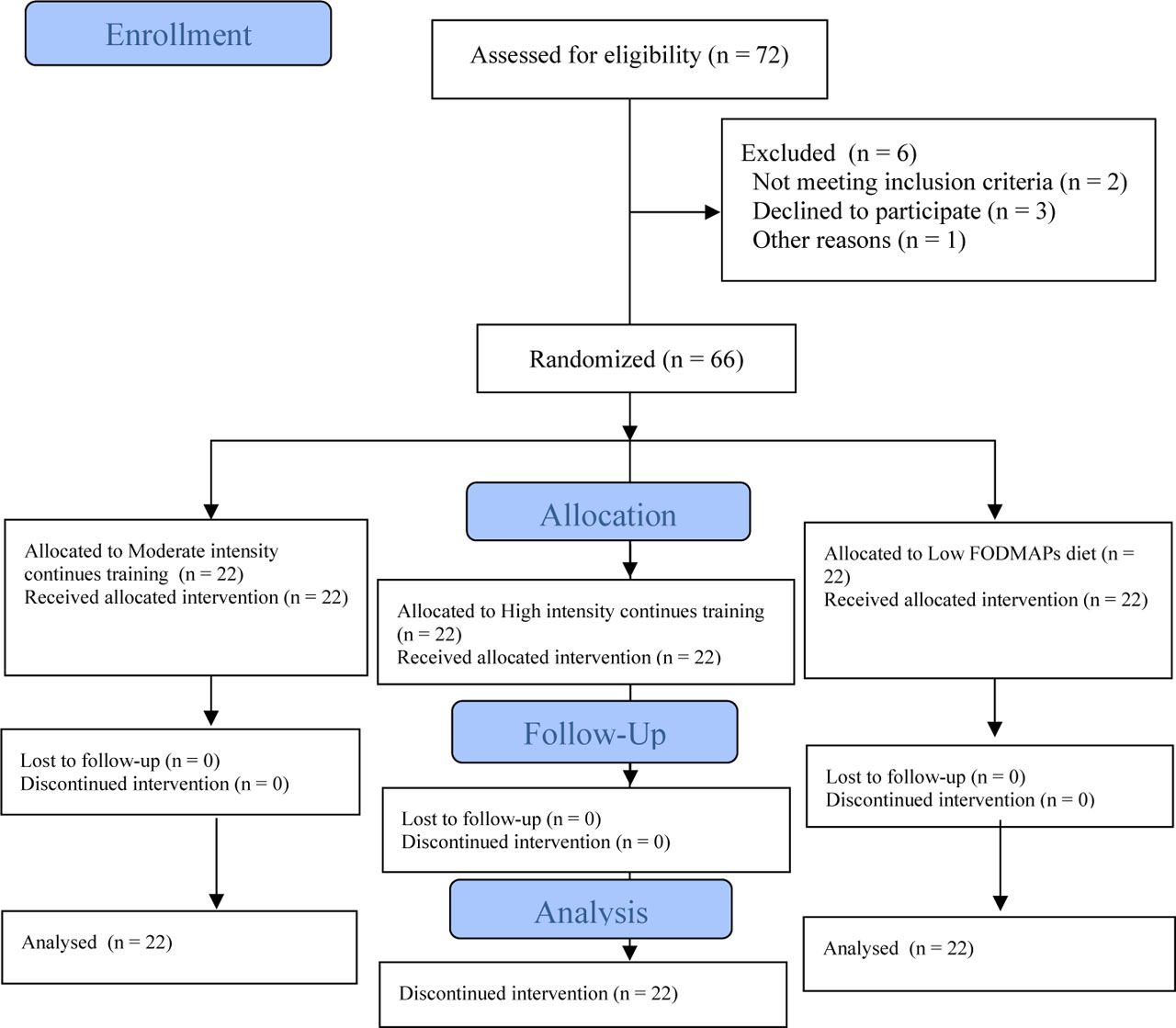
Figure 1.
CONSORT flow diagram of participant progress through the trial
Of the 72 individuals assessed for eligibility, 66 were randomised into three groups (n = 22 each). All received their allocated interventions with no loss to follow-up or exclusions.
Intervention
Participants were randomly allocated into three groups and assessed pre-and post-intervention. Group A underwent an MICT programme on a treadmill for 12 weeks. Each session lasted 40 minutes, consisting of a 5-minutes warm-up at low intensity, followed by 30 minutes of continuous walking or jogging at 65%–75% of the target HR and concluded with a 5-minutes cool-down period. Participants also adhered to a structured LFD throughout the intervention period. Group B participated in HIIT sessions on a treadmill for 12 weeks. Each session lasted 30 minutes, beginning with 5-minutes warm-up, followed by 10 cycles of 1 minute at 90% of the target HR, interspersed with 1 minute of active recovery at 50% of the target HR (totalling 20 minutes of interval training) and ending with 5-minutes cool-down. Participants also followed the LFD during the study. Group C received only dietary management in the form of an LFD for the entire 12-week period without any structured exercise intervention.
Primary outcomes
Short-chain fatty acid
Stool faecal samples were gathered and immediately processed for SCFA analysis. Sample preparation involved four analytical steps to ensure proper extraction and quantification. Briefly, faecal specimens were homogenised, centrifuged, filtered and finally derivatised to prepare for injection into a GC-MS system (GC-TSQ Mass Spectrometer, Thermo Scientific, Austin, TX, USA) having a TG-5MS capillary column. Analyses were conducted at Nawah Scientific Laboratories. The three primary SCFAs, acetate, propionate and butyrate, were quantified using internal standard calibration and expressed in μmol/g. Standardised techniques and validated predictive approaches were employed throughout the analytical process to ensure the accuracy, reproducibility and comparability of the results across samples.
GLP-1 hormone blood serum level
Blood samples were collected at the Hormonal Unit, Clinical Pathology Department, Kasr Al-Ainy Medical School. Venous blood was drawn into chilled 3-mL EDTA vacutainer tubes containing protease inhibitors to prevent peptide degradation. The serum was separated after allowing the blood to clot for 10–20 minutes at room temperature. Serum GLP-1 concentrations were quantified using a commercially available ELISA kit following the instructions. Briefly, the microplate wells were precoated with a monoclonal antibody specific to human GLP-1. GLP-1 in the serum samples bound to the immobilised antibodies following sample addition. A biotinylated detection antibody against human GLP-1 was introduced and bound to the captured GLP-1 antigen, forming a sandwich complex. Subsequently, Streptavidin-HRP was introduced, binding specifically to the biotinylated detection antibody. After incubation, unbound Streptavidin-HRP was eliminated by washing. A chromogenic substrate solution was added, resulting in a colorimetric reaction proportional to the GLP-1 level in the sample. The enzymatic reaction was terminated using an acidic stop solution, and absorbance was measured at 450 nm using a microplate reader. Standard curves were used to determine GLP-1 concentrations in the serum samples.
Secondary outcomes
IBS Severity Scoring System
The IBS severity scoring system (IBS-SSS) is a validated, five-item questionnaire to assess IBS symptom severity. It evaluates key domains, including abdominal pain frequency and intensity, bloating, satisfaction with bowel habits and the impact of symptoms on daily activities. Each item is scored on a scale of 0–100, with higher scores reflecting greater symptom severity. The total score is calculated by summing all five domain scores, with the following clinical classifications: 75–175 indicating mild IBS, 176–300 indicating moderate IBS and >300 representing severe IBS30.
IBS Quality of Life Questionnaire
The IBS quality of life (IBS-QoL) questionnaire is a validated, disease-specific instrument designed to evaluate IBS impact on health-related QoL and assess treatment outcomes. The questionnaire comprises 34 items distributed across eight domains: dysphoria, activity interference, body image, health worry, food avoidance, social reaction, sexual functioning and relationship satisfaction. Each item is rated on a 5-point Likert scale ranging from ‘not at all’ to ‘extremely’. Raw scores are calculated by summing responses across all items, then averaged and transformed into a standardised total score of 0–100, with higher values reflecting better IBS-specific QoL31.
Weight and height measurements
Height was measured using a manually calibrated wall-mounted stadiometer set at 200 cm from a flat, level surface. Weight and body composition parameters were assessed using a bioelectrical impedance analysis device (InBody 720) at the Healthy Life Nutrition Clinic. The device employs a three-compartment model to estimate body composition by differentiating total body water (including intracellular and extracellular compartments), dry lean mass (comprising protein and mineral content) and adipose tissue. Additional derived indices included BMI, waist-to-hip ratio, fat-free mass index and visceral fat area. These metrics were utilised to assess overall body composition and estimate the relative risk of metabolic and cardiovascular health complications associated with obesity.
Intervention and exercise management
Participants were randomised into either a non-exercise control group (Group C), instructed to follow an LFD only, or one of two supervised exercise training groups. Following randomisation, all participants underwent baseline assessments. Group A engaged in a 12-week MICT programme, while Group B participated in a HIIT regimen of the same duration.
Resting HR was measured in all participants assigned to Groups A and B using a fingertip pulse oximeter (Smart Care FS10A). Measurements were obtained after participants had rested in a seated position for 10 minutes in a quiet, temperature-controlled environment to ensure standardised conditions.
An exercise stress test was conducted using the Stex 8020T treadmill to determine individual exercise tolerance and guide the training intensity prescription before initiating the intervention programme32. Participants were instructed to begin with a 5-minute warm-up phase, followed by a gradual increase in treadmill speed until reaching their maximal exertion level, under direct supervision by a physician. The inability to speak comfortably (talk test) was used as a secondary, supportive indicator of near-maximal exertion but not as the primary criterion. The test was terminated upon reaching maximal HR, volitional exhaustion or physician-determined safety limits. HR was continuously monitored via the treadmill's integrated sensors and cross-verified using the pulse oximeter employed for baseline resting HR measurements. The stress test was performed thrice: once during the initial assessment and twice during re-evaluations. Re-evaluation occurred after 1 month of adherence to the exercise programme, allowing for adjustment of training intensity based on updated performance metrics. All test results were systematically documented in the participants' clinical records for ongoing monitoring and programme modification.
All exercise sessions were supervised by certified physical therapists with expertise in metabolic and GI disorders. Supervision ensured protocol fidelity, safety and real-time HR monitoring. Attendance was recorded for each session, and adherence was defined as completion of ≥80% of scheduled sessions (≥29 of 36 sessions over 12 weeks).
While the total session duration differed (40 minutes for MICT vs 30 minutes for HIIT), the design aligns with standard exercise guidelines. MICT included 30 minutes of continuous effort, whereas HIIT involved 10 minutes of high-intensity intervals. This structure reflects the time-efficient nature of HIIT, which has been shown to elicit similar or greater physiological adaptations compared to longer-duration MICT, despite reduced total exercise time33.
MICT protocol
Frequency: Three sessions per week for 12 weeks, conducted at the Healthy Life Nutrition Clinic using a Stex 8020T treadmill.
Intensity: Exercise intensity was maintained at 65%–75% of the individual's target HR, determined based on baseline assessments.
Duration: Each session lasted 40 minutes: 5-minutes warm-up, 5-minutes cool-down period and 30 minutes of continuous treadmill walking or jogging at the prescribed intensity.
HIIT protocol
Frequency: Three sessions per week for 12 weeks, performed at the Healthy Life Nutrition Clinic using the Stex 8020T treadmill.
Intensity: Each session consisted of 10 cycles of high-intensity intervals (1 minute at 90% of target HR) alternated with 1 minute of active recovery at 50% of target HR.
Duration: Total session time was 30 minutes: 5-minutes warm-up and 5-minutes cool-down period.
LFD Intervention
All 66 participants, regardless of group assignment, followed an LFD as part of the dietary intervention. Each participant received individual counselling and a detailed dietary guide outlining foods to eliminate (including fermentable carbohydrates and dairy products) and suitable alternatives. The elimination phase lasted 6 weeks, after which a reintroduction phase commenced in week 7. During this phase, previously excluded foods were gradually reintroduced into the diet to assess individual tolerance levels and identify specific symptom triggers. Dietary adherence was monitored through weekly dietary logs and bi-weekly counselling sessions with a registered dietitian. Participants recorded all food and beverage intake using a standardised food diary, which was reviewed during counselling to assess compliance with LFD principles. Adherence was defined as >80% avoidance of high-FODMAP foods during the elimination phase and structured reintroduction during weeks 7–12. Any deviations were discussed, and personalised strategies were provided to improve compliance.
Statistical analysis
Data analysis was performed through SPSS (v25, IBM, Chicago, IL, USA). Categorical variables are reported as frequencies and percentages (n [%]) and compared between groups using the Chi-square test (χ2) or Fisher's exact test, as appropriate. The sample size was determined using G*Power 3.1.9.7 software, with the primary outcome being the change in IBS-SSS. With an alpha of 0.05, a power of 0.80 and an effect size of 0.35 (based on previous studies), the required sample size was 18 participants per group. To account for potential dropouts, we recruited 22 participants per group, resulting in a total sample size of 66. We have added this information to the ‘Statistical analysis’ section for transparency.
The Shapiro–Wilk test was initially performed to assess the normality of continuous variables. Parametric tests were applied based on these findings. Pair t-tests were applied to evaluate within-group changes from pre- to post-intervention. Mean differences between baseline and post-intervention values and 95% CI were calculated for each group. Inter-group comparisons across the three study groups were conducted using one-way ANOVA, followed by Tukey's post hoc test for pairwise comparisons when a significant overall effect was detected. A mixed-model repeated-measures ANOVA was employed to determine the interaction effects of time and group assignment throughout the intervention. Effect sizes were estimated using partial eta-squared (ηp2), with the following thresholds: small = 0.01, medium = 0.06 and large = 0.14. Statistical tests were two-tailed, with p < 0.05 indicating statistical significance.
RESULTS
The participants' baseline demographic and clinical characteristics (Table 1) revealed that the mean age was 34.0 years, with an age range of 30.0–39.0 years; the majority were female (n = 43, 65.2%). At baseline, no significant differences were observed among the groups in age, sex, BMI, SCFAs (acetate, propionate and butyrate), GLP-1 concentrations, IBS-SSS or IBS-QoL scores (p > 0.05).
A significant reduction in BMI from pre- to post-intervention was observed in MICT and HIIT groups, with no significant change in the control. Post-intervention, the MICT group demonstrated the greatest decrease in BMI (Δ = 2.96 kg/m2, 9.07%) compared to the HIIT (Δ = 3.61%) and control groups (Δ = 1.68%). The BMI did not significantly differ between the HIIT and control groups after intervention. A significant main effect of time (F = 12.296, p < 0.001, η2 = 0.281), treatment (F = 12.296, p < 0.001, η2 = 0.281) and time × treatment interaction (F = 12.296, p < 0.001, η2 = 0.281) were observed (Figure 2).
The levels of acetate (Figure 3A), propionate (Figure 3B) and butyrate (Figure 3C) significantly diminished from baseline to post-intervention across all groups, with the most pronounced reductions observed in the MICT group (acetate: 18.83%, propionate: 10.42% and butyrate: 25.00%), followed by HIIT (acetate: 14.48%, propionate: 1.25% and butyrate: 17.30%) and control (acetate: 11.36%, propionate: 1.26% and butyrate: 7.81%). Propionate levels did not significantly differ between the HIIT and control groups. Significant main effects of time and treatment were observed for all SCFAs: acetate (time: F = 4637.447, p < 0.001, η2 = 0.987; treatment: F = 77.478, p < 0.001, η2 = 0.711); propionate (time: F = 116.814, p < 0.001, η2 = 0.650; treatment: F = 73.988, p < 0.001, η2 = 0.701) and butyrate (time: F = 5309.939, p < 0.001, η2 = 0.988; treatment: F = 450.303, p < 0.001, η2 = 0.935). Additionally, a significant time × group interaction was found for each SCFA (acetate: F = 98.278, p < 0.001, η2 = 0.757; propionate: F = 69.256, p < 0.001, η2 = 0.687 and butyrate: F = 472.515, p < 0.001, η2 = 0.938).
Table 1.
Baseline characteristics of participants in the MICT, HIIT and control groups (n = 66)
| Variables | Total (n = 66) | MICT group (n = 22) | HIIT group (n = 22) | Control group (n = 22) | Test of significance | p value |
|---|---|---|---|---|---|---|
| Age (Years) | 34.00 ± 2.44 | 33.95 ± 2.92 | 34.50 ± 2.35 | 33.55 ± 1.97 | F = 0.846 | 0.434 |
| 30.00–39.00 | 30.00–39.00 | 31.00–38.00 | 30.00–37.00 | |||
| Sex, N (%) | χ2 = 3.737 | 0.154 | ||||
| Male | 23 (34.8) | 5 (22.7) | 11 (50.0) | 7 (31.8) | ||
| Female | 43 (65.2) | 17 (77.3) | 11 (50.0) | 15 (68.2) | ||
| BMI (kg/m2) | 32.48 ± 1.44 | 32.64 ± 1.65 | 32.73 ± 1.39 | 32.09 ± 1.23 | F = 1.270 | 0.288 |
| 30.00–35.00 | 30.00–35.00 | 30.00–35.00 | 30.00–34.00 | |||
| Acetate | 32.68 ± 0.19 | 32.71 ± 0.17 | 32.67 ± 0.18 | 32.67 ± 0.21 | F = 0.260 | 0.772 |
| 32.22–32.93 | 32.38–32.93 | 32.38–32.92 | 32.22–32.93 | |||
| Propionate | 2.40 ± 0.03 | 2.40 ± 0.03 | 2.40 ± 0.03 | 2.39 ± 0.03 | F = 1.347 | 0.267 |
| 2.32–2.45 | 2.37–2.45 | 2.34–2.43 | 2.32–2.44 | |||
| Butyrate | 18.96 ± 0.02 | 18.96 ± 0.02 | 18.96 ± 0.02 | 18.96 ± 0.01 | F = 1.500 | 0.231 |
| 18.93–19.00 | 18.93–19.00 | 18.94–19.00 | 18.94–18.98 | |||
| GLP-1 | 12.25 ± 2.98 | 12.69 ± 2.51 | 12.02 ± 2.68 | 12.04 ± 3.71 | F = 0.349 | 0.706 |
| 1.21–18.43 | 7.80–18.43 | 7.43–17.34 | 1.21–16.61 | |||
| IBS-SSS | 228.36 ± 34.22 | 228.50 ± 38.56 | 226.82 ± 31.38 | 229.77 ± 33.89 | F = 0.040 | 0.961 |
| 175.00–290.00 | 175.00–290.00 | 180.00–280.00 | 175.00–290.00 | |||
| IBS QOL | 62.44 ± 7.76 | 62.09 ± 8.40 | 62.27 ± 8.96 | 62.95 ± 5.91 | F = 0.074 | 0.929 |
| 50.00–80.00 | 50.00–75.00 | 50.00–80.00 | 50.00–75.00 | |||
BMI - body mass index, GLP-1 - glucagon-like peptide-1, HIIT - high-intensity interval training; IBS-QoL - irritable bowel syndrome quality of life questionnaire, IBS-SSS - irritable bowel syndrome severity scoring system, MICT - moderate-intensity interval training.
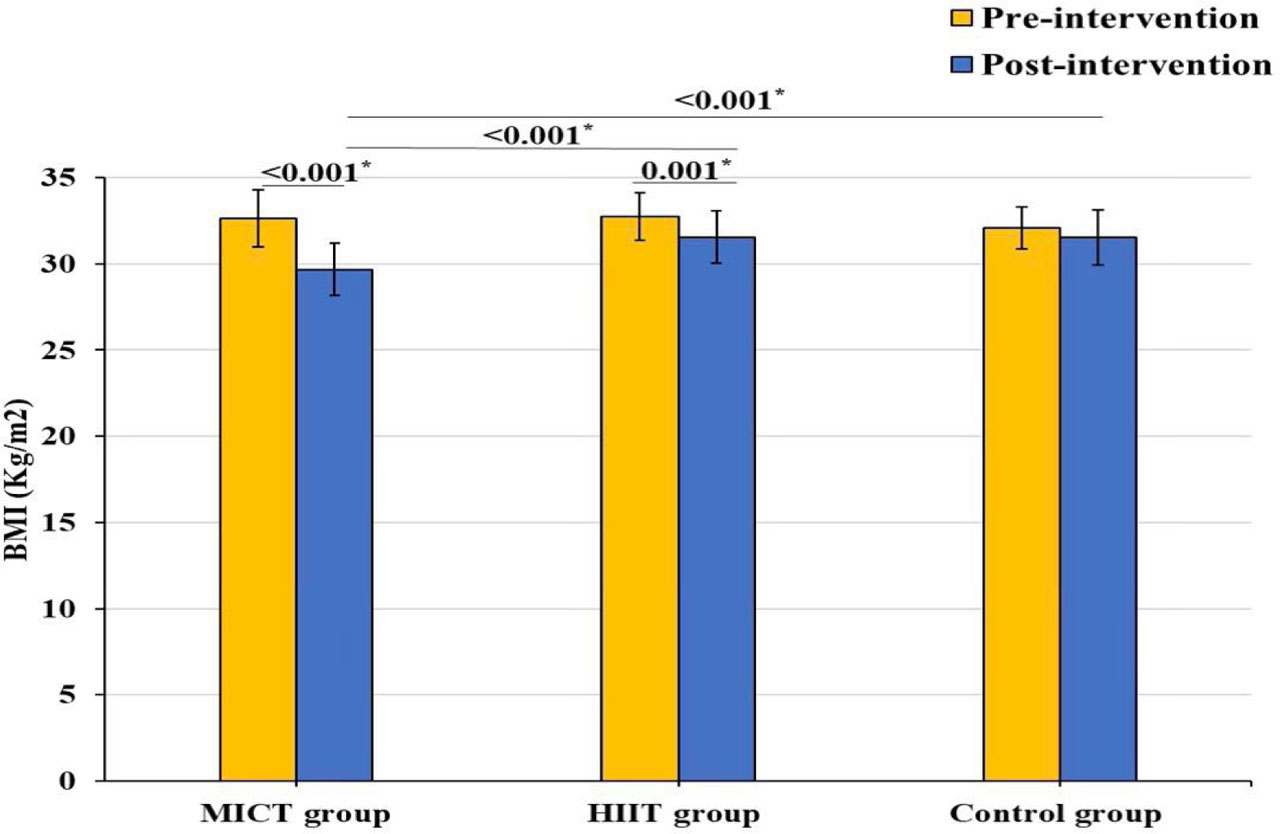
Figure 2.
Changes in mean BMI before and after the intervention in the MICT, HIIT and control groups. Values are presented as mean ± SD. p < 0.001 indicates statistically significant differences within and between groups. BMI - body mass index, HIIT - high-intensity interval training, MICT - moderate-intensity interval training, SD - standard deviation
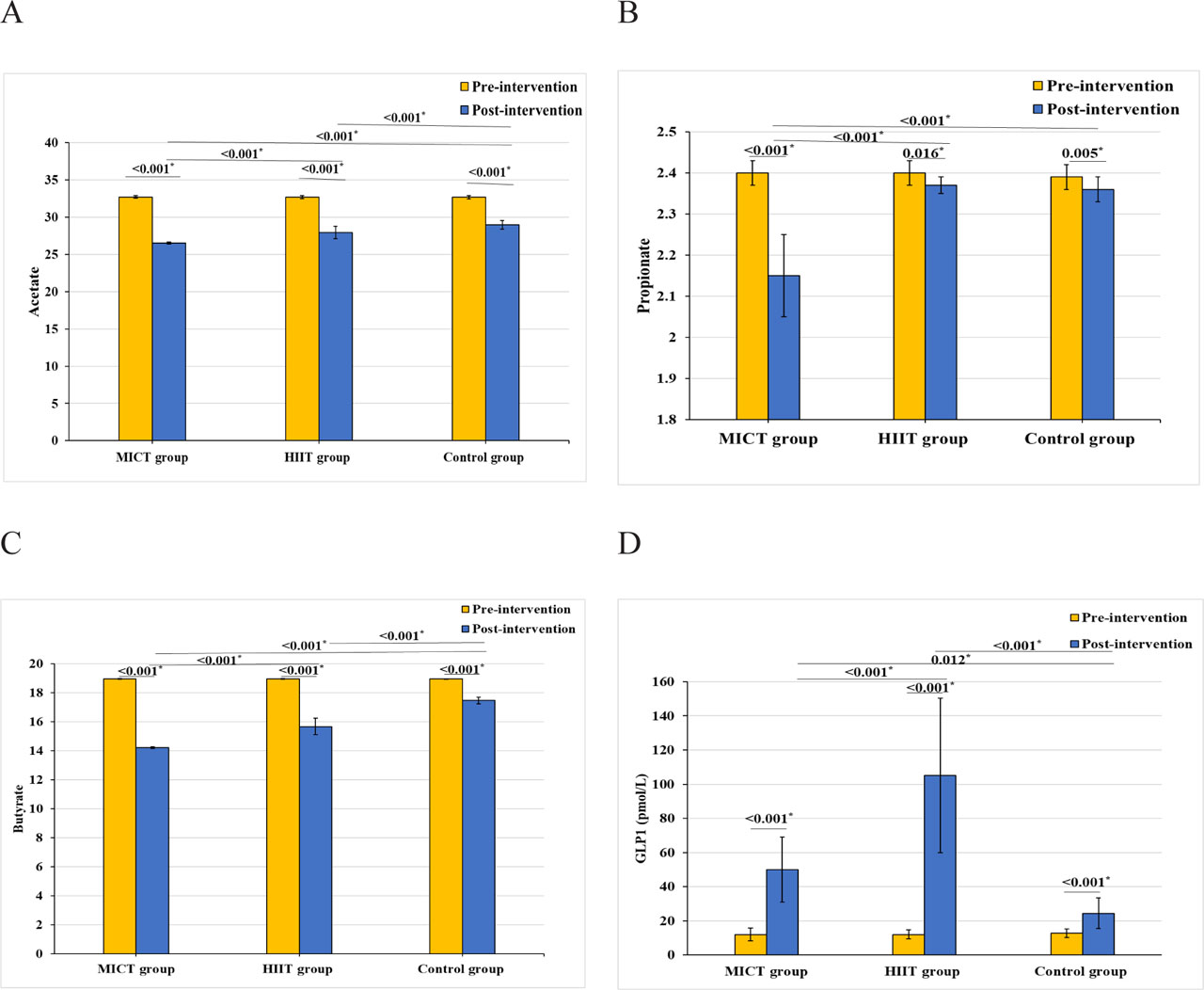
Figure 3.
Changes in the mean levels of (A) acetate, (B) propionate, (C) butyrate and (D) GLP-1 before and after the intervention in the MICT, HIIT and control groups. Values are expressed as mean ± SD. p < 0.05 indicates statistically significant differences between pre-and post-intervention values within each group and across groups. GLP-1 - glucagon-like peptide-1, HIIT - high-intensity interval training, MICT - moderate-intensity interval training, SD - standard deviation
Moreover, GLP-1 levels increased significantly from pre- to post-intervention in all groups, with the HIIT group displaying the largest increase (MD = 93.12 pg/mL, 774.71%), followed by the control (MD = 11.80 pg/mL, 92.99%) and MICT group (MD = 38.02 pg/mL, 15.78%). Significant main effects of time (F = 181.021, p < 0.001, η2 = 0.742), treatment (F = 43.373, p < 0.001, η2 = 0.281) and time × treatment interaction (F = 45.781, p < 0.001, η2 = 0.592) were observed (Figure 3D).
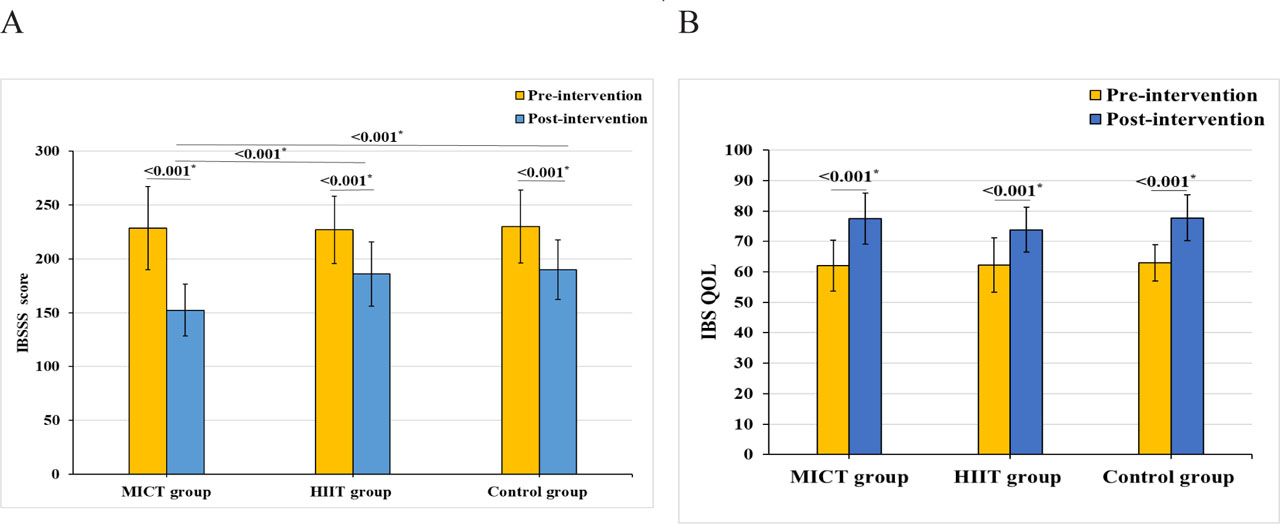
Figure 4.
Changes in (A) IBS-SSS and (B) IBS-QOL scores before and after the intervention in the MICT, HIIT and control groups. Values are presented as mean ± SD. p < 0.001 for all within-group comparisons (pre- vs post-intervention). HIIT - high-intensity interval training, MICT - moderate-intensity interval training, IBS-QOL - IBS quality of life, IBS-SSS - IBS symptom severity score, SD - standard deviation
IBS symptom severity, assessed via IBS-SSS, significantly improved in all groups post-intervention. The MICT group displayed the greatest improvement (MD = −76.23, 33.36%), followed by HIIT (MD = −40.91, 18.04%) and control (MD = −39.77, 17.32%). Significant main effects of time (F = 154.000, p < 0.001, η2 = 0.710), treatment (F = 3.487, p = 0.037, η2 = 0.100) and time × treatment interaction (F = 8.061, p = 0.001, η2 = 0.204) were identified (Figure 4A). A significant improvement in IBS-QoL scores from pre- to post-intervention was observed across all groups (Figure 4B). However, there were no significant between-group differences at either time point. Statistical analysis showcased a significant main effect of time (F = 215.987, p < 0.001, η2 = 0.774) but no significant effects of group (F = 0.666, p = 0.517, η2 = 0.021) or time × group interaction (F = 1.554, p = 0.219, η2 = 0.047).
DISCUSSION
Alterations in GM composition and function have been implicated in the pathogenesis of various metabolic and inflammatory disorders, including obesity and IBS, primarily through mechanisms involving increased oxidative stress and cellular inflammation34. Recently, PA has emerged as a key modifiable factor that not only promotes general health and reduces stress but also exerts protective effects on GI function, as highlighted by Bianco et al.35. Several studies support the beneficial impact of aerobic exercise on gut microbial diversity. For instance, Dalton et al.36, Varghese et al.12 and Skrzydło-Radomanska et al.37 independently reported that regular aerobic exercise enhances commensal bacterial genera abundance, such as Bifidobacterium and Lactobacillus, which contribute to gut homoeostasis by producing SCFAs and other anti-inflammatory metabolites. However, findings regarding high-intensity or prolonged exercise remain inconsistent. While Gevers et al.38 observed that intense and sustained PA may lead to a microbial profile associated with increased inflammation, Motiani et al.39 demonstrated that intense exercise could paradoxically reduce intestinal inflammation by modulating the GM, potentially improving glucose metabolism and metabolic health. These contrasting results suggest that the impact of exercise on GM composition is intensity-dependent and warrants further investigation to delineate its clinical implications.
Fani et al.40 observed a mean reduction in IBS-SSS of 42.3 points after 6weeks of treadmill exercise, whereas our MICT group showed a significantly greater improvement of 76.23 points over 12 weeks (p < 0.001), likely due to the extended intervention period and combined LFD. Similarly, Bianco et al.35 investigated the effects of moderate-intensity aerobic exercise on physical capacity and IBS symptoms in a cohort of 40 patients who engaged in 180 minutes of exercise per week at 60%–75% of their maximum HR. Pre- and post-intervention assessments using the IBS-SSS demonstrated significant reductions in symptom severity and notable improvements in QoL, reinforcing the therapeutic potential of structured aerobic exercise in IBS management. However, Groenendijk et al.41 highlighted that not all forms of aerobic activity are equally well-tolerated among individuals with IBS. Some patients reported discomfort associated with high-impact activities such as running and jumping, often avoiding or rescheduling these exercises during periods of mild symptom exacerbation. Vertical movements characteristic of running were perceived by some to provoke abdominal discomfort, particularly if defecation had not occurred beforehand. One participant noted a preference for stair walking over treadmill running due to reduced vertical impact, suggesting that individualised exercise prescriptions may be necessary to optimise adherence and symptom response in IBS populations.
Allen et al.42 demonstrated that aerobic exercise over 6weeks modulated intestinal microbiota composition and SCFA profiles in individuals with obesity, with changes in SCFA levels correlating with improvements in cardiorespiratory fitness (VO2max). These findings are supported by preclinical evidence showing that aerobic exercise increases faecal SCFA concentrations, as observed in rodent models43, where exercise-induced hypoxia was shown to directly enhance SCFA production. However, the present study observed a significant decrease in faecal SCFA levels following both MICT and HIIT, which appears contradictory to previous reports. This observed reduction in faecal SCFA levels following both exercise interventions, particularly in the MICT group, may reflect improved colonic absorption rather than microbial depletion. In IBS, compromised epithelial integrity often leads to luminal accumulation of SCFAs due to impaired uptake44. Exercise-induced enhancement of gut barrier function and mucosal perfusion may restore SCFA absorption, thereby reducing faecal excretion. Additionally, the LFD itself is a major driver of reduced SCFA output, as it restricts FODMAPs necessary for bacterial fermentation45. The significant decrease in SCFAs in the control group, which underwent only the LFD, further supports the dominant role of diet in modulating SCFA levels. Thus, the decline in faecal SCFAs in our study may indicate a shift towards improved gut metabolic efficiency and host utilisation, rather than dysbiosis or microbial dysfunction. Farup et al.46 reported higher faecal SCFA concentrations in IBS patients compared to healthy controls, attributing this finding to compromised gut barrier integrity, which may lead to increased luminal loss of SCFAs. Further, Duncan et al.47 conducted a crossover trial in which 19 obese men followed a calorie-restricted diet for 4weeks and found a significant reduction in total and individual SCFA concentrations with weight loss, suggesting that dietary and metabolic factors also influence SCFA dynamics. Similarly, Magzal et al.48 reported higher faecal SCFA levels in sedentary individuals compared to physically active counterparts, reinforcing the notion that PA may reduce faecal SCFA excretion, potentially reflecting enhanced colonic absorption or microbial metabolism.
Dombrowski et al.49 reported average fat mass reductions of 0.91 kg with MICT and 1.38 kg with HIIT after ~12 weeks. In our study, the MICT group achieved a greater BMI reduction (Δ = 2.96 kg/m2, 9.07%) compared to HIIT (Δ = = 1.18 kg/m2, 3.61%), despite similar training frequency. This suggests that in the context of IBS and concurrent LFD, continuous aerobic exercise may be more effective for weight management than interval training. These findings align with the results of the present study, which also observed a significant decrease in BMI in both exercise groups compared to the control group. Notably, the greatest clinical improvements in IBS symptom severity and BMI were observed in the MICT group, which also exhibited the largest decline in faecal SCFAs. This inverse relationship suggests that the beneficial effects of exercise may be mediated through mechanisms beyond simple SCFA production, such as enhanced receptor sensitivity (e.g. GPR41/43), improved mitochondrial function in colonocytes or modulation of the gut–brain axis50. Therefore, faecal SCFA levels alone may not be a reliable proxy for gut health in the context of dietary and exercise interventions in IBS. Similarly, Wewege et al.51 reported that both short-term HIIT and MICT interventions led to comparable, modest improvements in body fat percentage and waist circumference among overweight and obese adults. Given that HIIT achieves similar outcomes to MICT with approximately 40% less weekly time investment, it may serve as a more time-efficient alternative for weight management in clinical populations.
Hu et al.52, in a meta-analysis of five studies, reported that both HIIT and MICT increased GLP-1 levels compared to control conditions, but found no significant difference between the two exercise modalities (p = 0.12). In contrast, our study demonstrated a significantly greater increase in serum GLP-1 in the HIIT group (MD = 93.12 pg/mL, 774.71%) compared to both the MICT group (MD = 38.02 pg/mL, 15.78%) and the control (MD = 11.80 pg/mL, 92.99%), with a statistically significant between-group difference (F = 43.373, p < 0.001). This discrepancy may be attributed to the longer intervention duration in our study (12 weeks vs acute or 4-week protocols in prior work), allowing for cumulative physiological adaptations. In contrast, Matos et al.53 reported greater increases in total GLP-1 following MICT compared to HIIT protocols. However, the findings of the present study differ from both of these reports, as a significant increase in serum GLP-1 levels was observed after 12 weeks of HIIT, compared to both the MICT group and the control.
Strengths and limitations
This study has several strengths. First, it employed a randomised controlled design with supervised, standardised exercise protocols, enhancing internal validity. Second, outcome assessments included both subjective (IBS-SSS and IBS-QoL) and objective biomarkers (SCFAs, GLP-1 and BMI), providing a comprehensive evaluation of intervention effects. Third, dietary adherence was monitored through structured counselling and food diaries, improving the reliability of the LFD component. Finally, the use of validated tools and consistent intensity monitoring via HR contributes to the reproducibility of our findings.
Several limitations should be acknowledged. First, the 12-week intervention duration precludes assessment of long-term sustainability. Second, while SCFA levels were measured, we did not assess GM composition (e.g. via 16 S rRNA sequencing), limiting our ability to confirm dysbiosis or microbial remodelling. Third, all participants followed the LFD, which may have confounded the observed effects, as dietary changes independently influence SCFA production and symptom severity. Fourth, the absence of a non-diet, non-exercise placebo group prevents isolation of exercise-specific effects. Finally, maximal effort during stress testing, while guided by HR criteria, did not include direct VO2 measurement, which may affect precision in intensity prescription.
CONCLUSIONS
While MICT appeared more effective in reducing BMI and IBS symptom severity, and HIIT showed greater increases in GLP-1, these findings should be interpreted with caution due to the absence of microbiota composition data and the confounding effect of the LFD across all groups. The observed changes may reflect synergistic rather than isolated exercise effects. Future studies should incorporate metagenomic sequencing to better characterise microbial remodelling.
ACKNOWLEDGEMENTS
The authors would like to thank all participants for their commitment and cooperation throughout the study. Gratitude is also extended to the staff of Cairo University Hospitals and the Faculty of Physical Therapy for their support during data collection and intervention implementation.