
INTRODUCTION
Chronic knee pain is a common source of disability, with the prevalence of knee problems reported across a lifespan ranging from 20% to approximately 40%1,2. Knee pain is a broad term that can refer to generalised knee pain (GKP) or be classified into specific pathologies, such as patellofemoral pain (PFP)3. GKP is the most common type of knee pain in older adults and is defined as pain reported across all compartments of the knee. PFP is considered as a subgroup of GKP but is specific to pain felt behind the patella when the knee is flexed during loaded activities4. Associated activity limitations include pain and difficulty loading, particularly squatting5.
Those experiencing chronic knee pain often seek physical therapy (PT) services to improve their pain, mobility and quality of life3,5,6,7. Conservative management, including exercise therapy, is currently considered as the gold standard and first line option for those with this condition8. Furthermore, PT has been shown to be especially efficacious when utilised within the first 30 days of symptom onset9. In addition to its positive influence on pain and disability, PT is also associated with reduced healthcare costs compared with those who delay or forgo therapy7. Most individuals with GKP benefit from strengthening exercises to target lower extremity muscle weakness10. Alternative options for short-term conservative management also include pain relievers, supportive taping, bracing, ice and orthotics11.
Widely recognised factors contributing to the development of GKP include movement-related impairments in regions above and below the knee joint12. These impairments can alter mechanics and loading which, in turn, can exacerbate pain and dysfunction in the knee joint12. PT plays a crucial role in helping to accurately identify and treat altered movement patterns which can lead to improvements in pain and function13. Rehabilitation professionals often use a combination of tactile, verbal and visual cues to facilitate motor learning. Among these, visual feedback (VF) may be particularly powerful because it provides an external reference that supports postural adjustments and promotes the development of efficient movement patterns14,15,16,17,18. VF facilitates motor learning by providing augmented error signals that allow patients to compare intended and actual movements19,20. Early in practice, VF supports feedback-driven correction, but with repetition these corrections are incorporated into updated internal models that enable feedforward, anticipatory control19,20. This transition reflects core motor-learning principles, in which external feedback fosters adaptation, and later consolidation promotes more automatic and efficient performance19,20,21,22,23,24,25. In addition, VF enhances attentional focus and sensory integration, processes linked to neuroplastic changes in cortical and cerebellar networks that underlie improved movement quality and retention18,26,27,28.
Low-tech tools, such as mirrors, have long been used in clinical settings to deliver VF in conjunction with tactile feedback strategies. In recent years, technological advances, such as augmented reality, motion capture and virtual rehabilitation systems, have broadened the possibilities for delivering VF and have shown promising results to further enhance motor learning and control29,30. Ultimately, by leveraging the visual system, PTs help patients understand their body position in space, facilitating safer and more effective movement patterns31.
However, there is limited research on its application in the clinical settings for closed kinetic chain (CKC) functional movements such as squatting, lunging and step-ups. While VF strategies have shown favourable results in gait retraining and running interventions, the evidence supporting their use in functional CKC rehabilitation remains sparse32,33,34,35,36,37. In running populations, real-time VF interventions have demonstrated clinically meaningful benefits. In a large randomised controlled trial, Chan et al.38 found that VF-based gait retraining reduced injury incidence by over 60% at 12-months follow-up, while Noehren et al.39 and Willy et al.40 showed that mirror and motion-capture VF retraining corrected aberrant hip and knee mechanics and significantly reduced pain in runners with PFP.
Notably, the most recent clinical practice guidelines (CPGs) for PFP, published by the Academy of Orthopedic PT, acknowledge that although PT is the gold standard for treatment, visual biofeedback is not currently recommended based on the results of a single trial, limiting definitive conclusions and widespread clinical adoption8. Furthermore, this CPG highlights a diagnosis-specific evidence gap for GKP or PFP. Because the guideline’s recommendations are condition-specific, the most clinically relevant and actionable question involves determining whether VF improved functional CKC patterns in individuals with GKP or PFP, rather than including all sources of knee pain or non-region-specific populations. Therefore, the scope of this review was intentionally limited to GKP and PFP populations to directly address this CPG-identified gap and clarify whether VF may warrant reconsideration within future guidelines updates.
This gap underscores the importance of further investigation into the potential benefits of VF for knee rehabilitation. Due to the limited number of published studies and heterogeneity of methodologies, a scoping review was chosen to explore a diverse array of intervention types and outcomes in clinical trials. The primary aim of this scoping review was to investigate the effects of VF during CKC exercises on pain, function and kinematic outcomes for adults with GKP or PFP. For the purposes of this review, we examined specific VF interventions that may include mirror therapy, video feedback, motion capture and 3D analysis, force plate or pressure mapping displays and virtual reality environments.
MATERIALS AND METHODS
This scoping review was reported following the Preferred Reporting Items for Scoping Reviews (PRISMA-ScR) guidelines and registered a priori (PROSPERO Registration No. CRD42024549514)41.
Search strategy
A comprehensive search of literature was conducted on PubMed, Web of Science, Science Direct, CINAHL, Metadata and PEDro databases from 2009 to 2024. The grey literature was also investigated using WorldCat database, clinicaltrials.gov, govinfo.gov and American PT Association conference presentations, to ensure that no relevant studies were excluded. A search strategy of all fields combining medical subject headings (MeSH) terms, key words and phrases was used (Appendix A) In summary, the terms ‘knee pain’, ‘VF’ and ‘closed kinetic chain’ along with alternate search terms and synonyms were used for our search. Each search term was then combined, and filters were applied for full text, human participants and English language.
Selection criteria
Eligibility study designs included randomised controlled trials and other quasi-experimental designs assessing the effects of visual or augmented feedback on GKP in adults aged 18–65 years published between 2009 and 2024. Diagnoses of mild to moderate osteoarthritis (OA) were also included as GKP, as mild to moderate OA has shown to lack a strong association between pain and positive imaging findings of OA42,43,44. Severity of OA was determined based on the Kellgren–Lawrence (KL) grading system45. Studies were excluded if participants had inflammatory arthritis or severe OA (KL grade ≥3), a history of knee arthroplasty or knee pain resulting from past or current fractures or malignancies. Additionally, studies that were published before 2009 lacked integration of visual or augmented feedback, or only assessed gait, were excluded to focus on the intended research question. This population restriction was intentionally applied to align with current CPG for PFP, which identifies a diagnosis-specific gap in evidence regarding the clinical utility of VF during rehabilitation. These terms are commonly used together because they often overlap clinically, with PFP functioning as a subgroup of GKP. Because the uncertainty in guideline recommendations is specific to GKP conditions rather than generalised musculoskeletal disorders, the scope of this review focused exclusively on adults with chronic GKP or PFP to directly address this gap.
Data management
Covidence data management software (Veritas Health Innovation Ltd, Melbourne, Australia) was used for study screening and data extraction. Two independent reviewers performed the title and abstract screening, full-text screening, scoring and data extraction, and analysis.
Data extraction
Two reviewers independently extracted data into a predefined form for mapping of findings. Data of interest for extraction included study and participant characteristics, VF and comparator interventions and how they were delivered, and outcomes (i.e. joint kinematics, kinetics and muscle activation). VF interventions were recorded and categorised using a framework based on the type of exercise (e.g. squat) and feedback modality provided (e.g. mirror, EMG, virtual reality), as well as whether it would be considered low-tech (e.g. mirror-based systems with alignment markers) or high-tech (e.g. computer-based, model-driven or motion capture systems). Disagreements were resolved through discussion with a third reviewer to resolve conflicts if consensus could not be achieved.
Risk of bias assessment
Two reviewers independently assessed the risk of bias of included studies using Version 2 of the Cochrane Collaboration risk-of-bias tool for randomised trials (RoB 2) for randomised controlled trials, and the Risk Of Bias In Nonrandomised Studies – of Interventions (ROBINS-I)46,47. Cochrane RoB 2 assesses risk of bias across five domains: randomisation process, deviations from the intended interventions, missing outcomes data, measurement of the outcome and selection of the reported results. A rating of low, high or some concerns is assigned to each domain, and an overall risk of bias rating is assigned for each trial. The ROBINS-I tool assesses the risk of bias across seven domains: bias due to confounding, bias in selection of participants into the study, bias in classification of interventions, bias due to deviations from intended interventions, bias due to missing data, bias in measurement of outcomes and bias in selection of the reported result. Ratings of low, moderate, serious and critical risk are assigned to each domain, and an overall risk of bias rating is assigned to non-randomised studies. Disagreements between raters were resolved by a third reviewer.
Data analysis and synthesis
Data extracted from all included trials were aggregated and are presented in narrative form, tables and figures below. Due to the heterogeneity and limited volume of data across included trials, no pooling of data or meta-analyses were performed.
RESULTS
A total of 676 studies were included for title and abstract screening after removal of duplicates, with 56 studies included for full-text review. Primary reasons for exclusion during full-text screening are shown in the PRISMA flow diagram (Figure 1). Ultimately, three trials were included for analysis. There was substantial reliability and agreement for the full-text screening phase (k = 0.78, 96.4%). A list of included trials and their respective study characteristics can be seen in Table 1. Participants across all three studies were young adults, primarily female and physically active. Participant characteristics for each study can be seen in Table 1.
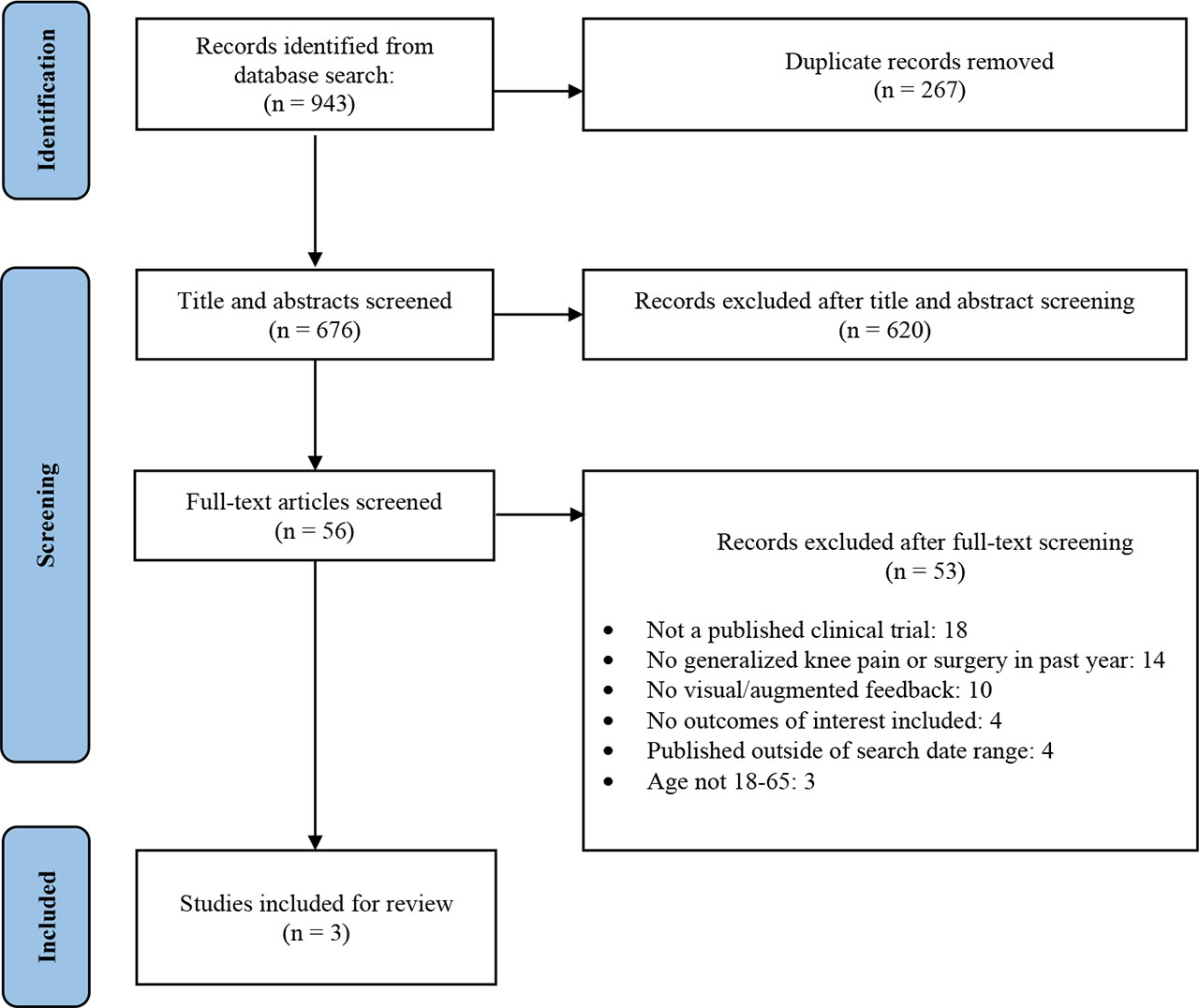
Figure 1.
PRISMA flow diagram
Risk of bias
The risk of bias assessments for individual trials can be found in Appendix B. Of the two RCTs, one49 had some concerns of bias and another48 had a high risk of bias using ROB 2. The third study was a non-randomised trial and was rated as having moderate risk of bias using ROBINS-I50. The most common risks for bias included a lack of randomisation procedures, lack of blinding and lack of prospective study registration or a published protocol outlining a statistical analysis plan (selective reporting bias).
Table 1.
Study and participant characteristics
| Hwangbo [48] | Rabelo [49] | Kernozek [50] | |
|---|---|---|---|
| Population | N: 20 | N: 34 | N: 20 |
| Age: 22–23 years | Age: 18–30 years | Age: 18–25 years | |
| Sex: not reported | Sex: All female | Sex: 17 females, 3 males | |
| Inclusion criteria | Increased quadriceps (Q) angles | Clinical diagnosis of PFP; symptoms ≥3 months; pain with squatting/stairs | Clinical criteria for PFP; NPRS ≥3 during activity |
| Study design | RCT | RCT | NRSI |
| Experimental group | Squat exercises with EMG VF | Motor control and strengthening with mirror VF | Squatting with 3D motion capture analysis VF (post-training) |
| Comparator group | Squat exercises with no VF | Strengthening only | Squatting with no VF (pre-training) |
| Outcomes | VL and VM EMG | Function, pain intensity, strength, trunk and lower limb kinematics | Joint and muscle forces, joint angles |
Joint and muscle forces
One study (Kernozek et al.50) employed a high-tech, real-time model-based VF system displaying patellofemoral joint forces and found a 14.4% reduction during squatting. Squat depth remained unchanged during testing, thus the reduction in joint forces were attributed to changes in biomechanics, including decreased knee extension moments and quadriceps forces50 (see Table 2). The study did not randomise subjects, leading to a moderate risk of bias. Due to the objective nature of the outcomes the results should be interpreted as promising preliminary evidence despite the lack of randomisation.
Joint angles
Two studies examined the effect of VF on joint angles. Kernozek et al.50 found participants had reduced knee flexion and hip flexion angles following VF. These biomechanical adjustments occurred without compromising overall squat depth, indicating participants adjusted technique rather than avoiding movement. Conversely, another study used a low-tech, mirror-based VF as part of a motor control and strengthening programme and found no significant between-group differences in lower limb kinematics following 4 weeks of intervention, except for a small reduction in ipsilateral trunk lean in the motor control group49 (see Table 3). Both studies were rated as ‘moderate’ or ‘some concerns’ for risk of bias, primarily due to limitations in reporting on pre-planned statistical analyses, participant blinding and concerns about potential confounding factors. While the outcomes assessed are objective in nature again, the differing results should be interpreted with caution and indicate that more high-quality trials are needed.
Table 2.
Joint and muscle forces and moments
| Lead author | Intervention | Outcome measure | Baseline | Final | Change | p-value |
|---|---|---|---|---|---|---|
| Kernozek [50] | Squatting with 3D motion capture analysis VF (post-training) | PFJ force (BW) | 4.64 ± 1.05 | 3.97 ± 0.81 | −0.67 BW | <0.001a |
| Knee extension moment (Nm/BW) | 0.11 ± 0.02 | 0.10 ± 0.02 | −0.01 Nm/BW | 0.01a | ||
| Hip extension moment (Nm/BW) | 0.06 ± 0.04 | 0.04 ± 0.03 | −0.02 Nm/BW | 0.001a | ||
| Quadriceps forces (BW) | 4.67 ± 0.98 | 4.06 ± 0.87 | −0.61 BW | <0.001 |
Table 3.
Joint angles (degrees)
| Lead author | Intervention | Joint angle | Baseline | Final | Change | p-value |
|---|---|---|---|---|---|---|
| Kernozek [50] | Squatting with 3D motion capture analysis VF (post-training) | Hip flexion | 91.99 ± 14.60 | 86.20 ± 15.05 | −5.79 | 0.001a |
| Knee flexion | 102.96 ± 16.55 | 97.26 ± 17.11 | −5.70 | 0.001a | ||
| Ankle dorsiflexion | 35.63 ± 6.95 | 34.77 ± 7.28 | −0.86 | 0.07 | ||
| Rabelo [49] | MC&S with mirror VF | Trunk ipsilateral lean | 5.0 ± 3.7 | 3.9 ± 2.3 | −1.1 | 0.02b |
| Strengthening only | Trunk ipsilateral lean | 4.4 ± 1.7 | 3.2 ± 1.6 | −1.2 |
Muscle activity
One study examined the effects of VF compared with no-VF on quadricep muscle activity during squatting in young adults with an increased Q-angle48. Low-tech VF consisted of marks on a mirror to provide a visual guide for ideal lower extremity alignment. The VF group exhibited greater improvement in vastus medialis (VM) muscle activation compared to the no-VF group, but there were no statistically significant differences between groups. Both the VF and no-VF groups showed statistically significant improvements within-group for vastus lateralis activation, with between-group differences favouring the no-VF group (p < 0.05); see Table 4. These mixed results come from a single RCT with high risk of bias due to unclear methodology and reporting. Thus, the validity of these specific findings is uncertain.
Pain and function
Only one study examined both pain and function related to VF49. This study reported improvements in these domains across both the strengthening-only group and the strengthening plus motor control group. However, only a modest functional benefit was observed at 3 months in the motor control group. Additionally, pain scores improved similarly in both groups, suggesting that the addition of visual/motor control feedback did not offer substantial added benefit in terms of clinical pain reduction (see Table 5). This study had ‘some concerns’ of bias due to participant blinding. While participants were unable to be fully blinded to their treatment allocation, potentially influencing their subjective pain ratings (e.g. knowing they are receiving a novel treatment), the methodology for collecting pain and function outcomes was consistent with previous studies.
Table 4.
Muscle activity (EMG)
| Lead author | Intervention | Muscle | Baseline | Final | Change |
|---|---|---|---|---|---|
| Hwangbo [48] | Visual EMG feedbacka | VM | 46.94 ± 5.36 | 50.51 ± 4.78 | +3.57 ± 2.28 |
| No feedback | VM | 43.40 ± 4.98 | 45.85 ± 6.95 | +2.45 ± 3.26 | |
| Visual EMG feedbacka | VL | 60.84 ± 6.54 | 61.75 ± 7.72 | +0.91 ± 3.40 | |
| No feedbacka | VL | 58.37 ± 5.72 | 62.43 ± 7.18 | +4.06 ± 3.66 |
Table 5.
Pain and functional outcomes
| Lead author | Intervention | Outcome measure | Baseline | Final | Between-group difference (95% CI) | p-value |
|---|---|---|---|---|---|---|
| Rabelo [49] | MC&S | NPRS | 6.1 ± 1.4 | 1.3 ± 1.8 | −0.3 (−1.7 to 1.0) | >0.05 |
| Strengthening only | NPRS | 6.6 ± 1.0 | 2.2 ± 1.6 | |||
| MC&S | AKPS (0–100) | 67.1 ± 7.6 | 89.0 ± 8.2 | −8.5 (−16.8 to −0.3) | 0.04a | |
| Strengthening only | AKPS (0–100) | 67.5 ± 11.3 | 84.8 ± 9.8 |
DISCUSSION
This scoping review aimed to evaluate evidence regarding VF and the effects of knee kinematics on pain. Our findings highlight a paucity of research reviewing the effects of VF with CKC exercises and activities for GKP for adults. The three included studies collectively support the utility of VF as a motor learning strategy during CKC exercises for individuals with PFP, though their results differ in clinical impact48,49,50 (see Table 6). However, risk of bias ratings for included studies ranged from ‘moderate/some concerns’ to ‘high’, limiting the strength of conclusions and generalisability of this review.
Kernozek et al.50 demonstrated that high-tech, real-time VF using motion capture systems led to a 14.4% reduction in PFP joint forces during squatting. This was achieved through subtle alterations in movement patterns, including reduced knee flexion angles and quadriceps forces, without compromising on squat depth. These findings suggest that VF can effectively reduce joint stress, potentially minimising symptom provocation during functional activity. However, the study only measured immediate effects post-training, and did not assess longer-term pain outcomes, limiting the interpretation of sustain benefit or symptom resolution. In general, findings from this study are consistent with motor learning research showing that VF facilitates error detection and correction, leading to subtle yet effective movement modifications26,27. Moreover, by providing real-time kinematic and kinetic information, high-tech VF parallels visual-motor training approaches in other domains that have demonstrated cortical reorganisation and improved movement efficiency51.
Table 6.
Summary of study interventions, outcomes and key findings
| Lead author | Intervention | Comparator | Outcomes | Total follow-up period | Key findings | Risk of bias |
|---|---|---|---|---|---|---|
| Hwangbo [48] | Squat exercises with EMG VF | Squat exercises without VF | Muscle Activity (EMG): VM, VL | 6 weeks |
| High |
| Rabelo [49] | MC&S with mirror VF | Strengthening only | Pain: NPRS Function: AKPS Kinematics: Trunk lean | 4 weeks (kinematics) 6 months (NPRS, AKPS) |
| Some concerns |
| Kernozek [50] | Post-training squatting with 3D motion capture analysis VF | Pre-training squatting without VF | Joint Forces/Moments: PFJ force, knee & hip ext. moment, quad force Joint Angles: hip, knee, ankle | Immediate |
| Moderate |
Similarly, Hwangbo et al.48 found that use of low-tech mirror VF during squat exercises significantly enhanced activation of the VM, which is often underactive in individuals with PFP. The no-VF group did outperform the VF group in muscle activation improvements for the VL; however, there was little information on the statistical analysis and no confidence intervals or p-values were provided to highlight the differences between groups. These findings suggest that VF may promote more balanced quadriceps function and support patellar tracking, potentially serving as a preventive strategy against knee pain. This study aligns with the broader neuromuscular literature where augmented VF has been shown to enhance muscle recruitment patterns through increased attentional focus and cortical engagement19,52,53,54,55. While many studies have emphasised EMG biofeedback, other studies have found benefit in strength and neuromuscular control used lower-tech options, such as sphygmomanometers20. The observed improvements in VM activation may therefore reflect similar neuroplastic mechanisms described in mirror therapy and other visual–motor paradigms.
By contrast, Rabelo et al.49 found that adding motor control and low-tech, mirror VF strategies to a strengthening programme did not significantly enhance pain or functional outcomes compared with strengthening alone. While there was a small improvement observed in function in 3 months, the addition of feedback did not result in superior kinematic changes or pain relief. Comparable findings have been observed in the balance and postural control research, where benefits of VF are sometimes task-specific and may not generalise to pain outcomes without sufficient intensity or dosage26,56.
Beyond the three trials included in this review, other feedback modalities have been explored in PFP rehabilitation. For example, EMG biofeedback has been combined with patellar taping to improve quadriceps strength and functional outcomes in young athletes with PFP33,34. More broadly, reviews of augmented feedback confirm that visual input accelerates skill acquisition and supports retention through error correction and attentional focus52,57. Research in postural control further highlights that VF recalibrates sensory weighting and improves stability56,58. Finally, neurorehabilitation studies using mirror therapy and visual–motor training provide mechanistic support, demonstrating that VF can drive cortical reorganisation and neuroplastic change51,53.
Clinical implications
Together, these studies offer important insights, even if not definitive. It can be broadly stated that these findings illustrate that while VF can influence movement kinematics and muscle activation, its direct effect on pain remains inconsistent across studies. While limited in volume, these outcomes provide some support to our hypothesis that VF can influence kinematics and motor recruitment. Additionally, this research reveals a disconnect between observed kinematic/muscular changes and consistent clinical improvements in pain. Finally, our findings suggest that low-tech interventions are useful for building foundational strength and patient self-efficacy, while high-tech tools may be better utilised to augment and quantitatively guide these core processes for complex cases. A tiered approach, starting with low-tech and integrating high-tech as needed, may optimise resource allocation and patient outcomes. Ultimately, low-tech interventions can often be used effectively when high-tech options are not available, however, more research is needed to clarify the relationship between improved movement patterns and clinical pain outcomes in PFP rehabilitation.
Limitations
While the findings from the included studies offer preliminary support for the potential benefits of VF during CKC exercises, several limitations within both the individual studies and our review process must be considered when interpreting these results. First, the inclusion criteria were deliberately narrow to focus on non-surgical adults aged 18–65 years performing functional CKC activities, excluding paediatric, adolescent (<18), older adult (>65) and post-surgical populations. As a result, while designed to enhance relevance to general outpatient orthopaedic rehabilitation, it also limits the generalisability of findings to athletic adolescents, older adults and those recovering from surgery. Our strict inclusion criteria yielded only three eligible studies, further limiting the breadth and generalisability of the findings. This limited pool reflects a gap in the literature, particularly regarding high-quality randomised controlled trials investigating VF in relation to pain outcomes, muscle activation patterns and functional joint mechanics during CKC tasks. As a result, the findings of this review should be interpreted with caution due to the small number of studies and elevated risk of bias across all included studies due in part to lack of blinding, poor/absent reporting of statistical analysis plans and lack of randomisation.
While each included study explored components of the research question, (such as joint force reduction, VM activation or changes in movement strategies), none of the studies directly examined the interaction between VF-induced biomechanical change and self-reported pain. Thus, the hypothesis that VF could improve pain through more efficient movement patterns remains plausible but underexplored.
Additionally, the included studies employed varying approaches to VF, ranging from low-tech solutions such as mirror-based feedback with physical markers48, to more advanced real-time digital feedback using motion analysis systems50. Rabelo et al.49 combined VF with motor control training, but the specific modality of VF was less clearly defined. This variation in modality, intensity, outcomes of interest and user interaction with the feedback limits the ability to make direct comparisons across studies and prevents drawing consistent conclusions about the most effective VF strategies. Standardisation of VF interventions in future research would improve comparability and clinical translation. Furthermore, the follow-up periods in the included trials were generally limited to immediate or short-term post-intervention assessments for kinematic outcomes. The lack of long-term data limits our understanding of whether changes in muscle activation or joint kinematics translate into sustained improvements in pain, function or motor control. Future studies should include extended follow-up periods to assess the durability of VF-related intervention effects on long-term clinical outcomes. Finally, it should be noted that although the grey literature was searched, the small number of eligible studies and the predominance of studies reporting on positive effects raise the possibility of publication bias59. Studies with negative or null findings may remain unpublished, which could skew the overall interpretation of VF effectiveness.
Furthermore, the follow-up periods in the included trials were generally limited to immediate or short-term post-intervention assessments for kinematic outcomes. The lack of long-term data limits our understanding of whether changes in muscle activation or joint kinematics translate into sustained improvements in pain, function or motor control. Future studies should include extended follow-up periods to assess the durability of VF-related intervention effects on long-term clinical outcomes. Finally, it should be noted that although the grey literature was searched, the small number of eligible studies and the predominance of studies reporting on positive effects raise the possibility of publication bias59. Studies with negative or null findings may remain unpublished, which could skew the overall interpretation of VF effectiveness.
CONCLUSIONS
Despite limitations, these findings contribute meaningfully to the existing literature by identifying a critical need for studies that bridge the gap between improved movement mechanics and meaningful clinical outcomes. Our review suggests that while VF appears to enhance muscle activation and reduce joint forces, current studies are underpowered or too limited in scope to confirm long-term functional or pain-related benefits. The lack of homogeneity in intervention dosage, outcome measures and populations also prevented meta-analysis. Given the dearth of data on this topic, it remains crucial to build on the findings of previous studies to develop a more comprehensive understanding of how patients’ pain reposes change with CKC movements in the context of VF. In conclusion, this study contributes to the body of knowledge surrounding this topic by narrowing in on a specific, clinically relevant adult population and a targetted intervention that has not been comprehensively reviewed. However, the evidence remains preliminary and translation into broad clinical recommendations is not yet justified. Future studies should prioritise standardised outcome measures, longer-term follow-up and diverse populations.
Notes
ACKNOWLEDGEMENTS
The authors gratefully acknowledge Shalyn Trawick, DPT and Jordan Cordrey, DPT, for their valuable contributions to the development of the research project, article screening and data extraction.
Appendices
Appendix A.
Search strategy (PubMed)
| Search term | Alternate terms included | Search details |
|---|---|---|
| #1: Knee pain | Knee ache, PFP | (((‘knee’[MeSH Terms] OR ‘knee’[All Fields] OR ‘knee joint’[MeSH Terms] OR (‘knee’[All Fields] AND ‘joint’[All Fields]) OR ‘knee joint’[All Fields]) AND (‘pain’[MeSH Terms] OR ‘pain’[All Fields])) OR ((‘knee’[MeSH Terms] OR ‘knee’[All Fields] OR ‘knee joint’[MeSH Terms] OR (‘knee’[All Fields] AND ‘joint’[All Fields]) OR ‘knee joint’[All Fields]) AND (‘ache protein human’[Supplementary Concept] OR ‘ache protein human’[All Fields] OR ‘ache’[All Fields] OR ‘pain’[MeSH Terms] OR ‘pain’[All Fields])) OR (‘patellofemoral pain syndrome’[MeSH Terms] OR (‘patellofemoral’[All Fields] AND ‘pain’[All Fields] AND ‘syndrome’[All Fields]) OR ‘patellofemoral pain syndrome’[All Fields] OR (‘patellofemoral’[All Fields] AND ‘pain’[All Fields]) OR ‘patellofemoral pain’[All Fields])) |
| #2: VF | Feedback, biofeedback, mirror therapy, virtual reality, gamification, CAREN, Computer assisted rehabilitation environment, external focus | (‘feedback, sensory’[MeSH Terms] OR (‘feedback’[All Fields] AND ‘sensory’[All Fields]) OR ‘sensory feedback’[All Fields] OR (‘visual’[All Fields] AND ‘feedback’[All Fields]) OR ‘visual feedback’[All Fields] OR (‘feedback’[MeSH Terms] OR ‘feedback’[All Fields] OR ‘feedbacks’[All Fields] OR ‘feedback s’[All Fields]) OR (‘biofeedback, psychology’[MeSH Terms] OR (‘biofeedback’[All Fields] AND ‘psychology’[All Fields]) OR ‘psychology biofeedback’[All Fields] OR ‘biofeedback’[All Fields]) OR (‘mirror movement therapy’[MeSH Terms] OR (‘mirror’[All Fields] AND ‘movement’[All Fields] AND ‘therapy’[All Fields]) OR ‘mirror movement therapy’[All Fields] OR (‘mirror’[All Fields] AND ‘therapy’[All Fields]) OR ‘mirror therapy’[All Fields]) OR (‘virtual reality’[MeSH Terms] OR (‘virtual’[All Fields] AND ‘reality’[All Fields]) OR ‘virtual reality’[All Fields]) OR (‘gamification’[MeSH Terms] OR ‘gamification’[All Fields]) OR ‘CAREN’[All Fields] OR ((‘computability’[All Fields] OR ‘computable’[All Fields] OR ‘computating’[All Fields] OR ‘computation’[All Fields] OR ‘computational’[All Fields] OR ‘computations’[All Fields] OR ‘compute’[All Fields] OR ‘computed’[All Fields] OR ‘computer s’[All Fields] OR ‘computers’[MeSH Terms] OR ‘computers’[All Fields] OR ‘computer’[All Fields] OR ‘computes’[All Fields] OR ‘computing’[All Fields] OR ‘computional’[All Fields]) AND (‘assistances’[All Fields] OR ‘assistant s’[All Fields] OR ‘assistants’[All Fields] OR ‘assisted’[All Fields] OR ‘assisting’[All Fields] OR ‘assistive’[All Fields] OR ‘dental assistants’[MeSH Terms] OR (‘dental’[All Fields] AND ‘assistants’[All Fields]) OR ‘dental assistants’[All Fields] OR ‘assistant’[All Fields] OR ‘helping behavior’[MeSH Terms] OR (‘helping’[All Fields] AND ‘behavior’[All Fields]) OR ‘helping behavior’[All Fields] OR ‘assist’[All Fields] OR ‘assistance’[All Fields] OR ‘assists’[All Fields]) AND (‘rehabilitant’[All Fields] OR ‘rehabilitants’[All Fields] OR ‘rehabilitate’[All Fields] OR ‘rehabilitated’[All Fields] OR ‘rehabilitates’[All Fields] OR ‘rehabilitating’[All Fields] OR ‘rehabilitation’[MeSH Terms] OR ‘rehabilitation’[All Fields] OR ‘rehabilitations’[All Fields] OR ‘rehabilitative’[All Fields] OR ‘rehabilitation’[MeSH Subheading] OR ‘rehabilitation s’[All Fields] OR ‘rehabilitational’[All Fields] OR ‘rehabilitator’[All Fields] OR ‘rehabilitators’[All Fields]) AND (‘environ’[All Fields] OR ‘environment’[MeSH Terms] OR ‘environment’[All Fields] OR ‘environments’[All Fields] OR ‘environment s’[All Fields] OR ‘environs’[All Fields])) OR ((‘external’[All Fields] OR ‘externally’[All Fields] OR ‘externals’[All Fields]) AND (‘wood des focus’[Journal] OR ‘focus’[Journal] OR ‘focus ohio dent’[Journal] OR ‘focus madison’[Journal] OR ‘focus am psychiatr publ’[Journal] OR ‘focus’[All Fields]))) |
| #3: CKC | Squat, biomechana, functional movement | (((‘close’[All Fields] OR ‘closed’[All Fields] OR ‘closely’[All Fields] OR ‘closeness’[All Fields] OR ‘closes’[All Fields] OR ‘closing’[All Fields] OR ‘closings’[All Fields]) AND (‘kinetical’[All Fields] OR ‘kinetically’[All Fields] OR ‘kinetics’[MeSH Terms] OR ‘kinetics’[All Fields] OR ‘kinetic’[All Fields]) AND (‘chain’[All Fields] OR ‘chain s’[All Fields] OR ‘chains’[All Fields])) OR ‘squat*’[All Fields] OR ‘biomechan*’[All Fields] OR ((‘functional’[All Fields] OR ‘functional s’[All Fields] OR ‘functionalities’[All Fields] OR ‘functionality’[All Fields] OR ‘functionalization’[All Fields] OR ‘functionalizations’[All Fields] OR ‘functionalize’[All Fields] OR ‘functionalized’[All Fields] OR ‘functionalizes’[All Fields] OR ‘functionalizing’[All Fields] OR ‘functionally’[All Fields] OR ‘functionals’[All Fields] OR ‘functioned’[All Fields] OR ‘functioning’[All Fields] OR ‘functionings’[All Fields] OR ‘functions’[All Fields] OR ‘physiology’[MeSH Subheading] OR ‘physiology’[All Fields] OR ‘function’[All Fields] OR ‘physiology’[MeSH Terms]) AND (‘movement’[MeSH Terms] OR ‘movement’[All Fields] OR ‘movements’[All Fields] OR ‘movement s’[All Fields]))) |
| #4: #1 AND #2 AND #3 | ||
| #5: #4 with filters of randomized controlled trial, clinical trial, english language, and publication date of 2009–2024 |
Appendix B.
Risk of bias of included studies
| Lead author | Risk of bias tool | Study design | Key domains | Overall risk of bias |
|---|---|---|---|---|
| Rabelo [49] | RoB 2 | RCT |
| Some concerns |
| Hwangbo [48] | RoB 2 | RCT |
| High |
| Kernozek [50] | ROBINS-I | NRSI |
| Moderate |