
Introduction
The apparel industry is undergoing a transformation with the latest trends. In the past, the stylish and trendy clothes were only affordable for rich people. But at present, such garments are affordable for all. This significantly increases the profitability of the apparel industry (Chauhan et al., 2023). The apparel industry is significantly impacted by globalization which leads to fluctuating customer buying behaviour. These provide long term as well as short term benefits to both entrepreneurs and customers (Mishra et al., 2024).
The marketing strategies opted by textile companies shape the perceptions of customers. The apparel industry is opting online marketing strategies which helps to showcase the distinct features of clothing that differentiates them from competitors. Other psychological and demographic factors also influence customers while purchasing clothes (Nanda et al., 2024).
The role of innovation hubs in the apparel industry enhances the formation of strategic alliances among the stakeholders, fashion designers and stylists, and manufacturers to implement innovative as well as eco-safe fashionable outfits. They provide a space to apparel manufacturers to experiment with new types of materials developed, advanced technologies, innovative production techniques which leads to adopting effective sustainable production for apparels (Harsanto et al., 2023).
The paper aims to identify the multiple attributes that affect the marketing strategy thereby helping to enhance the consumer purchasing behaviour in the apparel industry mainly in India through innovation hubs. The objectives include identifying the role of innovation hubs, significance of consumer buying behaviour and factors affecting the same. The authors postulate mainly two research questions which are as follows.
RQ1: What is the role of innovation hubs in the Indian apparel industry?
RQ2: What are the factors influencing consumer buying behaviour in the apparel industry through innovation hubs?
Traditional marketing methods often struggle to increase consumer spending on apparel. Innovation hubs enhance collaboration, integrate advanced technologies, and develop innovative marketing strategies, attracting customers, increasing competition, and driving revenue growth (Gazzola et al., 2020). These hubs blend traditional and modern approaches, influencing consumer decision-making. However, there is a research gap in understanding how innovation hubs shape consumer purchasing intentions. As India is a major global apparel market (Ganbold, 2024), this study uniquely integrates data analytics, consumer psychology, and innovation to analyse the impact of innovation hubs on purchasing behaviour. However, limitations include regional focus (southern India), convenience sampling bias, time constraints, and lack of long-term market trend analysis.
A quantitative research methodology was employed, using a digital survey of 153 employees of small-scale textile firms and B2B consumers. Data was analysed using factor analysis in SPSS 29 to identify key drivers of consumer behaviour. This methodological approach provides actionable insights for improving consumer engagement and sales performance.
Literature Review
Importance of Consumer Buying Behaviour in the Indian Apparel Industry
How consumers choose to purchase is essential for understanding the future of India's apparel industry in response to digital transformation and globalization. (Prasad, 2022) The report by Joshi and Khatri (2020) identifies brand perception, socio-psychological influences, and status orientation as key drivers of apparel purchase decisions among young consumers. Yet most existing literature regards these influences as fixed and fails to account for the ways in which innovation-driven infrastructure, such as innovation hubs, changes these motivations within a dynamic market environment. Singh & Sarvanan (2013) highlight buying behaviours of female buyers and investigate impulse buying during the COVID-19 pandemic. However, little research has been carried out regarding consumer decisions within the context of structural changes in the industry, notably digital advances and sustainability-oriented innovation platforms. The importance of innovation hubs for transformations that prioritise consumer needs has been examined.
Role of Innovation Hubs in Apparel Sector Transformation
Innovation hubs are becoming known as places that bring together designers, technologists, and manufacturers to create sustainable and personalized fashion solutions. (Harsanto et al., 2023). Such hubs foster eco-innovation, advanced materials, and digital production techniques – all in line with the goals of sustainable development (Gardetti & Muthu, 2015).
Yet much of the current research only considers operational performance (Huong 2022) or environmental advantages (Sanil et al., 2016) without establishing a direct link between these innovations and behavioural outcomes for end-users (consumers). There is still some disconnect between supply side changes and marketing strategies. This work fills that gap by exploring how engagement with the results of innovation hubs influences consumer behaviour in physical stores and online environments.
The authors organize this relationship according to the Innovation Diffusion Theory (Rogers, 2003) and the Technology Acceptance Model (TAM) (Davis, 1989). This research examines mechanisms through which new technologies become accepted by users focusing on how innovation-driven retail and digital experiences shape consumer behaviour in the apparel market.
Factors Affecting Consumer Purchasing Behaviour Through Innovation Hubs
There are various factors that influence the customer buying habits after the emergence of innovation hubs in the Indian apparel industry. They are mainly technical factors, innovative retail stores, digital engagement factors and personalization factors.
Technical Factors
The Indian retail apparel market is gaining attention of the global online industry due to its technically advanced consumer base. Innovation hubs are significantly influencing customer buying habits through augmented reality (AR), virtual reality (VR), IoT-enabled smart textiles, and mobile applications (Victor et al., 2018).
AR technology allows customers to virtually try on clothing, enhancing personalized shopping experiences and reducing the need for trial rooms (Thomas, 2021). VR enables fashion designers and stylists to develop, assess, and showcase new trends while collecting real-time customer feedback, improving decision-making and satisfaction (Kumari & Polke, 2019).
IoT-enabled smart textiles incorporate advanced materials like nanotubes and metallic particles to sense, process, and transmit information, enhancing interactivity with clothing. These textiles, equipped with pressure sensors and Bluetooth antennas, are also used by the military (Fernández-Caramés & Fraga-Lamas, 2018; Singha et al., 2019).
Mobile applications further revolutionize shopping by enabling users to preview clothing, compare prices, read reviews, and receive personalized recommendations without visiting physical stores, making shopping more convenient (Bhosale et al., 2022). Innovation hubs, through these technical advancements, are transforming the Indian apparel industry and enhancing consumer experiences.
Appearance Related Factors
Innovative retail stores developed through innovation hubs in India's apparel industry offer convenience, customization, and user engagement, making apparel sales highly profitable (Goswami & Khan, 2015). Key factors driving this transformation include advanced retail stores, digital payment methods, and eco-friendly materials. The emergence of pop-up and concept stores has reshaped consumer shopping behaviour. Liberalized FDI regulations have attracted global brands like Gucci, Zara, Nike, and Adidas, alongside domestic stores like Pantaloon and Westside, providing diverse clothing options (Basu et al., 2014; Roggeveen et al., 2021). With increased Internet penetration and mobile data access, digital payment methods have boosted apparel sales. Initiatives under Digital India encourage transactions through cashback offers, discounts, and loyalty points, enhancing customer purchasing power (Liébana-Cabanillas et al., 2020). The use of eco-friendly materials such as jute, silk, wool, linen, bamboo, and organic cotton appeals to environmentally conscious consumers. Eco-labels from the Global Organic Textile Standard (GOTS) and Indian textile departments help authenticate organic clothing, increasing consumer confidence and purchase rates (Aram & Tryphena, 2017).
Digital Engagement Factors
Digital engagement factors play a crucial role in shaping consumer buying habits by offering detailed product information, reviews, and personalized recommendations, strengthening the relationship between customers and apparel marketers (Rasool et al., 2020). Interactive websites and social media enhance brand visibility, engagement, and recognition, allowing consumers to compare prices, read user reviews, and receive targeted recommendations, increasing curiosity and brand trust (Sharma et al., 2020). AI-powered customer service, including chatbots, machine learning, and cognitive commerce, provides 24x7 support, personalized notifications, and seamless checkout experiences. These technologies keep customers informed about the latest fashion trends and improve shopping convenience (Pillai et al., 2020).
Personalization Factors
Personality traits are reflected in customers' clothing choices and behaviour, influencing their purchasing decisions. By focusing on personality factors, apparel marketers can enhance customer satisfaction and develop targeted strategies (Be & Dua, 2023). Innovation hubs enable mass customization through advanced technologies, allowing for personalized apparel, which boosts demand, brand loyalty, and customer happiness while reducing client attrition (Almousa, 2023). User-Generated Content (UGC), including posts, likes, shares, and comments, aligns consumer expectations with real experiences, reducing post-purchase dissatisfaction and enhancing customer confidence (Colicev et al., 2019). Virtual fitting rooms help customers assess fit and suitability, increasing their purchase satisfaction and improving overall shopping experiences (Batool & Mou, 2023).
Figure 1 represents the various attributes that influence consumer purchasing behaviour. Based on the literature analysis, the authors have put forward the following hypothesis statements:
H1. Consumer buying behaviour in the apparel industry in India through the innovation hubs is affected by technical factors.
H2. Consumer buying behaviour in the apparel industry in India through the innovation hubs is affected by appearance related factors.
H3. Consumer buying behaviour in the apparel industry in India through the innovation hubs is affected by digital engagement factors.
H4. Consumer buying behaviour in the apparel industry in India through the innovation hubs is affected by personalization factors.
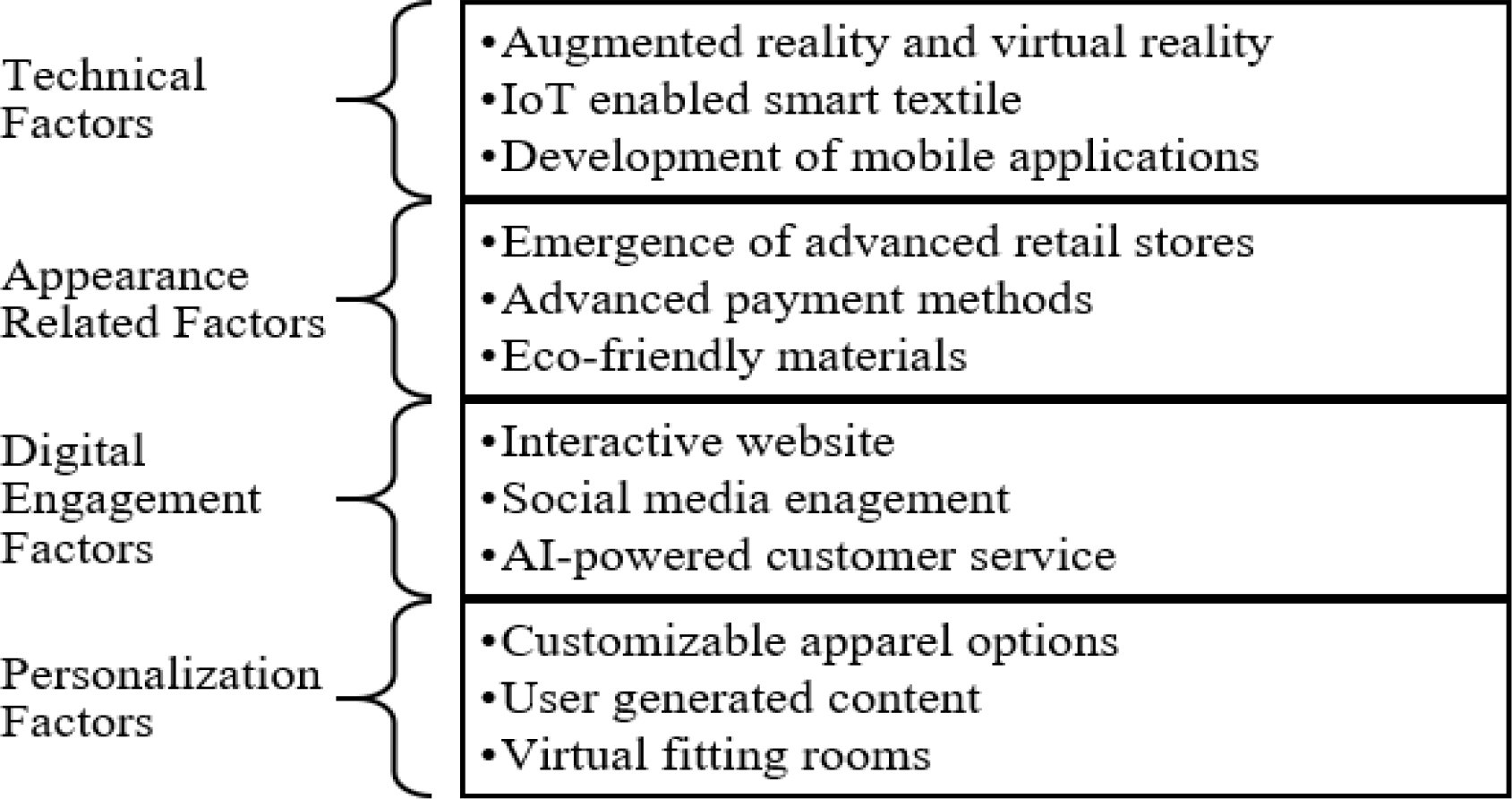
Figure 1.
Factors influencing consumer purchasing habits through innovation hubs (Created by the authors)
Research Gap and Conceptual Framing
Though digital commerce, customisation and sustainability are often explored independently, little theoretical work has investigated how innovation hubs become intersectional spaces for these themes in emerging economies such as India. And regional studies often fail to account for the contribution of quantitative evidence alongside behavioural theory that may provide insight into consumer behaviour in response to innovation-driven marketing approaches.
This research fills that gap exploring four key conceptual dimensions: Engaging, Sustainable, and Technology (Green), Retail Experience, and Social Interaction. The scholarly literature and empirical factor analysis inform these dimensions. This framework is a solid, but flexible way of understanding how innovation hubs might be used to drive consumer engagement/influence buying behaviour.
Materials and Methods
Data Collection Methods
The study employs a quantitative methodological approach to analyse consumer buying habits after the emergence of innovation hubs. Primary data was collected through a Google Forms survey using Likert scale options, while secondary data was sourced from Google Scholar, considering 738 results from 2013 to 2024. The research focuses on South India, particularly Tamil Nadu’s Tirupur district, a major apparel production hub, to ensure industry relevance (Carswell & De Neve, 2024; Härri & Levänen, 2024). This approach enables quantitative predictions and provides insights into the role of innovation hubs in shaping consumer behaviour (Askarzai & Unhelkar, 2017).
Research Sample and Analysis
The survey targeted employees of small-scale South-Indian apparel companies and their B2B consumers, using convenience sampling to select respondents based on availability (Adeoye, 2023). The sample size was determined by population homogeneity rather than size (Bornstein et al., 2013). Out of 200 invited individuals, 153 participated. Respondents were from various departments: 22.2% (production), 18.3% (marketing), 16.3% (quality control), 14.4% (administration), 15.7% (design and development), and 13.1% (B2B consumers). Conducted from November 11 to December 24, 2024, the survey maintained a margin of error below 5% at a 95% confidence level, adhering to ethical guidelines and confidentiality. After the collection of responses from the survey, author mainly used factor analysis to evaluate the survey data and to reach the final findings through SPSS 29. This helps to identify the hidden relationships existing between the consumer buying behaviour and identified factors.
Data Measurement Tools
It is significant to check the survey validity before conducting factor analysis. The authors mainly conducted pilot study and Cronbach’s alpha test. The pilot study was conducted by taking a digital survey by including only 25 participants. The suitability of the poll questionnaire was analysed from the responses, and authors made necessary corrections in the survey questionnaire before sending the link to large sample size. The test named Cronbach’s alpha was conducted to check the reliability of the survey. The value greater than 0.7 are considered as reliable (Pandian et al., 2023). The value obtained after conducting the Cronbach’s alpha test was 0.879 which could be considered as highly reliable.
Results
After the coding process, during the factor analysis verbal options like heavily influence, moderately influence, neutral, slightly influence and does not influence were converted into 1,2,3,4 and 5 respectively. To assess the adequacy of the sample, the authors performed the KMO test, while to test the formulated hypothesis statements in the literature review, Bartlett’s test was conducted (Mahmoudzadeh et al., 2023).
Table 1 presents the KMO and Bartlett’s test results. The KMO value (0.812) exceeded 0.6, indicating good sample adequacy. The Bartlett’s test significance value (0.000)was less than 0.05, leading to the rejection of the null hypothesis and validation of the remaining hypotheses. Following this, factor analysis determined whether the identified factors positively or negatively influence consumer buying behaviour in India. The next step, principal component analysis (PCA), simplified complex data sets by filtering out irrelevant components. Components were extracted based on Eigenvalues, ensuring that the analysis focused on significant factors.
Table 1
Results of the KMO and Bartlett's test (SPSS software)
| Kaiser-Meyer-Olkin Measure of Sampling Adequacy | .812 | |
|---|---|---|
| Bartlett’s Test of Sphericity | Approx. Chi-Square | 725.402 |
| df | 105 | |
| Sig. | .000 | |
Table 2 presents the results of the principal component analysis (PCA), where Eigen values greater than 1 served as the extraction criteria. The analysis identified four major components, each representing the characteristics of twelve variables. The variance percentages for these components were 32.902% (Component 1), 15.388% (Component 2), 9.573% (Component 3), and 8.275% (Component 4). The next step involved the component matrix analysis, where Pearson correlation values were used to group the twelve variables into components based on shared characteristics.
Table 2
Results of principal component analysis (SPSS Software)
| Component | Initial Eigen Values | Extraction Sums of Squared Loadings | Rotation Sums of Squared Loadings | ||||||
|---|---|---|---|---|---|---|---|---|---|
| Total | Variance % | Cumulative % | Total | Variance % | Cumulative % | Total | Variance % | Cumulative % | |
| 1 | 4.826 | 32.902 | 32.902 | 4.826 | 32.902 | 32.902 | 3.317 | 22.736 | 22.725 |
| 2 | 2.415 | 15.388 | 45.892 | 2.415 | 15.388 | 45.892 | 2.854 | 17.238 | 38.925 |
| 3 | 1.589 | 9.573 | 54.754 | 1.589 | 9.573 | 54.754 | 1.957 | 13.572 | 46.257 |
| 4 | 1.179 | 8.275 | 59.127 | 1.179 | 8.275 | 59.127 | 1.547 | 12.482 | 65.185 |
| 5 | .987 | 5.495 | 68.567 | ||||||
| 6 | .756 | 4.886 | 72.147 | ||||||
| 7 | .618 | 4.682 | 76.483 | ||||||
| 8 | .611 | 4.558 | 79.258 | ||||||
| 9 | .579 | 3.925 | 82.985 | ||||||
| 10 | .547 | 3.871 | 88.149 | ||||||
| 11 | .489 | 3.625 | 93.643 | ||||||
| 12 | .432 | 2.820 | 100.00 | ||||||
Table 3 displays the values obtained from the component matrix analysis, showing that several factors—mobile applications, advanced retail stores, advanced payment methods, social media engagement, AI-powered customer service, customizable apparel options, and user-generated content—exhibit cross-loading, meaning they load onto multiple components. This can lead to ambiguity in factor interpretation. To resolve this, a rotated component matrix analysis was conducted, which refined the factor structure by increasing the number of iterations, ensuring a clearer and more accurate classification of variables.
Table 3
Component matrix analysis (SPSS Software)
| Component | ||||
|---|---|---|---|---|
| 1 | 2 | 3 | 4 | |
| Augmented reality and virtual reality | .681 | |||
| IoT enabled smart textile | .657 | |||
| Development of mobile applications | .547 | -.423 | ||
| Emergence of advanced retail stores | .589 | .235 | ||
| Advanced payment methods | .356 | .614 | ||
| Eco-friendly materials | .421 | |||
| Interactive websites | .661 | |||
| Social media engagement | -.321 | .432 | ||
| AI-powered customer service | .527 | .578 | ||
| Customizable apparel options | .552 | .421 | ||
| User generated content | .621 | .616 | .548 | |
| Virtual fitting rooms | .548 | |||
The Table 4 shows the factor values after the rotation component matrix analysis. A cross-loading situation was avoided and subfactors were separated into four components.
Table 4
Rotated component matrix (SPSS Software)
| Component | ||||
|---|---|---|---|---|
| 1 | 2 | 3 | 4 | |
| Augmented reality and virtual reality | .681 | |||
| IoT enabled smart textile | .657 | |||
| Development of mobile applications | .547 | |||
| Emergence of advanced retail stores | .589 | |||
| Advanced payment methods | .614 | |||
| Eco-friendly materials | .421 | |||
| Interactive websites | .661 | |||
| Social media engagement | .432 | |||
| AI-powered customer service | .527 | |||
| Customizable apparel options | .552 | |||
| User generated content | .623 | |||
| Virtual fitting rooms | .548 | |||
| Extraction Method: Principal Component Analysis Rotation Method: Varimax with Kaiser Normalization | ||||
The Figure 2 represents the factor loadings into distinct components based on the Pearson correlation coefficients value. The first component named “digital engagement and support factors” (32.902%) constituted the factors augmented reality and virtual reality (0.681), interactive websites (0.661) and AI-powered customer service (0.527). These factors help to increase the customer engagement and provide personalized shopping experiences. The second component titled “tech enabled sustainability factors” (15.388%) comprised IoT enabled smart textile (0.657), development of mobile applications (0.547), advanced payment methods (0.614) and eco-friendly materials (0.421) that helped to bring sustainability practices in the Indian apparel industry. The third component “enhanced retail experience factors” (9.573%) constituted emergence of advanced retail stores (0.589), virtual fitting rooms (0.548) and customizable apparel options (0.552) that helped to improve the shopping experiences by enhancing the apparel stores in India. The fourth component “social influence and co-creation factors” (8.275%) included user generated content (0.623) and social media engagement (0.432) that helped the apparel marketers to interact with the apparel customers in India.
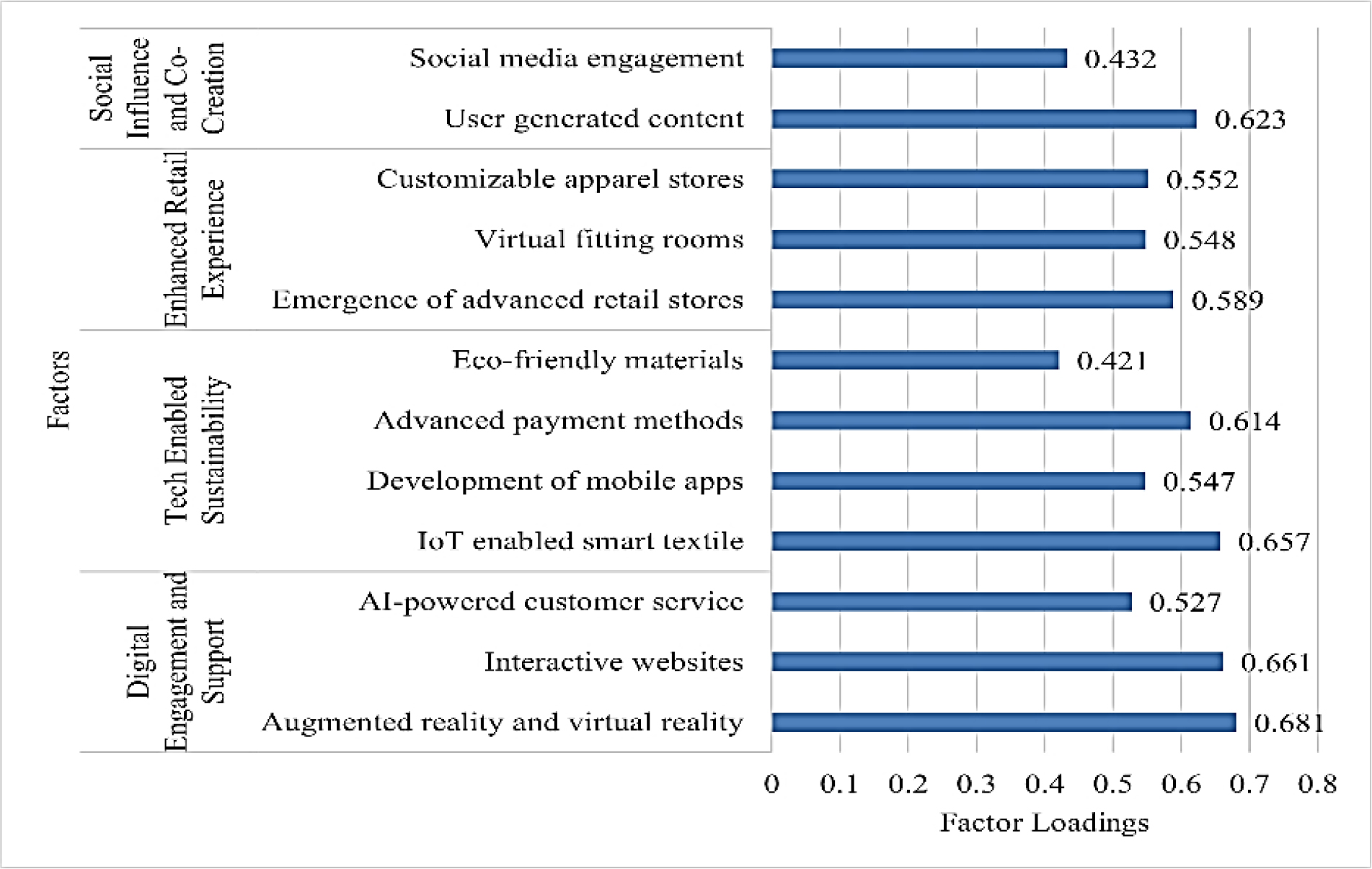
Figure 2.
Factor Loadings Value (Created by authors)
The Figure 3 represents the marketing strategy that should be implemented by stakeholders in apparel industry in India to enhance customer purchasing habits. Since the priority of the digital engagement factors is the highest with 32.902%, focusing more on these distributed subsidiary factors helps to improve the apparel customers purchasing patterns. The hierarchy of the subfactors is based on the Pearson correlation coefficient values. Among the digital engagement and support factors, augmented reality and virtual reality with Pearson value 0.681 was the most important subfactor. This was followed by interactive websites and AI-powered customer service with 0.661 and 0.527 respectively.
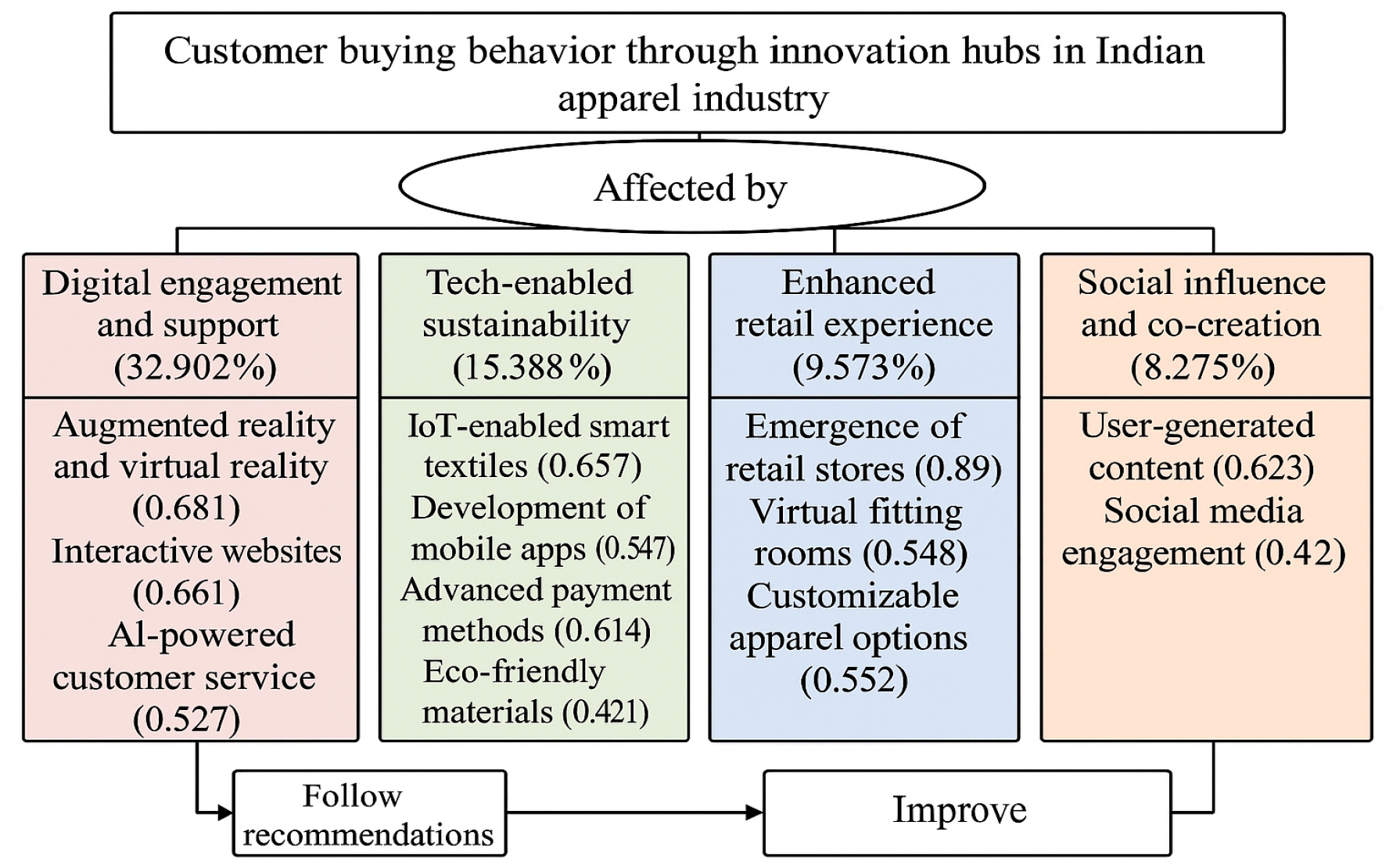
Figure 3.
Strategy to enhance the consumer buying behaviour through innovation hubs in apparel industry in India (Created by authors)
As the environmental issues are increasing rapidly, the Indian apparel industry needs to adopt the sustainable practices to tackle the ecological challenges. To manage the tech enabled sustainability factors, the authors proposed following recommendations:
1) Stakeholders should deploy smart tags or QR codes that give detailed information about sustainable practices.
2) Apparel marketers must organize loyalty programs for customers to encourage the number of purchases.
3) Marketers should form strategic partnerships with influencers to attract the attention of customers.
It is considered that appearance of the apparel stores also plays an important role in improving the purchasing tendencies of the customers. To effectively manage the enhanced retail experience factors, the authors propose several recommendations which are given as follows:
1) Apparel store owners must design the interior of the stores with innovative layouts which motivates the customers to visit the stores.
2) They must ensure that virtual try-on technology mechanism is easy to handle by each customer which increases the rate of visiting the apparel websites.
3) Marketers should provide real-time service for customers who need to customize their clothing, which increases satisfaction.
Establishing a strong bond with customers is important to develop the apparel brand which is possible through social influence and co creation factors. The recommendations are as follows:
1) Apparel brands should organize hashtag campaigns monthly to increase brand visibility.
2) The should encourage the customers to share their photos in outfits as well as post reviews which influence other customers to buy the specific clothing item.
Discussions
The above-mentioned recommendations help stakeholders to effectively improve the purchasing patterns of the customers in the Indian apparel industry.
Therefore, it is important to understand whether the hypothesis statements developed by authors were accepted or rejected.
Table 5 indicates that technical, appearance-related, digital engagement, and personalization factors positively impact consumer buying behaviour in the Indian apparel sector after the introduction of innovation hubs. Factor analysis of sub-factors helps determine the nature of their influence on consumer purchasing patterns. The positive Pearson correlation values from the rotated component matrix confirm this impact.
Table 5
Status of developed hypothesis statements (Created by authors)
| Number | Hypothesis statement | Status |
|---|---|---|
| H1 | Consumer buying behaviour in the apparel industry in India through the innovation hubs is affected by technical factors | Accepted |
| H2 | Consumer buying behaviour in the apparel industry in India through the innovation hubs is affected by appearance related factors | Accepted |
| H3 | Consumer buying behaviour in the apparel industry in India through the innovation hubs is affected by digital engagement factors | Accepted |
| H4 | Consumer buying behaviour in the apparel industry in India through the innovation hubs is affected by personalization factors | Accepted |
Consumer buying behaviour in India involves decision-making in choosing, purchasing, and wearing apparel, balancing traditional and modern preferences (Joshi & Khatri, 2020).
The first research question was “What is the role of innovation hubs in the Indian apparel industry?”. The results reveal that innovation hubs are essential for an evolving Indian apparel sector. These are hubs that bring together designers, technologists, marketers, and manufacturers for innovation through digital and sustainable practices (Harsanto et al., 2023; Gardetti and Muthu (2015)). And they do more than improve technology; they help build communities. It also involves creating new business models and strategies focusing on consumer needs. Technological tools like augmented and virtual reality (Thomas, 2021), IoT-enabled smart textiles (Fernandez-Carames & Fraga-Lamas, 2018), and AI-enabled customer service systems (Pillai et al.). These technologies, implemented via innovation hubs, link customers and brands thus improving service quality and brand loyalty. Impacts of innovation hubs are different depending on where they operate. The results obtained in Tirupur, Tamil Nadu, may not be comparable in other less industrialized areas. Moreover, these hubs need the right infrastructure, digital readiness, and skill development for employees in SMEs (Chenoy et al., 2019). Insufficient investments in such areas may restrain the growth potential of innovation hubs across India.
The second research question was “What are the factors influencing customer purchasing habits in Indian apparel industry after the introduction of innovation hubs?”. The second research question was addressed through factor analysis, which identified four significant dimensions impacting consumer buying behaviour: digital engagement and support, tech-enabled sustainability, enhanced retail experiences, and social influence and co-creation. The highest variance was explained by digital engagement and support factors (32.902%). Technologies like augmented reality (AR), interactive websites, and AI-powered services have become key differentiators in the consumer journey. These findings align with the Technology Acceptance Model (Davis, 1989), perceived usefulness and ease of use drive adoption. In urban Indian markets, digitally empowered consumers expect on-demand, personalized shopping experiences (Rasool et al., 2020), and innovation hubs are instrumental in meeting those expectations. Tech-enabled sustainability factors (15.388%) reveal an increasing consumer sensitivity toward ethical and eco-friendly apparel. IoT-enabled smart textiles (Singha et al., 2019), mobile applications that inform sustainability practices (Bhosale et al., 2022), and materials certified by eco-labels (Aram & Tryphena, 2017) are shaping purchase decisions. This supports prior findings that Indian consumers are becoming more environmentally conscious, particularly when technology enhances transparency and traceability (Victor et al., 2018). The third factor, enhanced retail experience (9.573%), emphasizes the importance of transforming both physical and digital retail spaces. Customizable apparel options and virtual try-on tools reflect a shift toward experiential retail (Batool & Mou, 2023). This resonates with studies that suggest that hybrid retail experiences are especially valued in fashion where fit, feel, and personal identity matter (Roggeveen et al., 2021). Social influence and co-creation factors (8.275%) are also critical, especially in the Indian market where community validation and peer recommendations play a strong role. User-generated content and social media campaigns (Colicev et al., 2019; Sharma et al., 2020) influence perception, credibility, and ultimately purchase intent.
The findings affirm that co-creation not only enhances brand authenticity but also encourages community engagement, which is pivotal in the age of digital word-of-mouth. While the factor structure is statistically validated, its interpretation must consider certain contextual constraints. The use of convenience sampling and the regional scope of the study may limit generalizability. Moreover, the influence of these factors could vary by age, income, gender, and geographic location–elements not deeply explored in the current study but essential for a fuller understanding of market segmentation.
In conclusion, innovation hubs serve as critical infrastructures for advancing technological and sustainable marketing strategies in the Indian apparel sector. The identified factors provide apparel marketers with a strategic framework to align their innovations with evolving consumer expectations. However, their effective application demands a nuanced understanding of local capabilities, consumer diversity, and long-term digital inclusion strategies.
Limitations and Future Research Directions
The research provides insights on how innovation hubs influence consumer buying behaviour in the Indian apparel industry. Some limitations may however limit its applicability. Practical convenience sampling carries the risk of selection bias since participants are selected based on availability rather than their capacity to represent the broader population. And the geographic scope was limited to South India - specifically the Tirupur district in Tamil Nadu. Such limitations may not take into account regional differences in consumer preferences, technological infrastructure, and innovation adoption patterns across India. This suggests that caution should be taken when extending the findings to different situations or broader groups of people. Using probability sampling methods and expanding the geographic reach to include future studies are possible. This approach would improve external validity and provide a more comprehensive national view.
Conclusions
This study investigated the role of innovation hubs in reshaping consumer buying behaviour within the Indian apparel industry. Using a quantitative methodology and factor analysis, the research identified four key dimensions influencing purchasing patterns: digital engagement and support, tech-enabled sustainability, enhanced retail experiences, and social influence and co-creation. Addressing the first research question, the findings affirm that innovation hubs play a transformative role by fostering technological adoption, sustainability integration, and collaborative marketing. These hubs serve not only as physical and digital platforms for experimentation but also as strategic tools for enhancing customer-centric innovation. Their role is particularly impactful in regions like Tirupur, where industrial infrastructure supports rapid technology diffusion. Regarding the second research question, the study demonstrated that consumer preferences are increasingly shaped by digital convenience, environmental consciousness, personalized experiences, and peer validation. These factors, derived through robust statistical methods, offer a clear roadmap for apparel firms to align marketing strategies with evolving consumer expectations. Unlike traditional marketing approaches, innovation hubs facilitate the convergence of advanced technology and sustainability with consumer engagement, thereby enabling apparel brands to differentiate themselves in a competitive landscape. However, the applicability of these findings is moderated by regional, infrastructural, and demographic variations, suggesting the need for localized implementation strategies. The authors also suggested recommendations for future researchers and stakeholders in the Indian apparel industry. The recommendations are as follows:
1) Prospective researchers should increase the sample size by including the sample population across India which reduces the bias.
2) Potential researchers should use statistical tools such as multiple linear regression analysis as well as factor analysis to improve the results.
3) Future researchers can use this study as a base model and develop research by expanding the investigation by considering case studies in other countries with similar geographical origins.
4) Stakeholders can implement the strategic model proposed by the authors to improve the purchasing behaviour of customers.