
1. Introduction
The linguistic relativity hypothesis, commonly known as the Sapir–Whorf hypothesis, is a theory positing that the structure of an individual’s native language systematically influences how that individual perceives and conceptualizes the world. Viewed from the perspective of architectural discipline, this hypothesis examines not only the role of language as a communication tool but also how designers define spatial problems, how technical terminology directs visual perception, and the cognitive constraints that digital design tools impose on mental schemas. An expert-level architectural analysis reveals that language is not merely a passive tool that expresses thought, but conversely, acts as an active filter in the construction of spatial reality [1–5].
1.1. Historical and theoretical development of the linguistic relativity hypothesis
The ontological foundations of the relationship between thought and language are rooted in the eighteenth- and nineteenth-century German intellectual tradition, particularly in the works of Johann Gottfried von Herder and Wilhelm von Humboldt. Humboldt argued that every language harbors its own unique worldview (Weltansicht) and that the structure of the language draws the perceptual boundaries of the speaker. This line of thought was carried to an anthropological ground in the early twentieth century by the American anthropologist Franz Boas and his student Edward Sapir. Sapir asserted that human communities do not live merely in the objective world alone, but rather in a reality significantly built upon the specific language habits of the society [1,2,6–8].
Benjamin Lee Whorf is the most prominent figure who brought this theoretical framework to its modern form and attempted to support it with empirical data. Whorf’s observations as a fire prevention engineer strikingly revealed the impact of language on practical behaviors. For instance, his realization that workers smoked near gasoline drums labeled as “empty,” whereas these drums were actually “full” of explosive vapor, provided one of the early observational examples of how linguistic categories (empty/full) could overshadow the perception of physical danger [1,6,9].
1.1.1. Comparison of the strong and weak versions of the hypothesis
Debates on linguistic relativity have, over time, been shaped around two main interpretations of the hypothesis. This distinction focuses on the degree of language’s influence on cognition (Table 1).
Table 1
| Concept | Core argument | Level of cognitive impact | Modern acceptance |
|---|---|---|---|
| Linguistic Determinism (Strong Version) | Language completely determines thought and perception; concepts lacking linguistic equivalents cannot be conceived | Rigid and restrictive; language is viewed as a mental prison | Largely rejected by modern linguistics; counters that translation is possible |
| Linguistic Relativism (Weak Version) | Language exerts a degree of influence and creates tendencies in perception and cognition; it directs attention to specific aspects | Flexible and directive; language functions as a set of habits | Widely accepted in cognitive sciences and anthropology; supported by empirical data |
Source: data from Wolter (2026), Rigas (2026), Kte’pi (2024).
Modern research demonstrates that language does not render thought entirely impossible but rather accelerates or decelerates mental processes by making specific concepts “encodable.” In the context of architecture, this situation manifests as the specific terminology utilized by the designer (e.g., “threshold,” “tectonic,” and “permeability”) determining which data to prioritize when analyzing a spatial condition [11–13].
1.2. Spatial cognition and linguistic frames of reference
Spatial cognition is a phenomenon at the center of architectural design and encompasses how an individual represents the locations of objects in their surroundings. Stephen C. Levinson’s work, “Space in Language and Cognition,” deeply examines the impact of the frames of reference used by languages to encode spatial relationships on cognitive processes, showing that spatial perception, once assumed to be universal, actually exhibits vast variation according to linguistic structure [14–16].
1.2.1. Levinson’s ternary typology and its architectural reflections
Levinson states that languages construct space according to one of three main frames of reference. These systems are directly related to the representational tools a designer uses during the design process.
a) Relative (Egocentric): In this system, coordinates are defined according to the observer’s body plans (left/right, front/back). In architecture, this corresponds to a user’s first-person experience within a space, perspective drawings, and sensory perception [14–17].
b) Absolute (Allocentric): The locations of objects are determined according to fixed external references (such as north/south or mountain/sea). Speakers of languages that exclusively use this system, such as the Guugu Yimithirr community in Australia, must know which direction is north at all times, even in a closed room. In architecture, this aligns with site plans and aerial analyses [14–16].
c) Intrinsic: The location of an object is defined according to the inherent properties of the reference object (e.g., “the entrance of the building”). This system is critical in the construction of structural details and object-object relationships [16–18].
1.2.2. Spatial encoding and navigation strategies
Research conducted on architecture students indicates that following a comprehensive exploration process, students transition from an “egocentric” perception to an “allocentric” perception. This cognitive shift increases the accuracy of spatial representation by 21.5% (Table 2) [15].
Table 2
Comparison of allocentric and egocentric approaches [15]
| Strategy | Definition | Architectural benefit | Drawing accuracy |
|---|---|---|---|
| Allocentric | Positioning objects relative to each other and the environment | Holistic spatial understanding, hierarchical organization | Higher (21.5% increase) |
| Egocentric | Positioning objects relative to one’s own body | Sequential memory (step-by-step description), detail orientation | Lower (global errors present) |
Source: data from Papaz, D., & Ilić, M. (2025).
These findings suggest that architectural education actually teaches the individual a new “language of spatial frame of reference,” and that this language optimizes non-verbal thinking processes during professional practice [5,15].
1.3. Architectural expertise and the “Thinking for Speaking” hypothesis
The “Thinking for Speaking” hypothesis, developed by Dan Slobin, is one of the most modern and widely accepted forms of linguistic relativity. According to this theory, when an individual prepares to convey an experience through language, they tend to focus only on the characteristics of that experience that possess equivalents in the language they speak. In the context of architectural expertise, this situation transforms into a process where architects “see” space using professional jargon and filter out details that do not fall within this jargon [5,12].
1.3.1. Visual behavior and entropy analysis
The visual perception processes of architects and laypeople have been compared using eye-tracking technologies. These studies present concrete data on how architectural education transforms “subconscious visual processing” mechanisms:
Architectural Expertise and Low Entropy: When architects look at the built environment, they exhibit lower entropy, meaning a more focused and systematic scanning behavior. Architects’ gazes consistently direct towards structural components, circulation lines, and solid-void ratios [5,19].
In-group Similarity: A high level of similarity in observation models has been detected among architects. This indicates that architectural education instills a common “spatial grammar” in individuals, and this grammar enables professionals to parse their environment with a similar logical hierarchy [5,19].
Layperson Dispersion: Non-expert individuals, on the other hand, exhibit visual models that are more random, irregular, and where individual differences are vastly high. These individuals perceive space through superficial aesthetics or familiar objects rather than structural integrity [5,19].
These differences can be interpreted within the framework of a Whorfian analogy, demonstrating how the “linguistic representation of space” formed in the architect’s mind merges with visual input. Architects do not merely see a space; they momentarily reconstruct it through categories in their professional language, such as “axes,” “modules,” or “tectonic joints” [5,20].
1.4. The Whorfian effect of design tools: CAD and algorithmic thought
In architecture, language does not merely consist of spoken words; computer-aided design (CAD) software and Building Information Modeling (BIM) systems also constitute a “design language” in their own right. William Mitchell’s argument that “Architects draw what they can build and build what they can draw” invites discussion, through a Whorfian analogy, of how the tool used may guide design decisions [4].
1.4.1. Tool dependency and ontological boundaries
Design tools influence the architect’s method of solving spatial problems through the following mechanisms:
Conceptual Proximity and Ease: The presence of ready-made commands like “wall” or “window” in a software’s interface pushes the designer toward the standard geometries offered by these commands. If generating a form with the software is difficult, the designer tends to mentally distance themselves from that form [4].
Algorithmic Architecture and Parametricism: Algorithmic tools (such as Grasshopper, Dynamo) encode space as a “set of variables and relationships” rather than a static form. An architect using this language begins to think of their design not as a geometric object, but as “performance data” [4,21].
Cyclical Effect: The designer is forced to think according to the potential offered by the tool; the tool, in turn, may direct the designer’s mind toward a specific logic (e.g., Boolean operations or mesh geometry). This situation, which may restrict the designer’s creativity through the tool’s “technological grammar,” can be interpreted through a Whorfian analogy [4].
In this context, each new software essentially may offer a new “mode of spatial thinking” to the architect. The fact that the forms an architect produces while working with SketchUp, Revit, or Rhino differ from each other is not merely a difference in software capability but is related to the different “cognitive languages” these tools trigger in the architect’s mind [4,21].
1.5. Future projections: Artificial intelligence and digital Whorfianism
Today, Large Language Models (LLMs) and generative AI tools constitute a new layer of representation through which architectural thought is expressed. The training of these models on internet-scale texts incorporates the “linguistic logic structures” and “reasoning biases” embedded within them into the architectural process [7].
Internalized Biases: Multilingual AI models may impose the spatial logic of their dominant training languages (typically English) onto other languages. This situation brings along the risk of a globally homogenized “digital architectural language” [7,22].
New Conceptual Domains: New design methods developed through the language of AI (e.g., “prompt engineering”) radically change how the architect describes space and force the designer to rethink the relationship between words and form [7].
The primary innovative aspect of this study is its analogical discussion of the concept of Digital Whorfianism at the intersection of generative AI and architectural design. In this study, Digital Whorfianism is not a claim that equates human cognition with AI representations, but a metaphorical and analytical model. Instead of viewing AI merely as a visualization tool, the study examines, within this experimental setup, whether JSON-based structured languages may function as a representational filter in communication established with the machine. While traditional approaches focus on natural language prompts, this research integrates the constraints imposed by architectural design tools and software languages on the architect’s mental schemas on a technical and theoretical plane. Thus, the design process ceases to be merely a search for form and transforms into the construction of a “spatial frame of reference” where human intent is translated into a structured form of representation.
Methodologically, the study presents a unique perspective to the literature by treating different AI systems (Gemini and ChatGPT) not as human-like linguistic subjects, but as comparable computational systems, and conducting cross-system tests between them. Combining ChatGPT’s ability to transform visual data into a conceptual-logical structure (semantic interpretation) with Gemini’s skill in visualizing this data with aesthetic and atmospheric integrity in a hybrid workflow proposes an efficiency model that transcends the use of a single tool. The “representational mismatches” emerging in this process are noteworthy because they suggest that AI parameters are not universal and that each system possesses its own unique “world of computational logic.” Consequently, this research aims to disrupt the traditional “tool-user” relationship in its field by redefining the designer’s role in future architectural practice as a “metaphorical cognitive interface architect” who bridges human aesthetics and machine language.
2. Method and findings
The Whorfian effect in architecture should be defined not as a rigid determinism where language absolutely dictates spatial reality, but rather as a flexible “system of tendencies” that channels the attention of the architect and the user in specific directions, determines perceptual priorities, and frames solutions. Studies demonstrate that architectural expertise creates low entropy and high focus in visual perception, that linguistic frames of reference affect navigation and drawing accuracy, and that design tools draw the architect’s ontological boundaries [1,3–5,15].
For an architect, being aware of the Whorfian constraints presented by their own professional language and the tools they use means overcoming one of the greatest obstacles to creativity. This inseparable bond of space with language transforms architecture from merely a technical act of construction into a profound cultural and cognitive act that constructs human consciousness. The architecture of the future must be built upon a hybrid understanding that both meets our universal biological needs and preserves those unique spatial perspectives offered by languages and cultures. Aiming to test the technical and cognitive boundaries of this aforementioned hybrid understanding, this study examines the Sapir-Whorf (linguistic relativity) hypothesis within the axis of the interaction between the modern architectural discipline and artificial intelligence (AI), thereby opening up for discussion how professional jargon and digital tools shape the designer’s spatial approach as a “cognitive filter” [13,19,23,24].
The experiment, constructed on the basis of this theoretical framework, aims to directly observe the extent to which the modes of representation in communication established with artificial intelligence systems affect output quality. At the focus of the research lies the directive function of JSON-based definitions that express natural-language design intent in a structured form in visual production processes. Centering on the Whorfian proposition that “language shapes thought,” this experimental setup investigates the possibilities of a new representation language in architectural design by observing the responses of artificial intelligence systems to prompts that are closer to their own data structures. The workflow visual of the research, which consists of 6 stages, is given in Figure 1. This study is an exploratory case study conducted with a single reference image and a limited number of variants; therefore, its findings should not be regarded as generalizable results. The outputs were evaluated qualitatively according to semantic interpretation (whether modified parameters were visible in the output), aesthetic continuity (the consistency of relationships among color, material, light, and atmosphere), and visual integrity (the preservation of spatial and geometric relationships without evident distortion).
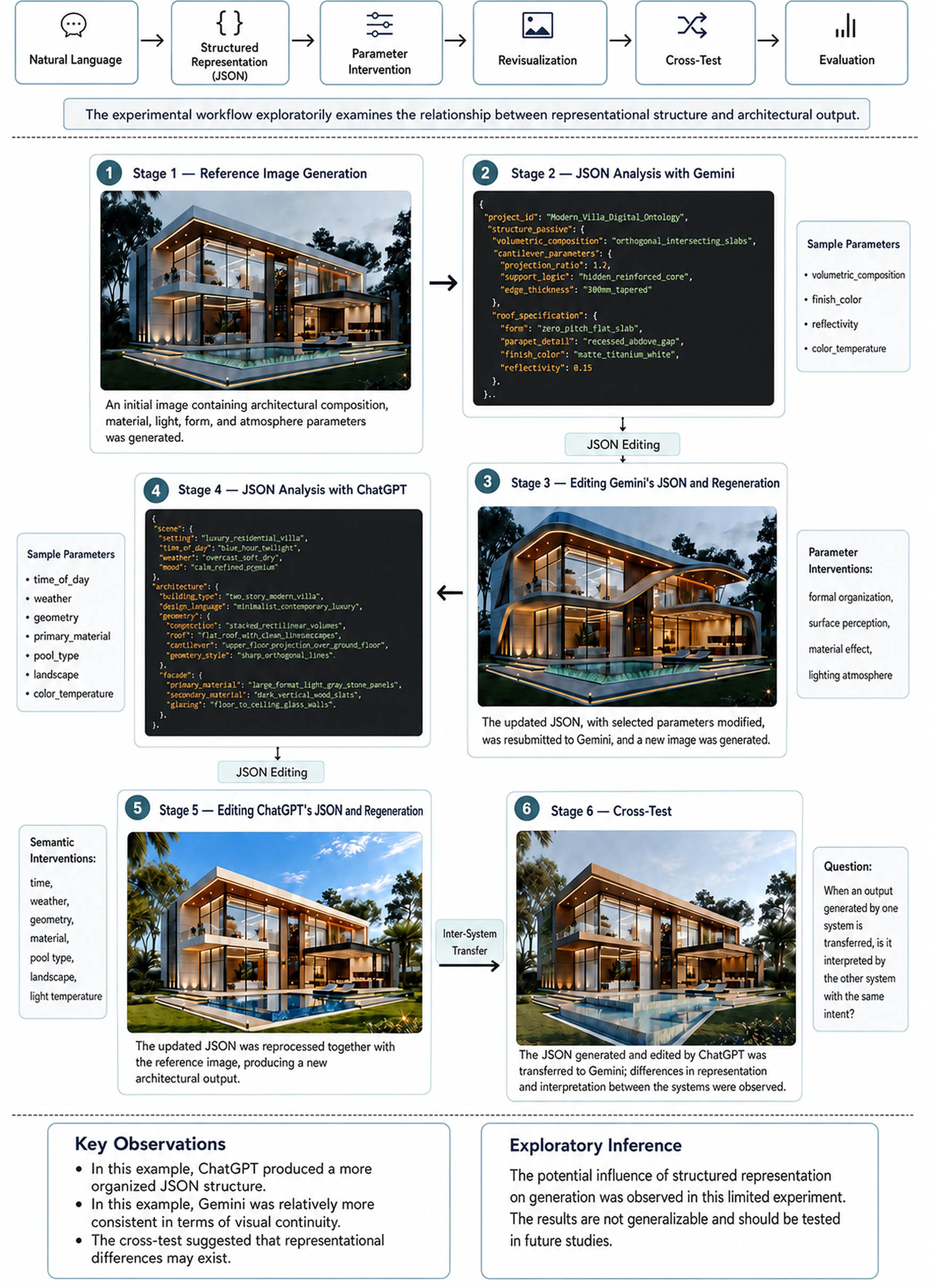
Figure 1
Workflow visual of the research.
Source: Author’s contribution.
2.1. Experimental image generation stage
In the first stage of the experiment, an initial image (Figure 2) was generated using an artificial intelligence image generation system. This image was accepted as the reference data of the experiment, and all subsequent comparisons were conducted based on this foundational image. The primary reason for selecting the initial image is that it serves as an example encompassing both visual composition and architectural parameters such as material, light, form, and atmosphere. Thus, subsequent transformations became trackable not only at the aesthetic level but also at the spatial and semantic levels.

Figure 2
Experimental image.
Source: Authors’ contribution.
2.2. Image to structured data representation stage
In the second stage, this obtained reference image was fed back into artificial intelligence, and the system was asked to describe the visual in question in JSON format. This process is highly important because the aim here is not to reveal an image seen by a human, but under which categories, which variables, and which conceptual headings the artificial intelligence parses the same image. In other words, this step shows the conceptual headings through which the model articulates the image. The JSON definition generated by the Gemini 3.1 Pro model (Figure 3) re-encodes the structural properties of the image; for instance, through formal composition, material effect, color attribute, lighting character, and compositional relationships. Thus, the visual ceases to be merely a picture and transforms into a data structure composed of parameters.
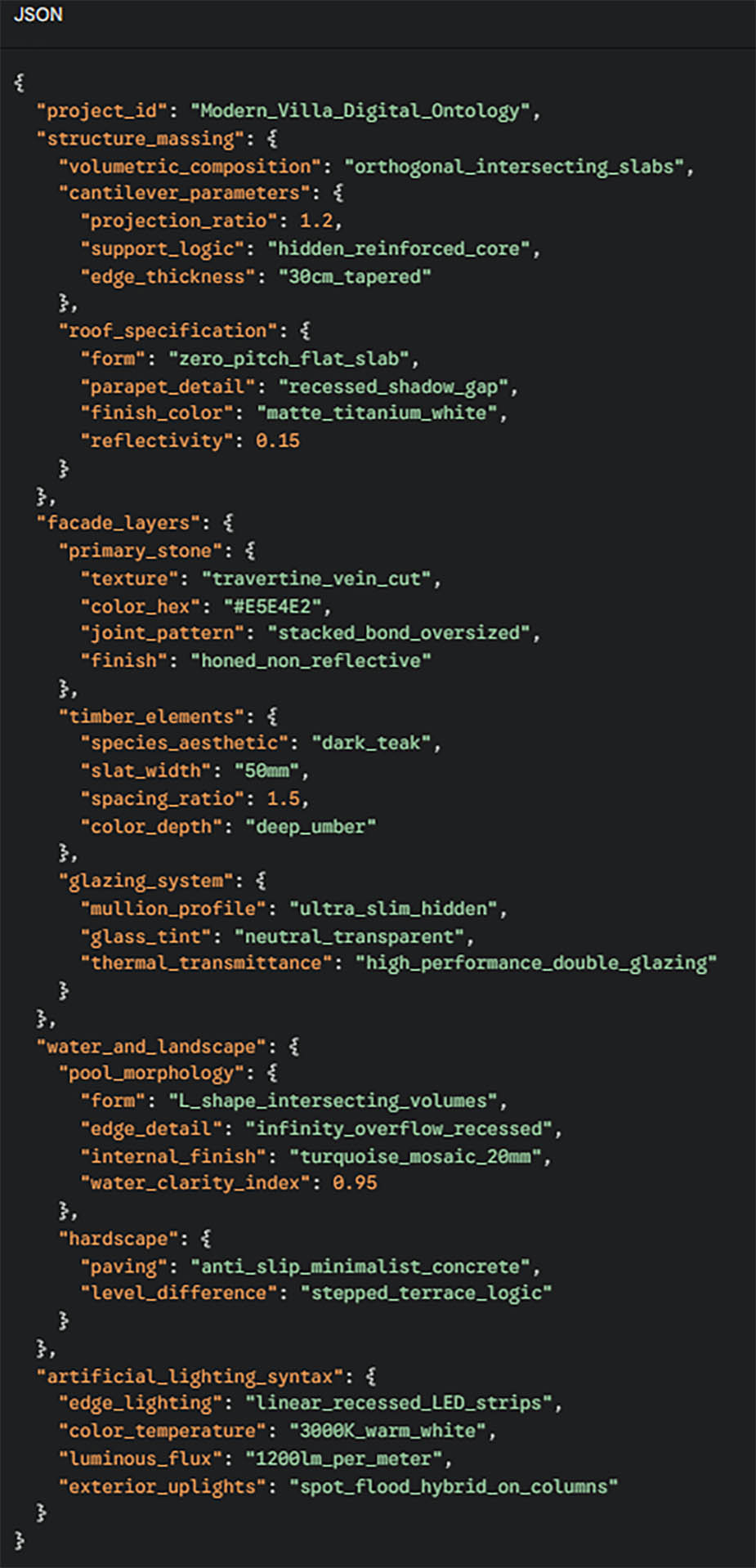
Figure 3
JSON Definition by the Gemini 3.1 Pro model.
Source: Authors’ contribution.
2.3. Communication through structured data representation stage
In the third stage, specific modifications were made to the JSON definition generated by the Gemini 3.1 Pro model. These modifications were executed on parameters that possess the potential to transform the fundamental character of the image. For instance, interventions such as “volumetric_composition”: “parametric_design,” “finish_color”: “blue,” “reflectivity”: 0.5, and “color_temperature”: “2000K_light” were considered as elements that alter the formal organization, surface perception, material effect, and atmospheric lighting quality of the structure. At this point, the aim is to observe how seemingly minor parameter shifts within the JSON can create substantial impacts on the visual result. This modified JSON, along with the initial image, was fed back into the Gemini 3.1 Pro model, and it was asked to generate a new image (Figure 4). The resulting output constituted a significant stage of the experiment because it provided an opportunity to observe how structured interventions were reflected within this experimental setting.

Figure 4
Resulting image (Nano Banana 2).
Source: Authors’ contribution.
2.4. Model comparison stage
In the fourth stage, the identical method was executed using the ChatGPT 5.5 model. The initial experimental image was provided to the ChatGPT 5.5 model, and the system was requested to generate a JSON-based definition for this image. The aim here is to compare how different artificial intelligence systems define the same image with different syntaxes, conceptual priorities, and parameter sets. The JSON prompt generated by the ChatGPT 5.5 model (Figure 5) decomposed the image within a different logical framework; it systematically expressed numerous parameters such as time, weather, geometry, primary material, pool type, surface finish, landscape layout, and light temperature.
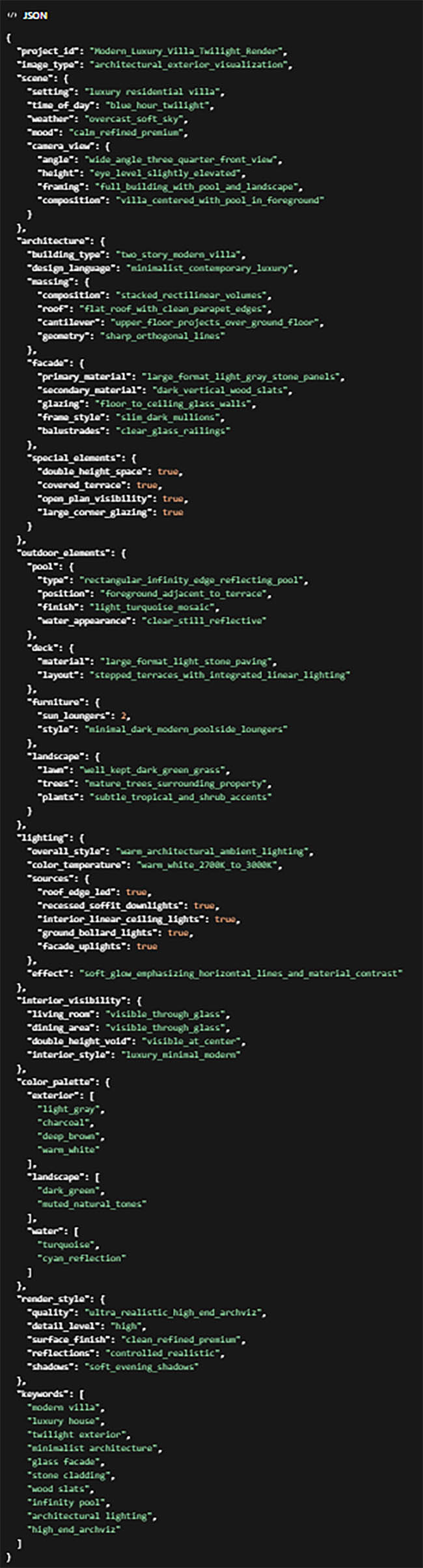
Figure 5
JSON Prompt by the ChatGPT 5.5 model.
Source: Authors’ contribution.
2.5. Stage of analyzing the results of the second model
In the fifth stage, deliberate modifications were made to the JSON generated by the ChatGPT 5.5 model. These modifications included “time_of_day”: “morning,” “weather”: “sunny,” “geometry”: “parametric,” “primary_material”: “wood,” “type”: “triangle_infinity_edge_reflecting_pool,” “finish”: “light_dark_blue_mosaic,” “lawn”: “well_kept_green_grass,” “plants”: “subtle_egean_and_shrub_accents,” “color_temperature”: “warm_white_1500K_to_2000K,” along with additional emphases regarding color reflections. These parameters are not merely objective changes; they are also semantic interventions that influence the image’s aesthetic tone, geographical connotation, material language, and spatial atmosphere. This updated JSON, together with the reference image, was provided to ChatGPT, and the new image (Figure 6) generated by the system in response was evaluated.

Figure 6
Resulting image (ChatGPT Image 2.0).
Source: Authors’ contribution.
2.6. Cross-testing stage
In the sixth and final stage, a cross-test was conducted. This time, the JSON prompt generated and modified by the ChatGPT 5.5 model was provided to the Gemini (Nano Banana 2) system. Thus, not only “definition and generation within the same system” but also “how the language generated by one system is interpreted by another system” was tested. This stage constitutes one of the most critical parts of the experiment. Because here, the question that comes into play is no longer merely the content of the prompt, but which system generated the prompt and how it is processed by another system. The resulting image (Figure 7) allowed for the analysis of interpretational differences between the two systems and differences in representation across systems. This stage shows that the observed differences do not arise solely from linguistic logic.

Figure 7
JSON Prompt (ChatGPT 5.5), Image (Nano Banana 2).
Source: Authors’ contribution.
This entire process aims to demonstrate that visual generation is not merely a matter of issuing a command; on the contrary, the structure of the language used, the mode of abstraction, and the parameter organization may be associated with the outcome. The experiment also indicates that in order to establish more efficient communication with artificial intelligence, humans must rethink not only what they desire but also in what structure they express it.
3. Conclusion and evaluation
The findings obtained from this experiment suggest that the representation language used in communication with artificial intelligence may be associated with output characteristics. In particular, defining the image in JSON format and introducing this structured data into the regeneration process suggests that artificial intelligence systems can yield more controlled and predictable results when they encounter a prompt structure closer to their own computational logic. This situation suggests that a difference may exist between natural language and structured language that is more suitable for the machine.
One of the significant observations that draws attention during the experimental process is that ChatGPT produces functional results in this experimental setup when conceptually parsing the visual and expressing it within an ordered JSON structure. The definitions generated by ChatGPT explicitly establish the relationships between parameters, decomposing the different components of the image to create a readable and manipulable data structure. In this aspect, ChatGPT can be evaluated as a functional tool in the stage of “semantic interpretation” and “translating into language” of the visual.
Conversely, it has been observed that in this experimental setup, Gemini yields relatively more consistent results in terms of visual generation quality. Especially in the process of regenerating modified JSON definitions, Gemini was seen to present relatively more consistent outputs in terms of aesthetic continuity, atmosphere creation, and visual integrity. This finding suggests that different artificial intelligence systems can specialize in different stages of the same process. In other words, while one system analyzes the visual better, another system can visualize it more successfully. This suggests that instead of relying on a single artificial intelligence tool, multiple systems can be utilized in a complementary manner.
The most striking dimension of the experiment emerged during the cross-testing stage. The result obtained by providing the JSON generated by ChatGPT to Gemini suggests that not only parameter modification but also the representational structure may be interpreted differently across systems. A representation structure generated by one artificial intelligence may not be read with the exact same intent by another artificial intelligence. This situation suggests that differences in processing and interpretation may exist between systems.
In this framework, the experiment opens a meaningful sphere of discussion when interpreted in terms of the Whorfian effect. If language influences human thought and perception, it can similarly be said that the mode of representation used in artificial intelligence systems directs the generated outcome. However, caution is required here. This experiment should not be viewed as a study that conclusively and universally validates the Whorfian analogy. More accurately, the results of the experiment present an exploratory example that can be discussed through the Whorfian analogy. Because the situation observed here is that the linguistic structure or the representation format is influential on the outcome, determining the scope, boundaries, and generalizability of this effect requires vastly more examples, more controlled experimental setups, and quantitative comparisons. Furthermore, because the study was conducted with a single reference image and a limited number of variants, the generalizability of the results is limited. Therefore, the strongest contribution of this study is its demonstration that the relationship between artificial intelligence and humans must be addressed not only at the content level but also at the level of linguistic and structural representation (Figure 8).
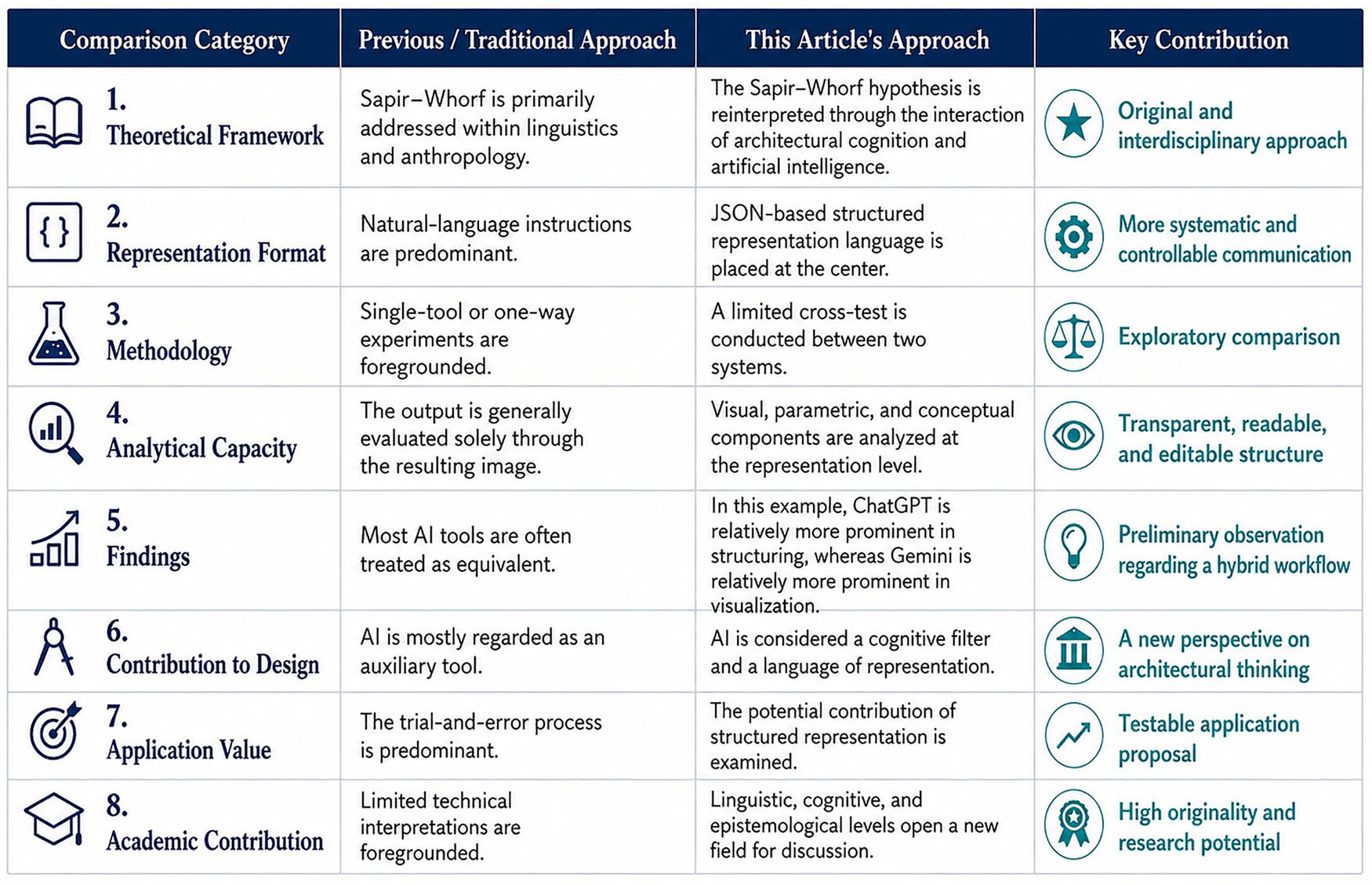
Figure 8
Strengths of the study.
Source: Authors’ contribution.
The user does not merely tell the artificial intelligence “What it should generate”; simultaneously, they indirectly determine “within which representational structure it should operate.” Structured formats like JSON function as an interface that makes parameters more explicit and editable in this regard. This opens up a new field of study in AI-assisted design, visualization, and creative production processes.
In conclusion, this experiment suggests, within the scope of this experimental setup, that the path to establishing more effective communication with artificial intelligence systems may lie not merely through providing more detailed commands, but simultaneously through developing a representation language more suited to the system’s mode of comprehension. The visual generation process, here, transforms into a kind of translation activity: human aesthetic and conceptual intent is first translated into structured data representation, and subsequently visualized anew through this language. Therefore, in future studies, how different artificial intelligence systems define the same visual, which parameters they highlight, with which syntactic patterns they yield more successful results, and how these processes can be quantitatively measured must be investigated in greater detail. Thus, the relationship between artificial intelligence and design will become evaluable not only in an instrumental framework but also in a linguistic, cognitive, and epistemological framework.
Funding information
Authors state no funding involved.
Author contributions
Burak EGE: Methodology, Software, Resources, Writing – original draft, Writing – review & editing, Visualization. Derya Demircan Palabıyık: Conceptualization, Validation, Formal analysis, Investigation, Data curation, Writing – original draft, Writing – review & editing, Supervision.
Conflict of interest statement
Authors state no conflict of interest.