
1. INTRODUCTION
Progressive climate change and the imperative to reduce greenhouse gas emissions constitute a major driver for intensifying efforts toward sustainable development [1]. One of the principal contributors to the global rise in carbon dioxide emissions remains the combustion of fossil fuels, which continues to dominate the global energy mix. According to long-term projections by the U.S. Energy Information Administration (EIA), global energy demand is expected to increase by approximately 34% between 2022 and 2050, underscoring the magnitude of the challenges associated with ensuring sustainable energy supply in the coming decades [2].
In accordance with the findings of the Intergovernmental Panel on Climate Change (IPCC) presented in the Sixth Assessment Report (AR6), stabilizing climate change requires the implementation of comprehensive decarbonization strategies across all sectors of the economy. Transformation pathways consistent with this objective include, among others, decarbonization of the power sector, electrification, preservation and expansion of natural carbon sinks, and improvements in energy efficiency [3].
The building sector accounts for approximately 40% of global primary energy consumption and 35% of greenhouse gas emissions [4]. Glazing systems, as integral elements of the building envelope, play a critical role in shaping its overall energy performance. According to the literature, windows can be responsible for 40% to as much as 60% of heat losses associated with building envelope materials [5]. Consequently, intensive research efforts focus on the development of advanced glazing technologies that can substantially enhance the energy efficiency of buildings.
In this context, the integration of renewable energy sources and the deployment of high-performance passive and active solutions are of particular importance. One of the most promising approaches are BIPV systems (Building Integrated PhotoVoltaics), which enable building envelope components to simultaneously serve as construction elements and sources of electrical power. A specific subgroup of these technologies includes semitransparent and transparent photovoltaic glazing systems capable of generating electricity while functioning as windows. A schematic comparison illustrating the difference between conventional glazing and photovoltaic glazing, as well as their impact on the building’s energy balance, is presented in Figure 1.
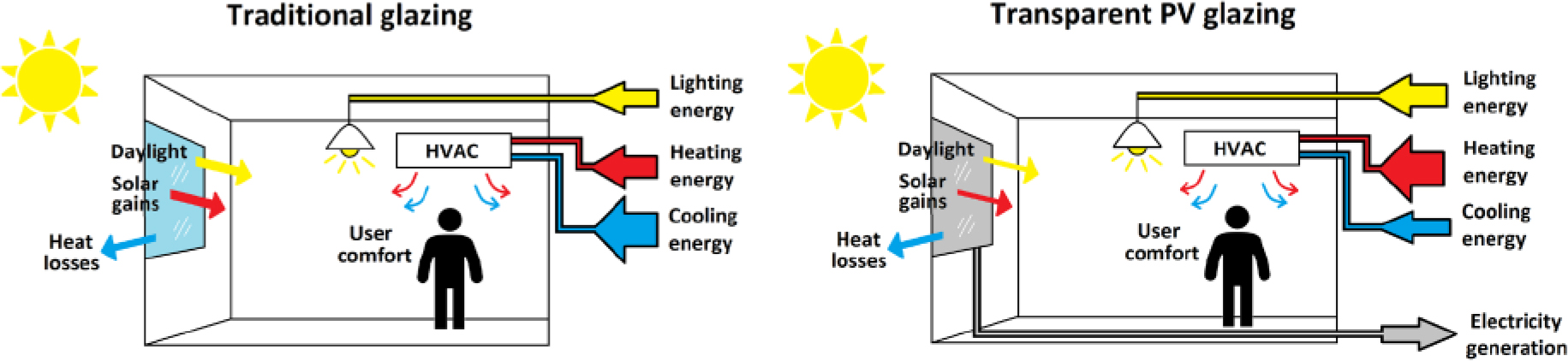
Figure 1.
Difference between traditional glazing and PV glazing on the energy balance of a building interior
BIPV glazing systems employ both passive and active mechanisms of solar energy conversion, which not only reduce final energy demand and associated operating costs but also contribute to CO2 emission mitigation, delivering benefits for both end users and the environment [6, 7]. In recent years, numerous studies have confirmed that the performance of BIPV systems is strongly influenced by local climatic conditions, façade orientation, and the optical properties of the glazing. Such research approach was adopted, for example, in the study by Mesloub et al. (2020) [8], which identified optimal BIPV window configurations for a semi-arid climate in Algeria (Biskra), maximizing energy savings while simultaneously improving visual comfort. Most available studies focus on regions with high solar irradiance – such as Southern Europe, the Middle East, or Asia – while the climatic conditions of Central Europe, characterized by a comparatively high proportion of diffuse solar radiation, remain relatively underexplored.
This is particularly relevant, as demonstrated by the findings of Goia (2016) [9], which showed that the selection of an appropriate window-to-wall ratio (WWR), for non PV windows, is one of the key parameters influencing the overall energy balance of a building and is strongly dependent on climatic conditions. The study revealed that different European climate zones require markedly different WWR values, ranging from very high to relatively low, in order to achieve maximum energy-saving potential, highlighting the need for location-specific optimisation. Kisilewicz, in his work [10] showed the relationship between the thermal mass and the optimal window to floor area ratio (Rw/f) for traditional glazing in a passive standard building in one of the locations in Poland. Depending on the thermal mass, the optimal Rw/f for south oriented window ranged from 0.12 to 0.27 (the optimal glazing area, which gives the lowest heating demand, was greater the greater the thermal mass of the building). Furthermore, the review by Kuhn et al. (2021) [11], based on the experience of the German market – one of the few in Europe where BIPV has gained broader application indicates that the effective use of this technology requires careful adaptation to local climatic, constructional and material conditions. This demonstrates that even in regions where BIPV is more frequently implemented, fully exploiting its potential depends on a precise understanding of the context and the specific characteristics of the building.
The literature lacks analyses conducted for locations representative of Poland that provide a comprehensive assessment of the energy and environmental performance of BIPV envelope systems. This article focuses on evaluating the influence of transparent photovoltaic modules integrated into the transparent façade elements of an office building, with particular emphasis on their potential to reduce energy consumption and improve the overall energy balance under temperate climate conditions.
2. METHODS
2.1. Used simulation environment
The analyses were conducted using the DesignBuilder software (version 6.1.8.021), which operates on the validated EnergyPlus simulation engine (version 8.9.0.001). DesignBuilder is an advanced building energy modelling tool that integrates the computational engines EnergyPlus, Radiance, and CFD [12]. The software enables comprehensive assessments of energy performance, daylight availability, thermal comfort, CO2 – emissions, and HVAC system operation based on a unified three-dimensional geometric building model.
EnergyPlus is a well-established and extensively validated building energy simulation engine used to model heating, cooling, lighting, ventilation, and other energy flows. Built on the most widely utilized capabilities of the BLAST and DOE-2 engines, it offers sub-hourly time-step analysis, modular system configuration, integrated plant and zone simulations based on heat-balance principles, multizone airflow modelling, thermal comfort evaluation, and photovoltaic system modelling. However, EnergyPlus does not provide a user interface that allows straightforward graphical model definition, parameter specification, or rapid visualization and interpretation of simulation results. This gap is addressed by DesignBuilder, which translates the graphically defined building model into the pdf format, sends it to the EnergyPlus computational engine, and subsequently enables visualization of the resulting output in the form of timestep graphs or tables.
2.2. Office room model
The energy balance simulation was performed for a medium-sized office space located in a building in Wroclaw, Poland. The room, with dimensions of 6.0 m × 4.0 m × 3.0 m (length × width × height), featured an exterior wall oriented to the east, south or west direction, and its schematic geometry is illustrated in Figure 2. For the purpose of isolating the effects associated with the glazing systems, the internal partitions (walls and floors/ceilings) were modelled as adiabatic surfaces, i.e., without heat exchange with adjacent building spaces. The simulations were conducted with an hourly time step; however, due to space limitations, the discussion showed in the paper focuses on the annual energy balance results. The performed analyses were carried for a reference glazing system (a conventional triple-pane, high-thermal-insulation window) and a BIPV glazing system (a triple-pane transparent photovoltaic window based on the CdTe technology), which, in addition to functioning as a conventional window, is capable of generating electrical energy. The technical parameters of the glazing systems are described in detail in the section 2.3 of the article.
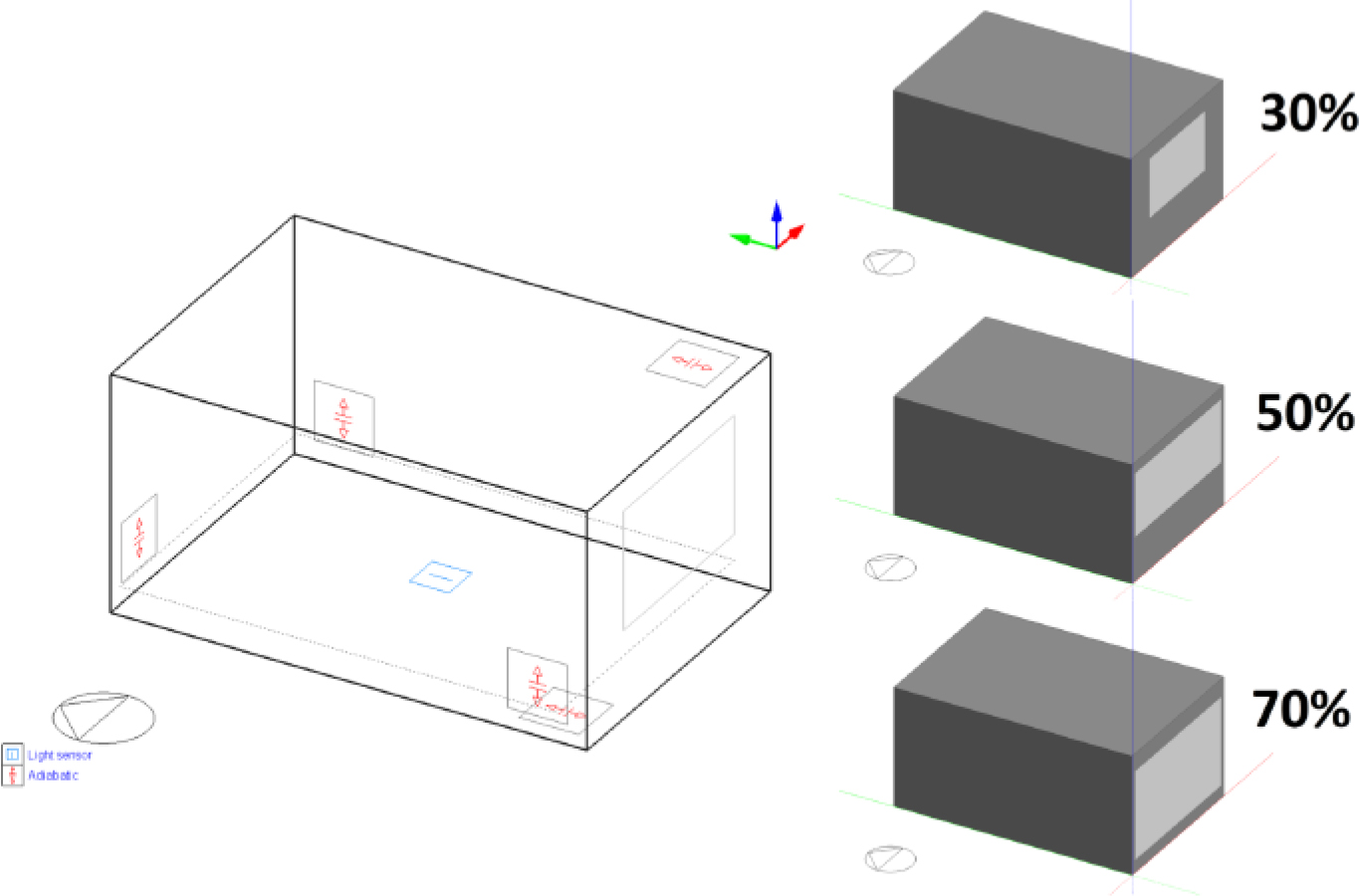
Figure 2.
Office room geometry (6.0 m x 4.0 m x 3.0 m) and analyzed WWR values (Window to Wall Ratio) for east, south and west façade orientation
For each glazing type, three variants of window surface share in the façade – defined using the Window-to-Wall Ratio (WWR) – were considered: 30%, 50%, and 70%. In total, 18 simulation scenarios were evaluated (2 glazing types × 3 orientations × 3 WWR values). The fundamental assumptions and simulation settings for the analyzed room model are summarized in the Table 1.
Table 1.
Office room simulation settings
| Room parameter | Analyzed values |
|---|---|
| Location | Wroclaw, Poland (IMGW* weather data) |
| Dimensions (lenght x width x height) | 6.0 m x 4.0 m x 3.0 m |
External partition:
| East, South or West oriented façade (no shading from surroundings) Internal plaster + AAC blocks 25 cm + XPS boards 15 cm + External plaster U-value = 0.17 W/(m2K), according to WT2021 standard [13] Reference window or PV window, both with U-value = 0.80 W/(m2K) in three cases: with WWR of 30%, 50% and 70% |
Internal partitions:
| Set as adiabatic (but its heat capacities were added to room thermal mass): drywall / 10 cm airgap / drywall concrete 20 cm |
| User schedule | Monday – Friday, 8:00 - 16:00 + overtime hours (with lower activity) inbetween 7:00-8:00 and 16:00-18:00 |
| User density | 0,1 person/m2, according to EN 16798-1:2019 standard [14] |
Internal gains:
| As for typical office use: 127 W/person (1,2 Met, 70 W/m2 – for typical office activity according to ISO 7730 standard [15]) 11.77 W/m2 16.25 W/m2 |
| Lighting | 500 lx (typical for office spaces [16], according to EN 12464-1:2021 standard) |
Thermal comfort:
| Users clothing insulation levels: 1.0 clo (winter) and 0.5 clo (summer) Design temperatures for II category spaces (according to EN 16798-1:2019 standard [14]): +21°C inbetween 5:00–19:00, outside this period may drop to +19°C +24°C, inbetween 5:00–19:00 outside this period may rise to +28°C |
Technical systems:
| All relying on electricity from grid: Fan coil unit, Heating system seasonal CoP = 3.0 Fan coil unit, Cooling system seasonal CoP = 3.0 Mechanical, heat recovery 75% LEDs, power density 3.0 W/m2 |
The simulation results included the annual energy demand for heating, cooling, and artificial lighting, the annual electricity generation for the PV glazing variants, as well as the thermal comfort assessment based on the PMV (Predicted Mean Vote) and PPD (Predicted Percentage of Dissatisfied) indices.
2.3. Analyzed glazing type cases
The glazing variants analysed in this study were selected such that their thermal insulation parameters (U-value) comply with current legal requirements for energy performance in Poland and the European Union [13][17]. Simulations were conducted for two glazing types: a reference glazing set (further called Reference glazing or REF) and a transparent photovoltaic glazing set (further called PVglazing or PV).
In the reference glazing model, a triple insulating glass unit with the configuration 3LE/12/3/12/3LE was applied. The two outer panes were Low-E glass (with low-emissivity coating), and the inter-pane cavities were filled with argon. This configuration was adopted in accordance with the manufacturer’s technical specifications [18], ensuring consistency with current standards used in energy-efficient commercial buildings. The selected parameters correspond to contemporary high-performance insulating glass units, providing an advantageous balance between thermal insulation, daylight availability, and protection against overheating [19]. Such glazing types are widely recommended in the literature as a benchmark for energy performance analyses, particularly in buildings with large glazed areas [20].
As a alternative to the reference glazing the BIPV glazing system was used, which combines the function of a building envelope component (window) with the capability of generating electrical energy. A review of the literature indicates that conventional BIPV glazing systems often exhibit relatively high thermal transmittance values (U-values), exceeding the regulatory limits established in Poland (U-value ≤ 0.9 W/(m2K)) [13, 21]. For example, the average U-value for CdTe-based BIPV glazing systems is approximately 2.7 W/(m2K), while enhanced configurations with improved thermal insulation reach values around 1.52 W/(m2K) [22, 22]. Other studies report U-values of approximately 1.62 W/(m2K) for BIPV IGU systems (Building-Integrated Photovoltaics Insulated Glazing Unit), which also fail to meet Polish regulatory requirements [24].
The literature review, supported by empirical findings, clearly indicates that among the evaluated technologies, only Vacuum Photovoltaic Glazing (VPV) complies with Polish regulatory thresholds [13], offering U-values below 0.9 W/(m2K) [25, 26, 27]. While maintaining the capability to generate electricity, VPV glazing constitutes a particularly favorable solution for buildings with stringent energy performance requirements [7, 20]. In selecting the parameters for the analyzed variant, the reduced electrical efficiency of CdTe modules incorporated within the VPV system was taken into account. This results from the strong interdependence between the thermal insulation properties of the glazing and the energy conversion efficiency of photovoltaic cells. Enhanced thermal insulation, reflected by a lower U-value, reduces the heat dissipation from PV cells, leading to increased operating temperatures. This, in turn, results in decreased power conversion efficiency, a phenomenon well documented in the literature [22, 23]. The technical parameters adopted for the simulation analysis are summarized in the Table 2.
Table 2.
Technical parameters of analyzed glazing units
| Parameter | Reference glazing set (Reference) | Transparent photovoltaic glazing set (PV) |
|---|---|---|
| Thermal transmittance – U-value [W/(m2K)] | 0.80 | 0.80 |
| Solar Heat Gain Coefficient – SHGC [-] | 0.47 | 0.42 |
| Light Transmittance – LT [-] | 0.66 | 0.25 |
| Power Conversion Efficiency – PCE [%] | Not applicable | 6.3% |
Due to the limited market availability and relatively short commercial history of semitransparent and transparent BIPV modules, the nominal power PPV,glazíng was determined using the standard methodological approach [28]. For each WWR variant, the rated power was calculated according to formula:
where:PPV,glazing – peak power of the BIPV photovoltaic glazing BIPV [W],
APV,glazing – area of the photovoltaic glazing (dependent on the WWR value) [m2],
GSTC – solar irradiance under Standard Test Conditions, assumed as 1000 W/m2,
η – power conversion efficiency (PCE) [%].
This approach results in a peak power value that increases proportionally with the glazing area. The resulting values for each configuration are presented in the Table 3.
3. RESULTS
3.1. Solar heat gain reduction
The relationship between the window-to-wall ratio (WWR), façade orientation and the amount of solar heat gains for both types of glazing is presented in Figure 3. The simulations revealed a consistent reduction in solar gains of approximately 17% for the PV glazing compared to the reference glazing, regardless of the WWR value or the façade orientation.
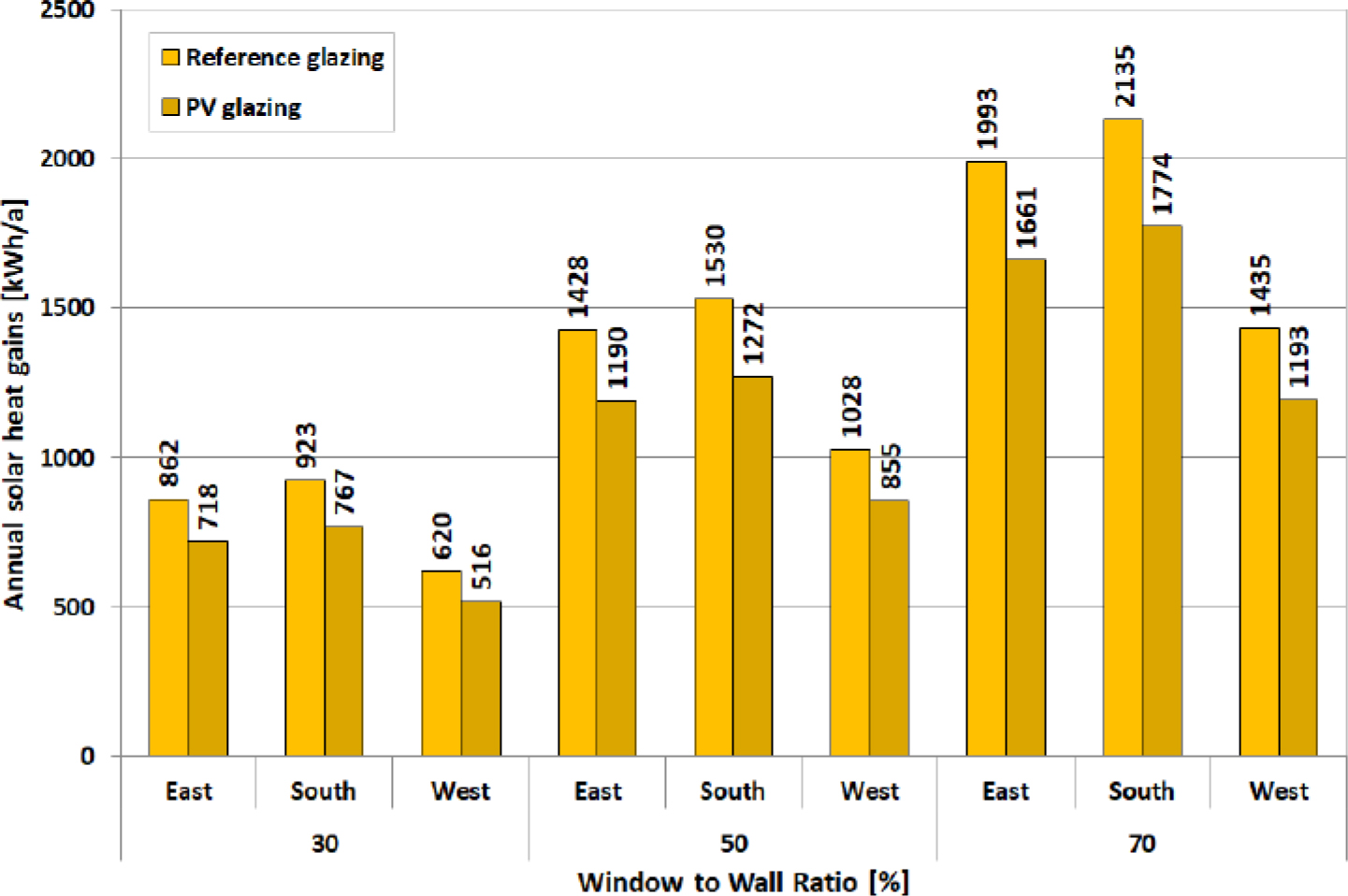
Figure 3.
Annual solar heat gains for the reference and PV glazing depending on the WWR value and façade orientation
All south oriented windows had the highest solar gains. For the reference glazing, a reduction of 6.6% were observed for east oriented windows and 32.8% for west oriented ones. For the PV glazing these values were respectively: 6,4% and 32.7%. The visible difference for east and west oriented face is mainly connected with solar radiation values in the weather data file.
3.2. Heating, cooling and lighting energy
Figure 4 presents the summarized energy demand for heating, cooling, and lighting as a function of the window-to-wall ratio, façade orientation and the type of glazing applied. The analysis indicates that the integration of transparent PV modules in the windows results in a substantial increase in lighting energy demand compared to the reference variants (with conventional glazing). For east oriented windows, that increase was depending on the WWR between 62% and 71%, for south windows between 50% and 55% and for west windows between 64% and 75%. At the same time, the simulation results show that for south oriented windows, use of PV glazing lead to higher heating demand (from 1.4% to 8.8%) than reference glazing, but for east and west orientation heating demand is slightly decreasing (between 0.2% and 4.1%). The cooling energy demand decreases, for almost all PV glazing cases, between 1.3% and 9.4%. Only the west oriented PV glazing case with WWR = 30% shown an increase in cooling by 1.9% in comparison to its reference case.
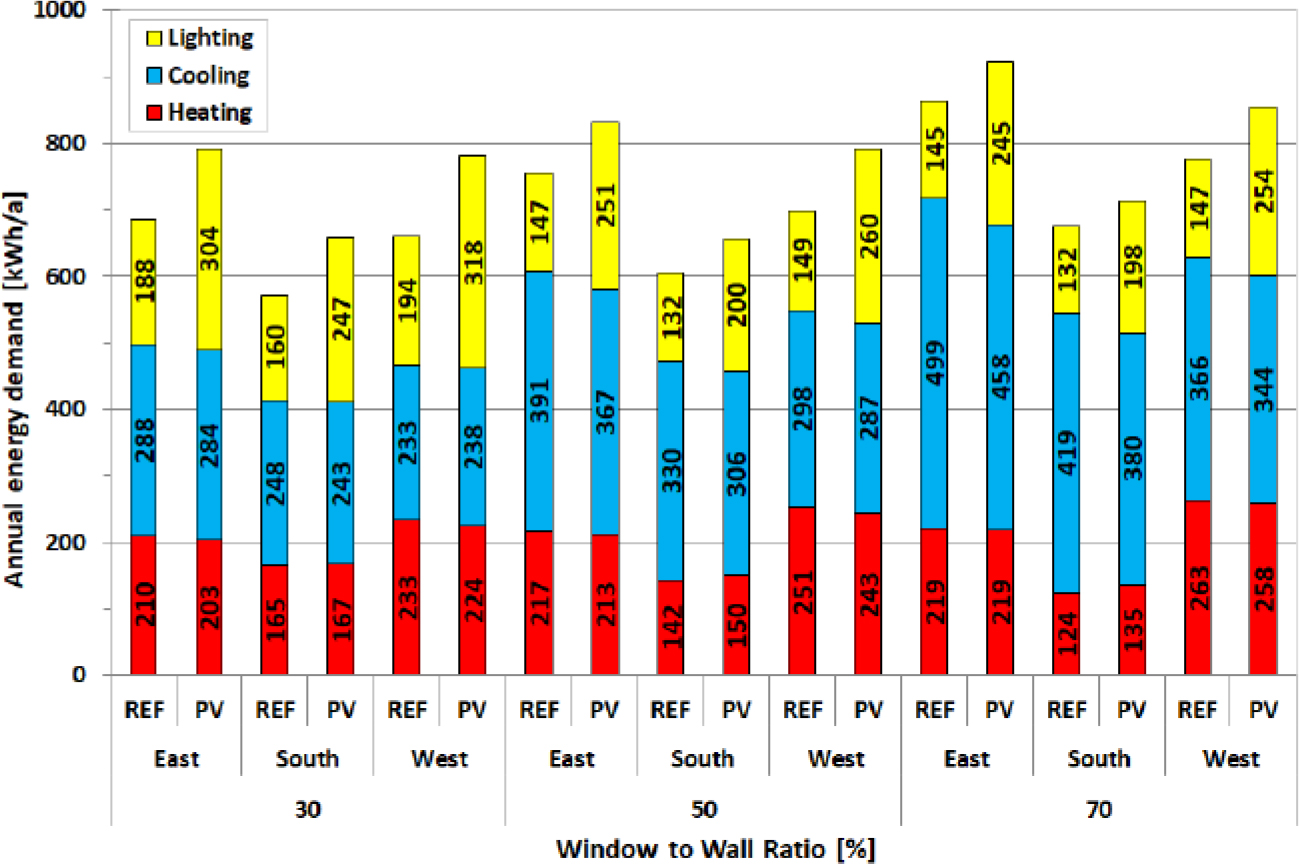
Figure 4.
Annual heating, cooling and lighting final (site) energy for reference and PV glazing depending on the WWR value and façade orientation
3.4. Thermal comfort of users
Annual average Predicted Mean Vote index values for reference glazing ranged from -0.35 to -0.05, while the Predicted Percentage of Dissatisfied were between 9 and 11%. For PV glazing, PMV ranged from -0.40 to -0.10, and the PPD were, similarly, between 9 and 11%. The annual average values of both thermal comfort indices for all PV glazing variants fell within the limits defined by ISO 7730:2005 for comfort categories A/B [15].
3.5. PV glazing electricity production
The electricity production from the PV glazing was highest for south oriented façade and the biggest WWR value (70%), which is clearly visible on the Figure 5. For all analyzed façade orientation the increase in electrical energy production was 66% when changing WWR values from 30% to 50% and around 40% when going from WWR 50% to 70%. A comparison of these values with the additional energy loads indicated a positive net electricity balance for almost all analyzed cases. Only for the west oriented smallest window (WWR = 30%) the energy production was smaller than the added energy demand for heating and lighting.
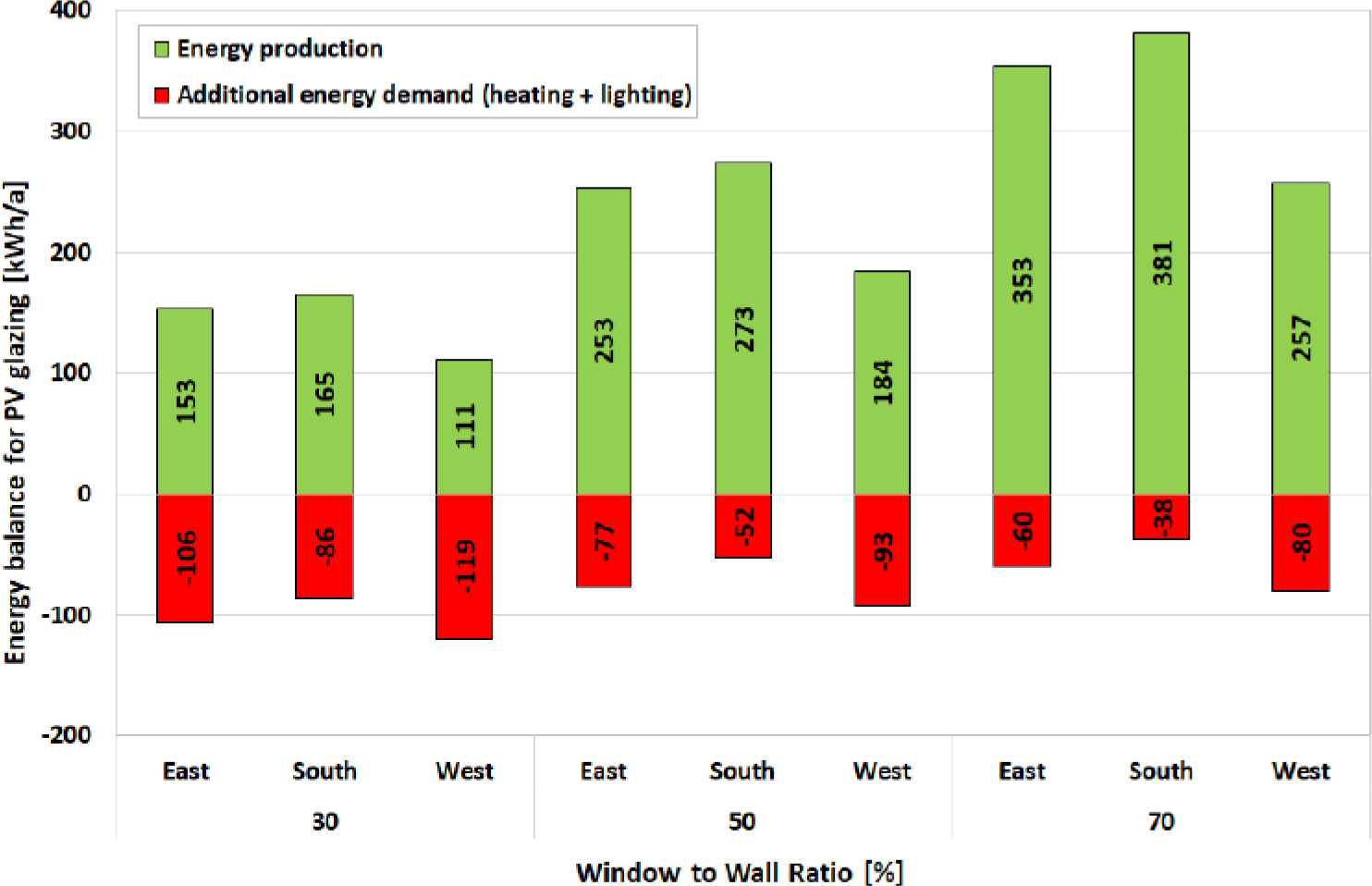
Figure 5.
PV glazing energy balance (energy production and additional energy demand) depending on the WWR value and façade orientation
4. DISCUSSION
4.1. Effects of PV glazing integration on building energy performance
The observed reduction of solar gains by use of PV glazing was by approximately 17% in comparison to the traditional glazing. The limitation of daylighting results in an increase in electricity consumption for lighting, which is consistent with observations reported by other authors [22, 23]. At the same time, the reduction in heat gains leaded mostly to lower cooling loads, in agreement with the findings of Peng et al. (2021) [24] and Ghosh et al. (2018) [26]. Some anomalies were also observed (decrease of heating energy and increase of cooling energy for PV glazing cases) which shows a need for further more detailed research in that area. Consequently, despite the increased lighting demand, the overall energy balance of the building improves due to electricity generation from the BIPV system.
4.2. User thermal comfort
The thermal comfort analysis indicated that the use of PV glazing results in only minor deviations in PMV and PPD indices compared to the reference variant. The annual average PMV values ranged from -0.40 to -0.10, which, according to ISO 7730:2005 [15], corresponds to comfort categories A/B (-0.5 ≤ PMV ≤ +0.5). This implies that building occupants would perceive neutral to slightly cool conditions, remaining within the thermal comfort range. The PPD index ranged from 9.0% to 10.7%, which only slightly exceeds the 10% threshold required for category B thermal comfort under ISO 7730:2005 [15]. Differences relative to the reference variant (maximum 0.77 percentage points) are negligible and do not affect the comfort classification. These values fall within the tolerance limits of the simulation model and within the acceptable operative temperature ranges specified in EN 16798-1:2019 (category II: 20–24°C for the heating season, 23–26°C for the cooling season) [14].
4.3. Renewable energy production
The annual electricity production from the PV system ranged from 111 kWh to 38 kWh, depending on the window-to-wall ratio (WWR) and façade orientation. Comparison with the additional energy loads, it demonstrated a positive net energy balance in almost all cases (without West oriented WWR=30% PV glazing case), indicating that electricity generated by the PV modules can compensate for the increased demand for lighting and heating. As the WWR increases, the energy balance improves due to the larger active PV area, confirming observations by Ghosh et al. (2018) [26] and Huang et al. (2018) [27]. Variants with WWR ≥ 50% exhibit the most favorable ratio of energy gains to additional losses, making them optimal for temperate climate conditions.
4.4. Novelty and climatic relevance of the research
The preformed simulation analysis represent one of the few studies addressing the application of transparent PV glazing under the temperate climate conditions of Poland. Previous analyses have primarily focused on regions with significantly higher solar irradiance, such as semi-arid climates (Mesloub et al., 2020 [8]) or Asian locations (Kim et al., 2024 [29]). Consequently, data representative of the real climatic conditions of Central Europe, where diffuse radiation and seasonal variability of solar availability are considerably higher, were lacking. The results presented in this study fill this gap, providing preliminary yet meaningful data on the performance of BIPV glazing systems in a temperate climate. The simulations confirm that, despite lower solar availability in Poland compared to southern regions, transparent BIPV glazing technology demonstrates the potential to achieve a positive annual energy balance. Notably, in a temperate climate, the benefits arising from the reduction of heat gains during the summer period outweigh the increased heating demand in winter, leading to stabilization of the final energy consumption.
5. CONCLUSIONS
The obtained results indicate that the integration of PV glazing could, in the long term, serve as an effective solution supporting the implementation of nZEB (nearly Zero Energy Buildings) targets in Poland. Further research should include detailed analyses of monthly, daily, and even hourly energy balances between energy demand and PV energy production, because shifting the production and consumption of electricity in time, the possibility of reselling it to an energy supplier or even the use of home energy storage facilities may have a significant impact on the final efficiency of the entire system. Despite the limitations inherent to simulation-based studies, the presented preliminary results confirm the technical and environmental potential of implementing this technology within the national climatic context.
ACKNOWLEDGEMENTS
The authors would like to thank the Department of General Building Engineering for the possibility of using DesingBuilder software.