
1. INTRODUCTION
Pollution has become a pressing concern across industrialized and developing nations in recent decades. The surge in the production of both natural and synthetic substances, including vital minerals and chemicals, has not been matched by advancements in waste management and disposal protocols. Because of inefficient methods like extraction, heating, and grinding have resulted in significant losses of raw materials across the production cycle, from agriculture to manufacture (Wang et al., 2024). Consequently, the global dissemination of pollutants continues to escalate, with industrial and agricultural effluents being the primary culprits. When entering the ecosystem, these anthropogenic pollutants contaminates air, water, and soil [1]. Pollution is a persistent global challenge, with water systems increasingly contaminated by compounds like caffeine and nicotine, which are clear indicators of natural and anthropogenic waste. Caffeine, a ubiquitous component of coffee and tea, and nicotine, commonly found in tobacco products, are highly soluble in water, making them easily transported through the environment. Studies have consistently shown that regions with high coffee and tobacco consumption exhibit elevated levels of these compounds in wastewater. This contamination extends globally, with caffeine and nicotine traces detected in freshwater environments across all continents, highlighting the pervasive impact of human presence [2], [3]. Because of this, these two pollutants – more especially, those found in wastewater streams – can be regarded as pioneers in pollutant research.
In response to this growing threat, the global community has initiated various measures to mitigate pollution, including reducing factory emissions and sources of ozone depletion. Additionally, governments have enacted strategies to curtail agricultural runoff by endorsing sustainable farming practices and enhancing wastewater treatment systems. Despite these initiatives, there is an imperative need for further action to protect our ecosystems from the myriad of pollutants emanating from countless sources (4). Among the diverse pollutants, nicotine and caffeine are ubiquitous indicators of human waste within surface, subsurface, and groundwater systems. Caffeine, consumed globally at an average rate of 70mg per person daily, is produced naturally by over 60 plant species and is one of the most popular psychoactive substances in the world. Conversely, plant-derived nicotine is extensively dispersed throughout the environment [5].
Approximately 5% of caffeine consumed is excreted in the urine, permeating various water systems. This analysis encompasses the entire spectrum of caffeine and nicotine release mechanisms, including those stemming from ground coffee, cigarettes, food, and beverages and the disposal of pharmaceuticals containing these compounds in natural and synthetic forms. Research indicates that caffeine and nicotine pose numerous detrimental effects on aquatic life and microorganisms [6], [7].
Urban wastewater treatment plants (WWTPs) play a pivotal role in the environmental release of nicotine and caffeine. The efficiency of WWTPs in removing contaminants, such as caffeine and nicotine, varies widely based on system design and digestion techniques, often leading to incomplete breakdown and metabolism by diverse microbial populations. These substances can be readily detected in surface waters even at low concentrations, such as a few nanograms per litre [8].
The efficiency of wastewater treatment plants (WWTPs) in removing these pollutants varies. This discrepancy in removal efficiency highlights global disparities in wastewater treatment capabilities, with some regions needing more infrastructure for comprehensive pollutant removal. By integrating these data points and citations, this paper aims to explore analytical methods for quantifying caffeine and nicotine in natural environments and municipal wastewater. Understanding these processes is crucial for improving treatment methods and safeguarding water resources from the harmful effects of these pollutants.
This study aims to review and explore analytical methods capable of quantifying caffeine and nicotine levels in natural settings and municipal wastewater. Relevant literature on the extraction, measurement, and analysis of caffeine and nicotine was explored. This review not only aims to consolidate existing knowledge but also to provoke discussion and recognition of the prevailing limitations and research gaps in the remediation of specific pollutants from aqueous solutions and wastewater effluents.
1.1. Caffeine and nicotine: Circulation in the environment
Caffeine is a pervasive natural compound with a molecular weight of 194.19 g/mol, recognized by its international union of pure and applied chemistry (IUPAC) name as 1,3,7-trimethyl purine-2,6-dione. This odourless, solid substance has a mild solubility in water, ranging from 10 to 50 mg/mL at 73°F, and is characterized by a pH of 6.9. It melts into a tasteless, dry, white powder at 178°C (Figure 1). Found in seeds and leaves of coffee plants, it is also prevalent in chocolate, cocoa, cola, and certain medications, particularly pain relievers. As the primary component of coffee, caffeine stimulates the human neurological system. Its hydrophilic nature is reflected in its octanol-water partition coefficient, with values from - 0.04 to -0.01, indicating high solubility. The acidity of caffeine is defined by its pKa value, which spans from 5.3 to 14, showcasing the strength and proton-donating ability of the acid within the molecule. High concentrations of caffeine in water systems can signify pollution, given its stability and solubility [9], [10].
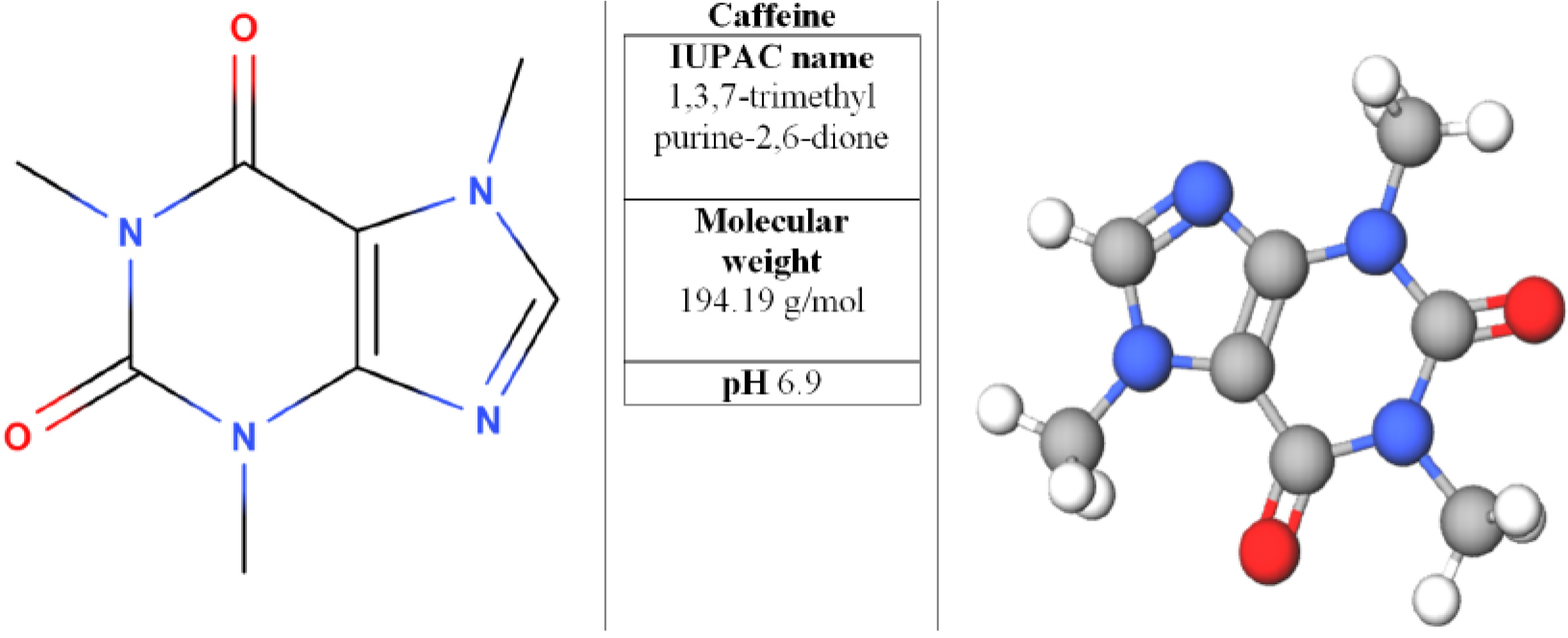
Figure. 1.
Chemical structure and properties of caffein. Caffeine – PubChem (nih.gov)
Caffeine, commonly consumed in everyday beverages like coffee and tea, can be toxic at high doses. The lethal dose (LD50) for caffeine is typically around 5 to 10 grams (5,000 to 10,000 mg) for most adults, which equates to roughly 150 to 200 mg per kilogram of body weight. For comparison, a typical cup of coffee contains about 95 mg of caffeine, meaning an overdose would require consuming an excessive amount, far beyond typical consumption.
Nicotine, a vital element in tobacco, is known for its addictive properties and psychotropic effects. It has a molecular weight of 162.23 g/mol and a pH of 10.2 (Figure 2). The liquid form of nicotine ranges from colourless to light yellow, and it is toxic when absorbed through the skin or inhaled. Nicotine is a combustible substance that produces harmful nitrogen oxides upon burning. Nicotine’s pike value is around 8.11 to 8.1, and its log Kow value is 1.17 (hydrophobic), which represents the octanol/water partition coefficient expressed as a dimensionless ratio value, typically assessed using the decadic logarithm (denoted by “log”). It quantifies the distribution of a compound between octanol and water phases [11].
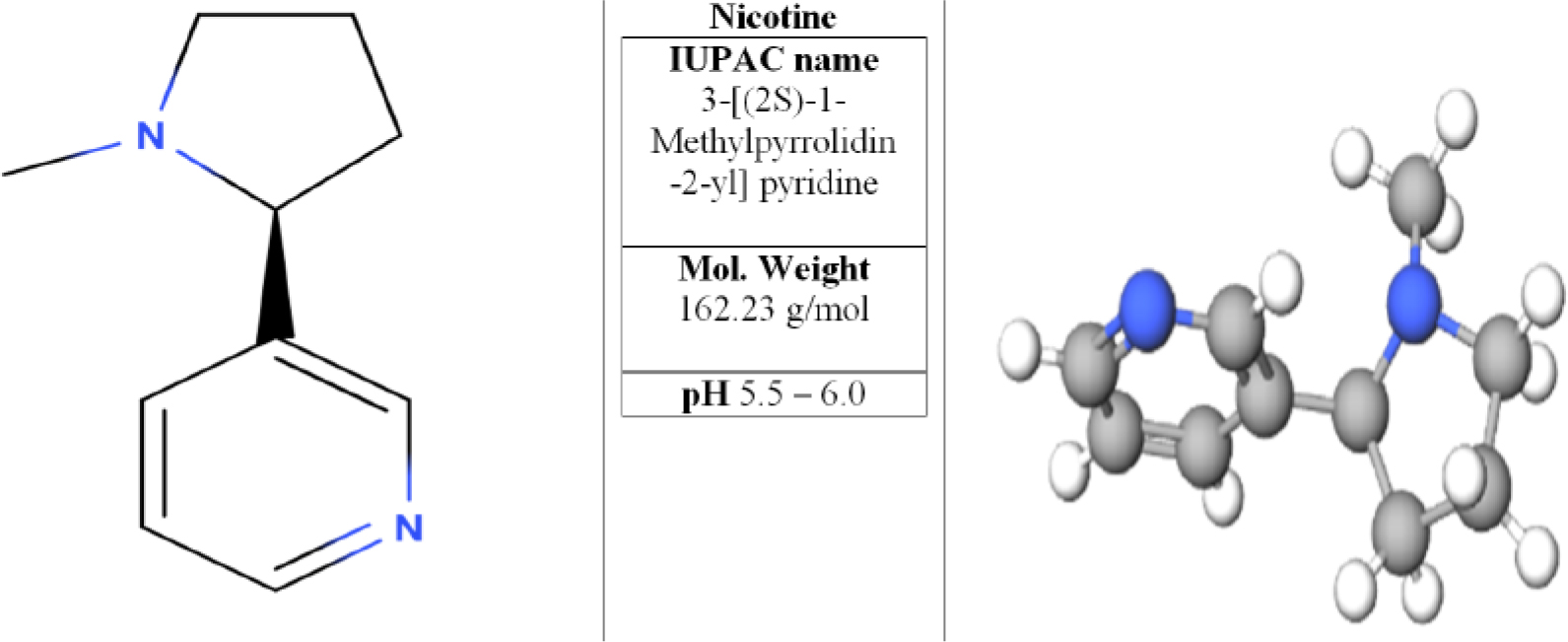
Figure. 2.
Chemical structure and properties of nicotin. Nicotine – PubChem (nih.gov)
Nicotine, a highly toxic substance, has significant adverse effects on human health, with its lethal dose (LD50) varying by age. In adults, the LD50 of nicotine is estimated to be between 30-60 mg, while in children, it is much lower at 10 mg, highlighting the increased vulnerability of younger individuals to nicotine toxicity. Acute exposure to nicotine can lead to symptoms such as irritation, nausea, abdominal pain, vomiting, and diarrhoea. Systemic effects include increased heart rate, blood pressure, catecholamine levels, hypothermia, hyperglycemia, and respiratory distress. In severe cases, nicotine poisoning can result in tremors, cyanosis, convulsions, and even death due to paralysis of the respiratory muscles [12], [13].
Once nicotine and its metabolites are excreted postconsumption, they can be washed out from cigarette residues or dispersed into the environment from tobacco plantations. These compounds then undergo various environmental processes that can alter their chemical structure, including transformation through biological, chemical, and photodegradation processes, leaching, transportation, and interaction with soil and sediment matrices. It is worth noting that the presence of nicotine can have adverse effects on nontarget organisms. Nicotine is a plant-derived alkaloid that can have a range of impacts on bacterial and fungal pathogens. These effects can not only be detrimental to the target organisms but also pose potential threats to the foundational levels of aquatic food webs. Therefore, it is essential to consider the potential ecological impacts of nicotine and its metabolites in the environment (Ali Esmail, 2022), (Khan, 2024). Tobacco-specific biomarkers, such as anabasine and anatabine, are alkaloids unique to tobacco plants and their derived products. These compounds serve as critical indicators of tobacco exposure, mainly when analysed alongside traditional nicotine biomarkers like cotinine and trans-3'-hydroxy cotinine. Unlike nicotine, which can also originate from sources like nicotine replacement therapies, anabasine and anatabine are exclusive to tobacco use, making them particular markers. Their inclusion improves the accuracy of distinguishing active tobacco use from exposure to nicotine-containing medications or environmental sources. These biomarkers provide a comprehensive understanding of tobacco-related exposure, aiding in smoking behaviour studies, public health surveillance, and tobacco cessation program evaluations. They are particularly valuable in environmental studies, such as wastewater analysis, where they can indicate population-level tobacco consumption and assess the ecological impact of tobaccorelated contaminants [15], [16].
It is common for people to use caffeine and nicotine, which are natural substances that often end up in the environment. These two substances share specific characteristics, such as being highly soluble in water and not very hydrophobic. Research has shown that countries with high coffee and cigarette consumption rates also have prominent levels of caffeine and nicotine in their wastewater. Traces of caffeine have been found in freshwater environments on all seven continents. Moderate caffeine consumption, up to 200 mg daily, is generally considered safe for healthy adults, as stated by the European Food Safety Authority (2015). However, certain groups, including women of reproductive age and children, are advised to exercise caution with their intake. Research by [17] highlights that caffeine consumption should be limited to less than 300 mg per day for women of reproductive age and to less than 2.5 mg per kilogram of body weight for children. However, most of the research articles and case studies found on this topic from Asia and Europe are similar, but very few studies were found from Antarctica, Africa, or Oceania [9], [11], [18], [19].
The consensus is that human activities are the leading cause of this environmental problem caused by these substances. Caffeine is notably recognized as a pollutant caused by human activities, and its concentration in freshwater habitats is closely related to human presence. Caffeine, in particular, is widely acknowledged as an anthropogenic pollutant, with its occurrence in freshwater environments strongly correlated with human activity [20]. Indeed, studies have underscored the close association between caffeine concentrations and factors such as population density and economic development [21]. The consumption patterns of caffeine-containing products, typically higher in residential areas than commercial zones, further accentuate this relationship [22].
Consequently, sampling locations near densely populated areas tend to exhibit elevated levels of residual caffeine [23]; they are part of the food chain and food web, delineating a fundamental hierarchical structure illustrating the unidirectional transfer of nutrients and energy across different trophic levels within an ecosystem. Conversely, a food web comprises a complex network of interlinked food chains spanning numerous trophic levels. It comprehensively represents the intricate interconnections among various organisms and their feeding relationships within an ecosystem. A higher concentration of residual caffeine was found in densely populated locations, which shows the direct connections between caffeine sources and human consumption [24].
A study conducted in the northern Antarctic Peninsula region reported an exceptionally high caffeine concentration of 71.3 mg/L in a glacier drain, which surpasses the highest concentrations observed for other analgesics, such as ibuprofen (10.1 mg/L), diclofenac (15.1 mg/L), and acetaminophen (48.7 mg/L) (de Lima et al., 2023). This finding highlights caffeine’s significant environmental presence, even in remote regions, and raises concerns about its persistence and potential ecological impacts [25].
Some plant family members from the Solanaceae, such as eggplant, capsicum, potato, tomatoes, and tobacco, hold trace amounts of nicotine. Nicotine is also present in tea leaves, brewed tea, and tobacco leaves. [11] However, it is believed that less than 1% of the amount found in a cigarette, or 1.4 g of nicotine, is consumed daily through a Western diet that includes tea. It is worth noting that consuming insignificant amounts of nicotine through food is a better alternative than smoking cigarettes. Nicotine enters municipal wastewater through the tobacco waste and food cycle and, along with other tobacco alkaloids, passes through the human urethra [26]. Studies conducted globally have identified the presence of natural pollutants, such as caffeine and nicotine in multiple locations [27]. However, the conventional methods and wastewater treatment plants typically employed to eliminate pollutants are inadequate for removing these natural pollutants due to the lack of tertiary treatment plants. The absence of such treatment plants results in the absence of biodegradation performance through various microbial species. Additionally, direct photochemical destruction or conversion of materials caused by sunlight is rare since the conversion of chemical structures requires a captive light source [28]. There is still potential for water surface volatilization. Nicotine residues mainly do not absorb light with a wavelength of more than 290 nm, while the atmosphere does not transmit light with a wavelength of less than 295 nm. Finally, they appear to be hydrophilic and hydrophobic, and their potential for bioaccumulation is minimal [29].
The significant elevation of caffeine levels in this remote area, devoid of significant human influence, underscores the urgent need to address this emerging environmental concern. These variations and distribution can be understood by Figure. 1. The circulation and distribution cycles of caffeine and nicotine are illustrated in the image below. (Figure. 1) Both substances are well distributed in the environment, From the farming and cultivation of coffee and tobacco, their consumption by humans, and the various natural streams. Its presence in river and wastewater samples was the subject of more than a quarter of all research [20], [23], [24]. Reclaimed water typically holds nicotine, ranging from 12.6 to 947 ng/L. There was 164ng/L of nicotine discovered in groundwater, compared to 9,340 ng/L in rivers and 15,4 ng/L in lakes. Most water released from a WWTP is sent to rivers and lakes, but it can also be found in water used to carry wastewater effluent.
Micropollutants can be present in the environment at deficient concentrations. The levels of these pollutants can vary widely depending on the type of water source or sample being analysed (Figure 3). For instance, in potable or marine waters, micropollutants can be found in trace amounts in the range of nanogram per litre (ng L-1). However, in wastewater, the concentrations can be excessively high, ranging from micrograms per litre (μg L-1). Furthermore, when measured on a dry weight basis, the concentration levels in the sediment and sludge samples range from nanograms to micrograms per kilogram (ng kg-1 to μg kg-1). Recently, a wastewater treatment plant was found to be using a vertical and horizontal flow wetland treatment with an active sludge system for tertiary osmosis treatment. Despite this innovative approach, most sampling points showed the detection of the target chemicals, with concentrations in the old WWTP ranging from 0.004 ± 0.001 to 59.2 ± 11.7 μg L-1 [30]. This highlights the urgent need for ongoing research into the occurrence, mitigation strategies, and potential ecological consequences of micropollutants, particularly within the complex milieu of wastewater treatment. Given the inherent variability across environmental matrices and WWTP configurations, it is crucial to continue gathering comprehensive data on micropollutants to develop effective mitigation strategies and prevent potential ecological harm.
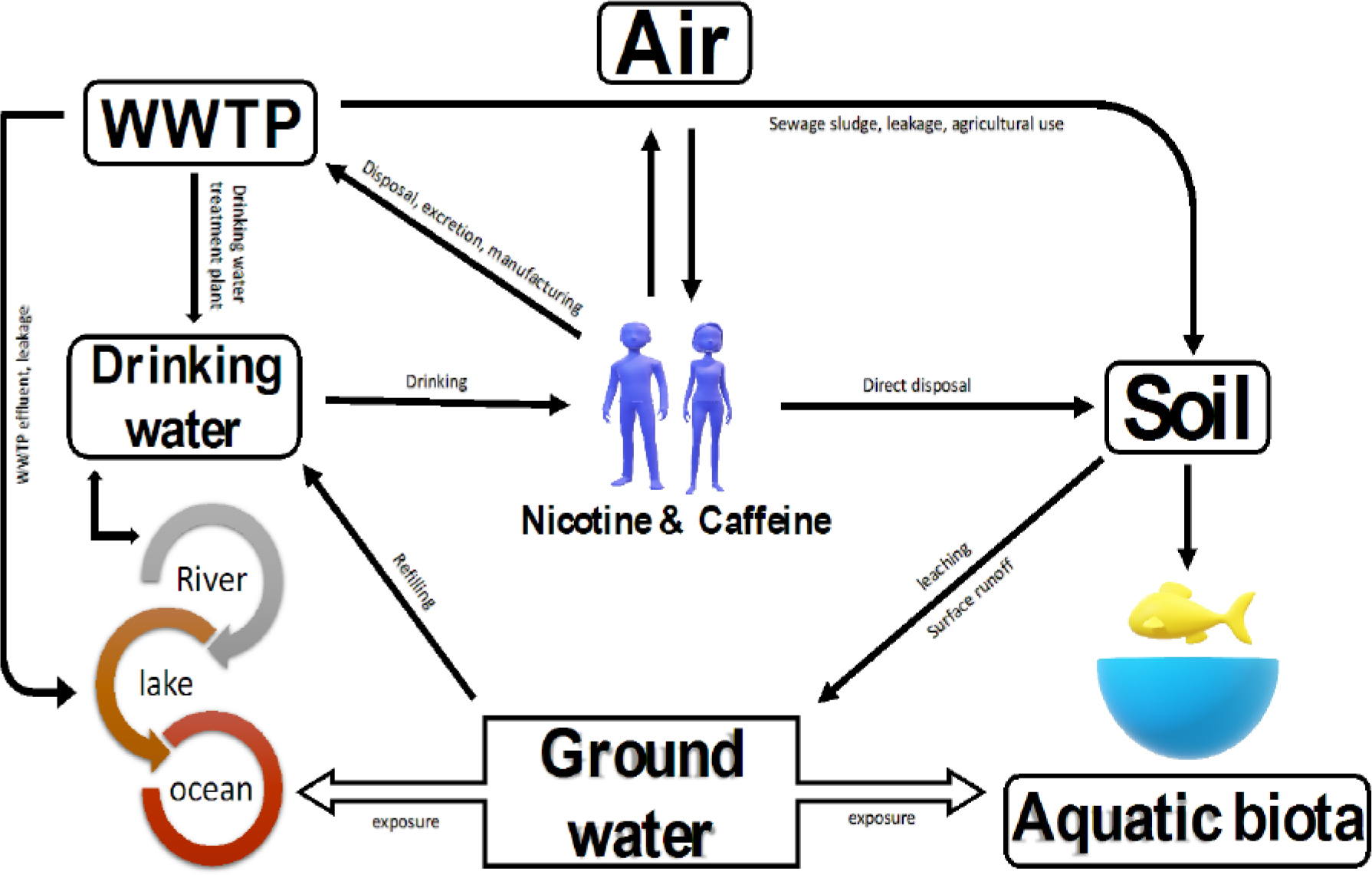
Figure. 3.
Source and circulation of nicotine and caffeine
2. ONGOING TREATMENT APPROACHES
Wastewater treatment plants are the bulwark against water pollution, employing various methods to tackle contaminants like caffeine and nicotine. For instance, caffeine removal efficiency in most WWTPs across different countries exceeds 95%, indicating their effectiveness in reducing caffeine concentrations in surface waters [31]. However, a minority of WWTPs demonstrate lower removal rates, such as in the Kharkiv region, Ukraine, where the elimination rate of caffeine was reported to be only 58.3% [32]. This lower efficiency could be attributed to using immature constructed wetland technology in the WWTP. Activated sludge technology, the conventional method for urban and industrial wastewater treatment, typically achieves high caffeine removal rates, often exceeding 99.5% [33]. This process primarily relies on biodegradation mechanisms, wherein microorganisms facilitate the breakdown of caffeine into end products such as CO2 and CH4. Additionally, many WWTPs employ heat treatment methods to reduce the pharmaceutical content in sludge further, thereby improving caffeine concentration levels [34]. Despite the effectiveness of conventional WWTPs, there are concerns regarding the emergence of pharmaceutical pollutants, including caffeine and nicotine, in various areas worldwide, indicating the limitations of existing treatment methods. For instance, a study [35] reported removal rates of caffeine ranging from 47% to 60%, suggesting incomplete removal during secondary treatment processes around Nagpur, one of the “A class city” in the central India over 1 year. This incomplete removal may be attributed to the absence of tertiary treatment systems in the studied WWTP. In summary, while WWTPs generally demonstrate high efficiency in removing caffeine and nicotine from wastewater, there remain challenges in achieving complete removal, especially in cases where unconventional or immature treatment technologies are employed. Addressing these challenges and exploring effective treatment technologies remain essential in mitigating the environmental impact of caffeine and other pharmaceutical pollutants in wastewater.
Understanding that concentrations vary on river flow, dilution, degradation, and sorption processes, as well as sampling time following seasonal fluctuations, is essential [33]. This is in addition to consumption patterns and treatment procedures. Numerous investigations discovered amounts that were noticeably higher in downstream samples than in the effluent, pointing to other potential sources, including wastewater discharge that was either inadequately or not at all cleaned [34]. Caffeine and nicotine may be attributed to the primary source, which also substantially influences the concentration in the flow medium. Examples include the discharge from coffee or tobacco agricultural farms, processing plants, industrial units, population density and tourism [36]. Because of this distribution cycle, researchers focus more on residual caffeine in wastewater and rivers since caffeine is considered a specific sign or a wastewater biomarker, allowing pollutants to be distributed through cycles and loads in water systems [37].
The amount of caffeine and nicotine residues in wastewater treatment plants can vary based on the methods used for their removal and digestion. However, most facilities efficiently remove caffeine residues at over 95%, significantly reducing caffeine levels in surface water. Nevertheless, some WWTPs need help to remove more than 60% of the caffeine they process and may require additional assistance [37].
The most common and considerable approach is biophysical, a standard method used to clean wastewater in towns and manufacturing facilities. This procedure is divided into three phases: primary settling and integrated hydrolytic acidification, biological digestion treatment, and final settling with UV disinfection treatment [38]. The activated sludge process is crucial in removing natural pollutants, including chloramphenicol (CP), bezafibrate (BF), caffeine (CF), carbamazepine (CBZ), propranolol (PPN), trimethoprim (TP), mefenamic acid (MA), metoprolol (MTP), nalidixic acid (NA), sulpiride (SP), and N, N-diethyl-m-toluamide (DEET), which are often present in high quantities in sludge (39). Many WWTPs use procedures like drying, incineration, pyrolysis, and gasification to treat sludge with high pharmaceutical content, including caffeine, which can significantly increase the amount of caffeine in the sludge [34].
Anaerobic bioreactors are a type of wastewater treatment technology designed to work without oxygen, and they contain complex microbial ecosystems that play a crucial role in the treatment process. These ecosystems facilitate various chemical and biochemical transformations necessary to remove organic matter and other contaminants from wastewater. The removal mechanisms facilitated by anaerobic bioreactors primarily involve adsorption within the biomass matrix and chemical and biochemical reactions orchestrated by the diverse microbial community inhabiting the bioreactor. The biomass matrix, composed of organic and inorganic matter, is a substrate for the microbial community to grow. The microbial community then breaks down the organic matter in the wastewater into simpler compounds like carbon dioxide, methane, and hydrogen [40], [41].
Anaerobic bioreactors offer several advantages over other types of bioreactors. For example, they require less energy than aerobic bioreactors because they do not require oxygen. They also occupy minimal land, generate fewer solids, and produce potentially viable energy sources like methane and hydrogen. Additionally, the anaerobic bioreactors can tolerate higher organic loads within the wastewater, making them more resilient than other reactors [42], [43].
Despite their many advantages, anaerobic bioreactors do have some drawbacks. One of the most significant is their tendency to emit unpleasant odours, such as hydrogen sulfide. Additionally, they are less effective at removing nitrogen, phosphorus, and pathogens from wastewater than other reactors. This means that supplementary post-treatment procedures may be necessary. Furthermore, the intricate biochemistry of the anaerobic microbiota makes them susceptible to inhibition, which can impede the attainment of steady -state operational conditions within the bioreactor. As a result, establishing and maintaining anaerobic bioreactors can be time-consuming and requires careful microbial community monitoring to ensure optimal performance [44].
Ozone is a powerful oxidizing agent that treats surface water, groundwater, and wastewater effectively. Its oxidative properties make it valuable in various ozone-based technologies that enhance disinfection and eliminate organic compounds from water matrices. However, the cost associated with ozone as an oxidizing agent and its tendency to generate toxic intermediate radicals during treatment necessitates optimization in these methodologies. As a result, researchers have been exploring ways to improve ozone-based technologies by integrating complementary techniques such as coagulation, filtration, or ultraviolet (UV) irradiation. Combining ozone treatment with these techniques can significantly improve the biodegradability of contaminants and the removal efficiency of organic compounds from water matrices. This approach leads to a more efficient and cost-effective water treatment process that better serves public health and environmental needs [45].
Advanced oxidative processes (AOPs) are highly effective in breaking down and eliminating organic matter from wastewater. However, these processes are yet to be widely adopted on a large scale, and future research should focus on harnessing solar energy and photocatalysis to make AOPs more practical. Homogeneous catalysis via the photo-Fenton reaction and heterogeneous catalysis facilitated by UV/TiO2 systems are two primary AOPs that have garnered significant research attention. Although many technologies are available for wastewater treatment, adsorption continues to be a prevalent and extensively studied method. Traditional sorbent materials such as activated carbon, zeolites, silica gel, and alumina are still highly useful in wastewater treatment. However, with the emergence of novel materials, the use of adsorption in wastewater treatment has been constrained. Nanotechnology has spurred the development of innovative nanomaterials, particularly carbon-based variants, including biochar derived from solid residues, which provide environmentally friendly alternatives to traditional sorbent materials. These advancements offer great potential for wastewater treatment and should be explored further [46], [47].
Advanced oxidative processes are highly efficient methods of separating and eliminating organic matter from wastewater. These processes utilize advanced chemical reactions to create oxidizing agents, which then react with the contaminants to break them down into simpler, harmless substances. However, despite their effectiveness, the widespread adoption of AOPs on a large scale still needs to be improved. To address this, future research should focus on harnessing solar energy and photocatalysis to make advanced oxidative processes more practical and cost-effective. Two primary AOPs have garnered significant research attention: homogeneous catalysis via the photo-Fenton reaction and heterogeneous catalysis facilitated by UV/TiO2 systems [48], [49].
Although many technologies are available for wastewater treatment, adsorption remains a prevalent and extensively studied method. Adsorption involves using a solid material to trap and remove contaminants from wastewater. Traditional sorbent materials such as activated carbon, zeolites, silica gel, and alumina are still highly useful in wastewater treatment. However, with the emergence of novel materials, the use of adsorption in wastewater treatment has been constrained. Nanotechnology has spurred the development of innovative nanomaterials, particularly carbon-based variants, including biochar derived from solid residues, which provide environmentally friendly alternatives to traditional sorbent materials. These advancements offer great potential for wastewater treatment and should be explored further. These innovative materials can create more sustainable and efficient methods of treating wastewater, helping protect our environment and improve public health [50].
3. OVERVIEW OF ANALYTICAL METHODS
The investigation into water quality begins with the crucial sampling step, laying the foundation for subsequent analytical scrutiny. Sampling methodologies are split between composite and grab techniques, with a near-even distribution of focus: 44% on environmental waters and a slightly higher 56% on wastewater. The choice of technique is more than procedural; it provides a snapshot of the concentrations of analytes at a given moment. However, this randomness necessitates a series of samples collected over time to paint an accurate picture and mitigate the impact of fluctuating external factors and sporadic concentration spikes. Sampling strategies must account for analyte stability and the sampling location and depth specifics to avoid overlooking significant variables [51], [52]. The impact of external and process-related factors can be ignored due to variations in water flow, concentration sampling, and spikes. Therefore, it is necessary to consider analyte stability, location, and depth while sampling, as stated in (53–55). The polar organic chemical integrative sampler (POCIS) is an exact and dependable sampling method. It has proven effective in detecting effluent, river, lake, and saltwater [26], [56]. The main advantage of Polar Organic Chemical Integrative Samplers (POCIS) is their ability to monitor a wide range of polar organic contaminants, including pesticides, in aquatic environments. POCIS provides time-weighted average (TWA) concentration measurements, enabling chemical exposure assessment over extended periods. This is particularly useful for detecting episodic pollution events and low-concentration contaminants that might be missed with conventional grab sampling methods [57].
Nonetheless, external environmental factors can affect the precision of chemical absorption rate, temperature, and water matrix determination [14]. When it comes to sample preparation, one size does not fit all. Each instrument demands a specific sample type and purity level, and any deviation can have a direct bearing on the instrument's performance and the analysis's integrity. Proper sample preparation is crucial for the effective functioning of instruments [56]. Nicotine and caffeine, ubiquitous in sewage sludge and wastewater systems, have been repeatedly flagged in numerous studies using analytical methods. These two substances are considered emerging contaminants of concern because they are commonly found in sewage and wastewater systems. As they are physiologically active, they can impact the entire water body. Therefore, it is essential to consider them as emerging contaminants in soil and water [38]. In nature, their concentration varies from micrograms to litters depending on the field.
Meanwhile, municipal wastewater contains a mixture of anthropogenic and natural contaminants that need to be effectively separated and identified [58]. Environmental engineering requires the removal, adsorption, and analytical investigation of these substances using various parameters. Procedures for measuring and identifying them are crucial. Analytical methods, including mass spectroscopy and high-performance liquid chromatography, come with their boundaries because of their sensitive and accurate measurement design and methodology. Liquid and gas chromatography with mass spectroscopy are the latest considerable technologies for analysis [59]). Analytical techniques are broadly categorized into physical, chemical, and biological. Physical methods, while effective, come with a high cost and are generally confined to laboratory settings. Chemical approaches, though adequate, paradoxically contribute to pollution through the use of toxic materials and chemicals. On the other hand, biological methods are both cost-effective and eco-friendly, yet their potential as viable alternatives is still under rigorous examination [60].
Impure substances are more apparent when organic material is eliminated and thickly digested. Chemical methods are the most popular and accurate methods of analysis. Several sensitive and selective techniques have been developed and validated to detect pollutants frequently found in wastewater based on their physicochemical features [19]. Several processes are needed to understand the targeted pollutants before beginning the analysis. For example, solid-phase and chemical extraction are used to separate or purify the compound from its natural sources [56]. If necessary, they are also used to increase the concentration of the targeted compound. Visual appearance is frequently needed in studies like this. Various microscopic techniques and tools, including optical or electron microscopes, scanning electron microscopes (SEM), and transition electron microscopes (TEM), can be utilized [61], [62].
3.1. Separation, extraction, and determination techniques
Identifying the presence of caffeine and nicotine in water samples begins with the pivotal extraction step, a precursor to the secondary or final analytical procedures. The extraction process influences the preparation of the sample. It is integral to the subsequent analysis, particularly when employing gas chromatography, which is often considered a prerequisite for analyzing solid samples [63]. Extraction techniques are often considered sample preparation techniques for gas chromatography. Solid sample analysis relies heavily on the extraction technique for the molecule or element of interest and the earlier examination and determination of the sample.
Most analytical methods for extracting and determining caffeine and nicotine residues in water samples are multi-residue. Solid phase extraction (SPE), predominantly using Oasis HLB cartridges, is a widely adopted technique for preparing samples to determine the presence of caffeine and nicotine in aqueous matrices. In parallel, continuous liquid-liquid extraction (CLLE) is applied for samples from surface and groundwater. These methods provide cleaner extracts and concentrate the analytes, which is vital when dealing with lower concentrations. However, challenges persist in achieving acceptable recoveries, especially in multi-residue methods(64). Large Volume Injection (LVI) is an alternative approach for analyzing wastewater influent, offering the advantage of eliminating the need for Solid Phase Extraction (SPE). With an injection volume of 1,800 μL, LVI provides a streamlined method for sample preparation. However, it requires a specific injector update kit and is susceptible to matrix effects, which can impact accuracy. The LVI SPE Kit is designed with specialized SPE column modules to optimize LVI for SPE extractions on large-volume samples. These modules can accommodate water extraction discs and standard SPE columns, enhancing sample processing efficiency for complex wastewater matrices [65], [66]. Various sample preparation methods are currently being investigated, such as the assistance of liquid extraction and liquid-liquid extraction into acetonitrile [14]. A liquid chromatography -tandem mass spectrometry (LC-MS/MS) method was developed by [59] and validated for simultaneous quantification of aripiprazole (ARI), its metabolite dehydro-aripiprazole (DARI), six antipsychotics, and caffeine (CAF) in human plasma. CAF was included due to its influence on drug metabolism via competitive inhibition. A three-step microevolution-solid-phase extraction (μ-SPE) method was optimized for efficient phospholipid elimination compared to protein precipitation (PPT). Chromatographic separation was achieved using a gradient method with a run time of 6 minutes. The method was validated across therapeutic ranges, meeting regulatory guidelines for precision, accuracy, and matrix effects. μ-SPE eliminated over 99% of early and 92% of late-eluting phospholipids, offering superior performance. The method successfully quantified ARI and OLA in healthy volunteers, proving its suitability for pharmacokinetic studies.
Extraction from natural sources like tobacco and coffee waste involves solvent extraction using ethylene acetate, ethanol, acetone, methanol, or methylene chloride. Despite their effectiveness, these solvents pose environmental and health hazards, spurring the search for more sustainable "green extraction" techniques. These alternative methods aim to minimize solvent use, yet complete solvent elimination remains elusive, highlighting the need for continued research into environmentally benign extraction substances. Although these solvents are effective, they have hazardous effects and are toxic. It is challenging to separate them from the extract, and they are not environmentally friendly. More sustainable and efficient extraction techniques, such as “green extraction” or “sustainable extraction techniques”, are gaining popularity. However, it is still impossible to use zero solvents in these techniques. Further research is needed to find natural substances that can biologically replicate these chemical solvents [11], [67].
In the chemical extraction of nicotine waste, the diluted extract is mixed with anhydrous sodium hydroxide in the second process for dehydration. Depending upon the sample, the combination is filtered using filter paper or even with syringe filters with various porosities. Dehydration can be advanced by evaporation in a vacuum at 49°C. Then, with 10 ml of ethanol and 0.2g of activated carbon, the extract is diluted to a concentration of 2mg. The mixture is then immersed in an ultrasonic bath at 37 to 45 kHz for 10 minutes at room temperature. Centrifugation is required for the residual extract at 1200 rpm for 10 min. The sediment is collected, and the supernatant is discarded after washing the sediment three times with 10 mL of 70% ethanol. Subsequently, 10 mL of distilled water is added to the residual sediment. The mixture is then subjected to sequential extraction using petroleum ether in a 1:1 volume ratio, repeated four times. The petroleum ether layers are combined, and the resulting extract is dried under vacuum at 45°C. This procedure yields 1 g of a pale-yellow membranous extract. This extract is further dissolved in dichloromethane, diluted, and prepared for gas chromatography/mass spectrometry (GC/MS) analysis [68]. The comparison between the mass spectra and retention indices of the chemical compounds with the mass spectra library data allows for identifying the chemicals of concern. Because of its properties, nicotine residues can be separated using reversed-phase (RP) columns, mainly because they can hold a wider variety of polarity-varying analytes. Nicotine was studied using hydrophilic interaction chromatography (HILIC) for polar substances with low log Kow [54], [68].
Various solvents were studied for alkaloid extraction, including chloroform, isooctane, benzene, and petroleum ether. Benzene showed greater solvent satisfaction with extraction than the other hydrocarbons. The solvent extraction process using ether is preferred to extract nicotine from tobacco waste since it selectively dissolves alkaloid compounds. A specific ratio of ether and petroleum ether is recommended to improve the efficiency of nicotine extraction. This can help speed up the process and increase the amount of nicotine produced. To separate nicotine from the alkaline solution, 30 ml of diethyl ether was used twice in a separating funnel. The two filtrates were combined in a conical flask and dried with anhydrous potassium carbonate. Finally, the ether was vaporized in a water bath at ambient temperature since high heat hydrolyses nicotine. The resulting yellowish, greasy liquid extract of nicotine can be analysed through FT-IR or NMR analysis [11], [69], [70].
To perform solid/liquid extraction, 50 ml of the coffee extract is combined with one of three solvents: dichloromethane, ethyl acetate, or a solution of ethanol and water. The mixture is heated for 15 minutes before being washed with 10 ml of solvent and filtered through a Buchner funnel. After this process, the resulting liquid extract is filtered using a syringe filter before conducting HPLC analysis [26]. Scientists often use mass spectrometers (MS) to detect caffeine and nicotine because of the advanced technology utilized in the detection process. Some researchers have employed LC [54], [71] and GC [54], [72] techniques to identify caffeine and nicotine. In tandem mass spectrometry (MS/MS), the use of multiple reaction monitoring (MRM) modes with a triple quadrupole (QqQ) or hybrid triple quadrupole/linear ion trap (QTRAP) mass analyser ensures high sensitivity and selectivity. (14) Direct sample analysis is possible with high sensitivity, minimizing matrix effects even for diluted samples [54], [72]. However, MRM has limitations. When there are more analytes, there are also more common transitions for compounds with similar mass and elute. Additionally, only one transition may be noticeable due to the varying strength of each transition [54], [73]. This poses a challenge for identification through LC-MS/MS, which requires three confirmation points, including two transitions and retention time, as per Commission Directive 2002/657/EC [64]. Gathering structural data through informationdependent acquisition (IDA) improves identification reliability [64]. For evaluating various water matrices of WWTPs influent, effluent, surface water, and reclaimed water, high-resolution mass spectrometry (HRMS), such as Time-of-flight (TOF) [74] and Orbitrap, is used. In every instance, the sensitivity needed is attained, resulting in low nicotine and ethyl sulfate levels at 200 ng/L. Through precise mass screening, the comprehensive scanning process detects unintended substances, such as transformation products [72].
Various physical methods are used in industries to extract components, such as the ultrasound-assisted extraction (UAE) method. This method employs cavitation and ultrasonic pressure waves to remove components using a solvent of 50% ethanol or methanol in water. The solvent-to-biomass ratio is 20:1, and the frequency and biomass solvent percentage may vary depending on the extraction sample. This method is used most to extract plant or cell components and uses less solvent, resulting in a greater yield. The CO2 extraction method is another widely used method in industries. This ecologically safe method removes harmful solvents during extraction and uses carbon dioxide (CO2) as the solvent. This method is affordable and valuable because CO2 can be collected and repurposed. Finally, microwave-assisted extraction (MAE) is a process that combines conventional extraction with microwave extraction. This method uses high pressure to make the solvent liquid at temperatures higher than boiling, and ethanol is believed to be a reliable energy absorber for microwaves. MAE demonstrates the best extraction efficiency compared to the other two physical approaches (Table 3) [63], [64], [75].
Table 1.
Advantages and disadvantages of UAE, SFE, and MAE
| Ultrasound-assisted extraction (UAE) | Supercritical fluid extraction (SFE) | Microwave-assisted extraction (MAE) |
|---|---|---|
| Advantages | ||
| short extraction time | highly specified and selective extraction | a most straightforward and rapid method |
| Lover extraction time | solvent-free extraction | lower extraction time |
| high yield extraction | fragrances and aromas remain same | selective heating of the sample solvent mixture |
| low extraction temperature | low-cost method, affordable for industry | |
| Disadvantages | ||
| not applicable to the industry | high investment required | after the process, centrifugation or filtration is required |
| the solvent cannot be removed | high usage of polar substances | not appropriate for extraction of heat-sensitive compounds |
| only a batch system is possible | amino acids, inorganic salts, and proteins are insoluble | non-selective for nonpolar compounds |
3.2. Functioning of Analytical Methods
When analyzing environmental fluids to detect caffeine and nicotine, the Limits of Detection (LOD) and Quantification (LOQ) are typically within the range of mg/mL to g/mL. Different studies use various methods to calculate the LOD, such as the calibration curve, standard solution, spiking sample, etc. However, it can be challenging to quantify matrix effects while analyzing wastewater due to signal suppression or enhancement caused by co-eluting chemical substances. This effect is particularly prominent in the electrospray ionization (ESI) MS/MS interface. Isotopically labelled internal standards (IS) are a viable option to address this issue. This method is the most used for detecting caffeine and nicotine in waste and environmental waters, but not all published trials use isotopically tagged internal standards for every medication. Wastewater composition can change daily, so conventional addition was used by some researchers, like Metcalfe et al. [73], to correct the matrix effect. However, this method has the drawback of requiring knowledge of the analyte’s approximate concentration and at least three additional sample runs for each sample before there are enough data points for the calibration curve. Montesdeoca-Esponda [76] and colleagues advise against external calibration for evaluating substances like nicotine in groundwater due to potential inaccuracies.
For the measurement and analysis of substances extracted via Supercritical Fluid Extraction (SFE), a high-pressure system with a modulator pump is employed, often accompanied by a compressor for high-pressure maintenance. The extraction process will be carried out in two stages. To extract caffeine, a jar with glass wool will undergo various pressure (10, 20, 25, 30 MPa), temperature (30, 40, 50, 60°C), and extraction time (1, 2, 3, 5 h) changes through SFE (64). Only CO2 supercritical flow will be used, with a fixed CO2 flow rate of 10 g/min as determined by the literature. Once this step is optimized, the same substance will be used for caffeine extraction. The temperature and pressure will be changed while the extraction duration remains at 3 hours. Ethanol with various concentrations will be used as modifiers in a 10 g/min supercritical CO2 flow (flow rates of 0.2, 0.3, 0.4, and 0.5 mL/min). The extracted mass generated after each condition will be used to calculate the crude extract yields (%). All experimental research results will be averaged after being repeated three times [37], [77].
High-Performance Liquid Chromatography (HPLC) is the method of choice to quantify the concentrations of caffeine and nicotine in each extract. The experiment utilizes HPLC-grade methanol and ultrapure water, adhering to stringent purity standards to guarantee the accuracy of results. The HPLC system operates with a variable-size, variable-temperature column, utilizing a solvent combination of type A (Milli-Q water) and type B (a mixture of DMF, methanol, and acetic acid in a 20:1:0.5 ratio). The peaks of nicotine and caffeine are then compared against standards of the original compounds, with DAD spectra from the HPLC system’s detector used for detection and identification [68].
Despite its efficacy, HPLC comes with limitations. The technique’s sensitivity is contingent upon the column packing method, and since there is no one-size-fits-all detection system, tailored methods are often required. The relatively high cost of instrumentation and its maintenance can also limit accessibility. Certain compounds may display reduced sensitivity or irreversibly adsorb onto the column, thus escaping detection. HPLC is versatile and can handle complex mixtures using various separation mechanisms. It is more versatile than Gas Chromatography (GC) as it can accommodate both aqueous and non-aqueous samples without much pre-treatment.
Additionally, it allows for multi-component analysis in a single run, increasing efficiency. However, HPLC also has its limitations. The column performance depends heavily on the packing method used, and there is no universal detection system, so tailored detection methods may be required. The high cost of instrumentation and maintenance limits accessibility to the technique. Some compounds may also exhibit limited sensitivity or irreversibly adsorb, making them undetectable [78], [79].
In gas chromatography, the detector in the column has a single-stage quadrupole and an electron ionization source through a heated interface. An internal standard fluorene solution in dichloromethane (2.0 mg/ml) is added to the residue. The autosampler can be used to inject samples. To ensure proper functioning in splitless mode, it is recommended to clean the syringe with sample solution and wash it three times with ethyl acetate before injecting 1 l of solution. The GC-MS instrument's temperatures were set at various levels. The mass analysis settings were adjusted for positive electron impact and selected ion monitoring (SIM) to identify caffeine and nicotine by comparing and relating retention periods and mass spectral ion ratios with established standards available in the National Institute of Standards and Technology (NIST) MS database [54].
In a recent scientific study, researchers employed liquid chromatography -tandem mass spectrometry (LC-MS/MS) to detect caffeine and its seven significant metabolites in wastewater samples. These metabolites included theobromine, theophylline, paraxanthine, 1-methylxanthine, 3-methylxanthine, 7-methylxanthine, and xanthine. To extract these compounds effectively, they combined a universal polymeric reversed-phase cartridge and a polymeric potent cation exchange cartridge, achieving recoveries ranging from 60.3% to 83.2%. Subsequently, the developed method was applied to assess the concentrations of caffeine and its metabolites in both the influent and effluent of an anaerobic–anoxic–oxic (A2O) process within a wastewater treatment plant. Results showed that in the A2O influent, concentrations of caffeine and its metabolites (excluding xanthine) varied between 1.39 and 5.45 μg/L, while in the A2O effluent, concentrations ranged from 10.2 to 171.3 ng/L. Moreover, by considering the population served by the target WWTP.
The mass loads of caffeine and its metabolites were calculated by multiplying their concentrations (μg/L) by the flow rate of the selected wastewater treatment plant (WWTP) (500,000 m3/day) and dividing the result by the population served (784,300). The analysis revealed a mass load of caffeine derivatives at 13.68 g/day/1000 inhabitants, equivalent to a total caffeine mass load of 14.90 g/day/1000 inhabitants. These values are consistent with those observed in Swiss WWTPs (15.8±3.8 g/day/1000 inhabitants) and Italian WWTPs (14±5.2 g/day/1000 inhabitants). In Japan, with a reported coffee consumption of 3.54 kg/person/year in 2014 – where 100 g of coffee contains approximately 40 mg of caffeine – the calculated mass load aligns with expected caffeine consumption patterns. These findings highlight the significance of analyzing caffeine and its derivatives in wastewater influents as a reliable proxy for estimating population size in areas served by WWTPs. This approach offers valuable insights for environmental monitoring and the development of effective public health management strategies (K. He, Echigo, Asada, & Itoh, 2018) (Table. 4).
Researchers aimed to enhance the accuracy of estimating tobacco usage trends in a population through wastewater-based epidemiology (WBE), a method challenged by the increased presence of nicotine metabolites from nicotine replacement therapies and e-cigarettes in wastewater. To address this challenge, they developed a rapid and precise method utilizing direct injection liquid chromatography-tandem mass spectrometry (LC-MS/MS) to quantify tobacco-specific biomarkers, anabasine and anatabine, alongside traditional nicotine biomarkers. Their process involved pre-filtration and solid-phase extraction of wastewater samples, resulting in satisfactory limits of quantification (LOQ) and recovery rates for all five compounds. Furthermore, stability assessments conducted in sewer reactors revealed varying stabilities among the biomarkers, with anabasine and anatabine demonstrating lower stability than cotinine and hydroxy cotinine. Upon application of the method to 42 daily wastewater influent samples collected from an Australian treatment plant, all five biomarkers were detected, showcasing concentrations ranging from 9.2 to 7430 ng/L. Notably, positive correlations among the compounds were observed, suggesting consistent trends in tobacco use within the sampled population. These findings underscore the effectiveness of the developed method in enabling high-throughput monitoring of tobacco use trends, thereby offering valuable insights for public health surveillance and intervention strategies [21], [56], [91].
Table 2.
Caffeine and nicotine with detection methods in WWTPs. Mean (min-max) of concentrations found in the influents and effluents of the WWTPs
| Analytical method | Influent (ng/L) | Effluent (ng/L) | Removal efficiency (%) | References |
|---|---|---|---|---|
| Liquid chromatography-mass spectrometry | 2.00 × 10⁴ - 3.80 × 10⁴ | 50.0-410 | 97.9-99.9 | (80) |
| 1.34 × 10³ (873-2.10 × 10³) | 103 (35.0-329) | 92.3 | (81) | |
| 17.0-1.45 × 10⁵ | NA | >99.0 | (30) | |
| 2.87 × 10³ | 748 | 73.9 | (82) | |
| 5.20 × 10³ | 44 | 99.2 | (83) | |
| 5.90 × 10³ | 470 | 92 | (83) | |
| 7.50 × 10³ | 48 | 99.4 | (83) | |
| 4.09 × 10⁴ | 73 | 99.8 | (84) | |
| Liquid Chromatography - Electrospray IonizationMass Spectrometry | 2.82 × 10⁴ (1.05 × 10⁴- 5.60 × 10⁴) | 440(ND-940) | 98.2 | (31) |
| 1.49 × 10⁴ (1.66 × 10³- 5.35 × 10⁴) | 190(ND-523) | 98.7 | (31) | |
| 643(ND-1.93 × 10³) | 50.3(ND-188) | 92.3 | (31) | |
| 615 (ND-1.85 × 10³) | <LOQ (ND-29.3) | 100 | (31) | |
| 2.61 × 10⁴ (1.70 × 10⁴-3.62 × 10⁴) | 336 (99.2-587) | 98.7 | (85) | |
| 362 (ND-883) | <LOQ (ND-34.0) | 100 | (31) | |
| 5.81 × 10⁴ (213 - 9.66 × 10⁴) | 416 (ND-1.18 × 10³) | 99.3 | (31) | |
| Liquid chromatography triple quadrupole mass spectrometer | 2.02 × 10³ (35.8- 4.58 × 10³) | 8.20 (2.50-414) | 99.6 | (86) |
| Electrospray ionization mass spectrometry | 3.00 × 10⁴- 6.10 × 10⁴ | 1.10 × 10³ - 3.40 × 10³ | 88.7-98.2 | (85) |
| Liquid chromatography-mass spectrometry | 4.09 × 10³ (102-5.60 × 10³) | 138 (30.0-961) | 96.6 | (87) |
| 2.38 × 10⁴ (1.04 × 10³- 1.50 × 10⁵) | 1.74 × 10³ (148-3.42 × 10⁴) | 92.7 | (88) | |
| 523-1.84 × 10³ | 117-769 | 58.3-77.6 | (32) | |
| 1.75 × 10³ | ND | 100 | (89) | |
| 2.90 × 10⁴ | 2.02 × 10³ | 93 | (84) | |
| High resolution-liquid chromatography-mass spectrometry | 1.50 × 10⁴ -1.96 × 10⁴ | ND - 6.00 | 100 | (90) |
There are several critical aspects of chromatographic techniques, specifically in the context of high-performance liquid chromatography (HPLC) and its advancements over the years. It delves into the nuanced parameters that impact the precision and effectiveness of compound analysis, including the internal diameter (ID) of columns, particle size, pore size of the stationary phase, pump pressure capacity, and the influence of temperature. The internal diameter influences analyte loading capacity and sensitivity; it is a fundamental factor in determining the chromatographic process’s analyte loading capacity and sensitivity. It also affects the performance of all chromatographic techniques. Smaller ID columns improve sensitivity using less solvent, while more enormous ID columns – typical in commercial drug purification – offer a higher loading capacity but may lose sensitivity. Another essential factor is particle size. Particle size within these columns also plays a pivotal role. Smaller particles are associated with more efficient separations and a greater surface area, allowing for more intimate interaction with the analytes. However, this efficiency requires a trade-off in the form of higher operational pressures, which are inversely proportional to the square of the particle diameter. In other words, the smaller the particles, the higher the pressure required to maintain the best linear velocity through the column [92–94].
Furthermore, the pore size of the stationary phase is another variable that directly impacts the interaction kinetics and surface area available within the column. Larger pores facilitate interaction, particularly beneficial for larger analytes, while smaller pores amplify the surface area, albeit potentially at the cost of interaction dynamics. The pump pressure capacity determines the constancy of the flow rate. Modern HPLC systems are made to function at more significant pressures, which allows the use of smaller particle sizes for improved separation efficiency. The functioning of HPLC is also influenced by temperature; most columns run best at room temperature or slightly above it (25–35°C), while other applications may need higher temperatures to function at their best. [95].
When it comes to precise compound analysis, manipulating these parameters is crucial and must be tailored to the chemical properties of the compounds under study. Internal diameter, pump pressure, pore size, and particle size are among the parameters that are carefully modified according to the particular chemical characteristics of the compounds that are being studied. Important parameters assessed in minutes and seconds are retention time, which is the duration from sample injection to the appearance of peak maxima, and retention volume, the volume of carrier gas required for 50% elution, which is a carefully monitored metric. The resolution parameter assesses the degree of separation between two components, considering their retention times and peak widths. The separation factor is another critical measure that determines the partition coefficient ratio of target components.
The Height Equivalent to a Theoretical Plate (HETP) Height Equivalent measures the column’s separation efficiency from that of a Theoretical Plate, where lower numbers correspond to higher efficiency. Separation efficiency is further quantified by evaluating the number of theoretical plates, with efficiency being directly related to retention time and peak width. Moreover, the asymmetry factor is used to assess the symmetry of chromatographic peaks, with any deviations hinting at potential issues such as sample concentration or column conditions. Broad peaks suggest a decline in column performance or highly concentrated samples. Over the past decade, the synergy between mass spectrometry (MS/MS) methods and liquid chromatography (LC) has been indispensable in accurately identifying and quantifying naturally occurring cannabinoids [96].
High-performance liquid chromatography (HPLC) and ultra-performance liquid chromatography (UPLC or UHPLC) are the two types of liquid chromatography methods. UPLC (also known as UHPLC) has become more prevalent than HPLC techniques because it is less expensive, requires less time to run, uses less solvent (mobile phase), and offers greater precision. The most commonly used combination, either as a gradient or isocratic elution, has been water and acetonitrile (ACN), both of which contain 0.05–0.1% formic acid (HCOOH) or acetic acid (CH3COOH). However, replacing ACN with methanol (MeOH) has also been observed. Several innovations, such as new mass spectrometry interfaces and method optimization strategies like Analytical Quality by Design (AQbD), have been introduced to enhance further the efficacy of LC-based methodologies in identifying and quantifying cannabinoids across various matrices.
4. CONCLUSIONS AND FUTURE DIRECTIONS
In conclusion, this review paper comprehensively examines current technological advancements in terrestrial ecosystems, focusing on the analytical methodologies used to study caffeine and nicotine pollutants. While significant strides have been made in understanding natural contaminants, numerous unanswered questions remain surrounding analytical methods, environmental quantities, origins, fate, and ecological impacts. Addressing these uncertainties necessitates the development of accurate, userfriendly, and efficient measurement techniques alongside enhanced simulation experiments to better represent real-world pollutant scenarios.
Moreover, future research efforts should prioritize the analysis of caffeine and nicotine’s origin, fate, degradation, and microbial interactions within terrestrial ecosystems. Understanding the environmental behaviours of these pollutants, including their horizontal and vertical transportation via wind, water, soil, and biota, is essential. Additionally, investigating trophic transfer and transgenerational effects and the implications of water pollution on microbial communities and urban and rural ecosystems is crucial for comprehensive environmental management.
Furthermore, the critical interplay of various parameters in chromatography underscores the importance of precise compound separation and analysis. Essential measurement of performance parameters, such as retention time, resolution, and asymmetry factor, is necessary. Emphasizing technological advancements, such as the adoption of UPLC for its efficiency and reduced solvent usage, along with innovations in mass spectrometry interfaces and Abd implementation, further enhances the accuracy and precision of analytical techniques.
Chromatographic techniques advance pharmaceutical, biochemical, and chemical research, contributing to sustainable ecosystem management and scientific progress. Moreover, the shifting perception of waste as a valuable resource underscores the importance of efficient disposal and waste recovery techniques. Emerging extraction strategies aim to produce high-value compounds from waste, signalling potential alternative uses beyond bioactive chemical extraction. This review underscores the multifaceted nature of environmental research and the importance of ongoing innovation and collaboration to address modern analytical challenges and mitigate environmental pollutants effectively.
Notes
[1] STATEMENTS AND DECLARATIONS
The authors declare that they have no known competing financial interests or personal relationships that could have appeared to influence the work reported in this paper.
[2] Conflicts of interest COMPETING INTERESTS
The authors declare that they have no relevant competing financial interests or personal relationships that could have appeared to influence the work reported in this paper.