
1. INTRODUCTION
Electronic devices have become indispensable components of modern life, finding applications in everything from everyday toys to high-power industrial equipment. However, the operation of these devices invariably leads to the generation of heat as electric currents flow through resistive elements. The magnitude of this heat emission increases proportionally with the power of the equipment. Failure to effectively dissipate this heat can result in a rise in temperature, thereby increasing the risk of equipment malfunction or reduced operational lifespan. Consequently, the management of temperature is a pivotal concern in both the design and operation of electronic equipment. One common solution to this challenge is the implementation of heat sinks, simple devices incorporating metal fins designed to efficiently transfer heat from the electronic equipment to the surrounding ambient air [1, 2].
Among the cooling techniques available, air cooling has emerged as a popular choice for electronic thermal management. It encompasses two primary methods: natural convection and forced convection. Natural convection, relying on the density differential created by temperature variations, represents a straightforward and cost-effective means of cooling heat sinks. In contrast, forced convection leverages fans to enhance air velocity, thereby optimizing heat transfer, as heat dissipation is directly proportional to air velocity. The direction of airflow can vary, either flowing horizontally across the heat sink or descending from the top. Additionally, alongside air cooling, more sophisticated methods like water cooling and heat pipes have found application in high-power electronic systems.
The evaluation of cooling system efficiency involves several critical criteria, including heat transfer rate, energy consumption for cooling and material usage [3]. A wide array of heat sink designs exists, such as flat fin heat sinks, pin fin heat sinks and cross-cut heat sinks. Among these, the pin fin heat sink, which can be tailored in terms of configuration, dimensions and materials, stands out as superior to its flat counterpart. Furthermore, utilizing computational fluid dynamics (CFD) simulations, recent studies have demonstrated that splayed and hybrid pin fin heat sinks offer heightened efficiency, maintaining electronic device temperatures 20% to 40% lower than standard pin fin heat sinks [4].
Research efforts have extended to explore advanced materials and novel designs for heat sinks. Anusha, et al. (2014) [5] utilized Ansys Fluent 12.1 CFD software to compare traditional materials like Aluminum and Copper splayed pin fin heat sinks to innovative materials such as Carbon Foam, Graphite Epoxy and Polyphenylene Sulphide (PPS). Results highlighted the improved thermal performance and reduced total weight associated with advanced materials. Similarly, Tijani and Jaffri (2018) [6] investigated perforated pin fins under forced convection, providing insights into parameters like pressure drop, velocity and temperature distribution. Their comprehensive simulation and experimental validation revealed an enhanced thermal efficiency of 1% to 4% with perforated pin fins compared to solid counterparts.
Further innovations abound in heat sink design. Hsieh and Li (2015) [7] introduced a novel hollow heat sink design, showcasing a 15% reduction in material consumption, which consequently lowered CO2 emissions during production. Kim, et al. (2009) [8] conducted a comparative experimental study on two prevalent heat sink types – plate-fin and pin fin – unveiling nuanced performance variations based on flow rate and channel width. The dynamic interplay between heat dissipation and velocity emerged, with plate-fin outperforming pin fin heat sinks at high velocities and short fins, while the reverse held true for low velocities and long fins [9].
Perforation, a design facet gaining prominence, has been explored across various studies. The implementation of elliptical perforations in pin fin heat sinks revealed promising potential for enhanced thermal performance through increased heat transfer area. Moreover, the quantity and angle of perforations correlate positively with heat transfer efficiency, effectively reducing pin fin weight [10].
Patil and Sawant (2018) [11] undertook a comprehensive comparison of plate-fin heat sinks with and without perforated pin fins under varying air velocities. Their findings endorsed the superior thermal efficiency of the perforated configuration, highlighting the influence of perforation parameters on heat transfer rate. Investigations into rectangular fins with rectangular perforations offered insights into heat dissipation improvements and weight reduction, both contingent on the size of the perforations. Similarly, Al-Damook, et al. (2016) [12] simulated the thermal performance of rectangular slotted pin fins, revealing a gradual increase in heat dissipation and reduction in pressure drop as perforation size expanded.
Shaeri and Yaghoubi (2009) [13] delved into solid and perforated fins attached to a heat sink base, revealing heightened heat transfer with increasing perforation count. Emphasis was placed on weight reduction, reinforcing the value of perforated designs. Dhanawade, et al. (2014) [14] extended the exploration to square fin heat sinks, assessing the impact of square and circular perforations. Their study confirmed the superiority of perforated fins, with square perforations offering superior heat transfer enhancement.
Tan, et al. (2013) [15] utilized advanced modeling techniques to study the effects of perforation number and geometry on rectangular fins, demonstrating the superiority of perforated designs while observing that geometry had no significant impact on efficiency. Raduan et al. (2022) [16] employed CFD software (COMSOL Multiphysics 5.4) to investigate heat transfer enhancement in rectangular-shaped pin fin heat sinks under turbulent flow conditions. By incorporating various hole shapes and altering bulge heights to increase the heat transfer area, their results indicated that a rectangular-shaped elliptical perforated pin fin heat sink with a bulge height of 4.5 mm achieved a 26% to 29% higher efficiency compared to prior findings. Similarly, Jéssica et al. (2023) [17] used computational fluid dynamics (CFD) software, ANSYS FLUENT, to evaluate the effects of fin height variations in square micro pin fins with HFE-7100 as the working fluid. Their study compared CFD simulations to experimental data and found a small error margin of 6% between the two.
In line with this ongoing research, the present study introduces the development and analysis of two novel heat sink designs – Square Pin Fin Heat Sink and Slotted Square Pin Fin Heat Sink – using Inventor 2018 and Autodesk CFD 2018. Research involving heat sink analysis with Autodesk CFD remains relatively rare and this study aims to contribute to the expanding field of heat sink design.
2. MATERIAL AND METHODS
Simulation Model
Two heat sinks were developed by Inventor 2018 and shown in Figure 1, with parameters as below:
The first one has a total of 25 fins (Figure 1a), the area of each fin is 6mm x 6mm, the height of 50mm, the thickness of the base is 4mm, the size of the base is 100mm x 100mm, fin spacing is 14mm, the material is Aluminum. It is easy to find out that the area of each fin is 12.36 cm2 and the area of base which excludes 25 fins is 91 cm2. Therefore, the total heat transfer area which comprises 25 fins and base is 400 cm2 and the volume is 85 cm3.
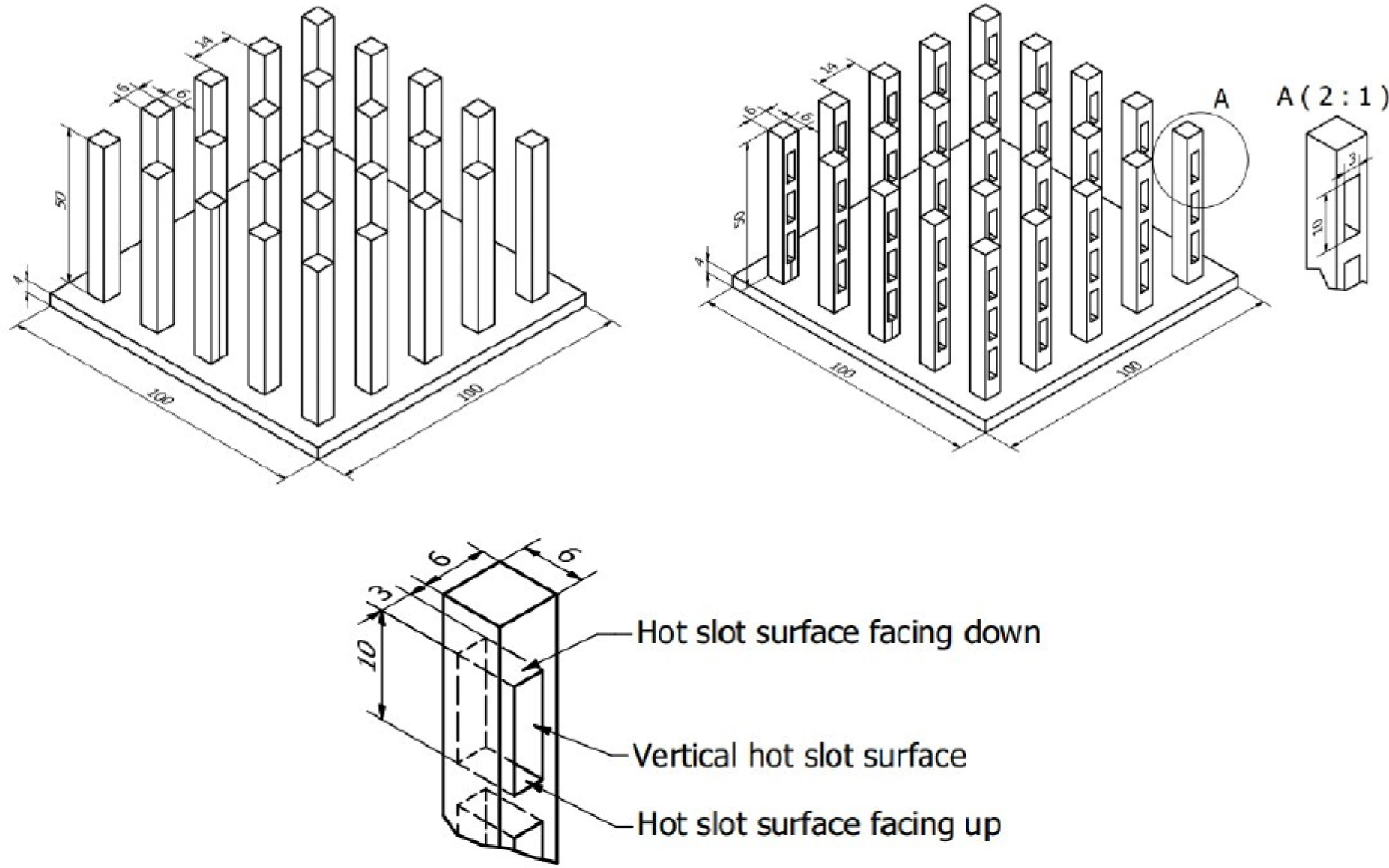
Figure 1.
The square pin fin heat sink (a), the slotted square pin fin heat sink (b) and Orientation of surfaces (c)
The second one has the same dimension, number of fins and material, but each fin has 3 slots (Figure 1b). Each slot has the size of 3mm x 10mm. The surface area of each fin is 15.24 cm2, the area of the base is 91 cm2. The total heat transfer area is 472 cm2 and the volume of 71.5 cm3.
With the volume V (cm3), the density of Aluminum (ρ=2.7 g/cm3), the weight of heat sink G (g) can be calculated follow Equation 1 [1].
In addition, the heat transfer area, volume and the weight of heat sink are summarized and displayed in Table 1.
Table 1.
Heat transfer area, volume and the weight of heat sink
| Heat sink | Surface area (cm2) | Volume (cm3) | Weight (g) | The increase in area (%) | The reduction of weight (%) |
|---|---|---|---|---|---|
| Square pin fin heat sink | 400 | 85 | 230 | 0 | 0 |
| Slotted square pin fin heat sink | 472 | 71.5 | 193.05 | 18 | 16 |
Heat is conducted from the base of the heat sink to the extended fins, causing the fins to attain elevated temperatures, which are subsequently dissipated into the surrounding ambient environment through mechanisms of convection and radiation. Under steady state conditions, the dissipation of heat from the fins is balanced by the conduction of heat from the base to the apex of each fin. In the theoretical scenario of infinite thermal conductivity (k = ∞), the temperature at the base (Tb) becomes equivalent to the temperature on the surface of the fin (Tfin). Consequently, the heat transfer reaches its maximum potential and this phenomenon can be elegantly described by Newton’s law of cooling [1].
Where:
hconv: the air convection, (W/m2K) and depends on the property of fluid, velocity.
Afin: the heat transfer area of fins, (m2).
Tfin: the fin’s surface temperature, (°K).
In practice, however, the temperature gradient along the fin exhibits a gradual decline from its base to its tip. Consequently, this spatial variance in temperature distribution leads to a corresponding degradation in heat transfer efficiency along the length of the fin. To comprehensively explore this phenomenon, our study employs CFD simulations to visualize the temperature distribution along the fins and quantify the heat dissipation characteristics of each individual fin.
An essential parameter characterizing the heat sink’s effectiveness in dissipating heat to the surrounding air is its thermal resistance. Maintaining a low thermal resistance is paramount as it directly influences the reduction of the chip’s operating temperature. The thermal resistance (Rb-a) of the heat sink to the ambient air can be mathematically expressed as follows, in Equation 3 [1]:
Where:
Rb-a: Thermal resistance of the heat sink to ambient air (°C/W);
Tb, Ta: Temperatures of the heat sink’s base and the ambient air (in Kelvin), respectively; Q: Power dissipated by the chip (in watts).
Boundary condition
The natural air convective heat transfer hconv (W/m2K) strongly depends on the temperature difference between the fin and surrounding air, the geometry of the fin [1], the natural air convective heat transfer for laminar flow can be calculated by this simplified equation.
Where:
ΔT= Tfin – Tfluid.
L: the characteristic length (m).
K: the constant which depends on the geometry and orientation and it is detailed as below.
For:
– Vertical plate or cylinder: K =1.42 and L is the height of the body. This situation is applied to the vertical pin fin, vertical hot slot surface.
– Horizontal plate with the hot surface facing up: K=1.32. This one is applied for: the horizontal base of the heat sink, the hot slot surface facing up.
– Horizontal plate with the hot surface facing down: K=0.56. This one is applied for the hot slot surface facing down.
Regarding horizontal plate, L=4A/p. Where A, p is the area and perimeter of the plate, respectively.
Follow equation 4 and the orientation of fin’s surfaces which are displayed in Figure 1c, the natural air convective heat transfer is calculated for each orientation of surface under different surface temperatures and itemized in Table 2.
Table 2.
The natural air convective heat transfers of pin fin’s surfaces (tfluid=29°C)
| Surface’s temperature (°C) | Vertical pin (W/m2.K) | Heat sink base (W/m2.K) | Hot slot surface facing down (W/m2.K) | Hot slot surface facing up (W/m2.K) | Vertical hot slot surface (W/m2.K) |
|---|---|---|---|---|---|
| 80 | 8.025 | 6.4 | - | - | - |
| 75 | 7.82 | 6.25 | 6.1 | 13 | 11.69 |
| 70 | 7.598 | 6.08 | 5.93 | 13.28 | 11.36 |
| 65 | 7.355 | 5.88 | 5.74 | 12.85 | 10.99 |
| 60 | 7.08 | 5.67 | 5.53 | 12.38 | 10.59 |
| 55 | 6.78 | 5.426 | 5.29 | 11.85 | 10.13 |
| 50 | 6.428 | 5.144 | 5.02 | 11.23 | 9.61 |
Table 2 presents the natural air convective heat transfer coefficients of various surfaces, illustrating their dependence on surface orientation and temperature. The hot slot surface facing upward consistently demonstrates the highest heat transfer coefficient across all temperature points, reaching 13 W/m2·K at 75°C. This superior performance is attributed to the enhanced convective airflow over upward-facing surfaces. Following this, the vertical hot slot surface exhibits relatively high heat transfer coefficients, such as 11.69 W/m2·K at 80°C, which are greater than those of the vertical pin surface (e.g., 8.025 W/m2·K at 80°C). This difference arises from the distinct geometric characteristics affecting the L and K parameters in Equation 2, with the vertical hot slot having a smaller L and larger K compared to the vertical pin. Meanwhile, the heat sink base consistently shows lower heat transfer coefficients compared to the hot slot surfaces. For example, at 80°C, the coefficient for the heat sink base is 6.4 W/m2·K, which is considerably lower than that of the vertical pin. Similarly, the hot slot surface facing downward exhibits relatively low heat transfer coefficients, as seen at 75°C (6.1 W/m2·K), due to reduced natural convection effects.
These findings underscore the critical role of surface orientation in optimizing heat transfer. Specifically, surfaces that promote stronger natural convection, such as the hot slot surface facing upward, are key to enhancing the overall thermal performance of heat sinks.
Because the natural convective heat transfer depends on the surface temperature as well as the power of chips. Therefore, the convective heat transfer boundary conditions were chosen and itemized in the Table 3.
Table 3.
The natural air convective transfers of various chip power heat
| Power chip | Square pin fin heat sink | Slotted square pin fin heat sink | ||||
|---|---|---|---|---|---|---|
| 10W | Parts | h (W/m2K) | Note | Parts | h (W/m2K) | Note |
| Vertical fin | 7.34 | The average value corresponding to 70°C, 65°C, 60°C | Vertical fin | 6.76 | The average value corresponding to 60°C, 55°C, 50°C. | |
| Horizontal base | 5.879 | Horizontal base | 5.414 | |||
| Hot slot surface facing down | 5.28 | |||||
| Hot slot surface facing up | 11.8 | |||||
| Vertical hot slot surface | 10.11 | |||||
| 12W | Vertical fin | 7.59 | The average value corresponding to 75°C, 70°C, 65°C | Vertical fin | 7.34 | The average value corresponding to 70°C, 65°C, 60°C |
| Horizontal base | 6.1 | Horizontal base | 5.879 | |||
| Hot slot surface facing down | 5.739 | |||||
| Hot slot surface facing up | 12.84 | |||||
| Vertical hot slot surface | 10.98 | |||||
| 14W | Vertical fin | 7.814 | The average value corresponding to 80°C, 75°C, 70°C | Vertical fin | 7.59 | The average value Corresponding to 75°C, 70°C, 65°C |
| Horizontal base | 6.254 | Horizontal base | 6.1 | |||
| Hot slot surface facing down | 5.93 | |||||
| Hot slot surface facing up | 13.26 | |||||
| Vertical hot slot surface | 11.35 | |||||
Apart from the natural air convective heat transfer boundary condition, other boundary conditions are surrounding temperature of 29°C, power of chips 10W, 12W, 14W. After boundary conditions were assigned, mesh calculation would be carried out.The mesh calculation of two heat sinks is displayed in Figure 2.
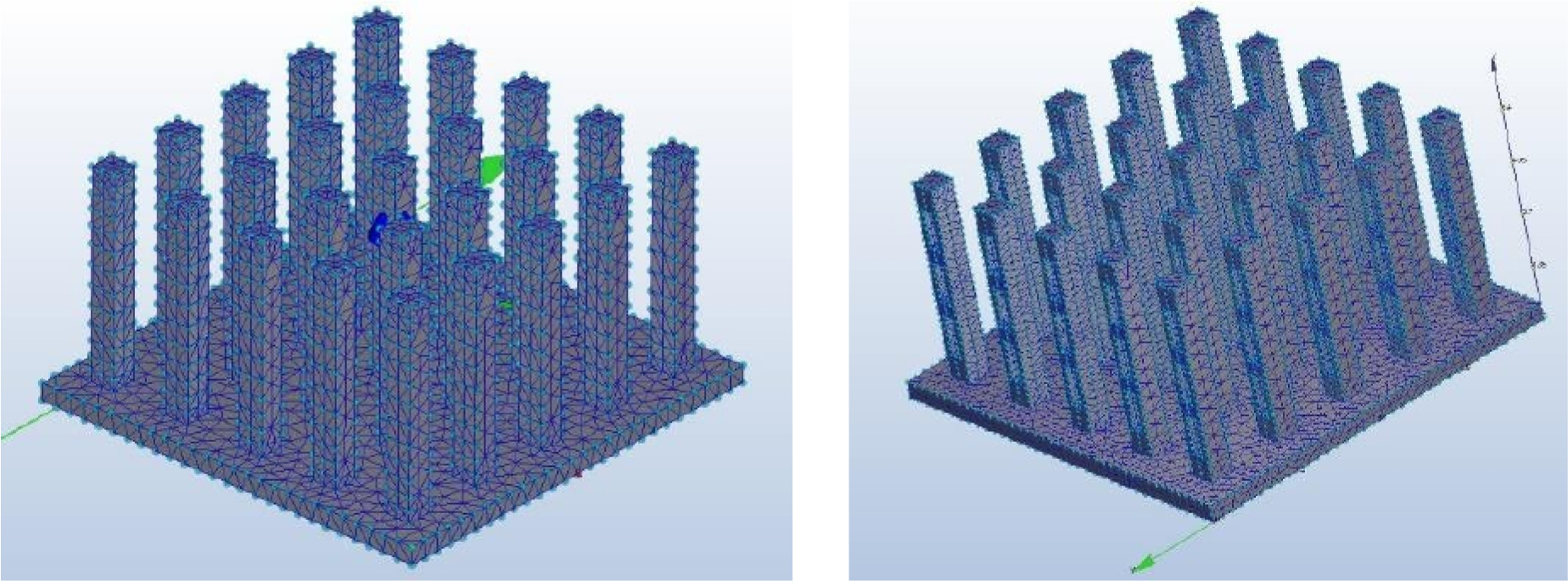
Figure 2.
The mesh calculation of the Square pin fin heat sink (a) and the Slotted square fin pin heat sink (b)
This study diverged from conventional methods by not establishing an air domain around the heat sink. Instead, it applied natural convective heat transfer coefficients directly to the surfaces of the heat sink and the faces of the rectangular slots. Given that natural convective heat transfer is strongly influenced by surface orientation – such as upward-facing, downward-facing and vertical orientations – the coefficients listed in Table III were meticulously assigned to their corresponding positions. This methodology allowed for a more realistic simulation, ensuring an accurate representation of the thermal behavior and efficiency of the heat sink designs under practical operating conditions.
3. RESULTS AND DISCUSSUON
The Heat Sink Temperature
In order to assess the thermal efficiency of the two distinct heat sinks, we conducted a comprehensive evaluation utilizing chips with power outputs of 10W, 12W and 14W. The resultant temperature profiles of both the heat sink’s base and its fins are visually represented in Figure 3, offering a clear insight into the thermal dynamics under scrutiny.
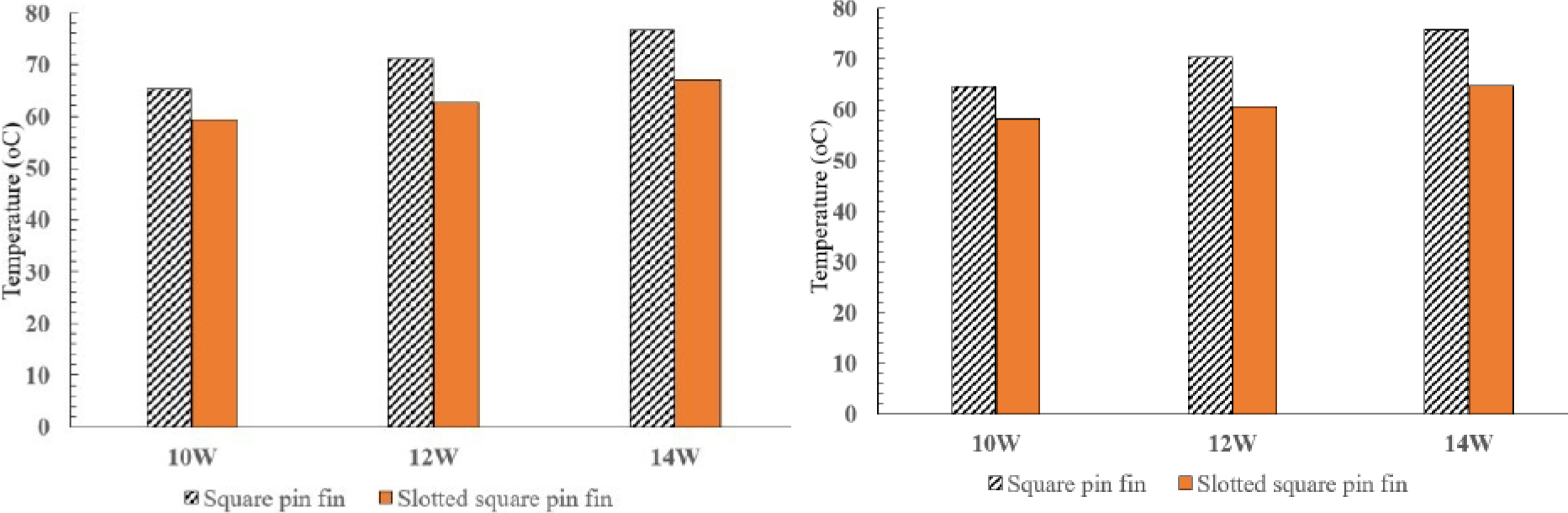
Figure 3.
The temperature of the base (a) and the fin (b) of heat sinks
Clearly discernible from our analysis is the Slotted square pin fin heat sink’s distinct advantage in tempering the temperature at its base, exhibiting an appreciable average reduction of approximately 10% in contrast to its Square pin fin counterpart. This discernible differentiation finds its genesis in the augmented heat transfer area inherent in the slot arrangement, allowing for more effective thermal dissipation. Notably, the augmentation of chip power contributes to a commensurate rise in the base temperature for both architectural configurations. Within a broader framework, it is evident that the Square pin fin heat sink registers a higher degree of temperature elevation, eclipsing the corresponding increase noted in the Slotted square pin fin configuration. Specifically, the Square pin fin design underscores an average temperature amplification rate of nearly 8%, whereas the Slotted square pin fin configuration displays a comparatively tempered rate of 6% (Figure 4a). In a similar vein, our visual analysis, as depicted in Figure 4b, underscores that the Solid square pin fin heat sink is characterized by relatively elevated temperature levels relative to its Slotted square pin fin counterpart. This outcome finds its rationale in the augmented surface area resulting from the intricately designed slot apertures in the latter, which duly enhances the heat dissipation efficiency. The variable of chip power further accentuates these temperature dynamics. It is, however, salient to note that, even within this comparative framework, the Slotted square pin fin heat sink consistently maintains a temperature profile of lesser magnitude compared to its Solid square pin fin equivalent. With specific regard to the Square pin fin configuration, the average rate of temperature escalation, in direct response to chip power, approximates 9%. In contradistinction, the corresponding value for the Slotted square pin fin heat sink is notably constrained, amounting to approximately 5%. In sum, it is evident that the Slotted square pin fin heat sink’s inherent elevation of heat transfer area translates into a consistently mitigated temperature profile as opposed to the more compact Solid square pin fin design. The intricate nuances of temperature distribution across the heat sink surface find further elucidation in Figure 4c to 4f.
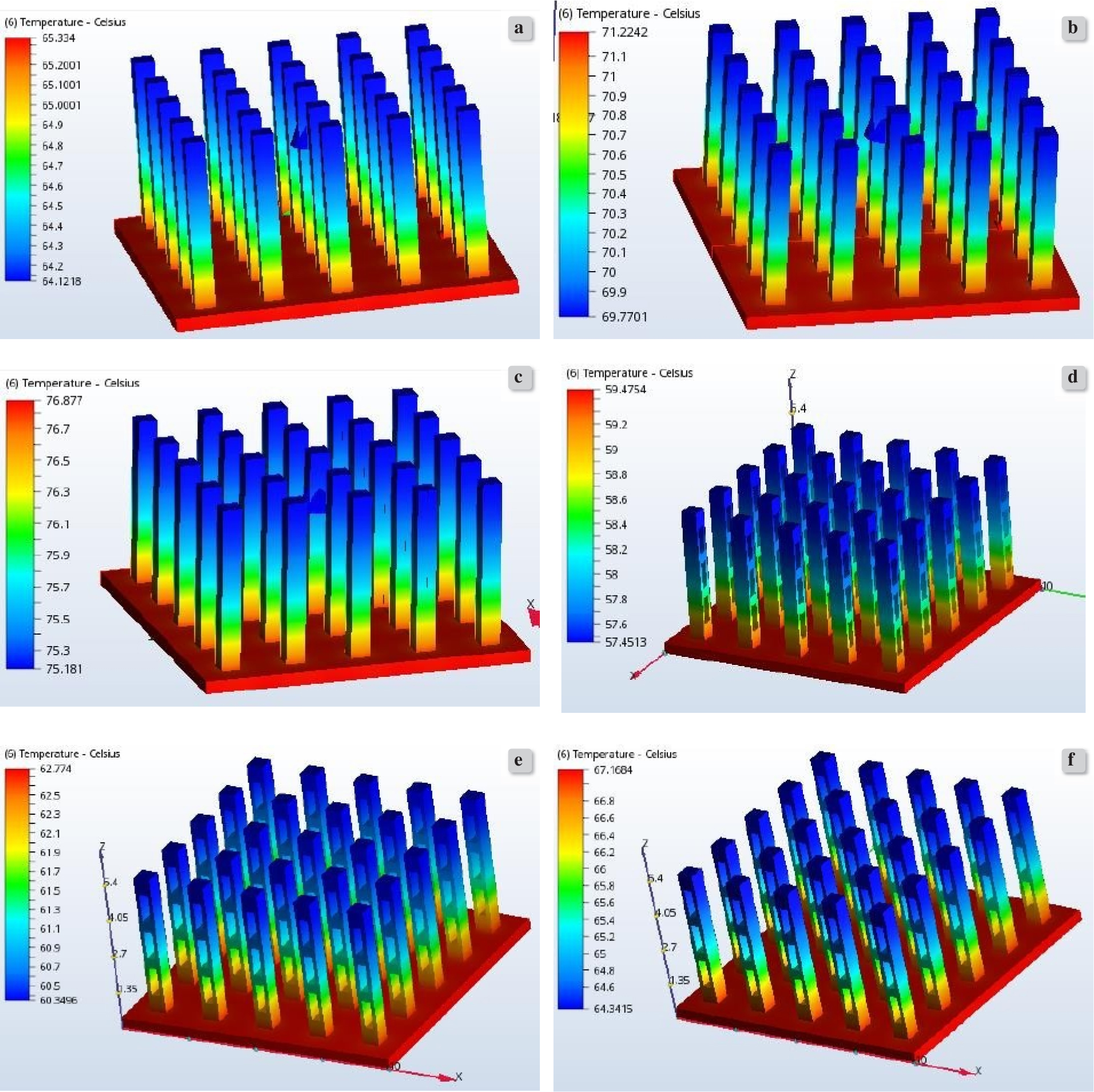
Figure 4.
Temperature distribution of: Square pin fin heat sink with 10W (a), 12W (b), 14W (c); Slotted square pin fin heat sink with 10W (d), 12W (e), 14W (f)
Heat transfer from the base to fin by conduction, then heat is lost to the surrounding air by natural convection. Heat dissipation along the fin makes temperature decreased. The red colour at the base and the blue colour at the tip represent the high temperature and the low temperature, respectively. The high temperature of the base (Tb) gradually reduces toward the tip of the fin. The temperature at any cross-section is uniform because the cross-sectional area is very small. Following equation 2, heat dissipation is maximum if the temperature of the fin is equal to the base, but this heat loss can not reach such value because of the temperature reduction along the fin, so the fin efficiency is usually less than 1. In this design, the temperature difference between the base and tip of the fin is small. The average temperature difference is about 1°C for the Square pin fin heat sink, but the value of the Slotted square pin fin heat sink is slightly higher than the Square pin fin heat sink. The ΔT is 1.26, 2.1, 2.31 with 10W, 12W, 14W, respectively.
Heat dissipation of heat sink
Heat flows from the base to the fin and this value depends on each geometry and convection heat transfer coefficient of the fin. This value of heat loss is obtained from the simulation and shown in Figure 5a.
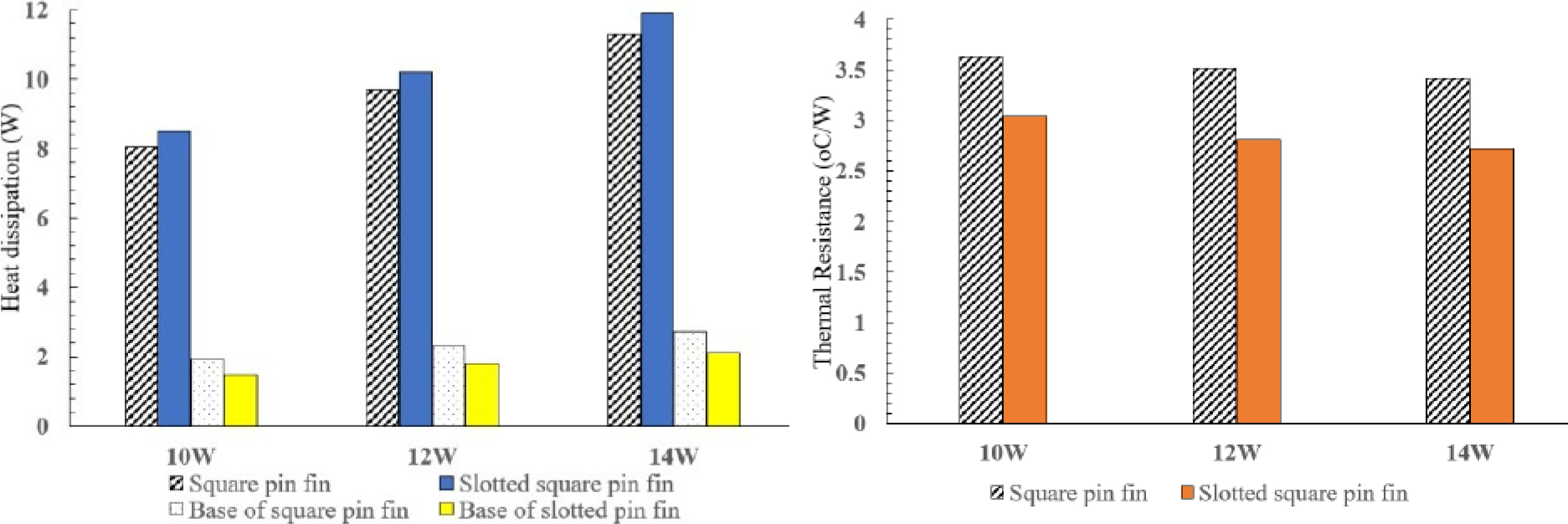
Figure 5.
Heat dissipation of heat sink (a) and The thermal resistance of heat sink to air (b)
The average heat rejection of the slotted square pin fin heat sink is higher than that of the square pin fin heat sink, primarily due to its increased heat transfer area and the enhanced convective heat transfer coefficient associated with its surface orientation, as shown in Table II. Regarding the square pin fin heat sink, the rate of increase in heat dissipation from 10 W to 12 W and from 12 W to 14 W is 9% and 7.8%, respectively. This trend is comparable to that observed in the slotted square pin fin heat sink.
However, the heat dissipation from the base of the square pin fin heat sink is, on average, nearly 30% higher than that of the slotted square pin fin heat sink due to its relatively higher base temperature. Overall, the heat dissipation through the fins accounts for 85% of the total heat dissipation in the slotted square pin fin heat sink, compared to 80% in the square pin fin heat sink. This difference underscores the improved thermal performance of the slotted design, which facilitates more effective heat transfer by leveraging its optimized geometry and enhanced surface area.
Thermal resistance of heat sink to air
The heat from the chip is conducted through the base to the fin and then it will be transferred to the ambient environment. Therefore, each part has its thermal resistance. The higher thermal resistance, the higher temperature of chips will be obtained because heat can not be quickly drawn away. It is clear that the thermal resistance is inversely proportional to the increase of thermal conductivity, geometry and orientation of heat sink, coolant and velocity. According to equation 3, the base temperature in Figure 5a, surrounding temperature of 29°C, the thermal resistance of heat sink to air was calculated and shown in Figure 5b.
It is clear that the thermal resistance of the Slotted square pin fin heat sink is nearly 19% lower than that of the Square pin fin heat sink. The slot areas contribute to the added total heat transfer. According to Table III, the natural convective coefficients of the vertical hot slot surface and the horizontal slot facing up are higher than the outside vertical pin, brozut that of the horizontal slot facing down is slightly lower than the outside vertical pin. Therefore, it makes heat transfer of the slotted square pin fin increased leading to the lower temperature at the base of the heat sink.
The average thermal resistance of the Square pin fin heat sink and the Slotted square pin fin heat sink are 3.52 (°C/W) and 2.85 (°C/W), respectively.
Table IV shows different studies carried out for slotted heat sink. From this review, it is clear that Slotted heat sink is effective and reduce temperature of electronic’s chip.
Table 4.
Studies on Slotted heat sink in different regions
| References | Research | Power | Material | Results |
|---|---|---|---|---|
| Unni and Sreedhar Babu (2021) [18] | Compared 3 kinds of heatsink: fin with no perforation, 8 perforations, 10 perforations | 8W, 12W, 45W | Aluminum | The increase of number of hole on heat sink will improve the heat transfer of heatsink. |
| Kumar, et al. (2018) [19] | Compared the one, three and four perforated pin finned heatsinks with no perforation fin using CFD simulation. | 72W | Aluminum, Copper | Four holes finned heatsink is the best. |
| Awasarmol and Pise (2015) [10] | Compared heatsink with 4mm to 12mm diameter hole, inclination from 0-90° with no hole heatsink. | 15 to 35W | Aluminum | Fins with a perforation diameter of 12 mm and an angle of inclination of 45° is the best and save up 30% of material |
| Venkitaraj and Siddikh (2016) [20] | Compared different kinds of perforation heatsink with various diameters such as circular, square, elliptical and triangular were set up with the no hole one. | 15 to 30W | Aluminum | Optimal choice: -12 mm diameter hole finned heatsink. Circular and elliptical perforations show similar heat transfer traits. Triangular perforations exhibit the lowest heat transfer coefficient. |
| Prasad, et al. (2016) [21] | Investigated the impact of number of hole to performance of heatsink | 24V to 60V | Aluminum | Raising the number of holes increases heat transfer due to more air coming in. |
| Current study | Compared Slotted finned and non-slotted finned heatsink | 10W, 12W, 14W | Aluminum | Slotted finned heatsink is better than that of non-slotted finned heatsink and reduce 16% of mass. |
4. CONCLUSION
This study delved into the development and analysis of two distinctive heat sink configurations: the Square pin fin heat sink and the Slotted square pin fin heat sink. Employing Inventor 2018 for design and Autodesk CFD 2018 for comprehensive analysis, our investigation yielded noteworthy insights. The Slotted square pin fin heat sink exhibited a remarkable 18% increase in heat transfer area and a concurrent 16% reduction in overall weight compared to the Square pin fin design. Moreover, the Slotted square pin fin heat sink consistently maintained a notably lower base temperature, with an average reduction of around 10%. Of significant import, the Slotted square pin fin configuration significantly contributed to the overall heat dissipation mechanism, accounting for an estimated 85% of total heat dissipation, in contrast to the Square pin fin configuration’s contribution of approximately 80%. Furthermore, the Slotted square pin fin heat sink demonstrated a commendable 19% reduction in thermal resistance compared to the Square pin fin design, implying its potential to effectively curtail chip temperatures and enhance thermal management. The obtained results illuminated the advantages of the Slotted square pin fin heat sink, marked by amplified heat transfer area, reduced weight, lower base temperatures and improved thermal resistance. These insights provide valuable contributions to the discourse on advanced heat sink design and effective thermal management strategies.
ACKNOWLEDGMENTS
We appreciate the effort of an anonymous reviewer and the useful comments and suggestions for improving the manuscript.