
1. INTRODUCTION
The building industry is a major consumer of natural resources and energy, although the concept of environmental sustainability has been present in the construction industry for many years [7]. Inefficiency in the construction process affects economic, environmental and social issues. Many engineers and architects often design buildings as static and permanent as a result of traditional building practices that focus on construction costs, quality and time. Even though the technical and functional service life of a traditional modern building is about 50 years. Today, however, the average functional service life of many buildings is being shortened over time, which makes it necessary to achieve a faster return on investment [37, 12]. This brings up the issue of flexibility in the field of building structure and architecture, as it is in every sector.
When traditional, fixed-use buildings can no longer meet the needs of their users, they are left vacant, completely renovated, or demolished. Along with the building, all energy, material, and financial resources are lost. Hence, it is essential that resources be used well and that designers apply strategies anticipating change [13]. To this end, economic and sustainable solution-oriented designs should be proposed to extend the life cycle of the building and its components according to the strategy of use over time [12].
One of the goals of sustainable building design is the creation of an adaptable building composed of systematically assembled building elements, each of which can be maintained and replaced. Therefore, to extend the life cycle of the structure and its components, it is important to plan for the life cycle of the building. The use of the building over time is very important in addition to the environmental and economic impacts of building design. Sustainable design is therefore a life-cycle construct that integrates all the phases of a building, from the pre-construction phase through the construction phase, the operation phase and the post-operation phase, to the efficient use of resources [12, 5, 21]. The rapid development of technology and industrialization has had an impact on the economic duration of the use phase of buildings, so that this period of use is now shorter than the technical life of most of the building components. New needs and spatial organization arise with each new phase of a building’s use. This necessitates some changes in the building. Therefore, after each phase of use, it is necessary to assess whether the building is suitable for the new requirements and, if not, what the technical and economic consequences of adaptation are [12].
It can be observed by that the decisions made at the design stages of architectural projects have an impact on the entire life and use cycle of the building, and this situation requires that the right decisions are made at the design stage. At the pre-construction stage of a project, or at the stage of redesigning an existing building through the modification process, a number of design decisions are made. The functional and operational form of the building is determined by these decisions. This fixed form can lead to problems with new functions and operations. However, the difficulties of later changes can be overcome by systematically controlling the decisions made during the design phase in the context of building flexibility.
It is important to provide a relative measure of a structure’s potential for future modification or development in terms of building flexibility during design phase of new or renovated buildings. In this way, it will be possible to consider the decisions that have to be taken during the design phase by decision groups such as architect, engineer and client. Therefore, this study focuses on the key flexibility indicators in design phase of a building and evaluate their weightings concerning structural elements that can be organized and supported in the context of flexibility and sustainability.
In order to achieve the above-mentioned assessment, the present study aims at highlighting the primary importance of flexibility indicators, and therefore the following research objectives are emphasized:
Examining previous definitions and approaches in the literature to ensure a clear understanding of the phenomenon of flexibility,
Investigating of the relationship and effects of building systems and elements on the flexibility of buildings,
Identifying the requirements and elements which define the structural flexibility,
Hierarchically expressing and understanding the identified requirements and how the elements relate to each other.
2. RESEARCH METHODOLOGY
The present study uses a methodological approach that includes a systematic review of various research studies and the model of Analytic Hierarchy Process which is a multi-criteria decision making method. A systematic literature review in academic research provides an opportunity to explore indicators of flexibility objectively. Consequently, this study examines flexibility indicators associated with a systematic review of research studies in the related literature. Therefore the literature review section focuses on the perspectives of several authors regarding key terms such as flexibility, changeability, and adaptability in relation to architecture. Various authors have defined the concept of flexibility while examining relevant studies in the field of architecture. The authors’ definitions of flexibility in various contexts have been discussed, along with the principles and criteria they have established through their research. Then a table was subsequently developed to list the principles and criteria that impact building flexibility based on the analysis of multiple authors’ studies on the subject.
2.1. AHP (The Analytic Hierarchy Process)
The next step of this study’s methodology involved using the Analytic Hierarchy Process (AHP) analysis as a research approach to identify crucial flexibility indicators. The analysis was conducted based on the weightings of eight expert opinions within the scope of this paper. AHP a multi-criteria decision making method is based on a systematic approach that allows the criteria of a problem to be tracked within a set of relative importance weights. Developed by Thomas L. Saaty in the early 1970s, AHP is designed to simplify and speed up the decision-making process, thus allowing more consistent decisions to be made in complex situations. It allows the creation of qualitative and quantitative decision data sets. In addition, AHP allows the participation of a group in the decision making process of a problem and incorporates the information of the individuals forming the group into the system [34, 35, 20, 10]. Especially for the success of construction activities and operations, the ability to make positive decisions is critical. AHP allows decision makers to use multiple criteria in a quantitative manner to evaluate potential alternatives and then select the optimal option, providing a powerful means to make strategic and progressive construction decisions [35].
The first step in the application of the AHP method is the decomposition of the criteria and sub-criteria that will have an impact on the decision. In this way, the criteria that influence the decision are expressed and clarified on a regular basis. Then, each criterion will be ranked in order of importance, and its relative importance will be weighted. Criteria and sub-criteria are hierarchically organized and priorities are defined on the basis of the relationship between levels. Pairwise comparisons and weight scaling are performed using a matrix at this stage. The priority ranks of the criteria are revealed by finding the eigenvector of the pairwise comparison matrix. To determine the weight distributions of the other criteria in the hierarchy, these priority ranks or relative importance coefficients are multiplied by the criteria to which each criterion is related at the lower level [34, 20, 10]. Consistency of judgments is not automatically guaranteed because AHP allows subjective judgments of decision makers. Therefore, it is necessary to check the consistency in order to ensure the best result. So, it is necessary to determine how consistent the relative importance coefficients obtained are within a certain range of assumptions. Evaluations may deviate from ideal consistency if the criteria are more than the amount that can be controlled. Therefore, the degree of deviation from consistency becomes important. According to Saaty, the inconsistency checked in this pairwise comparison matrix should not exceed 10%. If the Consistency Ratio exceeds this threshold, this indicates inconsistency, and the scores should be re-checked for comparison. Once all of the required pairwise comparisons and revisions have been made in a consistent manner, the decisions can be evaluated for prioritization of the decision criteria along with the relevant sub-criteria [35].
2.2. Literature review
In this section of the study, an examination will be conducted of a series of studies that have dealt with flexibility in buildings and have produced a range of conclusions on this subject. Despite the existence of studies of flexibility in architecture at varying levels and scales, this article will focus exclusively on the phenomenon of flexibility in buildings and their structural elements. In this direction, the examination of architectural flexibility will be approached systematically, taking into account the primary subjects of research and the most frequently mentioned criteria that affect them.
Flexibility in architecture is a phenomenon that emerged in the 20th century with the need for change during the modernist movement, which aimed to renew the principles of design and architecture. The flexibility of buildings can be defined as the ability of buildings to provide solutions to the demands generated by the cultural, technological, and economic changes in contemporary society [7]. Many researchers have defined flexibility in architecture in different ways. They have identified principles, trends, and strategies in line with their own work. The common perception of flexibility in the literature is a tool for the achievement of a certain level of adaptability [4]. Flexibility as an innovative approach to architectural design, as described by Živković and Jovanović, establishes variability as a parameter of spatial design [45]. Montellano emphasizes the interrelation of spaces that can adapt to architectural changes [29]. From another perspective, flexibility is a term referring to the adaptability of building characteristics to user needs [26, 36]. Sinclair and others examined a triple concept of spatial, functional, and aesthetic flexibility, referring to a building’s ability to transform its space, function, and identity. In this way, resilience allows buildings to meet the requirements of sustainability for a longer period of time with less waste by extending the life of the building [39].
Israelsson and Hansson discuss active and passive control mechanisms and their impact on building flexibility. They identified their own resiliency factors and explored the impact of these factors on their ability to adapt. They divided the factors into those with a direct physical link, such as material standards, production and manufacturing, and those without a direct physical link, such as awareness, finance and future plans [25]. Till and Schneider sum up flexibility as the ability to recalibrate existing layouts with new technological possibilities to adapt to changing social structures and changing user needs. Flexibility principles include spatial, structural, adaptive design, layering, typical planning, and services [42]. From an economic perspective, Slaughter outlines a number of design strategies to achieve building flexibility. These strategies aim to reduce the cost of renovating by reducing the time needed to make changes [40].
Cellucci and Di Sivo emphasized the strategies that enable flexibility and categorized flexibility design into four groups: user space, functional space, physical space, and procedural space [8]. Cavalliere et al. generalized the most common flexibility principles as general and vague space, layout, planning the use of mobile equipment and partitioning, and designate service and technical areas [7]. According to Graham, building design can be organized around groups of elements with similar life expectancies by thinking of buildings as temporary systems and structural layers. The recognition of how buildings change over the course of their lifespan provides flexibility for shortlived building layers and durability for long-lived layers [18]. In terms of architectural design, flexibility means that a building has built-in opportunities for rearrangement, addition, and subtraction of elements and systems as user needs change. Elasticity, on the other hand, refers to the ability to divide the building into different functional units or to expand the building in a horizontal or vertical direction [3]. In short, it is the process of adapting and modifying a structure or a building and/or its surroundings in order to fit in or adapt to new conditions [11]. Mandelbaum defined flexibility as the ability to respond effectively to changing conditions in two distinct ways: action flexibility and situational flexibility. While action flexibility is defined as the ability to take new actions to meet new circumstances, situational flexibility is defined as the ability to continue working effectively despite changes in the environment [27]. Similarly, Wiendahl et al. define flexibility as the potential to adapt quickly beyond the limits planned for the organization and technology without making major investments. Like Mandelbaum, they divide flexibility into static and dynamic [44].
The level of flexibility to be achieved in a demand program is determined by the expected type and duration of use, ownership, the physical context of the building, and the context of building codes and regulations. In accordance with these basic design decisions and technologies, every building has a potential for flexibility of action and flexibility of situation [41]. Regarding expectations, Narain et al. consider flexibility in three different dimensions: necessary flexibility, sufficient flexibility, and competitive flexibility. The “built-in” flexibility of the system fulfills the need when an anticipated expectation is realized in the building. Without having to transform the system again and again, the necessary change takes place within the system itself. However, the system must be changed if the need for change exceeds the defined flexibility limit. The perception of flexibility is directly affected by the speed at which the system changes. Such situations require envisioning a solution space in which the system can change [30]. The ability and speed of flexibility increases with the preparation of the solution space. The flexibility perspective on structure is inversely related to the speed of realization of change expectations. In competitive flexibility scenarios, where flexibility has high capacity and speed, the perception of flexibility is quite high even when costs are on the rise. On the other hand, the perception of flexibility is weakened if this process is prolonged or made more difficult, which leads to unwanted additional costs. Thus, expected and perceived flexibility are interdependent.
3. RESULTS AND DISCUSSION
Considering the articles examined in literature review, an array of architectural features that make building flexibility effective and the criteria affected by these features have been addressed by many authors in different scales. In order to clarify this situation, also as the primary step, a systematic set of conceptual categories is needed. These categories should be in accordance with the principles and criteria of the analyzed studies. Therefore, the flexibility analyses of 30 papers have been the subject of a detailed study within the framework of architectural building elements and features.
The structural flexibility of buildings necessitates a series of actions, which are designated as fundamental principles. These actions are further delineated by distinguishing between the physical components and the functional zones that facilitate their execution. These zones are then categorized into a three-tiered stratification, offering a structured approach to understanding building structural flexibility. The Table 1. above lists these principles of flexibility and the physical and functional criteria. As little overlap and differentiation in meaning as possible was chosen for the words used for the principles and criteria. The aim was to achieve a more comprehensive and less repetitive classification.
Table 1.
A list of conclusions drawn from the analysis of the studies in the context of the principles and criteria [Elaborated by the authors]
| Principles | Criteria | Reference Source |
|---|---|---|
| detachability, mobility, inter-changeability, readjustability, universality | structure/load assumption, materials, services, interior, facades, form/layout, joints | Durmisevic, E. (2006) [12] |
| universality, modularity, demountability, read-justability/usability, recyclability | structure, interiors, facades, facades, services, services, materials, joints | Thormark, C. (2001) [41] |
| adjustability, versatility, reusability, scalability, mobility | structure, services, building, equipment, | Schmidt III, R., Eguchi, T., Austin, S., & Gibb, A. (2010) [38] |
| modularity, mobility, reusability, versatility, universality | services, structure, interiors, facades | Till, J., & Schneider, T. (2005) [42] |
| modularity, versatility, universality, demountability | structure/load assumption, form, service, building, equipment | Cavalliere, C., Dell'Osso, G. R., Favia, F., & Lovicario, M. (2019) [7] |
| interchangeability, disassem-bly, durability, versatility | structure/load assumption, facade, service, material | Galle, W., & De Temmerman, N. (2013) [13] |
| readjustability, disassembly, interchangeability, modularity | structure/load assumption, services, facade, interior | Slaughter, E. S. (2001) [40] |
| universality, mobility, modu-larity, scalability, compatibility | structure, form, facade, site, layout | Nyhuis, P., Heinen, T., & Brieke, M. (2007) [31] |
| interchangeability, disassem-bly, durability, recyclability, modularity | structure/load assumption, materials, joints, | Sadafi, N., Zain, M. F. M., & Jamil, M. (2014) [36] |
| modularity, reconfigurability, versatility, reusability | materials, joints, services | Israelsson, N., & Hansson, B. (2009) [25] |
| interchangeability, readjustability, recyclability | structure, materials, services, interior | Bullen, P., & Love, P. (2011) [6] |
| durability, recyclability, versatility | materials, site, interior, services | Manewa, A., Siriwardena, M., Ross, A., & Madanayake, U. (2016) [28] |
| durability, scalability, versatility, recyclability, compatibility | structure/load assumption, materials, services, interiors, facades | Askar, R., Bragança, L., & Gervásio, H. (2021) [4] |
| interchangeability, durability, disassembly, versatility | structure, services, interiors, facades | Gosling, J., Sassi, P., Naim, M., & Lark, R. (2013) [16] |
| modularity, interchangeability, reconfigurability, mobility | services, interior | Arge, K. (2005) [3] |
| mobility, readjustability, interchangeability, modularity, demountability | interior, services, services, structure, facades | Heidrich, O., Kamara, J., Maltese, S., Cecconi, F. R., & Dejaco, M. C. (2017) [22] |
| mobility, reconfigurability, interchangeability, modularity, demountability, scalability, versatility | interior, services, services, structure, facades | Pinder, J. A., Schmidt, R., Austin, S. A., Gibb, A., & Saker, J. (2017) [32] |
| modularity, durability, adaptability, reconfigurability | structure/load assumption, materials, services, interiors, facades | Habraken, N.J. (2008) [19] |
| interchangeability, durability, disassembly, scalability | structure/load assumption, materials, services, interiors, facades | Remøy, H., de Jong, P., & Schenk, W. (2011) [33] |
| interchangeability, durability, disassembly, compatibility, mobility | structure/load assumption, materials, services, interiors, facades | Gijsbers, R. (2006) [15] |
| mobility, reconfigurability/usability, interchangeability, modularity, demountability, scalability, versatility | structure/load assumption, materials, services, interior, facades, form/layout, joints | Geraedts, R. (2016) [14] |
| mobility, reconfigurability/usability, interchangeability, modularity, versatility | structure/load assumption, materials, services, interiors, facades | Agha, R. H., & Kamara, J. M. (2017) [1] |
| mobility, reconfigurability/usability, interchangeability, modularity, demountability, scalability, durability | services, structure, interiors, facades, materials, materials, joints, form | Blakstad, S. H. (2001) [5] |
| mobility, reconfigurability/usability, interchangeability, scalability | structure, interior, facades, materials | Hudec, M., & Rollová, L. (2016) [24] |
| readjustability/usability, interchangeability, modularity, disassembly, versatility | structure/load assumption, materials, services, interior, facades, form/layout, joints | Graham, P. (2005) [18] |
| disassembly, mobility, inter-changeability, readjustability, | structure/load assumption, materials, services, interior, facades, form/layout, joints | Andrade, J. B., & Bragança, L. (2019) [2] |
| mobility, readjustability, interchangeability, modularity, demountability | structure/load assumption, materials, services, interior, facades, form/layout, joints | Schmidt III, R., Deamer, J., & Austin, S. (2011) [37] |
| mobility, modularity, durability, disassembly, reconfigurability | structure, interiors, facades, materials, joints | Sinclair, B. R., Mousazadeh, S., & Safarzadeh, G. (2012) [39] |
| mobility, modularity, univer-sality, demountability | structure, interiors, facades, facades, services, services, materials, joints | Hu, R., Follini, C., Pan, W., Linner, T., & Bock, T. (2017) [23] |
| universality, modularity, durability, disassembly, reconfigurability, recyclability | structure, interiors, facades, facades, services, services, materials, joints | Crowther, P. (2005) [9] |
3.1. Flexibility indicators
Table 1. presents a comprehensive list of thirty research papers that identify the critical areas in which flexibility in buildings is realized. Among the principles and criteria, the ones which differ from one another and the ones which were over-cited were identified so as to be able to make a systematic ranking. At this stage, the scope has been defined according to the principles and criteria which will allow the physical flexibility of the building. In this sense, the building elements and systems that make up the building have been categorized according to their function, and a layered classification has been obtained.
Structural flexibility in buildings is analyzed under three systematic headings: principles that enable building flexibility, physical layer criteria that determine building flexibility, functional layer criteria that determine building flexibility. These three layers are categorized according to their characteristics and are rendered meaningful by the transfer of information from one layer to the other in the building. However, it is not possible for every element between the layers to form a direct and meaningful expression with each other. Therefore, the relationship network should be clearly expressed as illustrated in Figure 1. before the consideration of the importance weights of these principles and criteria in the next step [17].
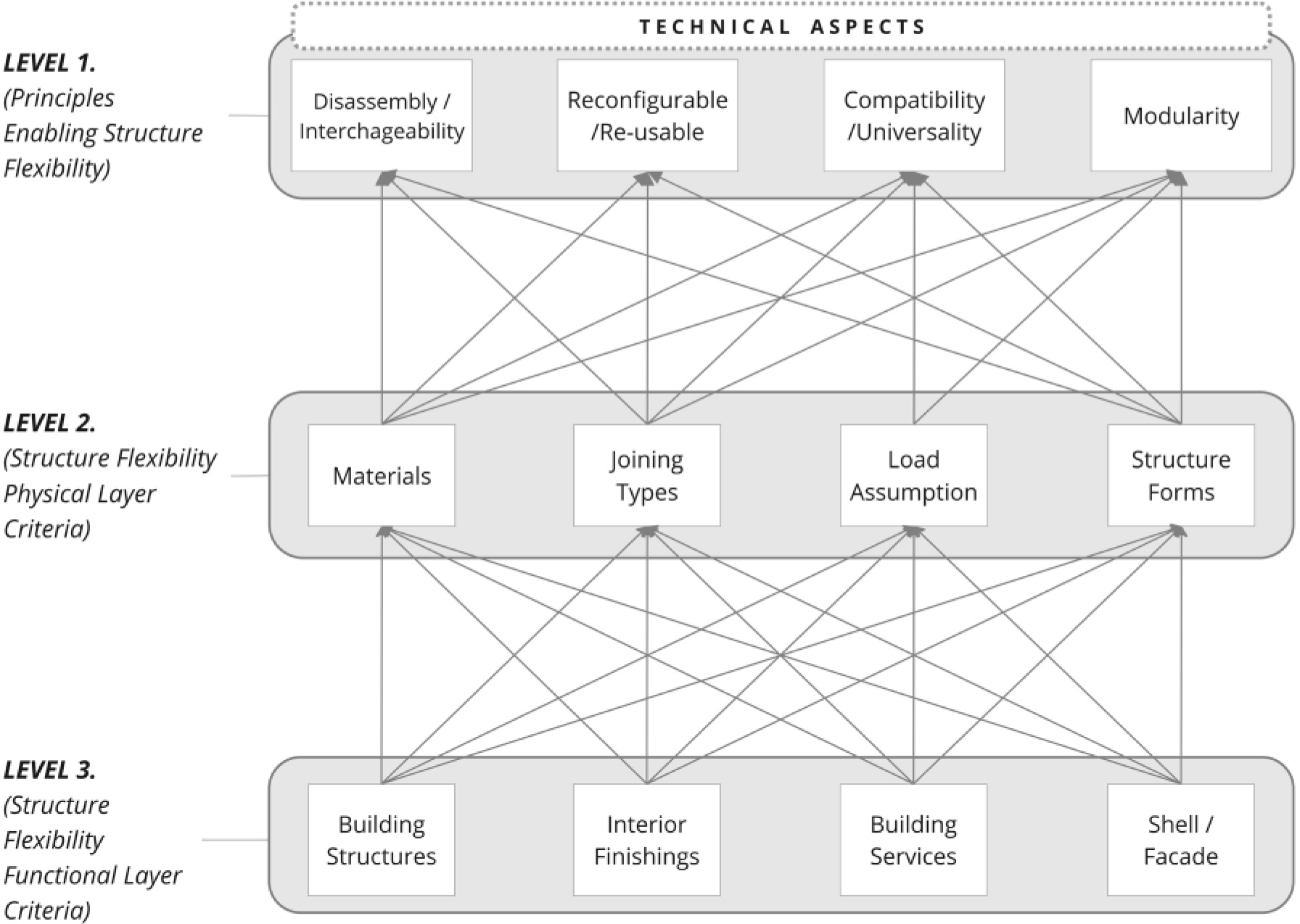
Figure 1.
Layered organization of principles and criteria [Elaborated by the authors]
The principles that enable building flexibility have four subheadings and these are: disassembly (detachability) / interchangeability, reconfigurability / reusability, compatibility / universality, and finally modularity. These principles, identified as a result of the literature review, provide great benefits to the technical subsystems that comprise the building to provide building flexibility. This is referred to as the highest level, because this level involves choices of principle. The physical factors determining the flexibility of the structure have four subcategories identified from the literature review: Materials, Joining Types, Load Assumption, and Form. It expresses the four system characteristics identified for the physical implementation of building flexibilities. In general terms, the materials that make up the building, how these materials come together, and the shapes and bearing capacities formed by the combined materials describe the physical organizations.
The functional layer criteria for determining building flexibility has four sub-headings identified as a result of the literature review and these are: Building Structure/Supports, Finishings/Interiors, Services, and finally Facade/Shell. This layer was used to express systematically assembled zones where building flexibility can be directly observed, where the physical elements that make up the building are functionally categorized.
At this stage, it is possible to make comparisons of criteria that can be related in a linear way from this layer to the first one. Each successive criterion match expresses a meaningful whole, except for the load assumption criterion of the physical layer criteria that determine building flexibility. Because with the principles of disassembly/interchangeability and reconfigurability/usability in the upper layer, the load assumption criterion does not provide meaningful and reliable integrity.
3.2. Structural flexibility indicators analysis with AHP method
This is the point at which the principles and criteria can be the subject of AHP calculation for relative weights. The following table shows the breakdown of the pairwise comparison ratings performed with the experts systematically in three layers (Figure 1.). The scale used in pairwise comparisons is highly significant. For AHP, ratio scales of 1-9, 1-7, and 1-5 are commonly used. These pairwise comparisons compare rows to columns and label responses by scale. In this study, a scale ranging from 1 to 9 was utilized. The scale was designed as follows: 1 indicated equal importance, 3 indicated weak importance of one over another, 5 indicated essential or strong importance, 7 indicated very strong importance, 9 indicated absolute importance, and 2, 4, 6, and 8 indicated intermediate values between the two adjacent judgments. The gathered answers will be represented as a square array. The priority order of the elements in the matrix is determined by the eigenvector of this matrix with the largest eigenvalue to check the consistency [10, 20, 35].
The pairwise comparison matrices for the elements belonging to the criteria of the physical layer, the second level below, were computed after determining the relative importance weights of the elements belonging to the first level, the principles layer, which allows structural flexibility. At this stage, the relative importance weights of the criteria, which are the elements of the second level, were obtained in accordance with the elements to which they were connected in the first level. In the same way, the relative importance weights of the items of the third level, called functional level, below the second level, have been considered according to the items connected to them at the next higher level. During these procedures, a consistency check of the judgments was also carried out for each expert.
The criteria that were illustrated according to the relationship shown in Figure 1 are listed as they are expressed in Table 2 by showing comparisons according to eight experts.. For the criteria in each level of the classification, pairwise comparison matrices were constructed. To establish the relative importance weights of the criteria, eight academic architects, who are experts in the field of architecture, were interviewed. The experts were given an overview of the relevant principles and criteria, as well as the topics to which they relate, and asked to compare them in order to determine their relative importance in the context of structural flexibility of buildings.
Table 2.
Comparison matrices scores data retrieved from experts [Elaborated by the authors]
| Principles Enabling | Building Flexibility | LEVEL 1 | ENABLERS | DISASSEMBLY/INTERCHAN. | COMPABILITY/UNIVERSAl. | RECONFIG. / REUSABLE | MODULARITY |
|---|---|---|---|---|---|---|---|
| DISASSEMBLY / INTERCHANGEABILITY | 1,000 | 4,643 | 1,751 | 3,750 | |||
| COMPABILITY / UNIVERSALITY | 0,215 | 1,000 | 0,334 | 2,233 | |||
| RE-CONFIGURABLE / RE-USABLE | 0,571 | 2,996 | 1,000 | 5,250 | |||
| MODULARITY | 0,267 | 0,448 | 0,190 | 1,000 | |||
| Structural Flexibility Physical Layer Criteria | LEVEL 2 | DISASSEMBLY / INTERCHANG. | MATERIAL | JOINING TYPES | STRUCTURE FORMS | ||
| MATERIAL | 1,000 | 0,587 | 2,583 | ||||
| JOINING TYPES | 1,704 | 1,000 | 5,000 | ||||
| STRUCTURE FORM | 0,387 | 0,200 | 1,000 | ||||
| LEVEL 2 | RECONFIGURABLE / REUSABLE | MATERIAL | JOINING TYPES | STRUCTURE FORMS | |||
| MATERIAL | 1,000 | 1,032 | 3,792 | ||||
| JOINING TYPES | 0,969 | 1,000 | 5,000 | ||||
| STRUCTURE FORM | 0,264 | 0,200 | 1,000 | ||||
| LEVEL 2 | COMPABILITY / UNIVERSALITY | MATERIAL | JOINING TYPES | LOAD ASSUMPTION | STRUCTURE FORMS | ||
| MATERIAL | 1,000 | 2,664 | 5,393 | 3,792 | |||
| JOINING TYPES | 0,375 | 1,000 | 4,000 | 4,073 | |||
| LOAD ASSUMPTION | 0,185 | 0,250 | 1,000 | 0,775 | |||
| STRUCTURE FORM | 0,264 | 0,246 | 1,290 | 1,000 | |||
| LEVEL 2 | MODULARITY | MATERIAL | JOINING TYPES | LOAD ASSUMPTION | STRUCTURE FORMS | ||
| MATERIAL | 1,000 | 0,705 | 2,833 | 2,117 | |||
| JOINING TYPES | 1,418 | 1,000 | 4,750 | 3,479 | |||
| LOAD ASSUMPTION | 0,353 | 0,211 | 1,000 | 1,381 | |||
| STRUCTURE FORM | 0,472 | 0,287 | 0,724 | 1,000 | |||
| Structural Flexibility Functional Layer Criteria | LEVEL 3 | MATERIAL | BUILDING STRUCTURE | INTERIOR FINISHING | BUILDING SERVICES | SHELL | |
| BUILDING STRUCTURE | 1,000 | 3,297 | 3,210 | 2,832 | |||
| INTERIOR FINISHING | 0,303 | 1,000 | 2,104 | 1,344 | |||
| BUILDING SERVICES | 0,312 | 0,475 | 1,000 | 1,406 | |||
| SHELL | 0,353 | 0,744 | 0,711 | 1,000 | |||
| LEVEL 3 | JOINING TYPES | BUILDING STRUCTURE | INTERIOR FINISHING | BUILDING SERVICES | SHELL | ||
| BUILDING STRUCTURE | 1,000 | 4,875 | 4,250 | 3,875 | |||
| INTERIOR FINISHING | 0,205 | 1,000 | 1,750 | 1,469 | |||
| BUILDING SERVICES | 0,235 | 0,571 | 1,000 | 1,608 | |||
| SHELL | 0,258 | 0,681 | 0,622 | 1,000 | |||
| LEVEL 3 | LOAD ASSUMPTION | BUILDING STRUCTURE | INTERIOR FINISHING | BUILDING SERVICES | SHELL | ||
| BUILDING STRUCTURE | 1,000 | 6,625 | 5,375 | 4,646 | |||
| INTERIOR FINISHING | 0,151 | 1,000 | 1,265 | 1,168 | |||
| BUILDING SERVICES | 0,186 | 0,791 | 1,000 | 1,244 | |||
| SHELL | 0,215 | 0,856 | 0,804 | 1,000 | |||
| LEVEL 3 | STRUCTURE FORMS | BUILDING STRUCTURE | INTERIOR FINISHING | BUILDING SERVICES | SHELL | ||
| BUILDING STRUCTURE | 1,000 | 6,250 | 4,875 | 3,250 | |||
| INTERIOR FINISHING | 0,160 | 1,000 | 1,437 | 0,425 | |||
| BUILDING SERVICES | 0,205 | 0,696 | 1,000 | 0,883 | |||
| SHELL | 0,308 | 2,353 | 1,132 | 1,000 |
For this study, eight experts completed comparison templates using a 1–9 scale to create pairwise comparison matrices. The data from the templates was transposed to the matrices. As seen in Table 2. above, for the pairwise comparison matrices in each layer, the arithmetic averages of the data obtained separately from the eight experts were taken and all matrices were recalculated with new data expressing the average opinion. Each matrix was then examined to see if it was consistent with threshold of 0.1. Relative importance weights of each layer’s criteria were determined by converting the pairwise comparison matrices from the eight experts into vectors. The relative importance weights of the criteria within each layer were determined by converting the pairwise comparison matrices from the eight experts into vectors. It is imperative to acknowledge that each number in this matrix table is the average of the eight expert opinions, comparing the entry in the left column with the entry in the top row within scope of each upper level related criteria. However, prior to this, these matrices were created independently for each expert, and their consistency was thoroughly verified.
The initial results were obtained by applying the Analytical Hierarchy Process (AHP) to twelve elements across three levels, as illustrated in Table 2. and assigning relative importance weights to them by evaluating eight expert perspectives. The local and global weights, which are the result of processing the data in Table 2, are listed in Tables 3 and 4, respectively. Among the principles required for the realization of building flexibility, the principle of disassembly has the relatively highest importance weight with 45.98%. It is followed by the principle of re-configurable / re-usable with 33.56%, the principle of compatibility / universality with 12.49% and the principle of modularity with 07.89%.
Table 3.
Local weightings of flexibility indicators [Elaborated by the authors]
| Level 1 (Enabling Principles) | DISASSEMBLY / INTERCHANGE. | COMPABILITY / UNIVERSALITY | RECONFIG. / REUSABLE | MODULARITY | |
| 0,4598 | 0,1249 | 0,3356 | 0,0798 | ||
| DISASSEMBLY / INTERCHANGE. | COMPABILITY / UNIVERSALITY | RECONFIG. / REUSABLE | MODULARITY | ||
| Level 2 (Physical Layer Criteria) | MATERIAL | 0,3176 | 0,5109 | 0,4326 | 0,2996 |
| JOINING TYPES | 0,5645 | 0,3028 | 0,4642 | 0,4594 | |
| LOAD ASSUMPTION | - | 0,0819 | - | 0,1212 | |
| STRUCTURE FORM | 0,1179 | 0,1044 | 0,1033 | 0,1198 | |
| MATERIAL | JOINING PRINC. & TYPES | LOAD ASSUMPTION | STRUCTURE FORM | ||
| Level 3 (Functional Layer Criteria) | BUILDING STRUCTURE | 0,4982 | 0,5794 | 0,6430 | 0,5917 |
| INTERIOR FINISHING | 0,2098 | 0,1688 | 0,1250 | 0,1099 | |
| BUILDING SERVICES | 0,1501 | 0,1380 | 0,1195 | 0,1169 | |
| SHELL | 0,1419 | 0,1137 | 0,1126 | 0,1816 |
Table 4.
Global weightings of flexibility indicators [Elaborated by the authors]
| Level 1 (Enabling Principles) | DISASSEMBLY / INTERCHANGE. | COMPABILITY / UNIVERSALITY | RECONFIG. / REUSABLE | MODULARITY |
| 0,4598 | 0,1249 | 0,3356 | 0,0798 | |
| Level 2 (Physical Layer Criteria) | MATERIAL | JOINING TYPES | LOAD ASSUMPTION | STRUCTURE FORMS |
| 0,3789 | 0,4898 | 0,0199 | 0,1115 | |
| Level 3 (Functional Layer Criteria) | BUILDING STRUCTURE | INTERIOR FINISHING | BUILDING SERVICES | SHELL |
| 0,5513 | 0,1769 | 0,1399 | 0,1319 |
As demonstrated in Table 4, among the criteria belonging to the physical layer, the criterion of Joining Types (Connections) has emerged as the relatively most important physical layer element for building flexibility, with a percentage of 48.98%. It is followed by the material criterion with 37.89%, the structure form criterion with 11.15%, and the load assumption criterion with 1.99%. It should be noted that these values are derived from the inter-layer effects. As indicated by the headings of the upper layer, assessments made individually are aggregated and transferred successively to subsequent layers. Accordingly, in regard to the integrity of meaning, the physical layer (level 2) situated between the aforementioned layers functions as a binding component that serves to connect the initial and final layers. In addition, the meaningful connections that are defined for this purpose are described in a linear form in Figure 1.
In the functional layer, the criterion of building structure has the largest relative coefficient of importance within this level with 55.13%, obtained as a result of the functional categorization of the systems that make up the building. Relatively close weights are given to the functional criteria of interior finishes with 17.69%, building services with 13.99% and facade/shell with 13.19%.
As illustrated in Figure 2., a building’s capacity for physical flexibility is contingent upon its capacity for disassembly. This capacity is influenced by the materials and joining types that are designed to enable disassembly. Furthermore, apart from the assembly process of structure, the physical elements of the building should also be easily accessible and reusable. Therefore, the ability of the structure that supports the building to realize these capabilities provides a greater gain in building flexibility. Also as seen in the functional layer with the coefficient of high importance level, building structure is a major actor in perception of structural flexibility.
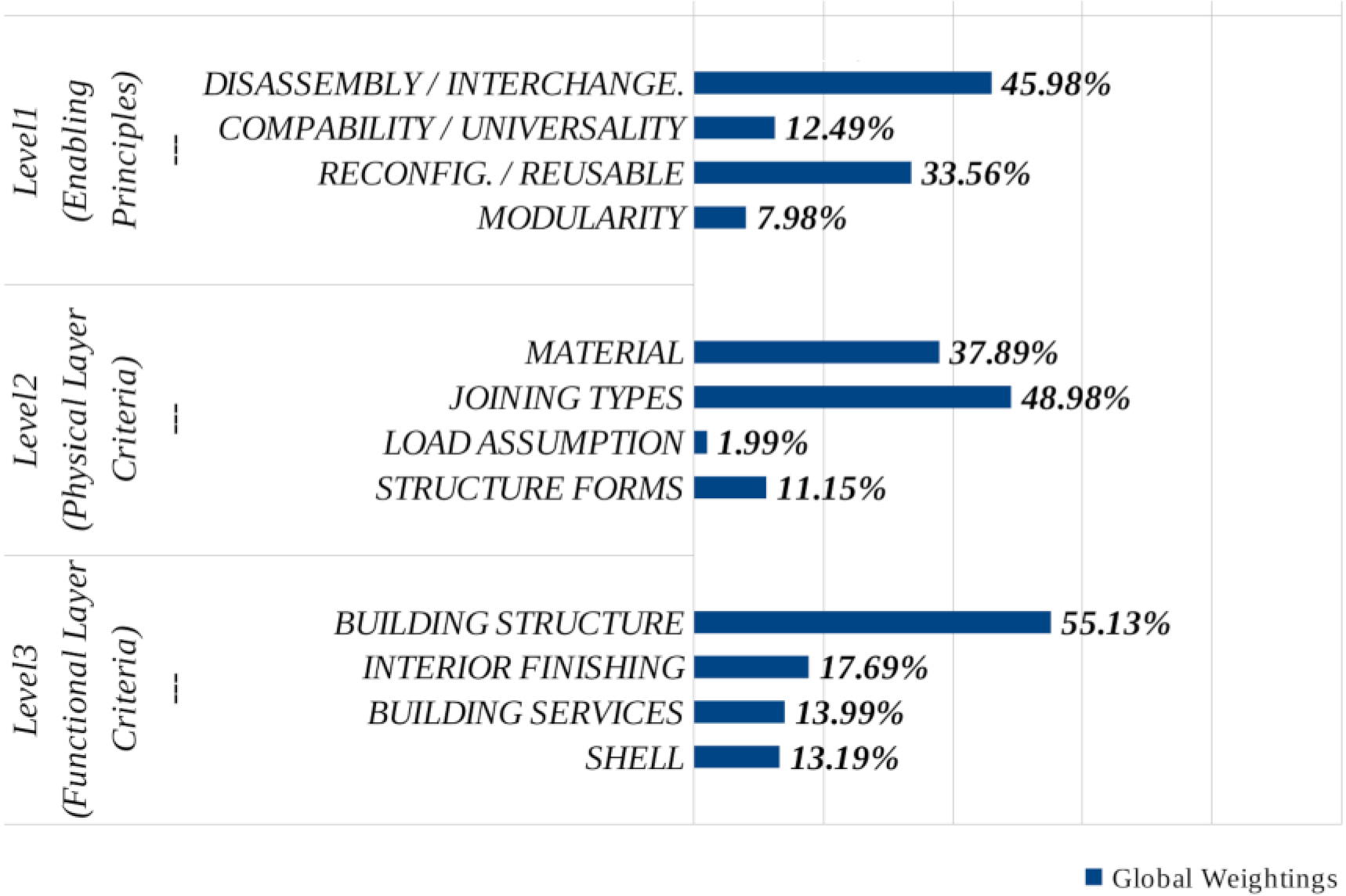
Figure 2.
Global weightings distributed in bar graph [Elaborated by the authors]
It is important to recognize that any value assigned to these principles and criteria is indicative of the order of preference derived from the comparisons made. The relative importance weights should not be interpreted to mean that certain elements are unimportant because of their low ranking. The system has been designed to ascertain the comparative importance of the criteria. Consequently, the measurement direction remains positive, thereby facilitating flexibility. The findings derived from this analytical process yield values that are conducive to enhancing flexibility.
4. CONCLUSIONS
In order to facilitate structural flexibility in a building, decisions about anticipated changes must be made in a flexible and adaptive manner, particularly during design. However, occupancy forecasts are often misguided. Therefore, it’s preferable to anticipate and account for future design variability. The method is to identify the components of the building that affect flexibility and their magnitude. This allows critical decisions to be made on a system basis, ensuring optimization of the building’s flexibility and risk mitigation during demolition and decommissioning.
In this study, a comprehensive analysis was conducted on 30 articles, with a focus on identifying the most prevalent topics and themes that have been discussed and referenced. The analysis utilized eight distinct criteria and four overarching principles, which were presented at three different levels to enhance the comprehensibility and clarity of the study. These four principles are listed as, disassembly/interchangeability, reconfigurability/reusability, compatibility/universality, and modularity. This is the highest level, where choices are made. Then two subcategories that determine a structure’s flexibility identified: physical and functional sections. The physical subsection contains materials, joining types, load assumptions, and form. These four characteristics describe physical implementation. The building’s functional layer has four criteria for determining its flexibility. These are building structure, finishes/interiors, services, and facade/shell. This layer categorizes building elements to observe flexibility. Subsequently, the relationship network between these principles and criteria is outlined to illustrate how flexibility can be fostered. Using the Analytic Hierarchy Process (AHP), a panel of eight experts was surveyed to determine the relative importance weights of the identified principles and criteria. A systematic and hierarchical expression of the relative importance weights of the criteria was established through the utilization of the perspectives of the expert architects. Consequently, a hierarchical ranking of the key indicators in the three systematic layers is obtained. The findings of the study indicate that a building’s capacity for physical flexibility is contingent upon its capacity for disassembly (level 1: enabling principles). This capacity is primarily influenced by the materials and joining types (level 2: physical layer) that are designed to enable disassembly. Additionally, as evidenced by the functional layer’s high importance coefficient, the building structure criterion (level 3: functional layer) plays a significant role in the perception of structural flexibility. These rankings serve as a foundation for a deliberation on the cultivation of flexibility and provide a guiding support mechanism for decisions to be taken in this direction.
This study provides a glimpse into the important indicators of flexibility to more precisely improve building structural flexibility, but there are still limitations. The most significant constraint of this study is the limited number of articles included in the review. Evidently, the articles identified may not encompass all articles pertaining to flexibility and flexible approaches in architecture. Moreover, the articles employed to ascertain the content coverage may be subject to substantial subjective interpretation by the authors, despite the implementation of a systematic review to categorize the subject content that these studies addressed for flexibility. Since the principles and criteria are subject to a literature-based limitation, they can be adapted in future studies with specific details for relevant studies. Consequently, it is anticipated that these requirements for future studies will also exhibit flexibility. It should also be kept in mind that the priorities set by the professionals are critical to the effective functioning of this system. It is possible to redefine the relative importance weights of the relevant criteria if the local condition is overly specific. Local conditions and circumstances may seriously affect the ranking of importance. Because regional priorities may vary based on local, physical, and cultural conditions. Accordingly, additions or corrections should be made to the relevant strata as necessary. In this way, the criteria are compared again according to the current situation and the whole evaluation process can be repeated. Consequently, depending on these external factors, the results will vary and demonstrate greater consistency.
Finally, the systematic and hierarchical approach established by the study will make it easier to determine the investments to be made in this direction in accordance with the allocated budgets. Concurrently, it will assist in the prevention of substantial damage and waste in the utilization phase of the building, and make a significant contribution to the field of sustainable architecture. In the context of environmentally friendly and sustainable buildings, contributing to the development of accessibility awareness is of particular importance. The study characterizes this as an opportunity to examine the research on accessibility with a systematic perspective on the axes and framework of flexibility. In other words, the one advantage of this study is to provide support for research in this field, and to offer a systematic perspective for the benefit of other studies in this domain.