
1. INTRODUCTION
Interactive spatial design of a museum is critical as it affects the placement of physical objects for to showcase to the visitors and ultimately affects people’s social experience and behaviour. The quality of the spatial design of a museum will determine the level of visitors’ engagement with the exhibits to ensure the effectiveness of the museum as a source of knowledge. In recent years, many conventional museums have faced the immense challenge of diminishing visitors’ interests [1]. As a consequence, design strategies to improve the experience and attract visitors especially among the younger generation becomes an alarming issue that is critical to be addressed. One of the ways to address this issue is through development in spatial design of the museum design typology to enhance visitors’ experience through interaction with the displayed items. This echoes a study by Hu et al. (2024) which underscores the importance of different visual experience for visitors in a museum to ensure continuous engagement with the exhibitions [2]. Different exhibition formats will create variation in visitors’ satisfaction and enhance the unique identity of the different displays. Therefore, analysis of spatial configuration of a contemporary museum’s typology is an essential insight to gain an understanding of the spatial characteristics and to enhance both the spatial design and ultimately the visitors’ experience.
A prominent example of a new typology of museum architecture is a natural science museum which is a type of contemporary museum where the scientific community preserves and exhibits as well as manages specimens and collections from the natural world. It is specifically for the public to have access to and provide better understanding of the natural environment. Nowadays, besides catalogs of research findings and an archive of scientific knowledge, the natural science museum provides a new architectural typology for a public visitors to engage with exhibits via interactive learning experiences designed to mimic the natural world [3]. Accordingly, the Natural Science Museum currently curates a myriad of interactive exhibitions designed to integrate natural elements featuring state-of-the-art technology for education and entertainment for a diverse community.
While many of the examples of natural science museum are becoming more popular in many developed countries worldwide, this museum typology is uncommon in some developing countries. Most museums are traditionally designed featuring conventional museum facilities adopted from the previous architectural design templates. These museums have struggled to provide new interests in displaying exhibits, particularly in engaging the younger generations. In the conventional design of museums, the exhibition spaces are designed as enclosed indoor spaces divided into sections for displaying exhibits [4]. This conventional layout characteristics often leads to a lack of engagement, visitor fatigue, and challenges with visitors’ navigation and wayfinding [4].
Accordingly, this study examines the Natural Science Museum typology to gain a comprehensive insights on the impacts of the building typology, and spatial configuration on user’s behaviour with primary emphasis on the level of permeability and wayfinding. The present study hypothesizes the unique qualities of navigational and spatial elements in contemporary museum such as passages, rooms, and partitions can enhance the visitors’ experience while viewing the exhibits displayed in the muesum [5]. These aspects of the museum’s design play a critical role in shaping visitors’ experiences [4] and serve as a foundation for identifying key characteristics that affects the positive experience in the natural museum typology [6].
In response to this gap of research on the subject, the present study has selected the Perot Museum of Nature and Science as a case study to investigate the spatial qualities of the selected typology. The museum is chosen for its ideal and innovative design characteristics as a museum which is dedicated to both the elements of nature and science. The Perot Museum is notable for its ingenious integration of the elements of architecture, nature, and technology to demonstrate scientific principles and spark public curiosity about the natural environment in an urban context. The building is designed by Thom Mayne, a Pritzker Architecture Prize Laureate and founder of Morphosis architects [7]. Since its early establishment the museum has garnered a myriad of novel recognitions, including an American Architecture Award [8] and six Nobel Prize medals.
This research aims to investigate the interactive experience created by integrating nature and technology within the spatial configuration of the Natural Science Museum typology, and its impact on visitors’ learning experience. Additionally, the study evaluates the level of permeability and wayfinding through visibility graph analysis (VGA) to simulate user experiences and assess visibility within the museum’s layout. The outcome of the study will serve as a general guideline to designing unique quality spaces of a museum building that can improve visitors’ navigation and ultimately the social behaviour and learning experience.
2. LITERATURE REVIEW
2.1. Space Syntax
Space Syntax analysis, as proposed by Bill Hillier and Julienne Hanson, is a set of theories and techniques used in examining the quality of spatial configurations [9]. Space Syntax examines the correlation between spatial logic and social behaviour by identifying syntactic attributes of spatial configurations within a constructed environment [10]. The term “Syntactic” focuses on the spatial configuration of a building [11]. “Permeability” in a building is defined as the degree of users’ accessibility within spaces from one point to another point in a building [11]. In addition, visual permeability is essential as if a space from one point is not visually accessible, the space remains unused and may lead to improper space usage [12]. On the other hand, wayfinding is defined as users’ psychological patterns based on visual perception during navigation through spaces [13].
Space syntax is a theory or method that analyses the relationship between spatial patterns and human behaviours [14, 15, 16]. In 1970, Bill Hillier and his colleagues at Bartlett Scholl of Architecture developed space syntax [17] that illustrates the link between spatial configuration and the implication on human navigation [18]. The space syntax analysis utilizes the justified to draw the relationship between space and human behaviour [19, 16]. Analysis of spatial patterns using space syntax methods can be achieved through justified graph analysis and Visibility Graph Analysis (VGA) method using the depthMapX software. Previous studies have shown the profound impact of spatial configuration and navigation choices as analysed through syntactic factors including the level of permeability, and wayfinding, connectivity [20, 21]. Three approaches to evaluate space syntax in present research are convex space, axial line and visibility graph analyses [22].
Originally developed by Bill Hillier and colleagues at the University College London [23], the space syntax analysis method is used to examine the influence of the spatial layout of buildings on social outcomes of human movement and social interaction [24]. The theory of space syntax aims to analyze the quality of space and its implications for human connectivity and movement [21]. Space syntax is a mathematically derived theory that provides a means of understanding the spatial configuration of a building from the perspective of the social interactions between the inhabitants [22]. Space syntax theory attempts to describe configured spaces as the patterns of embodied experiences [15], which humans encounter in daily life through the notion of spatial configuration [25].
2.2. The Level of Permeability
Permeability refers to the level of connectivity between spatial units, which allows for easy and direct access to each spatial unit within a building [26]. Different spaces inside a spatial configuration have different levels of permeability determined by the adjacency of the spaces. The surrounding space around a person is characterized by the interpersonal distance classes, measured based on scales of intimate, personal, peri-personal or social and public [27]. This spatial characteristic echoes the concept of permeability of a spatial configuration that determines the level of privacy of a space measured by qualities including public, semi-public, private and semi-private [11]. The level permeability allows for analysis and interpretation of the spatial hierarchy which is indicative of spatial efficiency.
The level of permeability is significant in determining the potential movement and navigation patterns of navigation inside the building by the occupants in between spaces within a configuration [24]. In the justified graph, the level of permeability can be easily determined [24] based on the distance a space or node to its roots (starting point). As the spatial node in the justified graph located further apart from the root, the spaces can be considered as reduced level of permeability and vice versa [11]. In principle, the spaces that possess low level of permeability tend to be more private and vice versa. Apart from the justified graphs and integration value, the convex maps and the axial line maps are two alternative methods to measure the permeability of spaces [25].
2.3. The Level of Wayfinding
Wayfinding determines the effectiveness of the connectivity between the users [24], spaces or zones and the available programs. The term “wayfinding” was originally introduced by [28], and it is commonly defined as “the process of determining and following a path or route between an origin and destination [29]”. In general terms, wayfinding is navigating oneself from a present location to a desired destination [30]. The element of path is the most prominent among the elements identified by [28] in determining wayfinding due to parameters of orientation and connectivity of indoor spatial arrangements. An effective wayfinding of indoor spaces can be achieved through the design of paths that allows occupants to maintain their orientations by relying on clear directional cues through the impression of the continuous path [31]. On the other hand, the absence of clear directional cues can cause disorientation, triggering users’ confusion and reliance on assisted means of wayfinding options.
Space syntax analysis has been increasingly used in applications related to predicting human wayfinding behaviors [24]. The space syntax methods have been utilized to capture surrounding environmental elements that determine individual human navigation decisions [5]. Numerous accounts have demonstrated a strong relationship between human wayfinding behavior and the indoor environment [32]. The complexity of the spatial layout is an important aspect to understand wayfinding behavior [13]. One way to analyse wayfinding using space syntax is through analysis of spatial integration and segregation of the justified graph. In the graph, the symmetrical and asymmetrical relationships between the nodes determine the spatial complexity that corresponds to wayfinding behavior of the occupants.
3. RESEARCH METHODOLOGY
3.1. Case Study
Perot Museum of Nature and Science is categorised as a museum building typology comprising of the Dallas Museum of Natural History, The Science Place, and the Dallas Children’s Museum [33] as shown in Figure 1. The museum is designed with the design intent to cultivate a memorable experience alongside to broaden the understanding of nature and science while serving as a platform for engagement of audiences of all age groups [34].
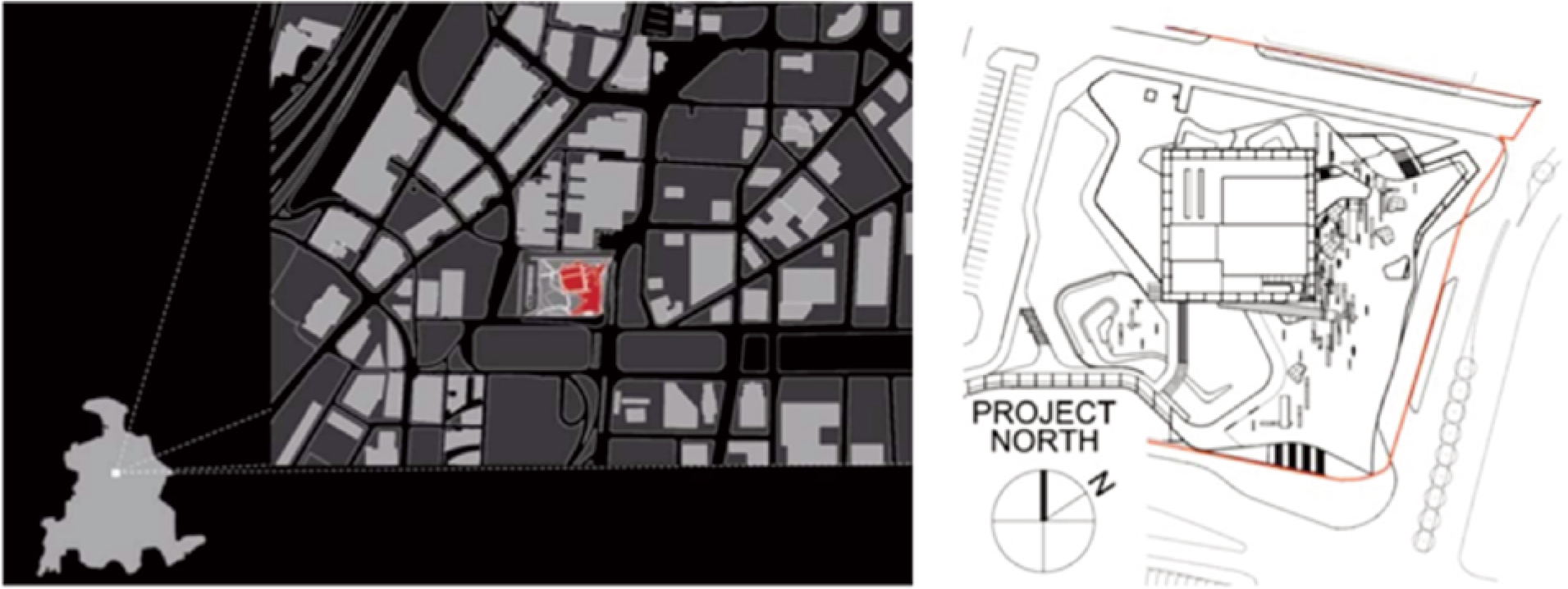
Figure 1:
Location Plan (Left) and Site Plan (Right) of Perot Museum of Nature and Science (Source: [36]
The Perot Museum of Nature and Science is constructed as a 180,000-square-foot public museum that stands 14-storey in height [8]. Overall, a total of 5 floors can be seen inside the museum that are accessible to the public accounting for 80% of the total public space inside the museum’s building [35]. On the other hand, 20% of the building floor area is designed to accommodate the private space in the museum. The public spaces consist of 11 permanent exhibition halls as well as six learning labs which are highly accessible visually and physically. The top floor of the museum is the administration office and is considered as a private space [36]. The museum acts as a pivot for an active and engaging science education by inspiring the public through an immersive and interactive environment that transcends public awareness on the significance of natural science [37].
Inside the museum, the immersive experience begins with a path through two native ecologies of Texas which intersect acting as the main entry plaza, a gathering and an event space for the visitors as well as to the general public [36]. Visitors will gather at the main entry plaza before advancing to the entry lobby. From the plaza, a landscaped roof lifts can be found to draw the visitors from a compressed space into a more expansive entry lobby. Moving from the entry lobby, the visitors’ view is channelled upwards towards the sky-lit atrium, the primary light-filled circulation space in the building. From the ground floor, a series of glass covered escalator brings the public through the atrium to the fully-glazed balcony at the uppermost level which provides a bird’s eye view of downtown Dallas, Texas.
From the balcony located above the city, the visitors can navigate downwards to the exhibition halls in a clockwise spiral path which embodies a distinctive visitor’s experience engaging the visitors towards an immediate connection to the immersive architectural and natural environment of the museum. The dynamic path gradually descends from the top floor and weaves in and out of the main circulation atrium, ultimately connecting the visitors from the internal sections of the museum to the outdoor environment of the city beyond. Accordingly, the east-facing corner of the museum opens up to reveal the activities taking place within the museum, thus allowing the visitors to engage with the museum’s architecture.
The Perot Museum of Nature and Science is located in Dallas, Texas, USA [34] as shown in Figure 1. The museum is constructed on a 4.7-acre site in Victory Park, downtown Dallas in the year 2010 and completed in year 2012 [7]. The concrete museum expresses a post-modern architectural style a trademark by Morphosis Architects. The post-modernist character of the building is apparent in the building style marked by technological and cultural elements. The architectural style of post-modernism in the building is expressed through an extension or evolution of modernist architecture, featuring digital and technological revolutions, emphasizing transformative aspects of technology through the use of cuttingedge materials and forms. The museum is conceived as a large concrete cube floating over a landscaped plinth with a glass-covered connection from the ground to the top floor as shown in Figure 2. The building form of the museum is reminiscent to a perfect cube rather than a rectangular volume as the form is more energy efficient in architecture. In addition, the museum incorporates a biophilic approach to minimise environmental footprint for long-term sustainable goals. The atrium is lit with natural daylight to boost energy efficiency performance of the building [34].
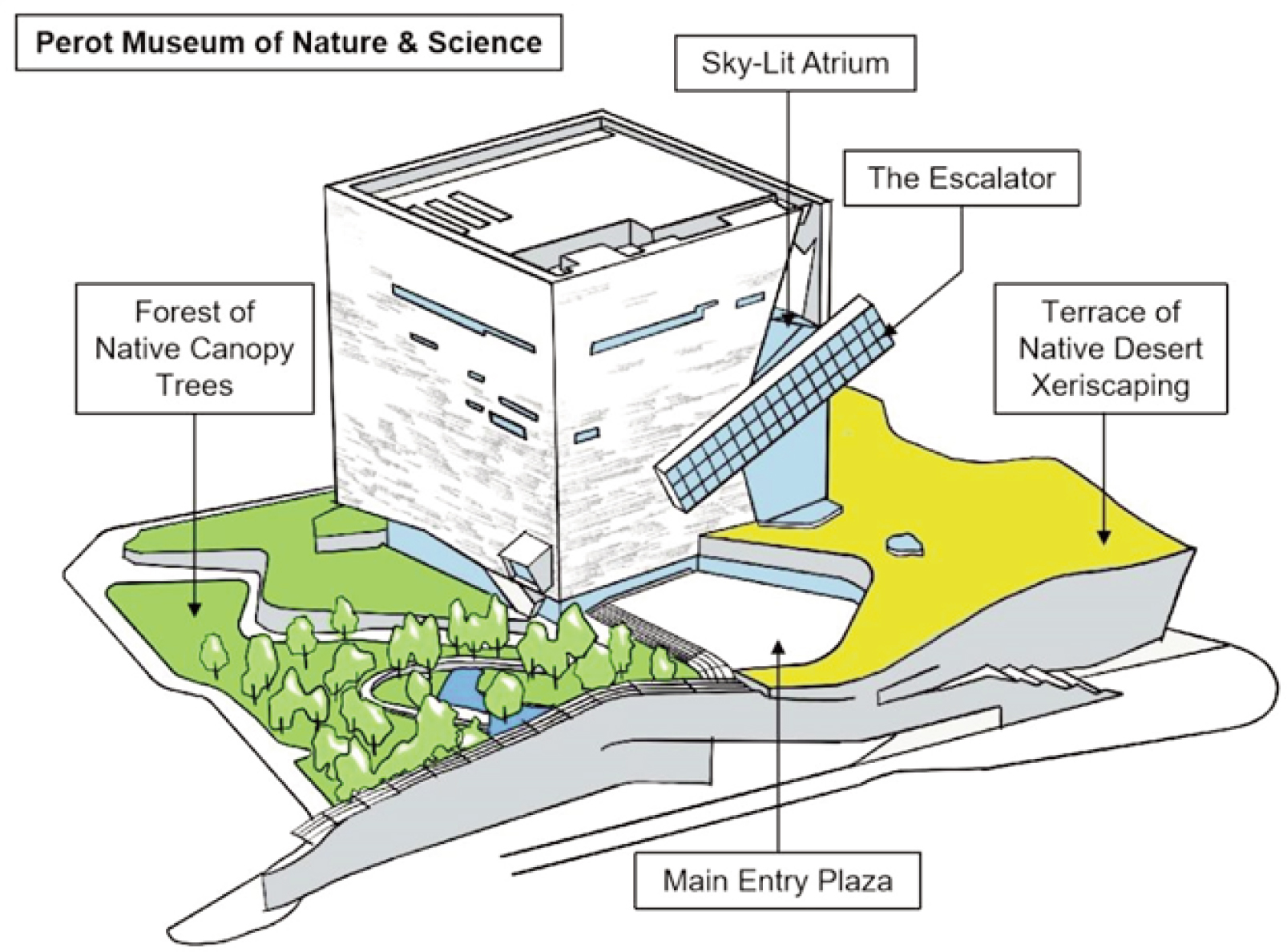
Figure 2:
Perot Museum of Nature & Science (Redrawn from source [40])
This research is conducted using a qualitative survey through Space Syntax. First and foremost, space syntax and the selected building typology are reviewed based on available sources to provide a general introduction to the case study to further analyze spatial layout and human activity patterns in the building [38].
3.2. Level of Permeability and Wayfinding
The research methodology then followed by analysing the level of permeability and wayfinding of the building using the illustrated layout plan [20]. Permeability is evaluated based on the level of users’ accessibility from one point to another indicated via Justified Graph. The ease of movement from one space to another indicate the users’ activity patterns while suggesting the level of privacy of the space.
Wayfinding is analysed through visibility in space syntax which refers to the extent of one point within a built environment can be visually accessed by another point measured through the visual connectivity of the spaces [24]. The visibility of spaces indicates the character of a space [39] whether it is designed to be a public or private space. By understanding the level of privacy of each spaces, it is easier to determine the users’ wayfinding and the social behaviour of users as well [11]. The more visible the space is, the easier the users find the space with social interaction [41].
The level of permeability and wayfinding is measured using the Likert Scale. A Likert Scale is one of the most basic and widely used tools in academic research which performs the bipolar scaling method, measuring either positive or negative response to a statement [24]. The Likert Scale of Measurement indicates the level of permeability and wayfinding by using a Justified Graph as shown in Figure 3. The justified graph is a graph that summaries the spatial configuration of all spaces being laid out from a specific space at different reference levels.
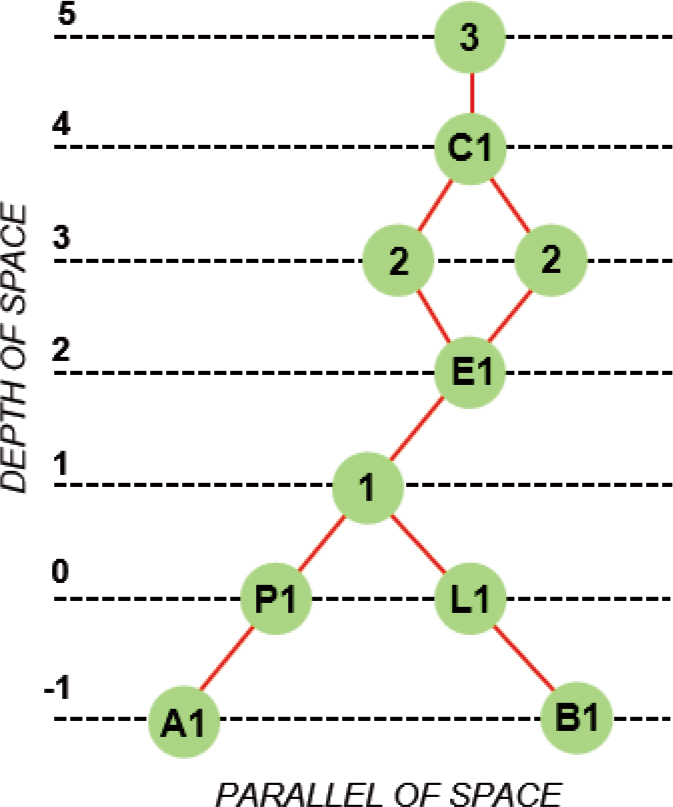
Figure 3:
Example of Justified Graph (Source: Author)
The layout plan of each level is initially illustrated using the AutoCAD software. Types of spaces in the layout plan are labelled with a numbering system which later aids in hierarchical spatial reasoning for permeability and wayfinding assessment in Justified Graph. The justified graph is constructed manually in the program based on the hierarchical order of the labelled spaces. In the Justified graph, the vertical axis represents the depth of space from the root or the starting point. As vertical axis is labelled with numerical values to indicate the level of permeability of the spaces. The spaces with high level of permeability will be arranged on the lower axes of the graph and vice versa.
Numerical numbering that is 1, 2, 3 and so on specifies the main functional spaces. including a lobby, exhibition hall, research center, and library. Alphanumerical numbering indicates the access of spaces from one point to another. For instance, N1 is indicated as the entrance into the building, vertical access such as the lift is indicated as L1 whereas E1 and S1 are indicated as escalator and staircase respectively. Furthermore, corridors are marked as C1 and C2.
On the site plan, the primary ingress is indicated as A1, and the outdoor plaza is indicated as P1. The numbering system is labelled in each floor plan to provide an in-depth understanding of the level of accessibility and wayfinding inside the building as a whole.
In addition, there is an underground floor plan for vehicular parking lots, therefore, the justified graph is extended with a negative Y-Axis. The underground floor plan is indicated as B1. Following the labelling process, the nodes are arranged based on each space level in the justified graph.
Ultimately, colours are labeled along with the numbering system to categorise the type of users involved in the space as represented in Figures 5, 7, 10, 13, 16 and 19. For instance, the pink colour represents the public known as the visitors whereas cyan represents the museum staff. Vertical access is labeled with purple and horizontal access is labeled with orange. The indications and labeling on each floor plan are then transferred to a Justified Graph to analyse the permeability and wayfinding based on the depth of space from the root.
3.3. Justified Graph
The method in analyzing the space syntax relationship patterns is performed through the justified graphs. The graph features the depth of space is described as the depth distance of space from the main entrance (root) on the y-axis. Based on the Justified Graph as shown in Figure 3, the number on Y-Axis indicates the depth of space either public, semi-public, semi-private, or private which affects the flexibility of users’ movement from one point to another [42]. Hence, the depth level of permeability decreases with the increasing number of Y-Axis [43]. The justified graph is manually drawn using illustration tools including Photoshop and Illustrator. As shown in Figure 3, number 0 indicates a space with the least privacy [44] inside the building, which is stipulated as public space [43]. In contrast, number 5 indicates a space with the highest privacy which has the lowest level of permeability to users. The space labelled as-1 indicates the spaces outside the building to indicate access from the site which is not included as part of the building. Qualitative research based on a Justified Graph is being utilized to indicate the users’ level of permeability and wayfinding in the case study building based on [11].
Accordingly, the number on the Y-Axis in the Justified Graph indicating the depth of space also shows the level of wayfinding from very easy, easy, difficult to very difficult or vice versa [44, 45]. An increase in the number of Y-Axis decreases the visual connection of users from 1 point to another and hence, lowers the level of wayfinding [46]. As shown in Figure 3 and Table 1, the number 0 indicates a space with a straightforward visual connection, which is stipulated as a public area. In contrast, number 5 indicates a space with the least visual connection and is very difficult to access visually.
Table 1.
Scale of Visibility Graph & Justified Graph, Level of Permeability & Wayfinding (Source: Author)
| Colour Scale | Visual Connectivity | Visual Integration | Level of Permeability | Level of Wayfinding | Scale of Justified Graph |
|---|---|---|---|---|---|
| Very High | Very High (Most integrated) | Extremely Public | Very Easy/Straightforward | 0 | |
| High | High (Integrated) | Public | Easy/Straightforward | 1 | |
| Medium | Medium | Semi Public | Moderate | 2 | |
| Low | Low (Segregated) | Semi Private | Difficult | 3 | |
| Very Low | Very Low (Most Segregated) | Private | Very Difficult | 4 |
3.4. Visual Analysis DepthmapX
In the present study, the DepthmapX software is used to perform simulation featuring visual accessibility based on the spatial configuration of each floor plan to study visual connectivity and visual integration through Visibility Graph Analysis (VGA). In this research, VGA is a method used to analyse the intervisibility within a building [47]. The DepthMapX software performs visibility analysis based on two measurable scales including the visual connectivity and visual integration as shown in Figure 4.
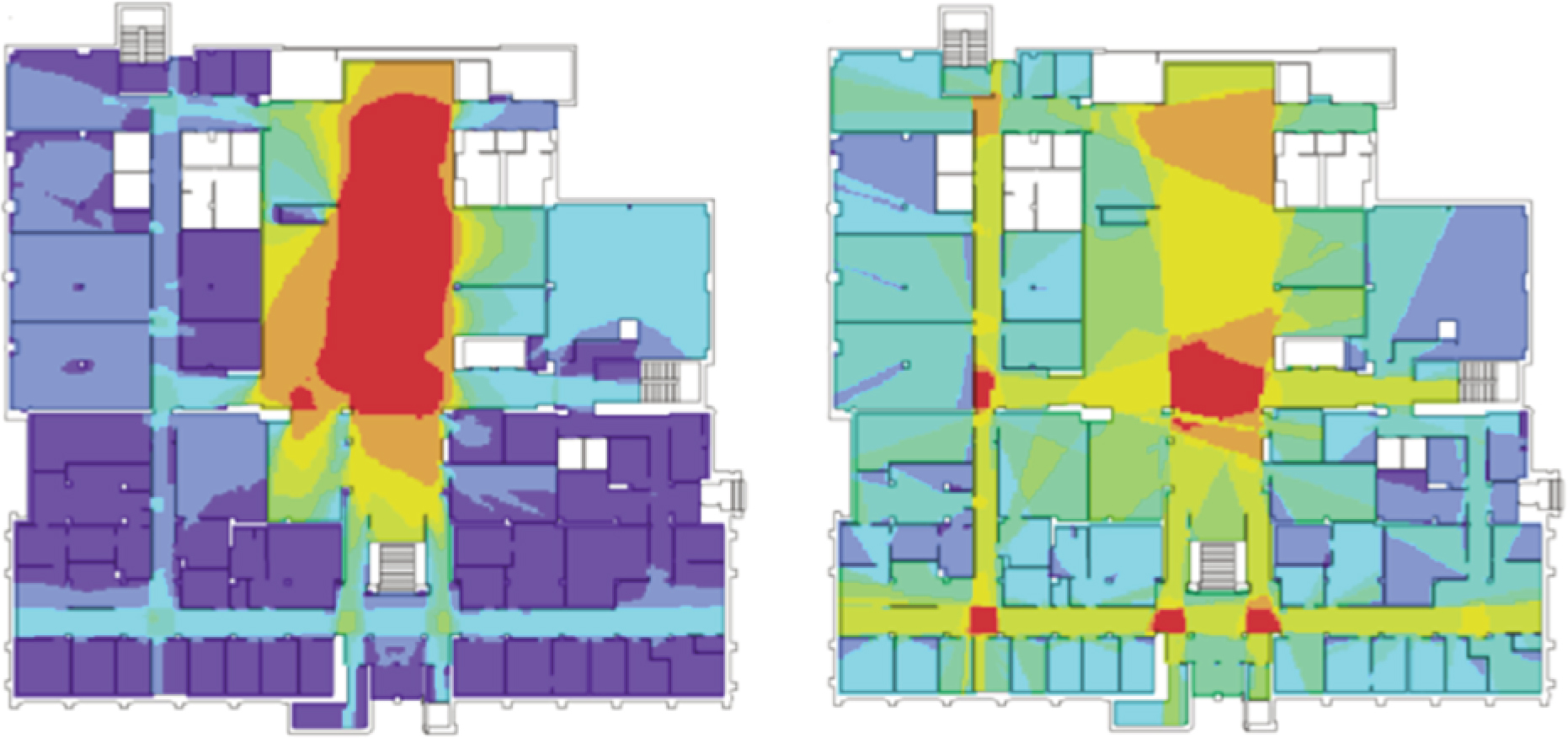
Figure 4.
Example of Visual Connectivity Graph (Left) and Visual Integration Graph (Right) of William Johnston Building (WJB) (Source: [25])
Visual integration is the centrality of a space in a spatial system [17]. The level of visual integration is also interconnected with the depth level of permeability from one point to another [14]. Highly integrated space is considered as a public space whereas the least integrated space is reflected as private space. Based on the Scale of Visibility Graph in Table 1, most integrated space is represented by red colour while the least integrated space is represented by dark blue colour.
Visual connectivity is a measure of connection within spaces in a building and is interrelated to the level of wayfinding from 1 space to another. The more visual connections of a space with the adjacent spaces, the space is more open to the public. Based on the Scale of Visibility Graph in Table 1, the most connected space is represented by red colour and is considered a public space. On the other hand, the least connected space is represented by dark blue colour and is reflected as a private space.
Levels of permeability and wayfinding are identified using hierarchical order of user behaviour affected by human movement along the spatial configuration. Levels of permeability and wayfinding are tabulated in percentages representing accessibility levels of users in primary order, secondary order, tertiary order, and so on.
4. RESULTS OF ANALYSIS
4.1. Analysis on the level of Permeability and Wayfinding
In this research, the Perot Museum of Nature and Science functions as an educational resource for the Dallas community, engaging public visitors of all ages with multi-sensory, immersive learning environments. The spatial configuration of this case study is analyzed based on users’ categories to indicate the level of permeability and wayfinding of the museum. In general, there are primarily two types of users: public visitors with the nodes labelled in pink numericals and museum staffs labelled in cyan. The types of users utilizing the spaces will be analysed to provide information on the level of accessibility of the different spaces inside the building, and indirectly the level of permeability and wayfinding of the museum. As a result, the navigation pattern and occupants’ behaviour shaped by the design of the museum can be interpreted to understand the relationship between spatial configuration and the occupants’ behaviour.
4.2. Site Plan
Based on Figure 6, the depth level of permeability on the Site Plan (Figure 5) is located at level-2 in the Justified Graph as the space demarcated is considered the exterior of the building on-site. Code for Main Entrance (N1), Side Entrance (N2), Main Lobby (1) and Entrance Lobby (B1) are coloured gray as these codes are considered under Ground Floor Plan which is located at depth level-1 onwards in Justified Graph on Ground Floor Plan (Figure 12).
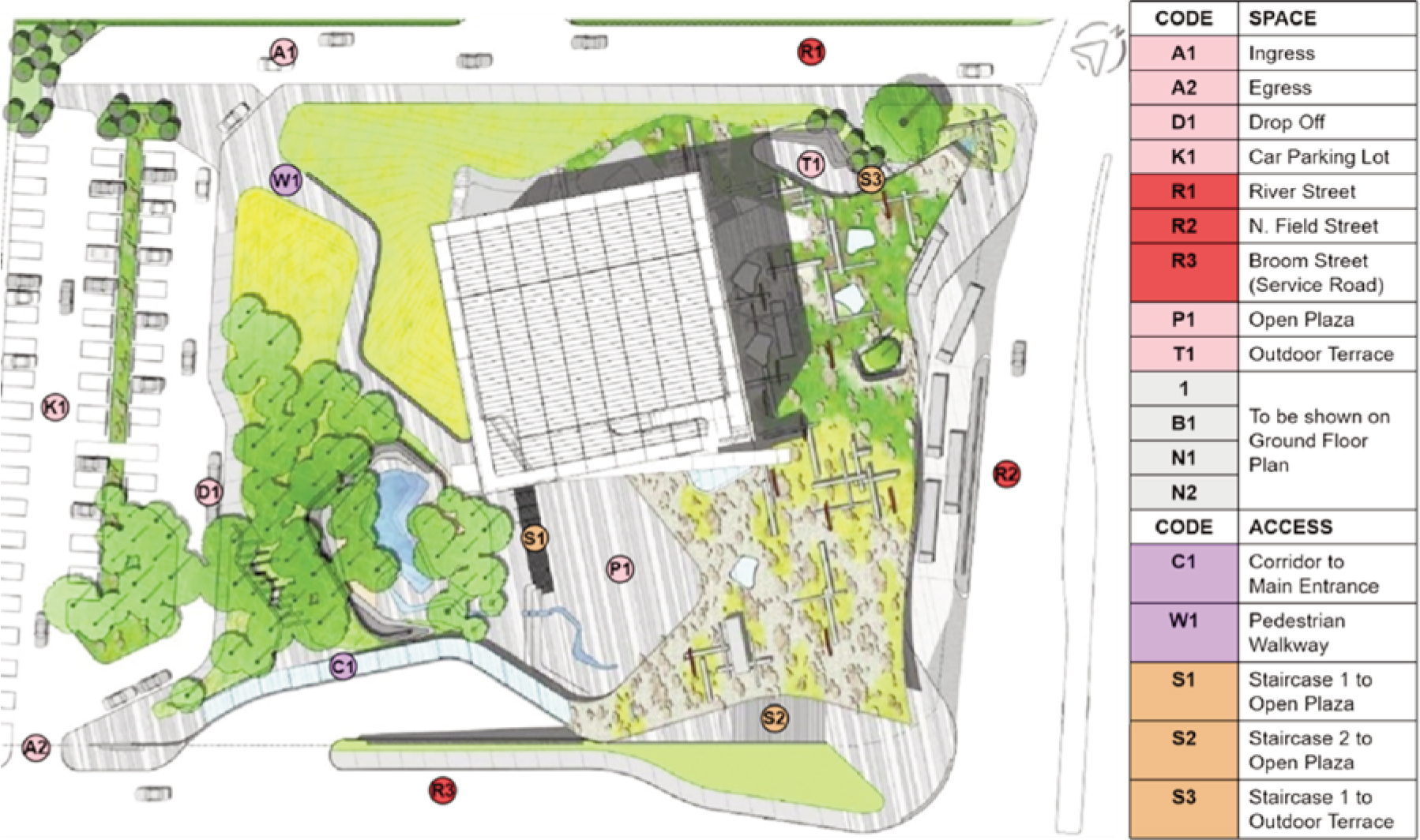
Figure 5.
Site Plan with SOA (Source: Morphosis)
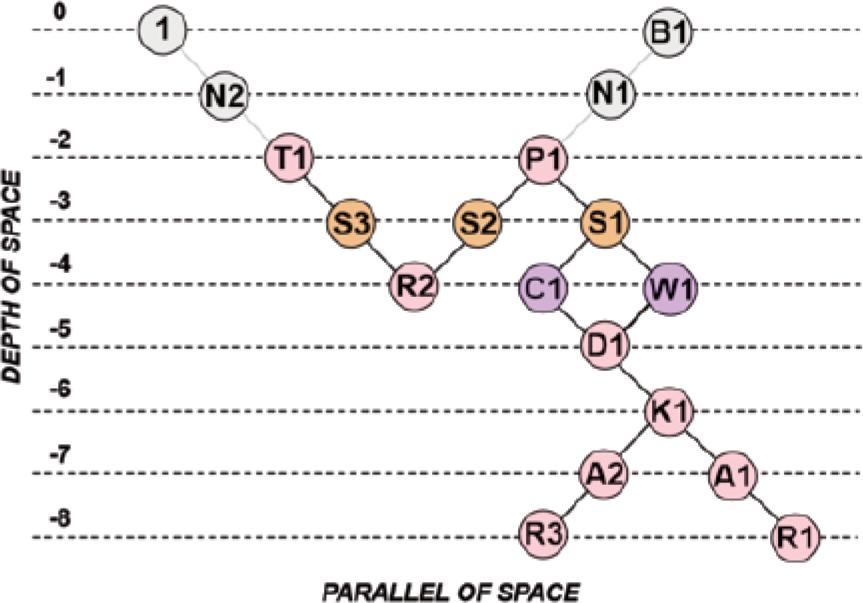
Figure 6.
Justified Graph of Site Plan (Source: Author)
4.2.1. Level of Permeability
On the Site Plan, the overall depth level of permeability is considered as public. In the Justified Graph as shown in Figure 6, the depth level at-8 is vehicular circulation. River Street (R1) is connected to Ingress (A1), and Broom Street (R3) is connected to Egress (A2). Car Parking Lot (K1) is the transition space from Ingress (A1) leading to Drop Off (D1) and then to Egress (A2). The corridor to the Main Entrance (C1) and Pedestrian Walkway (W1) connect the perimeter walkway between Drop Off (D1) and Staircase 1 (S1) which leads public visitors to Open Plaza (P1).
Another route leading to Open Plaza (P1) is Staircase 2 (S2) which is located nearer to N. Field Street (R2). Public visitors walk to Staircase 2 (S2) and Staircase 3 (S3) usually from the perimeter walkway near to coach parking lot alongside N. Field Street (R2). Staircase 2 (S2) leads public visitors to Open Plaza (P1) which gathers public visitors to Main Entrance (N1).On the other hand, Staircase 3 (S3) leads public visitors to Outdoor Terrace (T1) which gathers visitors to Side Entrance (N2).
4.2.2. Level of Wayfinding
The Site Plan is considered easy wayfinding overall as there is no blocking visually and physically from each corner of the site. At depth level-8, River Street (R1) around the site is considered straightforward as the street is straight instead of meandering. Ingress (A1) and Egress (A2) are located at both ends of the Car Parking Lot (K1) located right in front of Drop Off (D1). In addition, there is no obstacle on-site from the perimeter walkway blocking the view towards Main Entrance (N1) and Side Entrance (N2) despite the leveling on-site.
From Drop Off (D1), there is easy wayfinding to Open Plaza (P1) through the Corridor to the Main Entrance (C1) and Pedestrian Walkway (W1). With a flight of Staircase 1 (S1), public visitors will reach Open Plaza (P1). From N. Field Street (R2), there is coach parking alongside N. Field Street (R2), easy wayfinding from the coach parking lot to Staircase 2 (S2) towards Open Plaza (P1) and to Staircase 3 (S3) towards Outdoor Terrace (T1). Open Plaza (P1) and Outdoor Terrace (T1) are located at depth level-2. Hence, there are a few phases of movement from depth level-8 to reach Open Plaza (P1) and Outdoor Terrace (T1).
4.3. Lower Floor Plan
Based on Figure 8, the depth level of permeability on the Lower Floor Plan (Figure 7) is located at level 3 in the Justified Graph.
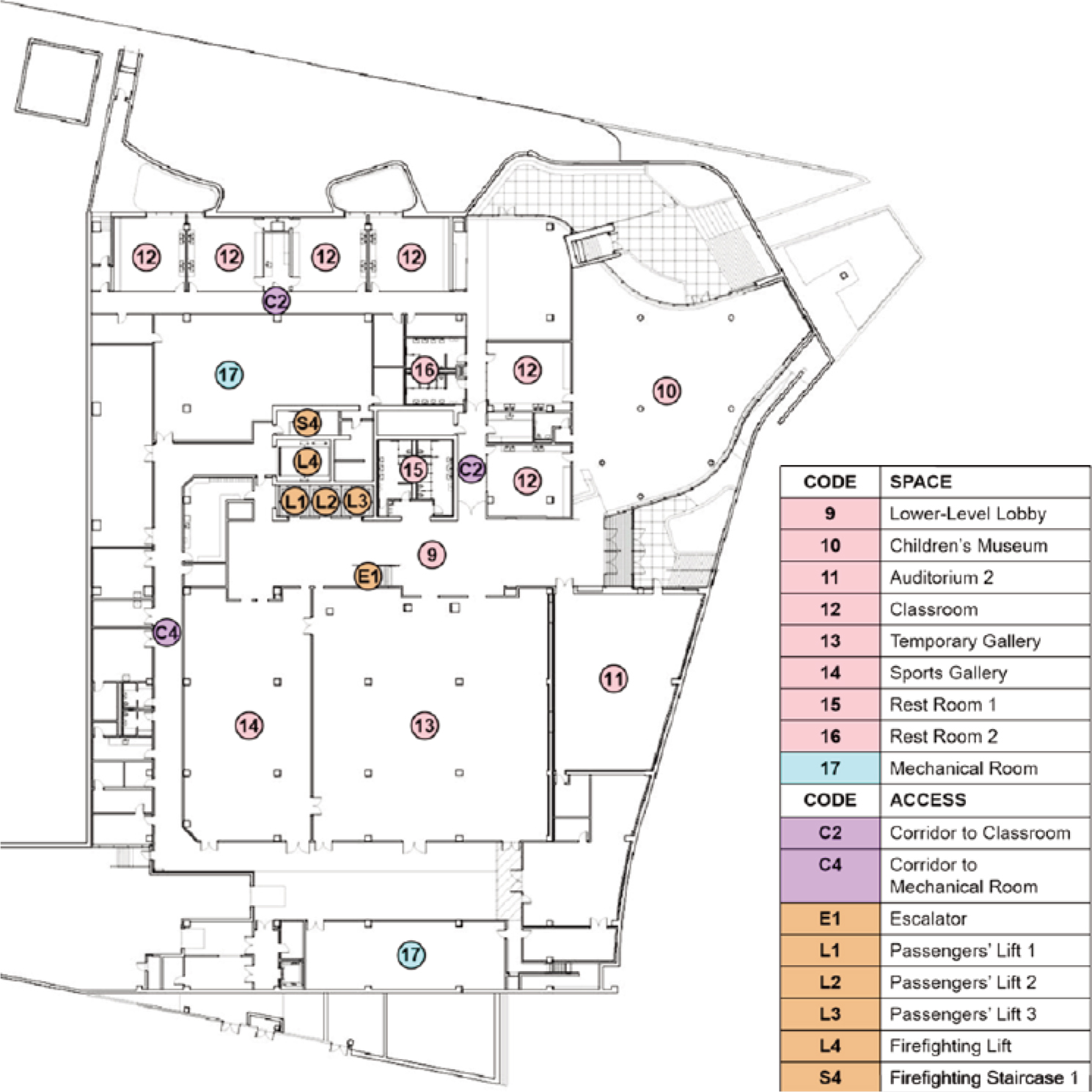
Figure 7.
Lower Floor Plan with SOA (Source: Morphosis)
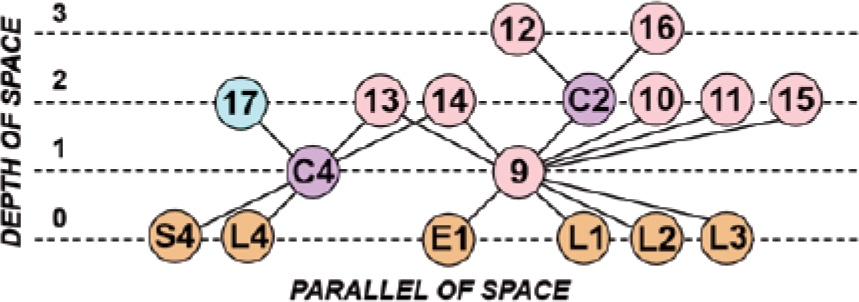
Figure 8.
Justified Graph of Lower Floor Plan (Source: Author)
4.3.1. Level of Permeability
At depth level 0, there is vertical access including Lift 1 (L1), Lift 2 (L2), Lift 3 (L3), Lift 4 (L4), and Staircase 4 (S4) from Ground Floor to Lower Floor and is considered as public space. Therefore, the Visual Connectivity Graph shows a dark blue colour for the vertical access indicating private should be justified as public space. Lower-Level Lobby (9) located at depth level 1 is considered a public space and is used to gather visitors before segregated into semi-public spaces including the Children’s Museum (10), Temporary Gallery (13), and Sports Gallery (14).
Furthermore, Classrooms (12) located at depth level 3 are considered semi-private spaces as the classrooms are connected through Corridor (C2) from the Lower-Level Lobby (9). The corridor to the Mechanical Room (C4) is considered a corridor connecting private space comprising the Mechanical Room (17), the back of house of the Temporary Gallery (13), and the Sports Gallery (14).
4.3.2. Level of Wayfinding
The Lower-Level Lobby (9) provides a high visual connection to the surrounding space which provides very easy wayfinding (based on Figure 9). Hence, the Lower-Level Lobby (9) should be coloured yellowish-orange in the Visual Connectivity Graph. Lower Level Lobby (9), Children’s Museum (10), Temporary Gallery (13), and Sports Gallery (14) are highly integrated with surrounding spaces as shown in Visual Integration Graph with the colour yellow, showing easy access to surrounding spaces. Classrooms (12) are considered as difficult to access as connected by Corridor (C2). Hence, coloured dark blue as shown in Visual Connectivity Graph. Mechanical Room (17) is very difficult to access due to being located at the back of house and only connected by Corridor (C4).
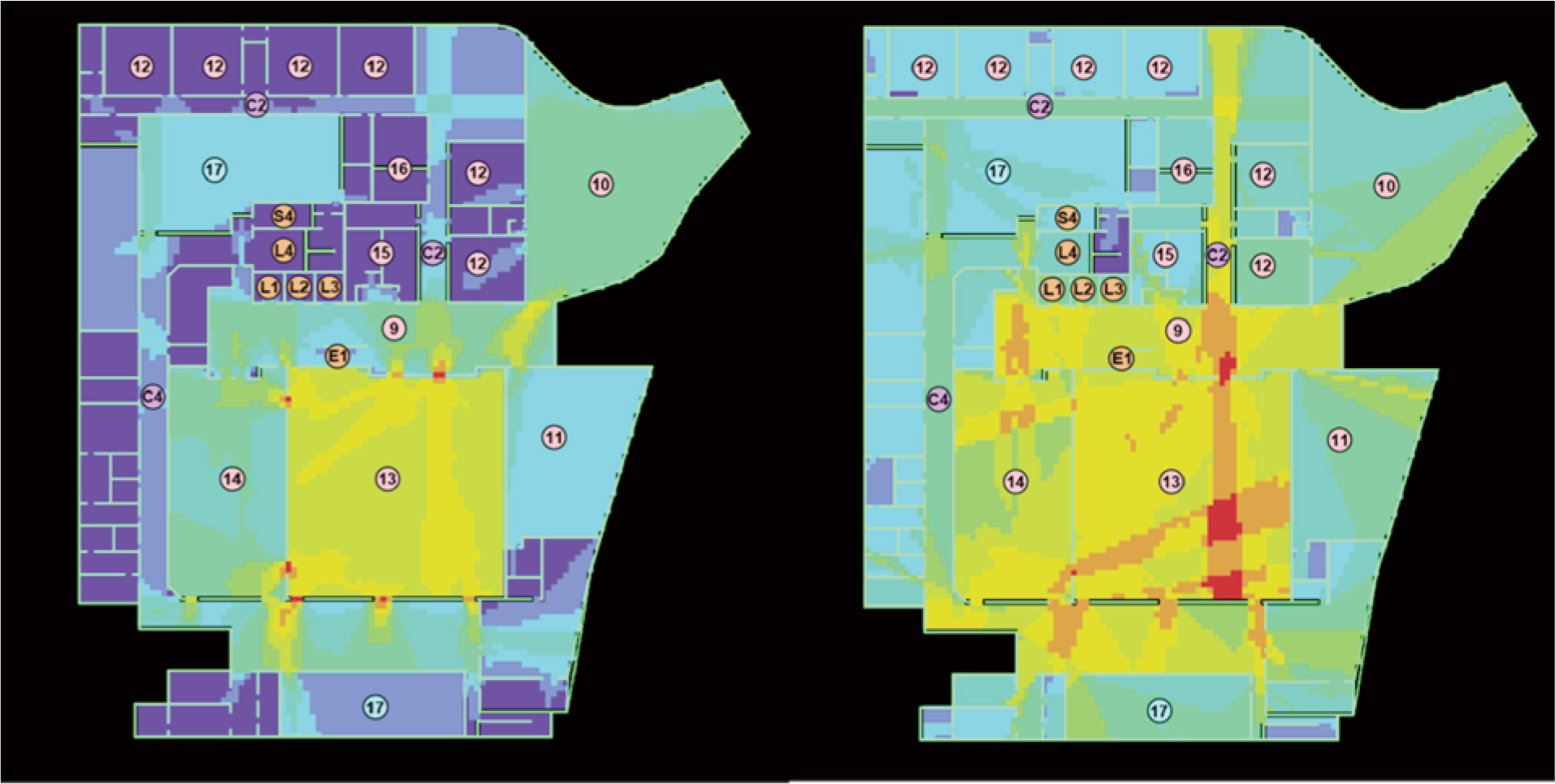
Figure 9.
Visual Connectivity Graph (Left) & Visual Integration Graph (Right)
4.4. Ground Floor Plan
Based on Figure 11, the depth level of permeability on the Ground Floor Plan (Figure 10) is located at level 3 in the Justified Graph. Codes for Staircase 1 to Open Plaza (S1), Staircase 1 to Outdoor Terrace (S3), Outdoor Terrace (T1), and Open Plaza (P1) are coloured gray as belong to Site Plan.
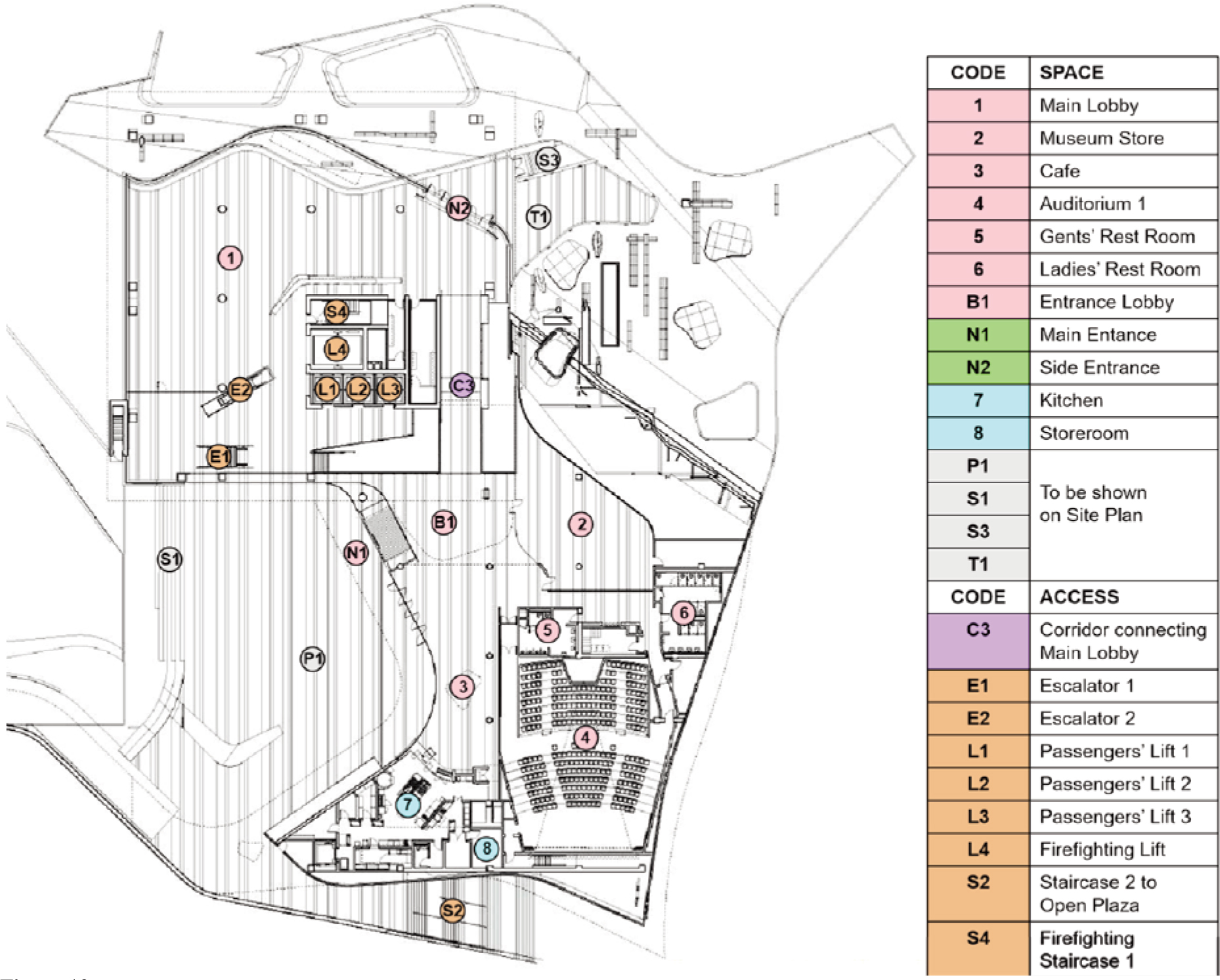
Figure 10.
Ground Floor Plan with SOA (Source: Morphosis)
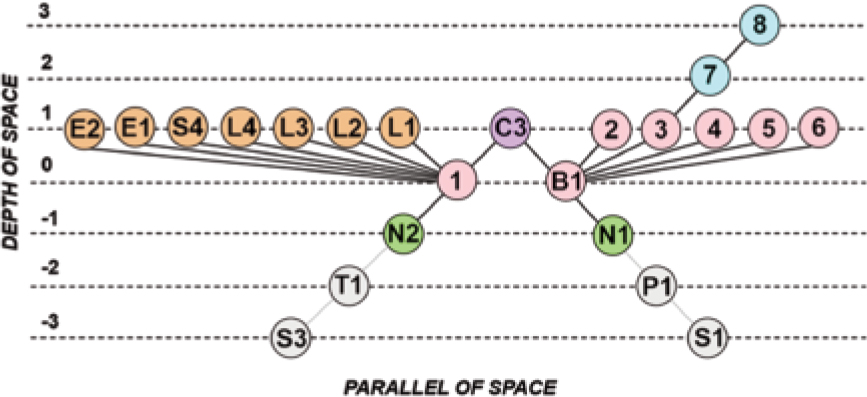
Figure 11.
Justified Graph of Ground Floor Plan (Source: Author)
4.4.1. Level of Permeability
In reference to the justified graph in Figure 11, the Entrance Lobby (B1) is a public space located at depth level 0. Access through the Main Entrance (N1) to the Entrance Lobby (B1) is highly integrated with the surrounding space which leads people into the Entrance Lobby (B1) seamlessly. Besides, visitors at the Main Entrance (N1) also have a high visual connection to the Entrance Lobby (B1), a space used to gather visitors before proceeding to the Main Lobby (1). There is a main axis connecting the Entrance Lobby (B1) and Main Lobby (1), which is a Corridor connecting 2 Lobbies (C3) at depth level 1 in the Justified Graph. Besides, the main axis is a public space providing high visual integration which attracts visitors to move along the connected spaces. At depth level 0, Main Lobby (1) is an open plan space, hence has a moderately high visual connection.
Side Entrance (N2) located at the Main Lobby (B1) is considered extremely public and used to welcome visitors from Outdoor Terrace (T1). In the Visual Connectivity Graph and Visual Integration Graph, the Side Entrance (N2) is coloured yellow indicating high visual connection and highly integrated. Museum Store (2) and Cafe (3) are semi-public spaces where public visitors enter occasionally. Auditorium (4) is also a semi-public space where visitors enter for certain events. The kitchen (7) and Storeroom (8) are at the back of house and considered semi-private whereby only staff can enter for their task and routine. At depth level 1, vertical access leads visitors to the Upper Floor for further public exhibition events.
4.4.2. Level of Wayfinding
As shown in the Visual Connectivity Graph (Figure 12), the Entrance Lobby (B1) at depth level 0 has very easy wayfinding from Open Plaza (P1). From the Site Plan, there is straightforward access to 2 entrances, the Main Entrance (N1) and Side Entrance (N2) into the building as shown in both the Visual Connectivity Graph and Visual Integration Graph. At depth level 1, Museum Store (2), Cafe (3), and Auditorium 1 (4) show easy wayfinding. Public visitors can easily find these spaces when they reach the Entrance Lobby (B1). The corridor connecting 2 Lobbies (C3) provides a moderate visual connection between the Entrance Lobby (B1) and the Main Lobby (1).
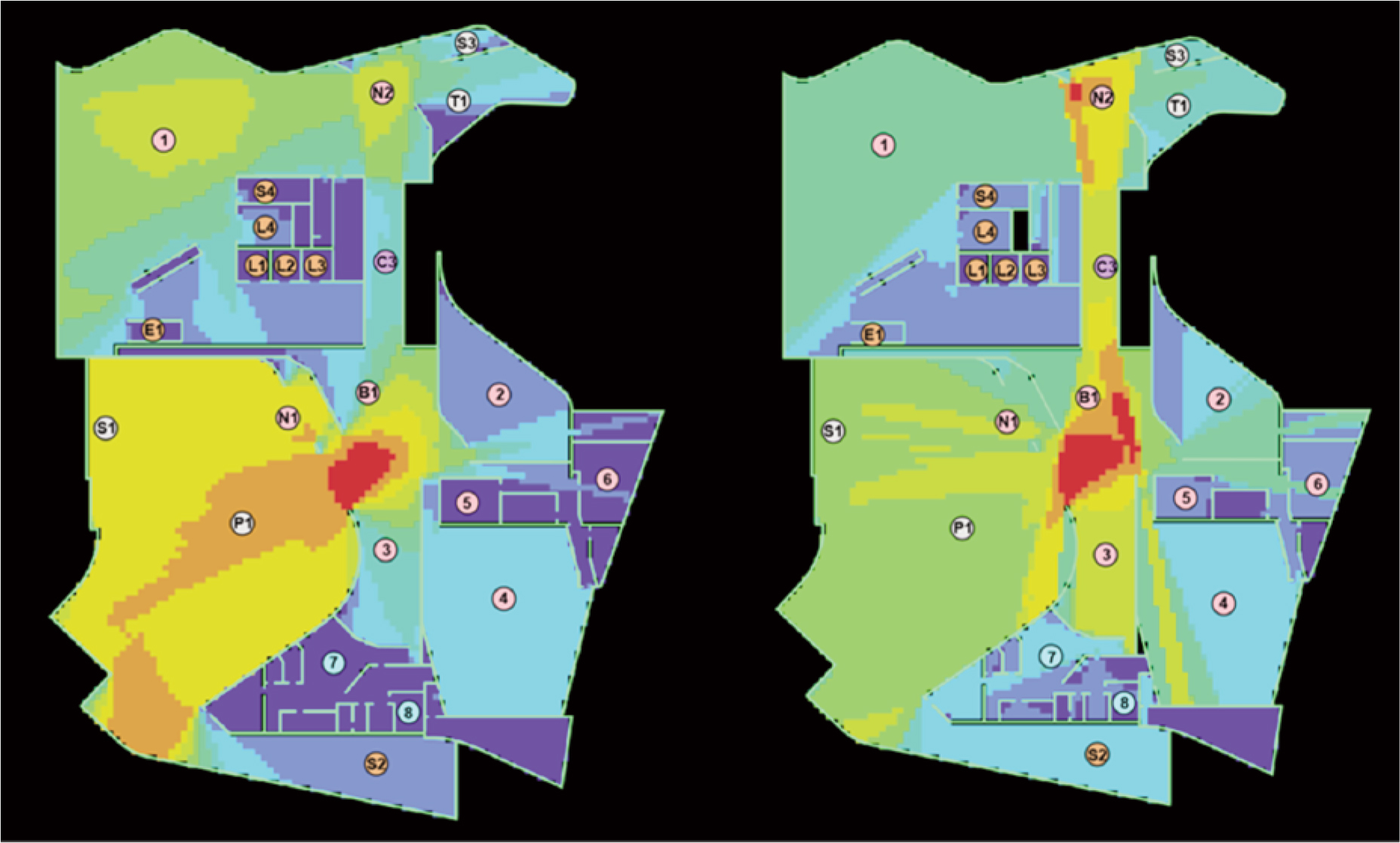
Figure 12.
Visual Connectivity Graph (Left) & Visual Integration Graph (Right)
Corridor connecting 2 Lobbies (C3) provides easy access for the visitors to the main lobby both visually and physically as shown in the Visual Integration Graph. The kitchen (7) and Storeroom (8) are coloured dark blue in the Visual Connectivity Graph as located at the back of house. Kitchen (7) is difficult to access for the public as authorised for staff at the cafe only. Storeroom (8) is very difficult to access, only staff at Kitchen (7) and Auditorium 1 (4) have a visual connection to Storeroom (8) and enter for maintenance and services. Vertical access from the Main Lobby (1) provides moderate wayfinding with a low visual connection to the surrounding space but will move visitors to the Upper Floor.
4.5. Mezzanine Floor Plan
Based on Figure 14, the depth level of permeability on the Mezzanine Floor Plan (Figure 13) is located at level 1 in the Justified Graph.
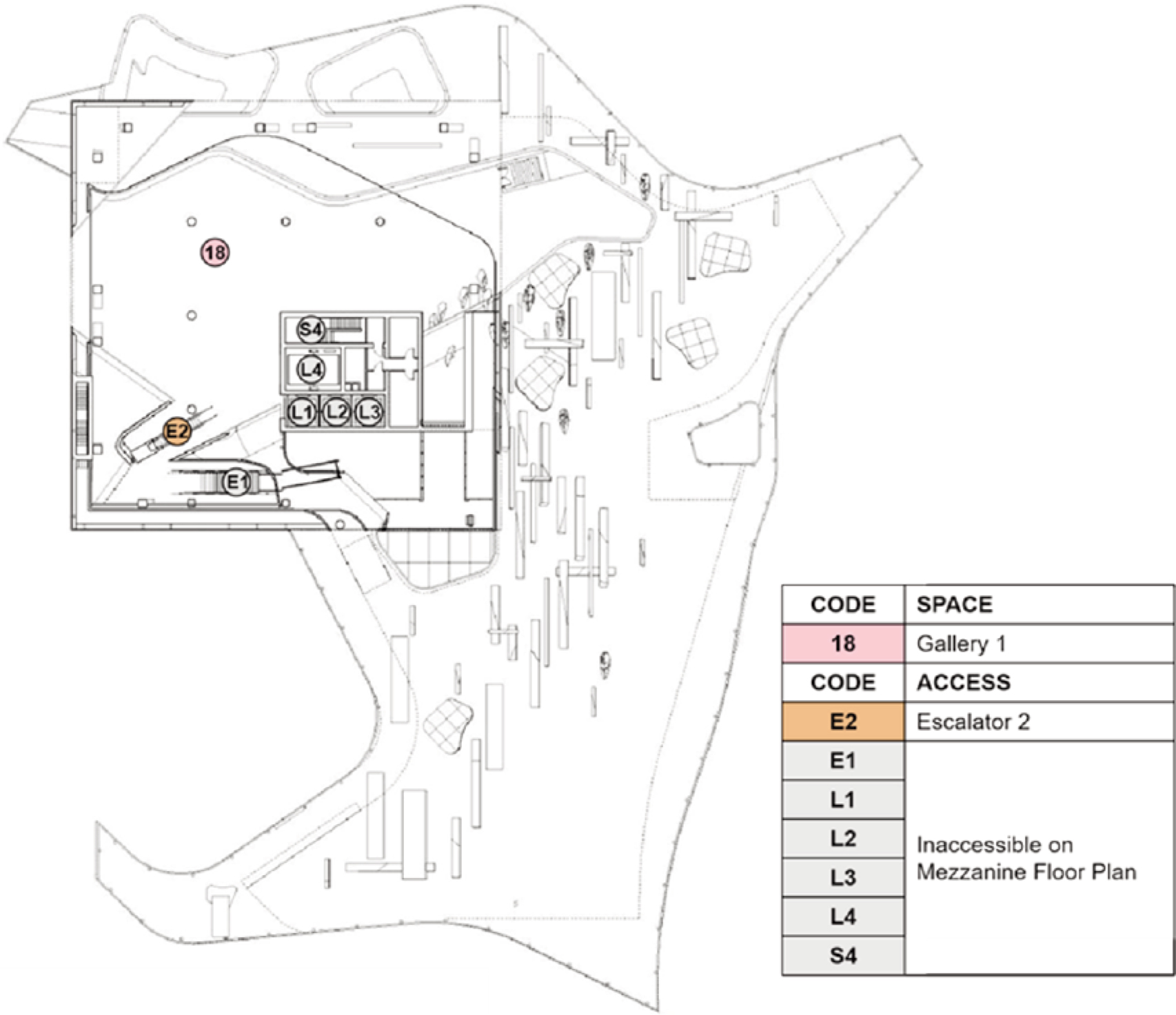
Figure 13.
Mezzanine Floor Plan with SOA (Source: Morphosis)
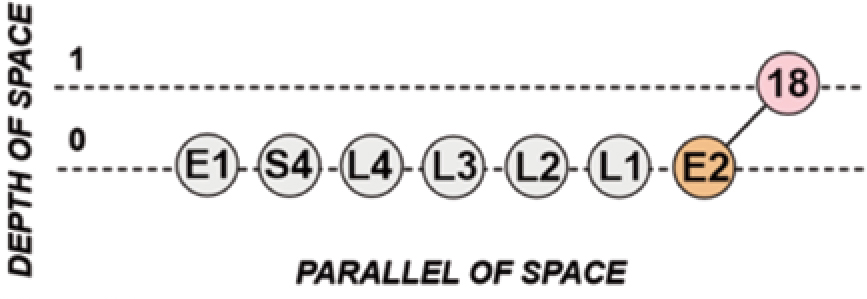
Figure 14.
Justified Graph of Mezzanine Floor Plan (Source: Author)
4.5.1. Level of Permeability
Gallery 1 (18) is an open plan public gallery space with red in the Visual Connectivity Graph and yellow to red in the Visual Integration Graph. Escalator 1 (E1) is an escalator connecting the Ground Floor to the Upper Floor with no access to the Mezzanine Floor. Escalator 2 (E2) caters to the public and should be in colour yellowish-orange instead of dark blue as Escalator 2 (E2) is visually connected and moderately integrated with Mezzanine Floor. Red is not coloured in Escalator 2 (E2) as Escalator 2 (E2) is a passageway that does not provide high visual connectivity and is not highly integrated into the surrounding space. The shaft system vertical access is considered private on the Mezzanine Floor Plan and is kept a dark blue colour in the Visual Connectivity Graph due to no access from the Mezzanine Floor Plan. The shaft system vertical access only provides a passageway for the lift car and fire escape for other floors.
4.5.2. Level of Wayfinding
Based on Figure 15, Gallery 1 (18) has very easy wayfinding as an open plan. The only access to this space being Escalator 2 (E2) from Ground Floor. Escalator 2 (E2) is an escalator from the Ground Floor and provides the only access to the Mezzanine Floor. Escalator 1 (E1) has low visual connectivity and does not provide access to the Mezzanine Floor hence, coloured dark blue in both the Visual Connectivity Graph and Visual Integration Graph. Lift 1 (L1), Lift 2 (L2), Lift 3 (L3), Lift 4 (L4) and Staircase 4 (S4) are not coloured in Visual Integration Graph by depthmapX due to no integration with surrounding space.
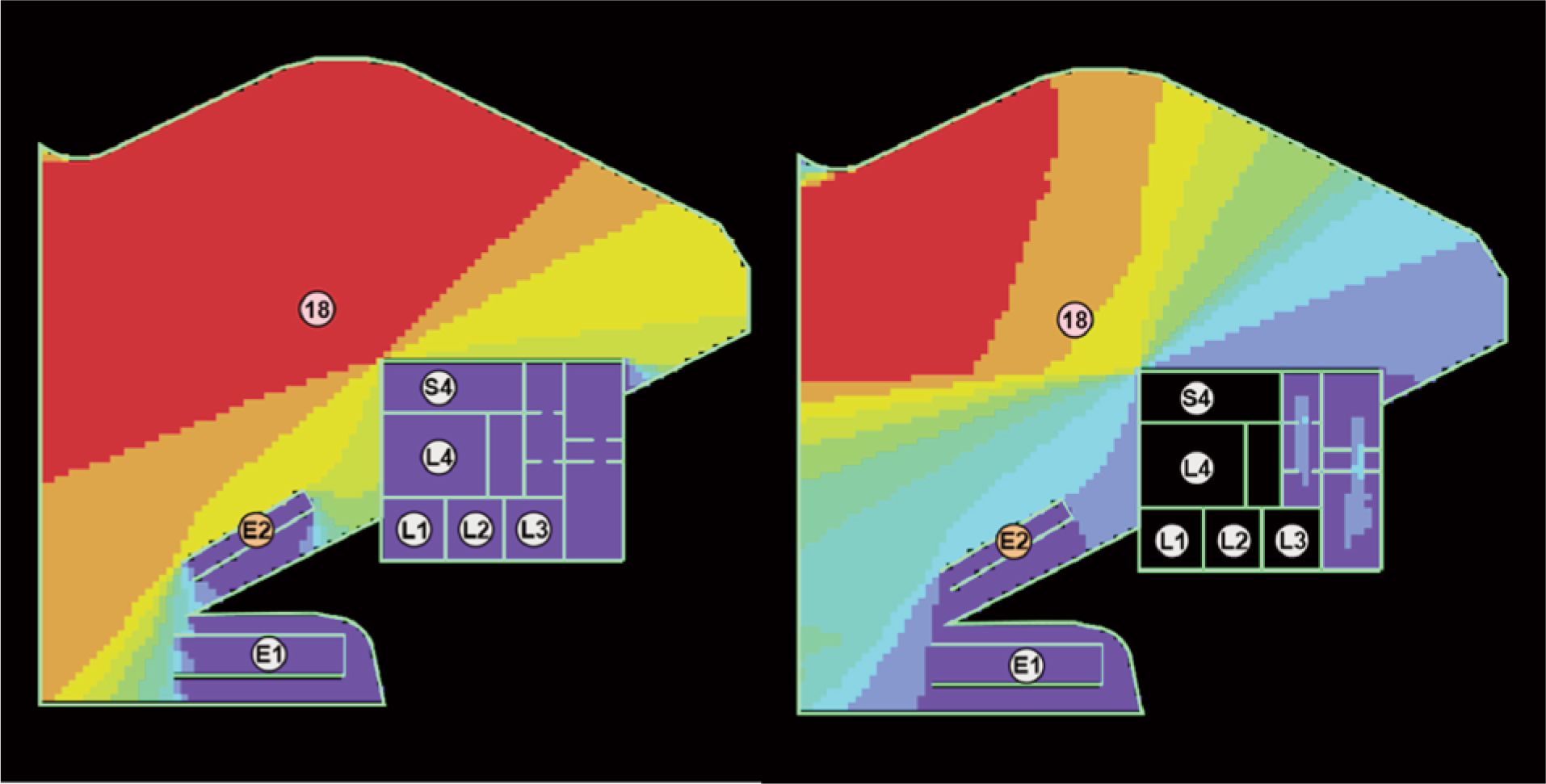
Figure 15.
Visual Connectivity Graph (Left) & Visual Integration Graph (Right) (Source: Author)
4.6. Upper Floor Plan
Based on Figure 17, the depth level of permeability on the Upper Floor Plan (Figure 16) is located at level 3 in the Justified Graph.
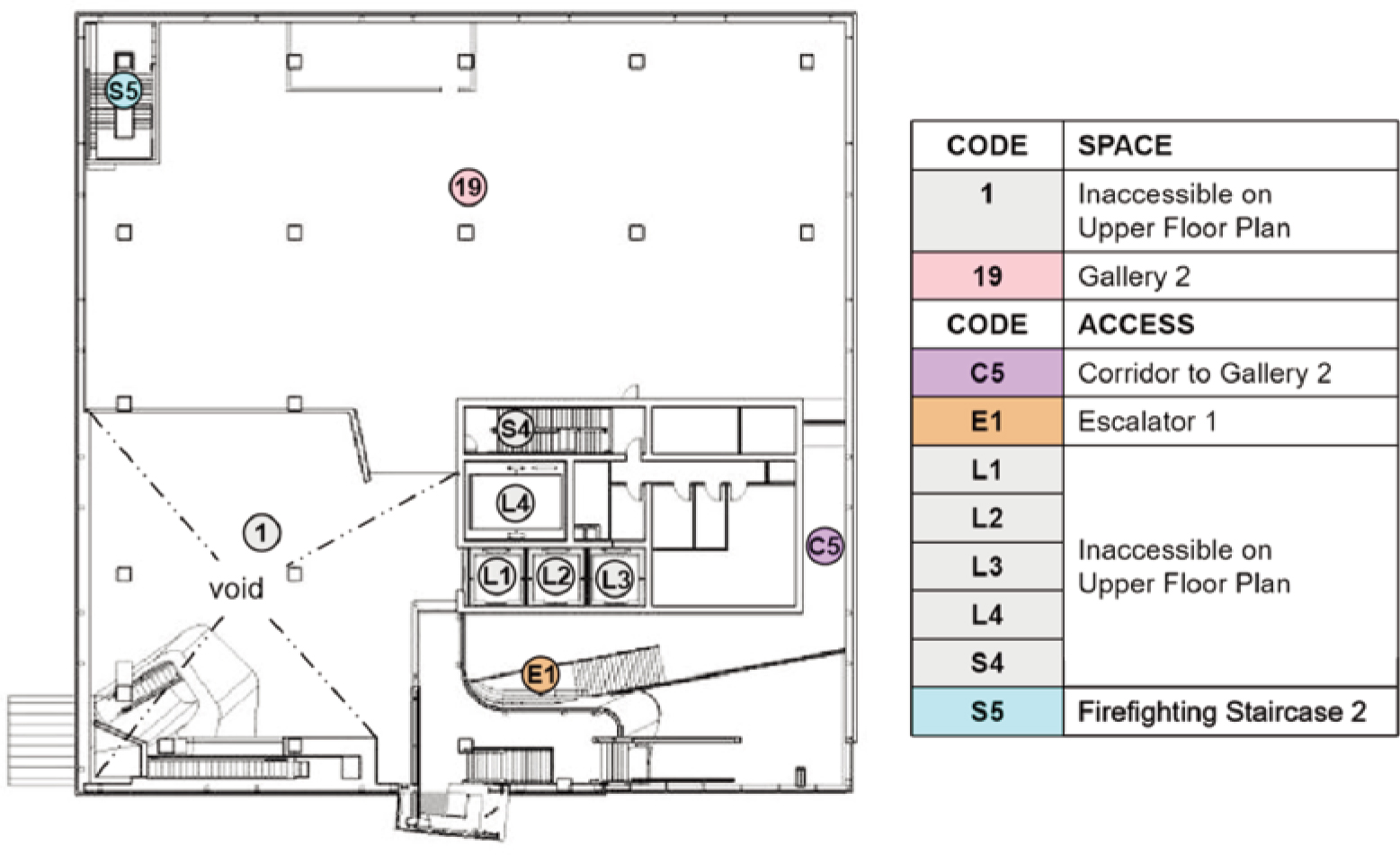
Figure 16.
Upper Floor Plan with SOA (Source: Morphosis)
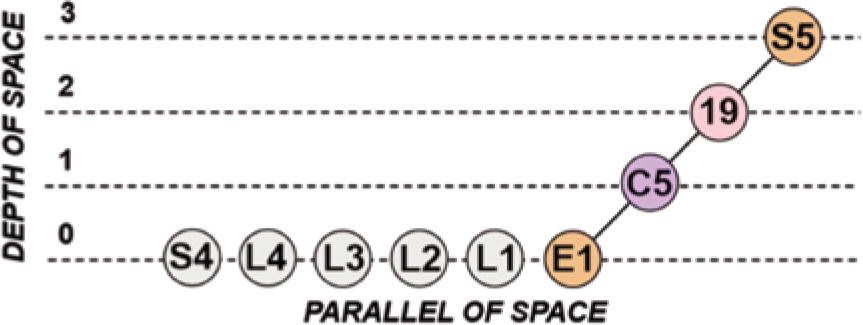
Figure 17.
Justified Graph of Upper Floor Plan (Source: Author)
4.6.1. Level of Permeability
In depthmapX in Figure 18, Gallery 2 (19) is located further away from the core space on the plan, hence coloured turquoise in Visual Integration Map. However, Gallery 2 (19) is the main space on the Upper Floor Plan and is a public space. Hence, has high visual connectivity as coloured red in the Visual Connectivity Graph. The only access to Gallery 2 (19) is Escalator 1 (E1), which connects from the Ground Floor. Although Escalator 1 (E1) caters to the public, this vertical access provides limited visual connection to Gallery 2 (19) as is located alongside of building. Hence, coloured dark blue in the Visual Connectivity Graph. The corridor to Gallery 2 (C5) connecting Escalator 1 (E1) and Gallery 2 (19) is also a public space, but coloured in turquoise to dark blue colour due to low visual connectivity and low integration as located alongside building as well.
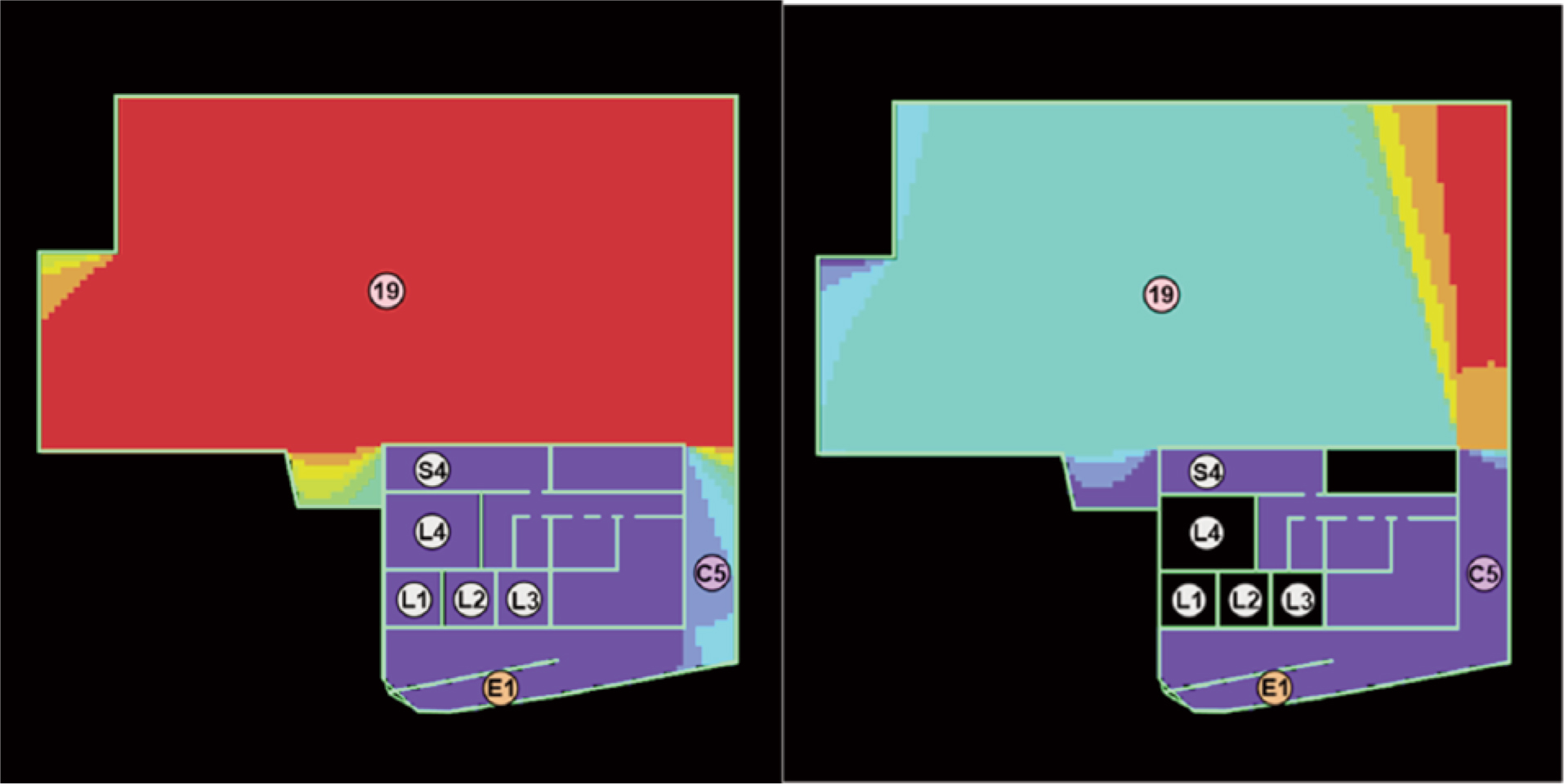
Figure 18.
Visual Connectivity Graph (Left) & Visual Integration Graph (Right)
4.6.2. Level of Wayfinding
As Gallery 2 (19) is also an open-plan space, hence provides very easy wayfinding for the visitors. There is only one access to Gallery 2 (19): Escalator 1 (E1) followed by Corridor to Gallery 2 (C5) is considered as straightforward access. However, their location is alongside the building, hence is coloured turquoise to dark blue in depthmapX. Shaft system vertical access provides no access to the Upper Floor Plan inhibiting visual connection and no integration with surrounding space. The vertical access is only a passageway for the lift car and fire escape for other floors. At depth level 3, Firefighting Staircase 2 (S5) is not accessible on this floor plan, hence not analysed in depthmapX.
4.7. Top Floor Plan
Based on Figure 20, the depth level of permeability on the Top Floor Plan (Figure 19) is located at level 3 in the Justified Graph.
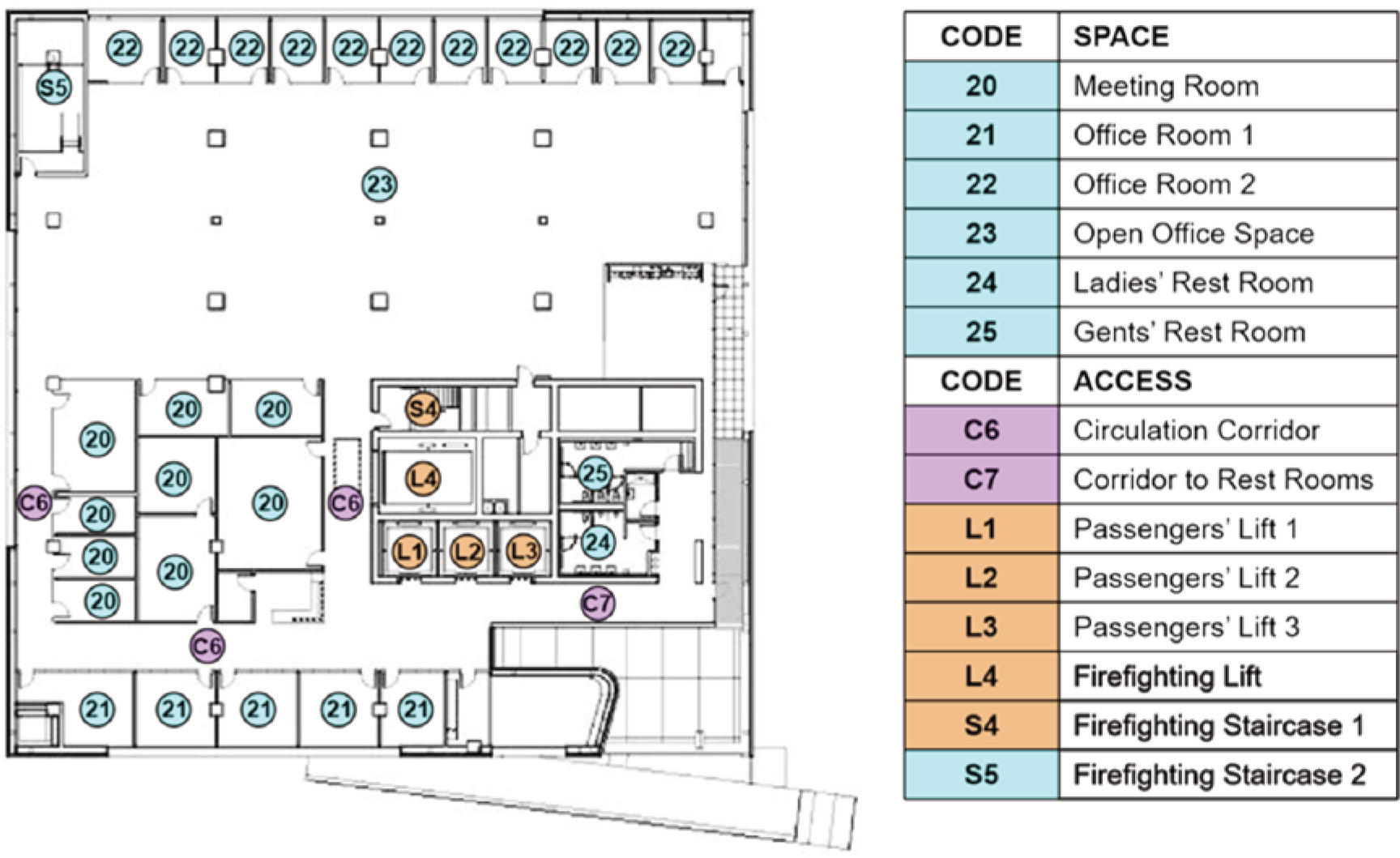
Figure 19:
Top Floor Plan with SOA (Source: Morphosis)
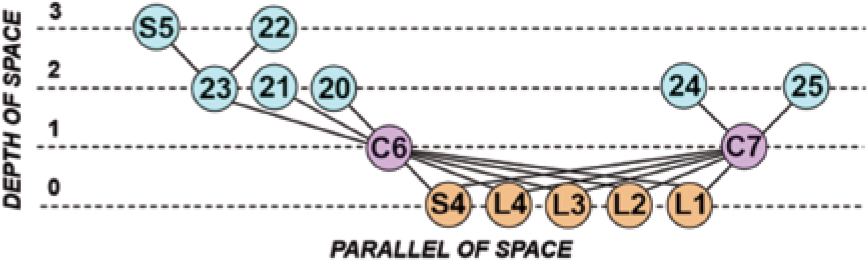
Figure 20:
Justified Graph of Top Floor Plan (Source: Author)
4.7.1. Level of Permeability
The Top Floor Plan is considered a private space in the overall view of this building, with only catering staff for admin and management. Open Office Space (23) is located at depth level 2 although strongly integrated with surrounding space due to Circulation Corridor (C6) existing as transition space from vertical access. Open Office Space (23) is an open-plan workspace that provides high visual connection and is highly integrated with surrounding spaces, considered a semi-public space for the staff. Meeting Rooms (20) are semi-private spaces for collaboration between staff and invited parties. Office Rooms 1 (21) and Office Rooms 2 (22) are located along the building perimeter providing private space in which only authorised staff can enter designated office rooms. Shaft system vertical access control access whereby only staff can reach the Top Floor hence is considered a semi-public passageway.
4.7.2. Level of Wayfinding
Vertical access located at depth level 0 is connected from the Ground Floor Plan. It becomes the main access in this building. The Top Floor Plan provides very easy vertical access for staff but not for the public. Open Office Space (23) is an open-plan workspace and provides very easy wayfinding to Office Rooms 2 (22). Circulation Corridor (C6) at depth level 1 also provides moderately easy wayfinding to Meeting Rooms (20) and Office Rooms 1 (21) by providing an island oneway access. However, low visual connection is established (as shown in Figure 20) from Open Office Space (23) towards Office Rooms 1 (21) as Office Rooms 1 (21) are located alongside the building and blocked by Meeting Rooms (20).
Ladies’ Rest Room (24) and Gents’ Rest Room (25) are difficult for wayfinding as located at the back of vertical access, and only connected by Corridor (C7). Ladies’ Rest Room (24) and Gents’ Rest Room (25) are coloured dark blue in the Visual Connectivity Graph due to low visual connection and are less integrated with the main space on the Top Floor Plan as shown in Figure 21. At depth level 3, Firefighting Staircase 2 (S5) is coloured dark blue due to being isolated at the corner of the building and less integrated from the main space leading to difficult physical access to Firefighting Staircase 2 (S5).
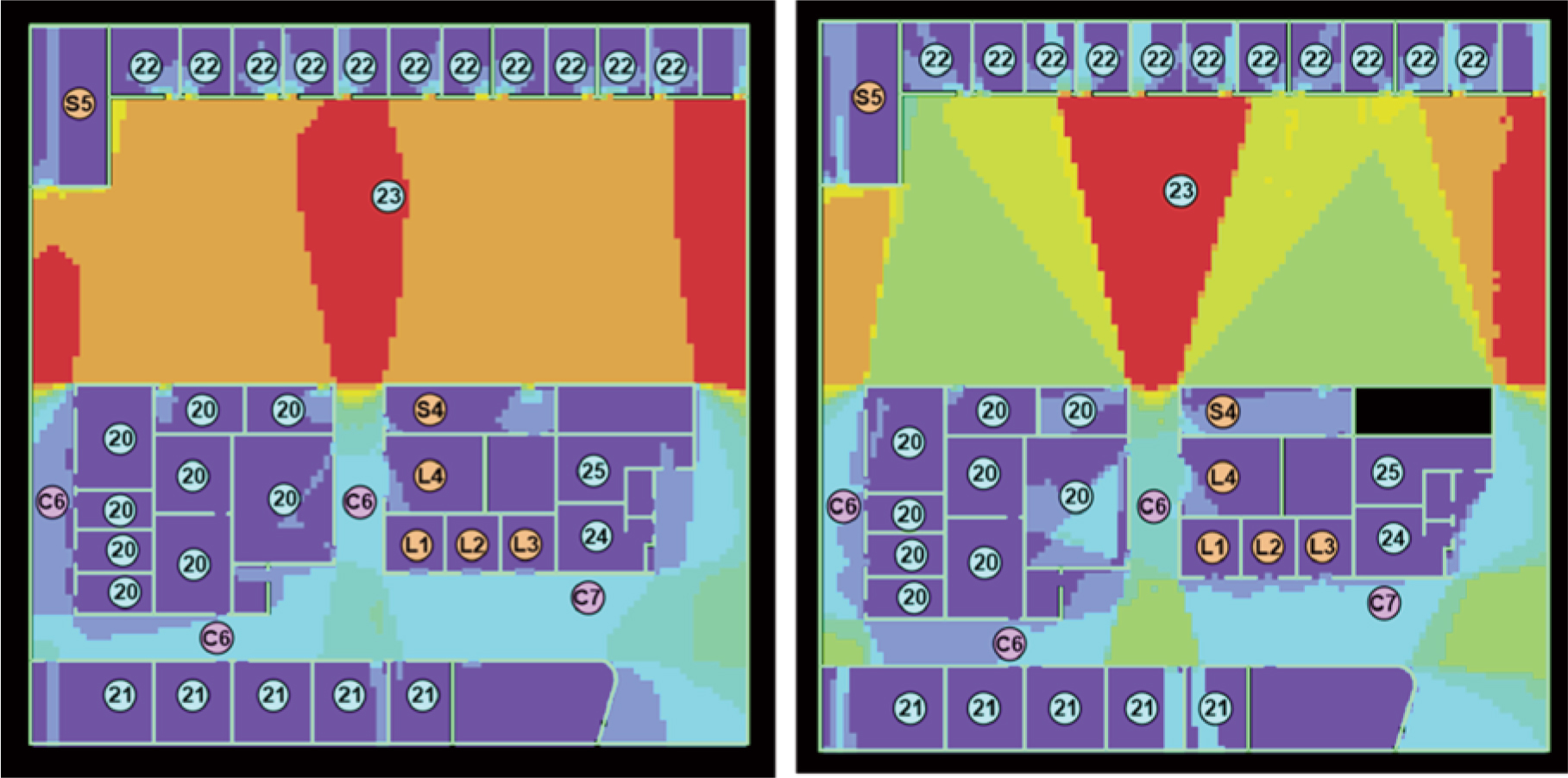
Figure 21.
Visual Connectivity Graph (Left) & Visual Integration Graph (Right) (Source: Author)
5. DISCUSSION
5.1. Overall Results of Analysis
The depth level of the site plan in Figure 6 is demarcated at depth level 0 and below, the route to Main Entrance (N1) shows an asymmetrical spatial system with 7 depth levels from River Street (R1) and Broom Street (R3). The asymmetrical spatial system on site (Figure 6) shows that the vehicular path is not directly connected to the building indicating high privacy of the building interior from the exterior.
Overall Justified Graph in Figure 22 shows a symmetrical spatial system as indicated by an array of coded spaces located at depth level 1 in Justified Graph including vertical access to upper floors and other ancillary spaces. The coded spaces are directly connected to root spaces: Entrance Lobby (B1) and Main Lobby (1). On top of that, as indicated at depth level 0, Entrance Lobby (B1) and Main Lobby (1) are the root spaces with 2 main security access for the public namely Main Entrance (N1) and Side Entrance (N2) located at depth level-1. A symmetrical spatial system eases circulation management, security and public circulation.
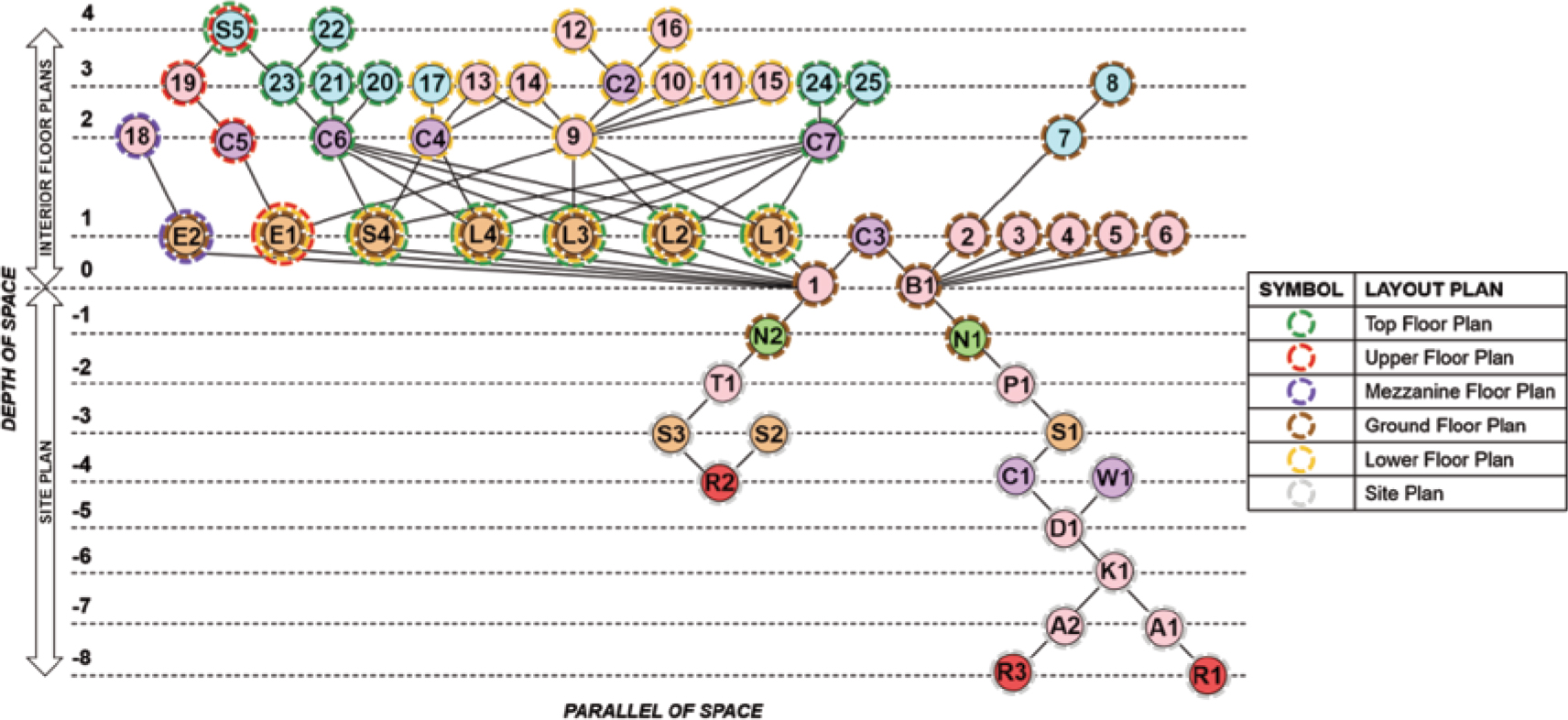
Figure 22.
Overall Justified Graph (Source: Author)
The symmetrical spatial system as shown in the Justified Graph reflects a relatively public building typology that focuses mainly on public spaces with private spaces located alongside the building. The low depth level of building interior spaces in the Justified Graph indicates most spaces are public and more integrated. Private space at a higher depth level in Justified Graph can only be accessed by museum staff and less integrated from public spaces. However, the back of house is still moderately integrated with the main space with low visual connectivity. Hence, the Justified Graph still indicates a symmetrical spatial system of connection from public space to private space.
As indicated in the Visual Connectivity Graph and Visual Integration Graph, public space coloured yellowish-orange shows open plan space used to cater public visitors. Public visitors have very easy wayfinding in open-plan public spaces as these spaces provide high visual connectivity and easy wayfinding to reach from one point to another. Public visitors do not intend to access private space due to low visual connectivity to private space which is isolated or less integrated with the main space as shown coloured dark blue in the Visual Integration Graph. Hence, low visual connectivity to private space leads to difficult wayfinding which makes visitors less attracted to navigate towards the private space.
The spatial system indicated by Justified Graph resonates well with the case study building typology as a Natural Science Museum that comprises public visitors’ interactive exhibition space and a private administrative office. A symmetrical spatial system allows balanced distribution of the main space, especially exhibition space to be easily connected to public visitors which enables active movement of the public inside-out leading to fully utilised space instead of isolated wasted space. Hence, a symmetrical spatial system helps to increase the internal space efficiency while facilitating the internal circulation of public visitors in this Natural Science Museum building typology.
5.2. Level of Permeability
As tabulated in Table 2, public space contributes to the highest percentage of the overall Schedule of Accommodation (SOA), which is 50.0% followed by 22.5% semi-public space. There is 5.0% extremely public space including the main entrance and side entrance. On the other hand, there is 5.0% private space which is the office rooms on the Top Floor Plan. In addition, 17.5% of semi-private space is the administrative office space on the Top Floor and back of house.
Table 2.
Level of Permeability (Source: Author)
| Hierarchical Order | Level of Permeability | Visual Integration | Corresponding Justified Graph Depth Level | No. of Spaces in building | Overall Percentage (%) |
|---|---|---|---|---|---|
| Primary level | Extremely public | 0 | 2 | 5.0 | |
| Secondary level | Public | 1 | 20 | 50.0 | |
| Tertiary level | Semi-public | 2 | 9 | 22.5 | |
| Quaternary level | Semi-private | 3 | 7 | 17.5 | |
| Quinary level | Private | 4 | 2 | 5.0 |
5.3. Level of Wayfinding
The case study building is found with 17.5% very easy wayfinding as shown in Table 3. Furthermore, public space and semi-public space in the case study building comprise of same percentage, 30% on straightforward wayfinding and moderate wayfinding each. Difficult wayfinding starts from semi-private space, which is the administrative office space on the Top Floor and back of house. In addition, office rooms alongside building on the Top Floor Plan is found very difficult to wayfinding as these spaces are less integrated with the main building space.
Table 3.
Level of Wayfinding (Source: Author)
| Hierarchical Order | Level of Wayfinding | Visual Integration | Corresponding Justified Graph Depth Level | No. of Spaces in building | Overall Percentage (%) |
|---|---|---|---|---|---|
| Primary level | Very easy/straightfor | 0 | 7 | 17.5 | |
| Secondary level | Easy/straightforward | 1 | 12 | 30.0 | |
| Tertiary level | Moderate | 2 | 12 | 30.0 | |
| Quaternary level | Difficult | 3 | 7 | 17.5 | |
| Quinary level | Very Difficult | 4 | 2 | 5.0 |
5.4. Types of Spatial Configuration
As shown in Table 4, single connecting spaces comprise 24.3%, which includes the ancillary spaces supporting the open plan space. Multi-connecting space which allows high visual access comprises the second highest percentage, 13.5% which is the open plan exhibition space, followed by 5.4% triple connecting space. Corridors used to connect the main space and ancillary space comprise 16.2%. There is an average of 2 lobbies with an entrance on each lobby, hence easy access for the public visitors from the surrounding site into the building interior. There is one vertical access that acts as the main passageway between floors which comprises of staircase and lift whereas the escalators are distributed to connect designated floors for specific functions.
Table 4.
Types of Spatial Configuration (Source: Author)
| Types of spaces in building | Justified Graph Depth Level | Percentage (%) | ||||
|---|---|---|---|---|---|---|
| 0 | 1 | 2 | 3 | 4 | ||
| End room | - | 10 | - | - | - | 2.7% |
| 0% | 2.7% | 0% | 0% | 0% | ||
| Single connecting space | - | 18 | 11,19 | 5,6,12,15,16 | 8 | 24.3% |
| 0% | 2.7% | 5.4% | 13.5% | 2.7% | ||
| Double connecting space | - | - | - | - | 17 | 2.7% |
| 0% | 0% | 0% | 0% | 2.7% | ||
| Triple connecting space | - | 2,4 | - | - | - | 5.4% |
| 0% | 5.4% | 0% | 0% | 0% | ||
| Multi-connecting space | - | 9,3 | 13,14 | - | 7 | 13.5% |
| 0% | 5.4% | 5.4% | 0% | 2.7% | ||
| Entrance & lobby | N1,N2 | 1,B1 | - | - | - | 10.8% |
| 5.4% | 5.4% | 0% | 0% | 0% | ||
| Corridor | - | C3,C5 | C2,C6 | C4,C7 | - | 16.2% |
| 0% | 5.4% | 5.4% | 5.4% | 0% | ||
| Staircase & escalator | - | E1,E2 | S2,S4 | - | S5 | 13.5% |
| 0% | 5.4% | 5.4% | 0% | 2.7% | ||
| Lift | - | L1,L2,L3,L4 | - | - | - | 10.8% |
| 0% | 10.8% | 0% | 0% | 0% | ||
6. CONCLUSION
The present study explores the spatial design characteristics and the implication on the level of permeability and wayfinding of natural science museum typology. The premise of the study is based on the issue that associates the conventional design of museums with the lack engagement with the displayed artefacts. As a result, many conventional museums suffer from lack of visitors especially the younger generation. The study incorporates space syntax analysis by means of justified graph to evaluate the level of permeability and wayfinding of the interior spaces of the selected case study. In the meantime, Visibility Graph Analysis (VGA) based on DepthMapX simulation is used to evaluate the wayfinding of the museum to understand the users’ behavioural pattern which has an affiliation with the level of engagement. The study finds that public spatial quality is reflected in the case study building with high visual connection and high visual integration on the main space based on VGA simulation in the Results of Analysis and the ratio of spatial configuration as discussed. A symmetrical spatial system is shown in the Justified Graph indicating the low-depth level of wayfinding. The main spaces are directly connected to the root spaces comprising the entrance lobby and main lobby. The spaces tend to be more public and highly permeable to public visitors. Besides, the spaces are more integrated as coloured in yellowish-orange in the Visual Integration Graph.
The spatial system of the case study building as a natural science museum which integrates interactive experience with nature and technology is appropriate about the level of permeability and wayfinding supported by Justified Graph and VGA. This forms an important aspect in the spatial design of the science museum incorporating interactive experience with nature while maintaining the permeability level suitable for a museum design. Overall space syntax performance shows high-quality public museum building typology with a moderately high level of wayfinding and visibility as evaluated through visibility analysis.
The spatial system demonstrates a relatively high level of permeability as the case study building serves the function of a public exhibition space and private administrative office. A higher degree of public experience is established when the public spaces are connected with single to multiple access. The moderately difficult wayfinding is only shown at the back of house and on the Top Floor with restricted access for administrative staff. Only one vertical access located in the middle of the building eases the management of public circulation. Spaces are arranged symmetrically in the spatial system with a lobby as root space provides highly permeable space for public access.
Public spaces with low depth levels in Justified Graph provides straightforward wayfinding for public visitors whereas private space at the back of house and on the Top Floor level provides difficult wayfinding. With low depth levels in the Justified Graph, public spaces provide high visual access to the spaces where public visitors are heading or passing by. This phenomenon highly engages public visitors to the programmed space about the Schedule of Accommodation (SOA). On the other hand, private administrative office space on the Top Floor is less integrated with the main space of the building which leads to low visual connection and low accessibility for public visitors. Only administrative staff can access the Top Floor.
6.1. Contribution and Recommendation
In this research, the study overlooks the floor area of each space whereby the size of the floor area can indicate the level of permeability and wayfinding of each space. Floor area is recommended to be considered while investigating the overall level of permeability and wayfinding in percentages. The data with different floor area sizes makes a significant impact on determining the space function and user behaviour in each space.
Based on the number of users in the gross floor area, multi-connecting space as a public space is appropriate for effective fire escape. However, multi-connecting spaces may lead to confusion among public visitors to the exhibition spaces with the same function with different themes in the result of missing out on some exhibition spaces to visit.
There is complexity of project spaces with different room sizes leading to misinterpretation of depthmapX in certain cases. Hence, the justified graph is used to validate the VGA to ensure an accurate result for analysis. In short, the Perot Museum of Nature and Science possesses an appropriate level of permeability and wayfinding with well-defined public-private zoning yet integrated as a whole. Overall space syntax complements well with natural science museum building typology and function.