
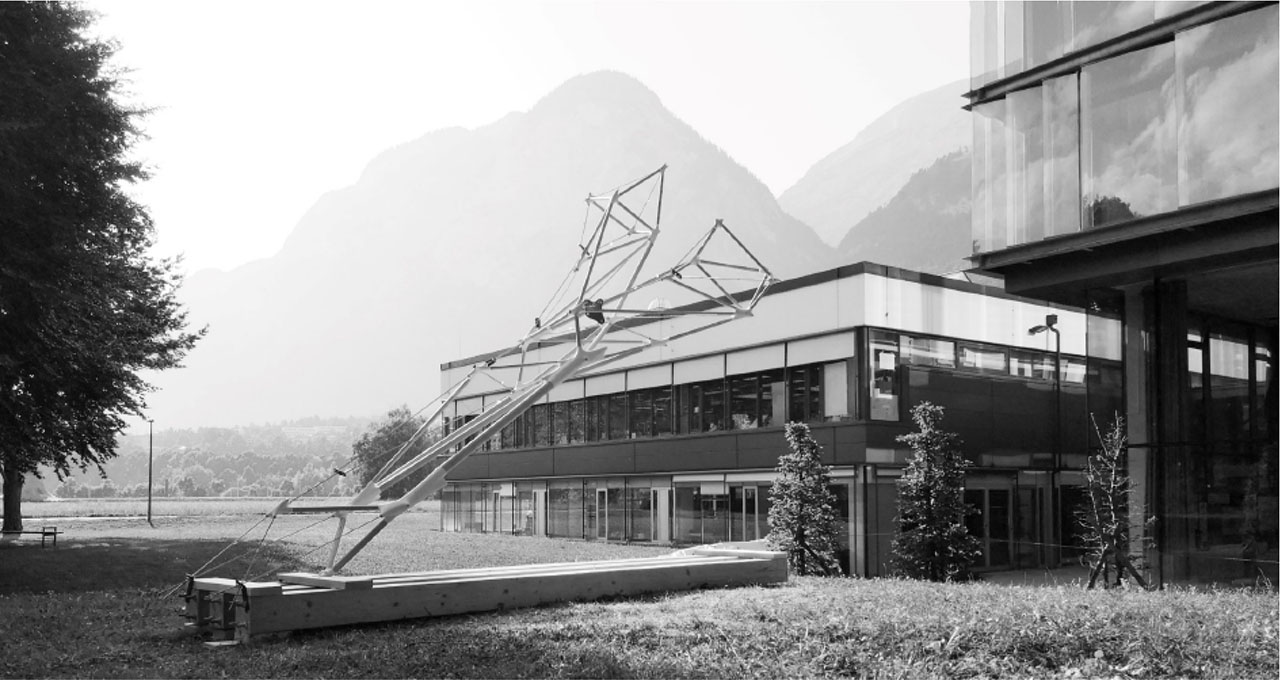
Figure 1.
Realized T1 configuration of the Y-shaped, cantilever arm assembled from standardized beech wood profiles and bespoke, 3D printed joints
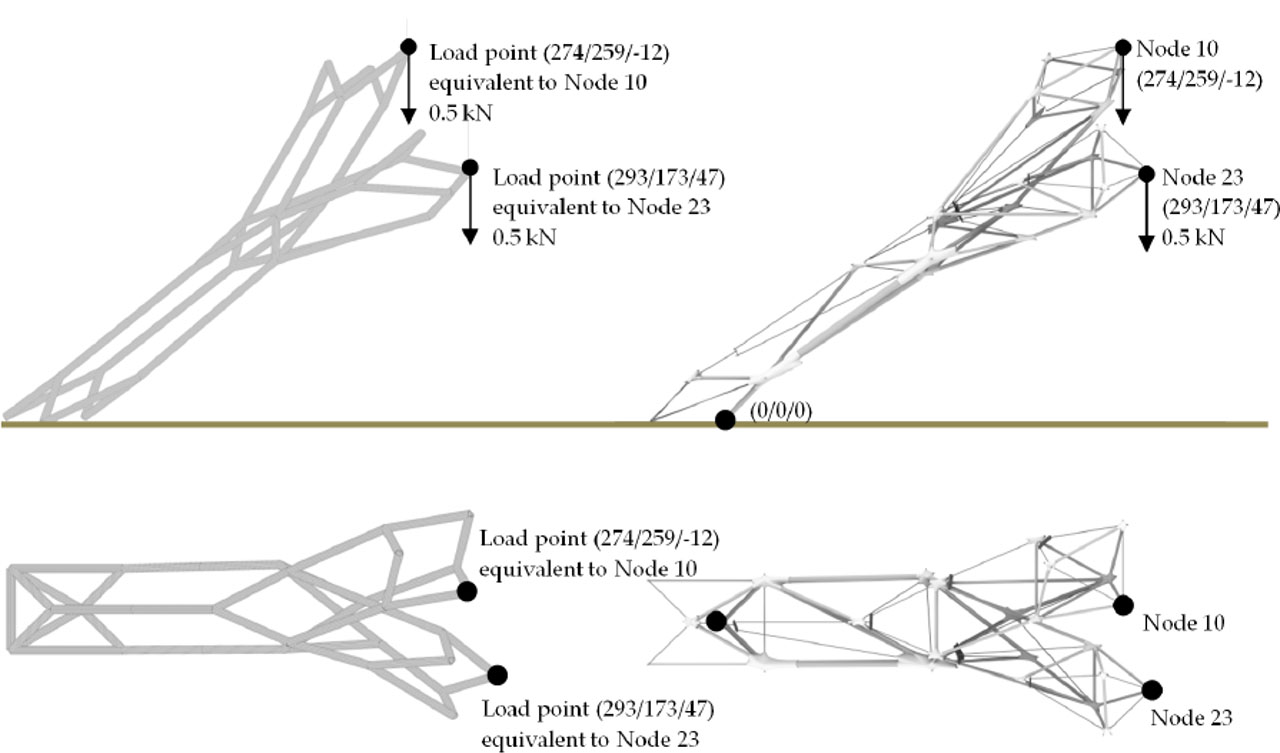
Figure 2.
Left: Benchmark Y-shaped, polyhedral cantilever with fixed joints in side and top view. Right: T1 with coordinates, and indication of node 10 (load point c10), node 23 (load point c23), and node 15 (0/0/0 = c0)
Table 1.
Numerical values of displacements of nodes 10 / 23 for T1-T5 including mass calculation (Polyhedral* = optimized)
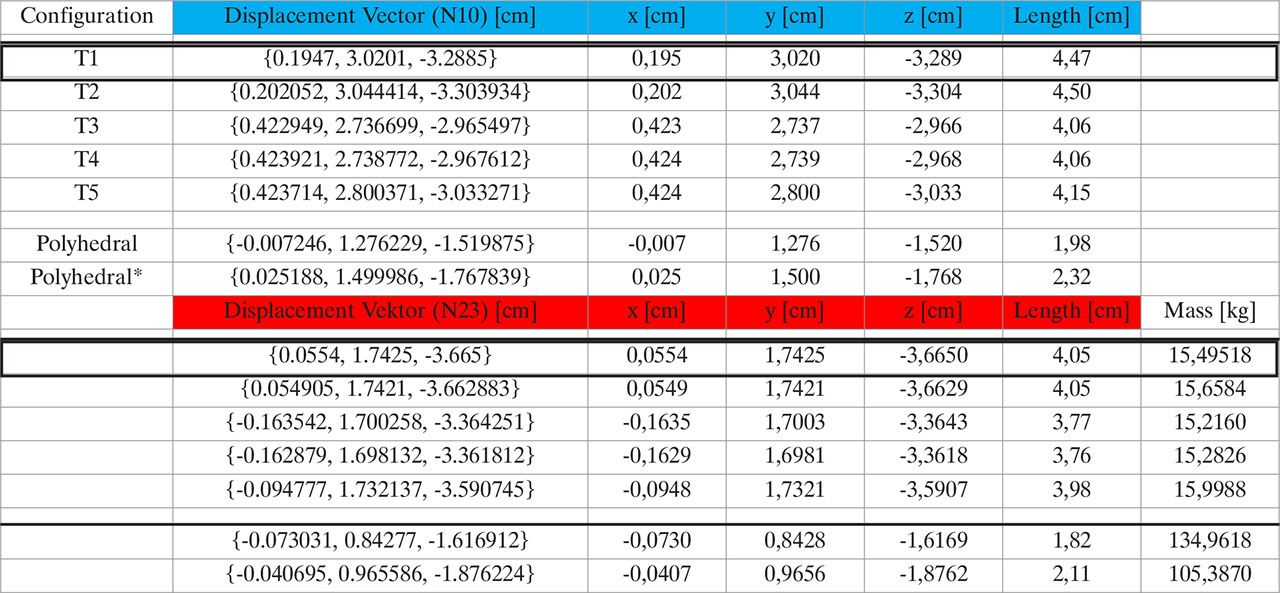
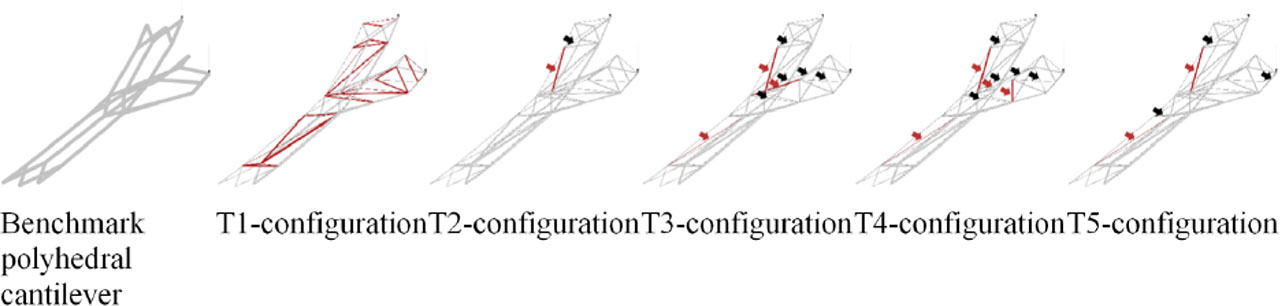
Figure 3.
Y-shaped, polyhedral cantilever with fixed joints as benchmark versus configurations T1-T5. The arrows indicate the differences between the individual configurations
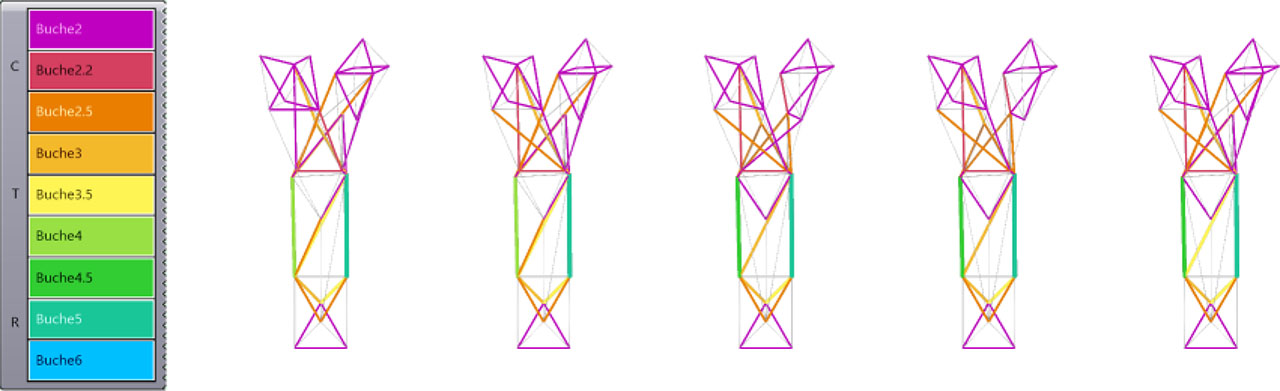
Figure 4.
Optimized cross-sections for beech wood (color coded) for configurations T1 to T5. Dimensions of standardized circular profile cross-sections in 2, 2.2, 2.5, 3, 3.5, 4, 4.5, 5, and 6 cm in diameter
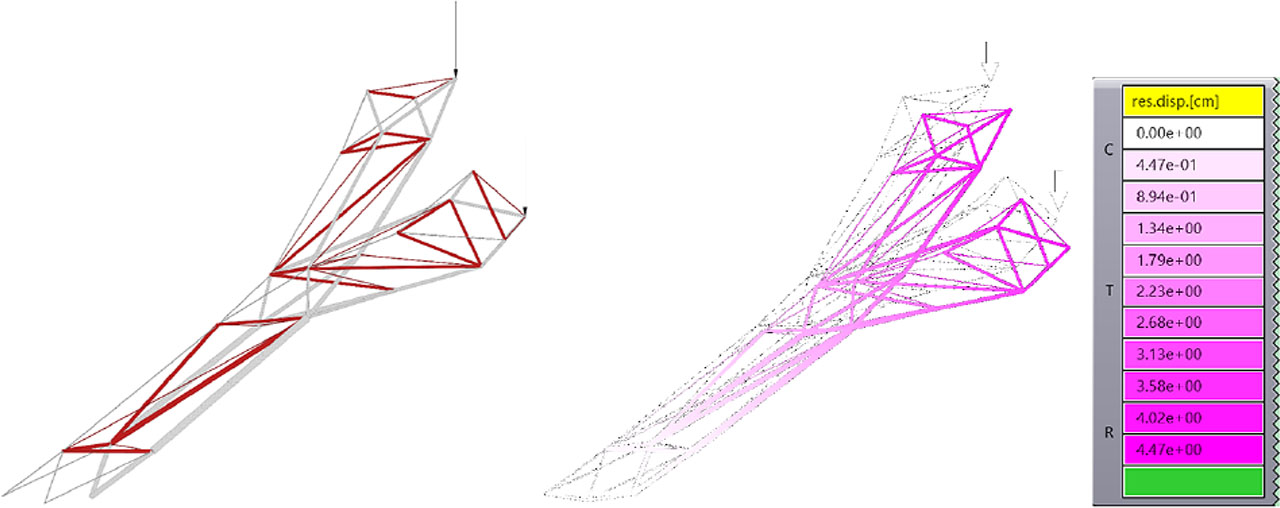
Figure 5.
Configuration T1 and its displacements as simulated in Karamba3D. The cantilever was loaded by self-weight and vertical loads of 0.5 kN to both nodes 10 and 23
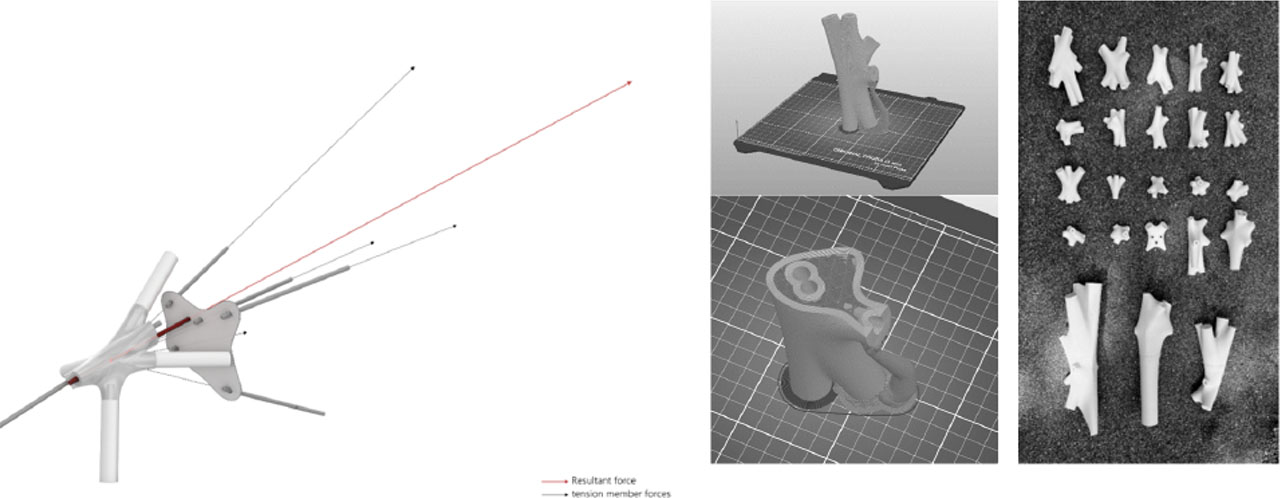
Figure 6.
Left: Resultant force replacing concentrical tension rods in multi-arm nodes by use of graphic statics. Center: 3D printing Node 11 including two through-the-joint-mounted fittings (also see Figure 8) by PrusaSlicer, Prusa i3 MK3 and PLA NX2. Right: 3D printed joints ready for T1 assembly
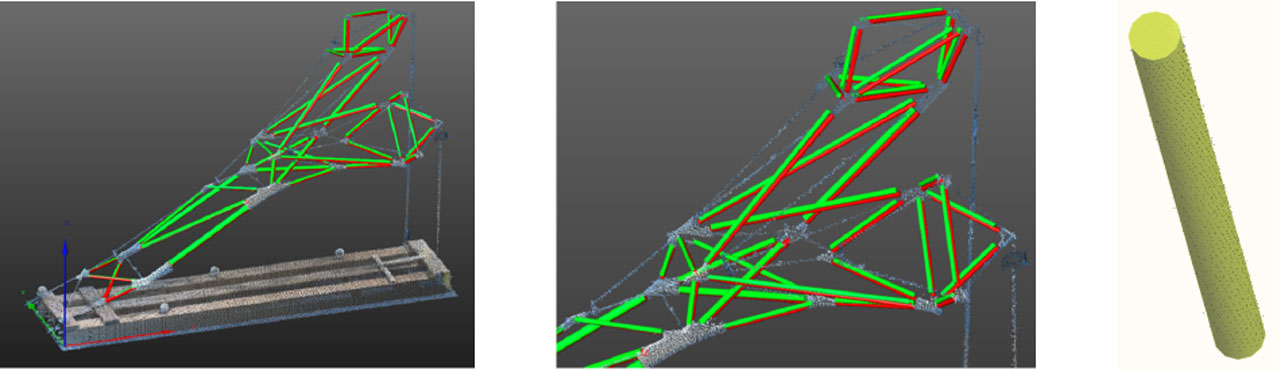
Figure 7.
Left: Two point-clouds from laser-scan with local coordinate system, target balls and reconstructed cylinders. Center: Scans from unloaded (green) and loaded (red) structure. Right: Example of reconstructed cylinder from approximately 1300 scanned points
Table 2.
Results of the computational comparison between the different configurations at the two load points
| load point | load point | ||||
| Difference vector : | Δx [cm]: | 3.21 | 1.39 | ||
| Δy [cm]: | 0.52 | 1.84 | |||
| Δz: [cm]: | 3.60 | 3.57 | |||
| Euclidian norm [cm]: | 4.85 | 4.25 | |||
| Directional angle αi [°]: | 0.1 | 0.4 | |||
| initial configuration | end configuration | initial configuration | end configuration | ||
| elevation to the horizontal plane βi [°]: | 40.43 | 39.69 | 27.41 | 26.79 | |
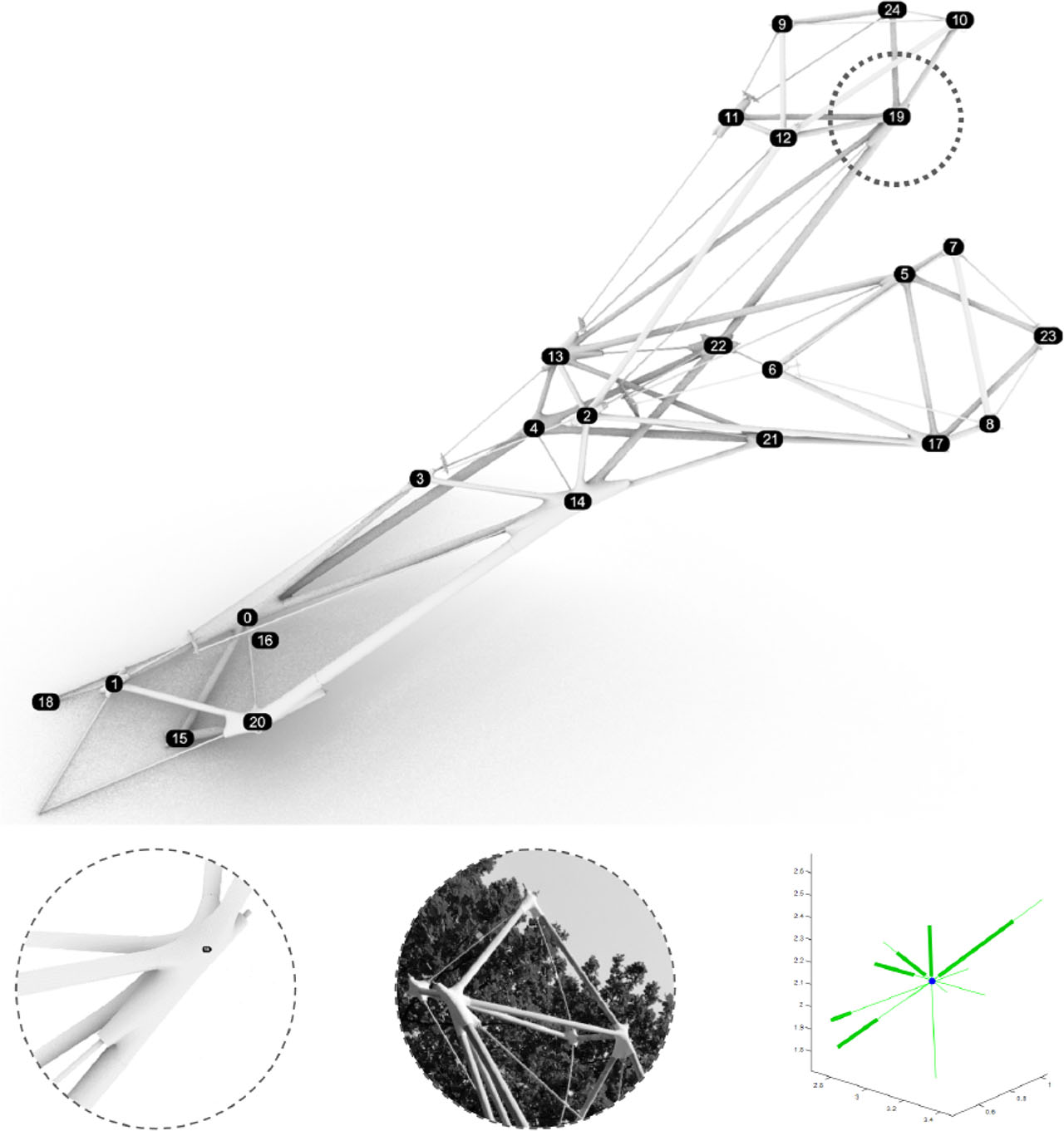
Figure 8.
Top: Overview of nodes. Bottom left: Node 19 with six wooden members and one threated tension rod. Bottom center: Node 19 in the realized structure. Bottom Right: Identical point (blue dot) of the joint i=19 with six wooden members