
1. INTRODUCTION
In the quest for innovative design of structures, the role of joints, usually associated with tectonics plays an important role. Their detailing has direct influence on how and what kind of forces are transferred, and consequently on both, the tectonics of the structure, and the geometrical shape of the individual members it is composed of (Engel, 1977). Beyond its structural meaning, the articulation of the joint detailing has significant impact on factors including, the number of elements and connectors, the structurally required cross-section of each member, the ease and speed of assembly and disassembly, the mass of material used and the associated sustainability, the visual appeal and the overall aesthetics of a structure.
In architecture, the term “node” often replacing the term “joint” has many facets. It describes organic thickening similar to what is created by an accumulation of cells, as well as intersections of networks and functions or technical entanglements of threads. The specific spatial gesture of a node is not tied to a particular material. (Thater et al., 2002) describe the node as “the result of very precise hand movements in a large number of professions”. Simultaneously, a node/joint of the building structure is often referred to as a detail.
It is a point, at which all or at least many of the load-bearing elements of a building converge. These include the vertical and horizontal load-bearing structure, the cladding, the insulation, and the envelope. According to Patrik Schumacher, detailing is not merely a technical discipline; it plays a vital role in the aesthetic, emotional, and semantic performance of buildings (DETAIL Architecture GmbH, 2021). For (Moravánszky, 2021), the node is of significant importance in the context of understanding the design idea.
The small detail should facilitate an appreciation of the essentials. In the design process, the solution of the node is of particular interest, as it serves to reveal the special nature of the detail. This is the signature of the designer and the craftsman, who together represent the profession. In Calvino's essay, the node refers not only to the individual tying it, but also to the profession they represent (Calvino, 1995). Nodes reveal the subjectivity of the object. They may manifest as coarse and assertive or elegant and decorative, as exemplified by the architectural work of Carlo Scarpa (Erzen & Emden, 2024), where the integration of traditional and contemporary elements is playfully represented. (Erzen & Emden, 2024) conclude that it is joints that, like those in the human body, bring together the multitude of elements to create a whole. The notion of a continuous and simultaneously standardized joint seems to contradict the argument of the subjectivity of the object. Konrad Wachsmann's search for the universally standardized joint represents a remarkable paradox (Burkhalter & Sumi, 2018). His joint, initially conceived for the mass production of a modular wall system, came to be known as the Wachsmann cube. Despite never entering into production, Wachsmann's universal knot exemplifies that the search for “universal” technical rationality ultimately manifests in a form that is unmistakably the signature of its designer.
Naturally grown structures, such as Radiolaria (Helmcke, 1990) or the bones of animals or humans often show highly optimized structural patterns that are internally connected by fixed joints. Such joints, also known as rigid joints or (bending) moment-resisting joints, are connections in a structure that are capable to transfer moments and thus stabilize the structure against bending. These joints are typically realized by welding, bolting, or other rigid connection techniques. The advantages of such joints include increased rigidity and stability of the structure, especially against bending and torsional forces and reduction of deflection. However, the design and manufacture of rigid joints is often more complex and requires specialized manufacturing techniques. Moreover, the use of rigid joints may result in increased construction costs, particularly when complex connection techniques are required. Compared to pins and hinges, such joints usually require more material to transfer forces. In timber construction for example, bending-resistant joints can determine the dimensions of members due to material required between bolts and distances to the edges, which are often larger than the actual dimensions required for load transfer. In the case of concrete structures, such connections are typically realized in-situ, and particular attention must be paid to the force-fit connection and reinforcement, in order to ensure structural integrity. Additionally bending-resistant joints are considered permanent and may prove more challenging to repair or modify than pinned connections. Conversely, pins, hinges and universal joints are pivotal when kinematic movement, assembly and disassembly, or temporary use is a design requirement (Elmas et al., 2022; Markou et al., 2021)
Nature-inspired patterns such as L-systems (Lindenmayer systems), a mathematical formalism used to model and mimic the growth processes and adaptation strategies of plant development, and branching structures inspire the aspect of looking at joints through the lens of topology optimization. Originating from Michell's 1904 work on the least-weight layout of trusses, the field of topology optimization is a rapidly expanding research field with significant theoretical implications in mathematics, mechanics, multiphysics, and computer science, as well as practical applications in industries such as automotive and aerospace (Michell, 1904). In “The limits of economy of material in frame-structures” he states that a frame, today referred to as a truss, achieves the maximum possible economy of material if the space it occupies can undergo an appropriately small deformation. This approach was further developed by Prager and Rozvany in the 1970s and 1980s, leading to the formulation of “optimal layout theory”. This theory primarily addressed the optimization of grid-type structures and has influenced numerical methods and continuum-type structures. By incorporating the branching aspect of L-systems, topology optimization often aims to explore new configurations that enhance structural integrity and material efficiency towards continuum-type structures. Bendsoe and Kikuchi's 1988 paper marked the beginning of extensive research into numerical methods for topology optimization, particularly finite element (FE)-based optimization and expanded into various aspects of structural and architectural design (Bendsøe & Sigmund, 2003; Eschenauer & Olhoff, 2001; Kobayashi, 2010; Lafuente Hernández et al., 2013; Soriano et al., 2015; Zhu et al., 2018). (Morales-Beltran et al., 2022) state that topology optimization aims to find the optimal layout for both continuum and lattice (discrete) structures. Continuum optimization determines the best material distribution within a design area, while discrete optimization focuses on the dimensioning of members and the definition of nodal connections. Continuous methods offer greater design freedom and are particularly useful in the early conceptual and preliminary design phase to explore new typologies and shape possibilities. They highlight several shortcomings of topology optimization in architecture, including the complexity of using heterogeneous materials, the difficulty in interpreting intermediate density fields, the reliance on indirect design control measures, the challenge of integrating creativity and aesthetics within a mathematical framework, and the laborious post-optimization process required to translate continuum design results into buildable discrete geometries. Combined continuous and discrete optimization methods have been proposed to overcome design and production challenges, and with today's additive manufacturing technology, the potential for producing non-standard shapes has increased significantly.
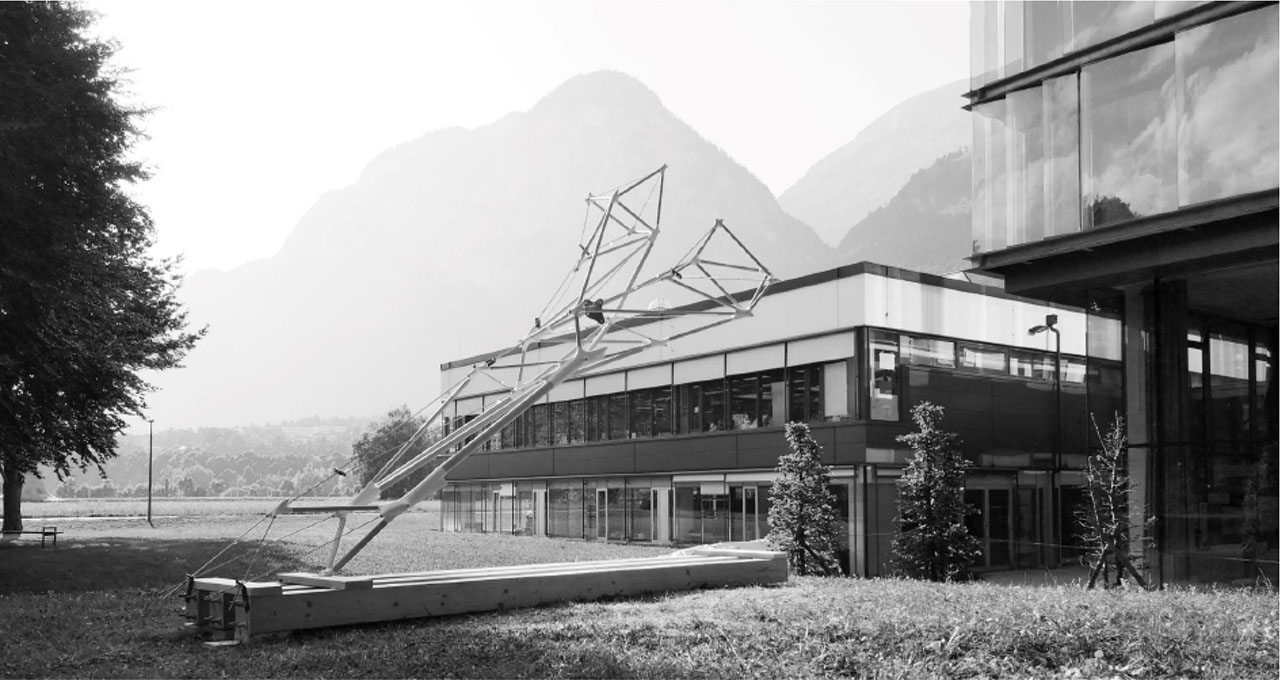
Figure 1.
Realized T1 configuration of the Y-shaped, cantilever arm assembled from standardized beech wood profiles and bespoke, 3D printed joints
2. AIMS, METHODS, LIMITATIONS
Rather than 3D printing an entire topology-optimized structure at once, a process is proposed in which individual parts are 3D printed separately and later assembled together with standardized, discrete elements to form a larger hybrid system. Moreover, discretizing continuous systems allows the shifting of the bespoke solution of architectural and structural designs to the 3D printed joint. This approach is exemplified, simulated, realized, load-tested and evaluated by a trussed configuration of a Y-shaped cantilever.
The study includes a set of digital and analogue methods depending on the individual project phase from design to transforming the cantilever with fixed joints into trussed configurations to the realization and observation respectively evaluation by laser scanning. The used methods and technology are explained in detail in each section, but a brief overview is provided here. A Y-shaped, polyhedral cantilever arm with fixed joints, serves as a benchmark. Five different trussed, triangulated configurations using universal joints were generated, respectively selected based on architectural creative design thinking (Deo et al., 2020; Ruan et al., 2021) and aesthetic qualities. All structural simulations were carried out and optimized digitally using Karamba3D (Preisinger, 2022) in the Rhinoceros7 (McNeel & Associates, 2022) environment. The principles of graphic statics were used to reduce the number of branches in the joints. In the design of the 3D printed joints multipipe and smoothing algorithms based on the SKO method (Soft Kill Option) as introduced by (Mattheck, 2010) were applied, and fabricated using a Prusa i3 MK3 (Prusa, 2024) and PLA NX2 (Extrudr | FD3D GmbH, 2024). One trussed cantilever was realized in full-scale, assembled and disassembled several times, and experimentally tested by loading the two free ends of the Y. The prototype was captured by terrestrial laser scanning in both unloaded and loaded states. Mathematical quantities such as angles and lengths were generated to computationally compare the structural performance by analyzing deflections at the two load points.
Some limitations are introduced for practical reasons, especially with regards to availability of standardized materials for the realization. The presented approach and study are limited to trussed configurations, resulting in joints that can be assumed as pins and members that only transfer axial forces. For practical reasons all compression members were simulated and realized in solid beech wood with circular cross sections and diameters as commonly provided by the industry. The connection between beech wood members and 3D printed joints was solved by hard-wood dowels centrally drilled/glued into the wooden members but only plugged into the joints. The same diameters were assumed for all tension members and designed as M6, threaded rods in the prototype. For safety reasons and simplicity of detailing all threaded rods were designed as through-the-joint-mounted fittings.
3. TRANSFORMING A CANTILEVER WITH FIXED JOINTS INTO TRUSSED CONFIGURATIONS
Initially designed as part of a larger structure by one of the authors, the Y-shaped, polyhedral cantilever arm with fixed joints, as shown in Figure 2 left, serves as a benchmark for a unique case study, combining several challenges due to its inclined orientation, placing it between a traditional cantilever and a mast. With two branches at different heights and an asymmetric form, it introduces both geometric and structural complexities, particularly in terms of cantilever forces combined with torsion. Architecturally, this configuration creates an aesthetically dynamic form used for evaluating the effectiveness of the study’s structural and design adaptations.
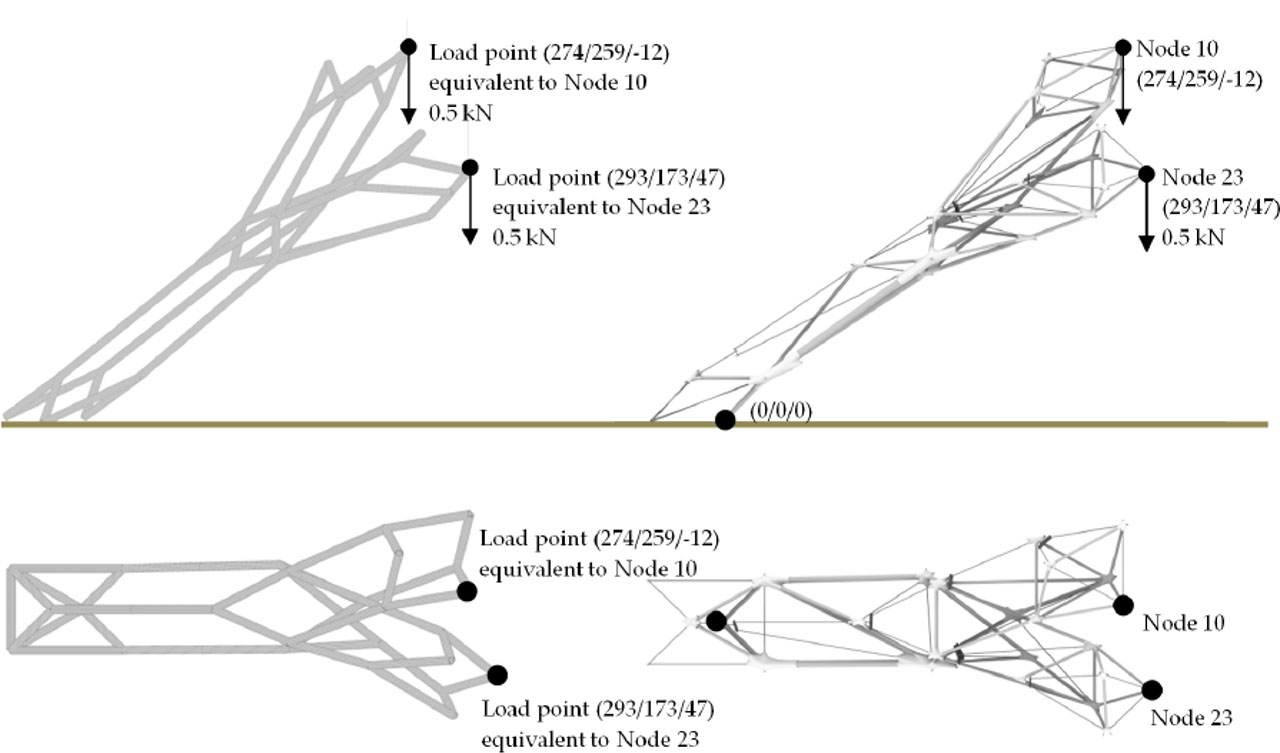
Figure 2.
Left: Benchmark Y-shaped, polyhedral cantilever with fixed joints in side and top view. Right: T1 with coordinates, and indication of node 10 (load point c10), node 23 (load point c23), and node 15 (0/0/0 = c0)
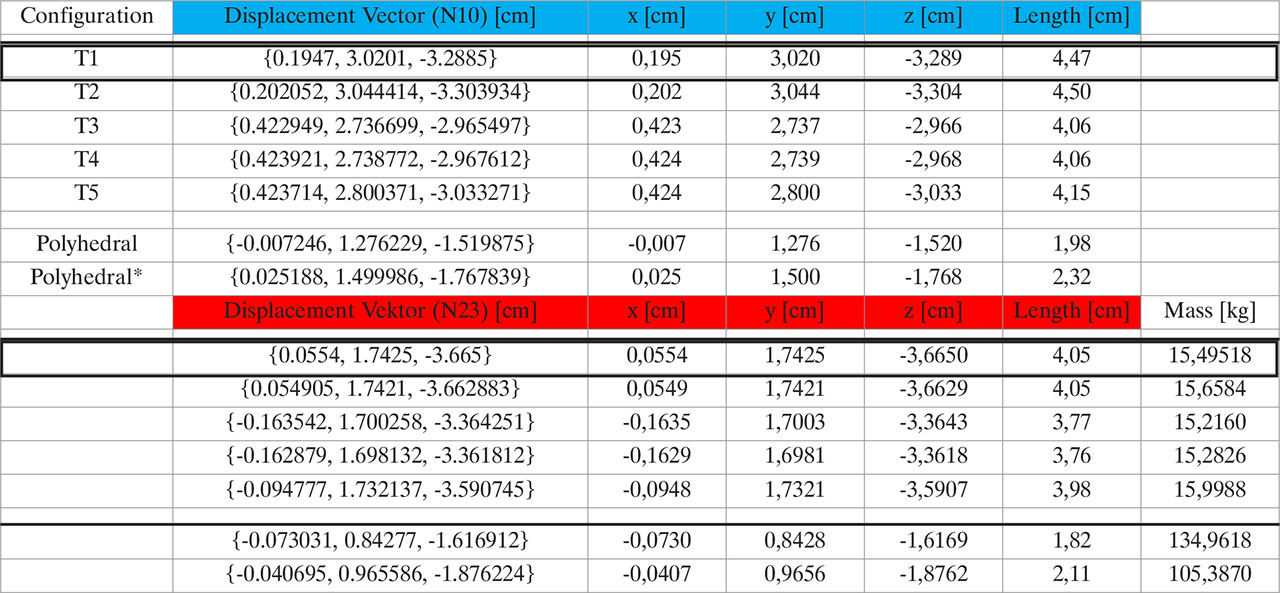
This original cantilever is composed of a minimum of 35 individual members, and if the two ends of the Y were closed, the number of members would sum up to a total of 41. The cantilever is supported at three points arranged in an isosceles triangle, thus forming a horizontal plane. The triangle is oriented so that the tip points centrally in the direction of the cantilever arm, which means the longitudinal axis of the structure. This support condition allows to work as firm clamping of the cantilever arm, rigidly attached to the ground. As a material steel S235jr, also known as material 1.0038, is assumed. Usually, it is a non-alloy structural steel with a minimum yield strength of 235 MPa for thicknesses under 16 mm, making it suitable for a wide range of steel products such as the assumed circular profiles. Furthermore, the material utilization was set to a maximum of 70% instead of an ultimate utilization of the full material capacity without safety margin. In a digital simulation by use of Karamba3D each of the ends of the Y-shaped cantilever were loaded with 0.5kN. These assumptions led to a circular profile of 60.3mm outer diameter and a wall thickness of 2.9mm, with a self-weight of 4.11kg per meter of and an overall cantilever self-weight of 134.96kg. The built-in optimization algorithm of Karamba3D proposed a reduction of some steel tubes to 57 mm outer diameter and a wall thickness of 2.9 mm. These profiles have a self-weight of 3.87 kg per meter. After optimization, the overall cantilever’s self-weight was reduced to 105.38 kg, which roughly equals to 23% less material. Looking at the deformations, the main interest is assumingly the free ends of the Y-shaped cantilever arm, labelled as nodes 10 and 23 in Figure 2. Note that nodes 10 and 23 are referred to as c10 and c23 load points in the mathematical quantities calculation below. As illustrated in Figure 2, with node 15 as a reference point assigned x-y-z coordinates (0/0/0), node 10 cantilevers 274 cm in the x-direction, 12 cm laterally in the y-direction, and 259 cm in the z-direction, and node 23 cantilevers 293 cm in x-, -47 cm laterally in y-, and 173 cm in z-direction. For the non-optimized cantilever under full load, node 10 changes its position by a Euclidian norm vector length of 1.98 cm, and node 23 changes its position by a Euclidian norm vector length of 1.82 cm. For the optimized cantilever these values change to 2.32 cm for node 10 and 2.11 cm for node 23. All exact values are shown in Table 1.
Table 1.
Numerical values of displacements of nodes 10 / 23 for T1-T5 including mass calculation (Polyhedral* = optimized)
In an iterative process, the Y-shaped, polyhedral cantilever arm with fixed joints was transformed into numerous trussed, triangulated configurations. This process was restricted by the following parameters; (i) The support of all trussed, triangulated configurations of the cantilever arm forms the same isosceles triangle as for the above-mentioned benchmark, (ii) The overall size and geometrical shape, respectively the geometrical position of all structural members of the polyhedral cantilever arm are not changed, (iii) The fixed joints of the polyhedral cantilever are replaced by universal joints, which do not transfer bending moments. This means that on one hand the axes of all members intersect in one single point (node), and on the other hand that triangulation of the polyhedral structure is needed to guarantee internal stability. The resulting trussed versions’ members only transfer axial forces and may be more slender compared to bending resistant members. Simultaneously, this provides the possibility of multiple assemblies and disassemblies of standardized, discrete elements that are connected by bespoke 3D printed joints, explained in more detail below, to form a larger hybrid, high-tech/low-tech system (Filz, 2013).
The transformation of the benchmark Y-shaped, polyhedral cantilever arm with fixed joints into trussed configurations was primarily driven by the triangulation of the original polyhedral geometry. Essentially, this geometric structure can be described as a triangular prismatic shape in cross-section with a surface-mesh composed of mostly non-planar hexagonal mesh faces. In the area of the Y-branching, the main arm and the two polyhedral branches of the grid structure intersect in a complex way, since the individual members of the grid pass through the node, extending through to the opposite side of the structure, as shown in Figures 1 to 5. Using Grasshopper for Rhinoceros, the non-planar hexagonal mesh was first subdivided into planar triangles and quadrilaterals. However, such a grid structure would be unstable if assembled with hinge-type nodes. Subsequently all quadrilaterals were triangulated by adding a diagonal. Simultaneously, configurations with grid collisions, including a minimum margin, were excluded. The margin ensures that a minimum spacing is maintained between the lines of the grid pattern, which represent the future axes of the grid members.
In addition to triangulations that subdivided each individual surface of the polyhedral structure, solutions with spatial diagonals were sought to reduce the number of structural members. This approach not only results in a significant reduction in the number of members, but also ensures that all diagonals from the base points to both ends of the cantilever arm must be continuous to create a stable configuration.
The geometric arrangement and sequence of the members also lead to varying path lengths, which determine whether individual components will later be subjected to tension or compression forces. Additionally, certain geometric arrangements and sequences result in complex multi-arm nodes, which can present challenges for realization. Configurations with spatial diagonals must also be checked for potential collisions and, if necessary, excluded. Overall, we digitally generated more than twenty stable configurations, which were also subject to discussions about node complexity and aesthetics. For a limited number of about five configurations physical, scaled models were built to support decision making.
Figure 3 shows, in comparison to the polyhedral structure, five found triangulated solutions that were considered for realization. Illustrations Figure 3 and Figure 4 also provide information on how configuration T1, which was later realized, differs in its triangulation from configurations T2, T3, T4 and T5. All configurations, T1 to T5, consist of 67 rods. Configurations with a total number of fewer than 67 members could not be found and thus appear to represent the minimum number of members. Depending on the triangulation, the configurations differ in how many of the 67 members are subjected to compression or tension, as well as in the total length of all members. With a total length of (node to node) 49.72 meters, in configuration T1, 56% of the rods are subjected to compression, and 44% to tension. Configurations T2 to T5 have similar total lengths and percentage distributions of compression and tension. For practical reasons all compression members were simulated and later realized in solid, beech wood with circular cross sections and diameters as commonly provided by the industry. The structural analysis of configurations T1 to T5 shows that the dimensions of these members, range between 2cm and 6cm in diameter as shown in Figure 5. The available standardized circular profile cross-sections are 2, 2.2, 2.5, 3, 3.5, 4, 4.5, 5, and 6 cm in diameter, whereas configuration T1 uses only five of the eight profiles. Based on the results of preliminary structural simulations and architectural creative design thinking the aesthetic qualities of the various configurations were discussed and explored in digital and physical scaled models, leading to the decision for realizing configuration T1.
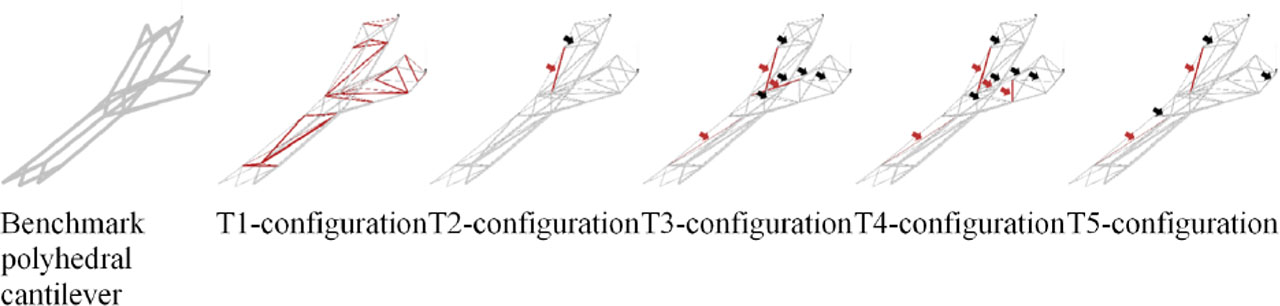
Figure 3.
Y-shaped, polyhedral cantilever with fixed joints as benchmark versus configurations T1-T5. The arrows indicate the differences between the individual configurations
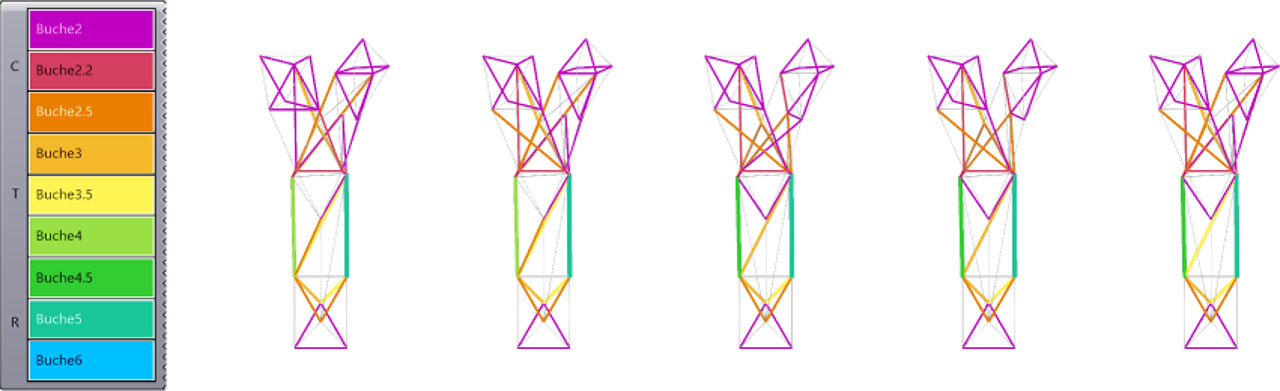
Figure 4.
Optimized cross-sections for beech wood (color coded) for configurations T1 to T5. Dimensions of standardized circular profile cross-sections in 2, 2.2, 2.5, 3, 3.5, 4, 4.5, 5, and 6 cm in diameter
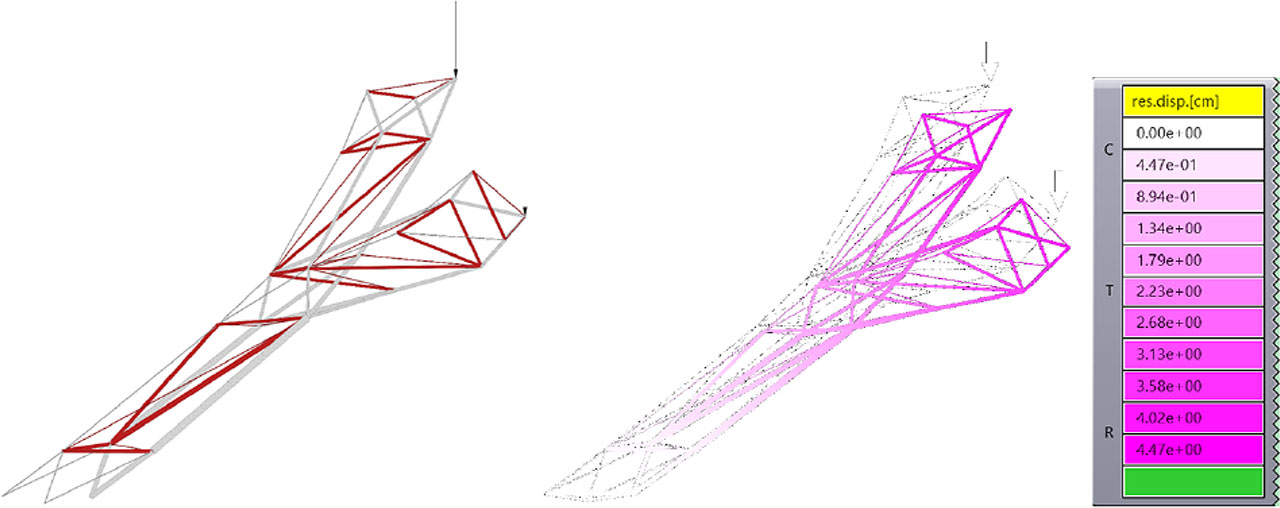
Figure 5.
Configuration T1 and its displacements as simulated in Karamba3D. The cantilever was loaded by self-weight and vertical loads of 0.5 kN to both nodes 10 and 23
4. DETAILING, PROTOTYPING, REALIZATION & TESTING OF CONFIGURATION T1
As mentioned, the configuration T1 was assembled (i) from compression members in solid, beech wood with circular cross sections and diameters as commonly provided by the industry, (ii) from tension members designed as M6, threaded rods and (iii) connected by 3D printed joints from PLA NX2. The connection between beech wood members and 3D printed joints was solved by inserting hardwood dowels, which were centrally drilled and glued into the wooden members but only plugged into the joints.
For safety reasons and simplicity of detailing, all threaded rods were designed as through-the-joint-mounted fittings. The threaded rods were passed through the 3D-printed node and secured with washers and nuts on both sides of each joint. With this detail two significant effects were achieved: first, unlike a cable, the threaded rod can also withstand small compressive forces during the assembly phase; second, the connection point of the tensioned threaded rod functions under compression. The latter is an important safety feature, as it eliminates the need for integrating a right-handed screw sleeve at one end of the rod and a left-handed screw sleeve at the other end into the 3D-printed joint. Additionally, this design allows the desired rod length to be easily and precisely adjusted. The disadvantage of this detail is that, in practice, the tension rods must pass by each other within the joint and do not concentrically intersect as theoretically intended. This is particularly problematic in multi-armed nodes. To decrease the number of concentrical tension rods in multi-arm nodes to a maximum of two per joint, the principles of graphic statics were applied to find their common resultant (Allen & Zalewski, 2010). As illustrated in Figure 6, the tension members were analyzed regarding their direction, sense, and magnitude and accordingly transformed into a single resultant force vector. In practice, these tensioned threaded rods were connected to a steel distributor plate, and only the resultant was connected to the 3D-printed joint designed as through-the-joint-mounted fitting.
4.1. Design of 3D printed joints
The articulation of joint detailing impacts factors such as the number of elements and joints, the ease and speed of assembly and disassembly, the flow of forces, and its associated formal aesthetics. In the design of the 3D printed joints, multipipe and smoothing algorithms based on the SKO method (Soft Kill Option) as introduced by (Mattheck, 2010) were applied. This approach was chosen for its ability to optimize material distribution and structural efficiency in complex joint geometries, which is crucial in structures where multiple linear elements converge at a single node. In the design process of the 3D printed nodes, the axes and system points of the digital 3D model served as the base geometry. As explained above, structural analysis in Karamba3D provided precise dimensions for the linear elements intersecting at each node. So, compression members were to be realized in solid beech wood with circular cross-sections, matching industry-standard diameters of 2, 2.5, 3, 4 and 5 cm, and all tension members were designed as M6, threaded rods. Accordingly, in the digital model, the concentrically intersecting axes from compression and tension members were informed by their later diameters, comparable with the intersection of cylinders of different thicknesses. Figure 6 (left) illustrates one of the most complex joints within the T1 configuration: a 10-armed node, with four members in compression and six in tension, plus five of the six tension members are located between two members in compression.
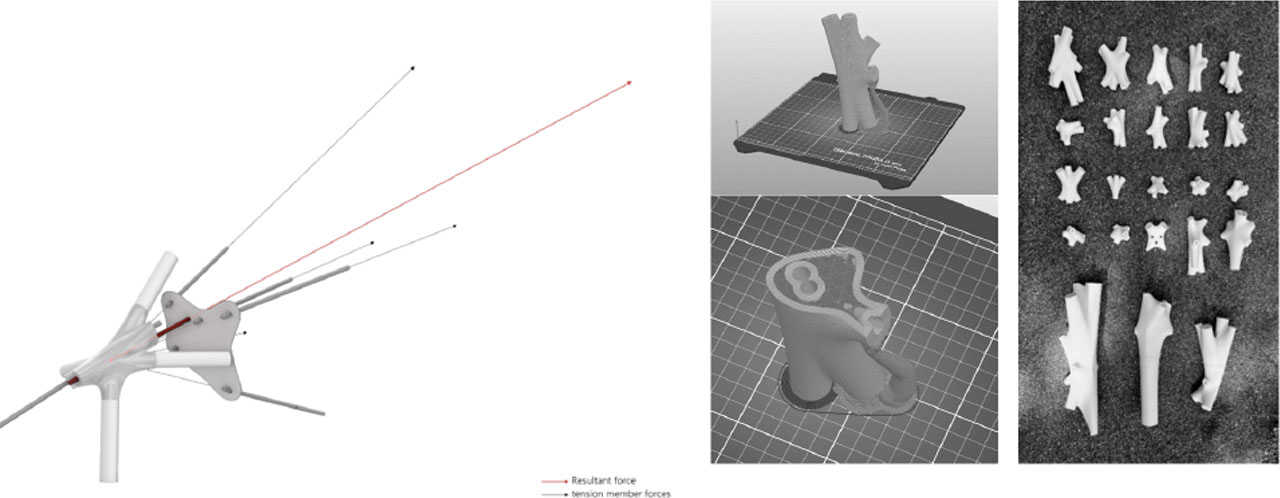
Figure 6.
Left: Resultant force replacing concentrical tension rods in multi-arm nodes by use of graphic statics. Center: 3D printing Node 11 including two through-the-joint-mounted fittings (also see Figure 8) by PrusaSlicer, Prusa i3 MK3 and PLA NX2. Right: 3D printed joints ready for T1 assembly
The multipipe algorithm of Rhinoceros3D (McNeel & Associates, 2022) allowed for the seamless integration of multiple intersecting elements, each representing a compression or tension member, at each joint. By generating smooth transitions between these elements, the algorithm minimizes stress concentrations, which are common at sharp intersections, and improves the distribution of forces within the joint. In applying and comparing to the SKO, a biomimetic optimization technique approach, to the joints, material is strategically minimized in low-stress areas, while the form is reinforced in regions with higher load demands. This results in an optimized structure with a balance of strength, stiffness, and material efficiency, closely resembling the natural load-bearing adaptations seen in biological structures. Refined joint geometry not only reduces abrupt changes in cross-sectional area and eliminates sharp edges that could compromise the joint’s integrity under load, it is particularly advantageous for 3D printing, as smooth transitions and gradual curves improve print quality and reduce the likelihood of defects that can arise in complex geometries.
The ends of the 3D-printed joint’s arms are defined by the point where the surface tangents of the branching arms are parallel to the axes of the compression and tension members, without colliding with neighboring members. The connection between compression members and 3D printed joints are solved by central dowels plugged into the joint’s arms and the circular wooden members. The six tension members of the 10-armed node were decreased to two, both passing the system point of the node not as an intersection but as a tangent. This is achieved by replacing the above-mentioned five of the six tension members by their common resultant, as illustrated in Figure 6 left. A distributor plate serves as an interface between the five tension members and their resultant that consequently passes through the node.
4.1. 3D-Printing of joints – technology, material and infill geometry
The 3D printed joints in this project were fabricated using a Prusa i3 MK3 (Prusa, 2024) and PLA NX2 (Extrudr | FD3D GmbH, 2024), a novel generation of PLA known for its enhanced mechanical properties. PLA NX2 features a matte surface, good tensile strength, and is CO2 neutral. It is also UV resistant and complies with FDA, RoHS, and Safety of Toys regulations, making it suitable for mechanically stressed parts due to its impact resistance and flexibility. Consequently, these joints exhibit improved mechanical performance for complex structural applications while offering the benefits of being environmentally friendly, as it is degradable according to ISO14885. According to the technical data sheet (Extrudr | FD3D GmbH, 2024) the flexural modulus (E-Modulus) of PLA NX2 is 2650 MPa, and the tensile modulus (E-Modulus) is 2600 MPa. The material has a density of 1.3 g/cm3, a tensile strength of 47 MPa and exhibits an elongation at strength of 4%.
PrusaSlicer (Prusa, 2024), an open-source slicing software, was used for the slicing process of the designed joints, printed with a perimeter (wall thickness) of 3.75 mm. Due to the full-scale size of the joints and their compressive and tensile loading, the joints were printed with an infill density of 20%. Infill in 3D printing plays a crucial role in providing internal support for outer layers and perimeters, which would otherwise bridge unsupported spaces. In addition to structural support, infill also influences printing speed, material consumption, object strength, and aesthetics. Most 3D models can be printed effectively with 10–15% infill. For models with gradually closing tops, 0% infill (hollow printing) is feasible but generally not recommended by manufacturers. Higher infill percentages increase the model's weight, compression resistance, and stiffness, but infill higher than 30% is not recommended by the manufacturer. Prints with higher up to 100% infill can negatively impact the material behavior, printing accuracy and especially surface quality. Additionally, the infill pattern will be forced to rectilinear in case of Prusa 3D-printers. However, the number of perimeters of a model's outer shell is the primary determinant of its overall strength, while infill can improve compression resistance.
PrusaSlicer (Prusa, 2024), offers a variety of infill patterns, each with different implications for print speed, material efficiency, appearance, and flexibility (especially relevant for TPU/TPE prints). Selecting an infill pattern depends on the specific requirements for support, material density, and desired flexibility. In this project, generating adequate support material was critical, especially since the model includes internal channels for one or more threaded rods (tensile elements). Within the 3D-printed joints, interactions between compressive forces, tensile elements, and internal channels are expected to produce shear forces; however, these forces are not presented in detail within this paper. The infill considerations are particularly significant for larger nodes, which range from a few centimeters up to 40 cm in length and 10 cm in diameter.
Infill types vary in structure and purpose. Gyroid infill, which does not cross itself in a single layer, is popular for models that may be filled with resin or liquid due to its unique wavy pattern. Rectilinear infill, a simple grid with alternating layer directions, is efficient, supporting top layers well and offering the fastest print times among infills. For 100% density requirements, rectilinear infill is preferred as it ensures consistent, even coverage without overlapping paths. Additional infill types offer varied properties for specialized needs. Concentric, grid, and line patterns are effective in certain configurations but may exhibit weaknesses like material accumulation or alignment issues at high densities. Patterns such as honeycomb, triangles, and 3D honeycomb provide enhanced strength through hexagonal or polygonal configurations but usually require more material and time. Meanwhile, visually unique options like the Hilbert curve, Archimedean chords, and octagram spiral serve more aesthetic and niche applications, with designs that also allow for liquid filling or flexibility adjustments when using flexible filaments. Each infill type provides specific structural and aesthetic benefits, but cubic and adaptive cubic are preferred for applications demanding balanced strength, material efficiency, and print speed.
All printed joints of presented research and realized structure were printed with Cubic infill, and larger joints particularly with its variant, Adaptive Cubic, which both of them are among the most effective and versatile 3D infill patterns due to its strength, material efficiency, and speed. The cubic structure provides balanced support in all directions, making it ideal for enhancing overall stability while conserving filament. The cubic infill is characterized by paths that intersect within a layer, and forms a grid of corner-down cubes, which creates air pockets that save material and weight. The orientation of the print is critical, therefore, aligned with the primary axes of the structural members, ensuring that the cubic infill grid aligned with these axes as well. Consequently, the perimeter shell is positioned perpendicular to the main axes, thereby perpendicular to the compressive forces – a setup that is assumed to enhance structural efficiency. Accordingly, the cubic infill with its corner-down cubes functions as an internal cross-bracing system, which contributes further to the structural stability and load distribution within each joint.
Adaptive Cubic, designed specifically for large models, dynamically varies its density based on proximity to the model’s walls – denser at the edges and top/bottom, while less dense in the center. This configuration reduces filament use by approximately 25% compared to rectilinear infill, without sacrificing top-layer support or mechanical integrity. The advantages of Adaptive Cubic led to its selection for printing the seven largest 3D joints in this project, as shown in Figure 6 right. Overall, the selection of a ready-made infill structure created a sufficiently stable structure saving filament consumption and printing time, which for the presented structure amounted to approximately 265 hours.
4.3. Realization and Load-Testing
The trussed cantilever configuration T1, shown in Figure 1, was realized in full-scale, assembled and disassembled several times, both outdoors and indoors. The assembly process typically required 2.5 hours with two to three people, and the fine-tuning of length of tension rods to achieve the desired geometry consumed at least one third of the time. Finally, the T1 was experimentally tested by loading the two free ends of the Y at the nodes 10 and 23. The loads were increased simultaneously at both nodes in increments of approximately 0.1kN to the maximum of the digitally simulated values by vertically down-pulling. Following each increment, manual geometrical measurements were taken at selected nodes to observe deflections and to prevent any unexpected deformations.
5. GEOMETRICAL COMPARISON BY LASERSCAN
To assess the impact of loading on the cantilever, precise geometrical measurements were conducted. These measurements involved documenting the cantilever's position in both unloaded and loaded states as illustrated in Figure 7. By comparing the actual changes in position with the pre-calculated displacements, the true impact of the loading could be accurately determined. Owing to the time constraints and the associated availability of the object, terrestrial laser scanning was selected as the optimal measurement method.
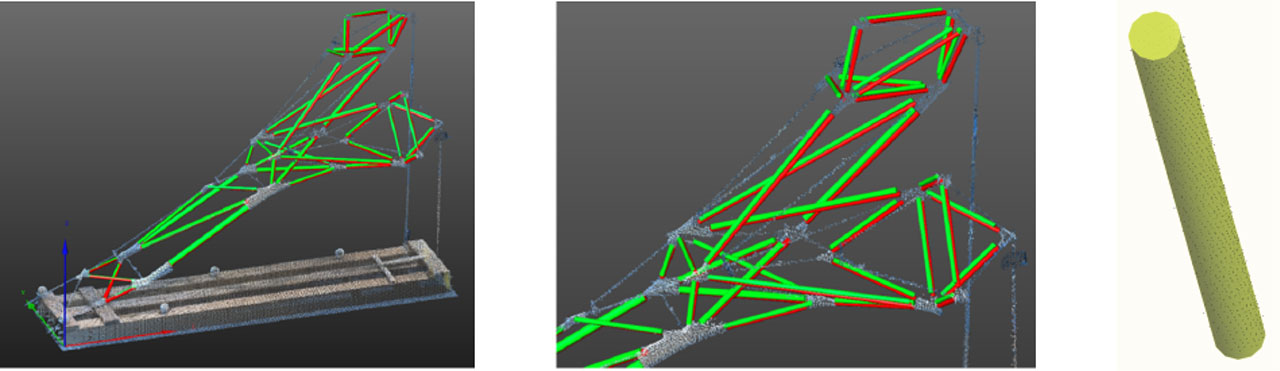
Figure 7.
Left: Two point-clouds from laser-scan with local coordinate system, target balls and reconstructed cylinders. Center: Scans from unloaded (green) and loaded (red) structure. Right: Example of reconstructed cylinder from approximately 1300 scanned points
The terrestrial Trimble X7 laser scanner (Trimble Inc. 2024a), was selected as the device for the shown scans. According to the provided datasheet (Trimble Inc., 2024b), the Trimble X7 is equipped with a Class 1 laser, and it operates at a scanning speed of up to 500 kHz and can complete a scan in 1 min and 34 s without images or 2 min and 34 s with images. The scanner uses a high-speed digital time-of-flight distance measurement principle and has a range of 0.6 meters to 80 m. It offers a range accuracy of 2 mm and a range noise of less than 3 mm at 60 m on 80% albedo (given at 1550 nm). In physical science, albedo, derived from the Latin term albedo, meaning “whiteness”, is defined as the ratio of diffusely reflected solar radiation to total incident radiation on a body. It can be expressed on a continuous scale between 0 and 1, where 0 represents a black body that absorbs all incident radiation, and a body with a value of 1 reflects all incident radiation. Surface albedo is defined as the ratio of radiosity (Je) to the irradiance (Ee) received by a surface. Irradiance is the flux per unit area (Wunderlich et al., 2013). The X7 features three coaxial, calibrated 10 MP cameras for imaging. It can capture raw images quickly, taking 15 images totaling 158 MP in one minute, or 30 images totaling 316 MP in two minutes. The scans were conducted in standard mode with a spatial resolution of 9 mm/10 m. To fully capture the object, three setups were made around the cantilever, with a maximum distance to the object of 5 m. The device datasheet specifies a distance accuracy of 2 mm (1σ) and a 3D point accuracy of 2.4 mm at 10 m. The scanning speed is approximately 0.5 million points per second. The X7 features automatic tilt compensation, and remaining tilt is computationally applied to the horizontal and vertical angles. To ensure color-realistic representation, images were also captured by the scanner using the three built-in cameras (each 3840 × 2746 pixels) after the scan. To evaluate the two scans (unloaded and loaded states) in the same coordinate system while accounting for the object's changing characteristics, “classic” target objects were employed for mutual registration. These objects were nine Trimble’s standard target balls, which were distributed on the base of the cantilever and in the nearby space to later match the different scans.
Trimble RealWorks software was used to generate and evaluate our scans (Trimble Inc., 2024a). Trimble RealWorks is a point cloud software designed for 3D scan management for the purposes of registration, analysis, and modelling of scan data. The above-mentioned nine target balls were first calculated from the scans at an average accuracy of 0.97 mm, and then the three setups for each of the two scans were transferred into a common coordinate system (“registered”). An accuracy of approximately 1.4 mm is achieved in this step. Subsequently, as shown in Figure 7 (left), a local coordinate system was placed in the object along the base of the cantilever (wooden beams). A preliminary analysis, as displayed in Figure 7 (center), revealed that the object exhibited a change in its dimensions due to the applied load. The points representing the unloaded state are colored green, while the points representing the load test are colored red. Since identical points are not measured during laser scanning, a further procedure was implemented. This involved the use of the 3D-printed nodes that connect the members of the cantilever, with the understanding that all members of a node point to a central point in these nodes. Subsequently, the wooden members were individually extracted from the point cloud in both scans, and cylinders were calculated within this point cloud using compensation by the Realworks software at an average accuracy of 1.4 mm. These idealized cylinders (Figure 7, right) were then assigned to a center using a mediating compensation. The coordinates of these centers of the connecting elements were thus calculated with an accuracy of approximately 1–2 mm. Consequently, these coordinates can be used for below analyses.
6. COMPUTATIONAL COMPARISON OF THE T1 CONFIGURATION IN UNLOADED AND LOADED STATES
Mathematical quantities such as angles or lengths are required to computationally compare the structural performance of the two different configurations. To obtain such mathematical quantities, identical points must be found in both configurations and their positions measured. Unfortunately, with the measurement method used (laser scanning, see section Geometrical Comparison by Laserscan), it is not possible to measure identical points in the two different configurations. Nevertheless, in order to identify identical points in both configurations, a mathematical approach has been used.
The joints of the structure are robust and rigid. Each joint has between two and six cylindrical wooden members that can only move forward or backward. The joints are designed so that their axes meet at a common intersection point. Based on the spatial position of these axes, the position of the joint i (and thus also the position of an identical point) can now be determined by the intersection point . Each axis is a straight line in a three-dimensional space ℝ3 and is then given in vector form by the expression
Here, the vector describes all points on the line lj. The point is an arbitrary point on the line lj, vector is a difference vector between two arbitrary points on the line lj and λj ∈ ℝ is an arbitrary value. The point and the vector have been obtained from the software Realworks (see section Geometrical Comparison by Laserscan). The calculation of an intersection point of all cylinder axes j1, j2,…,jm, which are going into the joint i, results in an overdetermined system of linear equations. Therefore, in general there is no common intersection point. In practice, also small shifts of the wooden members can result in there being no common intersection point. However, the least mean square method can be used to determine the point with the shortest distance to all rod axes j1, j2,…,jm, for each joint i. This point is then an identical point of each joint i and has now been used to compare the different configurations of the cantilever.
The determination of the point with the shortest distance to all cylinder axes j1, j2,…,jm results in the overdetermined system of linear equation
with the three unknown components of the center and the parameters λj1, λj2,..., λjm. This overdetermined system of linear equations can be reformulated to the matrix equationHere, I3 describes the 3×3 identity matrix. Equation (Eq.2) has been solved in Matlab by the backslash operator in a least mean squares sense and provides the coordinates of the identical point of joint i. The result of the identical point of the joint i=19 in the initial configuration of a joint with six wooden members is shown as a blue dot in Figure 8 (bottom right).
An intuitive mathematical quantity to compare two different configurations can now be expressed by the difference vector of each joint i
or its absolute distance (Euclidean norm)To compare the different configurations, we decided to use the two points at which the loads have been applied. The vector represents the first load point (joint i=10) and the second load point (joint i=23) (Results see in Table 2).
Table 2.
Results of the computational comparison between the different configurations at the two load points
| load point | load point | ||||
| Difference vector : | Δx [cm]: | 3.21 | 1.39 | ||
| Δy [cm]: | 0.52 | 1.84 | |||
| Δz: [cm]: | 3.60 | 3.57 | |||
| Euclidian norm [cm]: | 4.85 | 4.25 | |||
| Directional angle αi [°]: | 0.1 | 0.4 | |||
| initial configuration | end configuration | initial configuration | end configuration | ||
| elevation to the horizontal plane βi [°]: | 40.43 | 39.69 | 27.41 | 26.79 | |
The difference between the two configurations can also be seen in directional angles in the horizontal plane and elevation angles. The vectors pointing from the mounting point (joint i=15) to the first load point :
and from the mounting point to second load point : have been used to calculate these angles. The directional angle α in the horizontal plane between a vector w1 and a vector w2 is given by the formula:Here, 〈a,b〉 is the standard scalar product and ‖a‖ the Euclidean norm for the vectors a and b. The directional angle between the initial configuration and the end configuration for or load point and load point have been calculated as shown in Table 2. The elevation angles βi have been calculated from the mounting point to the two load points in relation to the horizontal plane by:
for both load points in both configurations as shown in Table 2.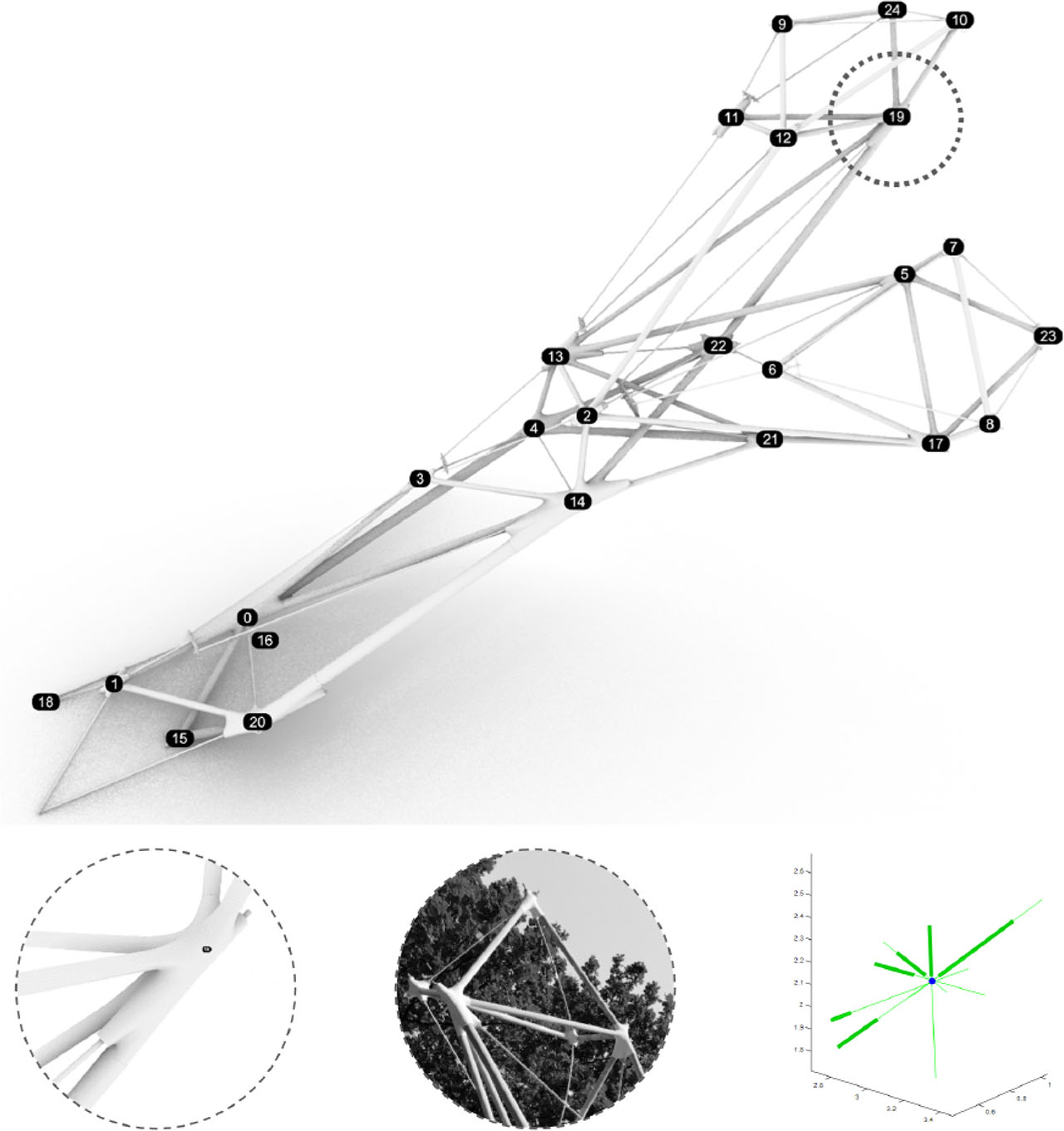
Figure 8.
Top: Overview of nodes. Bottom left: Node 19 with six wooden members and one threated tension rod. Bottom center: Node 19 in the realized structure. Bottom Right: Identical point (blue dot) of the joint i=19 with six wooden members
7. SUMMARY OF RESULTS, DISCUSSION AND CONCLUSION
A Y-shaped, polyhedral cantilever arm was successfully transformed in an iterative transformation process into multiple trussed configurations, enhancing structural efficiency by ensuring members only transfer axial forces. This was achieved without altering the overall size and geometrical shape of the structure. Among the configurations, T1 was chosen for its balance of structural stability, aesthetic appeal, and practical feasibility, as demonstrated by digital and physical models. Replacing fixed joints with universal joints and assuming all member axes intersect at nodes required triangulation for stability. Utilizing standardized materials and 3D printing technology allowed for efficient and precise construction, combining simple cylindrical beech wood members with modern fabrication techniques. The use of solid beech wood, M6 threaded rods, and 3D printed PLA NX2 joints proved effective for constructing a structurally sound and easily multiple times assembled and disassembled cantilever. The design allowed for simple adjustments and ensured safety during assembly. The cantilever was load-tested by incrementally applying vertical loads of 0.5 kN to both nodes 10 and 23. Overall, the T1 configuration demonstrated good structural integrity under load, and the different ways to monitor deflections of the free ends that included simulation by Karamba3D, manual geometrical measurements, laser scanning and numerical calculations showed similar results in a close for practice negligible range. The joint design avoided the need for complex screw sleeves, and although this meant that the tension rods did not cross concentrically in the multi-arm nodes, the cantilever’s performance was insignificantly or not affected at all. The use of graphical statics to find a common resultant force vector proved to be an efficient and practical method for simplifying multiarmed joints.
However, unlike traditional pins or hinges, the 3D-printed joints mimic the appearance of topology-optimized fixed joints, with smooth, continuous forms that integrate seamlessly with the structural members. The continuity of the form seems to having improved stress distribution across the joint due to the absence of abrupt angular changes in the node. The bespoke nature of the 3D-printed joints allows each joint to “tailor” the connections to standardized wooden and threaded rod members, ensuring a uniform and visually cohesive assembly. In this sense the customized part of the structure is condensed into the joint and its detailing, which creates design options that balance structural demands with design aesthetics. However, even though the 3D printed joints performed well in the real-world application of our study, the material use can be further optimized. So far preset infill patterns have been used, but bespoke infills and perimeter wall thickness may lead to increased structural performance at lower material consumption, and possibly to modified visual appearance. The used joints are designed to be plug-and-play, which simplifies assembly and disassembly processes, as demonstrated through repeated configurations in the study. The ease of assembly that typically characterize pinned structures is particularly enhanced by two key aspects. Firstly, the connection of multiple structural members is not at one and the same point but offset from the system point, which creates space for cooperating workers and their tools. Secondly, designed as through-the-joint-mounted fittings, the threaded rods could easily be integrated into the construction and assembly process, as they can be passed through the joint without simultaneously having to be screwed. Additionally, it is easy to later adjust and refine distances and geometries. Based on this advantage, future assemblies from preassembles modules may be an option that may be of interest for industrial applications. By combining such advanced digital fabrication techniques with readily available materials, the design may achieve a high degree of customization with rapid production capability.
The laser scan provided two data sets in the form of point clouds. These measurements offered very fast and highly precise results. However, the data volume was significant, making it challenging to handle and necessitating the cleaning of the point clouds' noise. Other measuring methods, which capture single points of a structure with high precision, may be more time-consuming initially. However, considering that discrete members are located between these points, such methods could save time in later processes. With the laser scan data, it was not possible to compare the two configurations mathematically because no identical points can be identified in the laser scan data. To identify identical points in the laser scan data a mathematical approach was used. The joints are designed such that the axes of all rods meet in a common intersection point. This intersection point is an identical point and was determined by the spatial position of the cylinder axes of the wooden members. Most joints consist of more than two cylindrical wooden members, which leads to an overdetermined system of linear equations. Therefore, in general there is no common intersection point. In practice even small displacements of the wooden members and the threaded rods can lead to there being no common intersection point. However, the least mean squares method has been used to determine an identical point of the joint as the point with the shortest distance to all cylinder axes. The two different configurations were compared using the difference vector of these identical points of each joint. The biggest difference was found at the two joints (i=10 and i=23) where the load was applied. The difference of these two points with the Karamba3D simulation results is only a few millimeters, more precisely 7.2% and 4.5%. Which is surprisingly good, since the Karamba3D simulation did not take into account the small displacements of the wooden members and the threaded rods that occur in practice. The direction angle in the horizontal between the initial configuration and the final configuration was only 0.1° and 0.4° for the two load points. The elevation angles of the two load points with respect to the horizontal are 0.74° and 0.62° smaller in the final configuration. These angles show that the load not only caused the cantilever beam to settle but also caused it to twist.
Beyond its structural significance, the articulation of joint detailing impacts factors such as the number of elements and joints, the structurally required cross-section of each member, the ease and speed of assembly and disassembly, material mass and associated sustainability, visual appeal, and overall aesthetics of the structure. This study demonstrates the potential of combining optimized, bespoke joints and advanced manufacturing techniques with simple standardized, discrete members to create efficient, modular/hybrid architectural structures. The successful realization and testing of configuration T1 highlight the feasibility of this approach, emphasizing the importance of precise joint detailing for structural performance and aesthetic quality. The findings suggest significant opportunities for sustainable practices and improved construction efficiency, paving the way for future research and applications in modular architectural structures and beyond.
ACKNOWLEDGEMENTS
This research was conducted with the assistance from Allterra Austria, represented by Wolfgang Probst. The authors would like to thank all students, especially Manuel Pleifer, Julia Geißler, as well as Pit Bernard, Phil Bossert, Lenz Freudenreich, Vivian Trabert and Johannes Wetzel, involved in fabrication and (dis-)assemblies, and Sandro Sanin for his support and for sharing his expertise in 3D printing.