
Table 1.
Impact of development on the mass of municipal waste produced; WAVR – waste accumulation volume rate; WAMR – waste accumulation mass rate [20]
| Type of development | WAVR (l/M/d) | WAMR (kg/M/d) |
|---|---|---|
| Large cities (more than 100,000 inhabitants) | 4.94-6.85 | 0.6-1.1 |
| High-rise urban development (housing estates) | 2.52 | 0.44 |
| Dense inner-city neighbourhoods | 3.62 | 0.92 |
| Single-family housing in rural areas | 3.97 | 1.01 |
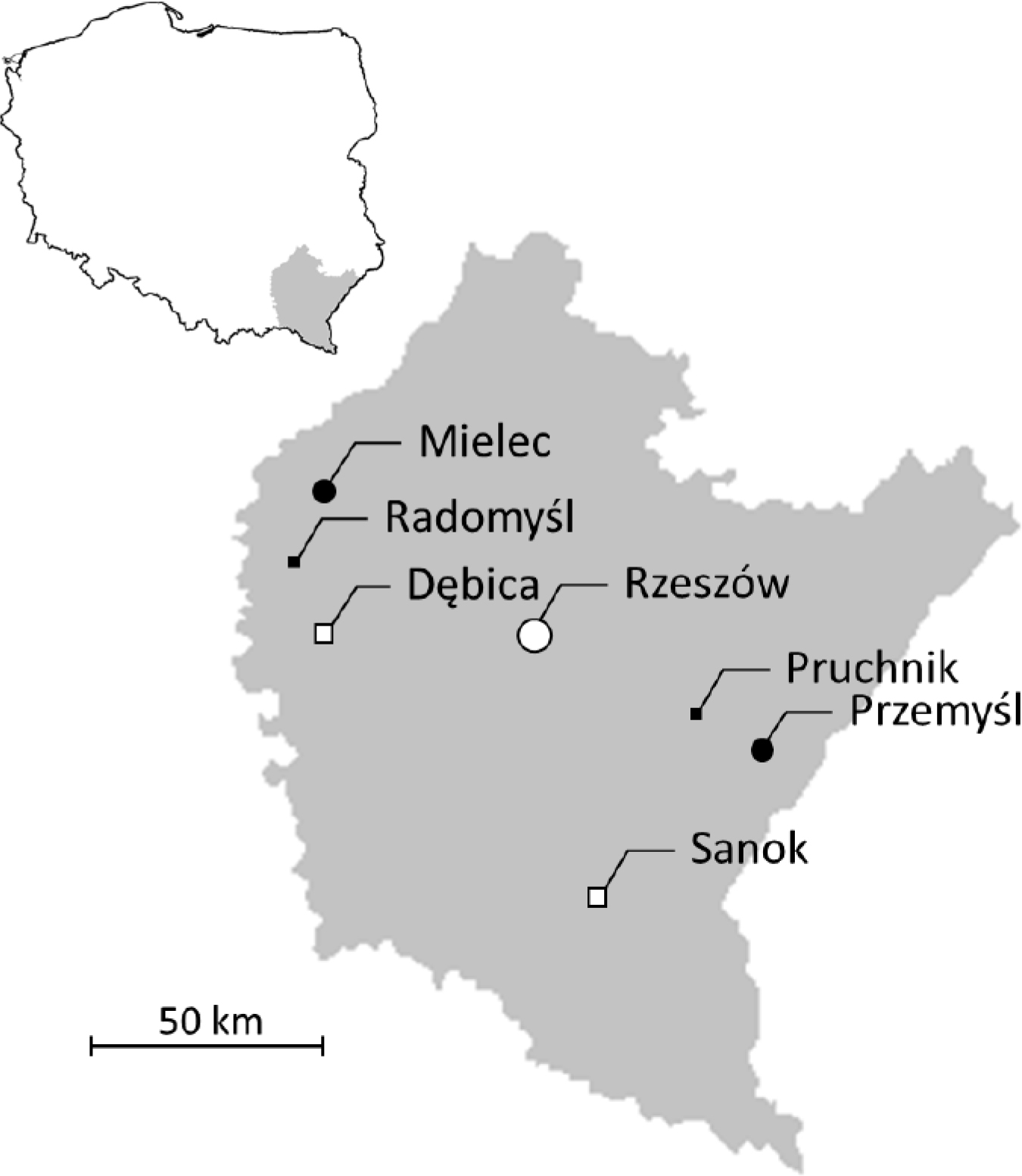
Figure 1.
Subcarpathian Province (Województwo podkarpackie) marked grey on the map of Poland, the localization and approximate size of towns mentioned in this work: white circle – ca. 200k, black circle – ca. 60k, white square – ca. 40k, black square – ca. 3k. Note that the pairs of towns are chosen to be separated by the capital of the province so it is at least about 50 km away
Table 2.
Population size of selected towns in the study area, MRWA coefficients and calculated AMMW. The table breaks down the city pairs compared in terms of population
| Year | Population | WAMR | AMMW | |
|---|---|---|---|---|
| Poland | 2021 | 38080411 | 360 | 1,371E+10 |
| 2020 | 38265013 | 360 | 1,378E+10 | |
| 2019 | 38382576 | 360 | 1,382E+10 | |
| Subcarpathi an Province | 2021 | 2110694 | 250 | 5,277E+08 |
| 2020 | 2121229 | 250 | 5,303E+08 | |
| 2019 | 2127164 | 250 | 5,318E+08 | |
| Rzeszów | 2021 | 198609 | 426 | 8,461E+07 |
| 2020 | 196638 | 426 | 8,377E+07 | |
| 2019 | 196208 | 426 | 8,358E+07 | |
| Przemyśl | 2021 | 58721 | 330 | 1,938E+07 |
| 2020 | 59779 | 330 | 1,973E+07 | |
| 2019 | 60689 | 330 | 2,003E+07 | |
| Mielec | 2021 | 59509 | 365 | 2,172E+07 |
| 2020 | 60075 | 365 | 2,193E+07 | |
| 2019 | 60323 | 365 | 2,202E+07 | |
| Sanok | 2021 | 36462 | 323 | 1,178E+07 |
| 2020 | 36999 | 323 | 1,195E+07 | |
| 2019 | 37359 | 323 | 1,207E+07 | |
| Dębica | 2021 | 44692 | 330 | 1,475E+07 |
| 2020 | 45189 | 330 | 1,491E+07 | |
| 2019 | 45504 | 330 | 1,502E+07 | |
| Radomyśl Wielki | 2021 | 3252 | 333 | 1,083E+06 |
| 2020 | 3225 | 333 | 1,074E+06 | |
| 2019 | 3226 | 333 | 1,074E+06 | |
| Pruchnik | 2021 | 3729 | 232 | 8,651E+05 |
| 2020 | 3740 | 232 | 8,677E+05 | |
| 2019 | 3745 | 232 | 8,688E+05 |
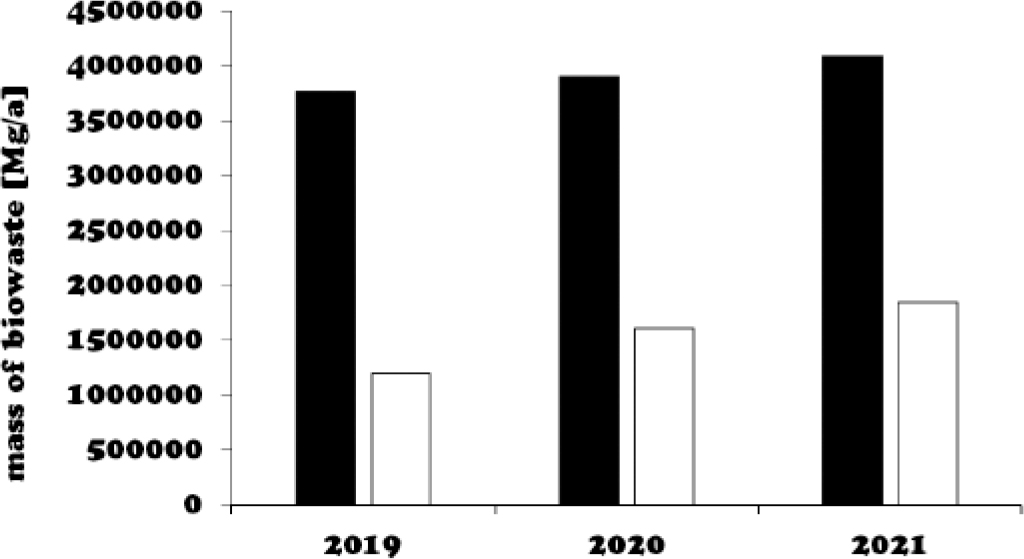
Figure 2.
The primary goal of a well-functioning waste management system is to reduce the mass of waste before its disposal. Expected (black bars), in accordance with KPGO 2028 [14] document and BN-87/9103-04 standard [19], and selectively collected (white bars, according to GUS 2022 [12]) masses of bio-waste in Poland
Table 3.
Logistics of biowaste collection according to type of development [42]
| Type of development | Population density (M/km2) | Level of participation | Collection logistics |
|---|---|---|---|
| City centre and highly urbanised areas | >1750 | very low | very difficult |
| Urbanised areas outside the inner city, multifamily development | 750-1750 | low | difficult |
| Suburbs or small towns, single-family housing | 150-750 | high | easy |
| Non-urbanised areas (rural) | <150 | medium | difficult |
Table 4.
Opportunities and challenges of biowaste management
| Categories | Technological options | Opportunities | Challenges |
|---|---|---|---|
| Bio-based materials (e.g. functional foods, supplements, enzymes, colourants, bioplastics) | Supercritical technology Membrane separation Green chemistry Solvent extraction Enzyme extraction Electro-based extraction (e.g. ultrasounds, microwaves) | Supply: large-scale, concentrated Low-cost supply of biowaste feedstock [49, 51, 52, 53] Market: customer shift towards natural-based products [49, 53]. | Technology: Low technological value readiness level (TRL), mainly at lab-scale [54, 55, 56] entails high R&D cost [56] and high investment uncertainty [57]. Quantification: low reliability in estimating material potentials in terms of of quantity and quality [58] Logistics: high logistics cost involved in the collection [56] and storage for quality reservation [54] Market: the understanding of nutrient and economic value for the nutraceutical products are fairly limited. while excessive modification of food; could cause a potential risk to consumers’ heath [58] |
| Waste-to-Energy (biogas, biodiesels, biochar, liquid, gas, fuels, heat and electricity) | Pyrolysis Gasification Fermentation combined heat and power | Technology: energy conversion technology has a high TRL [59] Logistics: the introduction of innovative biowaste transport, i.e. smart recycle bin [60], under-the-sink biowaste disposal connecting to the sewer system [61], pipeline transmission [62] | Technology: further R&D into optimal feedstock and optimal process. Design and conditions are needed to cope with the low-yield issue, and maximise the output of targeted products; [63, 64] Supply: supply locations are geographically dispersed [65]; source segregation is required [61]. |
| Compost | Composting Vermicomposting | Logistics: a growing interest in decentralised composting (e.g. Community, home composting), Market: the demand for fertilisers always exceeds supply [66]; consumer preferences towards foods produced from the upcycled and eco-friendly materials improve the intrinsic value of digestate; used as recycled fertilis-ers/compost [67] | Technology: this technology has a small production scale compared to fossil-based fertiliser production [66] encounters difficulty in planning and use, causes unfavourable odour for the neighbourhood [68]; there is limited information knowledge about vermicomposting [69]. Logistics: high collection and handling costs [70] Policy: the legal status of digestate that varies in different countries hinders its use [66, 71]; and no specific quality control and criteria available for using digestates as fertilisers [67] Market: lack of interest in fertilisers producers [66] and no pressure to change in the fertiliser (phosphorus) industry [67]. |
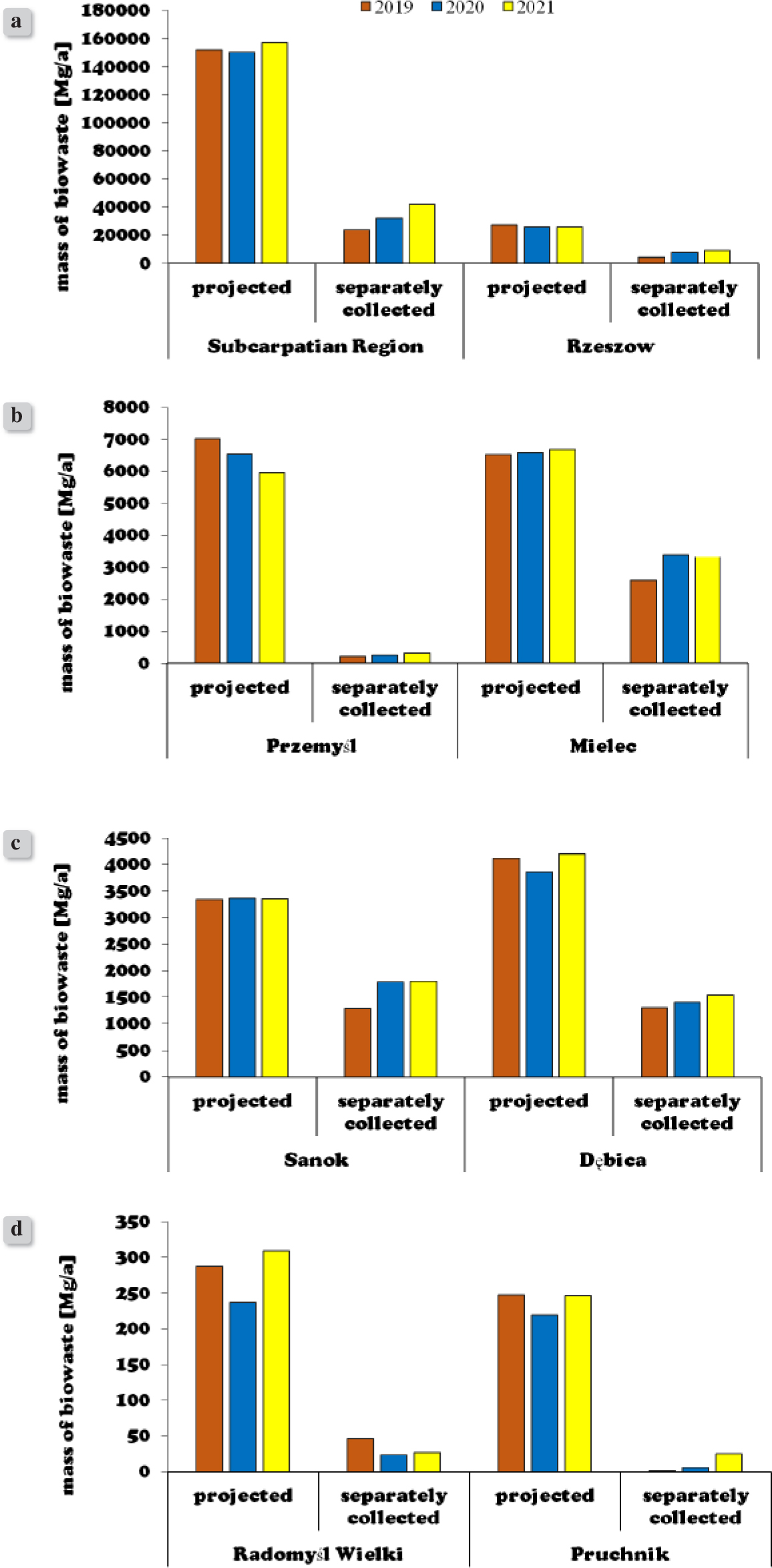
Figure 3.
Mass of biowaste expected and selectively collected in Podkarpackie province, the capital of region (A; 200k) and six exemplary cities, compared in pairs with similar number of inhabitants (I): Przemyśl and Mielec (B; 60k), Sanok and Dębica (C; 40k), Radomyśl Wielki and Pruchnik (D; 3k) in years of 2019–2021