
1. INTRODUCTION
Reverse logistics is an activity that involves the reverse distribution of materials as well as reducing the number of new materials in the system [1, 2]. It focuses on recovering products when they are no longer desired or can no longer be used for economic gain through reuse, recycling, or recycling into new production [3, 4]. Other authors draw attention to the importance of environmental requirements and the growing role of the reverse supply chain in material extraction [5, 6, 7]. Reverse logistics differs from waste management in that it focuses on adding value to the product to be recovered and then the results will be used by forward logistics, while waste management mainly involves the collection and processing of waste products that have no new use. The primary goal of a well-functioning waste management system is to reduce the amount of waste undergoing neutralization processes. Therefore, it is extremely important to selectively collect as many waste fractions as possible that can be recycled or recovered. The stream of biodegradable waste (broadly understood as green waste, kitchen waste, other biodegradable waste, as well as sewage sludge and waste from the agricultural, food processing, and distribution sectors) plays an extremely important role in reducing the amount of mixed waste sent to landfills. Bio-waste, i.e. organic waste, is one of the oldest wastes known to people, as it is related to the beginnings of the social life of the human species. They differ significantly from other raw materials whose production is accompanied by complicated processes. However, the potential of bio-waste (compared to glass or metal) is not lower.
European Union (EU) Member States are obliged to reduce the amount of biodegradable municipal solid waste sent to landfills and to recycle organic fractions using more environmentally friendly technologies under the Landfill Directive [8] and the Framework Directive on waste [9]. In recent years, the EU has adopted several measures to meet such requirements. For example, the European Commission [10] has adopted the “Circular Economy Package”, which includes revised waste legislative proposals with a greater common target for municipal waste recycling and lower limits on municipal waste going to landfill. The 2035 recycling target for municipal waste is set at 65% in the revised waste legal framework. The EU is therefore supporting the implementation of precise measures and actions among its members to improve current conditions and create a legal framework for the proper management of municipal waste. Platforms such as the European Compost Network [11] connect all European bio-waste organizations and their facilities, research, policy-making, consultants, and authorities and create a network of sustainable recycling practices in composting. Compost is a natural organic fertilizer that can be used to fertilize soil and crops. In reverse logistics, compost can be used to grow plants in places where distribution centers or warehouses previously operated.
According to the Central Statistical Office (GUS) in 2021, 13.7 million tons of municipal waste was collected in Poland (an increase of 4.2% compared to 2020) [12]. On average, 358 kg of municipal waste was collected per inhabitant, which means an increase of 16 kg compared to the previous year. In 27 countries in European Union it was 532 kg per inhabitant. Among the EU countries, the most waste was collecteg in Luxembourg and it was as much as 835 kg per inhabitant. In turn, the least waste was collected in Kosovo because only 270 kg per inhabitant [13]. In Poland most of the municipal waste generated in 2021 (86% – 11,732 thousand tons) was collected from households (compared to 2020, the amount of this waste increased by 4%). The structure of separately collected municipal waste has changed over the years. The waste fractions that dominated in 2005, such as paper and cardboard, glass and plastics (a total of 80% of separately collected waste), now constitute 34% of the total, and the share of metals has also decreased (from 2.5% in 2005 to less than 0.2% in 2021). Separate collection of large-size waste remains at a similar level of 10–15%, but in recent years it has been close to the upper limit of this range. Currently, the largest share is held by biodegradable waste (34% in 2021) and other fractions (18% in 2021) [12].
In Poland, the National Waste Management Plan 2028 [14] is a document that specifies the actions necessary to ensure integrated waste management in a way that ensures environmental protection, taking into account current and future economic opportunities and conditions as well as the technological level of the existing infrastructure. An important element in the management of biodegradable waste is its transport from the place of its generation to the place of storage, and then to the place of its management. Transport costs are significant in the overall costs of waste management, therefore the frequency of collection and collection routes should be properly planned [15]. Recycling nutrients is consistent with the principles of the Circular Economy (CE). The transition from a fossil fuel-based economy to a biotechnology-based economy requires the recovery of nutrients from waste streams, and replacing mineral fertilizers with bio-based alternatives is an important direction in material and energy recovery [16]. Waste from which biofertilizers can be produced should be collected selectively for appropriate biodegradable fractions and groups, starting from households, which is necessary for waste management in terms of valorization [17]. The amount of municipal waste, including bio-waste, generated depends not only on the population but also on consumption patterns and economic wealth. They also depend on the method of collecting and managing municipal waste. The type and amount of waste generated also depend on the type of area (city, village) in which it is generated, population density, type of development (single-family, multi-family), the number of tourists, the presence of public utility facilities and the presence, type, size, and number commercial establishments and small industry or services [18]. Therefore, the mass of bio-waste selectively collected at administrative levels: country, voivodeship, a city with over 50 thousand inhabitants and a city with a population of less than 50 thousand inhabitants. The obtained data were compared to the projected mass of municipal bio-waste calculated from the morphological composition of municipal waste presented in KPGO2028 [14].
2. MATERIALS AND METHODS
The study compared the mass of waste obtained from the study of the Central Statistical Office [12] and the estimated mass of separately collected waste calculated in accordance with the BN-87/9103-04 standard (Eq. 1, 2) [19] taking into account the data contained in the National Waste Management Plan 2028 (Table 1) [14]. Due to the lack of availability of statistical studies for all analyzed administrative levels before 2019, the analysis was carried out for the period 2019–2021.
Table 1.
Impact of development on the mass of municipal waste produced; WAVR – waste accumulation volume rate; WAMR – waste accumulation mass rate [20]
| Type of development | WAVR (l/M/d) | WAMR (kg/M/d) |
|---|---|---|
| Large cities (more than 100,000 inhabitants) | 4.94-6.85 | 0.6-1.1 |
| High-rise urban development (housing estates) | 2.52 | 0.44 |
| Dense inner-city neighbourhoods | 3.62 | 0.92 |
| Single-family housing in rural areas | 3.97 | 1.01 |
The estimated annual morphological mass of waste was calculated using the formula: (1)
where:
Qa – annual mass of municipal waste (AMMW) (Mg/a);
Vj – mass rate of waste accumulation (MRWA) (was adopted for each town in accordance with the GUS data) (kg. M/a);
M – number of inhabitants (according to GUS 2022) (Figure 1, Table 2) [12].
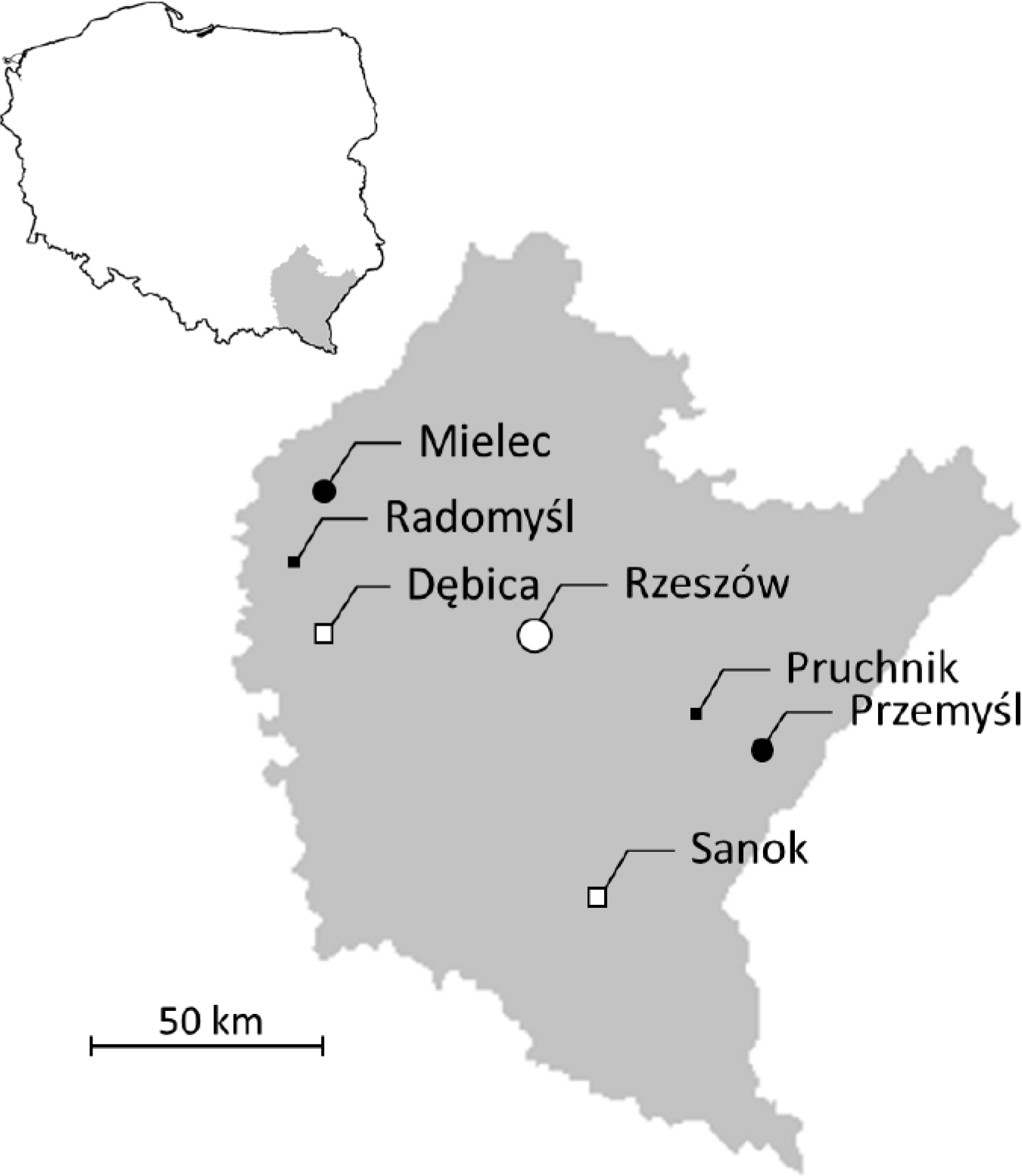
Figure 1.
Subcarpathian Province (Województwo podkarpackie) marked grey on the map of Poland, the localization and approximate size of towns mentioned in this work: white circle – ca. 200k, black circle – ca. 60k, white square – ca. 40k, black square – ca. 3k. Note that the pairs of towns are chosen to be separated by the capital of the province so it is at least about 50 km away
Table 2.
Population size of selected towns in the study area, MRWA coefficients and calculated AMMW. The table breaks down the city pairs compared in terms of population
| Year | Population | WAMR | AMMW | |
|---|---|---|---|---|
| Poland | 2021 | 38080411 | 360 | 1,371E+10 |
| 2020 | 38265013 | 360 | 1,378E+10 | |
| 2019 | 38382576 | 360 | 1,382E+10 | |
| Subcarpathi an Province | 2021 | 2110694 | 250 | 5,277E+08 |
| 2020 | 2121229 | 250 | 5,303E+08 | |
| 2019 | 2127164 | 250 | 5,318E+08 | |
| Rzeszów | 2021 | 198609 | 426 | 8,461E+07 |
| 2020 | 196638 | 426 | 8,377E+07 | |
| 2019 | 196208 | 426 | 8,358E+07 | |
| Przemyśl | 2021 | 58721 | 330 | 1,938E+07 |
| 2020 | 59779 | 330 | 1,973E+07 | |
| 2019 | 60689 | 330 | 2,003E+07 | |
| Mielec | 2021 | 59509 | 365 | 2,172E+07 |
| 2020 | 60075 | 365 | 2,193E+07 | |
| 2019 | 60323 | 365 | 2,202E+07 | |
| Sanok | 2021 | 36462 | 323 | 1,178E+07 |
| 2020 | 36999 | 323 | 1,195E+07 | |
| 2019 | 37359 | 323 | 1,207E+07 | |
| Dębica | 2021 | 44692 | 330 | 1,475E+07 |
| 2020 | 45189 | 330 | 1,491E+07 | |
| 2019 | 45504 | 330 | 1,502E+07 | |
| Radomyśl Wielki | 2021 | 3252 | 333 | 1,083E+06 |
| 2020 | 3225 | 333 | 1,074E+06 | |
| 2019 | 3226 | 333 | 1,074E+06 | |
| Pruchnik | 2021 | 3729 | 232 | 8,651E+05 |
| 2020 | 3740 | 232 | 8,677E+05 | |
| 2019 | 3745 | 232 | 8,688E+05 |
The estimated morphological composition of the waste was calculated using the formula: (2)
where:
Qga – annual mass of individual morphological groups of municipal waste (Mg/a);
Qa – annual mass of municipal waste (Mg/a);
%Ug share of bio-waste in the mass of municipal waste (according by KPGO 2028 [14], for Poland and Subcarpathian Voivodeship the result was averaged taking into account villages), bio-waste includes food (kitchen) waste, green waste and other bio waste:
large cities >50 thousand residents – 30.7%
small cities <50 thousand inhabitants – 28.8%
Poland and Subcarpathian Voivodeship – 29.8%
3. RESULTS AND DISCUSSION
The study compared the amount of bio-waste generated, calculated from the number of inhabitants, the individual waste accumulation rate, and the percentage composition presented in KGPO2028 [14] with the data contained in the Central Statistical Office [12]. The presented data show large discrepancies between the predicted and collected masses of municipal bio-waste. These discrepancies may indicate for example the imperfection of the sorted waste collection systems in Poland and cities, regardless of their size. The difference between the predicted and collected mass of municipal bio-waste may also be due to shortcomings in forecasting methods. The analysis of municipal waste should take into account, for example, differences in the dominant types of buildings, which are related to the heating system used, the wealth of the population living in a given area and other variables. However, this issue requires deeper consideration. Selective collection of dry municipal waste (paper and cardboard, plastics, glass, or bulky waste), despite the imperfections of the collection and collection system, is relatively easy. In the case of this waste, there are no problems with recycling or storage. However, the management of the generated bio-waste creates logistical problems, starting from the collection system, through transport, and ending with its management. It seems that in the case of rural areas or single-family buildings, which predominate in cities with a population of less than 50,000. the mass of bio-waste generated will remain constant or decrease. The presented data show that the largest increase in the mass of collected bio-waste (by 93% in 2021 compared to 2019) was observed in the case of Pruchnik, in the second of the analyzed small towns (Radomyśl Wielki) the opposite tendency was found – a decrease by 87% in the mass of collected bio-waste in 2019–2021. In the case of the second analyzed pair of cities with a population of less than 50,000 (Sanok and Dębica) but characterized by urban development and the presence of industrial plants, a 28 and 14% increase in the mass of collected bio-waste was found, respectively. In cities with over 50,000 inhabitants (Przemyśl and Mielec), an even greater increase in the mass of collected bio-waste was observed (by 46 and 38%, respectively). Data regarding Rzeszów are interpreted separately due to the large difference in the number of inhabitants (almost 200,000) and the type of buildings, which are mostly urban. In Rzeszów, in the years 2019–2021, an over 50% increase in the mass of separated bio-waste was observed. Analyzing data for the Podkarpackie Voivodeship and Poland, an increase in the weight of separated bio-waste was found by 41 and 29% (Figure 2).
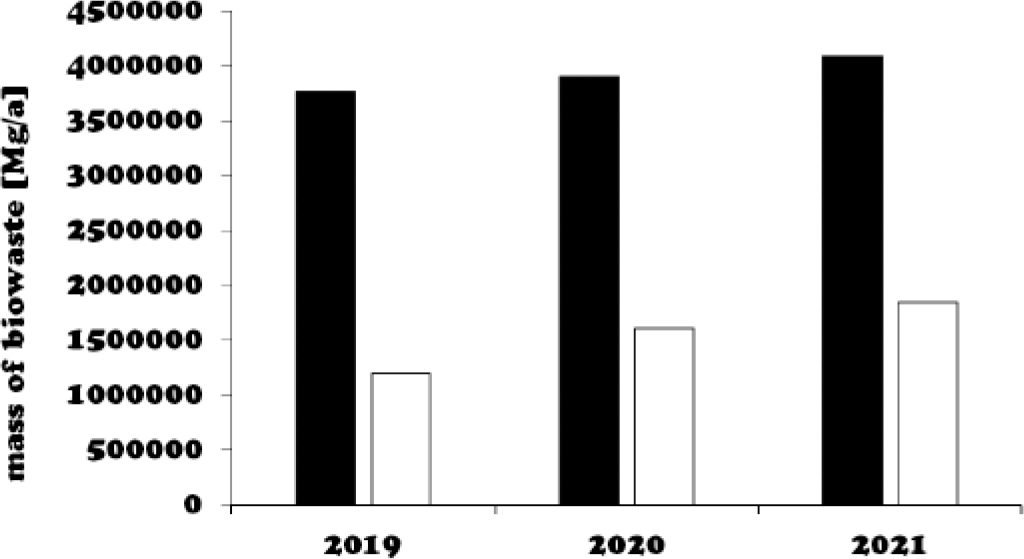
Figure 2.
The primary goal of a well-functioning waste management system is to reduce the mass of waste before its disposal. Expected (black bars), in accordance with KPGO 2028 [14] document and BN-87/9103-04 standard [19], and selectively collected (white bars, according to GUS 2022 [12]) masses of bio-waste in Poland
This can be explained by the urbanization rate, i.e. the percentage of city residents in the total population, which for the Podkarpackie Voivodeship is 41.6%. For Poland, it is higher (59.7%), but the reason for the smaller increase in the mass of separated bio-waste may be the fact that bio-waste collection was well organized in previous years throughout the country. Podkarpacie is a poor region located in the east of the country and only in recent years has a rapid development of infrastructure related to waste management been observed, unlike the central and western voivodeships, where such investments were co-financed in earlier years. This means that as the development changes from rural to urban, public awareness increases. The type of development also determines the mass of municipal waste produced (Table 2), which has a direct impact, along with the increase in residents' awareness and infrastructure funding, on the mass of segregated bio-waste. As compact housing grows (apartment blocks), both the volume and the mass of municipal waste collected decrease.
A similar phenomenon, a much smaller amount of collected waste than the theoretically calculated mass, was noticed by [21] who conducted research in five rural communes. The smaller mass of collected waste than the theoretical one may result from the smaller number of inhabitants than declared by the commune. Some residents may only be registered in the commune and stay e.g. abroad or, in the case of young people, go to study or go to school in other larger cities. All this means that many people do not spend most of their time at their place of residence and therefore do not produce waste there.
Another, but this time positive, phenomenon that may result in a difference in the amount of waste generated is the residents’ management of biodegradable waste by feeding farm animals or composting. According to the data presented in KPGO2028 [14], the projected percentage composition of waste may vary slightly depending on the size of the city and between towns and villages. In each division, the largest part of the waste is kitchen food waste, from 17.1% in small towns to 19.1% in large cities. It should also be noted that the sum of biodegradable waste (kitchen food waste along with green waste and other bio-waste) constitutes the largest group of selectively collected waste, ranging from 28.5% of all waste for small towns to 30.7% for large cities. That is why it is so important to develop an effective waste management plan. The increased share of collected bio-waste compared to forecasts indicates increasingly better collection of this waste fraction and increasing public awareness of waste segregation. On the other hand, it may indicate a food waste problem. The discussion around the relationship between consumers' behavior and food waste has been articulated through different models and approaches such as the Motivation-Opportunity-Ability (MOA) framework. According to the assumptions of MOA, consumers' actions are influenced by personal motivations, opportunities, and abilities [22]. Motivation can be defined as performing specific actions, such as avoiding food waste in the household, under the influence of awareness of the individual and social consequences of this behavior [23, 24, 25, 26]. Capacity refers to an individual's ability to cope with bio-waste generation, based on personal knowledge and skills [27, 28]. That is why the ability to plan purchases, store food, and the ability to assess the suitability of food for consumption is so important. Opportunity refers to the ability to access external tangible and intangible resources such as time, technology, and infrastructure [27, 28]. In the food domain, it refers to the actual or perceived availability of time for grocery shopping, cooking, and learning new food-related skills (intangible resources). This involves access to grocery stores and the purchase of inexpensive and high-quality food in appropriate packaging and portions (material resources) [26, 28, 30, 31]. According to Vittuari et al. [32] MOA framework does not treat food waste as a purely intended outcome but as an unintended consequence of iterative decisions and behaviors related to food management practices in and outside the home, driven by both internal (individual) and external (social and societal) factors.
Consumer food waste at the household level results from a complex set of different behaviors. They are influenced by psychological, socio-cultural, and economic factors such as awareness, attitudes, cognition, emotions, and contextual factors such as available technologies. Looking at the causes of food waste in both industrialized and non-industrialized countries [33], much of the literature highlights the significant role of consumer responsibility, particularly at the household level [34]. Socio-demographics are believed to have an indirect influence on consumer food waste behavior [26]. Age, gender, education level, household size and composition, employment status, and income appear to be the most common and important factors [35]. According to Van Geffen et al. [35], age appears to be correlated with the amount of food waste produced and consumers' waste attitudes. It turns out that older consumers waste less food compared to younger consumers. This is due to different attitudes towards food and a higher level of awareness about the effects of food waste compared to young people [36]. Another factor leading to lower levels of food waste generated by older people is personal experience with food shortages during and after World War II, especially in Europe.
Indirectly, the pandemic related to the SARS-CoV-2 virus also influenced the amount of municipal waste produced. Panic shopping at the beginning of the COVID-19 epidemic may have contributed to an increase in the level of food waste included in biowaste. This is confirmed by research [37, 38]. But there is also the possibility of reducing the resulting mass of this waste due to better food planning and management and the development of culinary skills. The literature review shows that there is no single regularity. Reductions in household food waste were observed in Italy and Romania [39, 40]. But in Serbia and Thailand, higher amounts of food waste were found [37, 41]. Opportunities for selective waste collection should be assessed in the local context. Not only is the mass and quality of waste generated important, but also the possibility of actively involving residents in the collection system (residents' participation). A very important factor influencing the collection of bio-waste is the logistics of its collection from residents. In rural areas, due to the dispersion of buildings, the cost of obtaining the same amount of bio-waste is much higher compared to urbanized areas. The areas of Podkarpacie are mostly characterized by rural buildings. This can also explain such large discrepancies between the mass of the collected municipal waste fractions and the mass forecast according to the National Plan for Water Management 2028. There are several waste collection systems, the simplest of which include the bagcontainer system, where waste, depending on the type, is placed in differently colored bags or containers. Waste containers can be replaced with an underground collection system, where the container is largely hidden underground, so it takes up less space. Vacuum systems for automatic waste suction are a slightly more complicated collection system. This system offers the highest hygiene standards but is also the most expensive. Bio-waste is specific waste due to the biological processes taking place in it and, as a result, its unpleasant smell, it should not be collected in large containers that are rarely collected. Residents may feel reluctant to collect bio-waste due to unpleasant odors or hygiene reasons. A future solution is to use biodegradable bags for biodegradable waste instead of ordinary plastic bags, which can be thrown into a bio-waste container together with the contents without having to empty them. Additionally, the frequency of biodegradable waste collection can be optimized depending on the period when larger amounts are generated, e.g. in autumn when biodegradable waste includes fallen leaves from trees. Table 3 shows the impact of the type of development on the possibilities of collecting bio-waste.
Table 3.
Logistics of biowaste collection according to type of development [42]
| Type of development | Population density (M/km2) | Level of participation | Collection logistics |
|---|---|---|---|
| City centre and highly urbanised areas | >1750 | very low | very difficult |
| Urbanised areas outside the inner city, multifamily development | 750-1750 | low | difficult |
| Suburbs or small towns, single-family housing | 150-750 | high | easy |
| Non-urbanised areas (rural) | <150 | medium | difficult |
The management of bio-waste must respond to local conditions, therefore the best processing method is selected at the local level. In the case of processing and using bio-waste, it must be borne in mind that there is an indirect return to the human food chain and, therefore, care must be taken to protect human health. From bio-waste, we can obtain animal feed, high-quality natural compost that can effectively replace mineral fertilizers, methane in the fermentation process that can replace conventional fuels, and recover energy in combustion processes. Processing bio-waste into organic fertilizer is a process that meets the assumptions of a circular economy and creates an environmentally friendly product. The biggest problem associated with composting bio-waste is its chemical contaminants, such as cadmium and PAH content, as well as physical contaminants such as glass, plastic, and metal.
European Union regulations [43] strictly define how composting should be carried out, it mentions composting technology, appropriate conditions, and permissible pollutants, which for fertilizers made from bio-waste are: permissible amount of cadmium 1.5 mg/kg dry weight, 6 mg/kg dry weight of polycyclic aromatic hydrocarbons, 3 g/kg dry weight of contaminants larger than 2 mm, such as glass, plastic or metal. In Poland, the process of biological processing of biowaste is regulated by the Regulation of the Minister of Climate and Environment on December 28, 2022 [44], on the mechanical and biological processing of unsegregated (mixed) municipal waste. Under § 5, point 4, it is possible to carry out a biological processing process of selectively collected biowaste, resulting in the creation of a product in the form of fertilizing products, fertilizers, or agents supporting the cultivation of plants that meet the requirements set out in the provisions of the previously mentioned Regulation 2019/1009 [43]. In such a case, this process is carried out as a separate variant of installation operation.
By defining the conditions that must be met by fertilizers of biological origin, the market was opened to innovative organic fertilizers, including fertilizers derived from bio-waste, which increased the use of organic fertilizers and bio-waste. Fertilizers containing compost from separate collections of bio-waste at the source may be placed on the market. Segregation of bio-waste in an integrated waste management system not only significantly increases its recovery potential, but also improves its environmental efficiency. The impact on human health was reduced by a factor of 4.6, on the quality of the freshwater ecosystem by a factor of 6.3, and on the consumption of resource scarcity by a factor of 2.5 when bio-waste is combined with the production and use of compost, material recovery and reprocessing for replacing fertilizers and raw materials [45]. Many authors have demonstrated the environmental benefits of separate collection of bio-waste and composting compared to traditional waste management systems such as landfilling [46, 47].
According to Do et al. [48] the essence of the Circular Economy (CE) in the case of bio-waste management of municipal origin is, among others:
Longer circulation principle: Keeping food in use longer by extending shelf life and redistributing surplus food for human consumption (inspired by cradle-to-cradle philosophy and efficiency economics),
Cascading principle: maximizing the economic value extracted from all bio-waste substances in a cascading manner according to the biomass value pyramid, instead of converting all food waste into low-value energy production (inspired by the blue economy),
Principle of regeneration: reintroduction of biological nutrients back into the soil; promoting the production of renewable energy from bio-waste in order to reduce the consumption of primary materials; and ideally eliminating the leakage of resources related to waste incineration and storage (inspired by biomimicry),
Clean circle principle: Maintaining a certain level of quality in bio-waste collection by separating and encouraging the use of short-lived products made from bio-based materials instead of fossil materials, e.g. biodegradable plastics (inspired by the cradle-to-cradle philosophy),
Principle of industrial symbiosis: Promoting the use of bio-waste as a resource on a local and regional scale (inspired by industrial ecology).
The waste hierarchy, based on the 1975 European Waste Framework Directive (WFD) [9], sets out an order of preference for waste reduction and management activities (prevention → reuse → recycling → recovery → disposal). This order of preference is based solely on the overall environmental score. While the hierarchy encourages longer circulation (prevention and reuse) and the remanufacturing (recycling and recovery) principles of CE, it ignores other principles, in particular the cascading principle, which takes economic value into account. Moreover, the general terminology used in the waste hierarchy is interpreted differently by users, especially about a specific industry such as the food sector [49].
The greatest attention in the literature was devoted to the conversion of bio-waste into energy and biological materials, and then to the production of compost. The main raw materials for the production of products of biological origin and animal feed are agro residues, processing by-products (e.g. fruit pulp), and vegetable/fruit waste, which are of a homogeneous nature. However, the main raw material for energy conversion is the heterogeneous inflow of organic municipal waste, such as waste from households or restaurants [48]. The opportunities and challenges associated with each type of product category are presented in Table 4. They are influenced not only by technological feasibility [50] but also by supply, market, logistics, and politics. The table includes the starting categories, technology options, and the opportunities and challenges associated with each category.
Table 4.
Opportunities and challenges of biowaste management
| Categories | Technological options | Opportunities | Challenges |
|---|---|---|---|
| Bio-based materials (e.g. functional foods, supplements, enzymes, colourants, bioplastics) | Supercritical technology Membrane separation Green chemistry Solvent extraction Enzyme extraction Electro-based extraction (e.g. ultrasounds, microwaves) | Supply: large-scale, concentrated Low-cost supply of biowaste feedstock [49, 51, 52, 53] Market: customer shift towards natural-based products [49, 53]. | Technology: Low technological value readiness level (TRL), mainly at lab-scale [54, 55, 56] entails high R&D cost [56] and high investment uncertainty [57]. Quantification: low reliability in estimating material potentials in terms of of quantity and quality [58] Logistics: high logistics cost involved in the collection [56] and storage for quality reservation [54] Market: the understanding of nutrient and economic value for the nutraceutical products are fairly limited. while excessive modification of food; could cause a potential risk to consumers’ heath [58] |
| Waste-to-Energy (biogas, biodiesels, biochar, liquid, gas, fuels, heat and electricity) | Pyrolysis Gasification Fermentation combined heat and power | Technology: energy conversion technology has a high TRL [59] Logistics: the introduction of innovative biowaste transport, i.e. smart recycle bin [60], under-the-sink biowaste disposal connecting to the sewer system [61], pipeline transmission [62] | Technology: further R&D into optimal feedstock and optimal process. Design and conditions are needed to cope with the low-yield issue, and maximise the output of targeted products; [63, 64] Supply: supply locations are geographically dispersed [65]; source segregation is required [61]. |
| Compost | Composting Vermicomposting | Logistics: a growing interest in decentralised composting (e.g. Community, home composting), Market: the demand for fertilisers always exceeds supply [66]; consumer preferences towards foods produced from the upcycled and eco-friendly materials improve the intrinsic value of digestate; used as recycled fertilis-ers/compost [67] | Technology: this technology has a small production scale compared to fossil-based fertiliser production [66] encounters difficulty in planning and use, causes unfavourable odour for the neighbourhood [68]; there is limited information knowledge about vermicomposting [69]. Logistics: high collection and handling costs [70] Policy: the legal status of digestate that varies in different countries hinders its use [66, 71]; and no specific quality control and criteria available for using digestates as fertilisers [67] Market: lack of interest in fertilisers producers [66] and no pressure to change in the fertiliser (phosphorus) industry [67]. |
In Poland, there are 220 installations for processing green waste and bio-waste. The average processing capacity of one installation is 8 thousand Mg per year and the total processing capacity equals 1,803 thousand Mg. These installations process biodegradable kitchen waste and other biodegradable waste (Figure 3). Unfortunately, the data presented by the Central Statistical Office [12] on the management of bio-waste in Poland seems unreliable. Records of biologically treated waste are kept only at the country and voivodeship level. According to published data, in the case of Poland, almost all of the collected biowaste is managed in this way, while in the Podkarpacie region, unfortunately, a small percentage of bio-waste was subjected to this process. This seems impossible from a practical point of view and therefore one should consider whether, in the case of Poland, sewage sludge is not included in the records, which is methodologically incorrect.
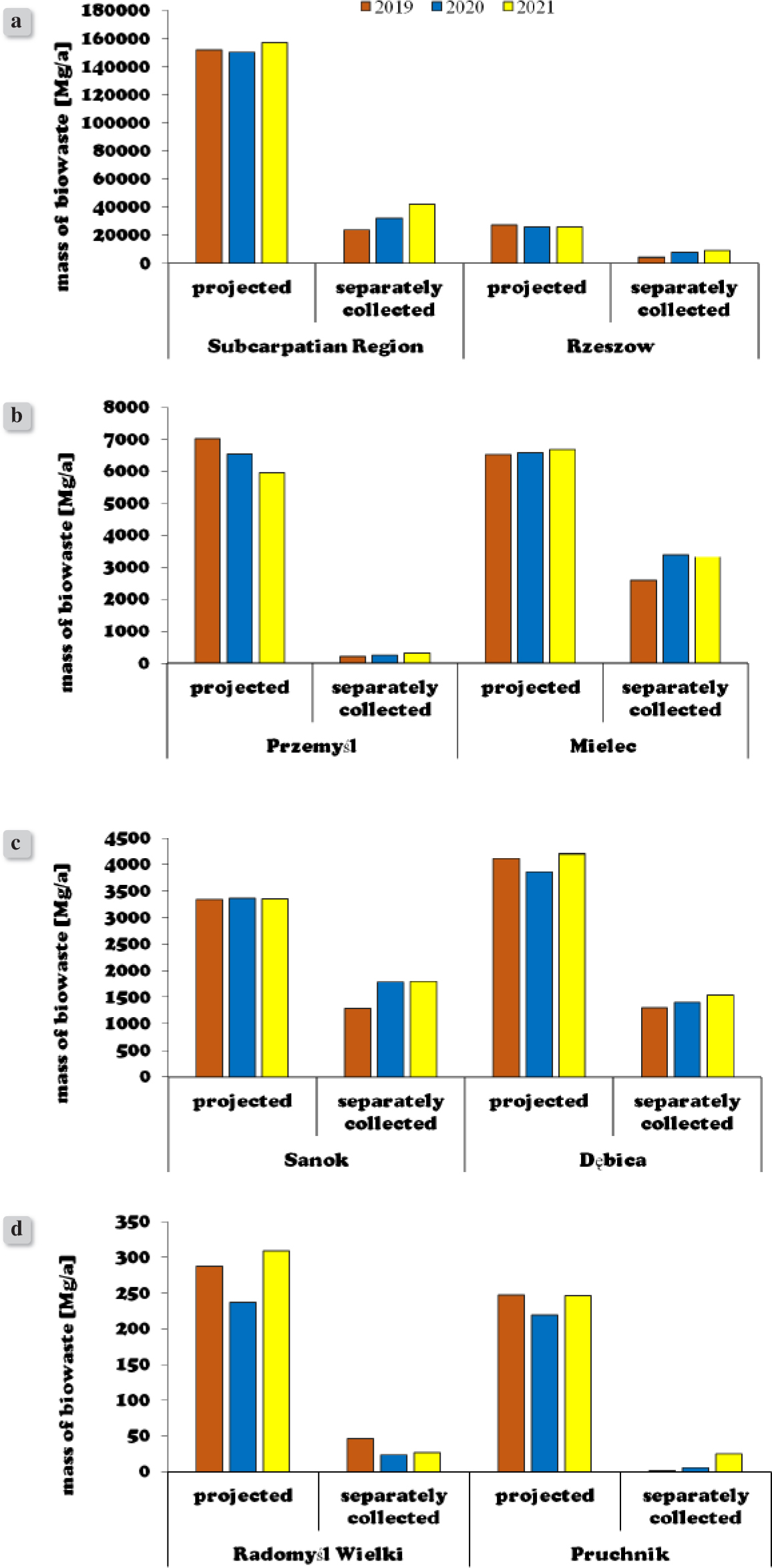
Figure 3.
Mass of biowaste expected and selectively collected in Podkarpackie province, the capital of region (A; 200k) and six exemplary cities, compared in pairs with similar number of inhabitants (I): Przemyśl and Mielec (B; 60k), Sanok and Dębica (C; 40k), Radomyśl Wielki and Pruchnik (D; 3k) in years of 2019–2021
Logistics and supply chain management are important elements in the prevention and management of bio-waste potential [72, 73]. Particularly for perishable products, important impacts are attributed to logistics activities and extended supply chain networks, which are driving the shift to a more sustainable production and consumption model in which food is produced and consumed locally [74].
Effective recycling and recovery of bio-waste involves the creation of extensive logistics networks and supply chain management – from collection, and transport to the production process before introducing the output products to the market [72]. When collection and transport steps are responsible for significant environmental impacts, addressing logistical issues related to these steps, such as geographic location, inbound and outbound transport modes, and distances, is a key parameter [62, 75, 76, 77].
It is worth considering solutions regarding, among others: innovations in intelligent collection and transport systems: the use of a sub-sink for bio-waste connected to the sewage system; pipelines to transport bio-waste instead of trucks [62]; pre-composter to reduce the mass and volume of bio-waste at the collection point [70]; drying process to reduce moisture content, allowing longer storage and lower transportation costs [52]. The solutions provided can help reduce the impact on the environment and reduce the costs associated with waste collection and transport. Another solution may be the existence of decentralized installations. Although fewer and larger plants can optimize economies of scale, the environmental benefits cannot offset the environmental impacts of longer transportation distances. Smaller plants reduce transportation costs and alleviate pressure on the required sorting, storage, and transportation infrastructure while intensifying the production process [54, 72]. Long periods of storage and transport cause a rapid deterioration of the quality of biowaste, which means a loss of nutrient content. It also encourages a closed-loop model that is consistent with the CE industrial symbiosis principle; for example, a decentralized biogas plant is located close to an agro-food processing plant, from which the raw material is supplied to the biogas plant through transmission pipelines, while the heat produced is transferred back to the processing plant or its farms [62].
4. CONCLUSION
Waste management is crucial to society because it has a direct impact on the environmental, social, and economic well-being of citizens. Environmental sustainability is an important factor taken into account when choosing a method for managing municipal biowaste. Managing organic waste in reverse logistics is an important step towards a more sustainable future. By using organic waste to produce energy or organic fertilizers, the amount of waste sent to landfills and the need to use environmentally harmful chemicals to fertilize plants are reduced. The use of biological waste is a practical solution for recovering valuable fertilizer ingredients. To effectively implement technologies based on biological resources, it is necessary to build small waste solubilization or fertilizer installations at the site of waste generation, which will solve the problem of waste transport or sanitary hazards. The concept of a circular economy is based on the reuse, valorization, recycling, and exploitation of natural cycles. Although this concept is widely discussed scientifically and politically, in practice it has been applied only piecemeal. The following aspects are important when developing biological fertilizer technologies: the impact on the environment should be minimized, resources should be used regeneratively, taking into account the issue of resource scarcity, and technologies should ensure profitability and economic benefits for industrial enterprises. Natural resource constraints and environmental protection should be a priority, while preserving business requirements for economic benefits. Logistics and production organization are important in implementing CE assumptions in fertilizer production. There is a lot of scope for action, but it requires taking into account the specificity of waste. In the future of the fertilizer industry, innovations should be both processes and products, but above all, the product.