
Table 1.
PDCAAS/DIAAS for animal- vs plant-based isolated protein and food
| Food | PDCAAS | DIAAS | Limiting amino acids |
|---|---|---|---|
| Animal-based protein | |||
| Milk protein concentrate | 1.00 | 1.18 | Met + Cys |
| Whole milk | 1.00 | 1.14 | Met + Cys |
| Egg (hard boiled) | 1.00 | 1.13 | His |
| Chicken breast | 1.00 | 1.08 | Trp |
| Ground Beef (cooked) | 0.92 | 0.99 | Leu |
| Plant-based protein | |||
| Soy protein isolate | 0.98 | 0.90 | Met + Cys |
| Pea protein isolate | 0.89 | 0.82 | Met + Cys |
| Cooked rice | 0.62 | 0.59 | Lys |
| Tofu | 0.70 | 0.97 | Met + Cys |
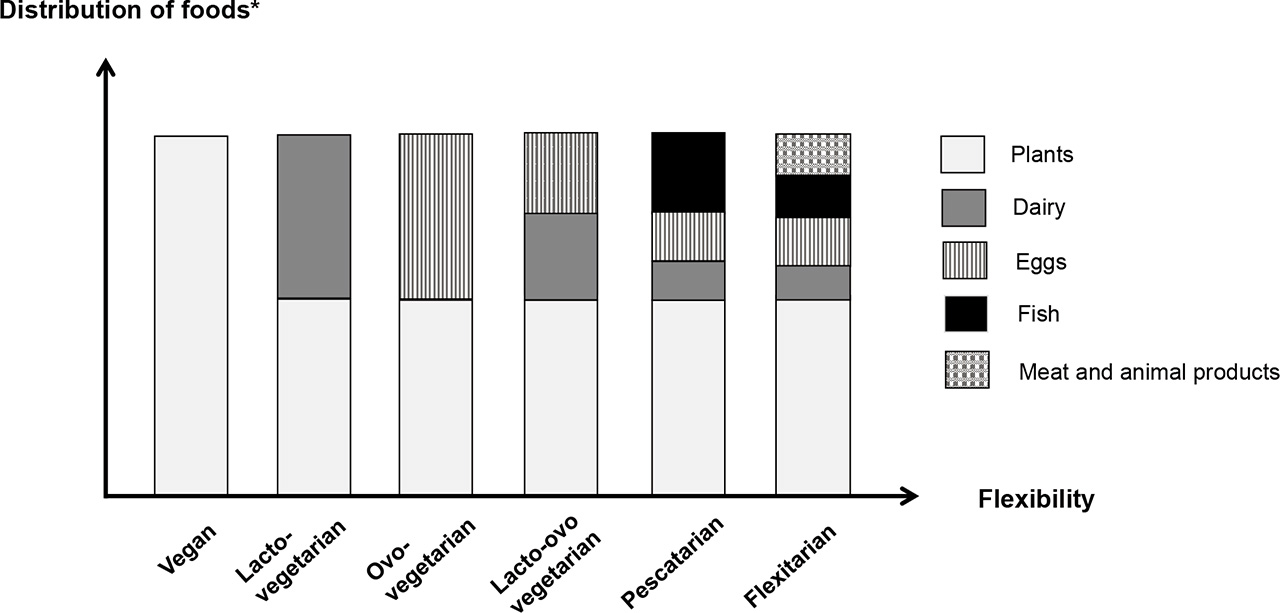
Figure 1.
The plant-based dietary spectrum. From left (less flexible) to right (more flexible): vegan diet (including only plant-based items), lacto-vegetarian diet (excluding meat, fish, or poultry but including dairy), ovo-vegetarian diet (excluding meat, fish, or poultry but including eggs), lacto-ovo-vegetarian diet (excluding meat, fish, or poultry but including dairy and eggs), pescatarian diet (excluding meat or poultry but including fish) and omnivorous diet (containing all food groups).
Table 2.
Overview of plant vs animal foods for management of CKD-related complications
| CKD-related complications | Animal foods | Plant foods |
|---|---|---|
| Metabolic acidosis | Worsen | Improve |
| (high non-volatile acid load) | (high contents of citrate and malate) | |
| Hyperphosphatemia | Worsen | Improve |
| (high phosphate bioavailability) | (low phosphate bioavailability) | |
| Uremic toxins | Likely worsen | Likely improve |
| (harbors proteolytic bacteria) | (harbors saccharolytic bacteria) | |
| Inflammation | Likely worsen | Likely improve |
| (low antioxidants and no fiber) | (high antioxidants and fiber) | |
| Hypertension | - | Improve |
| (high potassium and nitrate content) | ||
| Hyperkalemia | Less likely to cause hyperkalemia | Less likely to cause hyperkalemia |
| (usually low K+ contents if unprocessed foods) | (high K+ contents but increase bowel movement and K+ excretion) |
[i] K+, potassium; -, denotes a lack of sufficient evidence of their associations.
[ii] CKD, chronic kidney disease.
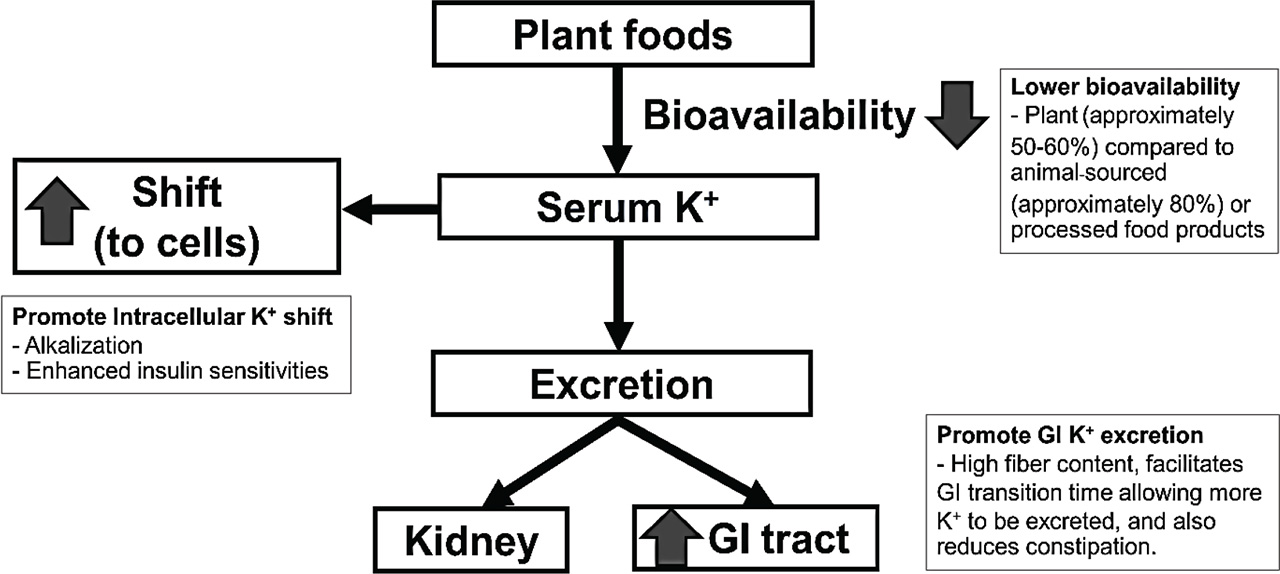
Figure 2.
Effects of plant foods on serum potassium level, including potassium bioavailability, shift and loss. GI, gastrointestinal; K+, potassium.
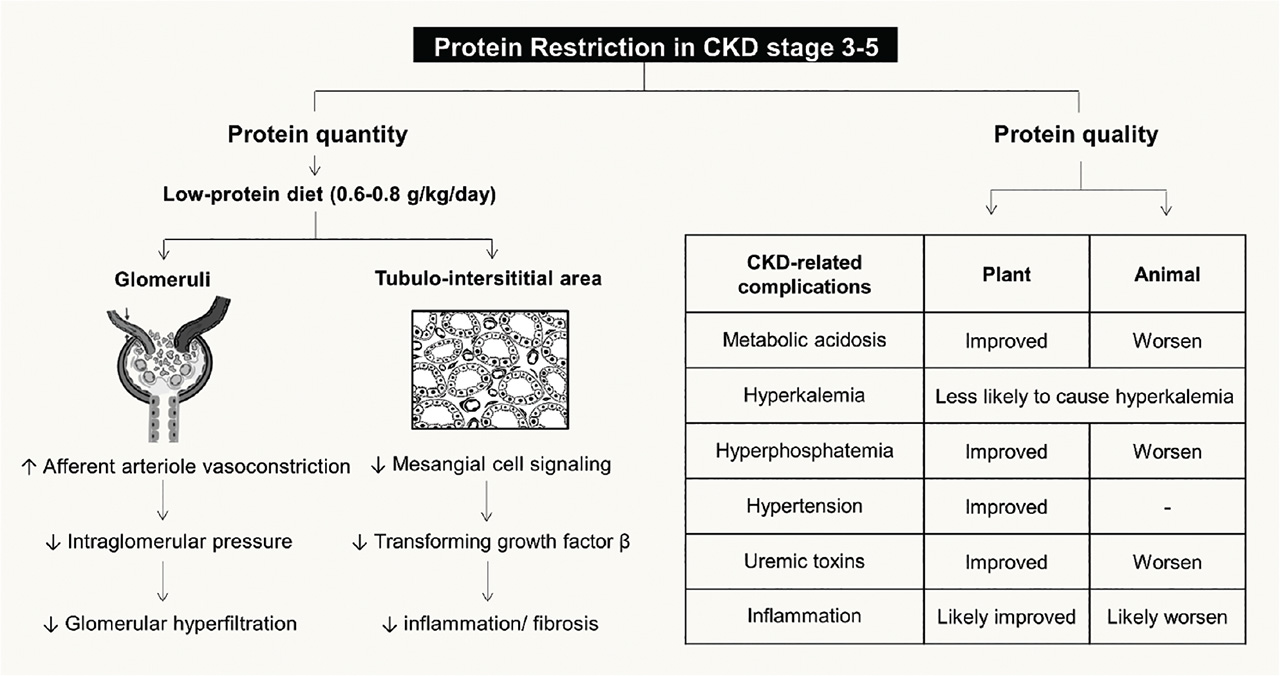
Figure 3.
Concept of protein restriction in CKD stages 3–5, focusing on both protein quantity, low-protein diet (0.6–0.8 g/kg/d) in order to slow down the CKD progression, and protein quality, plant-compared to animal-based protein in managing CKD-related complications. Adapted from [82]. CKD, chronic kidney disease.