
1. Introduction
Bullying has been a major and complex issue that is drawing more attention globally.1 It is a major problem and must be taken seriously.2 Bullying has many different manifestations. It is difficult to define since, in essence, it is a very individualized experience.3
Bullying is a violent act in which 1 person intentionally and persistently causes injury or distress to another individual.4 According to the National Center for Disease Prevention and Control, bullying is characterized as aggressive behavior exhibited by another young person or a group of young people who are not current siblings or romantic partners. This behavior involves a power imbalance, is repeated frequently, or is highly likely to recur.5
The relationship between bullying and violent behaviors is consistently observed, suggesting a concurrent occurrence of these phenomena. Both boys and girls exhibit a strong correlation between various violence-related activities and involvement in bullying behavior.6 Distinguishing between violence and bullying, researchers assert that violence entails the intentional use of force, causing physical or psychological harm, while bullying is a specific form involving intentional disturbance, encompassing actions such as spreading rumors, making threats, or physically or verbally attacking the victim.7,8
The researchers explain the difference between bullying and violence, asserting that violence is the intentional use of force by a person or a group against another person. This force can manifest as actual physical force aimed at causing physical or psychological harm.7 On the other hand, bullying is a specific form of violence practiced by an individual or a group, involving intentional disturbance of another person. Bullying may take various forms, including spreading rumors, making threats, or intentionally attacking the victim physically or verbally with the intention of causing psychological harm.8
A university study revealed that 5% of respondents (n = 2805) experienced bullying, while 11% witnessed incidents on campus. Over a third of bullied students faced monthly occurrences, and 1 in 7 experienced daily bullying. The result encountered instances throughout the semester, with other students being the primary perpetrators, though teachers were reported almost as frequently. Every other instance of bullying involved indirect public bullying, including pressure, prejudice, and unjust treatment.9
To our knowledge, there is limited research that has been directed toward exploring the prevalence of bullying, and sociodemographic predictors among university students in Jordan. Existing studies primarily focus on bullying among school students and focus on bullying among adolescents age in Jordan. Due to the scarcity of available research on bullying among university students, we included in the study published research on adolescent age. Further research is warranted to gain a deeper understanding of bullying among and sociodemographic predictors among university students in Jordan. This study aimed to determine the prevalence and sociodemographic predictors of bullying among university students in Jordan.
2. Methods
2.1. Study design
Adopting a descriptive cross-sectional research design, this study leveraged the efficiency of crosssectional studies, known for their cost-effectiveness and ability to collect data from a sizable participant pool.10 Cross-sectional studies offer a snapshot of the current rates of bullying in universities, which can help guide the development of intervention and prevention programs.10
2.2. Study setting
The research unfolded across 2 public universities and 1 private university in Jordan, spanning the period from September to October 2023. Table 1 provides a summary of the selected universities.
(A) The first university is a public university that offers 10 faculties, encompassing fields such as humanities, sciences, and allied medical professions. It provides 39 majors within its undergraduate program. The university has an estimated 20,000 students enrolled in its bachelor’s programs.
(B) The second university is a public university consisting of 19 colleges, which provide 52 undergraduate programs. The university has an estimated 24,314 students enrolled in its bachelor’s programs.
(C) The third university is a private institution consisting of 14 colleges and providing 52 undergraduate majors. It has around 8000 undergraduate students.
2.3. Study participants
The participants included in the study were all Jordanian university students and encompassed individuals of all genders, across various academic years, and diverse youth age from different colleges. Master’s and PhD students were excluded from participation because their time at university is too brief for them to experience bullying.
The questionnaires were collected from the participants in the lecture hall at each university, and they were given 10 min to fill them out. The researcher was present with them in the hall and obtained their informed consent by having them sign the form. The researcher also provided an email address on the consent form so that participants could contact the researcher at any time.
2.4. Study size
The study employed the convenience sampling method for participant selection. The sample size calculator was used for determination of the optimal sample size for this study. Including a confidence level of 95%, a specified margin of error was set at 5%. The study involved a total of 350 participants.11 Utilizing a stratified sampling technique, the researcher determined the allocation of participants for each university.
2.5. Definition of variables
The dependent variable in this study was bullying. A university student was considered to have perpetrated bullying if he/she was involved in traditional bullying or cyberbullying. The independent variables include sociodemographic predictors such as age, gender, family income, university, university specialization, and academic year.
2.6. Bias and quality control
A rigorous quality control process was implemented throughout this cross-sectional study on bullying prevalence among university students to ensure the reliability and validity of the findings. The research team used a standardized questionnaire, underwent extensive training, and employed data entry verification to minimize errors and biases. Ethical considerations, including informed consent and data anonymization, were prioritized. Data cleaning procedures were used to address inconsistencies, and statistical analyses were conducted by experts using appropriate software to ensure trustworthy results.
2.7. Instrument
A structured administered questionnaire was employed for data collection, incorporating questions adapted from previous research studies.12 Senior colleagues, who are experts in the field, evaluated the face and content validity of the questionnaire. The research instrument was pretested on 50 purposively selected university students (14% of the sample size). The reliability coefficient, measured using Cronbach’s alpha, was 0.76.
A self-administered questionnaire was distributed to university students, consisting of 2 sections. The first section aimed to collect sociodemographic details such as age, gender, family income, university, university specialization, and academic year. The second section sought to determine whether the students had experienced bullying during their time at the university.12
The questionnaire underwent a translation process from English to Arabic and then from Arabic back to English. A specialist conducted a thorough comparison between the 2 versions using back translation, a crucial method in localization quality control. This process aims to identify any discrepancies and assesses the accuracy of the translation to ensure fidelity to the original content.
2.8. Ethical considerations
Consent to participate in the study was requested before completing the questionnaire, and a letter outlining the goals of the study was enclosed with the questionnaire itself. Confidentiality was preserved, since the questionnaire did not ask for names or phone numbers and only the authors had access to the data. This study was approved by the Institutional Review Board (IRB) at the researcher university. Consent to use the 2 tools was obtained from the original researchers by sending an email.
After completing the questionnaire, the participants were given pamphlets containing instructions for a student in the event that the student is exposed to bullying, what the student should do, and what entities he can turn to for advice and guidance.
The present investigation strictly complied with strict ethical protocols, and all necessary ethics approvals were obtained before any data collection began. The chairman was initially contacted to provide them with thorough information about the study. They received a briefing on the goals, methods, and potential advantages of the study.
2.9. Data analysis
The obtained data was coded and analyzed using the Statistical Package for Social Sciences (SPSS), version 26 with multiple steps for accuracy and reliability.
The normality test was performed with the Kolmogorov–Smirnov test, whose results indicated that the data were normally distributed (statistics = 0.074, P = 0.05). This suggests that the data were normally distributed.
A descriptive analysis based on frequency and percent distribution was done for sociodemographic data. The collected data encompassed various factors: the participants’ age in years, gender, monthly family income, academic year, university grade, and the university (categorized into [A] University, [B] University, and [C] University).
A descriptive analysis was computed to examine the prevalence of bullying among university students in Jordan involving using the mean, standard deviation, and frequency analysis to summarize the data, and provided a comprehensive overview of the participants’ prevalence of bullying.
Additionally, to determine the predictors of bullying among university students in Jordan, a multivariate linear regression analysis was conducted. It is a statistical technique that uses several explanatory variables to predict the outcome of a response variable. This analysis allowed for the simultaneous assessment of categorical dependent variables to identify the factors that significantly influenced bullying among university students in Jordan. The regression analysis helped establish the strength and direction of these associations, enabling researchers to identify the most influential predictors.
3. Results
3.1. Sociodemographic characteristics of students
Figure 1 provides an overview of the demographic attributes of the 350 students under study. The student ages ranged from 18 years to 24 years, with an average age of 20.67 years. Examining the distribution among participants based on university, (A) University constituted 42.9% (n = 150), (B) University encompassed 37.1% (n = 130), and (C) University comprised 20% (n = 70). Analyzing the academic year, the distribution across different academic levels emerged as follows: 26.3% (n = 92) were in their first year, 20.6% (n = 72) in their second year, 19.7% (n = 69) in their third year, 17.7% (n = 62) in their fourth year, and 15.7% (n = 55) in their fifth year. Considering family income, participants’ economic backgrounds became evident: 45.1% (n = 158) reported a family income less than 500 JD, 41.4% (n = 145) reported incomes between 500 and 1000 JD, and 13.4% (n = 47) had family incomes exceeding 1000 JD. When evaluating university grades, the distribution of academic performance was reported as follows: 13.1% (n = 46) were deemed acceptable, 40.6% (n = 142) achieved a good standing, 34.6% (n = 121) secured a very good score, and 11.7% (n = 41) attained an excellent grade.
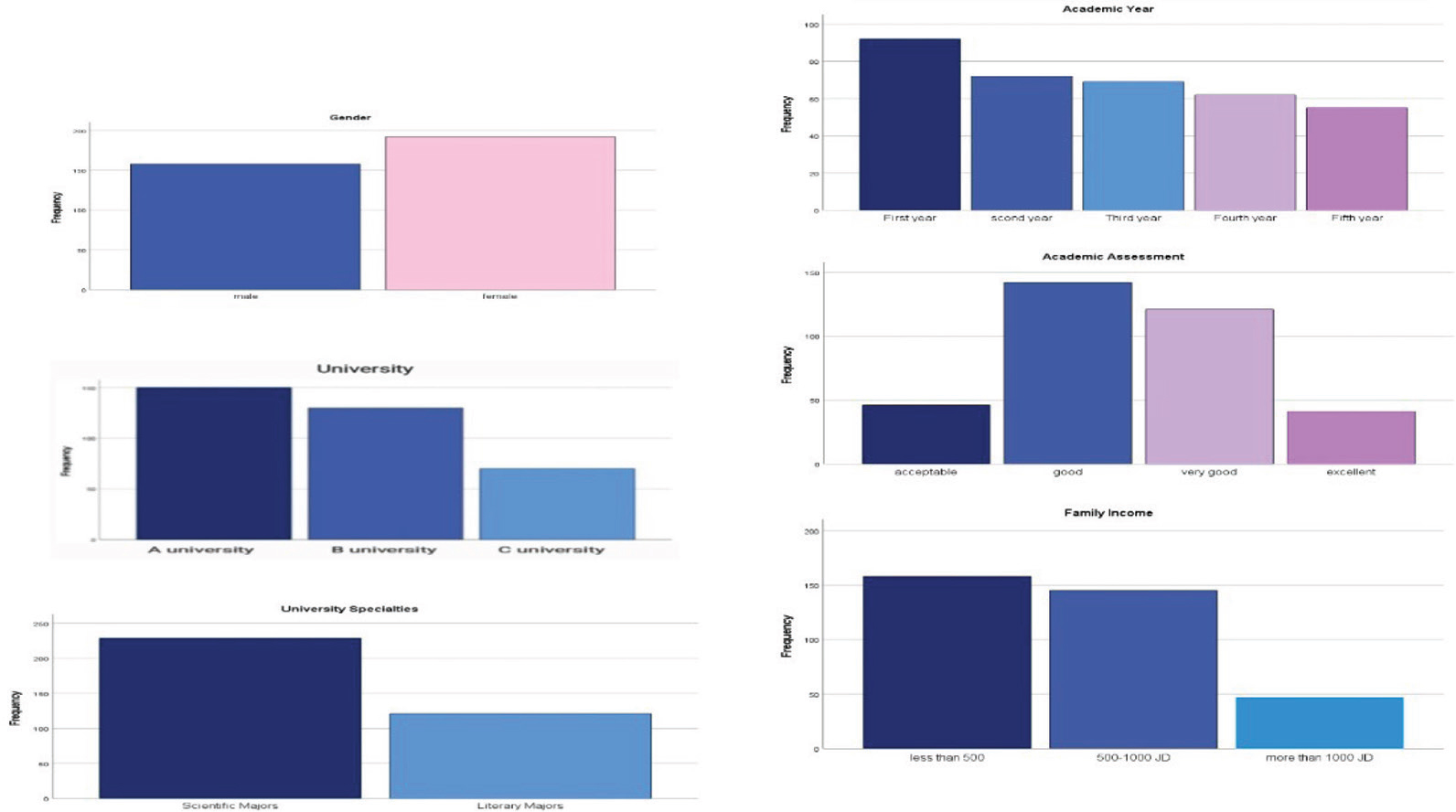
Figure 1.
Sociodemographic characteristics of student.
3.2. Prevalence of bullying among university students in Jordan
Table 2 reveals that 30% of participants have never been bullied, 41.1% were rarely exposed to bullying, 20% have sometimes been bullied, 4.3% were often exposed to bullying, and 4.6% were always exposed to bullying. With an overall mean of 2.12, there is a moderate level of reported bullying experiences among the respondents in the university setting. The overall standard deviation of 1.035 indicates some variation in how respondents have experienced bullying.
3.3. Sociodemographic predictors of bullying among university students in Jordan
The model summary that revealed that the combined predictors accounted for 9.0% of the variance in bullying among university students, with an adjusted R2 value of 7.1%. This indicates that the included predictors collectively had a meaningful impact on bullying, as evidenced by the statistical significance of the overall model (F = 4.821, significant value = 0.000) at a significant level (P ≤ 0.05).
Table 3 shows that regarding individual predictor variables, 2 emerged as significant contributors. “University” exhibited significance (B = −0.403, Beta = −0.296, t = −4.613, P < 0.001) at a significant level (P ≤ 0.05), implying its role as a meaningful predictor of bullying. Similarly, “academic year” was identified as a significant predictor (B = 0.213, Beta = 0.064, t = 3.350, P < 0.001) at a significant level (P ≤ 0.05). Conversely, the remaining predictor variables did not demonstrate statistically significant associations with bullying among university students.
Table 3.
Sociodemographic predictors of bullying among university students in Jordan.
| Model | Unstandardized coefficients | Standardized coefficients | t | P | Collinearity statistics | ||
|---|---|---|---|---|---|---|---|
| B | Std. error | Beta | Tolerance | VIF | |||
| Gender | −0.201 | 0.112 | −0.097 | −1.793 | 0.074 | 0.915 | 1.093 |
| Age (years) | 0.01 | 0.048 | 0.018 | 0.218 | 0.827 | 0.413 | 2.423 |
| University | −0.403 | 0.087 | −0.296 | −4.613 | 0.001 | 0.647 | 1.546 |
| Academic major | 0.083 | 0.119 | 0.038 | 0.698 | 0.486 | 0.889 | 1.124 |
| Academic year | 0.213 | 0.064 | 0.292 | 3.35 | 0.001 | 0.351 | 2.85 |
| Family income | −0.054 | 0.077 | −0.037 | −0.703 | 0.482 | 0.984 | 1.016 |
| University grade | −0.014 | 0.063 | −0.012 | −0.224 | 0.823 | 0.96 | 1.041 |
Table 4 summarizes the ANOVA results. The researcher began by examining the impact of “university.” The comparison between (C) University and (A) University revealed a statistically significant difference in bullying levels among university students. Bullying is 0.388 units more common at (A) University compared with (C) University. Turning to the variable “academic year,” our analysis also revealed significant disparities in bullying levels. The comparison between first-year and third-year students demonstrated a statistically significant difference, with third-year students experiencing an average of 0.562 units more bullying than their first-year counterparts (significant value of 0.018), at a significant level (P ≤ 0.05). Fourth-year students reported experiencing, on average, 0.604 units more bullying than their First-year peers (significant value of 0.01), at a significant level (P ≤ 0.05).
Table 4.
Post comparisons test using the setting method according to the variable of the academic year to measure bullying among university students in Jordan.
| Dependent variable | Academic year (I) | Academic year (J) | Mean difference (I–J) | P |
|---|---|---|---|---|
| Bullying among university students | Third year | First year | 0.562* | 0.018 |
| Fourth year | First year | 0.604* | 0.011 |
4. Discussion
The first aim of this study was to investigate the prevalence of bullying among university students in Jordan. A general question appeared without indicating any particular means of bullying. The findings of the current study indicated a high prevalence of bullying among university students in Jordan.
Further elucidating the prevalence of bullying among university students in Jordan, cultural differences emerge as a significant contributing factor. The combination of students from diverse cultures and social backgrounds often serves as a catalyst, escalating tensions and conflicts between individuals. Social dynamics, marked by issues such as jealousy and competition, also play a pivotal role in shaping relationships among students within the university.
The findings of this study are higher than the findings of the study conducted in the Finnish university, which aimed to examine the connections among Estonian academics between reported bullying, job engagement, and work performance. The results showed that 5% of all students reported being bullied. Moreover, it was found that a significant proportion of the survey participants, specifically 11%, reported witnessing instances of bullying occurring on campus.3
The findings of this study are lower than the findings of the study conducted in Palestine, which aimed to determine the prevalence of bullying and its causes among university students studying health sciences in Palestine. The results showed that male bullying was 77% and female bullying was 48%.13
The findings of this study are lower than the findings of the study conducted in the United Arab Emirates (UAE), which aimed to investigate bullying behaviors among college students at one of the national universities in the UAE. In addition, they look at the psychological traits of individuals who have been bullied or have been exposed to it. The results showed that 26.3% of the respondents reported being bullied. Of them, 45.8% said they had experienced bullying just once, 31.9% said they had experienced bullying twice, and 22.2% said they had experienced bullying 3 times.14
The prevalence of bullying exhibits variation across colleges and nations, influenced by factors such as culture, policies, and the social and economic environment. Culture and values significantly shape individuals’ behaviors and social interactions within each country. Furthermore, policies and legislation aimed at combatting bullying may vary between countries, contributing to differences in bullying rates. Social and economic conditions also come into play, impacting stress levels and interpersonal dynamics. Effectively addressing bullying on university campuses globally necessitates proactive measures, including the promotion of a culture of respect and peaceful coexistence among students. Moreover, fostering awareness about the detrimental effects of bullying and ensuring the availability of support for affected students is paramount.
The reasons for the different prevalence of bullying in different studies are diverse and may be influenced by several factors. These differences include, for example, differences in the design of the study itself, such as sample selection and how age groups were defined. The instrument used to collect data can also play a large role in these differences, as differences in methods can lead to different results.
In addition, the location of the study can be a major factor in explaining differences in bullying prevalence rates. Social and cultural conditions in a particular place may play a major role in shaping bullying behaviors. For example, differences in societal values and upbringing may influence the prevalence of bullying at the university. For example, there is a cultural difference in the UAE, so the rates of bullying were high, as the researcher studied,14 compared with the study done in France by the researchers.3
The second aim of this study is to investigate the predictors of bullying among university students in Jordan using multivariate linear regression analysis to explore the sociodemographic factors that predict bullying. The analysis indicated that university and academic year were influential predictors of bullying among university students in Jordan.
This study indicates that the impact of bullying at (A) University (a public university) is greater than at (C) University (a private university). Bullying is less prevalent in private universities than it is in government universities, which could be attributed to several factors. First, student crowding: public universities may be larger and attract a larger number of students than private universities. This crowding can increase the likelihood of bullying since there are more opportunities for negative interactions to occur between students. Second, student diversity: public universities may be characterized by greater student diversity in terms of cultural, social, and economic backgrounds. Sometimes, this diversity can increase the likelihood of clashes between students and thus increase instances of bullying. Third, cultural factors: cultural and social factors in some countries may influence whether bullying is widespread or ignored. There may be traditions or concepts that reinforce bullying behaviors in some societies. Further studies are needed to confirm the suggested interpretation, such as conducting a comparative study between a public and private university.
A study conducted in Australia aimed to find out if rural universities are more likely to experience bullying and harassment than urban universities or group of eight (Go8) universities, and what role other factors could have in such disparities. The researchers showed that if a culture encourages people to comply or allow themselves to be threatened into leaving, problems may become self-perpetuating.15
The findings of this study, consistent with the study conducted in Pakistan, aimed to compare the prevalence of bullying, its contributing variables, and the level of anti-bullying knowledge among students at Lahore’s public and private schools. The study showed that bullying was reported more frequently in public schools (54%) than in private schools (46%).16
Additionally, we observed that the academic year was a significant predictor of bullying among university students in Jordan. This study indicates that the impact of bullying in the third academic year is greater than in the first academic year, and the impact of bullying in the fourth academic year is greater than in the first academic year. This unique finding suggests that the academic year could play a role in influencing bullying among university students.
The prevalence of bullying among university students in their third and fourth years is higher than it was in their first year for a number of reasons. These competitive factors include as follows: As student’s advance in their studies, competition for jobs or academic opportunities can increase. The prevalence of bullying may rise as a result of this pressure, since some people may use bullying as a means of dominance or control. Also, university culture: at some universities, student culture may evolve and become more challenging as study progresses. This culture can include strong social pressures and behaviors that encourage bullying. Finally, forming friendships and relationships: Over time, students form friendships and relationships with their peers. These relationships can be complex and may include personal details that make them targets for bullying.
4.1. Implications for nursing
Bullying has been a major and complex issue that is drawing more attention globally.1 It is a major problem and must be taken seriously.2 Bullying has many different manifestations. It is difficult to define since, in essence, it is a very individualized experience.3 The study supports the need for education and training programs for students and employers in Jordanian universities about bullying issues.
4.2. Limitations and advantages
Our work is not without limitations. These include the Cross-sectional studies that offer just a snapshot of bullying at one specific moment, making it impossible to track changes in bullying behavior or assess the effects of interventions over time. Additionally, Cross-sectional studies frequently use self-report tools, which can be influenced by recall bias. Crosssectional studies are still a useful method in bullying research. They offer valuable insights into the prevalence of bullying, related factors, and potential directions for future studies.
5. Conclusions
This study aimed to ascertain the prevalence of bullying and identify the sociodemographic predictors of bullying among university students in Jordan. Bullying is less prevalent in private universities than it is in public universities, and the impact of bullying in the third academic year is greater than in the first academic year, while the impact of bullying in the fourth academic year is greater than in the first academic year.
Notes
[1] Ethical approval
This study was approved by the Institutional Review Board (IRB) at the researcher university.
[2] Conflicts of interest Conflicts of interest
All contributing authors declare no conflicts of interest.