

At the stage of designing and choosing the orientation of the location of a building, an extremely important aspect is the analysis of the degree of shading of the territory at different times of the day to ensure it is comfortable for anyone who is there. The general level of thermal comfort is closely related to the meteorological indicators and morphological features of the city. A number of scientific articles by foreign authors have been devoted to the study of this issue, with a direct reference to the area in which they live (Gulyás et al., 2006; Bourbia & Boucheriba, 2010; Heusinkveld et al., 2014). In this regard, the obtained research results may be relevant only for a specific geographical location (Zeng & Dong, 2015; Kedissa et al., 2016; Smith et al., 2019). The impact of climate change on the health of the population in terms of the varying orientations of buildings in an area and the component of solar radiation at different times of the day in Ukraine has not been sufficiently studied.
In the work by Willett and Sherwood (2012), the forecasting levels of exceeding the threshold values in summer were established, based on a fixed distribution of anomalies with respect to the average seasonal value according to the wet bulb globe temperature (WBGT) indicator. Forecasting the impact of the regional temperature rise and the level of risk for the population was described in a paper by Fischer et al. (2012). Many scientific studies are devoted to increasing the size of the thermal dome in urbanized areas and the comfort of residents staying in open spaces in the summer months of the year (Steeneveld et al., 2011).
Based on the example of the city of Kyiv, in Sviatohorov (2024), the long-term changes in heat stress depending on global climatic changes were studied. Based on the study of average monthly long-term climate data in the city of Kyiv using the Copernicus Climate Change Service (Boris Sreznevsky Central Geophysical Observatory, 2024) and the data of the Borys Sreznevsky Central Geophysical Observatory, the author obtained the dependence of the value of the heat index (HI) from the value of temperature and air humidity for observations in different periods. This index combines the air temperature and the relative humidity in the shade to determine the human-perceptible equivalent temperature.
Taking into account the trends of increasing temperature indicators as a result of global warming in matters of urban planning (Balcerak, 2014; Luo & Lau, 2018; Li & Zhang, 2021), significant attention has recently been paid to “green construction” technologies, which, at the same time as using innovative materials and landscaping technologies, should also take into account the orientation of the building (Prasad et al., 2017) with respect to the sides of the world, in order to increase the percentage of shading from direct solar radiation.
The purpose of these studies is to determine and compare the dependence of the heating of facade surfaces along the perimeter of the courtyard and the underfloor surface of the courtyard of a residential building on the percentage of surface shading at different orientations relative to the cardinal points. This will make it possible to assess the potential risk of thermal stress for the residents in this future residential area during the design stage when initially planning the territory.
These studies were conducted for Ukraine’s first climatic zone and, even at the design stage, allowed the reduction of the risk of heat stress in the adjacent territory during the operation of the buildings in the future.
For the assessment of the impact of thermal stress on the human body, which is based on the WBGT indicator as well as the interpretation of human thermal comfort, then the normative documents of the ISO series devoted to these calculations can be used, such as ISO 7243 (International Organization for Standardization [ISO], 2017).
The area of the residential area depends on the location of the building blocks, and has a different percentage of shading and heating of the surface depending on the amount of direct solar radiation falling on it at different times of the day.
For the study, a U-shaped construction scheme was selected, involving a five-section, nine-story residential building, typical for the city of Kyiv and the Kyiv region (the first climate zone). The total area of each section in the plan is about 550 m2, with the area of the underlying surface of the yard measuring 2,200 m2. This configuration of blocking sections creates the effect of self-shading of the facades and partial shading of the courtyard, which has a positive effect on the overall temperature of the surfaces. The influence of the surrounding buildings has been excluded from the calculation. It was decided to make the underlying surface free of trees and bushes to exclude the influence of unpredictable shading.
The calculation of the amount of solar radiation was conducted by the authors using the specialized TownScope program (Teller & Azar, 2001). At the beginning of the work, the authors prepared a corresponding 3D model of the building and exported it to the 3Ds format ( Fig. 1).
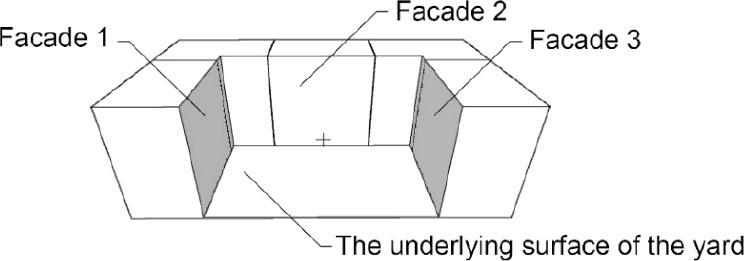
Scheme of blocking sections of a residential building (studied surfaces)
Source: own work.
The monitoring data of the Borys Sreznevsky Central Geophysical Observatory for July 2021 was also used for the study, with an average air temperature of 24.6°C. The choice of the calculation period was based on the purpose of investigating the changes in the heating of the subfloor surface and facade surfaces in the peak summer period, which corresponds to the month of July in the first climatic zone of Ukraine. Since the average air temperature for July was taken, the research was conducted based on the example of one daylight day during this month.
In the first stage, using the TownScope program, the amount of direct solar radiation in W·m−2 was calculated for each considered surface of the facades and the plane of the courtyard. Using the schemes obtained in the TownScope program, the percentage of shading of the surfaces of the residential building and the adjacent territory was determined graphically, with different orientations being used with respect to the cardinal points. The surfaces of the facades adjacent to the courtyard of the residential building were considered, as well as the underlying surface of the courtyard.
To determine the amount of direct solar radiation hitting a horizontal surface, depending on the orientation with respect to the sides of the world and considering shading, a separate unified element of the area was selected, which we take as a square with an area of Si.
We have two variables that depend on time:
Intensity of direct solar radiation on a separate unified element of the area:
(1) where: Ai – the hourly amount of direct solar radiation per 1 m2, depending on the orientation of the block of the building under consideration, was determined based on the tabular form used in the regulatory documents.R = f\left( {t,\,A_i } \right) = A_i \left( t \right)S_1 , Surface area of the element, considering shading:
(2) The effectiveness of shading is determined by the formula:S_1 = f\left( {t,\beta } \right). (3) where: β – coefficient that characterizes the percentage of shading, which should be taken according to the values that were calculated separately in accordance with the current regulatory documents, ΣS1i – the total area of the residential territory under consideration, і – the module number with areas S1, i = 1, 2, 3, …, n.\Delta R = \left[ {A_i \left( t \right) - A_{i + 1} \left( t \right)} \right]\sum {S_1 i = A_i \left( t \right)} \cdot \left( {1 - \beta } \right) \cdot \sum {S_1 i,}
Thus, we can present any area of the residential area featuring different locations of the building. The total areas of the surfaces were calculated on the basis of the 3D model of the residential building.
The average heating temperature of the surfaces of the building facades and the underlying surface from solar radiation during one hour of daylight can be determined according to the formula of A.M. Shklover (Korkina et al., 2023), which gives a good correlation between the calculated and experimental data:
The surface of the residential area also receives heat from neighboring buildings, and as a result the heat index on the residential area will increase. In this case, the expression of the balance of the specific heat flow for the surface of the facade, which receives radiation heat, is calculated under the following assumptions:
- –
there is no multiple reflection and absorption between building facades and the underlying surface,
- –
the temperature of the outer surface does not depend on the temperature of the indoor air,
- –
calculations are made for a thin surface layer of the facade in one hour, so it is considered that the thin layer has a constant temperature that corresponds to the end of the time interval,
- –
the considered surfaces of the facades do not have skylights,
- –
the influence of the atmosphere is not considered.
The heating temperature of the underlying surface of the courtyard is calculated considering the percentage of shading per hour and the average value is determined during the calculated hours. At the same time, we accept the coefficient of absorption of solar radiation by the surface of the yard in accordance with EN ISO 7730 (European Committee for Standardization [CEN], 2005), αS,c = 0.7, for the paving of the surface of the yard with clinker bricks, and 0.7 for the facade facing bricks. The coefficient of heat exchange of the surface is accepted according to Formula (5) for Kyiv, according to the average statistical reference data (Boris Sreznevsky Central Geophysical Observatory).
The percentage of shading of the facade surfaces and the amount of direct solar radiation falling on the investigated surfaces are presented in Table 1.
Calculation of the total amount of direct solar radiation on the horizontal surface and on the surface of the facades, depending on the orientation with respect to the sides of the world, considering shading during a day in July 2021 having an average monthly temperature of 24.6°C
| Surface name | Surface area [m2] | Shading [%] | |||||||
| S | SE | SW | NE | NW | N | W | E | ||
| Facade 1 | 1 050 | 48.8 | 61.5 | 42.7 | 80.4 | 36.0 | 54.2 | 28.8 | 80.9 |
| Facade 2 | 1 900 | 31.1 | 40.7 | 40.7 | 70.6 | 70.6 | 86.8 | 50.4 | 50.4 |
| Facade 3 | 1 050 | 48.9 | 42.5 | 61.5 | 31.6 | 80.2 | 54.4 | 80.7 | 28.9 |
| Underlying surface of the yard | 2 200 | 42.5 | 36.5 | 36.5 | 53.0 | 53.0 | 62.8 | 41.4 | 41.4 |
| Total shading [%] | 1 050 | 48.8 | 61.5 | 42.7 | 80.4 | 36.0 | 54.2 | 28.8 | 80.9 |
| × | × | Direct solar radiation [W·m−2] | |||||||
| S | SE | SW | NE | NW | N | W | E | ||
| Facade 1 | 1 050 | 4 230 | 2 792 | 4 033 | 4 127 | 5 411 | 6 608 | 3 446 | 640 |
| Facade 2 | 1 900 | 3 821 | 4 145 | 5 174 | 2 737 | 4 667 | 1 150 | 6 473 | 4 309 |
| Facade 3 | 1 050 | 6 123 | 4 899 | 4 761 | 4 125 | 2 538 | 4 381 | 367 | 3 377 |
| Underlying surface of the yard | 2 200 | 7 393 | 6 527 | 7 078 | 5 924 | 6 720 | 6 555 | 6 712 | 5 566 |
Source: own work.
The analysis of the obtained data, taking into account the percentage of shading, made it possible to plot the graphs of the dependence of the total amount of direct solar radiation during daylight for each hour over the entire area of the courtyard at different orientations with respect to the cardinal points (Fig. 2).
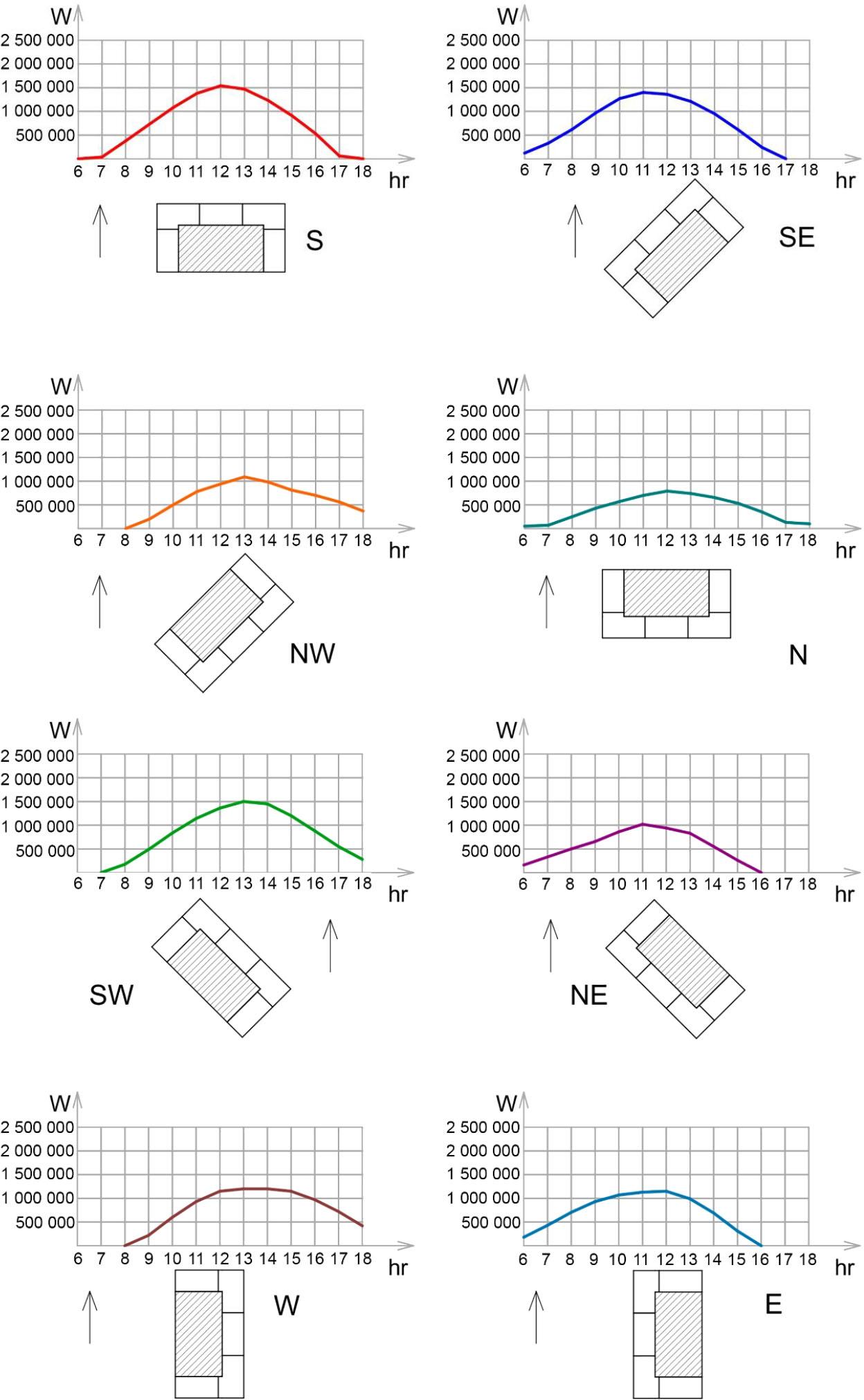
The amount of direct solar radiation hitting the horizontal surface of the yard, depending on the orientation with respect to the cardinal points, considering the shading
Source: own work.
The heating temperature of the underlying surface of the courtyard was calculated considering the percentage of shading per hour, with the average value being determined during the calculated hours (Table 2).
Average heating temperature of the facades during daylight hours adjacent to the courtyard, July 2021, Kyiv, with an average monthly temperature of 24.6°С
| Surface name | Surface area [m2] | S t [°C] | SE t [°C] | SW t [°C] | NE t [°C] | NW t [°C] | N t [°C] | W t [°C] | E t [°C] |
|---|---|---|---|---|---|---|---|---|---|
| Facade 1 | 1 050 | 29.7 | 27.1 | 31.0 | 25.8 | 29.8 | 29.2 | 28.3 | 24.8 |
| Facade 2 | 1 900 | 30.8 | 30.3 | 31.8 | 25.8 | 26.7 | 24.8 | 29.4 | 27.8 |
| Facade 3 | 1 050 | 31.9 | 31.2 | 28.9 | 28.6 | 25.4 | 27.6 | 24.7 | 28.2 |
| Underlying surface of the yard | 2 200 | 34.6 | 34.3 | 35.1 | 28.8 | 29.4 | 28.3 | 30.5 | 29.8 |
Source: own work.
According to Table 2, in all orientation options, the underfloor surface heats up more than the surface of the facades. This plane has the greatest impact on the risk of heat stress.
For effective evaluation of the obtained results, presented in Tables 1 and 2, two schemes were created (Figs 3 and 4). Figure 3 illustrates the relationship of the shading coefficient with respect to the average temperature of the understory surface of the inner yard at different orientations relative to the cardinal points. Figure 4 illustrates the relationship between the total amount of direct solar radiation falling on the underlying surface of the yard and the average temperature of this surface.

The scheme of the relationship between the shading coefficient and the average temperature of the underfloor surface of the courtyard of a residential building at different orientations with respect to the cardinal points
Source: own work.
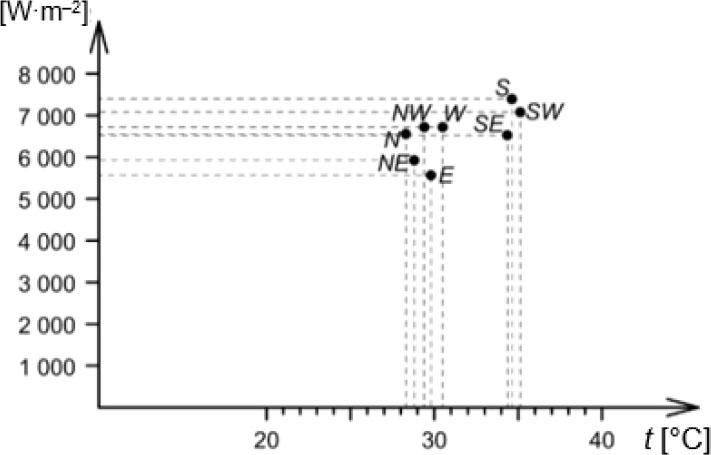
The scheme of the relationship of the total amount of direct solar radiation falling on the underfloor surface of the yard to the average temperature of the surface of the yard of a residential building at different orientations with respect to the sides of the world
Source: own work.
In analyzing the data of the scheme (Fig. 3), the lowest average temperature of the underfloor surface during the day was observed when the courtyard was oriented to the north, giving a temperature of 28.3°C. With this orientation, the largest percentage of shading of the courtyard surface was obtained at 62.8%. However, it should be considered that the orientation of the U-shaped yard to the north may become problematic when designing housing, due to the need to observe the standardized insolation of the yard sites.
The north-eastern (28.8°C) and north-western (29.4°C) orientations differ by heating the latter surface by 0.6°C in favor of the former. The shading coefficients were 59.4 and 60.1, respectively, which is less than with the northern orientation by 3.4% and 2.7%. Orientations to these directions are favorable from the point of view of limiting the heating of the underlying surface of the inner yard.
The average heating temperature of the underfloor surface in the eastern and western orientation of the courtyard of the U-shaped residential building is 29.8°C and 30.5°C. These are also satisfactory indicators within the limits of variability when designing this configuration of a sectional residential building.
The south, southeast and southwest orientations of the yard are the most unfavorable. The results differ from the average heating temperature of the surface of the northern orientation of the yard in the direction of growth by 6.8°C, 6.3°C and 6.0°C. The shading coefficient is lower by 20.3%, 26.3% and 26.3%, respectively.
Figure 2 makes it possible to compare the ratios of the total amount of direct solar radiation falling on the horizontal surface of the yard at different orientations. Thus, allows the pre-assessment of the effectiveness of the decisions taken during the design, in terms of reducing the risk of thermal stress of the population. Graphs are created for convenient demonstration of the results and can be used in the project work. This graphic material has a correlation with the obtained temperature indicators of the surface heating, presented in Tables 1 and 2.
The heating temperatures were obtained for all the considered surfaces. To achieve a more precise statement of the problem related to determining the air temperature in the courtyard, it is necessary to use the Stefan–Boltzmann formula, considering the angular radiation coefficient and consistently determining the additional heat flow obtained by the radiant heat exchange of the receiving surface having an area of 2,200 m2 from each of the adjacent facade surfaces.
Preliminary estimation calculations of the heating temperature of the inner courtyard surfaces in the peak summer period indicate the possibility of considering, at an early stage, the methods of designing the green building technologies based on passive methods of cooling the urban surfaces. This work can be useful for designers of residential buildings in order to regulate the temperature regime in microdistricts.
Considering the projected increase in average annual temperatures in Ukraine, particularly the situation for Kyiv and the Kyiv region, which are in the first climatic zone of Ukraine, a comprehensive solution to the issues of reducing the temperature indicators and increasing the degree of cooling of the surrounding area should be provided. One of the measures of “green building” technologies should be the adaptive orientation of urban buildings in relation to which direction they face in the world to prevent overheating of the courtyard surfaces.
Research has proven that the amount of solar energy reaching urban surfaces directly depends on the orientation of the residential structure. The underfloor surface of the U-shaped multi-section residential building considered in the work, given the shading, is the least prone to overheating when oriented towards the West, Northwest, North, Northeast, and East. Based on the results of the research, it should be recommended that during the design of a U-shaped residential structure, the orientation of the yard area should be laid out to have the angular values of East–North–West. That is, by designing the yard of a residential building in any degree between these directions. The greatest overheating of the underlying surface occurs in the Southwest–South–Southeast orientation. This placement of the volume of the U-shaped residential building is the most unfavorable from the point of view of the risk of heat stress in people in the yard. Surface shading coefficients are also much smaller. Heat exchanges between the surfaces of the facades and the sub-floor surface will take longer, which will negatively affect the average temperature of the yard. With such orientations, the courtyard needs additional measures of green construction to reduce the temperatures.
In further works, the authors plan to consider other typical urban residential structures, and to identify the most effective model of residential formation from the point of view of reducing the surface temperature of the inner yard.
This study may be useful to architects when planning the territories for new microdistricts on the outskirts of the city in areas free from existing buildings. The orientation of residential quarters, considering the heating of adjacent areas and facades of the surfaces, should improve the microclimate of the future residential environment and reduce the risk of heat stress for the population.