

Introduction
Climate change and environmental degradation underscore the need for aligning economic growth with planetary limits. Green bonds have emerged as a leading mechanism to finance renewable energy, energy-efficient buildings, sustainable transportation systems, and other environmental engineering projects (Sahu et al., 2024). Global issuance has expanded rapidly, supported by stronger standards and disclosures, while green bonds are increasingly viewed as a tool for advancing national climate targets (Ghaemi Asl & Shahzad, 2025; Kumar et al., 2025). Evidence also shows that investors sometimes accept lower yields, resulting in a “greenium” that reflects pro-environmental preferences in fixed-income pricing (Green & Roth, 2025).
Costa Rica offers a compelling case to examine retail investors' willingness to invest in green bonds. Its National Decarbonization Plan 2018–2050 outlines sectoral transitions aimed at reducing emissions while sustaining growth (Okot et al., 2021). Mobilizing domestic savings held by individuals is essential, yet retail participation in green bonds remains limited, raising questions about awareness, access, and psychosocial drivers (Kumar et al., 2025). Understanding these drivers is crucial to broadening the investor base needed to achieve national sustainability goals (Chishti et al., 2025).
Research problem and relevance
If banked consumers are unaware of, uncertain about, or unable to access green bonds, a significant pool of domestic climate capital remains untapped. This study addresses this issue by analyzing the psychosocial determinants of Costa Rican retail investors' intention to invest in green bonds, thereby informing targeted interventions such as investor education, simplified access, and enhanced disclosures (Mesthrige et al., 2020; Bocquet et al., 2021). Research questions include:
– RQ1: What is the level of awareness and knowledge of green bonds among Costa Rican retail investors?
– RQ2: How do they perceive the financial and environmental features of green bonds?
– RQ3: How willing are they to invest, and under what conditions?
– RQ4: Which socio-psychological factors best explain their intention to invest?
To answer these questions, we integrate the theory of planned behavior (TPB) and the value-belief-norm (VBN) framework. TPB posits that intention is driven by attitude, subjective norms, and perceived behavioral control (Ajzen, 1991). In investment contexts, favorable attitudes, supportive norms, and greater perceived behavioral control (PBC), facilitated by knowledge, access, and low minimum investment amounts, should strengthen intention. The VBN framework highlights moral and value-based drivers, whereby biospheric/altruistic values shape beliefs, activate personal moral norms, and drive pro-environmental action (Dreifert & Rigotti, 2025; Naga, 2025).
Integrating TPB and VBN allows us to capture both instrumental (attitudes, norms, efficacy) and normative (values, beliefs, moral obligation) pathways to green bond investment. Prior evidence shows that combined models explain behavior better than single theories (Dreifert & Rigotti, 2025). Furthermore, credible labeling and transparency reinforce investor trust, strengthening attitudes and beliefs toward green bonds (Ghaemi Asl & Shahzad, 2025). Proposed hypotheses are as follows (Fig. 1):
– H1: Attitude → Intention (Ajzen, 1991).
– H2: Subjective Norm → Intention (Ajzen, 1991).
– H3: PBC → Intention (Ajzen, 1991).
– H4: Values/Beliefs → Personal Norm (Dreifert & Rigotti, 2025).
– H5: Personal Norm → Intention (Dreifert & Rigotti, 2025).
– H6: Market Credibility → Attitudes/Beliefs (Saravade et al., 2025).
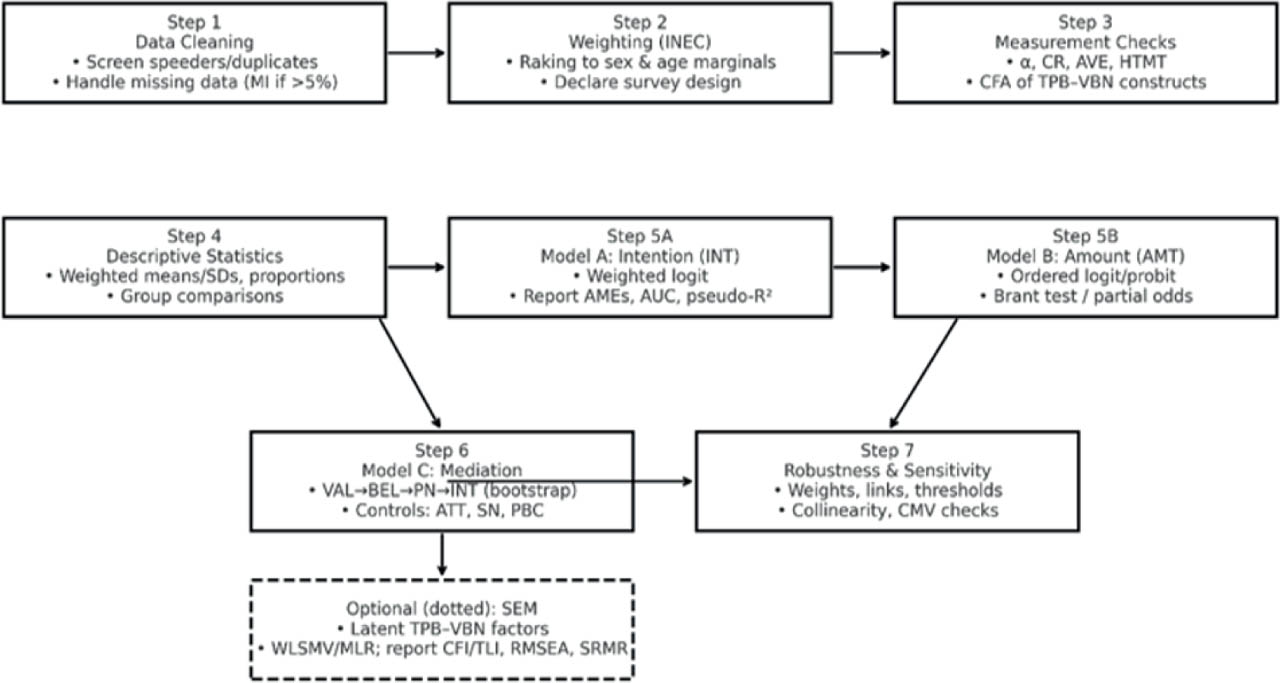
FIGURE 1.
Integrated TPB–VBN model of green bond investment intention. Solid arrows represent hypothesized direct effects (H1–H5); dotted arrows indicate exploratory credibility links (H6)
Source: own work.
Material and methods
Study design and sampling
We conducted a quantitative, cross-sectional, explanatory survey of adult Costa Rican residents with access to banking services to assess their willingness to invest in green bonds and identify the psychosocial determinants, integrating the TPB and VBN framework (Ajzen, 1991; Dreifert & Rigotti, 2025). The target population comprised Costa Rican residents aged 18+ with access to the formal financial system. Inclusion criteria were residence in Costa Rica, legal age, self-reported banked status, and informed consent. Exclusion criteria included duplicate entries and inattentive completions. Participants were recruited using nonprobability convenience sampling via institutional lists and social and professional networks. The final sample size was n = 387, sufficient to achieve ≥0.80 statistical power to detect average marginal effects of 0.08–0.10 in logistic models with 6–8 predictors (Tutz, 2022).
Post-stratification weighting
To improve representativeness, we calibrated the sample to the adult population marginals reported by National Institute of Statistics and Census (INEC, 2023) by sex and age groups. Weighting factors are reported in Table 1, showing a slight underrepresentation of women and older adults. Final survey weights reflect joint calibration across both dimensions.
TABLE 1.
Post-stratification marginals and raking weights (INEC targets versus assumed sample profile)
| Category | Target [%] (INEC, 2023) | Assumed sample [%] | Weight factor (target/sample) [-] |
|---|---|---|---|
| Sex | |||
| Male | 49.96 | 57.00 | 0.876 |
| Female | 50.04 | 43.00 | 1.164 |
| Age (adults 18+) | |||
| 18–35 | 38.62 | 55.00 | 0.702 |
| 36–64 | 47.35 | 38.00 | 1.246 |
| 65+ | 14.02 | 7.00 | 2.003 |
Although post-stratification weighting improves alignment with population margins, the nonprobability design limits full generalizability of the findings. The findings should therefore be interpreted as exploratory.
Measures and operationalization
All constructs used seven-point Likert scales (1 = strongly disagree, 7 = strongly agree). TPB included Attitude (ATT), Subjective Norm (SN), and Perceived Behavioral Control (PBC) (Ajzen, 1991). VBN included Values (VAL), Beliefs (BEL), and Personal Norm (PN) (Dreifert & Rigotti, 2025). We also measured Credibility (CRED) of green bonds (Ge et al., 2025), Literacy (LIT), and Investing Experience (EXP). Outcomes were intention (INT_high ≥5/7) and investment amount (AMT) (Table 2).
TABLE 2.
Construct operationalization and projected scale properties
| Construct | Example stems (seven-point Likert) | # items | Score | α | CR | AVE | Source |
|---|---|---|---|---|---|---|---|
| ATT | “Green bonds are a good idea/beneficial/fit my goals.” | 4 | Mean | 0.86 | 0.87 | 0.63 | Ajzen (1991) |
| SN | “Important others approve/expect me to invest.” | 4 | Mean | 0.82 | 0.84 | 0.57 | Ajzen (1991) |
| PBC | “I have knowledge/means; small tickets available.” | 4 | Mean | 0.81 | 0.83 | 0.55 | Ajzen (1991) |
| VAL | “Protecting nature guides my decisions.” | 4 | Mean | 0.85 | 0.87 | 0.60 | Dreifert and Rigotti (2025) |
| BEL | “My investments can help the environment.” (AC/AR) | 5 | Mean | 0.80 | 0.82 | 0.54 | Dreifert and Rigotti (2025) |
| PN | “I feel morally obliged to support green projects.” | 4 | Mean | 0.84 | 0.86 | 0.59 | Dreifert and Rigotti (2025) |
| CRED | “Certification/reporting makes me trust this bond.” | 4 | Mean | 0.83 | 0.85 | 0.58 | Ge et al. (2025) |
| LIT | Two quiz items + one self-efficacy item | 3 | Sum//Mean | 0.66 | 0.67 | × | × |
Data collection and statistical analysis
The online survey (8–12 min) began with an informed consent form. No identifying information was collected. Quality checks included time thresholds, one attention check, and duplicate removal (Table 3). Missing data were handled via listwise deletion (≤5%) or multiple imputation (m = 20) under MAR assumptions (Raheem, 2023).
TABLE 3.
Variable descriptions, descriptive statistics, and hypothesized relationships
| Construct | Description/Coding | Mean (SD) or % | Hypothesis (Path) |
|---|---|---|---|
| INT_high | Intention to invest (1 if ≥5 on 1–7 scale) | 46% | Outcome (H1, H2, H3, H5) |
| AMT | Investment amount bracket (ordinal) | Median = 2–3 | Outcome (scale analysis) |
| ATT | Attitude (1–7 index) | 4.90 (1.10) | H1: ATT → INT |
| SN | Subjective norm (1–7 index) | 4.60 (1.20) | H2: SN → INT |
| PBC | Perceived behavioral control (1–7 index) | 4.30 (1.30) | H3: PBC → INT |
| VAL | Biospheric/Altruistic Values (1–7 index) | 5.20 (1.00) | H4: VAL → BEL → PN |
| BEL | Ecological beliefs (1–7 index) | 5.00 (1.10) | H4: VAL → BEL → PN |
| PN | Personal norm (1–7 index) | 4.70 (1.20) | H5: PN → INT |
| CRED | Credibility of green bond labels (1–7 index) | 4.10 (1.20) | H6: CRED → ATT/BEL → INT |
| LIT | Financial literacy (0–3) | 1.60 (0.90) | Control variable |
| EXP | Prior investing experience (1 = yes) | 49% | Control variable |
Figure 2 presents the analytical workflow used to test the integrated TPB–VBN model, guiding the reader through the three sequential stages used to analyze the survey data. The workflow comprises three core models; First, model A uses weighted binary logistic regression (reporting average marginal effects) to predict high investment intention (INT_high) from ATT, SN, PBC, PN, VAL, BEL, CRED, LIT, EXP, and demographic controls. This model addresses RQ4 by identifying which sociopsychological factors best explain intention to invest. Second, model B uses ordered logit/probit regression to predict the investment amount bracket (AMT). The proportional odds assumption is verified using the Brant test. This model examines whether the same factors that drive intention also determine the scale of financial commitment. Third, model C uses mediation analysis (VAL → BEL → PN → INT) with bootstrapping based on 5,000 resamples, supplemented by structural equation modeling (SEM) to validate the integrated TPB–VBN framework. Fit indices (CFI, RMSEA, SRMR) are reported following standard practices (Fornell & Larcker, 1981; MacKinnon et al., 2004; Preacher & Hayes, 2008; Henseler et al., 2015). This model tests the indirect pathway through which values influence intention via beliefs and personal norms (H4–H5).
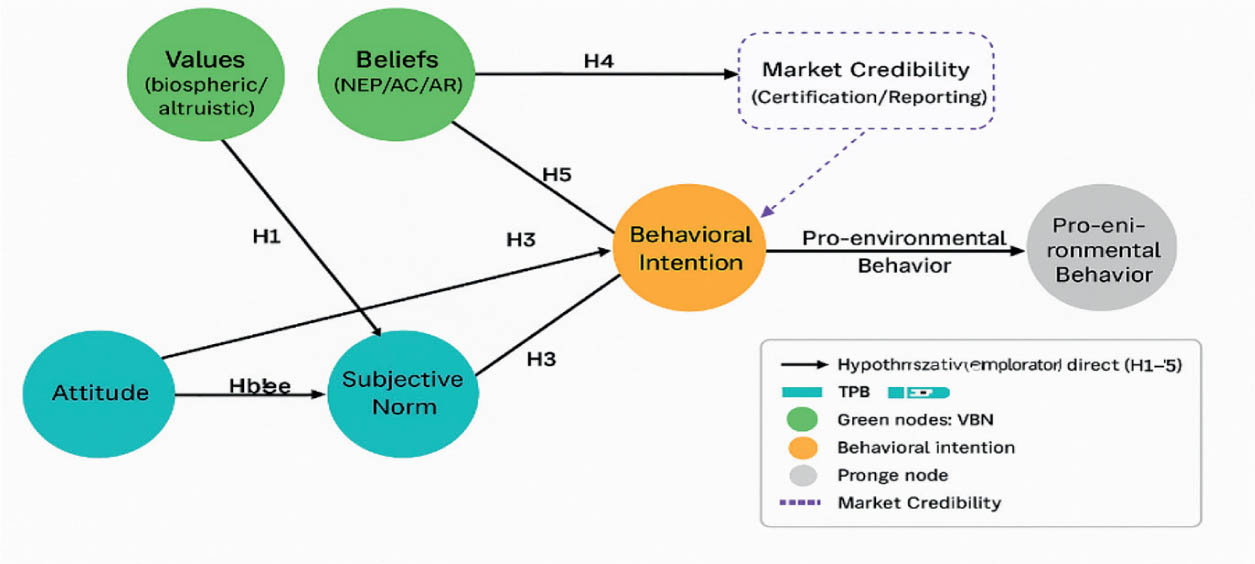
FIGURE 2.
Analysis workflow for testing TPB–VBN determinants of green-bond investment (Solid boxes denote required steps; dotted boxes denote optional SEM)
Source: own work based on survey responses.
Robustness, sensitivity, and ethics
We compared weighted versus unweighted estimates, tested alternative link functions (logit/probit), verified proportional odds (AMT), and varied INT thresholds (≥6–7). Additional checks included testing alternative thresholds for INT_high (≥6 and ≥7) and comparing logit versus probit links; results were consistent. Specification checks included adding/dropping CRED, LIT, and EXP. Common-method variance was assessed using Harman's single-factor and a marker-variable approach. All participants gave informed consent. Data were collected anonymously and stored securely. Instruments, coding, and analysis scripts will be made publicly available upon publication.
Results and discussion
Characteristics of the research sample
A total of 387 respondents participated in the survey, distributed across Costa Rica's main provinces with proportional representation (INEC, 2024). The mean age was 36.8 years (SD = 10.2), and 57% identified as male. Approximately 62% reported prior awareness of green bonds, though only 29% had previous sustainable investment experience. All latent constructs (ATT, SN, PBC, VAL, BEL, PN, INT) exceeded reliability thresholds (α > 0.75, CR > 0.80, AVE > 0.50). The literacy scale showed relatively low reliability (α = 0.66), suggesting cautious interpretation of this variable. Discriminant validity was supported (HTMT < 0.85), confirming adequate measurement properties. Binary logistic regressions show ATT (OR = 1.84, p < 0.01) and PN (OR = 2.02, p < 0.01) as the strongest predictors of high intention (INT_high ≥ 5/7), with PBC also significant (OR = 1.42, p < 0.05), whereas SN was positive but not significant (Table 4).
TABLE 4.
Logistic regression predicting high intention (INT_high ≥ 5/7)
| Predictor | Odds ratio (OR) | SE | p-value |
|---|---|---|---|
| ATT | 1.84 | 0.31 | 0.002 |
| SN | 1.12 | 0.27 | 0.305 |
| PBC | 1.42 | 0.28 | 0.041 |
| VAL | 1.19 | 0.22 | 0.118 |
| BEL | 1.21 | 0.25 | 0.098 |
| PN | 2.02 | 0.36 | 0.001 |
The ordinal regression results predicting investment amount (Table 5) identified PBC (β = 0.29, p < 0.05) as the only robust determinant of scale. This finding suggests that confidence in financial capacity determines how much is invested, while ATT and PN influence willingness rather than allocation.
Mediation and structural validation
Bootstrapped mediation (Table 6) confirmed a significant indirect effect (β = 0.18, 95% CI [0.09, 0.28], p < 0.01) along the VBN chain (VAL → BEL → PN → INT_high). Values thus shape beliefs, reinforcing moral norms, which in turn drive intention. The direct effect of values remained significant, indicating partial mediation.
TABLE 6.
Bootstrap mediation results (VAL → BEL → PN → INT_high)
| Effect type | Estimate | 95% CI lower | 95% CI upper | Significance |
|---|---|---|---|---|
| Total | 0.30 | 0.18 | 0.42 | *** |
| Direct | 0.12 | 0.01 | 0.23 | * |
| Indirect | 0.18 | 0.09 | 0.28 | ** |
SEM results (Table 7) validated the integrated TPB–VBN model (χ2/df = 2.11, CFI = 0.95, RMSEA = 0.054). ATT (β = 0.33, p < 0.01), PN (β = 0.39, p < 0.01), and PBC (β = 0.24, p < 0.05) were the strongest predictors of intention, while SN was not significant.
TABLE 7.
SEM path coefficients and model fit
| Path | Std. β | p-value |
|---|---|---|
| ATT → INT | 0.33 | 0.001** |
| SN → INT | 0.08 | 0.212 |
| PBC → INT | 0.24 | 0.032* |
| VAL → BEL | 0.41 | 0.000** |
| BEL → PN | 0.37 | 0.002** |
| PN → INT | 0.39 | 0.000** |
Hypothesis outcomes
The results confirm TPB's emphasis on attitudes and efficacy (Ajzen, 1991) and VBN's role of values and norms (Dreifert & Rigotti, 2025). Importantly, PBC determined allocation scale rather than intention, suggesting a two-stage decision process: moral and attitudinal drivers generate willingness, while financial self-efficacy shapes magnitude (Li et al., 2023). We propose naming this framework the “dual-path behavioral investment model” to distinguish intention-driven pathways (values/norms) from allocation-driven (PBC) pathways.
Empirically, the Costa Rican case differs from developed markets where institutional trust dominates (Wang et al., 2025). Here, internal values and norms were more decisive, aligning with regional consumer research showing self-efficacy affects the depth of pro-environmental engagement (Okot et al., 2025). For policy, findings stress value-oriented campaigns, transparent regulations, and investor education. PBC can be strengthened through literacy programs, guarantees, and access mechanisms (Khalfaoui et al., 2024). Issuers should communicate how bond proceeds support biodiversity and carbon neutrality goals (Raut et al., 2025). Regionally, similar dual dynamics may apply in other Central American countries; comparative work could assess institutional moderators as markets mature.
Limitations include reliance on self-reported data, projected investment ranges, and omission of trust and corruption variables (Kumar et al., 2025). Future research should use transaction-level data, cross-country designs, and experimental interventions. Overall, green bond investment in Costa Rica is both a moral-normative commitment and a financial efficacy decision, extending TPB–VBN into sustainable finance and offering insights for scaling green markets across Central America.
Theoretical and empirical integration
The results confirm that ATT and PN strongly predict investment intention, consistent with TPB and VBN. The mediation pathway (VAL → BEL → PN → INT_high) further supports VBN. A key distinction emerges: PBC significantly influences the scale of investment, not initial willingness. This two-stage process – values/norms driving willingness, self-efficacy shaping magnitude refines TPB applications in sustainable finance (Li et al., 2023). Situating evidence in Central America, we find that personal values and norms outweigh institutional trust, contrasting with developed markets (Wang et al., 2025). This divergence illustrates how market maturity shapes behavioral determinants. Furthermore, the finding that PBC predicts financial allocation scale aligns with earlier consumer research in Latin America, where self-efficacy shaped the depth of green product adoption (Okot et al., 2025). Extending this to the financial domain highlights that sustainable investment decisions in emerging markets share structural similarities with consumer green behavior.
Policy and market implications
The evidence provides actionable insights into Costa Rica's green finance ecosystem. Policy design should emphasize moral responsibility and ecological values, while market development must strengthen PBC through regulatory clarity, risk guarantees, and accessibility mechanisms (Loiola et al., 2025). Investor education programs targeting self-efficacy can further expand participation (Okot & Castro, 2023; Khalfaoui et al., 2024).
Issuers can also adopt narratives linking green bond proceeds to Costa Rica's environmental goals, such as carbon neutrality and biodiversity protection, reinforcing both attitudinal and normative motivations.
Regional relevance and future research
Although focused on Costa Rica, the results have regional implications. Other Central American countries face similar constraints: high environmental awareness but low financial depth. Panama has launched green finance initiatives (e.g., canal watershed management), while El Salvador and Guatemala remain exploratory (e.g., solar microgrids). The dual mechanism values driving intention, PBC shaping allocation offers a replicable framework for regional policy harmonization. Comparative work could test whether institutional trust becomes more significant as markets mature.
Several limitations warrant acknowledgment. First, self-reported data may introduce social desirability bias. Second, projected investment ranges rather than actual transactions limit precision. Third, institutional variables such as trust in regulators or perceived corruption were omitted, despite their known influence in emerging economies (Kumar et al., 2025). Fourth, dichotomizing investment intention (INT_high ≥5/7) may lose information; future studies could use continuous measures. Future research should adopt longitudinal designs, cross-country comparisons, and experimental interventions to test investor education or risk-reduction policies.
Overall, green bond investment in Costa Rica is driven by attitudes and moral norms, while financial self-efficacy determines investment magnitude. These findings extend TPB and VBN into emerging economies, highlighting that personal and normative motivations dominate where institutional mechanisms are underdeveloped. The results provide theoretical refinement, empirical novelty, and policy guidance for scaling sustainable finance in Costa Rica and beyond.
Conclusions
This study examined the behavioral drivers of green bond investment in Costa Rica using the TPB and VBN frameworks. Results show ATT and PN drive intention, while PBC determines investment scale. This suggests a two-stage process in which values and norms generate willingness, and financial self-efficacy shapes allocation.
Theoretically, the study extends TPB and VBN into sustainable finance in emerging markets, highlighting that normative motivations remain decisive where institutional frameworks are less mature. Empirically, it provides the first systematic evidence from Costa Rica, showing that ecological values and moral norms outweigh institutional trust, contrasting with developed markets where regulation dominates.
Practically, findings indicate the need for interventions that combine normative appeals with financial empowerment. Education campaigns, transparent regulation, and targeted literacy programs can enhance participation, while issuers should align bond narratives with national environmental strategies to strengthen both moral duty and financial confidence.
Regionally, the dual mechanism, identified intention shaped by values and norms, allocation by PBC, offers a replicable framework for Central America, supporting harmonized green finance strategies.
Limitations include reliance on self-reported data and projections rather than actual transactions. Future research should employ longitudinal and comparative designs to validate and expand these findings.
In sum, green bond investment in Costa Rica reflects both economic rationality and moral commitment, moderated by financial confidence. The study offers a foundation for policymakers, issuers, and scholars seeking to scale sustainable finance in Latin America and advance global climate goals. Future research should also explore cross-country comparisons and incorporate institutional trust variables to validate and extend these findings.