

Clay masonry units have been essential building materials for centuries in the construction of homes and infrastructure (Gallegos & Casabonne, 2005), not only due to their availability, ease of molding, and mechanical strength after firing (Uribe et al., 2021) but also because these properties have allowed ceramic bricks to become one of the most widely used and fundamental products in traditional masonry (Muñoz Pérez et al., 2021). This effectiveness continues to be observed in the use of these ceramic building units in many parts of the world, such as Latin America, Asia, and Africa, where their use remains predominant (Rotaondaro, 2007) in both artisanal processes and semi-industrialized systems that supply the growing urban demand (UN Environment et al., 2018), particularly in areas where self-construction is common (Tam et al., 2018).
At the same time, rapid urban growth has led to a significant increase in the generation of construction and demolition waste (CDW), which refers to waste or refuse generated from building, remodeling, and demolition work (Kofoworola & Gheewala, 2009) and generally consists of a mixture of leftover materials from these processes (Chi et al., 2020). Globally, this waste represents one of the largest volumes of solid waste streams, reaching over 30% of total solid waste in several cities (Lu et al., 2017). In Latin America, the limited infrastructure for its management means that a large portion of CDW is disposed of in informal landfills, causing negative environmental impacts, additional cleanup costs, and deterioration of the urban landscape (Oviedo Cogollo & Vega Suárez, 2021).
Given this scenario, the valorization of CDW has gained relevance as a strategy to promote more sustainable construction, with its incorporation into the production of building materials being one of the most researched alternatives (Sieffert et al., 2014). Some previous research has shown that CDW could be partially incorporated into the production of these units, provided that the dosage and corresponding particle size are controlled (Robayo et al., 2016). Bektas et al. (2007) highlight that both crushed stone and ceramic waste can function as the granular skeleton, improving internal stability and increasing brick density.
For instance, research has evaluated the incorporation of recycled concrete and brick powder in the production of geopolymeric mortars and bricks, demonstrating the potential of these residues to produce resistant and functional materials through alkaline activation processes and modifications in particle size distribution (Rahimpour et al., 2024; Capasso et al., 2025). Similarly, a study published in 2024 on geopolymers incorporating brick and concrete demolition waste explored mixtures with different percentages of CDW, highlighting the effects of waste composition and processing on the mechanical properties of the resulting materials (Parra et al., 2024). Furthermore, recent review studies have analyzed the use of recycled CDW aggregates in concrete, illustrating how variations in treatment and aggregate characteristics influence the final performance of construction products (Luo et al., 2024). Overall, these recent publications (2024–2025) demonstrate a growing research trend toward the valorization of construction and demolition waste with different particle sizes and processing methods, aiming to reduce waste generation, promote circular economy strategies, and develop more sustainable building materials.
An important aspect of this research lies in the particle size of the CDW, as this determines crucial properties such as compaction, porosity, and the final mechanical strength of the brick. Evidence suggests that fine fractions of ceramic waste or pulverized brick can act as micro-fillers, reducing porosity and modifying water absorption by filling the voids in the clay matrix (Rahhal et al., 2019). Zanelli et al. (2021) show that the incorporation of fine and very fine fractions of CDW is technically viable as long as there is an adequate granulometric classification, noting that particles with a size less than 0.6 mm can be incorporated without affecting the physical-mechanical behavior of the brick.
Other studies reveal that coarser particle sizes, or excessive substitution percentages, tend to increase porosity and absorption, while decreasing density and compressive strength if firing conditions are not controlled (Gencel et al., 2022). Similarly, recent research confirms that there is an optimal incorporation range depending on the type of waste and the firing temperature. Cases such as Dubale et al. (2023) report that substitutions between 10% and 25% of crushed CDW make it possible to obtain bricks that meet the established strength criteria when fired at temperatures between 850°C and 900°C.
In Peru, a similar situation exists. Brick production plays a dominant role in urbanized areas, while the generation of CDW is increasing due to the rapid growth of the construction sector. However, this waste is not receiving adequate attention from the authorities because a management and treatment plan has not been implemented to allow access to all the potential benefits that could be obtained from it (Bazán, 2018). This is because reuse strategies are needed to reduce clay extraction and promote more sustainable practices (Kumar et al., 2021).
However, there is still little evidence regarding how the particle size variation of CDW influences the physical and mechanical properties of clay units produced under local conditions (Torres, 2024). Therefore, this study aims to evaluate the influence of different CDW particle sizes (3/4”, 1/2”,% 3/8”, and No. 4) on the physical and mechanical properties of clay masonry units, considering parameters such as absorption, dimensional variation, and compressive strength. The results are intended to establish technical criteria to guide the optimal incorporation of CDW in the sector.
The use of CDW in the production of clay masonry units represents a natural, technical, and sustainable alternative to the challenges of overexploitation of resources and poor waste management in construction (Pacheco-Torgal, 2014). The relevance of this research lies in the problems generated by environmental degradation, the increase in informal dumps, and the need for affordable construction materials, while simultaneously promoting the circular economy and the efficient use of local resources (Lieder & Rashid, 2016). This fosters the production of more sustainable, safe, and durable bricks by combining technical innovation with responsible, low-environmental-impact construction practices (Tejada, 2025).
From a social perspective, this research proposes the reuse of CDW in clay bricks as an alternative for producing accessible and safe building materials for communities where debris accumulation and a lack of local resources are significant concerns (Santana et al., 2024). This allows for the production of affordable units with adequate mechanical properties, which helps improve the structural safety of homes and enhances the quality of life in communities, while also promoting more sustainable construction practices (Vega Garcia, 2024).
Theoretically, the study is supported by scientific documentation on the incorporation of construction and demolition waste as part of ceramic materials (Al-Fakih et al., 2018) and the effects of particle size on the physical and mechanical properties of bricks. It also draws on evidence of how the particle size of construction and demolition waste can act as a micro filler or granular structure, influencing absorption, dimensional variation, and compressive strength. Furthermore, it expands the knowledge applied to civil engineering and sustainable construction technologies (Junior et al., 2022).
From a methodological standpoint, the research presents a quasi-experimental and quantitative design that allows for the evaluation of how variations in particle size of CDW of 3/4″, 1/2″, 3/8″, and No. 4 influence the performance of clay bricks. Laboratory tests, conducted under current technical standards, ensure valid and reliable results, providing information to promote sustainable alternatives in the brickmaking industry (Xiao et al., 2022). From an environmental perspective, the research encourages the reuse of CDW, which reduces the extraction of virgin clay and the amount of waste in landfills (Padmalosan et al., 2023). This practice contributes to the circular economy and opens up possibilities that will lead to the production of more sustainable bricks, in line with ecological construction strategies and impact mitigation values associated with traditional materials (Zhang, 2013).
The main objective of this research was to evaluate the influence of the particle size of CDW on the physical-mechanical properties of clay bricks.
The research conducted is applied because it aims to obtain scientific results with practical applications (Quintero, 2007), allowing theoretical knowledge to be translated into feasible solutions that address the needs of the sector and society (Mayz & Pérez, 2002). In this sense, the research seeks to evaluate the influence of CDW size on the properties of clay bricks, providing technical criteria that promote more efficient and environmentally responsible production processes (Fig. 1).
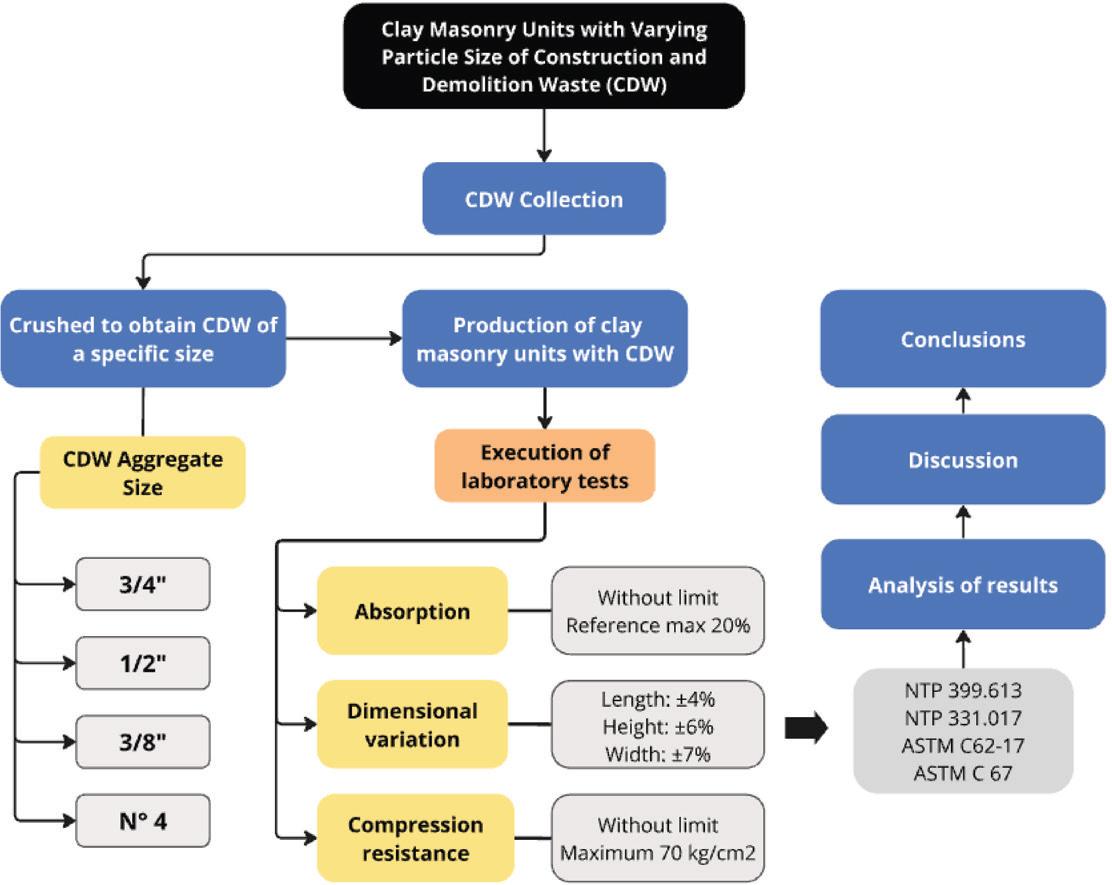
Investigation process
Source: own work.
The design is quasi-experimental because the independent variable is manipulated while total control of all external conditions is not achieved, allowing observation of its effects on the properties of the bricks produced (Shadish et al., 2002). This type of design allows, through the control of laboratory conditions and the application of technical evaluation protocols (Manterola & Otzen, 2015), the comparison of groups being subjected to different particle sizes. In this case, the research analyzes how the particle sizes 3/4″, 1/2″, 3/8″, and No. 4 influence the physical-mechanical performance of masonry units.
This research is quantitative because it focuses on the measurement and analysis of numerically obtained data to answer the research questions (Creswell & Creswell, 2018). It contributes to the application of standardized and objective procedures (Cárcamo Vásquez et al., 2009) for evaluating the physical-mechanical properties of clay bricks made with different particle sizes of CDW, such as water absorption, dimensional variation, and compressive strength. The application of precise measurements will yield replicable results that can be statistically verified, thus ensuring the validity and reliability of the analysis (Hernández et al., 2014).
The total number of clay bricks manufactured constituted the research population. The sample consisted of 75 bricks, comprising a control group without the addition of CDW and four experimental groups. Each experimental group was made with a different particle size, allowing for a comparative analysis of the effect of particle size on the aforementioned brick properties. The CDW was extracted from a landfill where this material had been present for extended periods, ensuring that the material obtained was representative. The aggregates were then processed through crushing and grinding to obtain the particle size fractions required for the study (3/4″, 1/2″, 3/8″, and No. 4).
The clay masonry units were handcrafted using molds measuring 20 × 11 × 9 cm (Fig. 2), classified as solid bricks Type II according to NTP 331.017 (Instituto Nacional de Calidad [INACAL], 2015). Five test groups were formed, each consisting of 15 specimens: one control group without added waste and four experimental groups with the different fractions of construction and demolition waste mentioned, allowing the tests to be organized in a controlled manner for subsequent evaluation.
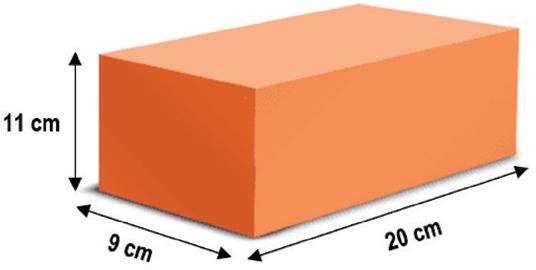
Clay brick unit dimensions
Source: own work.
Water absorption, dimensional variation, and compressive strength tests were conducted in accordance with the limits and procedures established by NTP 399.613 (INACAL, 2017), ASTM C62-17 (ASTM International, 2017), and ASTM C67-14 (ASTM International, 2014). For the water absorption test, the bricks were first dried to a constant mass, then fully immersed in water for a specified period, and the increase in mass was measured to determine the absorption percentage. Dimensional variation was evaluated by measuring the length, width, and height of the bricks before and after water immersion to quantify expansion or shrinkage (Fig. 3). Compressive strength tests were carried out using a universal testing machine, applying a gradually increasing load until failure and recording the maximum load sustained by each specimen. In addition, chemical composition data from previous studies on CDW were incorporated to assess their potential influence on the physical and mechanical behavior of the bricks. This combined approach ensures methodological rigor and provides a comprehensive understanding of how the characteristics of the recycled material affect key properties such as strength, durability, and water absorption.
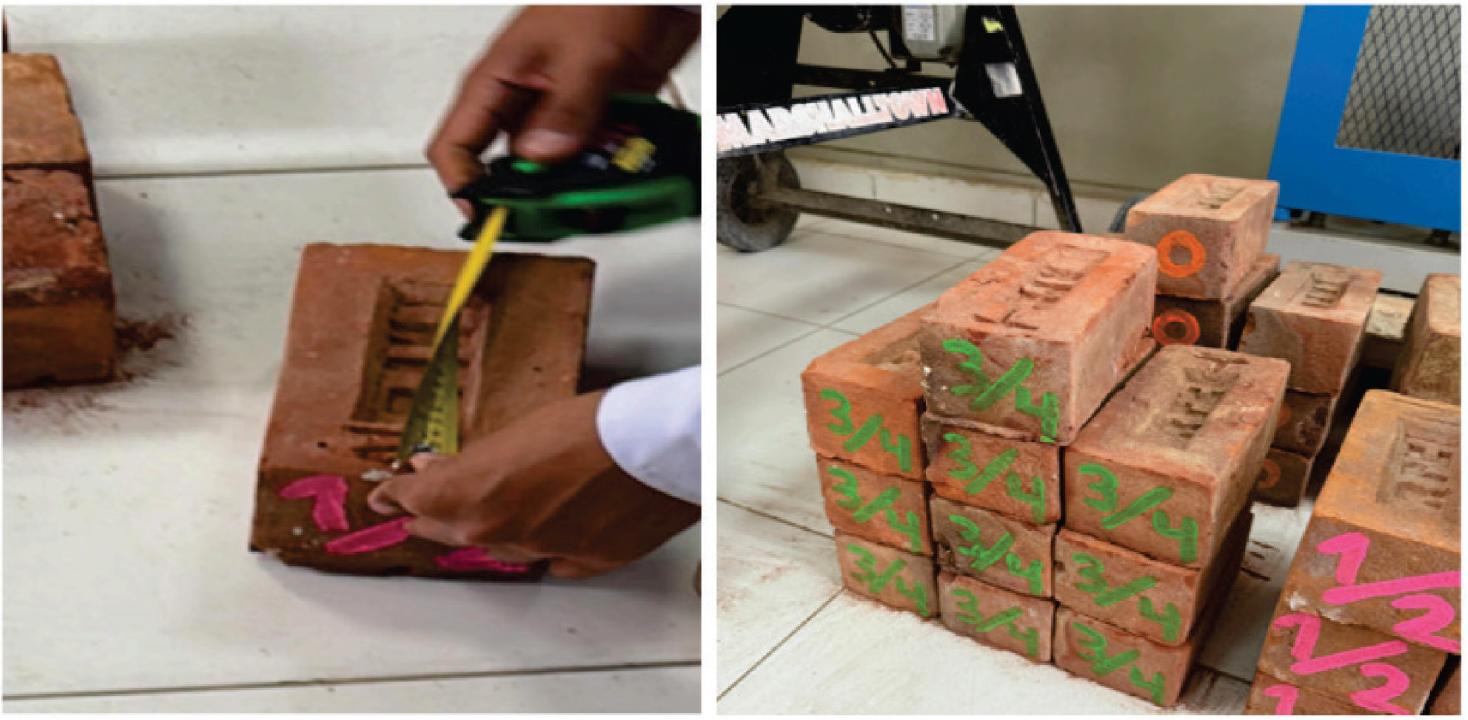
View of the manufactured masonry units
Source: own photos.
This composition of CDW shows that the majority consists of concrete, bricks, tiles, and slabs. These materials, which possess medium strength, represent the largest fraction of the waste, while other components appear in smaller proportions (Table 1). In this context, it can be interpreted that CDW has the potential to provide granular structure and some mechanical reinforcement to clay bricks, especially when appropriate particle sizes are used (Chica & Beltrán, 2018). Furthermore, the presence of ceramic and stone materials could influence water absorption and internal cohesion, which are key aspects for ensuring the durability of the final product.
Mean composition of construction and demolition waste
| Element | % by mass [%] |
|---|---|
| Concrete | 63.67 |
| Solid bricks | 17.98 |
| Tiles/Slabs | 11.11 |
| Mortar | 4.23 |
| Concrete block | 0.11 |
| Concrete tiles | 0.39 |
| Stones | 1.38 |
| Asbestos-cement | 0.38 |
| Wood | 0.11 |
| Organic matter | 0.20 |
Source: Chávez Porras et al. (2013).
However, it is also important to note that CDW does not have a uniform or identical composition everywhere, as this depends on factors such as the type of structure demolished, the demolition procedure, and the environmental management systems employed. For this reason, the behavior of the waste can vary between different collection areas (Suárez-Silgado et al., 2019). This justifies the need to carry out a proper classification before incorporating them into construction materials.
The analysis was performed using X-ray fluorescence spectrometry, a technique that, as explained by Torres-Rodríguez et al. (2022), identifies elements by exciting atoms with X-rays and then detecting the characteristic emissions, thus revealing the mineral composition of the CDW. The results, quantified in the following table, show the chemical components of the CDW and give us an idea of their potential role in the properties of the brick (Table 2).
Elemental composition of construction and demolition waste by X-ray fluorescence spectrometry assay
| Element | Result [%] | Oxides | Result [%] |
|---|---|---|---|
| Calcium (Ca) | 36.839 | Silicon oxide (SiO2) | 36.852 |
| Silicon (Si) | 29.509 | Calcium oxide (CaO) | 30.089 |
| Aluminum (Al) | 14.126 | Aluminum oxide (Al2O3) | 15.581 |
| Iron (Fe) | 10.202 | Iron oxide (Fe2O3) | 8.515 |
| Magnesium (Mg) | 4.477 | Magnesium oxide (MgO) | 4.334 |
| Potassium (K) | 2.069 | Potassium oxide (K2O) | 1.455 |
| Sulfur (S) | 1.199 | Sulfur oxide (SO3) | 1.748 |
| Titanium (Ti) | 1.066 | Titanium oxide (TiO2) | 1.038 |
| Manganese (Mn) | 0.218 | Manganese oxide (MnO) | 0.164 |
| Strontium (Sr) | 0.197 | Strontium oxide (SrO) | 0.136 |
| Zirconium (Zr) | 0.057 | Zirconium oxide (ZrO2) | 0.045 |
| Vanadium (V) | 0.041 | Vanadium oxide (V2O5) | 0.043 |
Source: Vega Neyra and Hizo Celestino (2025).
X-ray fluorescence analysis demonstrated that demolition waste contains components such as minerals and oxides, which are almost identical to those found in traditional fired bricks, with abundant silica, alumina, and calcium and iron oxides, all of which are active in the material’s behavior (Saíz et al., 2023). This similarity in chemical structure suggests the potential use of this waste as a material that could partially and adequately replace the traditional components of concrete masonry units, promoting compatibility with cementitious materials and the internal cohesion of the mixture.
In the present study, no presence of asbestos, asbestos-containing materials, or paints with heavy metals was detected in the construction and demolition waste evaluated; the materials were subjected to inspection and chemical characterization, which showed that their composition mainly consists of typical mineral phases from concrete and ceramics (such as silica, alumina, and calcium oxides), with no hazardous or toxic compounds identified, nor significant concentrations of contaminating elements that could pose a risk to human health or the environment. Therefore, the recycled material can be considered safe and suitable for use in the production of masonry units. Furthermore, the bricks produced with this material will be completely encapsulated by mortar during the plastering process, remaining fully covered, which serves as an additional physical barrier that limits any potential particle release and enhances the safety and stability of the material in its final application.
The water absorption results reveal slight variations (small percentages) as CDW is incorporated in different particle sizes, ranging from 10.7% for the control brick to values between 11.7% and 13.0% for mixtures with recycled aggregate (Fig. 4). However, these variations remain within technically acceptable limits for masonry units. This slight increase can be attributed to the increased porosity generated by the incorporation of CDW particles, which allows for greater water retention without compromising the brick’s internal structure. This effect is more noticeable in fine-grained residues, while coarser sizes tend to decrease absorption. Although NTP 399.613 (INACAL, 2017) does not establish a maximum absorption limit for this type of brick, a reference value of no more than 22% is considered to ensure adequate performance in bricks fired under this standard. From this perspective, all the values obtained are below the estimated threshold, with residue No. 4 registering the lowest absorption values, indicating better performance against moisture, while the 3/8” residues showed the highest absorption, showing that the granulometry of the CDW influences the absorption capacity, suggesting that there is an optimal residue size range that allows maintaining controlled porosity and ensuring the durability of the brick, but showing that the incorporation of CDW does not affect the absorption capacity or the hygroscopic condition of the brick.
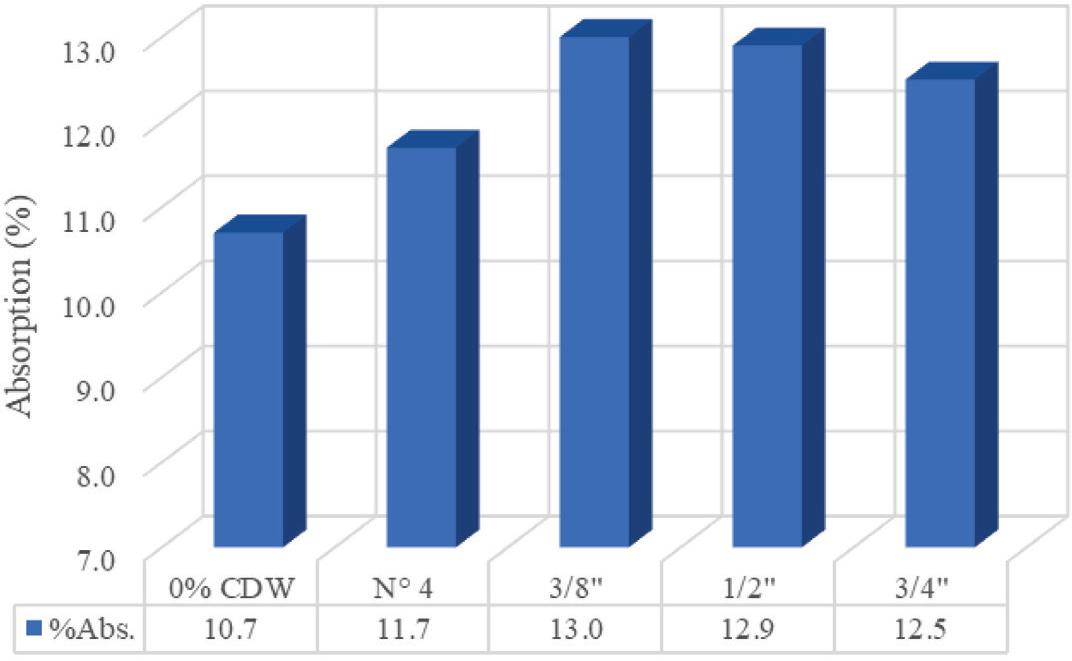
Average absorption of clay bricks with construction and demolition waste
Source: own work.
The dimensional variation reflected in the bricks incorporated with CDW is within the limits allowed by the national technical standard NTP 331.017 (INACAL, 2015), which stipulates tolerances in length of ±4%, in height of ±6%, and ±7% for the width of units such as those in this study. Regarding dimensional variations, height showed the greatest variation (102.7%), while length and width showed slight reductions, remaining close to the standard dimension. The 3/8″ waste best preserved its dimensions, while the No. 4 waste exhibited the greatest deviations (Fig. 5). This suggests that proper control of waste size can minimize deformations and promote a more uniform distribution of internal stresses during the drying and firing process. None of these variations exceeded regulatory limits, and no significant deformations were observed. Therefore, it can be concluded that the inclusion of CDW waste would not compromise the dimensional uniformity of the produced units. Furthermore, these results confirm that, with good control of dosage and particle size distribution, bricks can maintain high dimensional consistency, which is crucial for their correct placement and structural performance on site.
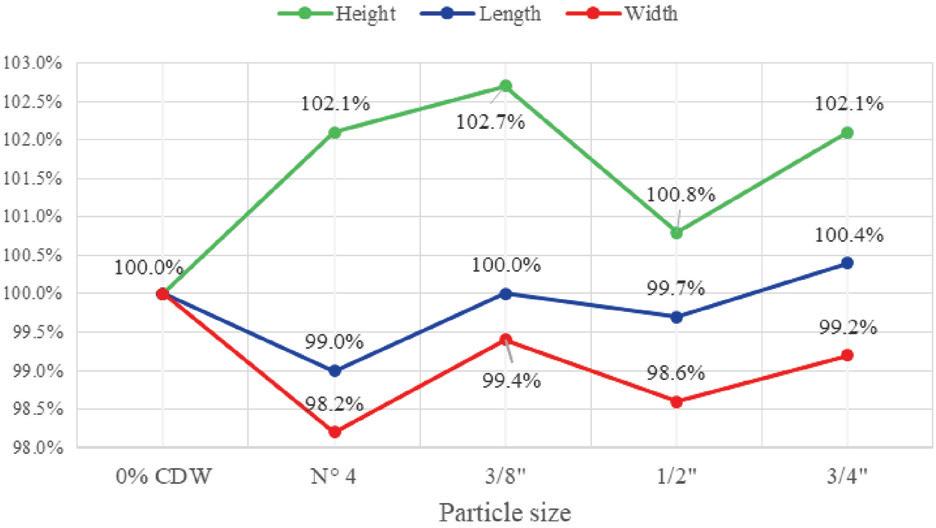
Average dimensional variation of clay bricks with construction and demolition waste
Source: own work.
The compressive strength results for the unit groups show significant variations depending on the size of the incorporated CDW residue. While bricks with 3/4″ and No. 4 residue achieved the highest values, 65 kg·cm−2 and 64 kg·cm−2, respectively, even surpassing the control brick (55 kg·cm−2), bricks with 3/8″ residue exhibited the lowest strength, and those with 1/2″ residue showed intermediate performance (Fig. 6). This behavior reflects that coarser residue allows for better compaction and internal densification of the brick, favoring the development of its internal structure during firing. This indicates that the selection of residue size is crucial for ensuring structural strength, with coarser residue offering better performance in bricks incorporating CDW. Therefore, the appropriate choice of residue size not only improves strength but also contributes to the uniformity and durability of the units in practical applications.
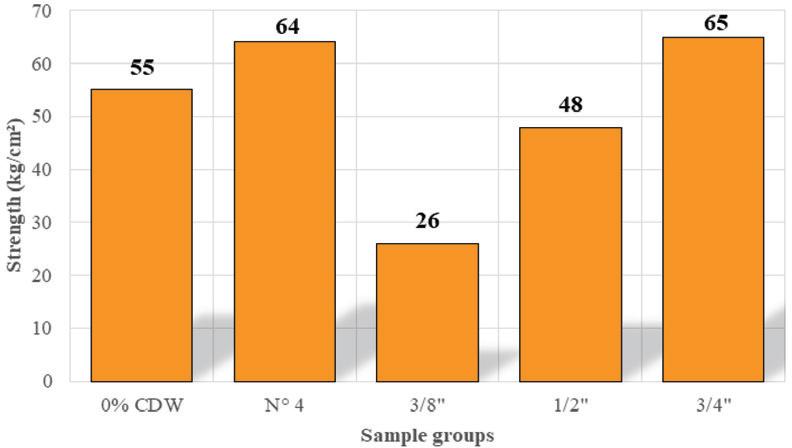
Average compressive strength of clay bricks with construction and demolition waste
Source: own work.
Regarding water absorption, a progressive increase was observed with the incorporation of CDW, particularly with 3/8″ particles, which reached 12.9%. This behavior is consistent with Voišnienė et al. (2019), who indicated that certain waste particle sizes can increase porosity. Similarly, Gencel et al. (2022) reported values up to 17.5% for particles smaller than 2 mm, noting that an unsuitable particle size distribution may influence the material’s hygroscopic response. Cruzado (2018) also obtained absorption values around 12.79%, reinforcing the relationship between finer particles and higher voids. A notable finding of the current study is that waste No. 4 showed the lowest absorption, suggesting an optimal particle size range that allows improved compaction and reduced porosity. Dos Reis et al. (2019) indicate that a moderate particle size in CDW can densify the material and decrease absorption. Similar results were reported by Gutiérrez and Miranda (2025), with absorptions as low as 4.93%, demonstrating that relatively coarse particles can enhance moisture resistance, while Peña and Rincón (2018) found absorption values of 3.63% for particle sizes around 2.5 mm, showing that fine particles, if properly controlled, also reduce absorption. Other studies, however, show that absorption depends on both the amount and type of residue. Gutiérrez and Oyarce (2021) reported values as high as 24.8%, while Raini et al. (2025) observed 20%, indicating that particle shape and incorporation percentage influence absorption as much as size. Finally, Torres (2024) reported 3.6% for mixtures with controlled granulometry, highlighting that a uniform and well-processed particle size limits absorption even in the presence of CDW (Fig. 7).
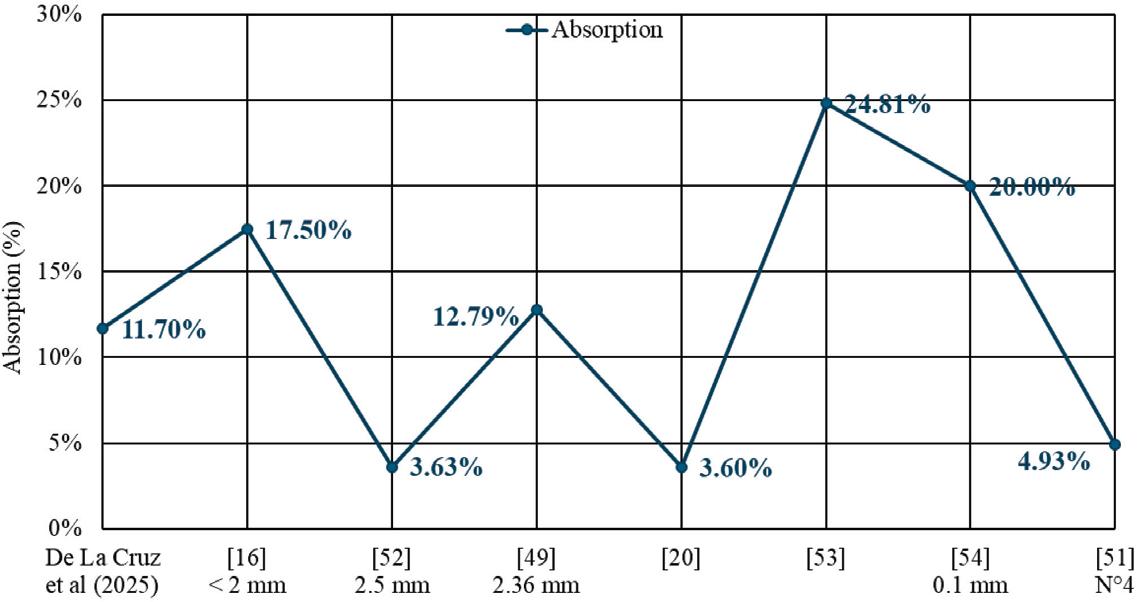
Absorption of bricks with construction and demolition waste according to different authors
Source: own work.
Continuing with the dimensional variation, no significant deformation was observed, as all bricks remained within the limits established by the standard. This is consistent with Cruzado (2018), who also reported that the incorporation of CDW did not produce significant deformations, observing a variation of 4.41% in height and noting that the greatest fluctuations occur in this dimension. Similarly, Torres (2024) found the greatest variation in height at 1.77%, and Gutiérrez and Oyarce (2021) recorded their most notable variation in thickness at 2.68%, although all values remained within the standard limits. In the present study, height showed the highest percentage of variation (102.7% relative to the nominal height), while bricks made with 3/8″ residues better preserved their dimensions, and those made with No. 4 residues exhibited the most noticeable deviations, indicating that CDW granulometry has a stronger influence on the geometric stability of bricks than commonly considered (Fig. 8).
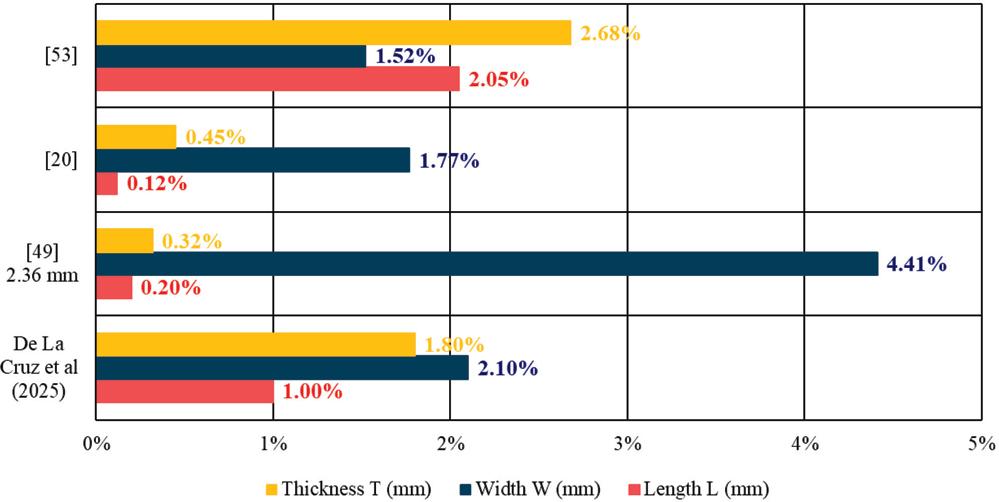
Dimensional variation of bricks with construction and demolition waste according to different authors
Source: own work.
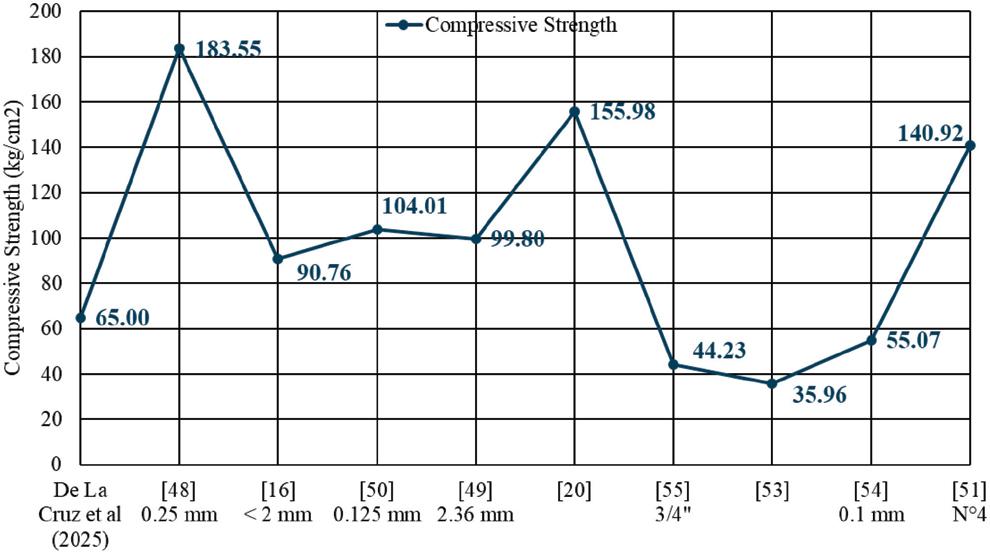
Finally, regarding compressive strength, the highest values were obtained with the coarse waste (No. 4 and 3/4″), even surpassing the standard brick. This behavior aligns with the findings of dos Reis et al. (2019) and Vega Neyra and Hizo Celestino (2025), who demonstrated that using optimal CDW particle sizes achieves better compaction and improves the internal structure of fired bricks. This is consistent with studies showing that coarse particles, such as 3/4″, allow for higher strengths by generating a denser matrix with lower porosity. Similarly, Gutiérrez and Oyarce (2021) indicated that adequate strength is achieved with small dosages of waste, but progressive increases in the proportion of incorporation can lead to a decrease, highlighting the existence of an optimal substitution limit, as also noted by Raini et al. (2025). In contrast, the 3/8″ residues exhibited the lowest strengths, reflecting the same behavior described by Gencel et al. (2022) and Cruzado (2018), who stated that fine particles (smaller than 2 mm or close to 2.36 mm) increase porosity, resulting in lower mechanical strength due to greater void occupancy within the matrix. Even studies with ultrafine particles, such as 0.25 mm (Voišnienė et al., 2019) or 0.125 mm (Reis et al., 2019), show that although considerable strength values can be achieved in specific contexts, performance depends heavily on the proportion and compaction process, and excessive use can lead to less dense structures. The results of the present study are also partially related to those of Torres (2024), who indicated that CDW can slightly decrease compressive strength compared to conventional bricks, without compromising their structural performance (Fig. 9).
Compressive strength of bricks with construction and demolition waste according to other authors
Source: own work.
The properties of the standard clay bricks, without the incorporation of CDW, showed an absorption of 10.7%, a dimensional variation within acceptable limits, and a compressive strength of 55 kg·cm−2. These values constitute the baseline for evaluating the effect of incorporating construction and demolition waste, allowing for clear identification of the changes generated by each recycled particle size compared to the conventional material.
Water absorption increased with the incorporation of CDW, reaching up to 13.0% in 3/8″ particles, while residues with a CDW aggregate size of No. 4 registered lower absorption (11.7%), demonstrating that fine particles increase porosity and facilitate water capture, while intermediate granulometries allow maintaining good performance against humidity and preserve the durability of the unit.
Regarding dimensional variation, all units with CDW remained within the limits established by standard NTP 331.017. Height showed variations of up to 102.7% with 3/8″ waste, while waste with a No. 4 CDW aggregate size showed a 102.1% fluctuation in height and smaller deviations in length and width. This demonstrates that the CDW particle size influences the geometric stability of the bricks, making it important to select appropriate sizes to maintain the required uniformity on site. Overall, the dimensional performance obtained demonstrates that the incorporation of waste is compatible with regulatory requirements, provided that adequate control of the production process and the particle size distribution used is ensured.
Regarding compressive strength, the CDW bricks with an aggregate size of No. 4 and those of 3/4″ reached 64 and 65 kg·cm−2, respectively, surpassing the standard brick, while the 3/8″ waste bricks registered only 26 kg·cm−2. This reflects that coarse particles favor compaction and, therefore, the development of the brick’s internal structure, improving its mechanical capacity, while the use of fine particles can generate greater porosity and significantly reduce the strength of the units. Taken together, all this evidence confirms that strength depends not only on the presence of CDW but also on particle size.