
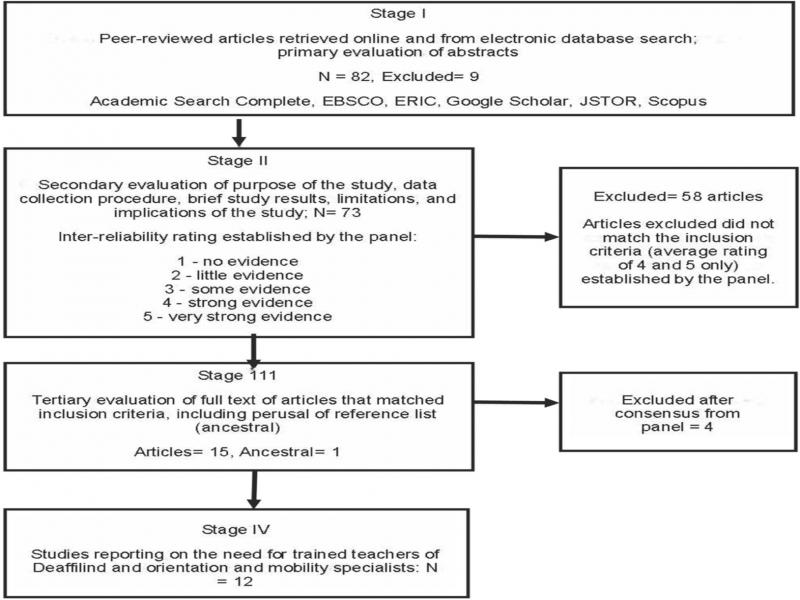
Figure 1.
Flow diagram illustrating each of the stages in the data review
Table 1.
Characteristics of Included Studies
| Article/Content (Author/s, Year, Title) | Participants | Setting/Location | Methods/Quality | Results/Outcomes |
|---|---|---|---|---|
| Bruce, S., Farrell, K. & Luckner, J. L. (2018). Assessment of students with sensory disabilities: Evidence-based practices. Assessment for Effective Intervention, 43, 79-89 | N/A | N/A | A systematic review |
|
| Hartmann, E. (2012). A scale to measure teachers' self-efficacy in deaf-blindness education. Journal of Visual Impairment & Blindness, 106, 728-738. | 87 in-service teachers comprising of: teachers of students with visual impairments, teachers of students who are deaf/hard-of-hearing, and teachers of students with moderate to severe disabilities. | N/A | Surveys and interviews | Teachers have limited training in the education of children who are DeafBlind and faced many challenges. |
| Hersh, M. A. (2014). Improving deafblind travelers’ experiences: An international survey. Journal of Travel Research, 55, 1-15. | Twenty-seven individuals who are DeafBlind, a woman with DeafBlind ness and autism, and a mother of a woman with DeafBlind ness and autism. | Six different countries in Europe | A qualitative approach |
|
| Howley, C, Howley, A., & Teifer, D. (2017). National provisions for certification and professional preparation in low-incidence sensory disabilities: A 50-state study. American Annals of the Deaf, 163, 277-294. | 50 U.S. states' preparation and licensure practices regarding students with: hearing impairment (HI), visual impairment (VI), and DeafBlindness (DB). | State education agencies for document reviews and interviews | Multimetho d study |
|
| Jackson, L, Corea, S., Luckner, J., Muir, S. & Ferrell, K. (2005). Perceived needs of students with low incidence disabilities in rural areas. Rural Special Education Quarterly, 24, 3-14. | Educators, service providers, administrators, and parents who are linked to the provision of special education and related services to students with low-incidence disabilities | The United States of America (U.S.A.) | Survey |
|
| Jackson, R.L., Ammerman, S.B., & Trautwein, B.A. (2015). Deafness and diversity: Early intervention. American Annals of the Deaf, 160, 356-367. | N/A | N/A | N/A |
|
| Landa-Vialard, O., Ely, M.S., & Lartz, M.N. (2018). Early learning visual impairment services training and advancement (EL VISTA) project: Leading the way for a new profession within a profession. Journal of Visual Impairment & Blindness, 112, 103-112. | 30 certified teachers of visually impaired students and O&M specialists. | Illinois State University | Case study |
|
| Nelson, C, & Bruce, S. M. (2016). Critical issues in the lives of children and youth who are deafblind. American Annals of the Deaf, 767,406-411. | N/A | N/A | Literature review |
|
| Nelson, C, Hyte, H.A., & Greenfield, R. (2016). Increasing self-regulation and classroom participation of a child who is deafblind. American Annals of the Deaf, 160, 496-509. | A five-year-old child who was blind, had severe hearing loss, developmental disabilities, sensory integrative disorder, and echolalic speech. | A self-contained classroom for children with visual impairmen ts and multiple disabilities. | Single-case multiple baseline study |
|
| Parker, A. T., & Nelson, C. (2016). Toward a comprehensive system of personnel development in deafblind education. American Annals of the Deaf, 161, 486-501. | Western Oregon University, Monmouth and University of Utah, Salt Lake | Literature review |
| |
| Parker, AT. (2009). Orientation and mobility with persons who are deaf-blind: An initial examination of single-subject design research. Journal of Visual Impairment & Blindness, 103, 372-377. | Twenty participants with DeafBlindness and cognitive abilities, ranging in age from 8 to 36 years (with an average age of 23 years) were included in the 13 studies. | Studies were conducted in an institutiona I matrix within a closed setting. | Single-Subject Design |
|
| Sauerburger, D., Siffermann, E., & Rosen, S. (2008). Principles for providing orientation and mobility to people with vision impairment and multiple disabilities. International Journal of Orientation and Mobility, 1, 52-56 | N/A | N/A | Best practice approach |
|
1 Adapted from = Testing Methodological Guidance on the Conduct of Narrative Synthesis in Systematic Reviews: Effectiveness of Interventions to Promote Smoke Alarm Ownership and Function,73x201D; by M. Rodgers, A. Sowden, M. Petticrew, L. Arai, H. Roberts, N. Britten, & J. Popay. Evaluation, January, pp. 47-71. Copyright 2009 by Sage Publications. Adapted with permission.
Table 2.
Sample of general themes with corresponding text evidences
| Recommended practices and competencies for professionals in DeafBlindness | [A-15] Practices should be based on the practices presented in the national special education organizations and should include: assessment, intervention, professional collaboration, multiple disabilities/DeafBlindness, early intervention and visual impairment | [25]Should be based on recommendations for quality personnel development for leading national organization in early childhood special education impairment of DeafBlindness. | [A-49] There is need to develop competencies among teachers and service providers who serve students with low incidence disabilities in the areas of knowledge and skills for behavioral changes as well as technological support for learning | [A-57] Orientation and mobility specialists need to provide assessment and instructional services using functional activities and environments. |
| Need for resources/services for students with low incidence disabilities | [A-49] The best educational practices (e.g., positive behavior interventions, the use of assistive technology, and using technology for learning in the home were not being provided to learners with low incidence disabilities. | [A-57] Skilled personnel need to advocate for support personnel services to enable individual in the society. | [A-54] The DeafBlind population has grown over the years but their needs of access to teachers and interveners with specific knowledge and training in DeafBlindness has remained unchanged overtime | [A-5] There is need for individuals with DeafBlindness to receive training in O&M skills such as communication and access to information, crossing indicators and street furniture, public transport and international standards. |