
Introduction
The Individuals with Disabilities Education Improvement Act (IDEIA) of 2004 defines “DeafBlindness” as “concomitant hearing and visual impairment, the combination of which causes such severe communication and other developmental and educational needs that the child cannot be accommodated in programs solely for children with deafness or blindness” (34 CFR §300.8(c)(2)). According to the IDEIA (2004), a child need not be both totally deaf and totally blind to be considered DeafBlind (Wiley, Parnell, & Belhorn, 2016).
According to the 2016 report of the National Child Count of Children and Youth Who Are DeafBlind, 10,749 children in the United States were identified as DeafBlind. In addition, approximately 90% of the population with DeafBlindness was identified as having one or more additional disabilities, the most common of which were cognitive impairments, orthopedic impairments, and complex health care needs (National Center of DeafBlindness, 2017).
Without enough personnel trained in serving children with DeafBlindness, this high-need population can be difficult to identify, evaluate, and serve. However, it is not fiscally prudent for many districts to hire professionals trained specifically in DeafBlindness and orientation and mobility (O&M). To solve this problem, the authors recommend that teachers of students with visual impairments (TVIs) be trained to acquire competencies to serve children with DeafBlindness and related O&M issues. Using an interdisciplinary team approach, TVIs could be cross-trained in O&M with a specialization in DeafBlindness to better meet the individualized needs of students with DeafBlindness (Ayala, 2017; Downing & Peckham-Hardin, 2007).
Many students who experience DeafBlindness leave school without having received a free and appropriate public education (FAPE), which is the cornerstone for meeting individualized learning and developmental outcomes required for completion and graduation from high school, and access to post-secondary education and vocational opportunities (Banks & Polack, 2014; Ferrell, Bruce, & Luckner, 2014). As a result, students with sensory impairments, especially those who are from low-income groups, suffer low employment rates unless they are provided vocational experiences (Banks & Polack, 2014; Ferrell, Bruce, & Luckner, 2014). In addition, DeafBlindness being a low-incidence disability and students with DeafBlindness often requiring specialized and expensive services, equipment, and assistive technology (AT), many states and districts find it financially difficult to serve students with DeafBlindness (Bhattacharyya & Spears, 2007; Montgomery, 2014; Sutton, Bausmith, O’Connor, Pae, & Payne, 2014). For this reason, federal support (e.g., funding personnel preparation programs to train professionals to teach children with DeafBlindness, social security income, Medicaid/Medicare) is essential for improving the quality of the services provided to students with DeafBlindness in geographically and financially challenged areas (Ayers, 2011).
There are country-wide shortages of personnel trained to serve students with DeafBlindness (Bruce, Luckner, & Ferrell, 2018; Landa-Vialard, Ely, & Lartz, 2018), and the programs that train personnel to serve students with DeafBlindness have limited capacity and scarce resources (National Center on Deaf-Blindness, 2019). In addition, these shortages will likely be exacerbated in the coming years by the retirement of large numbers of baby-boomer teachers (Ambrose-Zaken & Bozeman, 2010; Lenihan, 2010; Pogrund, 2017). Research indicates that the most significant factor in improving services and programs for students with DeafBlindness is the retention of qualified teachers (Jackson, 2005; Paige, Jones, & Pasternack, 2002; Rhim, Sutter, & Campbell, 2017). However, school districts in rural areas often face significant challenges in recruiting and retaining teachers, especially when large portions of their students come from underrepresented groups and low-income populations (Hammer, Hughes, McClure, Reeves, & Salgado, 2005).
To address the issues raised above, a narrative review of the literature was conducted to achieve the following goals:
Analyze data demonstrating the significant need for trained teachers and O&M specialists to serve students with DeafBlindness
Critically review and discuss common themes related to the significant need for professionals to serve students with DeafBlindness.
The following questions were used to guide this review:
Is there a need for trained teachers and O&M specialists to serve students with DeafBlind ness?
What common themes occur in the literature regarding the need for trained teachers and O&M specialists to serve students with Deaf-Blindness?
Methods
Mays, Pope and Popay (2005) claimed that, “a synthesis of findings is the heart of any systematic review” (p.6). Although there are different approaches for the synthesis of qualitative evidence (Barnett-Thomas & Paige, 2009; Cruice, Johansson, Isaksen, & Horton, 2018; Mays et al., 2005; Popay, Roberts, Sowden, Petticrew, Arai, Rodgers, Britten, Roen, & Duffy, 2006), a narrative review was conducted to evaluate the need for professionals to serve students with DeafBlindness. The narrative review conducted included the comprehensive summary and interpretation of evidence from published studies pertaining to the need for trained teachers and O&M specialists to serve students with DeafBlindness (Mays et al., 2005). Accordingly, the flexibility of a narrative review allowed the authors to review different types of evidence (qualitative and quantitative research studies) without generating new theories; however, even without generating new theories, the wide range of evidences from the narrative review can still inform public policy (Mays et al., 2005). In addition, the thematic analysis implemented in the narrative review produced a synthesis of findings within the included studies. As Mays et al. (2005) explained, thematic analysis brought the important issues or themes that arose from the body of the literature and were shaped by the review questions that guided this study. This review was conducted in the stages described below.
Stage I: Initial Literature Search
The literature was reviewed between May 2018 and March 2019, and papers were selected for inclusion using a broad range of criteria. To begin with, an electronic worksheet was used to identify all relevant texts in the literature. The worksheet was composed of 11 sections for encoding, and texts were evaluated using the following criteria: the names of the author/s, the average rating, a complete citation of the article in American Psychology Association (APA) format, the title of the article, the name of the journal in which the article was published, the purpose of the study, information on the participants and the location of the study, data collection procedures, and results. Once the sections were organized, a Boolean search was performed in Google Scholar using the following terms: “DeafBlindness,” “need for teachers of Deafblind students,” “Deaf-blind and O&M teachers,” “dual sensory impairment,” and “low-incidence disability.” These key phrases were chosen because they encompassed important elements surrounding DeafBlindness. Specific library links were also set during the search of Google Scholar to ensure that the search would include up to five libraries per the allowable library access links set by Google Scholar. The library links in Google Scholar included the Library of Congress, Open WorldCat, the Texas Tech University Library, Harvard University, and the Oxford Health NHS Foundation Trust.
Library subscription databases were also accessed online. These included Academic Search Complete, EBSCO, Information Services, ERIC, JSTOR, and Scopus by Elsevier Publishing. Because electronic searches often miss relevant articles, five journals were hand-searched for the specified publication years from 2000 to 2018. These were American Annals of the Deaf, International Journal of Orientation & Mobility, Journal of the American Academy of Special Education Professionals, Journal of Visual Impairment & Blindness, and the American Council for Rural Special Education Quarterly.
The initial search yielded 82 articles. Of these 82, nine were excluded because they were not peer-reviewed studies. Since O&M is an essential service in DeafBlindness, texts that specifically addressed both DeafBlindness and O&M (including journals that addressed these issues in different subsections) were immediately added to the appropriate section of the worksheet.
Stage II: Secondary Evaluation
The remaining, peer-reviewed articles were made accessible to all the authors. Between 12/1/2018 and 4/30/2019, each of the authors read all 73 articles and then met to discuss their ratings as a group. The ratings established by the panel were as follows: 1 — no evidence, 2 — little evidence, 3 — some evidence, 4 — strong evidence, and 5 — very strong evidence. The decision rules the authors followed were: the authors shared justification; the average of the rating scores provided a justification (e.g., evidence for their specific rating); individual ratings were changed based on the was calculated; the authors agreed that articles with average ratings of four or five would be included in the next round. Then, the remaining articles were encoded in a new tab in the primary electronic worksheet. Of the 73 articles reviewed, only 15 were included in the next round. Ratings of four and five revealed “there is strong evidence of the need for trained teachers and/or O&M specialists to serve students with DeafBlindness.”
Stage III: Final Review
In the final round, the authors reviewed the 15 articles that were included in the second round of review. First, the authors searched the reference lists of these articles for articles that could have been included in the initial search (Thomas, Ciliska, Dobbins, & Micucci, 2004; Vassar, Atakpo, & Kash, 2016). As a result of this search, nine articles were evaluated for inclusion. The first and second authors examined the contents of these articles, and only one was determined to meet the inclusion criteria. Then, each author reread the resulting 16 articles and rated them a second time. This process took two weeks, and 12 of the 16 articles were determined to meet the inclusion criteria for the final literature review.
These 12 articles were listed in a table and each analyzed under the following variables: content, participants, setting, outcomes, and methods (see Table 1). Figure 1 is a flowchart summarizing each stage of the data review and how it contributed to the synthesis process.
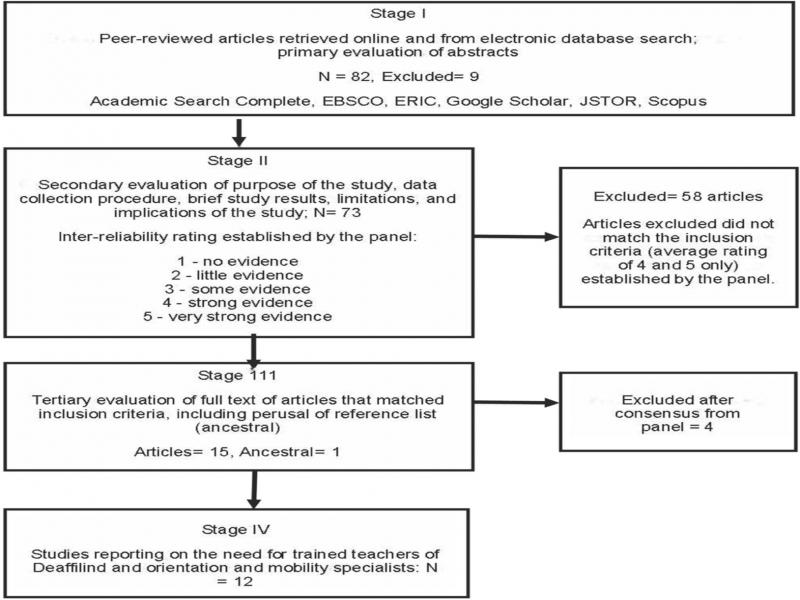
Figure 1.
Flow diagram illustrating each of the stages in the data review
Table 1.
Characteristics of Included Studies
| Article/Content (Author/s, Year, Title) | Participants | Setting/Location | Methods/Quality | Results/Outcomes |
|---|---|---|---|---|
| Bruce, S., Farrell, K. & Luckner, J. L. (2018). Assessment of students with sensory disabilities: Evidence-based practices. Assessment for Effective Intervention, 43, 79-89 | N/A | N/A | A systematic review |
|
| Hartmann, E. (2012). A scale to measure teachers' self-efficacy in deaf-blindness education. Journal of Visual Impairment & Blindness, 106, 728-738. | 87 in-service teachers comprising of: teachers of students with visual impairments, teachers of students who are deaf/hard-of-hearing, and teachers of students with moderate to severe disabilities. | N/A | Surveys and interviews | Teachers have limited training in the education of children who are DeafBlind and faced many challenges. |
| Hersh, M. A. (2014). Improving deafblind travelers’ experiences: An international survey. Journal of Travel Research, 55, 1-15. | Twenty-seven individuals who are DeafBlind, a woman with DeafBlind ness and autism, and a mother of a woman with DeafBlind ness and autism. | Six different countries in Europe | A qualitative approach |
|
| Howley, C, Howley, A., & Teifer, D. (2017). National provisions for certification and professional preparation in low-incidence sensory disabilities: A 50-state study. American Annals of the Deaf, 163, 277-294. | 50 U.S. states' preparation and licensure practices regarding students with: hearing impairment (HI), visual impairment (VI), and DeafBlindness (DB). | State education agencies for document reviews and interviews | Multimetho d study |
|
| Jackson, L, Corea, S., Luckner, J., Muir, S. & Ferrell, K. (2005). Perceived needs of students with low incidence disabilities in rural areas. Rural Special Education Quarterly, 24, 3-14. | Educators, service providers, administrators, and parents who are linked to the provision of special education and related services to students with low-incidence disabilities | The United States of America (U.S.A.) | Survey |
|
| Jackson, R.L., Ammerman, S.B., & Trautwein, B.A. (2015). Deafness and diversity: Early intervention. American Annals of the Deaf, 160, 356-367. | N/A | N/A | N/A |
|
| Landa-Vialard, O., Ely, M.S., & Lartz, M.N. (2018). Early learning visual impairment services training and advancement (EL VISTA) project: Leading the way for a new profession within a profession. Journal of Visual Impairment & Blindness, 112, 103-112. | 30 certified teachers of visually impaired students and O&M specialists. | Illinois State University | Case study |
|
| Nelson, C, & Bruce, S. M. (2016). Critical issues in the lives of children and youth who are deafblind. American Annals of the Deaf, 767,406-411. | N/A | N/A | Literature review |
|
| Nelson, C, Hyte, H.A., & Greenfield, R. (2016). Increasing self-regulation and classroom participation of a child who is deafblind. American Annals of the Deaf, 160, 496-509. | A five-year-old child who was blind, had severe hearing loss, developmental disabilities, sensory integrative disorder, and echolalic speech. | A self-contained classroom for children with visual impairmen ts and multiple disabilities. | Single-case multiple baseline study |
|
| Parker, A. T., & Nelson, C. (2016). Toward a comprehensive system of personnel development in deafblind education. American Annals of the Deaf, 161, 486-501. | Western Oregon University, Monmouth and University of Utah, Salt Lake | Literature review |
| |
| Parker, AT. (2009). Orientation and mobility with persons who are deaf-blind: An initial examination of single-subject design research. Journal of Visual Impairment & Blindness, 103, 372-377. | Twenty participants with DeafBlindness and cognitive abilities, ranging in age from 8 to 36 years (with an average age of 23 years) were included in the 13 studies. | Studies were conducted in an institutiona I matrix within a closed setting. | Single-Subject Design |
|
| Sauerburger, D., Siffermann, E., & Rosen, S. (2008). Principles for providing orientation and mobility to people with vision impairment and multiple disabilities. International Journal of Orientation and Mobility, 1, 52-56 | N/A | N/A | Best practice approach |
|
| Recommended practices and competencies for professionals in DeafBlindness | [A-15] Practices should be based on the practices presented in the national special education organizations and should include: assessment, intervention, professional collaboration, multiple disabilities/DeafBlindness, early intervention and visual impairment | [25]Should be based on recommendations for quality personnel development for leading national organization in early childhood special education impairment of DeafBlindness. | [A-49] There is need to develop competencies among teachers and service providers who serve students with low incidence disabilities in the areas of knowledge and skills for behavioral changes as well as technological support for learning | [A-57] Orientation and mobility specialists need to provide assessment and instructional services using functional activities and environments. |
| Need for resources/services for students with low incidence disabilities | [A-49] The best educational practices (e.g., positive behavior interventions, the use of assistive technology, and using technology for learning in the home were not being provided to learners with low incidence disabilities. | [A-57] Skilled personnel need to advocate for support personnel services to enable individual in the society. | [A-54] The DeafBlind population has grown over the years but their needs of access to teachers and interveners with specific knowledge and training in DeafBlindness has remained unchanged overtime | [A-5] There is need for individuals with DeafBlindness to receive training in O&M skills such as communication and access to information, crossing indicators and street furniture, public transport and international standards. |