Introduction
Attention deficit hyperactivity disorder (ADHD) is a frequent neurodevelopmental disorder typical with the primary symptoms as inattention, hyperactivity, and impulsivity in children (1). The worldwide prevalence in children is 7.2 % (6.7-7.8 %)(2), and ADHD studies report 2 to 10 times more frequency in boys than in girls (3).
Stimulants are the most widely used pharmacological agents in ADHD treatment (1), and methylphenidate (MPH) is the first choice among them according to the leading algorithms and the metaanalysis studies (4, 5). MPH acts as indirect dopamine (DA) agonist by disinhibiting D2 autoreceptors on the presynaptic dopaminergic neuron, and activating D1 receptors on the postsynaptic neuron (6). It principally increases the extracellular synaptic dopamine and norepinephrine by inhibiting their reuptakes via specific transporters in striatal and cortical areas (7), and mediates the redistribution of the vesicular monoamine transporter-2 (7). MPH improves attention deficit and executive function, lowers uncontrolled hyperactivity and impulsivity, and suppresses disruptive behaviors (1). As a result, family and peer relations, learning skills, and school success become much better in children with ADHD.
Adverse effects of MPH on expected growth in children have long been claimed and studied (8, 9). MPH may usually suppress height and weight gain in the first year (9-11), and this suppression disappears (12) or attenuates slowly, over time (9, 10). Weight is affected earlier (11, 13, 14), but height later and at higher doses (9, 15), and more in those who started the drug at prepuberty (16, 17). Not every study, to date, yielded similar and consistent results. A recent study from Thailand reported weight suppression only in the first year and no significant deviation for height throughout 1 to 5 years in the retrospective records of children and adolescents aged 5 to 18 (18). As against, only height gain decreased in the first months with no weight loss in the studies of Zhang et al. (19), Moungnoi and Maipang (20), Lisska and Rivkees (21). Harstad et al. (22) revealed that children who used stimulants in the past caught their peers at adulthood in height but the studies of Greenhill et al. (23) and Swanson et al (24) indicated the long-term MPH users to be shorter than their peers in adulthood. Furthermore, several studies reported no significant loss in height or weight despite long-term MPH treatment (25–28).
Growth deviations may lead to metabolic changes in bone structure and alterations in related blood biochemistry parameters as indicatives of these disturbances, but studies on this subject are very scarce.
Poulton et al. (29) studied the tissue growths in the body and the changes in blood variables in children aged 4 to 9 years with significant weight and height loss after MPH or dexamphetamine over three years. Leptin and P1NP reduced, and albumin increased at 3 months, but osteocalcin, C telopeptides, Insulin-like growth factor-1 (IGF-1), Insulin-like growth factor-binding protein 3 (IGFBP-3) increased in the 3rd year. Fat mass decreased and lean tissue, total bone mineral content, body mass density (in the arms) elevated at 3 months, but the growths of all the tissues increased in the 3rd year. In another study, Poulton et al. (30) revealed no delay in bone maturation during three years despite weight and height loss in MPH or dexamphetamine-treated children compared with their healthy siblings. Additionally, several blood parameters as fasting insulin, glucose, prealbumin, albumin, transferrin, IGF-1, IGFBP-3, and ghrelin had no predictive value on growth suppression. Feuer et al. (31) compared stimulant-treated children and adolescents with nonuser controls and found that height, weight, body mass index (BMI), weight z-score, BMI z-score were lower in boys; height, weight, and BMI were lower in girls, and bone mineral content and bone mineral density (BMD) were lower in both genders. 25OH-VitD levels were also higher in a small group of stimulant users (31). Lahat et al. (28) found no significant difference in expected height and weight, BMD, blood bone-specific alkaline phosphatase (B-ALP), and urinary deoxypyridinoline levels between the healthy group and the MPH-treated children in 12 to 24 months. Kim et al. (32) reported no difference in height and weight between the drug-naive ADHD group, the MPH-treated ADHD group, and the healthy group in children aged 7-11 with both genders over six months to 3 years. Only TSH was lower in the MPH-treated group among blood variables.
Why the results of previous studies are controversial, have various causes: Firstly, the pathophysiological mechanisms underlying the impact of MPH on growth are not evident yet even though several hypotheses as apathy loss, growth hormone reduction via dopaminergic activity, damage to cartilage tissue were suggested (33). Also, predictors or metabolic alterations that could contribute to or accompany the outcomes have not been proven consistently or investigated.
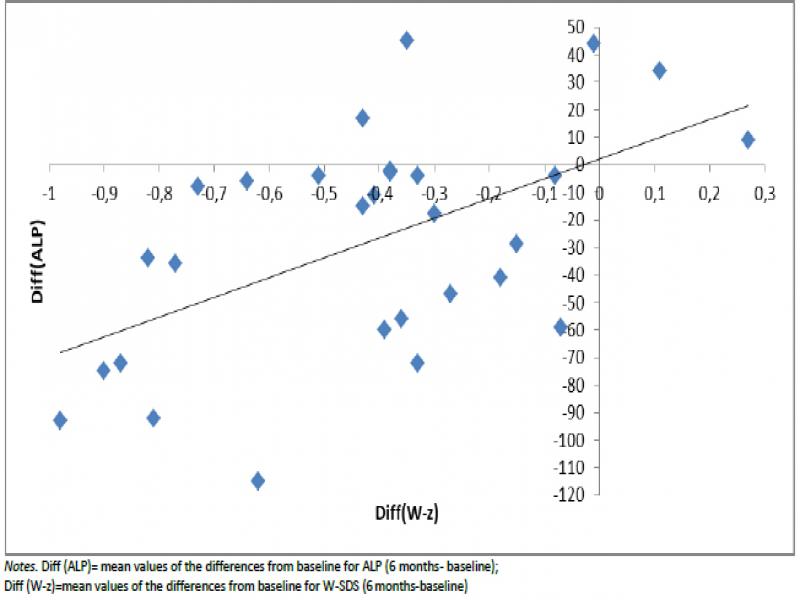
Our first aim was to measure the heights and weights at baseline and 6 month in prepubertal boys treated with MPH. Secondly, we intended to measure the blood biochemistry parameters, simultaneously. Baseline and 6 month values of all variables were compared to see the probable changes from baseline. Whether there is an association between the changes in blood parameters and the changes in growth values was also investigated. Our hypothesis was that: If MPH treatment causes any growth deviation, absolute changes from baseline values in the relevant blood parameters should be measurable. Also, it will be much more meaningful to obtain significant findings in the short term and at relatively low therapeutic doses. There is no doubt that pubertal maturation drives both genders into different phenotypical features in growth, and the outcomes with stimulants also differ in preschool, prepubertal and postpubertal ages. Moreover, it is not always possible to deal with all the factors related to growth in wide age ranges and long-term treatments. Therefore, our study sample included the boys at only prepubertal ages, and the follow-up was limited to six months.
Methods
Study design
This study was conducted in Child and Adolescent Psychiatry Clinic of Antalya Training and Research Hospital in Health Sciences University, Turkey for six months in 2015. The study proposal was approved by Internal Review Board of Clinical Studies according to the Declaration of Helsinki of the World Medical Association (March 12, 2015-56/7).
Inclusion criteria were male gender, 6 to 9 years of age, ADHD diagnosis based on DSM-5 criteria, and MPH treatment. Exclusion criteria were psychotropic drug history, other mental disorders (autism, bipolarity, intellectual disability, and depression), parental psychiatric disorders, the onset of puberty, physical diseases, and drug treatments likely to impact growth, symptoms and blood abnormalities referring to any disease.
A child psychiatrist completed the baseline and follow-up examinations, using the Diagnostic and Statistical Manual of Mental Disorders-Fifth Edition (DSM-5)(34). DSM-5 defines ADHD in five steps: Step A includes two symptom clusters: inattention and hyperactivity/impulsivity, each with nine items. Step B asks for whether some symptoms present before age 12, step C about the symptom presence in more than one setting, step D about the functional impairment, step E about the presence of another psychiatric disorder that could explain the symptoms. ADHD has three different subtypes: predominantly inattentive, predominantly hyperactive/impulsive, and combined, depending on the presence of at least six items from one of each symptom cluster or the combination of both. DSM-5 also describes the disorder severity as mild, moderate, and severe based on the symptom excess or functional impairment. At our follow-up, disappearance of the symptoms or decrease to the subclinical threshold in DSM-5 items and improvement in functionality were considered as symptomatic remission. Comorbid psychiatric conditions were also diagnosed by DSM-5. A child endocrinologist examined all the boys at baseline and 6 months for growth measurements, pubertal maturation, and other pathological conditions. Minimal hairy pigmentation at the base of the penis and increase in either long axis (2.5 to 3.2 cm) or volume (more than 4 ml) in the testicles were accepted as the onset of puberty, according to Stage 2 of Tanner’s scaling.
Study sample
Parents of boys who were newly diagnosed with ADHD and had been an indication to use OROS-MPH were invited for their boys to enroll in the study by giving informed consent if eligible to the study inclusion criteria. Of 98 boys invited during six months, parents of 21 boys refused to join (see Table 1). Eight boys were not taken into the study after the first clinical exam based on the exclusion criteria. Sixty-nine were recruited to the study sample. Eight boys discontinued the drug in a few days or weeks due to some adverse effects and 30 quitted the treatment due to various causes in subsequent months. Finally, 31 boys completed six months of MPH treatment (see Table 1). The age range of our sample was 74 to 104 months (mean=87.6, SD=9.2). The combined subtype was the most common diagnosis (N=18), seven boys had the inattentive subtype, and six had the hyperactive/impulsive subtype. Clinical severity was mild in fifteen boys, moderate in twelve, and severe in four. Six boys had comorbidities as one specific learning disorder, one oppositional defiant disorder, two anxiety disorders (specific phobia, separation anxiety), one somnambulism, and one phonological disorder.
Twenty-four boys completed 6 months with 18 mg/day OROS-MPH (77.4 %) (Concerta, Janssen-Cilag Manufacturing LLC, Gurabo, Puerto Rico). Those who could not use it due to inability to swallow or other excuses were not excluded from the study with the informed consents, switched to an equivalent dose of IR-MPH (5 mg three times a day) (N=7, 22.5 %) (Ritalin, Novartis Pharmaceuticals Corporation, USA), in a few days (35). Average daily dose was 0.66 mg/kg (SD=0.12, min-max=0.37-0.90). A fixed drug dose was preferred during six months because of two reasons: Consuming the first days or weeks to individualize MPH doses could lead to a waste of time in our short-term treatment. Individualization of drug dose for each child could cause the study sample to split into smaller groups and bias in interpreting the analysis results.
TABLE 1.
Study participants
| Subjects | N | |||||||||||
|---|---|---|---|---|---|---|---|---|---|---|---|---|
| Prepubertal boys with ADHD | 98 | |||||||||||
| Parents who rejected | 21 | |||||||||||
| Excluded at baseline exam | 8 | |||||||||||
| Intellectual disability (N=2) | ||||||||||||
| Pubertal signs (N=2) | ||||||||||||
| Very high levels of TSH (N=1) and transaminases (N=1) | ||||||||||||
| Severe anemia (N=1) | ||||||||||||
| Very low growth percentile (N=1) | ||||||||||||
| Recruited subjects | 69 | |||||||||||
| Drop-outs due to adverse effects | 8 | |||||||||||
| Appetite loss and insomnia (N=2) | ||||||||||||
| Nausea and appetite loss (N=1) | ||||||||||||
| Stomachache and irritability (N=1) | ||||||||||||
| Syncope (N=1) | ||||||||||||
| Headache (N=1) | ||||||||||||
| Insomnia, irritability, and appetite loss (N=1) | ||||||||||||
| Headache, stomachache, and insomnia (N=1) | ||||||||||||
| Drop-outs due to other causes | 30 | |||||||||||
| Weak compliance (N=6) | ||||||||||||
| Parental disagreement (N=6) | ||||||||||||
| Summer holiday (N=6) | ||||||||||||
| Surgical operation (N=2) | ||||||||||||
| City change (N=3) | ||||||||||||
| Pubertal signs (N=2) | ||||||||||||
| Unknown (N=5) | ||||||||||||
| Sample size | 31 | |||||||||||
| Variable | Baseline M (SD) | 6 months M (SD) | T value | df | Significance (p)* | Effect size (r) | ||||||
|---|---|---|---|---|---|---|---|---|---|---|---|---|
| Height z-score | 0.23 (0.87) | 0.28 (0.85) | ‒1.50 | 30 | 0.142 | |||||||
| Hemoglobin | 12.57 (0.87) | 12.47 (0.86) | 0.89 | 29 | 0.380 | |||||||
| Hematocrit | 38.22 (2.52) | 37.850 (2.26) | 0.91 | 29 | 0.368 | |||||||
| Platelet | 331.53 (91.91) | 311.50 (59.96) | 1.37 | 29 | 0.179 | |||||||
| Glucose | 82.54 (6.21) | 88.09 (6.66) | ‒4.33 | 30 | 0.000* | 0.6 | ||||||
| Creatinine | 0.56 (0.08) | 0.60 (0.06) | ‒3.27 | 30 | 0.003* | 0.5 | ||||||
| Calcium | 9.46 (0.51) | 9.51 (0.45) | ‒0.46 | 29 | 0.648 | |||||||
| Phosphate | 4.71 (0.45) | 4.66 (0.42) | 0.56 | 28 | 0.578 | |||||||
| AST | 29.26 (6.23) | 29.60 (3.98) | ‒0.33 | 29 | 0.738 | |||||||
| ALP | 243.06 (47.07) | 215.24 (44.33) | 3.63 | 28 | 0.001* | 0.5 | ||||||
| Vitamin B12 | 306.72 (121.66) | 288.41 (115.31) | 1.10 | 28 | 0.278 | |||||||
| TSH | 2.64 (0.98) | 2.38 (1.03) | 1.68 | 28 | 0.104 | |||||||
| fT3 | 3.96 (0.65) | 3.73 (0.46) | 1.93 | 28 | 0.063 | |||||||
| fT4 | 0.87 (0.10) | 0.86 (0.09) | 0.60 | 28 | 0.553 | |||||||
| B-ALP | 84.44 (25.58) | 82.98 (23.25) | 0.32 | 28 | 0.750 | |||||||
| Variables | Measurements M, (SD) | Negative ranks | Positive ranks | Statistics | ||||||||
|---|---|---|---|---|---|---|---|---|---|---|---|---|
| Baseline | 6 months | N | mean rank | sum of ranks | N | mean rank | sum of ranks | Ties | Z | Significance (p)* | Effect size (r) | |
| Weight z- | 0.63 (1.12) | 0.24 (1.04) | 29 | 16.83 | 488 | 2 | 4 | 9 | 0 | ‒4.704 | 0.000* | 0.5 |
| score | ||||||||||||
| P1NP | 471.15 (264.24) | 648.30 (507.60) | 14 | 13.14 | 184 | 17 | 18.35 | 312 | 0 | ‒1.254 | 0.210 | |
| NTx | 248.48 (228.69) | 250.29 (256.86) | 21 | 14.33 | 301 | 10 | 19.50 | 195 | 0 | ‒1.039 | 0.299 | |
| WBC | 8.31 (2.68) | 7.65 (1.70) | 21 | 15.29 | 321 | 9 | 16 | 144 | 0 | ‒1.822 | 0.069 | |
| RBC | 4.84 (0.52) | 4.78 (0.51) | 12 | 16.29 | 195.5 | 13 | 9.96 | 129.50 | 5 | ‒0.896 | 0.370 | |
| BUN | 11.20 (2.80) | 12.06 (2.51) | 11 | 11.18 | 123 | 15 | 15.20 | 228 | 4 | ‒1.339 | 0.181 | |
| Magnesium | 2.07 (0.16) | 2.01 (0.18) | 11 | 12.36 | 136 | 8 | 6.75 | 54 | 11 | ‒1.676 | 0.094 | |
| ALT | 16.66 (13.38) | 16.46 (8.55) | 12 | 15.83 | 190 | 15 | 12.53 | 188 | 3 | ‒0.024 | 0.981 | |
| Ferritin | 23.34 (11.57 | 19.72 (8.56) | 19 | 13.18 | 250.50 | 8 | 15.94 | 127.50 | 2 | ‒1.479 | 0.139 | |
| Transferrin | 266.06 (51.58) | 270.31 (30.90) | 17 | 13.47 | 229 | 11 | 16.09 | 177 | 1 | ‒0.592 | 0.554 | |
| Iron | 79.10 (31.90) | 75.37 (34.01) | 16 | 15.38 | 246 | 12 | 13.33 | 160 | 1 | ‒0.979 | 0.327 | |
| PTH | 38.09 (14.52) | 35.41 (24.25) | 21 | 15.88 | 333.50 | 8 | 12.69 | 101.50 | 0 | ‒2.509 | 0.012 | |
| OSC | 67.25 (18.75) | 60.18 (19.07) | 19 | 16.39 | 311.50 | 10 | 12.35 | 123.50 | 0 | ‒2.033 | 0.042 | |
| 25OH-vit D | 18.42 (7.15) | 27.22 (7.18) | 4 | 8.25 | 33 | 25 | 16.08 | 402 | 0 | ‒3.989 | 0.000* | 0.5 |