
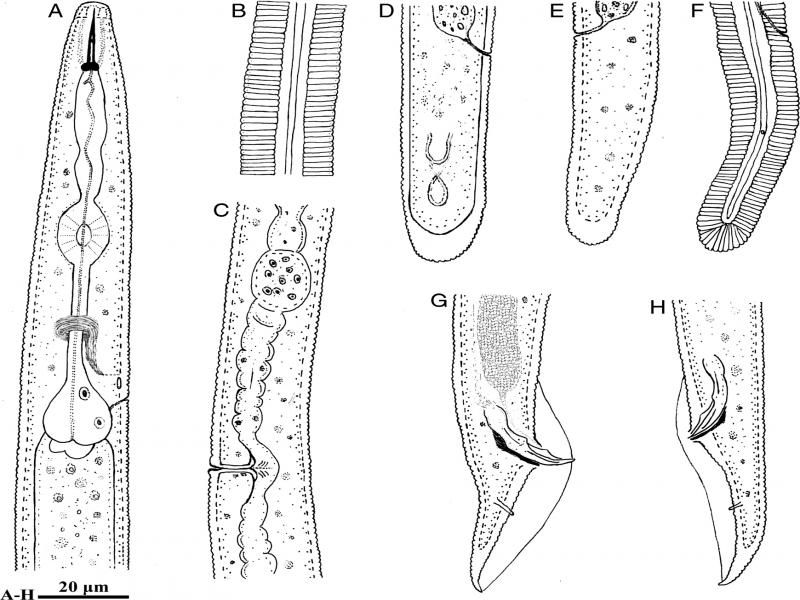
Figure 1:
Line drawings of Bitylenchus hispaniensis from Iran. A-F: Female. A: Anterior body region; B: Lateral field at mid-body; C: Part of reproductive system; D-F: Posterior body region; G, H: Posterior body region of male.
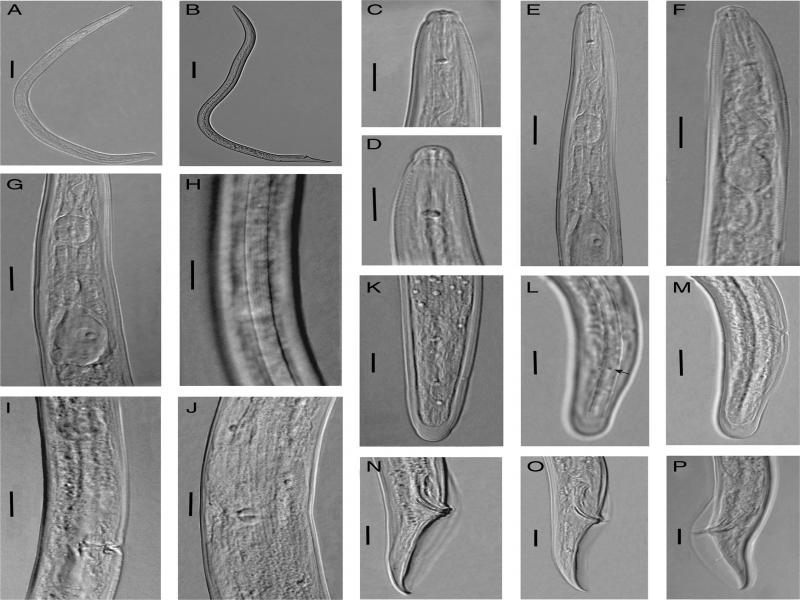
Figure 2:
Light photomicrographs of Bitylenchus hispaniensis from Iran. A, C-M: Female. A: Entire body; C, D: Anterior body region; E-G: Pharyngeal region; H: Lateral field at mid-body; I, J: Vulval region; K-M: Posterior body region (the arrow indicates the phasmid); B, N-P: Male. B: Entire body; N-P: Posterior body region. (Scale bars: A, B = 50 μm; C-P = 10 μm).
Table 1.
Morphometrics of Bitylenchus hispaniensis from Khuzestan province, Iran and compare with the original description and Greek population.
| Khuzestan province, Iran | Handoo et al. (2014) Córdoba, Córdoba, Spain | Tzortzakakis et al. (2018) Crete, Greece | |||
|---|---|---|---|---|---|
| Character | Females | Males | Females | Males | Females |
| n | 14 | 9 | 7 | 10 | 3 |
| L | 622.1 ± 41.0 (570–704) | 661.7 ± 58.0 (591–763) | 662 ± 38.4 (612–732) | 640 ± 60.9 (548–760) | 722 ± 47 (670–760) |
| a | 25.6 ± 3.5 (21.8–2.8) | 29.5 ± 0.1 (27.6–32.8) | 30.4 ± 1.7 (27.8–32.5) | 31.0 ± 3.9 (27.0–39.1) | 32.3 ± 0.6 (31.9–33.0) |
| b | 5.5 ± 0.4 (5.0–6.3) | 5.9 ± 0.4 (5.3–6.5) | 6.0 ± 0.4 (5.6–6.8) | 6.1 ± 0.7 (5.4–7.8) | 6.3 ± 0.4 (6.1–6.8) |
| c | 13.3 ± 0.7 (12.8–15.7) | 14.6 ± 0.7 (13.5–15.7) | 14.2 ± 1.7 (11.8–16.8) | 17.7 ± 1.4 (15.2–20.7) | 14.9 ± 0.6 (14.4–15.5) |
| c′ | 2.8 ± 0.4 (2.5–3.2) | 2.9 ± 0.2 (2.6–3.2) | 2.9 ± 0.3 (2.4–3.3) | 2.7 ± 0.2 (2.5–3.0) | 3.0 ± 0.2 (2.7–3.2) |
| V | 54.3 ± 1.5 (52.7–57.5) | - | 54.6 ± 1.5 (52.5–57.0) | - | 55.0 ± 1.0 (54–56) |
| Lip region height | 3.7 ± 0.9 (3.2–4.1) | 3.4 ± 0.3 (3.2–4.1) | 3.6 ± 0.3 (3–4) | - | - |
| Lip region width | 6.7 ± 0.2 (6.5–7.0) | 6.4 ± 0.1 (6.0–6.5) | 7.2 ± 0.3 (6.5–7.5) | - | - |
| Stylet length | 17.5 ± 0.3 (17–18) | 17.1 ± 0.4 (16.2–17.5) | 16.1 ± 0.5 (15.5–17.0) | 15.9 ± 0.8 (15.0–18.0) | 17.3 ± 0.3 (17.0–17.5) |
| m | 58.0 ± 2.7 (55.7–63.1) | 54.2 ± 2.7 (48.2–57.3) | - | - | - |
| DGO | 2.9 ± 0.2 (2.6–3.0) | 2.8 ± 0.2 (2.5–3.0) | 2.5 | - | - |
| MB | 49.2 ± 2.1 (46.8–52.6) | 51.2 ± 4.0 (45.2–57.3) | - | - | - |
| Maximum body width | 24.7 ± 7.4 (20.8–29.2) | 20.8 ± 1.3 (18.8–23.4) | 21.8 ± 1.0 (20.5–23.5) | 20.7 ± 1.3 (18.0–23.0) | 22.3 ± 1.2 (21–23) |
| Pharynx length | 115.3 ± 6.7 (105–120) | 116.0 ± 6.8 (106–124) | 110.0 ± 6.5 (100–120) | 105.4 ± 8.2 (90–120) | 114.0 ± 5.3 (110–120) |
| Anterior end to median bulb | 56.7 ± 3.8 (50.0–61.7) | 56.9 ± 2.8 (52–58) | - | - | - |
| Anterior end to nerve ring | 77.8 ± 2.9 (73.0–84.5) | 80.0 ± 4.2 (75.0–87.7) | 83.1 ± 5.6 (73–95) | - | - |
| Anterior end to excretory pore | 93.3 ± 6.1 (85.5–104.0) | 87.6 ± 9.0 (87–104) | 89.7 ± 3.9 (85–95) | - | - |
| Body width at vulva | 24.5 ± 2.7 (21.5–27.9) | - | - | - | |
| Anal body width | 16.5 ± 1.5 (15.0–19.5) | 15.4 ± 1.5 (13.6–17.5) | 16.1 ± 1.4 (13.5–17.5) | 12.8 ± 0.8 (12–15) | 16.5 ± 2.2 (14–18) |
| Tail length | 47.4 ± 6.5 (37.0–55.2) | 43.9 ± 3.5 (39.5–48.0) | 47.4 ± 6.3 (37.5–57.0) | 36.6 ± 5.6 (30–50) | 48.3 ± 3.1 (45–51) |
| Tail annuli | 51.8 ± 5.3 (40–58) | - | 55.1 ± 8.1 (40–66) | - | - |
| Spicule length | - | 25.5 ± 0.8 (24.0–26.5) | - | 25.3 ± 1.8 (23–30) | - |
| Gubernaculum length | - | 12.5 ± 0.4 (12.0–13.3) | - | 11.4 ± 1.6 (10–15) | - |
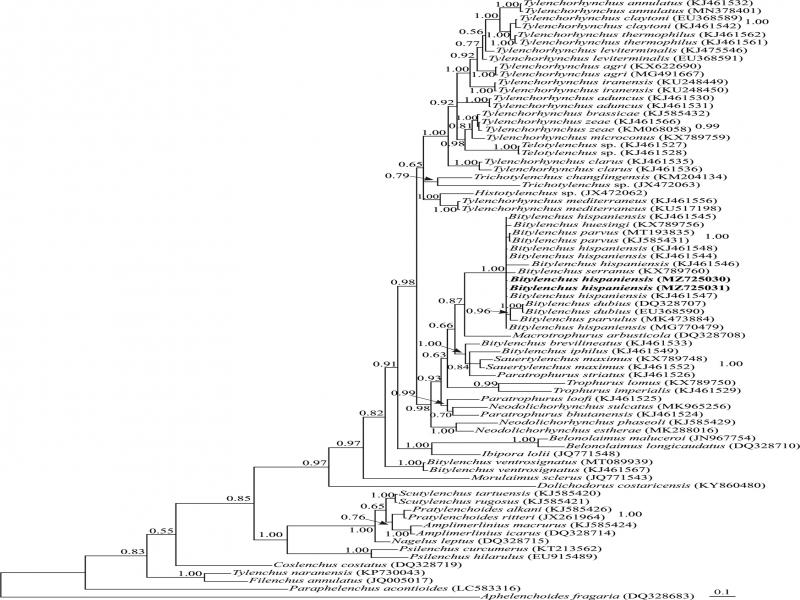
Figure 3:
Bayesian 50% majority rule consensus tree inferred from analysis of the D2-D3 domains of the LSU rDNA sequences of Iranian population of Bitylenchus hispaniensis under the GTR + G + I model. Bayesian posterior probability values of more than 0.50 are given for appropriate clades. New sequences are indicated in bold.
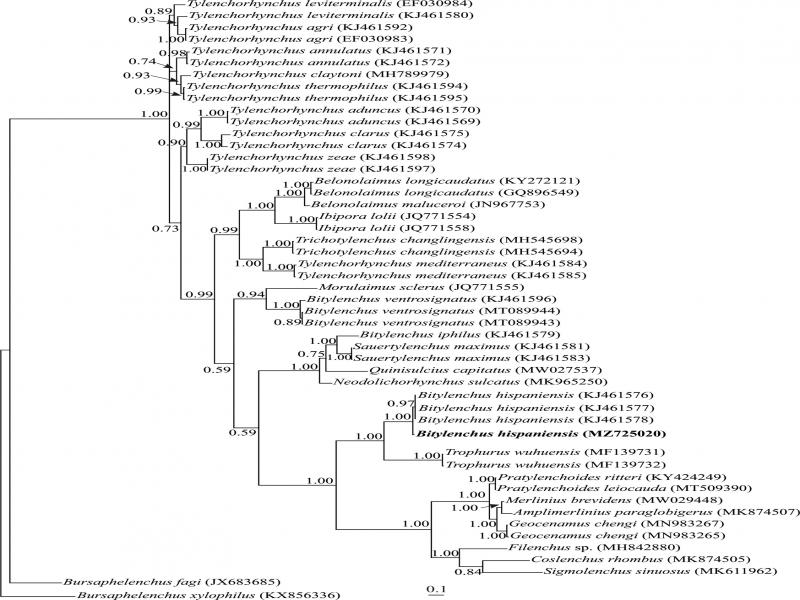
Figure 4:
Bayesian 50% majority rule consensus tree inferred from analysis of the ITS rRNA gene of Iranian population of Bitylenchus hispaniensis under the GTR + G + I model. Bayesian posterior probability values of more than 0.50 are given for appropriate clades. New sequence is indicated in bold.