Have a personal or library account? Click to login
Ecological Characterisation of Native Isolates of Heterorhabditis indica from Viti Levu, Fiji Islands Cover

Ecological Characterisation of Native Isolates of Heterorhabditis indica from Viti Levu, Fiji Islands

Open Access
|Oct 2021

Figures & Tables

Figure 1:

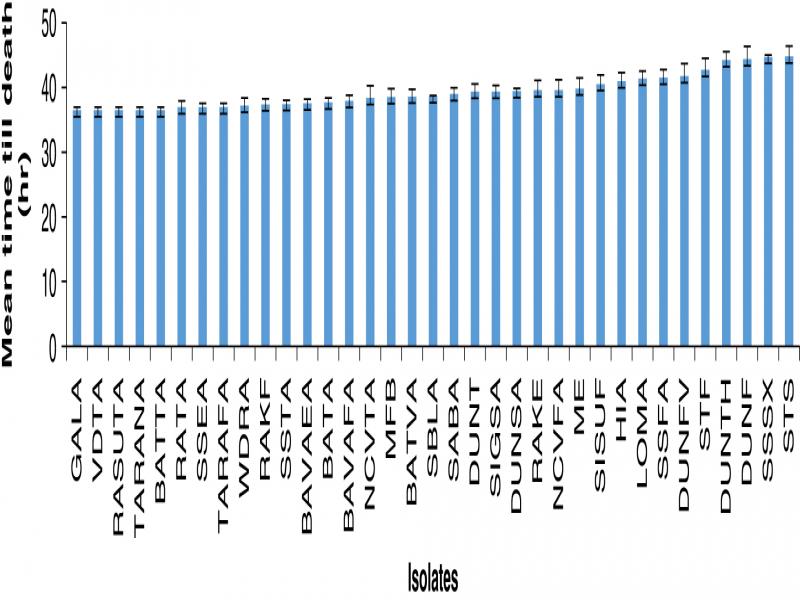
Time till death in hours (mean ± SE) of host Galleria caused by H. indica isolates from Viti Levu.
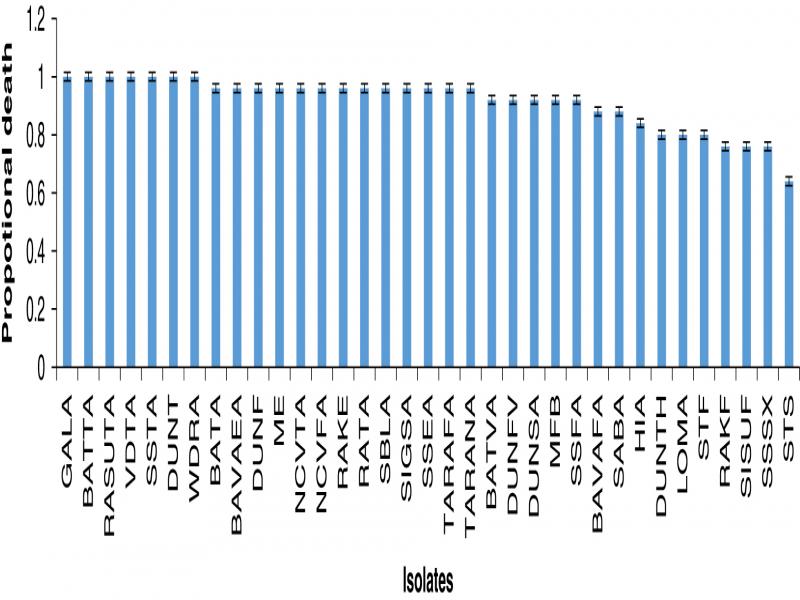

Figure 2:

Proportional death (mean ± SE) of host Galleria caused by H. indica isolates from Viti Levu.
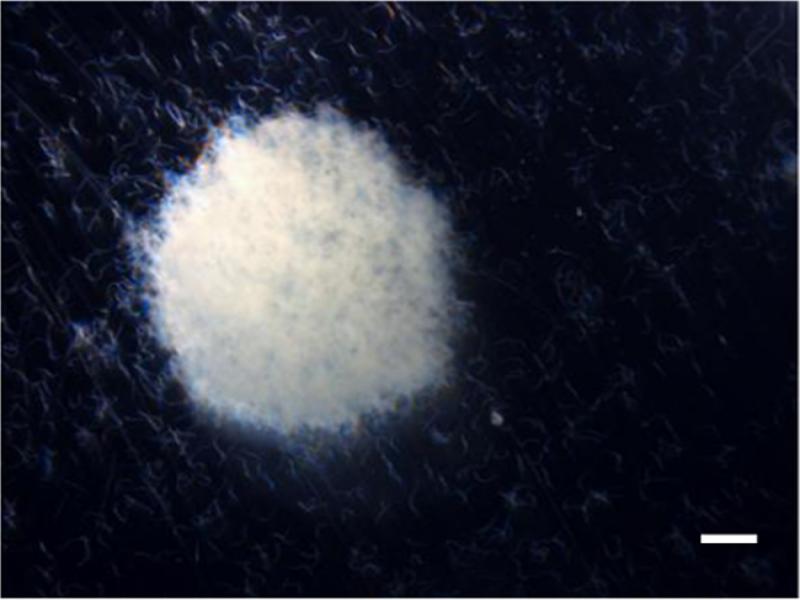

Figure 3:

Dense aggregate of H. indica IJ in aqueous suspension. Bar = 1 mm.
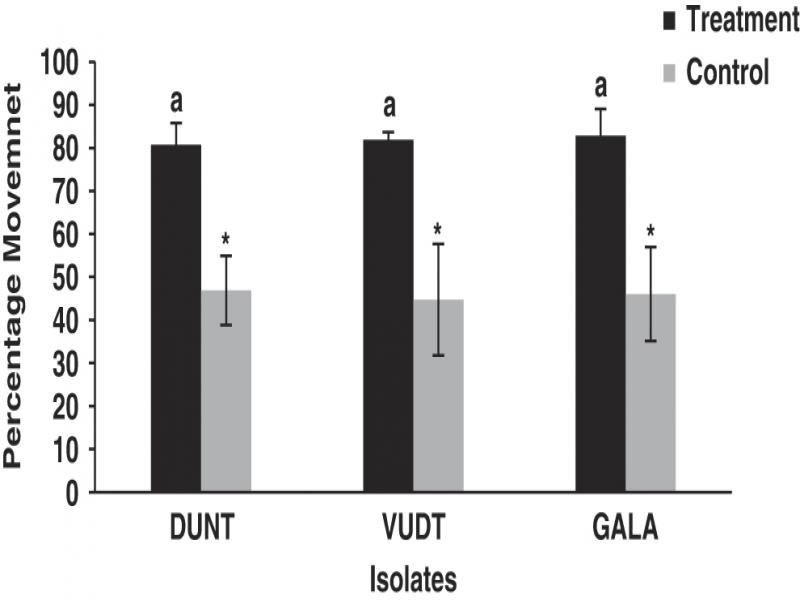

Figure 4:

Mean percentage of IJ of isolate DUNT, VDTA and GALA that moved on agar-filled petri dishes toward G. mellonella host cues (treatment), or toward side of a dish that did not contain any host cues (control). The same lowercase letter above bars indicate no statistical differences among nematode isolates (P > 0.05); asterisks indicate significant differences between Treatment and Control dishes within each isolate (P < 0.05).
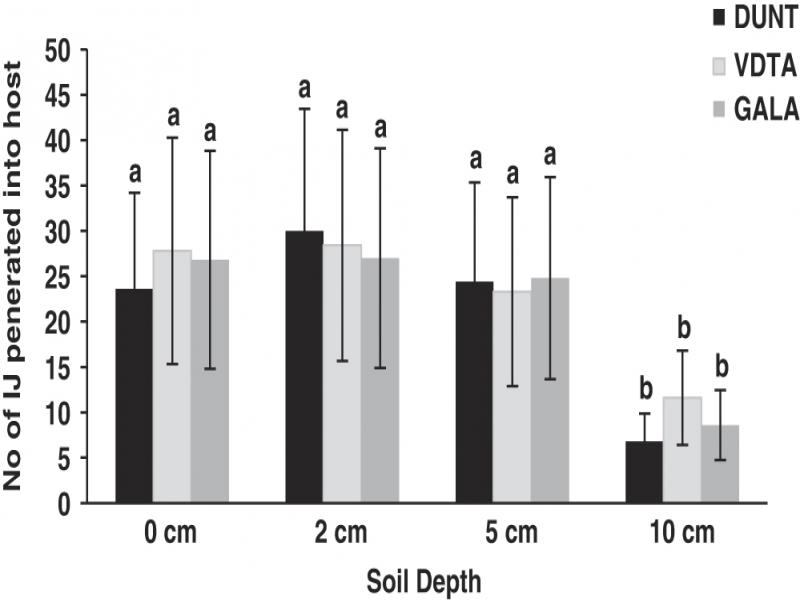

Figure 5:

Effect on depth of host in soil (mean ± SE) on penetration of IJ of isolate DUNT, VDTA and GALA in Galleria larvae. Individual larvae were placed at 0, 2, 5, and 10 cm depth in soil and soil surface was treated with 100 IJ. Same lowercase letter above bars indicate no statistical differences among nematode isolates (P > 0.05).
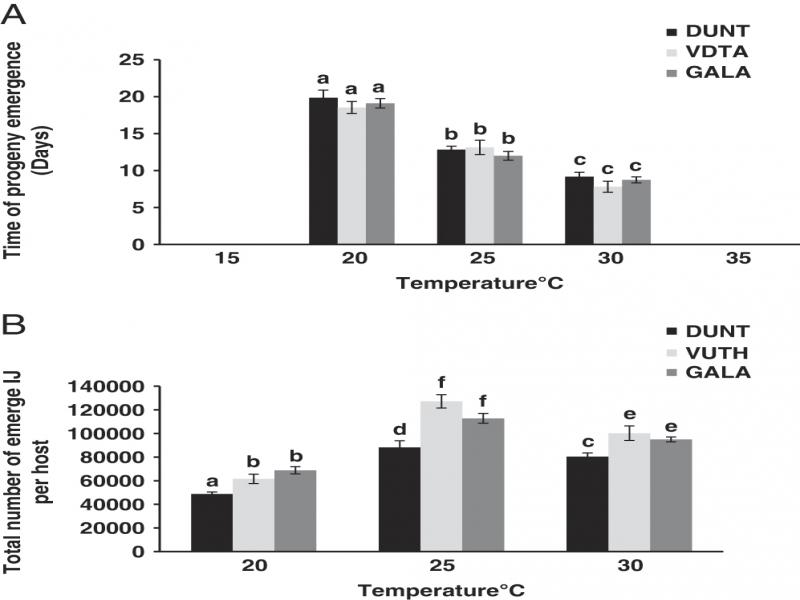
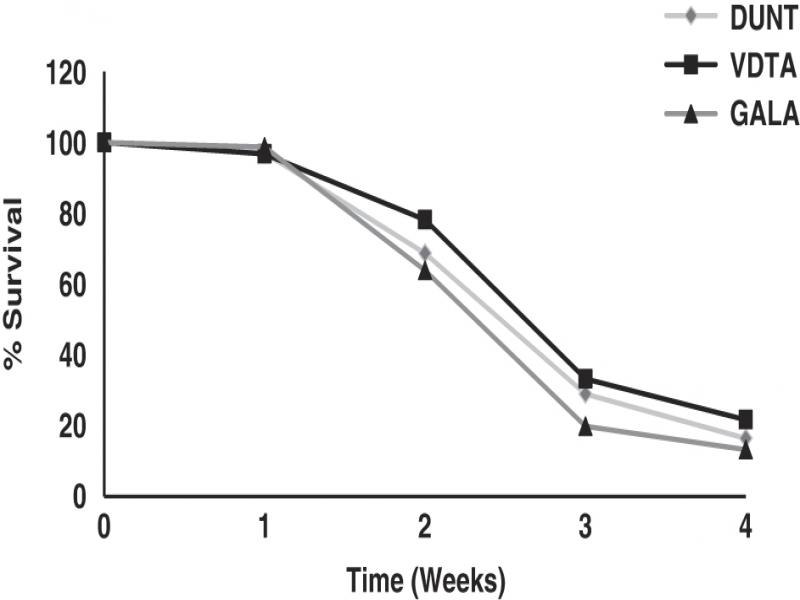
Figure 6:

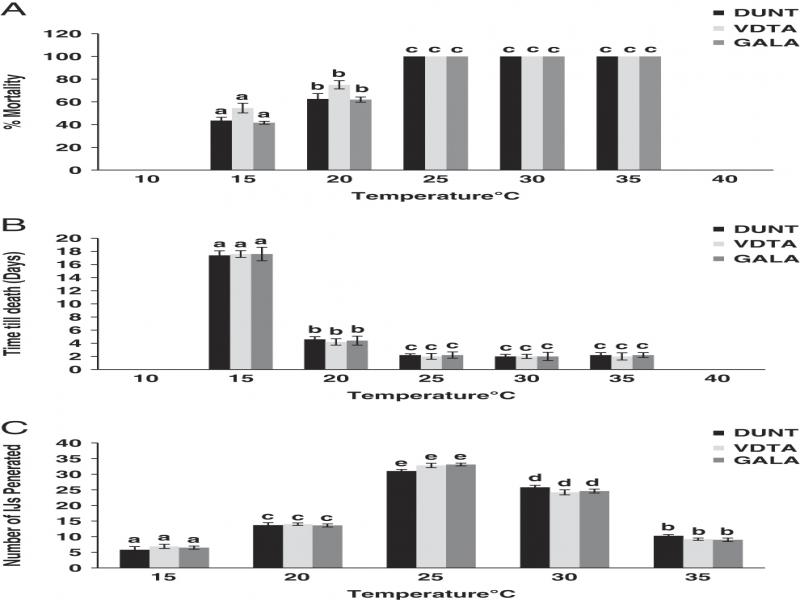
Pathogenicity of native isolates of H. indica at different temperatures. (A) Percentage mortality (Mean ± SE) of Galleria larvae when treated with IJ of isolat DUNT, VDTA and GALA at 10°C, 15°C, 20°C, 25°C, 30°C, 35°C, and 40°C. No Galleria larval mortality was observed at 10°C and 40°C. (B) Time to death (Mean ± SE) of Galleria larvae when treated with IJ of isolate DUNT, VDTA and GALA at 10°C, 15°C, 20°C, 25°C, 30°C, 35°C, and 40°C. (C) Number of IJ penetrated (Mean ± SE) into Galleria larvae when treated with IJ of isolate DUNT, VDTA and GALA at 15°C, 20°C, 25°C, 30°C, and 35°C. Same lowercase letter above bars indicate no statistical differences among nematode isolates (P > 0.05).

Figure 7:

Reproductive capacity of native isolates of H. indica at different temperature. (A) Time of first progeny emergence (mean ± SE) of IJ of isolate DUNT, VDTA and GALA at 20°C, 25°C, and 30°C from Galleria cadavers. No IJ emerged at 15°C and 35°C. (B) Total number (mean ± SE) of emerged IJ of native isolates DUNT, VDTA and GALA at 20°C, 25°C, and 30°C from Galleria cadavers. Same lowercase letter above bars indicate no statistical differences among nematode isolates (P > 0.05).

Figure 8:

Mean percentage survival of IJ of isolates DUNT, VDTA and GALA following exposure at 40°C for 1, 2, 3, and 4 hr.
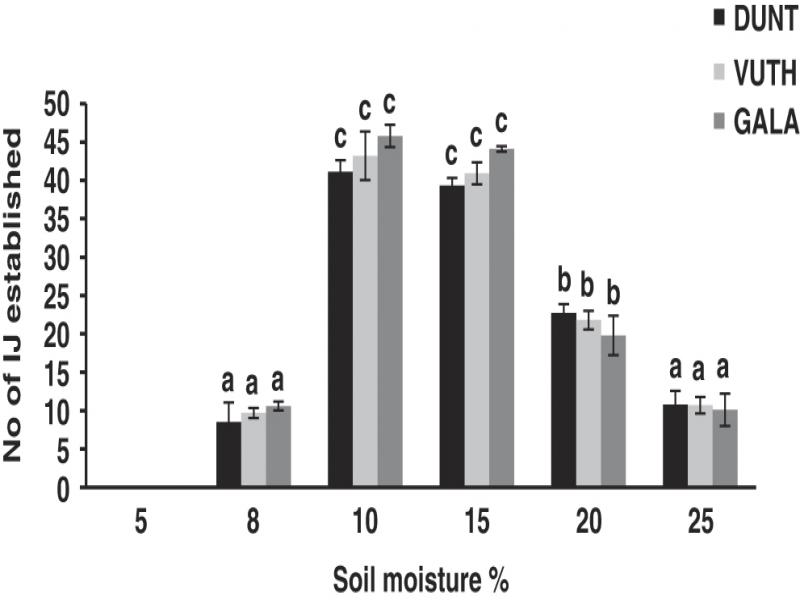

Figure 9:

Effect of soil moisture (mean ± SE) on penetration of IJ of isolate DUNT, VDTA and GALA in Galleria larvae at moisture level 5%, 8%, 10%, 15%, 20%, and 25% (w/w). No IJ penetrated at moisture level 5%. Same lowercase letter above bars indicate no statistical differences among nematode isolates (P > 0.05).
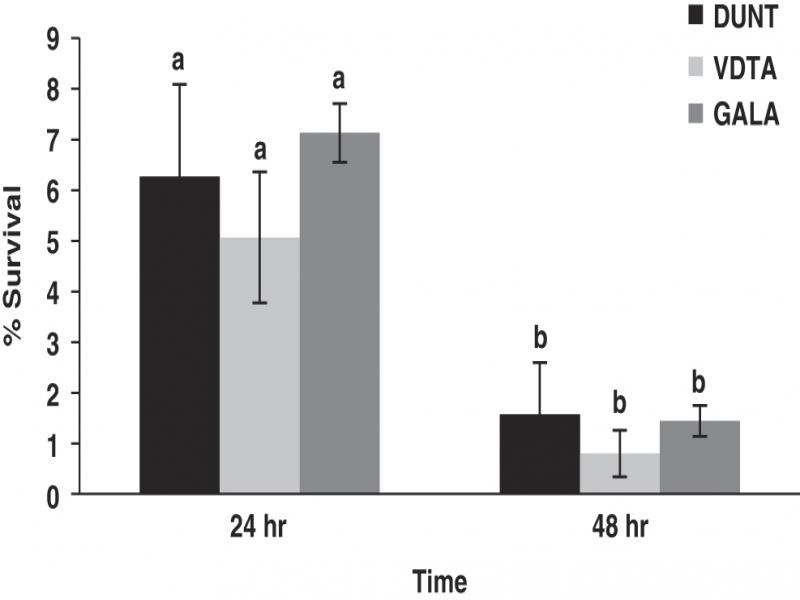
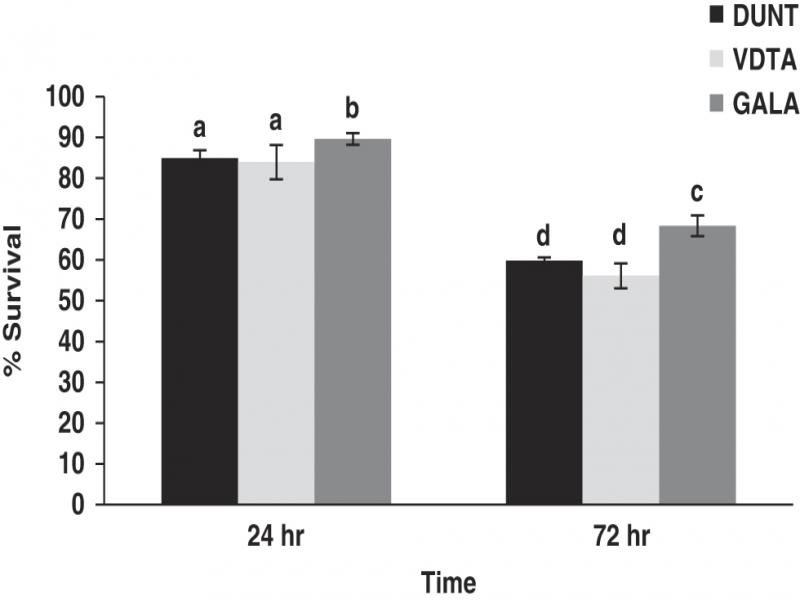
Figure 10:

Percentage survival (Mean ± SE) of IJ of isolate DUNT, VDTA and GALA following exposure to 85% RH for 24 hr and 48 hr. Same lowercase letter above bars indicate no statistical differences among nematode isolates (P > 0.05).
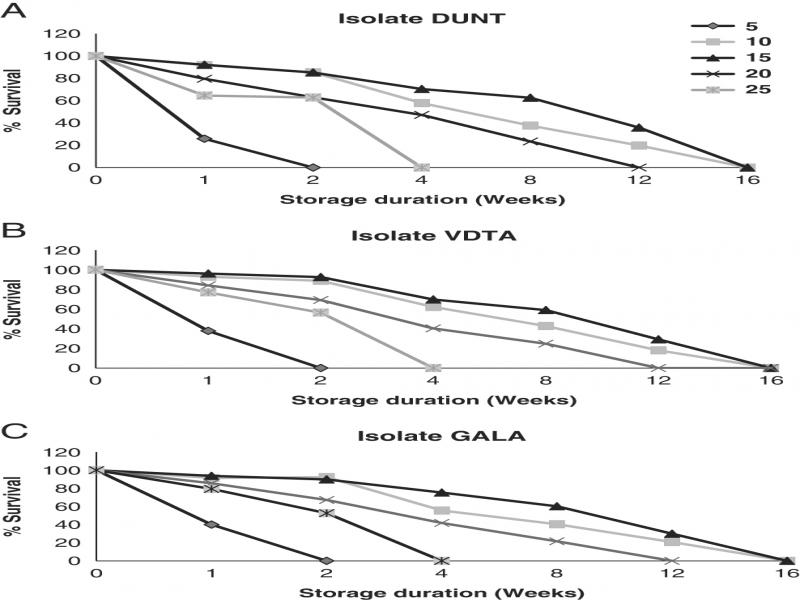

Figure 11:

Percentage survival (Mean ± SE) of IJ of isolate DUNT, VDTA and GALA following hypoxic conditions for 24 hr and 72 hr. Same lowercase letter above bars indicate no statistical differences among nematode isolates (P > 0.05).

Figure 12:

Survival capacity of isolates in storage stored at 5°C, 10°C, 15°C, 20°C, and 25°C for 1, 2, 4, 8, 12, and 16 weeks. (A) Effect of storage temperature and duration on % survival of the IJ of isolate DUNT. (B) Effect of storage temperature and duration on % survival of the IJ of isolate VDTA. (C) Effect of storage temperature and duration on % survival of the IJ of isolate GALA.

Qualitative comparison of ecological traits among native isolates of H_ indica DUNT, VUDT, AND GALA_

IsolateReproductive capacityHeat toleranceHypoxia toleranceStorage stabilityTotal
Isolate DUNT-10-1-1-3
Isolate VDTA11-1-10
Isolate GALA1-1112

LC50 of native isolates of H_ indica DUNT, VUDT AND GALA against last instar of G_ mellonella larvae at 48 hr after application_

% Mortalitya
Concentrations (IJ/larva)
Isolate1351025LC 50 (IJ/larva)95% confidence interval
Isolate DUNT15Aa45Bb75Cc100Dd100Dd3.32.5-4.1
Isolate VDTA10Aa60Bb85Cc100Dd100Dd2.92.1-3.6
Isolate GALA20Aa55Bb80Cc100Dd100Dd2.82.1-3.6
DOI: https://doi.org/10.21307/jofnem-2021-085 | Journal eISSN: 2640-396X | Journal ISSN: 0022-300X
Language: English
Page range: 1 - 20
Published on: Oct 28, 2021
Published by: Society of Nematologists, Inc.
In partnership with: Paradigm Publishing Services
Publication frequency: 1 issue per year

© 2021 Sumeet Kour, Uma Khurma, Gilianne Brodie, published by Society of Nematologists, Inc.
This work is licensed under the Creative Commons Attribution 4.0 License.