
Table 1.
Nutrient amendment application timing by N rate treatment in conventional production.
| Year 1 (2016–2017) | |||||||||||||||||
| Date | 20 Oct | 28 Nov | 13 Dec | 20 Dec | 27 Dec | 3 Jan | 10 Jan | 17 Jan | 24 Jan | 31 Jan | 7 Feb | 14 Feb | 20 Feb | 28 Feb | 7 Mar | 14 Mar | 21 Mar |
| DAPa: | ‒9 | 30 | 45 | 52 | 59 | 66 | 73 | 80 | 87 | 94 | 101 | 108 | 114 | 122 | 129 | 136 | 143 |
| Treatment (total kg N/ha) | -----------------------------------------N applied each date (kg/ha)-------------------------------------------- | ||||||||||||||||
| 168 | 28.0 | 17.5 | 17.5 | 17.5 | 17.5 | 17.5 | 17.5 | 17.5 | 17.5 | ||||||||
| 224 | 28.0 | 24.5 | 24.5 | 24.5 | 24.5 | 24.5 | 24.5 | 24.5 | 24.5 | ||||||||
| 280 | 28.0 | 31.5 | 31.5 | 31.5 | 31.5 | 31.5 | 31.5 | 31.5 | 31.5 | ||||||||
| 336 | 28.0 | 20.5 | 20.5 | 20.5 | 20.5 | 20.5 | 20.5 | 20.5 | 20.5 | 20.5 | 20.5 | 20.5 | 20.5 | 20.5 | 20.5 | 20.5 | |
| 392 | 28.0 | 24.3 | 24.3 | 24.3 | 24.3 | 24.3 | 24.3 | 24.3 | 24.3 | 24.3 | 24.3 | 24.3 | 24.3 | 24.3 | 24.3 | 24.3 | |
| Year 2 (2017–2018) | |||||||||||||||||
| Date: | 27 Oct | 4 Dec | 18 Dec | 21 Dec | 28 Dec | 4 Jan | 11 Jan | 16 Jan | 25 Jan | 1 Feb | 8 Feb | 13 Feb | 22 Feb | 1 Mar | 8 Mar | 13 Mar | 22 Mar |
| DAP: | ‒6 | 32 | 46 | 49 | 56 | 63 | 70 | 75 | 84 | 91 | 98 | 103 | 112 | 119 | 126 | 131 | 140 |
| Treatment (total kg N/ha) | -----------------------------------------N applied each date (kg/ha)-------------------------------------------- | ||||||||||||||||
| 168 | 28.0 | 17.5 | 17.5 | 17.5 | 17.5 | 17.5 | 17.5 | 17.5 | 17.5 | ||||||||
| 224 | 28.0 | 24.5 | 24.5 | 24.5 | 24.5 | 24.5 | 24.5 | 24.5 | 24.5 | ||||||||
| 280 | 28.0 | 31.5 | 31.5 | 31.5 | 31.5 | 31.5 | 31.5 | 31.5 | 31.5 | ||||||||
| 336 | 28.0 | 20.5 | 20.5 | 20.5 | 20.5 | 20.5 | 20.5 | 20.5 | 20.5 | 20.5 | 20.5 | 20.5 | 20.5 | 20.5 | 20.5 | 20.5 | |
| 392 | 28.0 | 24.3 | 24.3 | 24.3 | 24.3 | 24.3 | 24.3 | 24.3 | 24.3 | 24.3 | 24.3 | 24.3 | 24.3 | 24.3 | 24.3 | 24.3 | |
Table 2.
Nutrient amendment application timing by rate treatment in organic production for both Year 1 and Year 2.
| Treatment (total kg N/ha) | At plantinga | 5 WAPb | 7 WAP |
|---|---|---|---|
| N rate (kg/ha) per timing | |||
| 168 | 84 | 42 | 42 |
| 224 | 112 | 56 | 56 |
| 280 | 140 | 70 | 70 |
| 336 | 168 | 84 | 84 |
| 392 | 196 | 98 | 98 |
Table 3.
Schedule for data collection and trial establishment.
| Year 1 (2016–2017) | Year 2 (2017–2018) | |||
|---|---|---|---|---|
| Item | Conventional | Organic | Conventional | Organic |
| Soil fumigation | 9 Sep (‒50) | N/Aa | 13 Oct (‒21) | N/A |
| Date planted | 29 Oct (0) | 14 Nov (0)b | 2 Nov (0) | 15 Nov (0) |
| Date harvested | 10–11 Apr (170) | 17 Apr (161) | 19–20 Apr (168) | 20 Apr (155) |
| Midseason soil sampling | 16 Dec (48) | 6 Jan (53) | 2 Jan (61) | 2 Jan (48) |
| Harvest soil sampling | 28 Mar (157) | 28 Mar (141) | 13 Mar (131) | 13 Mar (118) |
Table 4.
Nematode genera in organic and conventional trials.
| -----------Organic---------- | -------Conventional--------- | |||||
|---|---|---|---|---|---|---|
| Nematode genera | Feeding group | cp value | Relative abundancea | Mean abundanceb | Relative abundance | Mean abundance |
| Rhabditis | Bacterivore | 1 | 25.95% | 506 | 14.38% | 79 |
| Panagrolaimus | Bacterivore | 1 | 1.67% | 33 | 0.03% | 0 |
| Diplogaster | Bacterivore | 1 | 0.04% | 1 | 0.14% | 1 |
| Cephalobus | Bacterivore | 2 | 11.27% | 220 | 56.71% | 310 |
| Acrobeles | Bacterivore | 2 | 9.31% | 182 | 1.07% | 6 |
| Eucephalobus | Bacterivore | 2 | 9.08% | 177 | 7.49% | 41 |
| Cervidellus | Bacterivore | 2 | 0.74% | 14 | 0.08% | 0 |
| Heterocephalobus | Bacterivore | 2 | 0.15% | 3 | N/A | N/A |
| Plectus | Bacterivore | 2 | 0.12% | 2 | 0.31% | 2 |
| Filenchus | Fungivore | 2 | 5.91% | 115 | 0.77% | 4 |
| Aphelenchus | Fungivore | 2 | 3.92% | 77 | 6.21% | 34 |
| Aphelenchoides | Fungivore | 2 | 3.26% | 64 | 5.00% | 27 |
| Ditylenchus | Fungivore | 2 | 0.36% | 7 | 0.07% | 0 |
| Diphtherophora | Fungivore | 3 | 0.23% | 4 | 0.10% | 1 |
| Paratylenchus | Herbivore | 2 | 3.21% | 63 | 0.08% | 0 |
| Malenchus | Herbivore | 2 | 0.89% | 17 | 0.02% | 0 |
| Mesocriconema | Herbivore | 3 | 11.45% | 223 | 4.62% | 25 |
| Pratylenchus | Herbivore | 3 | 6.52% | 127 | 0.24% | 1 |
| Meloidogyne | Herbivore | 3 | 0.18% | 4 | 0.82% | 4 |
| Paratrichodorus | Herbivore | 4 | 0.23% | 5 | 0.28% | 2 |
| Axonchium | Herbivore | 5 | 0.10% | 2 | 0.16% | 1 |
| Thonus | Omnivore | 4 | 1.48% | 29 | 0.36% | 2 |
| Mesodorylaimus | Omnivore | 4 | 0.36% | 7 | N/A | N/A |
| Eudorylaimus | Omnivore | 4 | 0.14% | 3 | 0.04% | 0 |
| Aporcelaimellus | Omnivore | 5 | 2.94% | 57 | 0.33% | 2 |
| Paraxonchium | Omnivore | 5 | 0.04% | 1 | N/A | N/A |
| Seinura | Predator | 2 | N/A | N/A | 0.50% | 3 |
| Discolaimus | Predator | 5 | 0.13% | 3 | 0.02% | 0 |
1 Notes: Data combined across sampling dates and years. aRelative abundance is proportion of total nematode abundance across all sampling dates and years within production system. Only nematode genera with 0.1% relative abundance in either organic or conventional production are shown; bMean abundance is mean nematodes/100 cm3 soil across all sampling dates and years within production system.
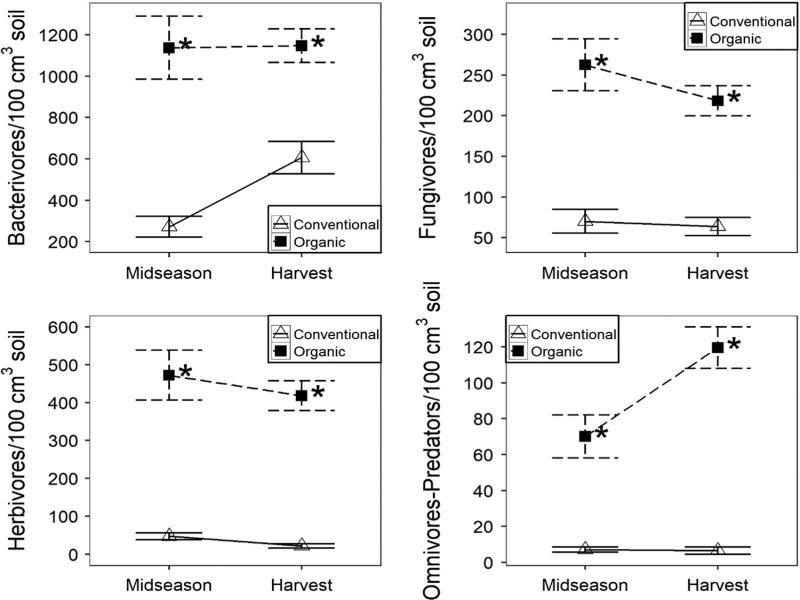
Figure 1:
Nematode soil abundances for different trophic groups as affected by production system. Data are combined across two years. Data points and error bars represent means and standard errors, respectively. ‘Conventional’ and ‘organic’ are conventional and organic production systems, respectively. An ‘*’ beside organic production mean indicates significant production system effects for a given season (ANOVA, p < 0.05).
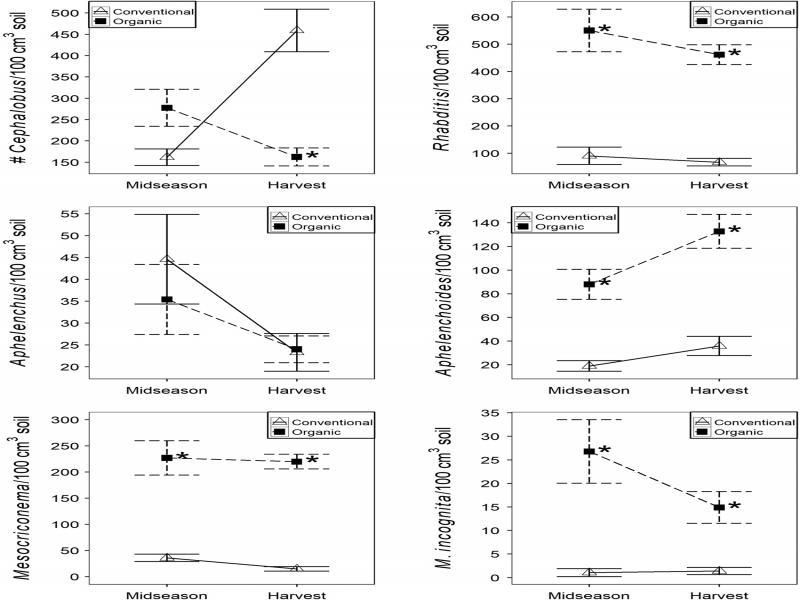
Figure 2:
Nematode soil abundances for common genera as affected by production system. Data are combined across two years. Data points and error bars represent means and standard errors, respectively. ‘Conventional’ and ‘organic’ are conventional and organic production systems, respectively. An ‘*’ beside organic production mean indicates significant production system effects for a given season (ANOVA, p < 0.05).
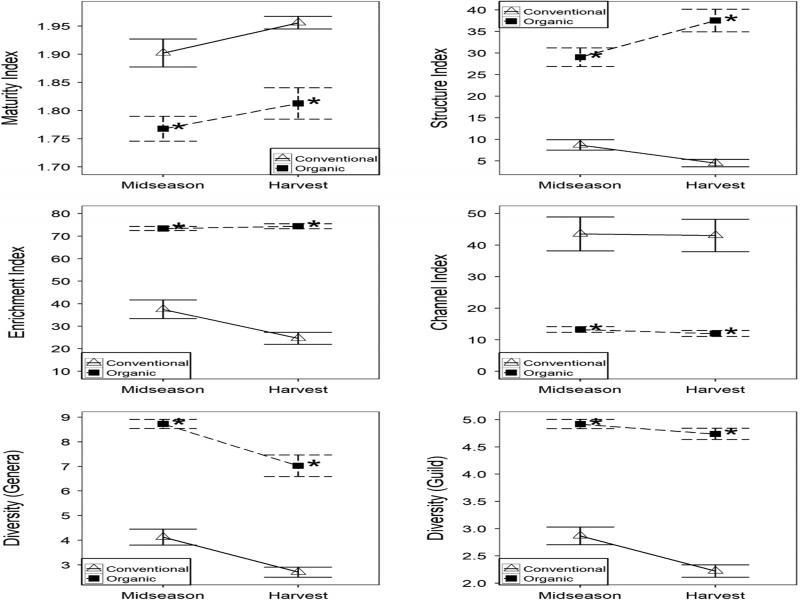
Figure 3:
Nematode community indices as affected by production system. Data are combined across two years. Data points and error bars represent means and standard errors, respectively. ‘Conventional’ and ‘organic’ are conventional and organic production systems, respectively. An ‘*’ beside organic production mean indicates significant production system effects for a given season (ANOVA, p < 0.05). Diversity is Hill’s N1 diversity based on nematode genera or trophic guilds.
Table 5.
Organic production: nematode soil abundances for bacterivores and fungivores (total and individual genera) as affected by nitrogen ratea.
| Year 1 | Year 2 | Year 1 | Year 2 | |||||
|---|---|---|---|---|---|---|---|---|
| Rate (kg N/ha) | Pmb | Pf | Pm | Pf | Pm | Pf | Pm | Pf |
| Bacterivores | Fungivores | |||||||
| 168 | 192 b | 719 b | 1,615 | 1,246 | 89 | 144 bc | 452 | 327 |
| 224 | 223 b | 768 b | 1,939 | 1,150 | 79 | 101 c | 389 | 191 |
| 280 | 259 ab | 703 b | 1,980 | 1,274 | 83 | 108 c | 355 | 248 |
| 336 | 360 a | 1877 a | 2,396 | 1,186 | 116 | 229 ab | 565 | 226 |
| 392 | 305 ab | 1,124 ab | 2,109 | 1,431 | 106 | 276 a | 393 | 335 |
| Rhabditis spp. | Aphelenchus spp. | |||||||
| 168 | 97 b | 362 b | 757 | 413 | 7 | 23 b | 67 | 21 |
| 224 | 100 ab | 361 b | 899 | 466 | 6 | 24 b | 55 | 0 |
| 280 | 113 b | 251 b | 1,017 | 450 | 8 | 17 b | 45 | 31 |
| 336 | 193 a | 872 a | 1,182 | 428 | 11 | 36 ab | 48 | 10 |
| 392 | 165 ab | 487 ab | 984 | 526 | 13 | 49 a | 96 | 30 |
| Cephalobus spp. | Aphelenchoides spp. | |||||||
| 168 | 25 | 38 | 468 | 295 | 33 b | 99 bc | 102 | 187 |
| 224 | 41 | 95 | 439 | 189 | 44 ab | 61 c | 108 | 90 |
| 280 | 54 | 31 | 534 | 331 | 36 b | 87 bc | 121 | 139 |
| 336 | 58 | 87 | 555 | 269 | 61 a | 184 ab | 207 | 89 |
| 392 | 33 | 97 | 570 | 190 | 51 ab | 214 a | 118 | 178 |
1 Notes: aValues are mean nematode soil abundances (nematodes/100 cm3 soil); bPm and Pf indicate midseason and final nematode soil abundances, respectively. Values for the same variable with different letters in the same column are significantly different according to Fisher’s protected LSD (p < 0.05). Absence of letters indicates there were no significant nutrient rate effects in that season for a particular variable (ANOVA, p > 0.05).
Table 6.
Conventional production: nematode soil abundances for bacterivores and fungivores (total and individual genera) as affected by nitrogen ratea.
| Year 1 | Year 2 | Year 1 | Year 2 | |||||
|---|---|---|---|---|---|---|---|---|
| Rate (kg N/ha) | Pmb | Pf | Pm | Pf | Pm | Pf | Pm | Pf |
| Bacterivores | Fungivores | |||||||
| 168 | 95 | 220 ab | 351 | 756 b | 10 | 15 b | 94 | 106 b |
| 224 | 119 | 156 b | 706 | 1,563 a | 19 | 15 b | 203 | 194 a |
| 280 | 89 | 216 ab | 542 | 967 b | 7 | 29 a | 148 | 93 b |
| 336 | 93 | 273 a | 356 | 770 b | 10 | 10 b | 140 | 111 b |
| 392 | 84 | 316 a | 280 | 829 b | 7 | 13 b | 61 | 51 b |
| Rhabditis spp. | Aphelenchus spp. | |||||||
| 168 | 2 | 2 | 131 | 73 | 9 | 7 | 70 | 42 |
| 224 | 2 | 2 | 359 | 214 | 14 | 8 | 138 | 56 |
| 280 | 4 | 2 | 240 | 149 | 6 | 14 | 99 | 46 |
| 336 | 1 | 3 | 103 | 116 | 8 | 7 | 53 | 23 |
| 392 | 2 | 3 | 60 | 108 | 5 | 6 | 45 | 26 |
| Cephalobus spp. | Aphelenchoides spp. | |||||||
| 168 | 89 | 214 ab | 186 | 623 | 1 | 4 | 20 | 62 b |
| 224 | 115 | 152 b | 295 | 933 | 4 | 5 | 52 | 134 a |
| 280 | 82 | 211 ab | 277 | 695 | 1 | 10 | 43 | 46 b |
| 336 | 89 | 267 a | 210 | 587 | 0 | 1 | 53 | 69 ab |
| 392 | 80 | 311 a | 196 | 597 | 1 | 5 | 15 | 23 b |
1 Notes: aValues are mean nematode soil abundances (nematodes/100 cm3 soil); b Pm and Pf indicate midseason and final nematode soil abundances, respectively. Values for the same variable with different letters in the same column are significantly different according to Fisher’s protected LSD (p < 0.05). Absence of letters indicates there were no significant nutrient rate effects in that season for a particular variable (ANOVA, p > 0.05).
Table 7.
Herbivore and herbivore genera soil abundances as affected by nitrogen rate in organic and conventional productiona.
| Organic production | Conventional production | |||||||
|---|---|---|---|---|---|---|---|---|
| Year 1 | Year 2 | Year 1 | Year 2 | |||||
| Rate (kg N/ha) | Pmb | Pf | Pm | Pf | Pm | Pf | Pm | Pf |
| Herbivores | ||||||||
| 168 | 80 | 648 | 860 | 260 | 13 | 13 | 80 | 648 |
| 224 | 87 | 567 | 804 | 359 | 7 | 4 | 87 | 567 |
| 280 | 85 | 310 | 821 | 312 | 7 | 5 | 85 | 310 |
| 336 | 92 | 511 | 950 | 367 | 4 | 3 | 92 | 511 |
| 392 | 75 | 500 | 872 | 350 | 5 | 3 | 75 | 500 |
| Mesocriconema | ||||||||
| 168 | 48 | 258 | 342 | 187 | 10 | 10 | 48 | 258 |
| 224 | 49 | 243 | 332 | 291 | 3 | 2 | 49 | 243 |
| 280 | 65 | 194 | 436 | 194 | 4 | 3 | 65 | 194 |
| 336 | 58 | 212 | 446 | 221 | 4 | 1 | 58 | 212 |
| 392 | 50 | 211 | 444 | 187 | 4 | 2 | 50 | 211 |
| Meloidogyne incognita | ||||||||
| 168 | 1 | 0 | 29 b | 18 | 0 | 0 | 1 | 0 |
| 224 | 2 | 3 | 41 b | 28 | 0 | 0 | 2 | 3 |
| 280 | 0 | 6 | 98 a | 18 | 0 | 0 | 0 | 6 |
| 336 | 0 | 0 | 49 b | 43 | 0 | 0 | 0 | 0 |
| 392 | 0 | 8 | 49 b | 25 | 0 | 0 | 0 | 8 |
1 Notes: aValues are mean nematode soil abundances (nematodes/100 cm3 soil); bPm and Pf indicate midseason and final nematode soil abundances, respectively. Values for the same variable with different letters in the same column are significantly different according to Fisher’s protected LSD (p < 0.05). Absence of letters indicates there were no significant nutrient rate effects in that season for a particular variable (ANOVA, p > 0.05).
Table 8.
Nematode community indices as affected by nitrogen rate in organic and conventional productiona.
| Organic production | Conventional production | |||||||
|---|---|---|---|---|---|---|---|---|
| Year 1 | Year 2 | Year 1 | Year 2 | |||||
| Rate (kg N/ha) | Vmb | Vf | Vm | Vf | Vm | Vf | Vm | Vf |
| Structure index | ||||||||
| 168 | 37 | 50 | 27 | 25 | 8 | 5 | 10 | 1.5 |
| 224 | 26 | 50 | 36 | 37 | 7 | 5 | 6 | 6.6 |
| 280 | 34 | 48 | 37 | 28 | 7 | 6 | 7 | 9.4 |
| 336 | 28 | 46 | 29 | 24 | 11 | 3 | 16 | 4.4 |
| 392 | 20 | 37 | 18 | 33 | 8 | 3 | 6 | 0.3 |
| Enrichment index | ||||||||
| 168 | 72 ab | 76 | 73 | 73 | 13 | 10 | 65 | 35 |
| 224 | 70 b | 71 | 72 | 73 | 18 | 11 | 61 | 42 |
| 280 | 70 ab | 69 | 77 | 72 | 19 | 13 | 66 | 41 |
| 336 | 76 a | 81 | 74 | 76 | 10 | 6 | 59 | 43 |
| 392 | 75 a | 76 | 74 | 76 | 12 | 8 | 54 | 37 |
| Hill’s N1 diversity-genera | ||||||||
| 168 | 9.4 | 9.5 | 8.6 | 4.6 | 2.5 | 2.1 | 6.2 | 3.1 |
| 224 | 9.4 | 9.8 | 9.1 | 4.4 | 3.0 | 1.9 | 5.4 | 4.0 |
| 280 | 8.8 | 9.7 | 8.5 | 4.5 | 2.4 | 2.1 | 5.2 | 4.0 |
| 336 | 8.0 | 8.8 | 8.9 | 4.6 | 2.3 | 1.4 | 7.1 | 4.0 |
| 392 | 8.1 | 9.8 | 8.4 | 4.5 | 2.3 | 1.6 | 4.9 | 2.8 |
| Hill’s N1 diversity-guild | ||||||||
| 168 | 2.0 | 1.8 | 4.1 | 2.8 | 5.1 | 5.1 | 5.3 | 4.5 |
| 224 | 2.2 | 1.6 | 3.4 | 3.0 | 4.8 | 5.2 | 5.3 | 4.6 |
| 280 | 2.1 | 1.8 | 3.6 | 2.9 | 4.8 | 4.8 | 5.2 | 4.4 |
| 336 | 1.9 | 1.3 | 4.2 | 2.9 | 4.5 | 4.6 | 5.0 | 4.5 |
| 392 | 1.9 | 1.5 | 3.4 | 2.6 | 4.4 | 5.1 | 4.8 | 4.8 |
1 Notes: aValues are mean nematode soil abundances (nematodes/100 cm3 soil); bVm and Vf indicate midseason and final values, respectively. Values for the same variable with different letters in the same column are significantly different according to Fisher’s protected LSD (p < 0.05). Absence of letters indicates there were no significant nutrient rate effects in that season for a particular variable (ANOVA, p > 0.05).