Lance nematodes, Hoplolaimus spp., are robust nematodes with a very distinct lip region and well-developed stylet with distinctly shaped stylet knobs (Fortuner, 1991) that feed on a wide range of plants and have a global distribution. Bae et al. (2009) reported that Handoo and Golden (1992) recognized 29 species in the genus Hoplolaimus Von Daday, 1905. Siddiqi (2000) listed 32 species in three subgenera with two species Hoplolaimus johani Tiwari, Mishra and Malhotra, 2001 and Hoplolaimus caudifurcatus Tiwari, Mishra and Malhotra, 2001, described in 2001 (Tiwari et al., 2001). Since the 2009 publication, three species namely Hoplolaimus bachlongviensis Nguyen, Bui and Trinh, 2015, Hoplolaimus puriensis Ali, Shaheen and Pervez, 2009 and Hoplolaimus smokyensis Ma, Robbins, Bernard, Holgun and Agudela, 2019 were described from Vietnam, India, and the United States of America, respectively (Ali et al., 2009; Nguyen et al., 2015; Ma et al., 2019). Hoplolaimus pararobustus (Schuurmans Stekhoven and Teunissen, 1938) Sher (1963) was described from the Democratic Republic of the Congo and since then, the species had been reported from 25 African countries, including Namibia (Loubana et al., 2007; EPPO, 2020).
Hoplolaimus pararobustus is associated with many plant species like grasses from bowling greens and lawns, fynbos, Adansonia digitata L., Ananas comosus (L.) Merr., Annona reticulata L., Amaranthus sp., Beta vulgaris L., Camellia sinensis (L.) Kuntze, Carica papaya L., Chloris gayana Kunth, Coffea arabica L., Citrus sp., Daucus carotae L., Digitaria abyssinica (A.Rich.) Stapf, Dioscorea spp., Elaeis spp., Eucalyptus sp., Gossypium hirsutum L., Mangifera indica L., Musa spp., Oryza sativa L., Paspalanum notatum Flügge, Phaseolus vulgaris L., Psidium guajava L., Pueraria phaseoloides var. javanica (Benth.) Baker; Triticum aestivum L., Saccharum officinarum L., Solanum tuberosum L., Vigna unguiculata (L.) Walp., Vitis vinifera L., and Zea mays L. (Caveness, 1967; Van den Berg and Heyns, 1970; Siddiqi, 1974; Bridge et al., 1995; Vovlas and Lamberti, 1985; CABI, 2014; Sikora et al., 2018). This semi-endoparasitic nematode (Yeates et al., 1993) has a broad distribution in Namibia, according to the South African Plant-Parasitic Nematode Survey (SAPPNS) database (De Waele et al., 1998; Marais et al., 2017) and it had been reported in soil around Acacia millefolia S.Watson, Brassica oleracea L., Cenchrus ciliaris L., Cucurbita maxima Duchesne, Gossypium hirsutum L., Medicago sativa L., Pennisetum glaucum (L.) R.Br., Solanum lycopersicum L., Vitis vinifera L., and Z. mays.
Hoplolaimus pararobustus has been reported from inside roots of banana (Whitehead, 1959) giving rise to dark-brown pustules that eventually result in necrotic cortical tissue situated around the heads of the feeding sites of the nematodes and eventually elongated ulcerated lesions on the roots (Siddiqi, 1974). It has also been reported, at a population density of 200 individuals per gram of tissue, in corms and roots of banana where they were likely to cause damage to the crop (Sikora et al., 2018). Phylogenetic analysis of Hoplolaimus spp. using D2–D3 expansion of 28 S and internal transcribed spacer (ITS1) ribosomal DNA sequences resolved the phylogeny of the genus and were useful in molecular identification of Hoplolaimus spp. (Bae et al., 2008). In addition, the PCR-RFLP method was applied by different researchers to evaluate the genetic diversity of Hoplolaimus spp. (Robbins et al., 2009; Bae et al., 2009). Later, a species-specific primer was developed to distinguish Hoplolaimus stephanus Sher, 1963 from another similar species viz. Hoplolaimus galeatus (Cobb, 1913) Thorne, 1935 (Ma et al., 2011). Moreover, sequences of the actin gene were successfully used for phylogenetic studies of Hoplolaimus spp. (Ma et al., 2011). High genetic variability among the Hoplolaimus populations in soybean-growing areas in the USA was reported when their genetic diversity was evaluated based on sequences of ITS1 ribosomal DNA and COI mitochondrial DNA genes (Holguin et al., 2015). Although the evolutionary relationships of Hoplolaimus spp. have been studied, phylogenetic analyses of this genus within the subfamily Hoplolaiminae are still lacking. Therefore, this study aimed to characterize a population of a Hoplolaimus isolated in Namibia using both morphological and molecular approaches, which is presented herein as H. pararobustus. To our knowledge, this is the first report of H. pararobustus from maize (Z. mays) roots.
Materials and methods
Nematode extraction and morphological studies
Nematodes were extracted from roots using an adapted sugar centrifugal flotation method (Marais et al., 2017). Females and males were fixed in a heated 4% formaldehyde plus 1% propionic acid (FPG) solution, dehydrated in a glycerine solution, and mounted in glycerine on glass slides using a wax ring method (Marais et al., 2017). Measurements and drawings of the mounted specimens were done with a Nikon LABOPHOT-2 microscope equipped with a Nikon 1.25× drawing tube. All measurements were done at ×1,000 magnification. Curved structures were measured along the median line. Morphometrics were used in the descriptions with standard morphometric calculations and terms used throughout the paper (Siddiqi, 2000). Specimens were deposited in the National Collection of Nematodes (NCN), Biosystematics, Agricultural Research Council (ARC) – Plant Health and Protection (PHP), Pretoria.
DNA extraction, PCR reaction, and gel electrophoresis
DNA from previously selected living males and females was extracted using chelex-100 as described by Rashidifard et al. (2019). Polymerase chain reaction (PCR) conditions followed the protocol of Swart et al. (2020) with the following DNA markers used for DNA amplification: 28 S rDNA: D2A (5–ACAAGTACCGTGAGGGAAAGTTG–3), D3B (5–TCGGAAGGAACCAGCTACTA–3) (Subbotin et al., 2006), and 18 S rDNA: SSU F04 (GCTTGTCTCAAAGATTAAGCC), SSU R26 (CATTCTTGGCAAATGCTTTCG) (Blaxter et al., 1998). DNA of the nematode specimens was stained using GelRed, loaded on 1% agarose gel, and visualized under UV transilluminator before sequencing by Inqaba Biotec (Pty) Ltd South Africa.
Taxonomy and phylogenetic analyses
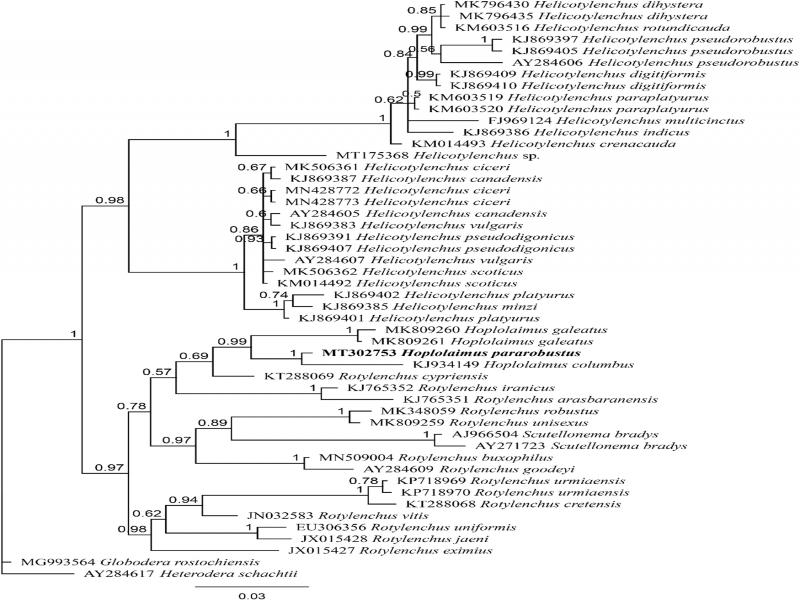
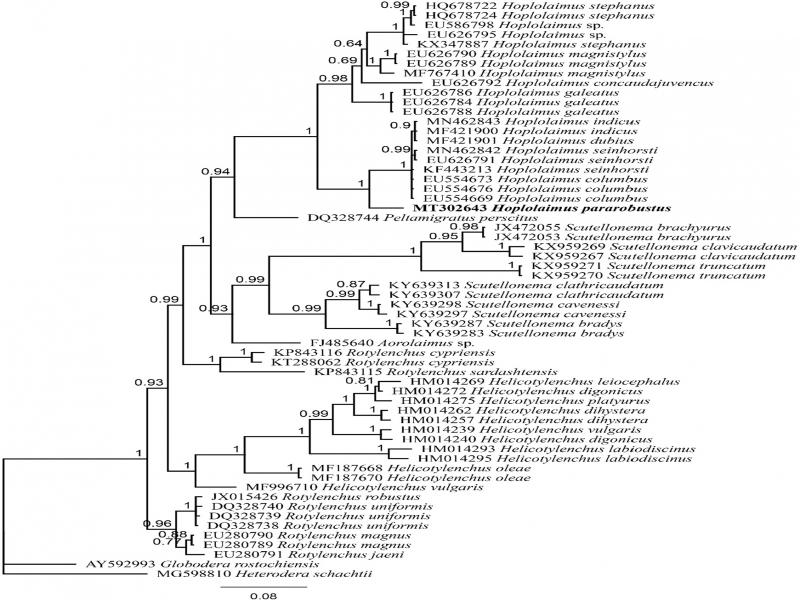
The newly generated 18 S and 28 S rDNA sequences of the Namibian nematode population were compared to those available in GenBank using a BLAST search. For phylogenetic tree construction, available sequences of the subfamily Hoplolaiminae were retrieved from GenBank for 18 S and 28 S data sets. Both data sets were aligned using MUSCLE (Edgar, 2004) in Geneious Prime 2020.0.4 (https//:www.geneious.com). The jModelTest 2.1.10 program (Darriba et al., 2012) was used to identify the best nucleotide substitution model. The General Time Reversible with an invariable site and a gamma distribution (GTR + I + G) and General Time Reversible with a Gamma distribution (GTR + G) were the most suitable models for 18 S and 28 S data sets, respectively. Bayesian analysis was accomplished using MrBayes 3.2.2 (Huelsenbeck and Ronquist, 2001) in Geneious Prime 2020.0.4 (https//:www.geneious.com); the chain was run for 3×10⁶ generations for each locus. After discarding burn-in samples (25%), posterior probability (PB) of the Bayesian trees was estimated using the Markov chain Monte Carlo (MCMC) algorithm (Larget and Simon, 1999) based on the 50% majority rule. Heterodera schachtii Schmidt, 1871 and Globodera rostochiensis (Wollenweber, 1923) Skarbilovich, 1959 were, respectively, used as outgroups for the 18 S and 28 S phylogenetic trees.
Results
Systematics
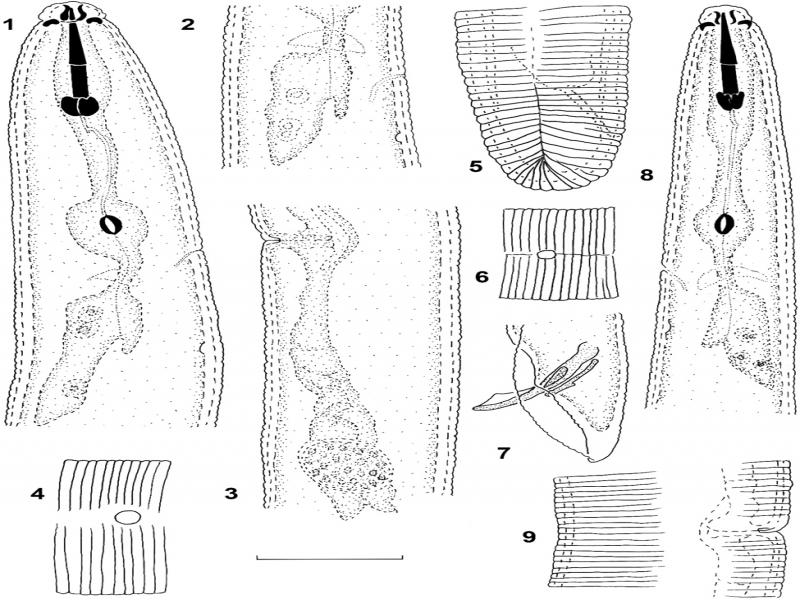
Hoplolaimus pararobustus (Schuurmans Stekhoven and Teunissen, 1938) Sher, 1963 (Figure 1 and Table 1).
Table 1.
Measurements of Hoplolaimus pararobustus females and males from maize in Namibia.
| Hoplolaimus pararobustus (Namibian specimens) | Hoplolaimus pararobustus (acc. to Fortuner (1991) | Hoplolaimus pararobustus (acc. to Van den Berg and Quénéhervé, 2012) | Hoplolaimus columbus (acc. to Fortuner, 1991) | Hoplolaimus dubius (acc. to Chaturvedi and Khera, 1979; Zarina and Maqbool, 1998) | Hoplolaimus galeatus (acc. to Van den Berg and Quénéhervé, 2012) | Hoplolaimus seinhorsti (acc. to Van den Berg and Quénéhervé, 2012 | Hoplolaimus seinhorsti (acc. to Mansourabad et al., 2016) | |||||||
|---|---|---|---|---|---|---|---|---|---|---|---|---|---|---|
| Characters | Females | Males | Females | Males | Females | Males | Females | Males | Females | Males | Females | Males | ||
| n | 21 | 21 | 17 | 14 | 20 | 8 | 8 | |||||||
| L | 1,100±76.1 (957–1,245) | 925±65 (818–1,018) | 1,314±0.127 (910–1,800) | 1,158±0.102 (930–1,500) | 940–1,800 | 920–1,500 | 1,260–1800 | 1,150–1,400 | 780–1,600 | 940–1,100 | 1,100–1,940 | 1,050–1,560 | 1,000–1,600 | 1,480–1,738 |
| a | 29±3.5 (23.7–36) | 29.2±4.2 (22–38.3) | 27.3±2.689 (20–39) | 29.2±2.2227 (21–37.2) | 20–39 | 21–37.2 | 30–38 | 31.9 (25.9–39.2) | 31.94–51.29 | 32.78–43.87 | 22–34 | 23–32 | 24.1–40 | 25.5–33.8 |
| b | 7.4±0.7 (6.2–8.6) | 6.7±0.4 (6–7.5) | 8.98±1.361 (6–14) | 8.5±1.328 (6.2–13.8) | 6–14.1 | 6.2–13.8 | 9.1–12.4 | 10.9 (9.58–12.18) | 8.16–12.49 | 8.0–9.45 | 6.3–10.8 | 8.3–10.3 | 5.2–14.2 | |
| b’ | 9.5±0.8 (7.9–11) | 8.5±0.7 (7.1–10.1) | 7.1±0.682 (5.1–10) | 6.6±0.57 (5–8.7) | – | – | 6.3–9.7 | 6.04–9.42 | 5.95–6.76 | |||||
| c | 59.7±10.5 (46.9–80.6) | 34.7±4.3 (25–41) | 60.8±15.185 (10–164) | 36.9±6.605 (22.2–51.9) | 40–164 | 22.2–51.9 | 39–57 | 29.9 (26.8–33.1) | 1.321.41 | 35.08–41.21 | 0.6–0.7 | 1.5–1.7 | 38–74 | |
| c’ | 0.8±0.1 (0.6–1.1) | 1.5±0.2 (1.3–2) | 0.67±0.135 (0.4–0.9) | 1.6±0.206 (1.4–2.1) | 0.4–0.9 | 1.4–2.1 | 0.61–1.17 | 0.7–0.9 | ||||||
| o (%) | 13±2 (8–17) | 13±2.5 (8–18) | – | – | 6.8–13.4 | 7.1–12.5 | 9–13 | 5.2 (4.8–5.2) | 7.55–16.28 | 12.5–17.7 | 8.5–17 | 10–17 | ||
| M | 51±1.5 (48–54) | 51±1.8 (50–53) | – | – | – | – | ||||||||
| V (%) | 55±2.5 (49–67) | – | 52.68±2.609 (51–62) | 51–62 | 51–60 | 41.56–59.16 | 52–60 | |||||||
| OV1 (%) | 31±14.0 (18–51) | – | ||||||||||||
| OV2 (%) | – | – | ||||||||||||
| h | – | 13±2.5 (10–19) | ||||||||||||
| Annulus width | 2±0.3 (2–3) | 2±0.3 (2–3) | 2 | 2–3 | ||||||||||
| Lip region height | 7±0.5 (6–8) | 6±0.6 (5–7) | ||||||||||||
| Lip region width | 13±1 (12–15) | 12±0.9 (11–13) | ||||||||||||
| Stylet length | 36±1.6 (34–40) | 34±1.3 (32–38) | 42.3±2.378 (37.5–49) | 40.8±2.673 (35–46) | 37.5–49.7 | 35–48 | 40–48 | 42 (40.2–43.7) | 34.4–42.4 | 41.5–54 | 40–48 | 38–45 | ||
| Metenchium length | 18±1.1 (17–21) | 17±0.6 (16–18) | ||||||||||||
| Telenchium length | 18±0.8 (17–19) | 17±1 (15–20) | ||||||||||||
| Stylet knob height | 6±0.5 (5–7) | 5±0.6 (4–6) | ||||||||||||
| Stylet knob width | 6±0.8 (5–9) | 6±0.5 (5–7) | 6.0–6.8 | |||||||||||
| Dorsal gland opening posterior to stylet knobs | 5±0.7 (3–6) | 4±0.9 (3–6) | 5.6±1.377 (4–8) | 3.2–5.6 | ||||||||||
| Median bulb length | 17±1.3 (15–20) | 16±1.5 (13–19) | ||||||||||||
| Median bulb width | 15±1.3 (13–17) | 12±1 (11–15) | ||||||||||||
| Medan bulb valve length | 6±0.7 (4–6) | 5±0.7 (4–7) | ||||||||||||
| Median bulb valve width | 4±0.6 (3–5) | 4±0.4 (3–4) | ||||||||||||
| Excretory pore from anterior end | 108±11.9 (82–123) | 93±13.6 (74–121) | ||||||||||||
| Esophagus length | 148±7.6 (136–161) | 139±10.4 (124–163) | ||||||||||||
| Esophagus overlap | 31±7.2 (15–44) | 30±5.7 (20–38) | ||||||||||||
| Body width at excretory pore | 33±3.5 (27–40) | 26±2.4 (23–30) | ||||||||||||
| Body width at midbody | 39±4 (32–46) | 32±2.9 (27–38) | ||||||||||||
| Body width at anus/cloaca | 25±2.2 (21–29) | 17±1.3 (15–20) | ||||||||||||
| Position of excretory pore/Esophagus length (%) | 73±7.5 (61–85) | 67±9.6 (61–85) | ||||||||||||
| Position of excretory pore/Body length (%) | 10±1.3 (8–12) | 10±(8–13) | ||||||||||||
| Anterior genital track length | 241±69.2 (171–301) | – | ||||||||||||
| Testes length | – | 350±34.6 (322–400) (n=4) | ||||||||||||
| Spicule length | – | 38±2.3 (35–42) | 46.9±3.318 (40–57) | 40–57 | 46.8 (36.6–52.5) | 368–43.36 | 40–52 | |||||||
| Gubernaculum length | – | 17±2.3 (11–20) | 21.9±2.4296 (15.4–31) | 15.4–31 | 14.4–18.4 | 20–28 | ||||||||
| Capitulum length | – | 11 ±0.8 (10–13) | ||||||||||||
| Phasmid diameter | 4±0.3 (3–4) | 3±0.5 (3–4) | 5.3 (4.1–6) | |||||||||||
| Anterior phasmid as % from anterior end | 36±6.9 (28–40) (n=3) | 36±3.5 (28–43) | 22–52 | 23.7–50.4 | 29–47 | 38 (35.4–42.2) | 23.90–41.34 | 21.18–44.35 | 23–46 | 29–45 | 24–46 | |||
| Posterior phasmid as % from anterior end tail | 79±4.1 (70–85) | 81±4.7 (72–87) | 58–89 | 68.9–85.4 | 79–90 | 82 (79.7–83.2) | 82.20–96.44 | 76.69–85.99 | 72–88 | 75–89 | 68–90 | |||
| Tail length | 19±3.1 (15–24) | 27±3.5 (22–35) | 7–15 | 16–28 | 26.1–35.1 | 17.5–36.2 | 32.3–44.2 | 22–28 | ||||||
| Number of tail annules | 12–18 | |||||||||||||