
Melodoigyne incognita, the Southern root-knot nematode, causes greater total damage than any other pathogen of cotton in the United States and is responsible for losses of $147 million/year in addition to the cost of nematicides used to manage the nematode (Lawrence et al., 2015). The infective second-stage juveniles (J2) are motile and penetrate into the root system to establish feeding sites. If a feeding site is successfully established, the nematode ceases movement and progresses to subsequent developmental stages. Some plants can inhibit the establishment of Meloidogyne spp. feeding sites through a hypersensitive response (Davies et al., 2015), which has been suggested as a mechanism of resistance to M. incognita in cotton (Mota et al., 2013). Failure to establish a feeding site may lead a nematode to leave (egress from) the root (Timper et al., 2000). Nematode egression from the roots of resistant plants has been documented for peanut, potato, alfalfa, and tomato (Timper et al., 2000; Mojtahedi et al., 1988; Mullin and Brodie, 1988).
Cotton germplasm with resistance to M. incognita is available (Shepherd et al., 1996), and two major resistance QTLs (quantitative trait loci), qMi-C11 and qMi-C14, have been identified. One QTL, qMi-C11, has a strong effect on root-galling and nematode reproduction, whereas the other QTL, qMi-C14, has little effect on the number of galls but does reduce reproduction (Gutiérrez et al., 2010; He et al., 2014). Current research utilizing isogenic lines with only one or the other resistance QTL (qMi-C11 or qMi-C14) documents that qMi-C11 inhibits successful establishment of a feeding site and subsequent development of the nematode, whereas qMi-C14 allows the successful establishment of a feeding site but then inhibits fourth-stage juveniles (J4) from becoming adults (Da Silva et al., 2019). Inhibition of gall formation was also observed by Jenkins et al. (1995) on the M-315 RNR resistant genotype, which contains qMi-C11 and qMi-C14. Successfully formed galls increased in size until 20 DAI and then ceased to enlarge further (Jenkins et al., 1995).
Since previous research found that the initial penetration of M. incognita into cotton roots was not affected by the qMi-C11 and qMi-C14 sources of resistance (Creech et al., 1995), we hypothesized that qMi-C11, which inhibits feeding site establishment, gall formation, and nematode development early in the infection process, leads nematodes to leave the root and may also affect gall size. The primary objective of this study was to determine whether the resistance QTLs qMi-C11 and qMi-C14 affect egression of M. incognita J2 from cotton roots. Additionally, the effect of the resistance QTLs on eggs/egg mass, percentage egg hatch, and gall size was evaluated.
Materials and methods
The isogenic cotton lines Coker 201, M-120 RNR, CH11, and CH14 were used to evaluate the effects of qMi-C11 and qMi-C14 on nematode egression from roots. The germplasm line M-120 RNR was derived from backcrossing resistance to M. incognita (later attributed to the resistance QTLs qMi-C11 and qMi-C14) into the susceptible cultivar Coker 201 (Shepherd et al., 1996). M-120 RNR contains both qMi-C11 and qMi-C14 (He et al., 2014). CH11 (containing qMi-C11) and CH14 (containing qMi-C14) were created by crossing M-120 RNR and Coker 201, self-pollinating plants for multiple generations, and selecting plants with either qMi-C11 or qMi-C14 beginning in the F2 generation. Seeds of each cotton genotype used in these studies were produced in a single batch.
Egression from roots was evaluated by planting seeds of the four isogenic lines in small tubes (Ray Leach Cone-TainersTM size RLC4; 2.5 cm × 16.1 cm) containing vermiculite and inoculating 2-week-old seedlings with 3,000 M. incognita J2s in a greenhouse. Each tube held one seedling. Two days after inoculation, plants were removed from tubes and roots were gently rinsed with water thereby ensuring that only nematodes inside roots remained associated with the seedlings, and then seedlings were replanted into different Cone-Tainers (size SC10; 3.8 cm × 21.0 cm) with fresh vermiculite thereby ensuring that any nematodes found outside the roots from that point forward must have egressed from the roots. At days 4, 6, 8, 10, and 12 after inoculation (DAI), M. incognita J2s were collected from vermiculite (Jenkins, 1964) and nematodes inside the roots were stained and counted using a modified version of Byrd et al. (1983). For the staining procedure, roots were carefully removed from cones, gently rinsed clean of vermiculite, soaked in a bleach solution (5.25% NaOCl) for 4 min., and then soaked in tap water for 15 min. Roots were immersed in a solution of one ml of cotton blue solution (0.35%) in 30 ml tap water and then microwaved for approximately 15 s just until the solution started to boil. Cotton blue solution was prepared by adding 0.35 g of cotton blue powder to 250 ml of lactic acid (85% (w/w) DL-lactic acid solution; 11.3 M) and 750 ml of distilled water. Roots were destained to better see nematodes inside the roots by washing stained roots in tap water and then putting them in a beaker containing glycerin. Each trial consisted of six replicates per genotype per sampling time in a randomized complete block design and the experiment was conducted three times.
Separate experiments were conducted in the greenhouse to evaluate whether the resistance QTLs influenced the number of M. incognita eggs per egg mass (fecundity) on the four cotton isolines. Seeds were sown in trays containing vermiculite and two-week-old seedlings were transferred (one seedling per pot) to 10.6 cm × 10.6 cm × 12.4 cm pots filled with approximately 1175 cm3 steam pasteurized soil (Tifton loamy sand). At the time of transfer, seedlings were inoculated with 5,000 M. incognita eggs produced on eggplant (the same batch of inoculum was used for all plants within a trial). The average number of eggs per egg mass was determined at 30 and 40 DAI by harvesting 10 egg masses per plant (different plants at 30 and 40 DAI), dissolving the gelatinous matrix with 0.82% NaOCl for 30 s, and counting the eggs. The four cotton genotypes were arranged in a randomized complete block design with seven replications. This experiment was conducted three times.
Percentage egg hatch (% of total eggs produced on each of the four cotton isolines) was measured to determine whether the resistance QTLs affected the viability of the eggs. Seeds of the isolines were germinated in vermiculite and two-week-old seedlings were transplanted (one seedling per pot) into 10.6 cm × 10.6 cm × 12.4 cm pots filled with steam pasteurized soil (Tifton loamy sand). Seedlings were inoculated with 7,000 M. incognita eggs/pot at transplanting; inoculum was produced on eggplant and a single batch of inoculum was used for an experiment. At 40 DAI, plants were removed from pots, soil was gently rinsed from roots, and roots were agitated in 0.5% NaOCl solution for 2 min to extract eggs. The eggs were then harvested on a 500 mesh sieve, rinsed with water, counted, and transferred to Kimwipes® tissue placed on top of hardware cloth (0.64 cm × 0.64 cm mesh) positioned on small bowls (1.72 L) to allow egg hatch. The bowls were placed in a mist chamber for 5 days. Percentage egg hatch was calculated from the initial egg counts and the number of J2s released from the eggs after 5 days. Each trial had seven replicates per cotton genotype in a randomized complete block design, and the experiment was conducted twice.
The effects of the resistance QTLs on gall size were evaluated by comparing the size of galls produced on the four cotton isolines. Seeds of the isolines were sown (one seed per bag) in 10 cm × 15 cm × 0.004 cm (thickness) propylene clear bags containing vermiculite. Seven days after planting, bags were inoculated with 2,000 M. incognita J2, and then bags were monitored daily to detect the first appearance of root galling on any of the genotypes. Using a scanner and WinRHIZO™ software, gall size (area in cm2 as visible in the scans) was measured beginning at 10 DAI. When galling first appeared in the experiment, individual galls were labeled and those galls were measured again 7 and 14 days after the initial measurement (recorded as days 0, 7, and 14). The total number of galls measured per plant varied and ranged from one to 12. The experiment had ten replications of each cotton isoline in a randomized complete block design. Plants were grown in a growth chamber at 28oC with 12-hour day light per day. The experiment was conducted twice.
Data were analyzed by analysis of variance (ANOVA) using the PROC MIXED procedure in SAS 9.3 statistical software (SAS Institute Inc., Cary, NC). Cotton genotype and trial were identified as fixed effects in the analyses. No outliers were apparent, so all data were included in the analyses. Normality of the data was assumed because there were no apparent patterns to the residuals. Statistical differences among means were identified using the LSMEANS statement with the DIFF option . For the nematode egression study and the eggs per egg mass study, mean separation to identify differences among cotton genotypes were performed within a DAI. There was a significant trial × cotton genotype interaction for the nematode egression trials, so data from the trials were not combined for analysis. In contrast, there was no significant trial × cotton genotype interaction for eggs per egg mass, percentage egg hatch, or gall size, so those data were combined for analysis.
Results
In the egression study, the total number of nematodes (inside plus outside roots) did not consistently differ among the cotton isolines (Figure 1A–C), although there appeared to be a trend where Coker 201 (the susceptible standard with neither resistance QTL) consistently had numerically more nematodes than the other genotypes at 10 and 12 DAI. The total number of nematodes observed increased as Trial 1 progressed, but an increase was not observed in Trials 2 and 3. CH11 and CH14 generally did not differ from M-120 RNR in the total number of nematodes observed. Results for the number of nematodes that egressed from the roots into the vermiculite were inconsistent among trials with more nematodes egressing from the roots of M-120 RNR than Coker 201 in Trial 1 but not in Trials 2 or 3 (Figure 1D–F). CH11 and CH14 generally did not differ from M-120 RNR in the number of nematodes that egressed from the roots. There were no consistent statistical or numerical patterns among cotton genotypes for differences in the number of nematodes that egressed from the roots. The number of nematodes that remained inside the roots was greater in Coker 201 than in M-120 RNR beginning 10 DAI in Trial 2 and 8 DAI in Trial 3; although differences were not significant in Trial 1, numerical differences were consistent beginning 8 DAI (Figure 1G–I). CH11 and CH14 did not consistently differ from M-120 RNR in the number of nematodes that remained inside the roots.
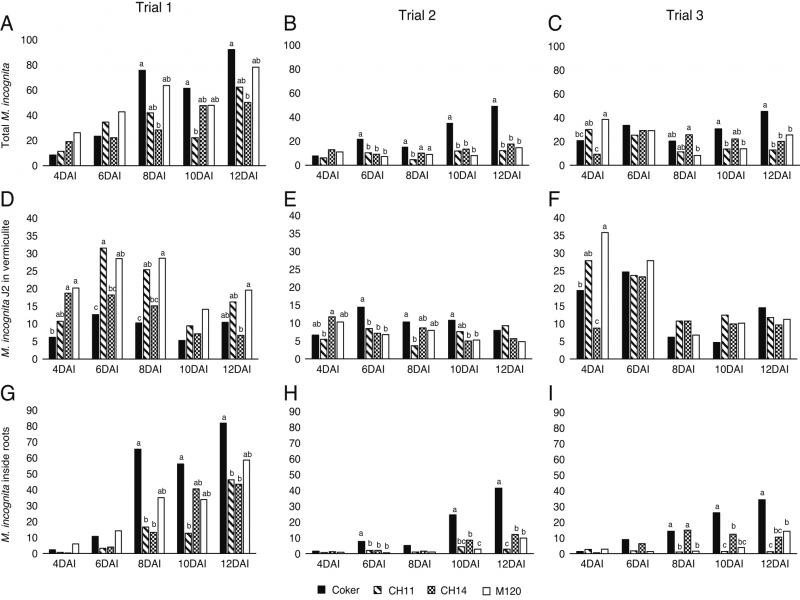
Figure 1:
Numbers of Meloidogyne incognita remaining inside roots, egressed from roots into the vermiculite, and total counts on four cotton isolines that differ in M. incognita-resistance genes in three experimental trials. DAI = days after inoculation. Different letters over bars within a sampling date indicate significant differences at α = 0.05. Bars with no letters showed no significant difference within a sampling date.
The number of nematodes that egressed from roots expressed as a percentage of the total number of nematodes differed among the cotton genotypes. Beginning 8 DAI, the percentage of nematodes that had egressed from the roots of M-120 RNR was generally greater than the percentage from the roots of Coker 201 with differences that were always numerically greater in all trials and generally statistically greater in Trials 2 and 3 (Figure 2A–C). The percentage of nematodes leaving the roots of CH11 and CH14 did not consistently differ from M-120 RNR among the trials. The percentage of nematodes remaining inside the roots was the inverse of the percentage egressing from roots, with Coker 201 generally retaining a greater percentage of nematodes inside the roots than did M-120 RNR and with the number of nematodes in CH11 and CH14 not consistently differing from the number in M-120 RNR (Figure 2D–F).
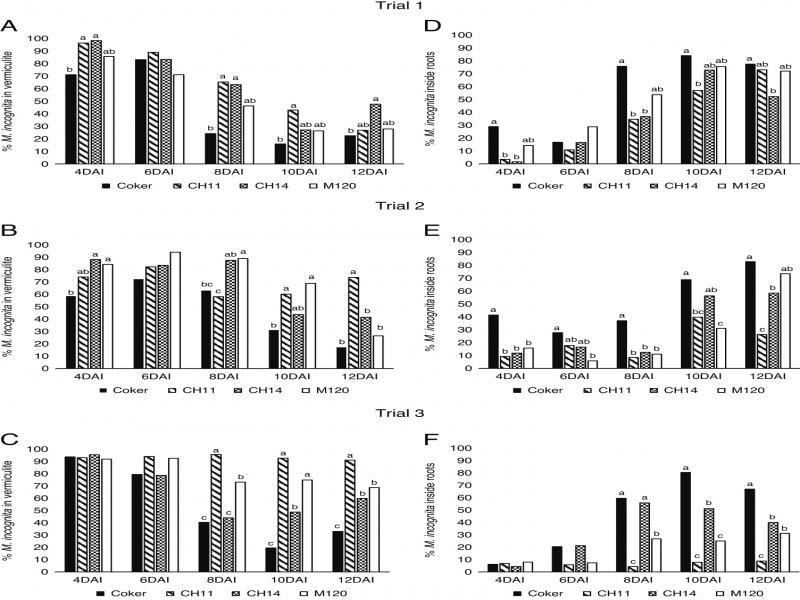
Figure 2:
Percentage of Meloidogyne incognita inside and outside of the roots (egressed into the vermiculite) of four cotton isolines that differ in M. incognita-resistance genes in three experimental trials. DAI = days after inoculation. Different letters over bars within a sampling date indicate significant differences at α = 0.05. Bars with no letters showed no significant difference within a sampling date.
The number of eggs per egg mass was two to three times greater at 40 DAI than at 30 DAI on all cotton genotypes. At 30 DAI, Coker 201 had the most eggs/egg mass numerically, but only CH11 had significantly less than Coker 201 (Table 1). At 40 DAI, Coker 201 had more eggs per eggs mass than the other genotypes, M-120 RNR had the fewest, and CH11 and CH14 were intermediate. Percentage egg hatch did not differ among the genotypes and ranged from 15 to 20% (Table 1).
Table 1.
Gall size, percentage egg hatch, and eggs/egg mass for cotton isolines that differ in M. incognita-resistance genes at 0, 7, and 14 days.
| Gall size (cm2) 1 | Hatch (%) | Eggs/egg mass | ||||
|---|---|---|---|---|---|---|
| Genotype | 0 days | 7 days | 14 days | 40 DAI2 | 30 DAI | 40 DAI |
| Coker | 0.0085 A a | 0.0091 A a | 0.0081 A a | 17.20 A | 182 A | 495 A |
| CH14 | 0.0080 A a | 0.0090 A a | 0.0080 A a | 14.96 A | 123 AB | 325 BC |
| CH11 | 0.0091 A ab | 0.0100 A a | 0.0068 A b | 19.24 A | 146 B | 386 B |
| M-120 | 0.0056 B b | 0.0074 A a | 0.0075 A a | 18.60 A | 135 AB | 300 C |