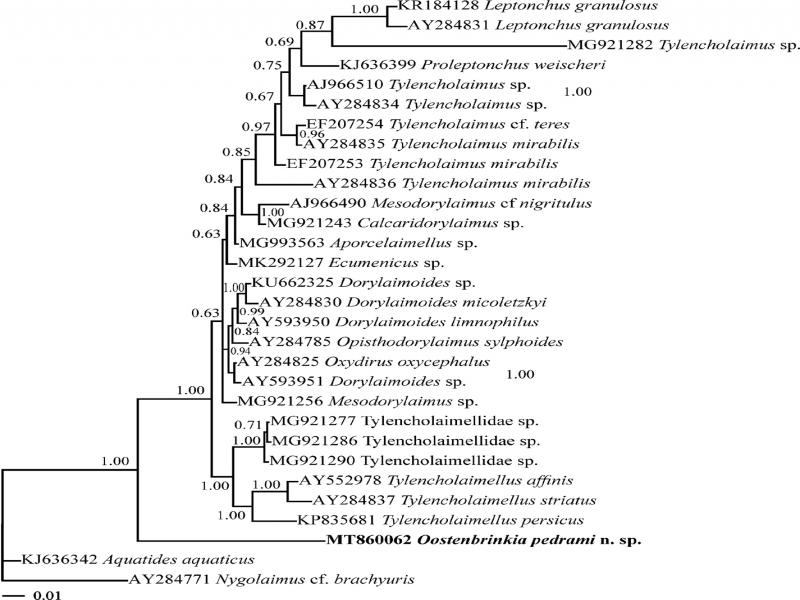
The nematode family Aulolaimoididae (Jairajpuri, 1964), currently placed in the dorylaimid superfamily Tylencholaimoidea (Filipjev, 1934), is mainly characterized by the presence of a basket-like structure in the stoma formed of small ribs, tripartite pharynx, and a distinct muscular pharyngeal bulb with a thickened valvular chamber. It represents a group of rarely collected soil-inhabiting nematodes (Andrássy, 2009). According to Mushtaq et al. (2006), this family contains 15 valid species belonging to four genera: Aulolaimoides (Micoletzky, 1915), Adenolaimus (Andrássy, 1973), Oostenbrinkia (Ali et al., 1973), and Cladocephalus (Swart and Heyns, 1991). The study by Mushtaq et al. (2006) and Pedram et al. (2012) represents the most recent studies on this rarely encountered family group.
The genus Oostenbrinkia is characterized by its smooth lip region, nonprotruding labial papillae, didelphic-amphidelphic genital system, and a short, rounded tail. It currently harbors two species, O. oostenbrinki (Ali et al., 1973), a large species (L = 780, 840 μm), and O. parva (Mushtaq et al., 2006) a smaller form (L = 440, 490 μm). Until now, only two species of the family Aulolaimoididae, Adenolaimus tropicus (Mushtaq et al., 2006) and Oostenbrinkia parva, have been recorded from Iran (Pedram et al., 2012); they added new information for the two aforementioned species.
During the present study, a population of an unknown species of the rarely collected genus Oostenbrinkia was recovered from natural forests of Mazandaran province in north Iran. The comparisons with two currently valid species under the genus revealed that it belongs to an unknown species, described herein as Oostenbrinkia pedrami n. sp. The molecular phylogenetic analysis for the new species, as the first representative of the family, was also performed.
Materials and methods
Sampling, nematode extraction, mounting, and drawing
Several soil samples were collected from natural forests and grasslands of Mazandaran province during July to August 2019. Nematodes were extracted from soil samples by means of the tray method (Whitehead and Hemming, 1965). Nematodes were observed and handpicked directly under a Nikon SMZ1000 stereomicroscope. The specimens were killed with hot 4% formaldehyde solution, transferred to anhydrous glycerin according to De Grisse (1969), and mounted on permanent slides. The specimens were examined using a Nikon Eclipse E600 light microscope. Photomicrographs were taken using an Olympus DP72 digital camera attached to an Olympus BX51 microscope equipped with differential interference contrast. Drawings were made using a drawing tube attached to the microscope and were redrawn using the CorelDRAW® software version 2017.
DNA extraction, PCR, and sequencing
For DNA extraction, a live individual nematode of the collected population of Oostenbrinkia was picked out, washed using distilled water, observed on a temporary slide, photographed, transferred to a small drop of Tris-EDTA (TE) buffer (10 mM Tris-Cl, 0.5 mM EDTA, pH 9.0, Qiagen) on a clean slide, and squashed using a clean slide cover with the aid of a pipette tip. The suspension was collected by adding 20 μl of TE buffer after gently removing the slide cover and leaving the solution on the slide (Pedram, 2017). The DNA sample was stored at −20°C until used as the polymerase chain reaction (PCR) template. The near-full-length sequence of the small subunit ribosomal DNA (SSU rDNA) was amplified using the forward primer 18S4 (5′-GCTTGTCTCAAAGATTAAGCC-3′) (Blaxter et al., 1998) and the reverse primr 18S-1573R (5′-TACAAAGGGCAGGGACGTAAT-3′) (Mullin et al., 2005). The PCR reaction for the amplification was performed according to Pedram (2019). The newly obtained sequence was deposited into the GenBank database under the accession number MT860062.
Phylogenetic analyses
The raw file of the newly generated sequence of SSU rDNA of Oostenbrinkia pedrami n. sp. was manually checked, edited, and compared with several other sequences of dorylaimid species available in GenBank database using the BLAST homology search program. The 30 selected sequences (maximal number of available SSU sequences of Tylencholaimoidea and sequences from other dorylaimid genera) were aligned with the Q-INS-i algorithm of the online version of MAFFT version 7 (http://mafft.cbrc.jp/alignment/server/) (Katoh and Standley, 2013). The online version of Gblocks 0.91b (Castresana, 2000) was used to eliminate ambiguous parts of the alignment, with all three options for a less-stringent selection (http://molevol.cmima.csic.es/castresana/Gblocks_server.html). The most appro-priate substitution model for the dataset was selected using the Akaike information criterion (AIC) by using PAUP∗/MrModeltest v2 (Nylander, 2004). A general time-reversible model, including a gamma distribution for rates across sites and a proportion of invariant sites (GTR + G + I), was selected for the phylogenetic analysis of the SSU dataset. Bayesian inference (BI) was performed using MrBayes v3.1.2 (Ronquist and Huelsenbeck, 2003) with selecting a random starting tree and running the chains for 3 × 10⁶ generations. After discarding burn-in samples, the remaining samples were retained for further analyses. The Markov chain Monte Carlo (MCMC) method within a Bayesian framework was used to estimate the posterior probabilities of the phylogenetic trees (Larget and Simon, 1999) using the 50% majority rule. The resultant phylogenetic tree was visualized with Dendroscope V.3.2.8 (Huson and Scornavacca, 2012) and drawn in CorelDRAW software version 16.
Results
Systematics
Oostenbrinkia pedrami n. sp. (Figs. 1, 2).
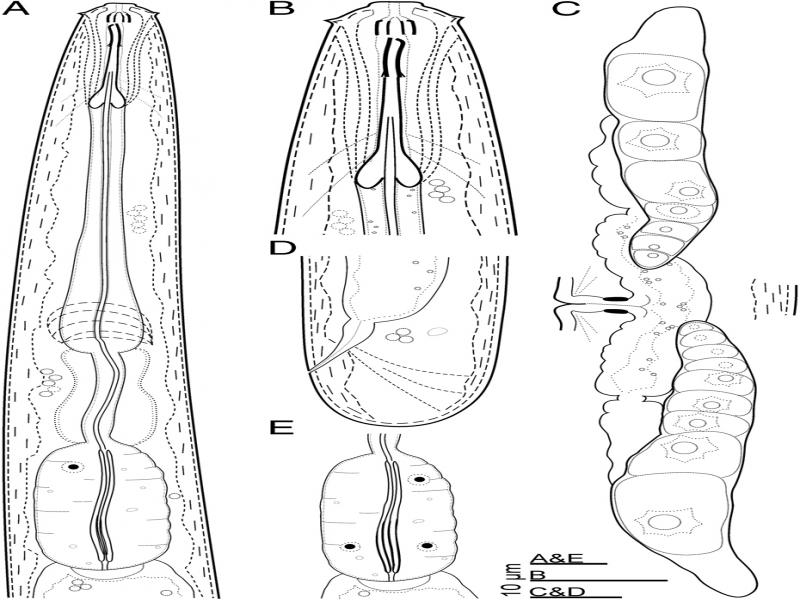
Figure 1:
Line drawings of Oostenbrinkia pedrami n. sp., female. (A): Neck region; (B): Anterior end; (C): Reproductive system; (D): Posterior body region; (E): Pharyngeal bulb with triquetrous chamber in its lumen.
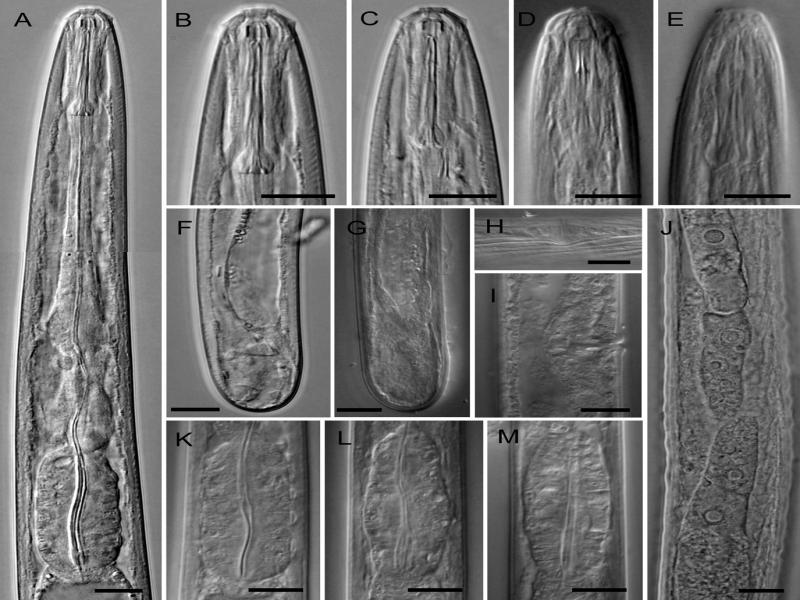
Figure 2:
Light photomicrographs of Oostenbrinkia pedrami n. sp., female and juvenile (A-C, F: Fresh sample in water; C, Juvenile). (A): Neck region; (B, D, E): Anterior body region in female; (C) Anterior body region; (F, G): Posterior body region; (H, I): Vulva region; (J): Part of the reproductive system showing reflexed ovaries; (K-M): Pharyngeal bulb with variation of triquetrous chamber in its lumen. (Scale bars = 10 µm).
Measurements
Measurements of the new species are given in Table 1.
Table 1.
Morphometrics of Oostenbrinkia pedrami n. sp.
| Character | Holotype | Paratypes |
|---|---|---|
| n | – | 10 |
| L | 847 | 747 ± 83 (648-920) |
| a | 27.3 | 31.0 ± 1.8 (27.3-33.5) |
| b | 5.0 | 4.7 ± 0.4 (4.0-5.5) |
| c | 65.2 | 56.8 ± 8.8 (42.5-65.2) |
| c′ | 0.7 | 0.8 ± 0.1 (0.6-0.9) |
| V | 59.0 | 59.7 ± 0.9 (58.5-61.0) |
| Lip region width | 10 | 9.7 ± 0.4 (9.0-10.5) |
| Lip region height | 5 | 4.6 ± 0.5 (4-5) |
| Odontostyle | 6.5 | 7.0 ± 0.6 (6-8) |
| Odontophore | 19.5 | 19.6 ± 1.2 (18-21) |
| Total stylet length | 26 | 26.7 ± 1.6 (24-29) |
| Anterior end to nerve ring | 98 | 93.1 ± 5.2 (87-102) |
| Neck length | 171 | 159.4 ± 17.5 (124-187) |
| Body width at mid-body | 31 | 24.3 ± 3.9 (20-31) |
| Body width at anus/cloaca | 20 | 17.8 ± 1.6 (15.5-20.0) |
| Body width at the base of terminal bulb | 25.5 | 22.0 ± 1.9 (19.0-25.5) |
| Anterior genital tract | 109 | 70.4 ± 21.3 (45-109) |
| Posterior genital tract | 115 | 74 ± 22 (52-115) |
| Length of terminal bulb | 36 | 39.1 ± 2.0 (36.0-42.5) |
| Width of terminal bulb | 17 | 14.7 ± 2.0 (12-17) |
| Flanges width | 4 | 4.9 ± 0.6 (4-6) |
| Anterior genital branch as % to L (G1) | 12.9 | 9.5 ± 2.3 (6.4-12.9) |
| Posterior genital branch as % to L (G2) | 13.6 | 10.0 ± 2.2 (7.3-13.6) |
| Prerectum/anal body width | 5.5 | 4.6 ± 1.3 (2.6-6.0) |
| Cardia length | 6.5 | 5.7 ± 0.8 (5-7) |
| Cardia width | 9.5 | 9.4 ± 0.4 (9-10) |
| Anterior end to vulva | 495.5 | 434 ± 32 (395-495) |
| Prerectum length | 110 | 97.4 ± 26.0 (50-125) |
| Rectum length | 14 | 12.6 ± 2.0 (10-16) |
| Tail length | 13 | 13.6 ± 2.4 (10-18) |