
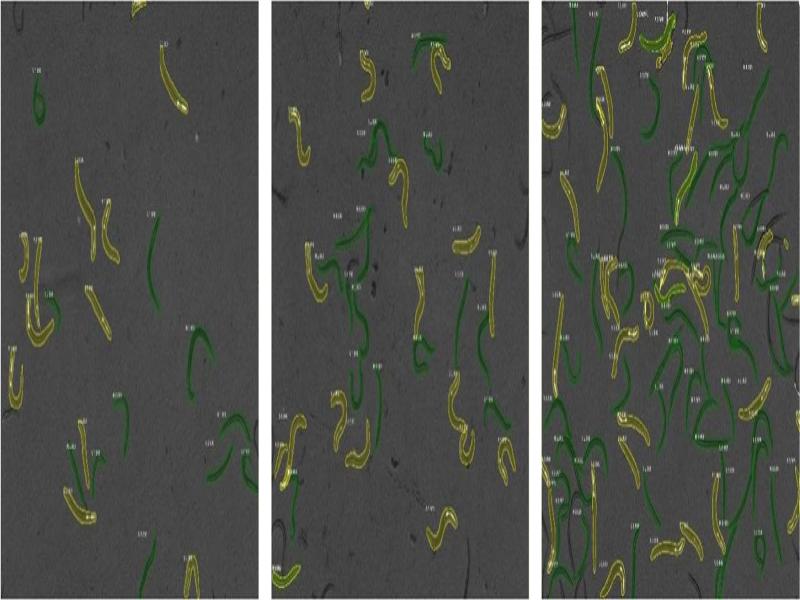
Figure 1:
Images with GFP (yellow) and non-GFP (green) animals marked by the CNN model.
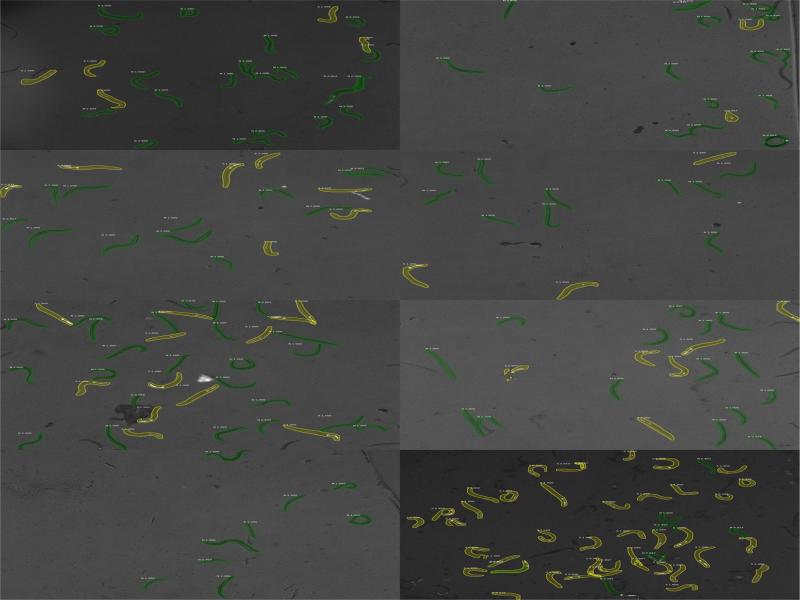
Figure S1:
Pictures that rendered: the most extreme proportion differences (+) on the first panel, the most extreme proportion differences (−) second panel, no difference on the last panel.
Table 1.
Performance metrics of the CNN model computed on the evaluation set for low and moderate animal densities (below 70).
| Area | ||||
|---|---|---|---|---|
| Metric | Small | Medium | Large | All |
| Average precision @ IoU = 0.50 | No animals | 0.870 | 0.883 | 0.872 |
| Average recall @ IoU = 0.50 | No animals | 0.930 | 0.918 | 0.917 |
Table 2.
Performance metrics of the CNN model computed on the evaluation set for high animal densities (above 70).
| Area | ||||
|---|---|---|---|---|
| Metric | Small | Medium | Large | All |
| Average precision @ IoU = 0.50 | No animals | 0.784 | 0.810 | 0.787 |
| Average recall @ IoU = 0.50 | No animals | 0.851 | 0.856 | 0.842 |
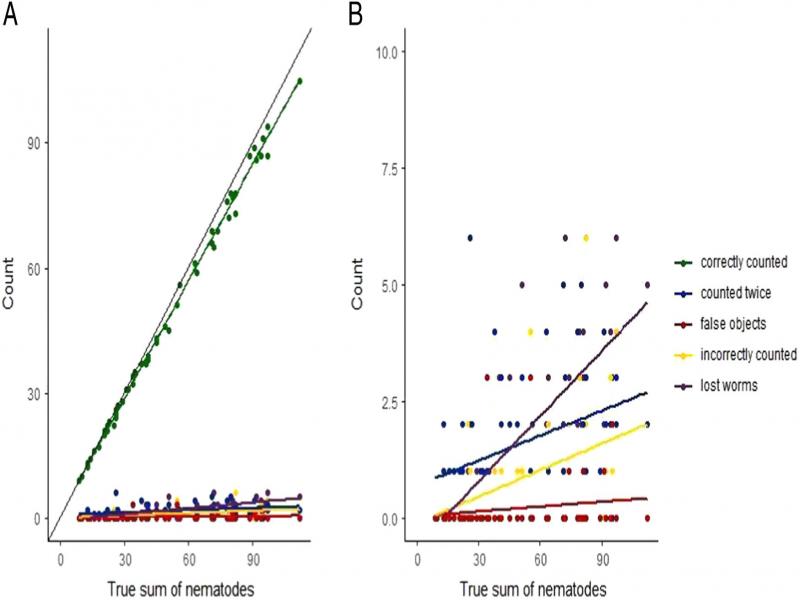
Figure 2:
(A) Correct detection of worms and the number of errors at increasing concentrations of animals, (B) Close-up of error types at increasing animal density.
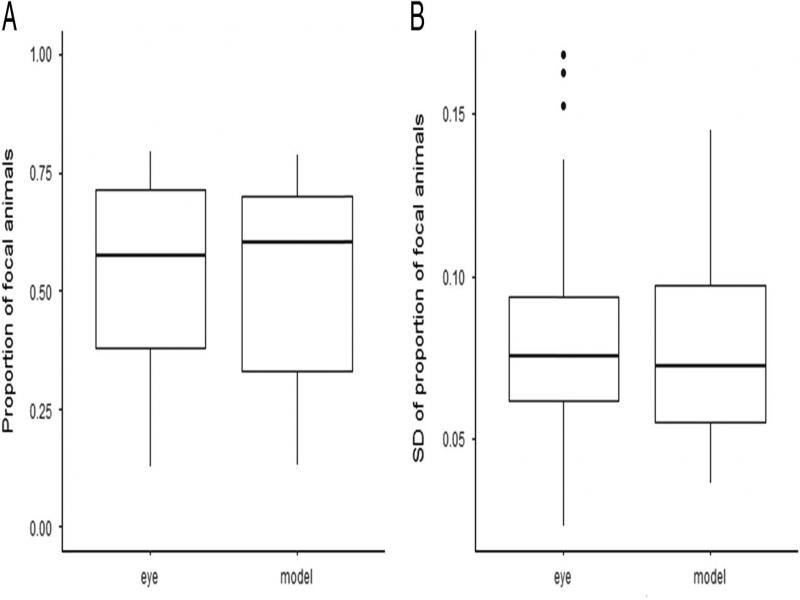
Figure 3:
(A) Boxplot of the frequency of focal animals for the two methods, (B) Boxplot of the standard deviation of the proportion of focals for the two methods.
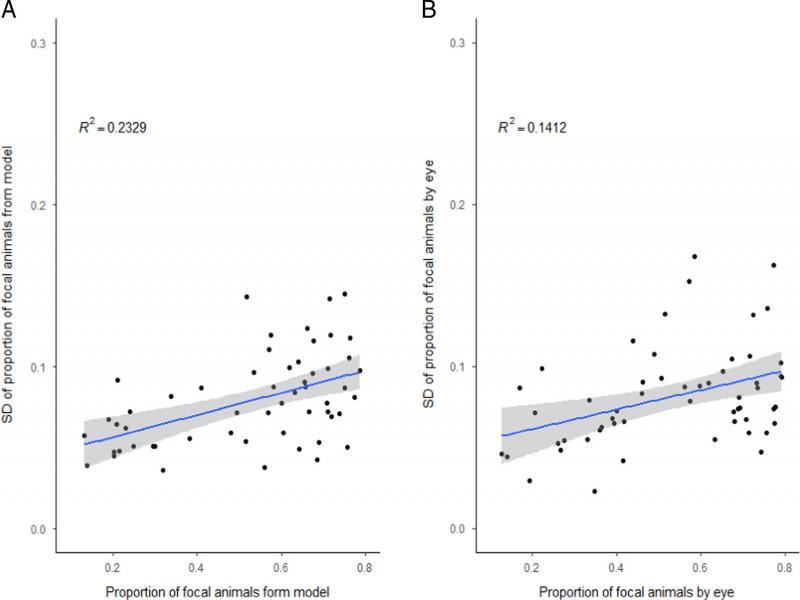
Figure S2:
Variability of measures of competitive fitness. Plots of measures of variability (y-axis) vs. measures of competitive fitness (x-axis). Panel A show the plots for the model, while panel B, for the plots for count ‘by eye’. Panels show the frequency of the focal animals as the measure of competitive fitness.