
Table 1.
Reaction test on Xanthosoma sagittifolium with Meloidogyne enterolobii under the six treatments and the tomato (indicator plant) showing susceptibility or resistance in the treatments based on the reproduction factor (RF).
| M. enterolobii | ||||||
|---|---|---|---|---|---|---|
| Plant | Inoculated eggsa | Galls | Egg mass | Eggs | RFb | Classification |
| X. sagittifolium | 0 | 0b | 0b | 0b | 0b | Resistant |
| 333 | 0b | 0b | 0b | 0b | ||
| 999 | 0b | 0b | 0b | 0b | ||
| 3,000 | 0b | 0b | 0b | 0b | ||
| 9,000 | 0b | 0b | 316b | 0.03b | ||
| 27,000 | 0b | 0b | 1,076b | 0.04b | ||
| Tomato | 1,000 | 4.80a | 4.80a | 13,876a | 13.9a | Susceptible |
| CV (%) | – | 3.00 | 3.00 | 42.78 | 10.41 | – |
1 Notes: aNumber of inoculated eggs; bFR = final population/initial population. Plants with FR < 1 are considered resistant and FR ≥ 1 susceptible (Oostenbrink, 1966).
Table 2.
Reaction test on Xanthosoma sagittifolium with Meloidogyne incognita under the six treatments and the tomato (indicator plant) showing susceptibility or resistance in the treatments based on the reproduction factor (RF).
| M. incognita | ||||||
|---|---|---|---|---|---|---|
| Plant | Inoculated eggsa | Galls | Egg mass | Eggs | RFb | Classification |
| X. sagittifolium | 0 | 0b | 0b | 0b | 0b | Resistant |
| 333 | 0b | 0b | 0b | 0b | ||
| 999 | 0b | 0b | 0b | 0b | ||
| 3,000 | 0b | 0b | 0b | 0b | ||
| 9,000 | 0b | 0b | 0b | 0b | ||
| 27,000 | 0b | 0b | 0b | 0b | ||
| Tomato | 1,000 | 4.80a | 4.80a | 12,350a | 12.35a | Susceptible |
| CV (%) | – | 3.00 | 3.00 | 40.86 | 14.86 | – |
1 Notes: aNumber of inoculated eggs; bRF = final population/initial population. Plants with FR < 1 are considered resistant and FR ≥ 1 susceptible (Oostenbrink, 1966).
Table 3.
Reaction test on Xanthosoma sagittifolium with Meloidogyne javanica under the six treatments and the tomato (indicator plant) showing susceptibility or resistance in the treatments based on the reproduction factor (RF).
| M. javanica | ||||||
|---|---|---|---|---|---|---|
| Plant | Inoculated eggsa | Galls | Egg mass | Eggs | RFb | Classification |
| X. sagittifolium | 0 | 0b | 0b | 0b | 0b | Resistant |
| 333 | 0b | 0b | 0b | 0b | ||
| 999 | 0b | 0b | 240b | 0.24b | ||
| 3,000 | 0b | 0b | 326b | 0.11b | ||
| 9,000 | 0b | 0b | 360b | 0.04b | ||
| 27,000 | 0b | 0b | 582b | 0.02b | ||
| Tomato | 1,000 | 4.80a | 4.80a | 10,592a | 10.6a | Susceptible |
| CV (%) | – | 3.00 | 3.00 | 56.59 | 14.19 | – |
1 Notes: aNumber of inoculated eggs; bRF = final population/initial population. Plants with FR < 1 are considered resistant and FR ≥ 1 susceptible (Oostenbrink, 1966).
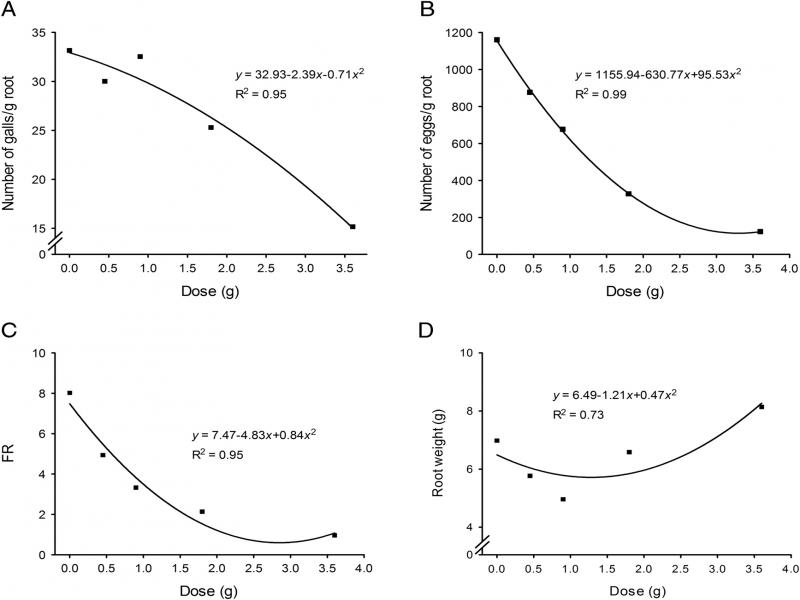
Figure 1:
Biofumigation with Xanthosoma sagittifolium leaves macerates against Meloidogyne enterolobii. These experiments were done by incorporating X. sagittifolium leaves at different concentration (g/45 g) along with M. enterolobii eggs and planting tomato after three days of biofumigation. A: Number of galls. B: Number of eggs. C: Reproduction factor. D: Root weight. The experiments were done twice. Quadratic polynomial regression models, p < 0.01.
Table 4.
Volatilome of Xanthosoma sagittifolium leaves by gas chromatography.
| Compounds | RI expa | RI Litb | Intensityc Macerated | Intensityc Water |
|---|---|---|---|---|
| Ethanol | – | – | XX | XX |
| Acetone | – | – | XX | XX |
| Propanol | – | – | X | X |
| Ethyl acetate | 609 | 628 | X | X |
| 2-methyl-propanol | 615 | 622 | – | X |
| 3-penten-1-ol | 687 | 686 | X | X |
| 3-pentanone | 700 | 696 | X | X |
| Acetoin | 720 | 718 | X | – |
| 3-methyl-butanol | 737 | 734 | XX | XX |
| 2-methyl-butanol | 740 | 738 | X | X |
| 2,3-butanediol | 811 | 811 | X | – |
| Ethyl 2-methyl-butanoate | 849 | 846 | X | – |
| 3-hexen-1-ol | 856 | 857 | XX | XX |
| Hexanol | 871 | 867 | X | X |
| 3-methyl-butyl acetate | 875 | 880 | X | – |
| 3-octanone | 985 | 984 | X | – |
| 2-ethyl-hexanol | 1,033 | 1,029 | X | X |
| Not identified | 1,189 | – | X | – |
| Dodecane | 1,199 | 1,200 | X | – |
1 Notes: aCalculated retention indices by injecting a homologous series of alkanes; bTheoretical retention index according to the literature (ADAMS, 2007); cX: low intensity; XX: medium to high intensity.
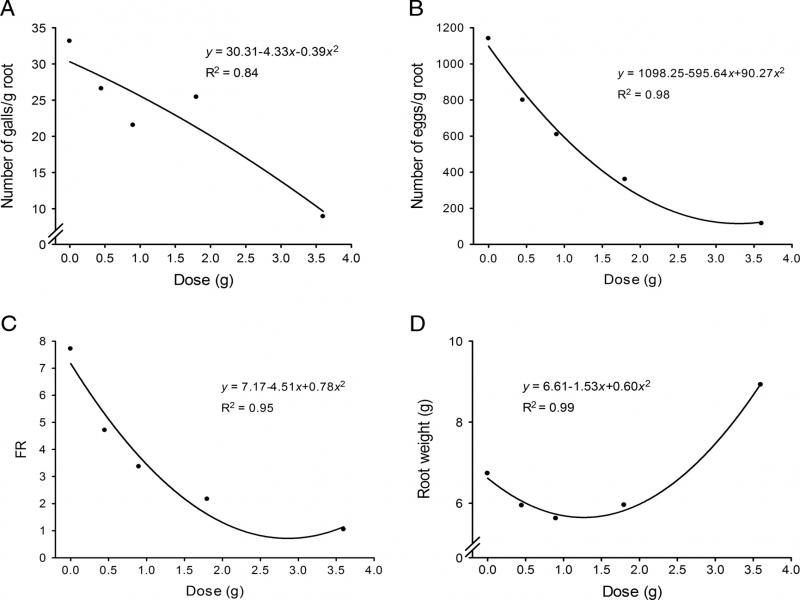
Figure S1:
Biofumigation with Xanthosoma sagittifolium leaves macerates against Meloidogyne enterolobii. These experiments were done by incorporating X. sagittifolium leaves at different concentration (g/45 g) along with M. enterolobii eggs and planting tomato after three days of biofumigation. A: Number of galls. B: Number of eggs. C: Reproduction factor. D: Root weight. Experiment two. Quadratic polynomial regression models, p < 0.01.