
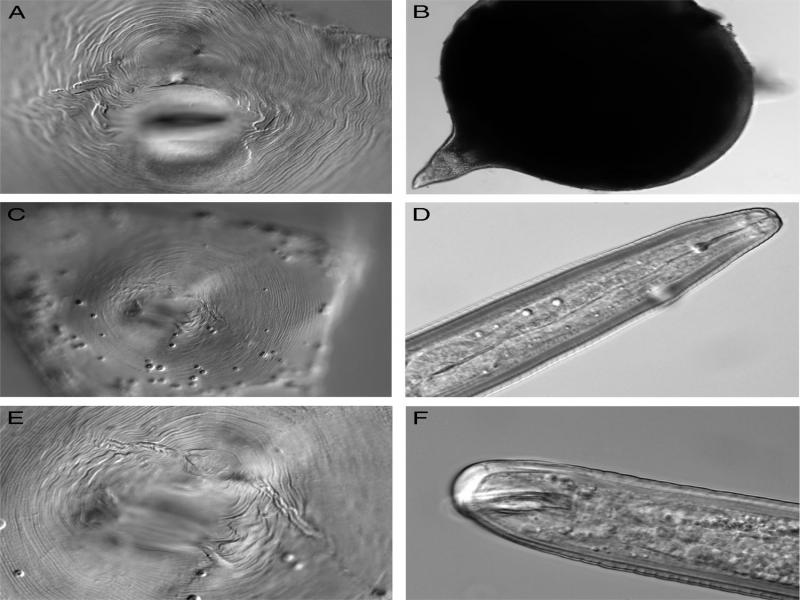
Figure 1:
Light micrographs of females and males of Meloidogyne mali. A, C, E: perineal pattern; B: whole female; D: male head; E: male tail (scale bars = 10 μm).
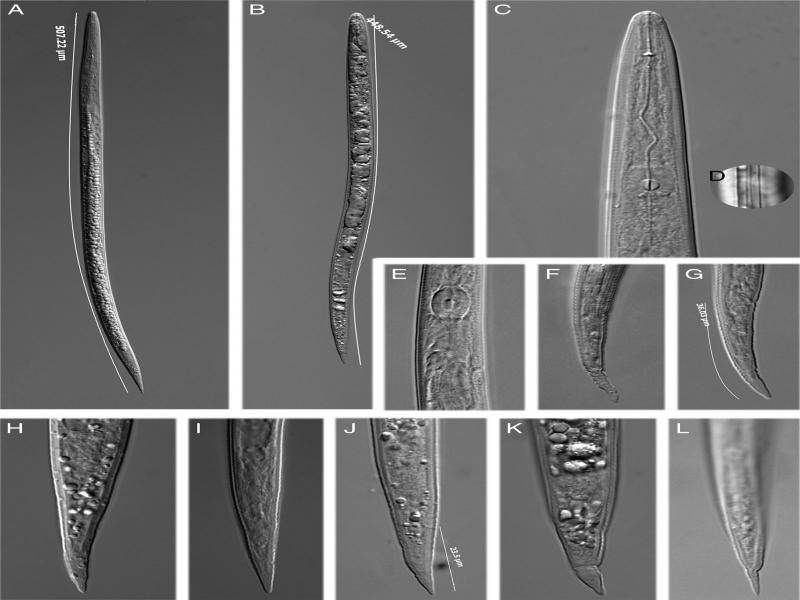
Figure 2:
Light micrographs of juveniles of Meloidogyne mali. A: whole body of a long juvenile; B: whole body of a normal juvenile; C: anterior region; D: lateral lines; E: median bulb region; F-L: tail region. (scale bars = 10 μm).
Table 1.
Morphometrics of the described M. mali population from Japan compares to a population detected in 2013.
| M. mali population with high intragenomic rRNA polymorphism | M. mali population (Gu et al., 2013) | |
|---|---|---|
| n | 20 | 20 |
| Body length | 445 ± 28.3 (401-507) | 425 ± 30.1 (362-466) |
| Body width at mid-body | 14.0 ± 0.6 (13.1-15.4) | 14.0 ± 1.1 (13.1-18.1) |
| Anterior end to median bulb valve | 52.7 ± 4.1 (46.8-58.7) | 53.5 ± 2.1 (49.5-56.8) |
| Anterior end to the hemizonid | 79.0 ± 3.8 (74.4-85.5) | – |
| Anterior end to the excretory pore | 75.1 ± 4.2 (72.8-83.3) | 74.1 ± 4.2 (68.8-82.3) |
| Head width | 5.8 ± 0.3 (5.3-6.4) | 5.1 ± 0.41 (4.1-5.7) |
| Head height | 3.0 ± 0.2 (2.6-3.4) | 2.6 ± 0.32 (2.1-3.2) |
| Stylet length | 10.4 ± 0.5 (9.4-11.1) | 10.5 ± 0.5 (9.5-11.6) |
| Stylet cone length | 5.4 ± 0.2 (5.1-5.8) | 5.7 ± 0.5 (4.7-6.7) |
| Stylet knob height | 1.5 ± 0.4 (1.0-2.6) | 1.2 ± 0.2 (0.8-1.6) |
| Stylet knob width | 2.2 ± 0.3 (1.8-2.8) | 2.1 ± 0.2 (1.8-2.7) |
| DGO | 3.2 ± 0.5 (2.4-4.0) | 4.4 ± 0.57 (3.5-5.5) |
| Tail length | 30.5 ± 4.5 (23.5-35.8) | 32.7 ± 3.0 (29.2-39.3) |
| Body width at the anus | 7.8 ± 0.7 (6.1-8.7) | 7.9 ± 0.9 (5.9-9.6) |
| Hyaline tail terminus length | 9.8 ± 1.6 (6.8-12.0) | 7.2 ± 2.3 (3.9-9.3) |
| a | 31.9 ± 2.5 (27.4-36.6) | 30.4 ± 2.6 (25.2-34.5) |
| b′ | – | 8.0 ± 0.6 (6.8-9.2) |
| c | 14.8 ± 2.5 (12.1-19.4) | 13.2 ± 1.1 (11.6-15.3) |
| c′ | 3.8 ± 0.6 (3.0-4.8) | 4.2 ± 0.7 (3.1-5.6) |
| m | 52.4 ± 2.4 (49.5-58.6) | 54.5 ± 3.8 (47-60.3) |
| O | 30.6 ± 4.7 (22.9-38.8) | 41.9 ± 5.8 (31.6-53.9) |
| Head width/head height | 1.9 ± 0.1 (1.7-2.2) | 2.0 ± 0.2 (1.6-2.3) |
| H% | 33.2 ± 8.6 (19.1-47.3) | 21.7 ± 5.9 (12.7-27.8) |
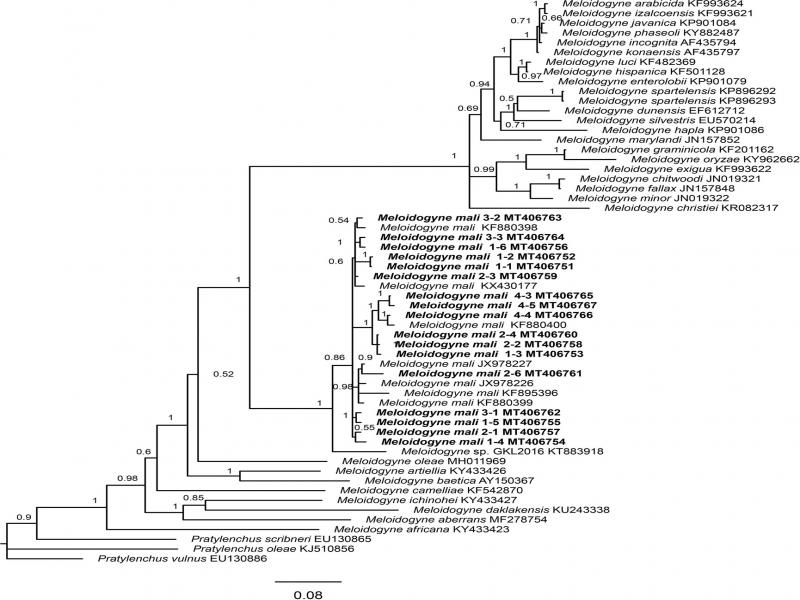
Figure 3:
Phylogenetic relationships within the genus Meloidogyne as inferred from Bayesian analysis of the D2-D3 region of the 28S rRNA gene sequences using the GTR + I + G model. Posterior probabilities are given in clade nodes. Newly obtained sequences are indicated in bold and the sequence codes are given in specimen-clone.
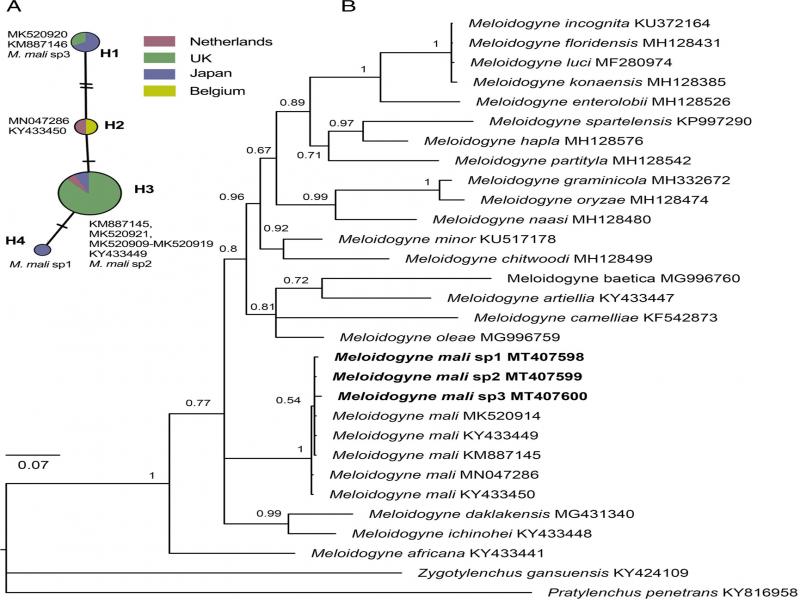
Figure 5:
The TCS haplotype networks of Meloidogyne mali (A) and the Bayesian majority rule consensus tree of Meloidogyne mali based on mitochondrial COI gene (B). A: Pie chart indicates the composition and proportion of haplotypes in each location. Each circle corresponds to one haplotype and its size is proportional to its frequency. Each line connecting the haplotypes refers to a mutational step. Marks on the lines indicate the number of steps. B: Values at branche nodes are Bayesian posterior probabilities. Newly submitted sequences are indicated in bold.
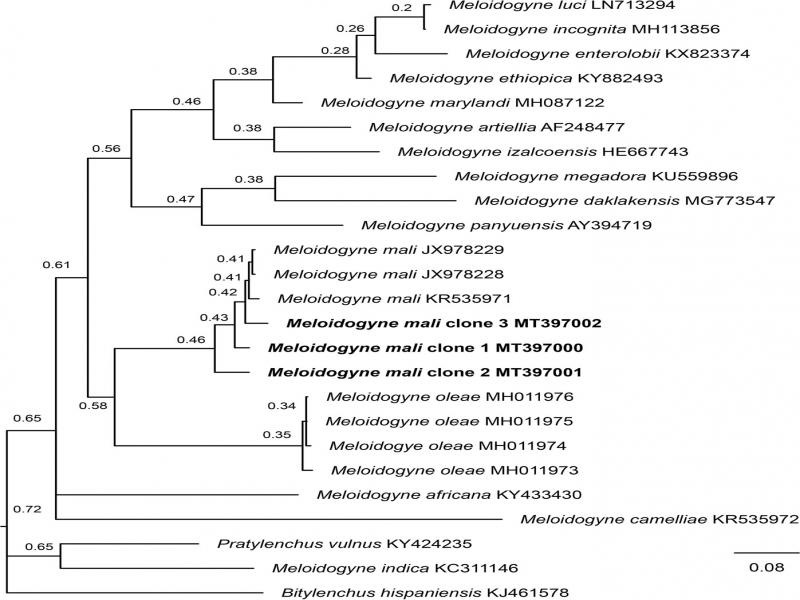
Figure 4:
Phylogenetic relationships within the genus Meloidogyne as inferred from Bayesian analysis of the ITS sequences using the GTR + I + G model. Posterior probabilities are given in clade nodes. Newly obtained sequences are indicated in bold.