
Table 1.
Description and level of anthropic disturbance in three areas of Restinga de Jurubatiba National Park, Brazila.
| Levels | |||
|---|---|---|---|
| Description | Area 1 | Area 2 | Area 3 |
| Removal of vegetation due to road construction | 1b | 1 | 0 |
| Removal of vegetation for the establishment of commercial activities | 1 | 0 | 0 |
| Removal of vegetation of gardening/landscaping interest | 2 | 1 | 0 |
| Removal of vegetation for establishment of coconut plantation | 2 | 0 | 0 |
| Damage to vegetation due to human trampling | 2 | 2 | 0 |
| Littering on vegetation | 2 | 1 | 0 |
| Traffic of vehicles in the area | 2 | 1 | 1 |
| Establishment of housing | 2 | 0 | 0 |
| Sand removal for building purposes | 2 | 1 | 0 |
| Sum | 16 | 7 | 1 |
1 Notes: aAdapted from Rocha et al. (2004); blevels: 0: non-existent; 1: little or localized; 2: intense or widespread.
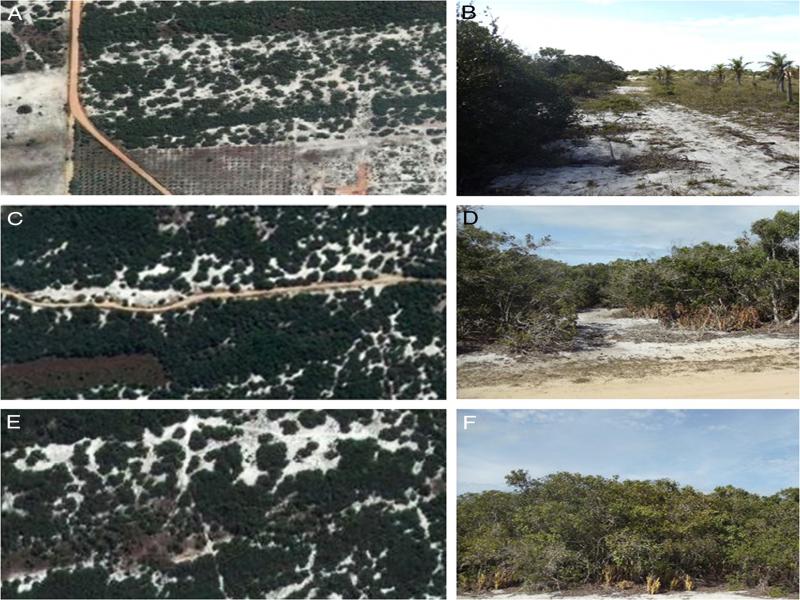
Figure 1:
Satellite (source Google Maps®) and ground views of areas with different levels of anthropic disturbance, in Restinga de Jurubatiba National Park, Brazil. A, B: area 1, most disturbed; C, D: area 2, intermediate; D, E: area 3, least disturbed.
Table 2.
ANOVA of nematode abundance in Neoregelia cruenta phytotelma, in areas with different levels of anthropic disturbance, in Restinga de Jurubatiba National Park, Brazil.
| Sources of variation | Statistical parameters | Area | Season | Area×season | Error | R 2 |
|---|---|---|---|---|---|---|
| Bacterial feeders | MSEa | 123.3 | 363.3 | 393.5 | 94.7 | 0.5 |
| p-value | nsc | ***b | *** | – | – | |
| Hyphal feeders | MSE | 261.7 | 162.9 | 62.8 | 24.5 | 0.6 |
| p-value | *** | *** | ** | – | – | |
| Carnivores | MSE | 771.4 | 570.7 | 469.7 | 96.3 | 0.6 |
| p-value | *** | *** | *** | – | – | |
| Total abundance | MSE | 293.7 | 3877.7 | 1266.1 | 558 | 0.6 |
| p-value | ns | *** | ** | – | – |
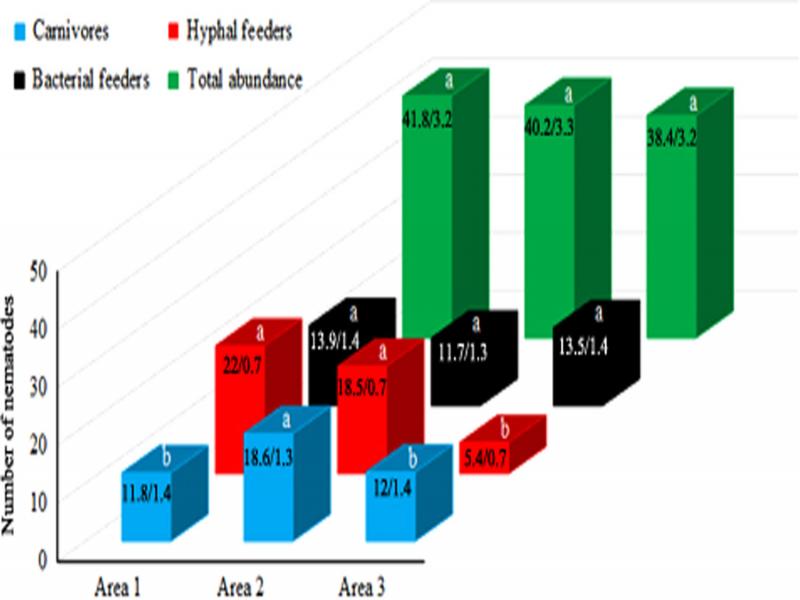
Figure 2:
Mean number of nematodes in Neoregelia cruenta phytotelma in areas (1-3) with different levels of anthropic disturbance, in Restinga de Jurubatiba National Park, Brazil. For each trophic group, columns marked with the same letter are not significantly different according to the Tukey test at 5%. Numbers in the columns indicate the mean number/standard error of the mean. Values are mean of 64 sampled bromeliads.
Table S1.
Mean number of nematodes in Neoregelia cruenta phytotelma in seasonal samplings in areas with different levels of anthropic disturbance, in Restinga de Jurubatiba National Park, Brazil.
| Season/year | Area | BFa | HF | C | Total abundance |
|---|---|---|---|---|---|
| Fall/2014 | 1b | 14.7a | 22a | 17b | 82.1ab |
| 2 | 9.9a | 18.5a | 57a | 92.7a | |
| 3 | 8.9a | 5.4b | 21.1b | 54.2b | |
| Winter/2014 | 1 | 2.4a | 5.8a | 8.9a | 31.6b |
| 2 | 9.7a | 9.6a | 14.6a | 44.5ab | |
| 3 | 14.4a | 4a | 11.5a | 64.9a | |
| Spring/2014 | 1 | 15.9a | 7.2a | 14.8a | 48a |
| 2 | 29.3a | 5.8a | 7.2a | 40.2a | |
| 3 | 3.8a | 4.2a | 9.1a | 22.9a | |
| Summer/2015 | 1 | 22.4a | 11.8ab | 9.9a | 40.9a |
| 2 | 7.6b | 7.1a | 9.2a | 34.5a | |
| 3 | 8.9b | 3b | 6.8a | 25.1a | |
| Fall/2015 | 1 | 12.8a | 4.5a | 8.4a | 24a |
| 2 | 6.9a | 1.5a | 6.7a | 12.9a | |
| 3 | 7.3a | 0.6a | 6.3a | 11.3a | |
| Winter/2015 | 1 | 24.9a | 9.1a | 16a | 53.9a |
| 2 | 11.9b | 5.9a | 16.1a | 35.4a | |
| 3 | 29.7a | 2.7a | 12.3a | 48.9a | |
| Spring/2015 | 1 | 8.5a | 6.5a | 7.6b | 28.7a |
| 2 | 7.7a | 4.3a | 28.1a | 41.7a | |
| 3 | 7.5a | 5.3a | 10.5b | 24.5a | |
| Summer/2016 | 1 | 9.3b | 3.3a | 12.2a | 25.4ab |
| 2 | 10.4b | 2.3a | 10.2a | 19.6b | |
| 3 | 27.7a | 4.6a | 18.2a | 55.7a |
1 Notes: Values are adjusted means of eight bromeliads per season and per area. For each season, values followed by the same letter in the columns do not differ by the Tukey test at 5%. aBF: bacterial feeders; HF: hyphal feeders; C: carnivores; bcomparison of anthropic disturbance among areas: 1 > 2 > 3.
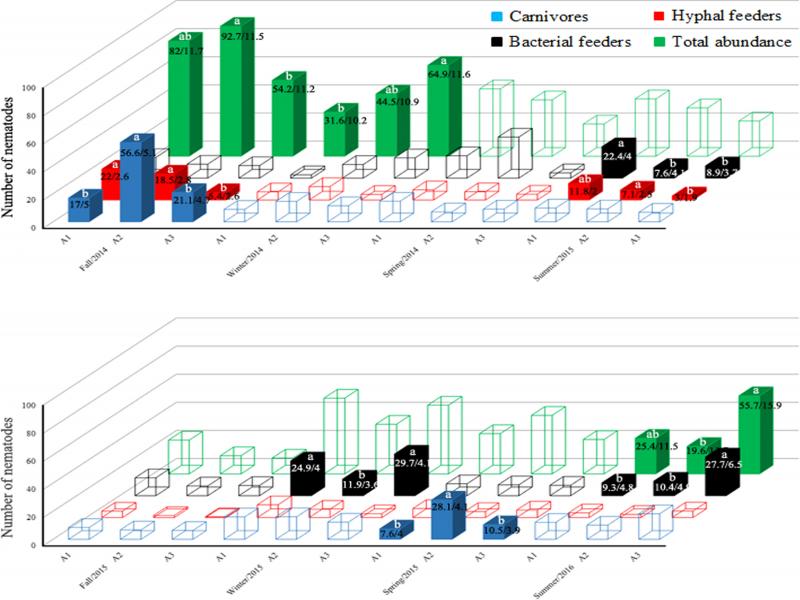
Figure 3:
Mean number of nematodes in Neoregelia cruenta phytotelma in seasonal samplings in areas (A1-A3) with different levels of anthropic disturbance, in Restinga de Jurubatiba National Park, Brazil. For each sampling, empty columns indicate no significant differences among areas according to the Tukey test at 5%. Different letters indicate significant differences among areas. Numbers in the columns indicate the mean number/standard error of the mean. Values are mean of eight bromeliads sampled per season and per area.
Table 3.
Descriptive statistics of physico–chemical properties of the water retained in Neoregelia cruenta phytotelma, in areas with different levels of anthropic disturbance, in Restinga de Jurubatiba National Park, Brazil.
| Areas | ||||||
|---|---|---|---|---|---|---|
| 1a | 2 | 3 | ||||
| Properties | Mean (min-max) | SD | Mean (min-max) | SD | Mean (min-max) | SD |
| Temp (°C)b | 21.9 (20-26) | 2.1 | 22.1 (20-26) | 2.3 | 21.1 (20-29) | 2.6 |
| DO2 (mg/L) | 5.5 (2.7-8) | 1.2 | 5.6 (3.7-7.4) | 0.9 | 5.7 (3.2-8) | 1 |
| DS (mg/L) | 64.1 (12-381) | 55.1 | 69.8 (9-284) | 54.2 | 80 (8-247) | 56.6 |
| EC (mS/cm) | 0.09 (0.02-0.6) | 0.08 | 0.1 (0.01-0.4) | 0.08 | 0.1 (0.01-0.4) | 0.08 |
| pH | 6.1 (4.1-8.2) | 0.8 | 5.8 (4.5-6.8) | 0.6 | 5.6 (3.5-8.1) | 0.7 |
| Vol (mL) | 270.6 (25-845) | 171.2 | 271.1 (20-740) | 177.1 | 222.5 (37-910) | 157.9 |
| OD (g) | 13.4 (0.3-55.8) | 12.3 | 13.5 (1-61.4) | 12.4 | 13.7 (1-51) | 10.4 |
| DOC (mg/L) | 62.3 (13.2-210.7) | 42.8 | 78.7 (14.9-468.3) | 64.8 | 97.4 (15.9-574) | 108.5 |
| N (mg/L) | 4.1 (0.1-17.4) | 2.9 | 4.4 (0.1-10.8) | 2.7 | 4.2 (0.1-12.8) | 2.9 |
1 Notes: Values are mean of eight bromeliads sampled every season, from June 2014 through March 2016, for a total of 64 samples. aComparison of anthropic disturbance among areas: 1 > 2 > 3; bTemp: temperature; DO2: Dissolved oxygen; DS: dissolved solids; EC: electrical conductivity; Vol: volume; OD: macroscopic organic debris; DOC: dissolved organic carbon; N: nitrogen.