
Table 1.
Morphometric data of Heterodera dunensis n. sp. from fixed specimens mounted in glycerin, except for cysts that were not fixed.
| Cysts | |
| n | 21 |
| Length without neck (L) | 482 ± 75 (316-610) |
| Maximum cyst width (W) | 360 ± 72.1 (241-478) |
| Neck length | 110 ± 31.9 (55-180) |
| L/W | 1.4 ± 0.2 (1.2-1.9) |
| Vulval area | |
| n | 13 |
| Fenestral length | 42.1 ± 4.3 (37-51) |
| Mean semifenestral width | 41.8 ± 5.2 (34-53) |
| Vulva bridge width | 8.1 ± 1.6 (5.2-11) |
| Vulva slit length | 52.1 ± 7.3 (35-63) |
| Underbridge length | 63.4 ± 9.8 (44-83) |
| Underbridge width | 18.2 ± 6.2 (8.8-29) |
| Vulva-anus distance | 58.4 ± 5.7 (50-68) |
| Juveniles | |
| n | 21 |
| Body length (L) | 471 ± 25.3 (426-520) |
| a = L/MBD | 20.1 ± 1.4 (19-23) |
| b = L/Anterior end to pharynx-intestine junction | 3.6 ± 0.4 (3.1-4.8) |
| b′ = L/Anterior end to the end of pharyngeal gland | 2.7 ± 0.2 (2.4-3.1) |
| c = L/Tail length | 11.6 ± 0.6 (11-12) |
| c′ = Tail length/ABD | 33.6 ± 2.6 (27-39) |
| Stylet length | 29.1 ± 1.1 (27-31) |
| Stylet knob width | 6.4 ± 0.4 (5.9-7) |
| Lip region height | 4.8 ± 0.3 (4.3-5.3) |
| Lip region width | 9.1 ± 0.4 (8.6-10) |
| Dorsal gland opening from stylet base | 3.7 ± 0.4 (3.2-4.4) |
| Anterior end to median valve | 74.2 ± 2.4 (70-79) |
| Anterior end to secretory-excretory pore | 109 ± 3.9 (101-117) |
| Anterior end to pharynx-intestine junction | 131 ± 11.1 (103-155) |
| Anterior end to pharyngeal gland end | 177 ± 9.2 (156-193) |
| Maximum body diameter (MBD) | 23.5 ± 1.4 (21-26) |
| Anal body diameter (ABD) | 14.1 ± 0.8 (13-16) |
| Tail length | 40.7 ± 2.4 (35-45) |
| Hyaline tail length | 20.6 ± 1.9 (16-23) |
Table 2.
Comparison of important characters of seventeen Heterodera species of the Schachtii group.
| Character | Cyst length (L) | Cyst width (W) | L/W ratio | Fenestral length | Fenestral width | Vulval slit length | J2 body length | J2 stylet length | J2 tail length | J2 tail hyaline length | Hyaline% of the tail |
|---|---|---|---|---|---|---|---|---|---|---|---|
| H. agrostis | 429-800 | 320-541 | 1.2-2.6 | 34-54 | 16-24 | 39-48 | 384-472 | 25-26 | 46-61 | 27-40 | 59-66 |
| H. betae | 830-878 | 455-518 | 1.6-1.9 | 44-55 | 38-43 | 48-57 | 547-607 | 29-31 | 70-74 | 38-42 | 54-57 |
| H. cajani | 448-670 | 209-422 | 1.4-2.1 | 27-65 | 25-40 | 43-55 | 420-519 | 22-27 | 42-52 | 23-31 | 55-60 |
| H. ciceri | 570-930 | 350-550 | 1.6-2.4 | 32-52 | 20-37 | 43-60 | 440-585 | 27-30 | 53-72 | 31-42 | 58-58 |
| H. daverti | 650-749 | 380-491 | 1.4-1.5 | 42-54 | 31-40 | 47-52 | 457-476 | 25-26 | 54-57 | 30-33 | 56-58 |
| H. dunensis n. sp. | 316-610 | 241-478 | 1.2-1.9 | 37-51 | 34-53 | 35-63 | 426-520 | 27-31 | 35-45 | 16-23 | 46-51 |
| H. galeopsidis | 576-797 | 408-556 | 1.4-1.5 | 41-50 | 31-38 | 39-50 | 485-553 | 26-28 | 61-75 | 35-40 | 57-53 |
| H. glycines | 474-709 | 327-535 | 1.3-1.7 | 34-58 | 16-41 | 38-50 | 386-471 | 21-23 | 39-51 | 22-30 | 56-59 |
| H. lespedezae | 678-719 | 371-522 | 1.4-1.8 | 43-59 | 35-41 | 45-47 | 457-481 | 24-25 | 54-56 | 26-30 | 48-54 |
| H. medicaginis | 568-728 | 364-570 | 1.4-1.5 | 39-55 | 30-40 | 39-55 | 417-512 | 24-26 | 41-60 | 22-33 | 54-55 |
| H. mediterranea | 430-690 | 240-570 | 1.2-1.6 | 38-45 | 37-42 | 42-48 | 360-430 | 25-27 | 38-45 | 19-26 | 50-58 |
| H. rosii | 537-1173 | 403-634 | 1.0-1.7 | 48-65 | 40-45 | 45-59 | 430-662 | 27-34 | 58-77 | 37-45 | 64-58 |
| H. schachtii | 768-815 | 512-529 | 1.5-1.6 | 35-38 | 25-31 | 41-44 | 436-489 | 25-26 | 45-49 | 24-27 | 53-55 |
| H. sonchophila | 732-1032 | 381-616 | 1.6 | 37-58 | 29-50 | 42-56 | 437-492 | 24-27 | 47-56 | 26-30 | 55-54 |
| H. spiraeae | 467-861 | 283-566 | 1.1-1.7 | 33-60 | 20-45 | 39-45 | 371-446 | 22-23 | 39-49 | 21-27 | 54-55 |
| H. swarupi | 520-700 | 320-475 | 1.6-2.1 | 45 | 35 | 41 | 400-440 | 21-23 | 39-54 | 20-29 | 51-54 |
| H. trifolii | 608-841 | 341-536 | 1.3-1.8 | 43-53 | 33-44 | 40-53 | 492-613 | 25-28 | 60-72 | 32-37 | 53-51 |
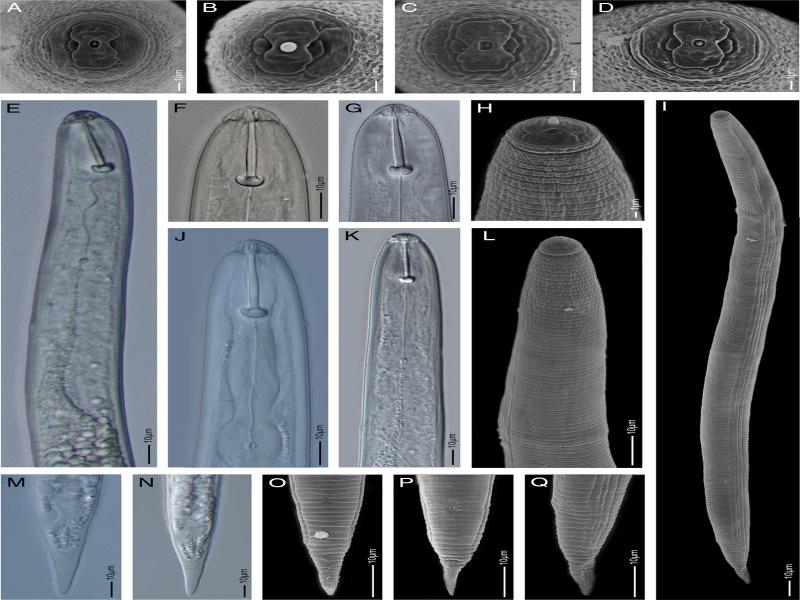
Figure 1:
Light microscopy and scanning electron microscopy images of second-stage juveniles of Heterodera dunensis n. sp. A to D: En face view, E: Anterior part up to pharyngeal gland end, F to H: Labial region showing stylet and labial annuli, I: Total body, J to L: Anterior part showing median bulb, hemizonid, and secretory-excretory pore, M to Q: Tail region showing hyaline portion and anus.
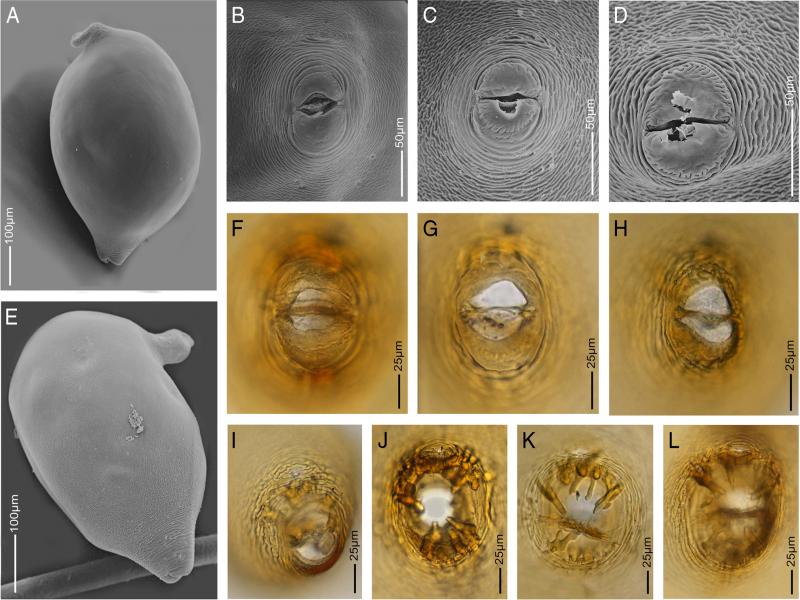
Figure 2:
Light microscopy and scanning electron microscopy images of cysts and vulva cones of Heterodera dunensis n. sp. A, E: In toto, lemon-shape cysts showing protruded vulva cones and bent necks, B to D, F to H: Vulva cones showing cone fenestration and vulva slits, I to L: Vulva cones showing anus, bullae, and underbridge.
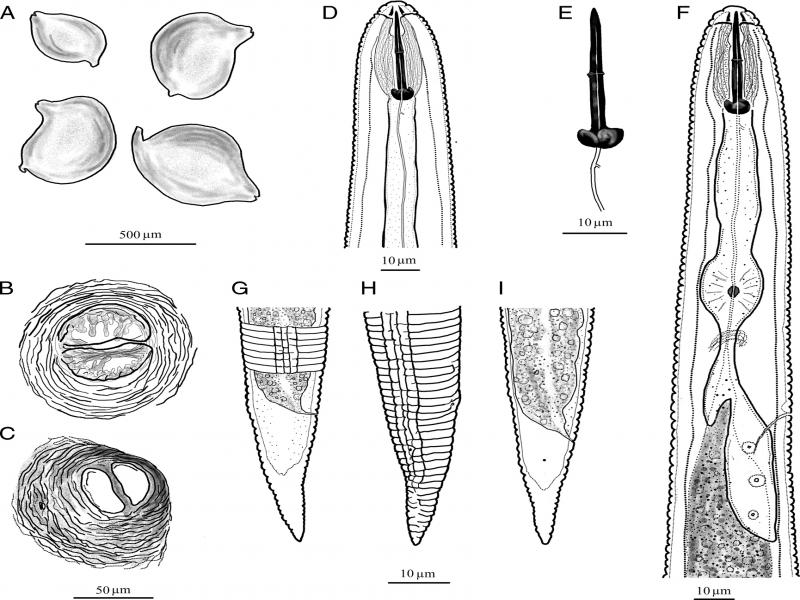
Figure 3:
Line illustrations of cysts and second-stage juveniles (J2) of Heterodera dunensis n. sp. A: Whole cysts, B, C: Vulva cones showing cone fenestration, vulva slit, bullae, underbridge, and anus, D, F: Anterior part of J2 showing lip region, pharynx, hemizonid, and secretory excretory pore, E: Stylet of J2, G to I: Tail region of J2 showing lateral field differentiation, anus, phasmid, and tail hyaline portion.
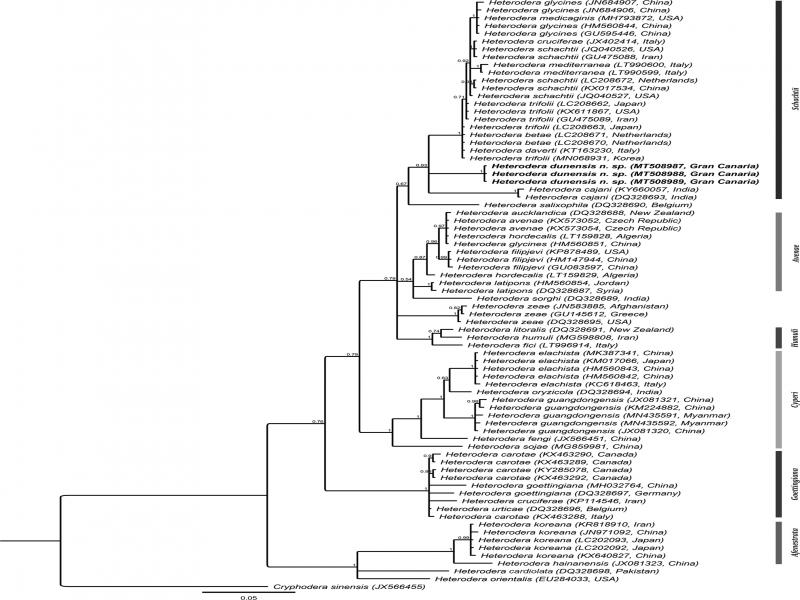
Figure 4:
Phylogenetic relationships of Heterodera dunensis n. sp. with 33 known Heterodera species. Bayesian 50% majority-rule consensus tree as inferred from the analysis of D2-D3 of 28S rDNA sequences under GTR + G model. Posterior probabilities of more than 0.5 are given for appropriate clades.
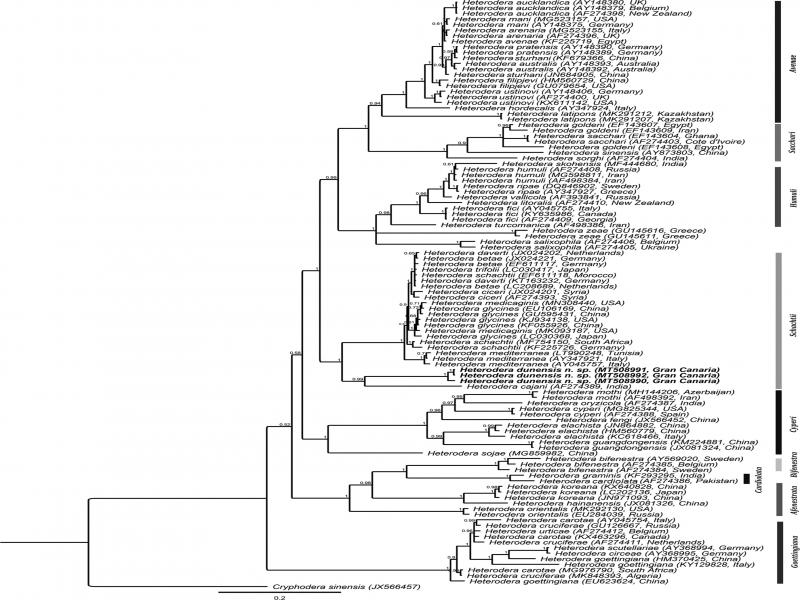
Figure 5:
Phylogenetic relationships of Heterodera dunensis n. sp. with 54 known Heterodera species. Bayesian 50% majority-rule consensus tree as inferred from the analysis of partial ITS of rDNA sequences under GTR + I + G model. Posterior probabilities of more than 0.5 are given for appropriate clades.
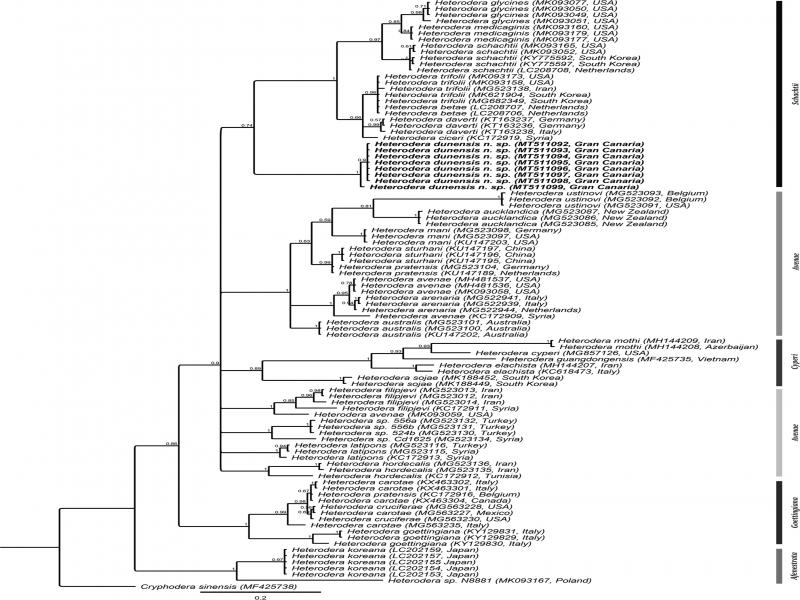
Figure 6:
Phylogenetic relationships of Heterodera dunensis n. sp. with 29 known Heterodera species. Bayesian 50% majority-rule consensus tree as inferred from the analysis of COI of mtDNA sequences under GTR + I + G model. Posterior probabilities of more than 0.5 are given for appropriate clades.