
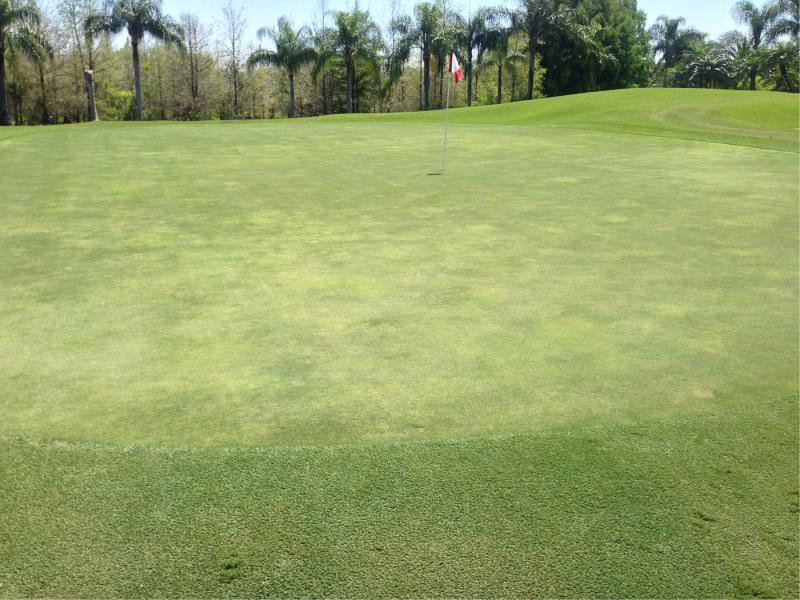
Figure 1:
Symptoms of Meloidogyne graminis on an ultradwarf bermudagrass golf green. Only low numbers of M. graminis vermiform stages were recovered from soil, while staining revealed the roots were infested with large numbers of sedentary stages.
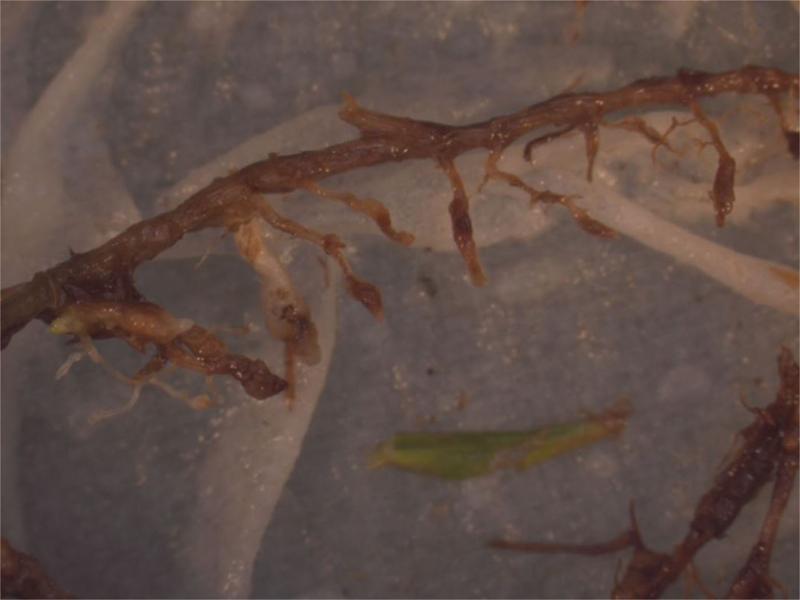
Figure 2:
Golf course bermudagrass roots infested by Meloidogyne graminis and M. marylandi typically rot off just below small galls near the soil-thatch interface, creating an extremely abbreviated root system.
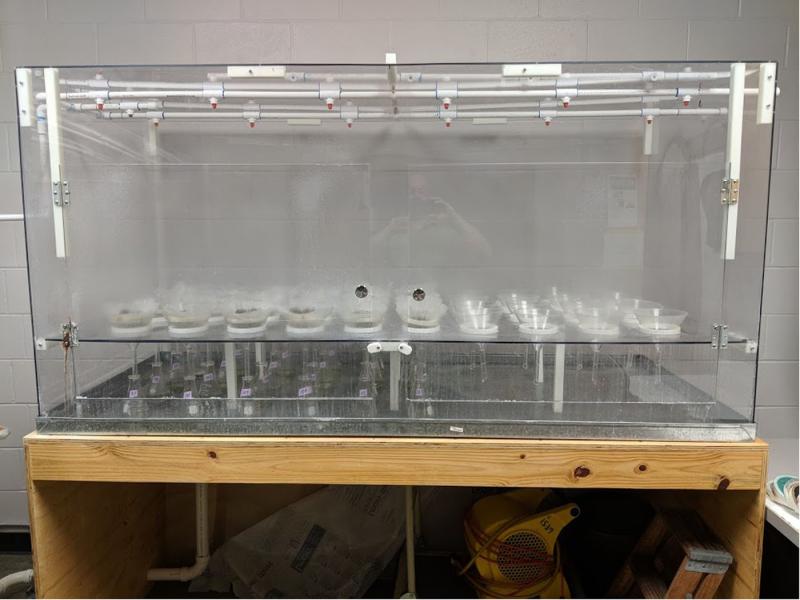
Figure 3:
The University of Florida Nematode Assay Lab mist chamber.
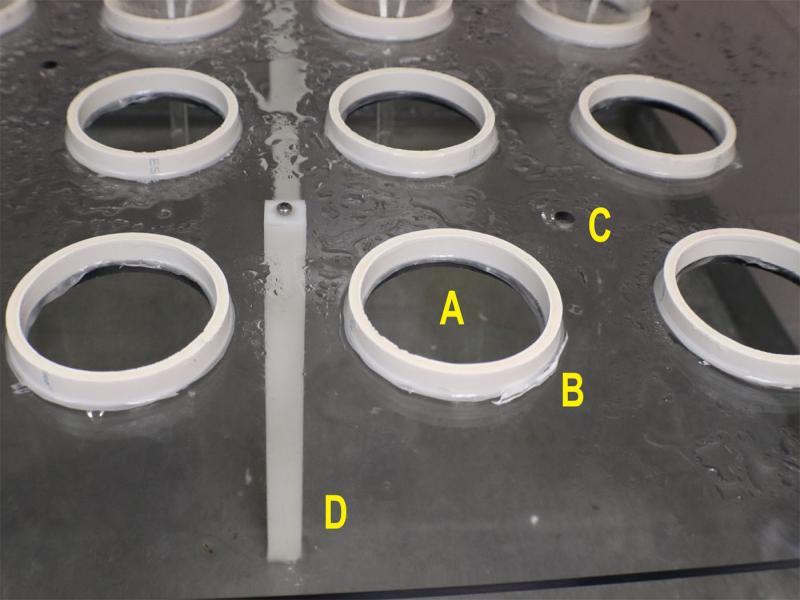
Figure 4:
(A) Funnel hole cut in center shelf. (B) Water flow prevention ring. (C) Drain hole. (D) Shelf support.
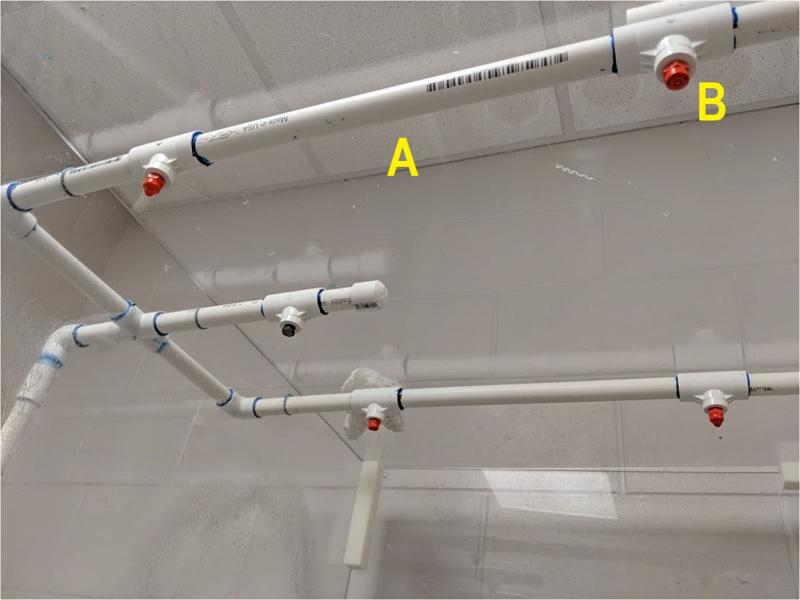
Figure 5:
(A) Misting rail. (B) Superfine mist emitter.
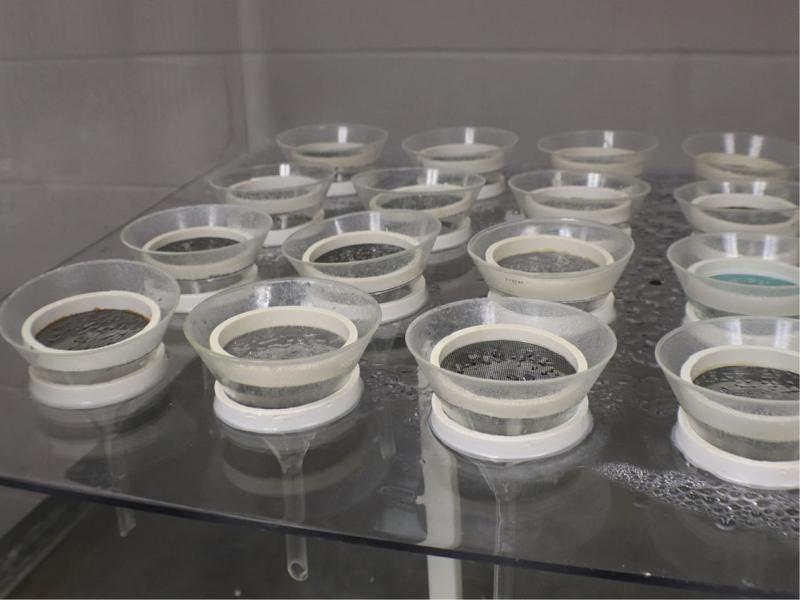
Figure 6:
Funnels with sample support rings.
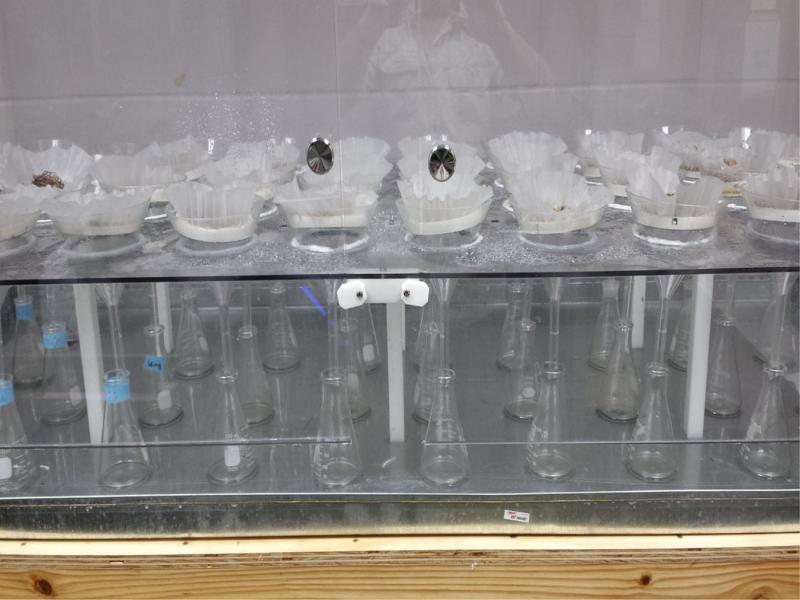
Figure 7:
Samples are placed onto coffee filters on the sample support rings. Funnel necks insert slightly into the 250-ml-flaskes.
Table 1.
Comparison of the number of Meloidogyne spp. J2 and males recovered from either 100 cm3 of soil using centrifugal flotation or from four 3.8-cm-diam. turf plugs using mist extraction.
| J2 | Males | |||||||||
|---|---|---|---|---|---|---|---|---|---|---|
| Year | Cultivar | n | Soil | Mist | P < | r 2 | Soil | Mist | P < | R 2 |
| 2017 | Jones Dwarf | 77a | 6b | 436 | 0.0001c | 0.014d | 1 | 40 | 0.0001 | 0.059 |
| 2017 | Tifdwarf | 49 | 225 | 945 | 0.0001 | 0.003 | 100 | 184 | 0.0001 | 0.085 |
| 2017 | Tifdwarf | 45 | 92 | 387 | 0.0001 | 0.002 | 21 | 92 | 0.0001 | 0.150 |
| 2017 | TifEagle | 59 | 69 | 368 | 0.0001 | 0.048 | 2 | 25 | 0.0001 | 0.059 |
| 2018 | Tifdwarf | 40 | 130 | 466 | 0.0001 | 0.005 | 28 | 129 | 0.0001 | 0.000 |
| 2019 | TifEagle | 71 | 70 | 723 | 0.0001 | 0.332 | 22 | 108 | 0.0001 | 0.122 |
| 2019 | TifEagle | 100 | 24 | 128 | 0.0001 | 0.604 | 2 | 13 | 0.0001 | 0.374 |
| 2019 | Sunday | 120 | 14 | 81 | 0.0001 | 0.202 | <1 | <1 | 0.0001 | 0.003 |
| 2020 | Jones Dwarf | 35 | 22 | 286 | 0.0001 | 0.560 | 5 | 26 | 0.0001 | 0.244 |
1 Notes: Samples were collected as the pre-treatment samples for nine bermudagrass golf course nematicide trials on multiple sites, multiple cultivars, and over multiple years. aNumber of plots sampled; bAverage number of nematodes recovered from n samples; cProbability that nematode counts did not differ between methods; dGoodness of fit for regression of nematode counts from mist extraction on the counts from soil extraction.
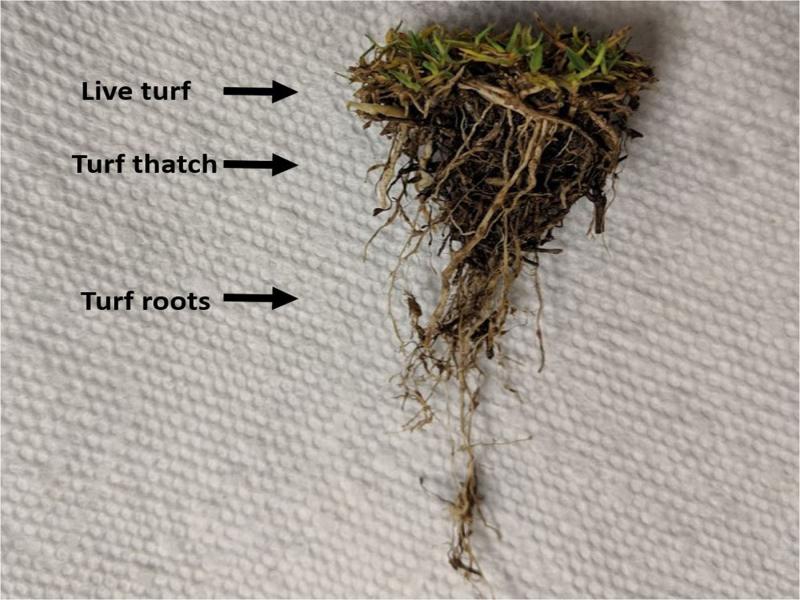
Figure 8:
A washed turf plug including live turf, thatch and roots, ready for mist extraction.
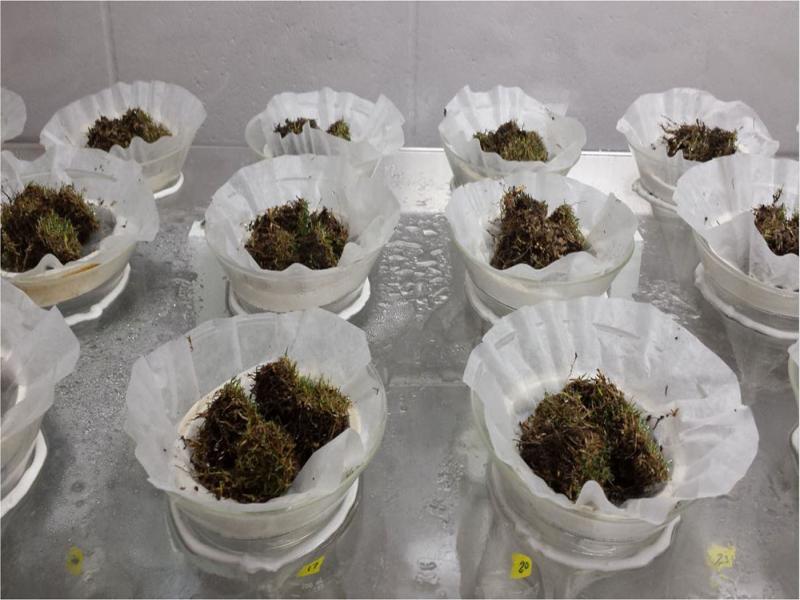
Figure 9:
Four washed turf plugs are placed in each funnel in the mist chamber and incubated for 72 hr.
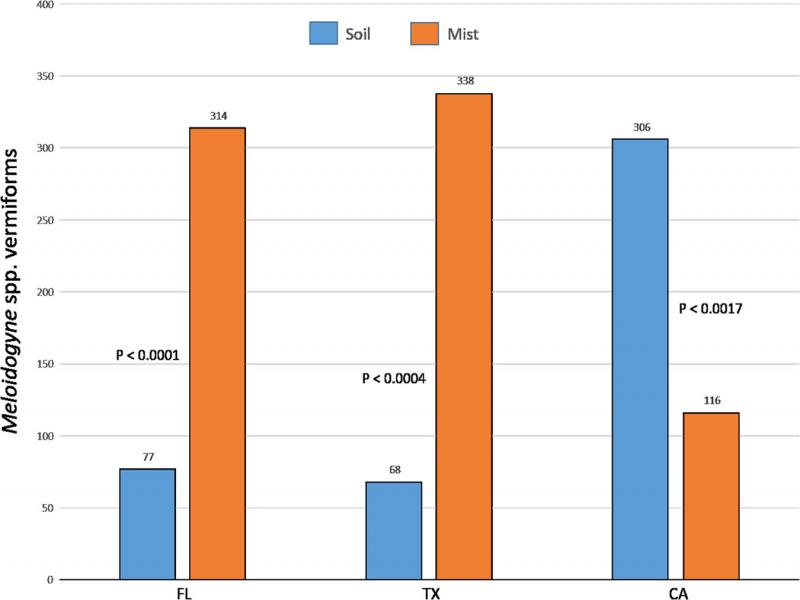
Figure 10:
Average number of Meloidogyne spp. vermiform stages (J2 and males) recovered from diagnostic samples submitted to the University of Florida Nematode Assay Lab using centrifugal flotation extraction from 100 cm3 of soil (Soil) and mist chamber extraction from four 3.8-cm-diam. turf plugs (Mist) from golf course bermudagrasses in Florida (N = 431), golf course bermudagrasses in Texas (N = 36), or golf course bentgrass/bluegrass in California (N = 34).
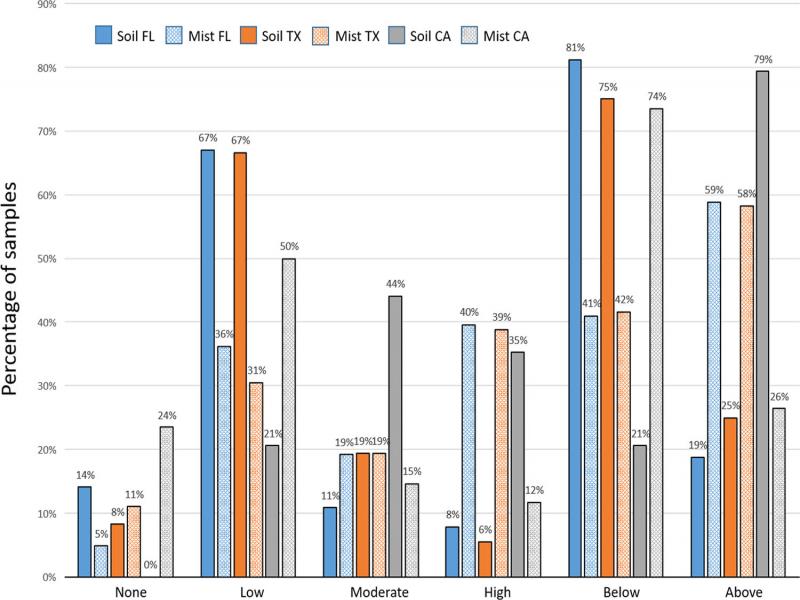
Figure 11:
Percentage of samples submitted to the University of Florida Nematode Assay Lab from golf course bermudagrass in Florida (N = 431), golf course bermudagrass in Texas (N = 36), and golf course bentgrass/bluegrass in California (N = 34) that were classified as having no risk, low risk, moderate risk, or high risk of damage from Meloidogyne spp. and the percentage of samples that were ‘below threshold’ (no or low risk) and ‘above threshold’ (moderate or high risk) using centrifugal flotation extraction from 100 cm3 of soil (Soil) or mist chamber extraction from four 3.8-cm-diam. turf plugs (Mist). Risk thresholds used per 100 cm3 of soil or per four 3.8-cm-diam. turf plugs were 0 = no risk, 1 ≤ 79 = low risk, 80 ≤ 299 = moderate risk, ≥ 300 = high risk.
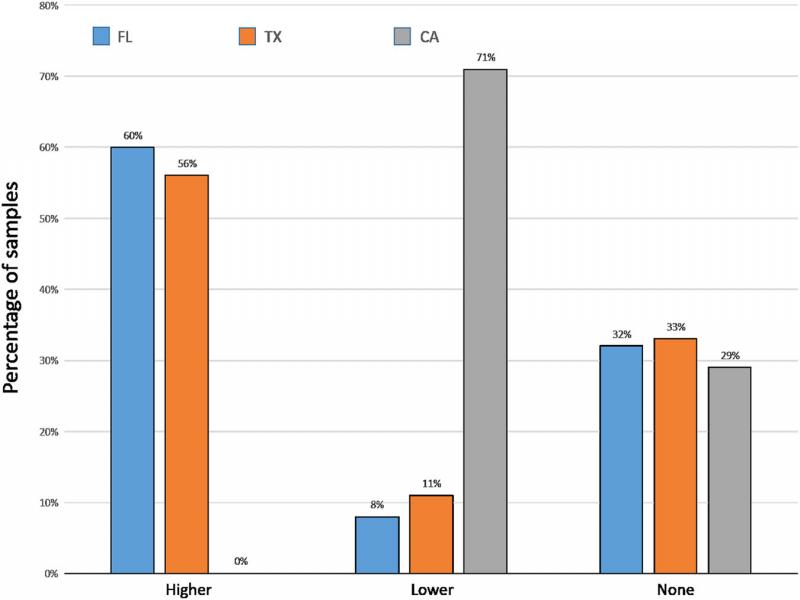
Figure 12:
Percentage of samples submitted to the University of Florida Nematode Assay Lab from golf course bermudagrass in Florida (N = 431), golf course bermudagrass in Texas (N = 36), and golf course bentgrass/bluegrass in California (N = 34) from which the resulting risk level was higher, lower, or no different when vermiform Meloidogyne spp. were extracted by mist chamber extraction from four 3.8-cm-diam. turf plugs than by centrifugal flotation extraction from 100 cm3.