
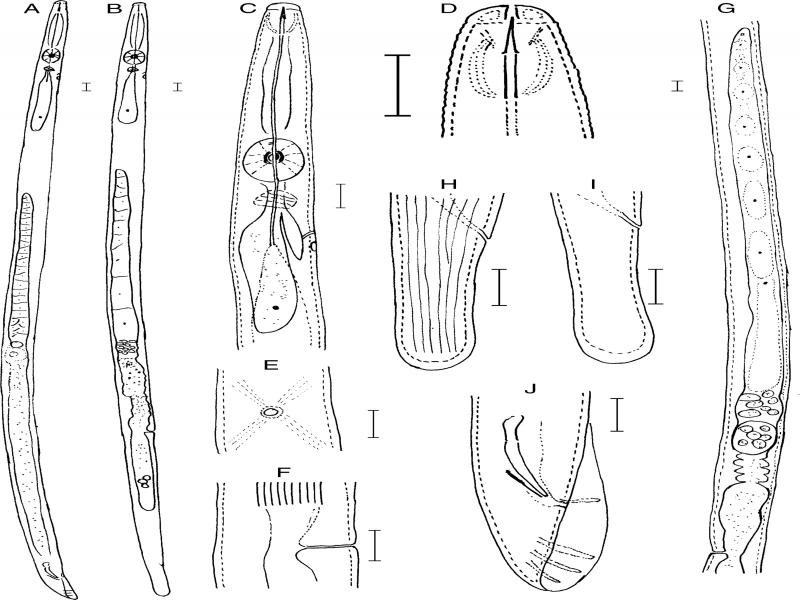
Figure 1:
Aphelenchus yinyuensis n. sp. A: Entire male; B: Entire female; C: Anterior region; D: Lip region; E: Vulval region lateral view; F: Vulval region ventral view; G: Female reproductive system; H, I: Female tails; J: Male tail. Scale bars (A, B = 20 μm; C-J = 10 μm).
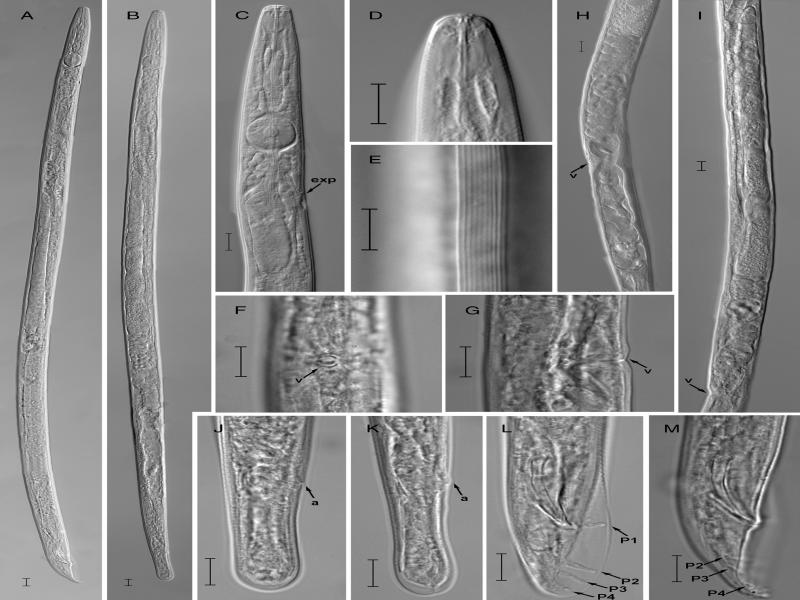
Figure 2:
Light photomicrographs of Aphelenchus yinyuensis n. sp. A: Entire male; B: Entire female; C: Anterior region: D: Lip region; E: Lateral lines; F: Vulval region lateral view; G: Vulval region ventral view; H: Vulval region with post-uterine sac; I: Female reproductive system; J, K: Female tails; L, M: Male tail showing papillae arrangement (arrowheads). (ex = excretory pore; h = hemizonid; P + number = genital papillae; scale bars = A, B = 20 μm; C-M = 10 μm).
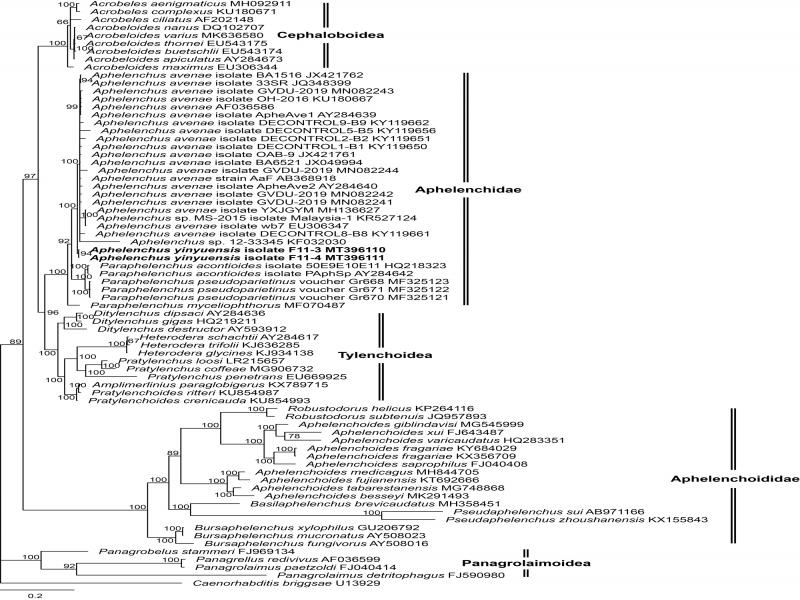
Figure 3:
Phylogenetic relationship of Aphelenchus yinyuensis n. sp. and other nematodes based on near full length 18S of rDNA. Bayesian tree inferred from 18S under GTR + I + G model (lnL = −19,759.9398; freqA = 0.2462; freqC = 0.2010; freqG = 0.2710; freqT = 0.2818; R(a) = 1.1079; R(b) = 2.1894; R(c) = 1.2504; R(d) = 0.7956; R(e) = 3.9256; R(f) = 1.0000; Pinvar = 0.1260; Shape = 0.5890). Posterior probability values exceeding 50% are given on appropriate clades.
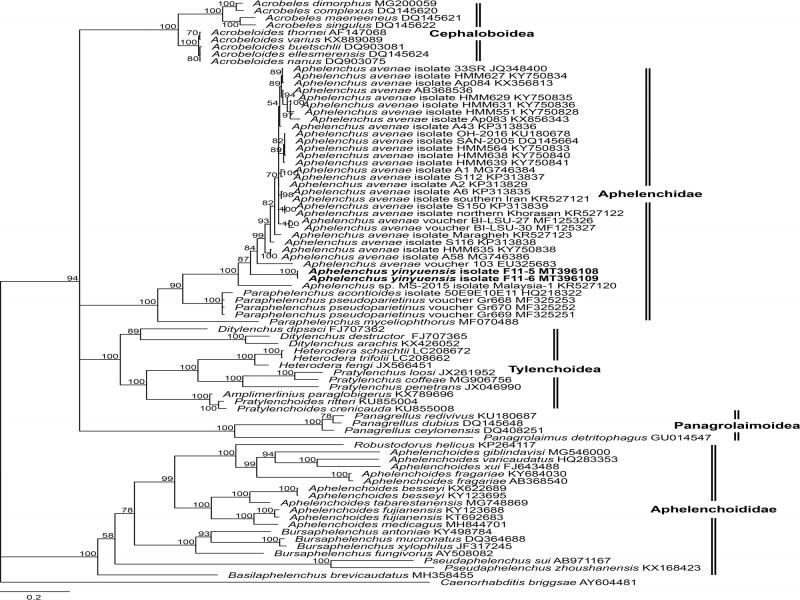
Figure 4:
Phylogenetic relationship of Aphelenchus yinyuensis n. sp. and other nematodes based on 28S D2 to D3 of rDNA. Bayesian tree inferred from 28S D2 to D3 under GTR + I + G model (lnL = −17,543.4883; freqA = 0.1670; freqC = 0.1883; freqG = 0.3314; freqT = 0.3134; R(a) = 1.3541; R(b) = 3.5721; R(c) = 1.7006; R(d) = 0.5742; R(e) = 4.6218; R(f) = 1.0000; Pinvar = 0.1400; Shape = 0.6940). Posterior probability values exceeding 50% are given on appropriate clades.
Table 1.
Morphometrics of Aphelenchus yinyuensis n. sp.
| Female | Male | ||
|---|---|---|---|
| Character | Holotype | Paratypes | Paratypes |
| n | – | 15 | 15 |
| L | 792 | 793 ± 71.9 (639-877) | 756 ± 59.6 (647-863) |
| a | 31.0 | 30.5 ± 2.7 (26.9-33.6) | 31.9 ± 3.4 (26.7-37.0) |
| b | 9.6 | 7.7 ± 1.0 (6.2-8.8) | 7.5 ± 0.7 (6.1-8.7) |
| b′ | 5.0 | 4.8 ± 0.6 (3.9-5.7) | 4.5 ± 0.4 (3.8-5.3) |
| c | 19.5 | 21.0 ± 3.1 (16.7-27.1) | 26.7 ± 2.6 (22.1-30.4) |
| c′ | 3.1 | 2.7 ± 0.4 (2.3-3.8) | 1.8 ± 0.2 (1.5-2.2) |
| V or T | 72.7 | 72.8 ± 3.8 (65.2-77.6) | 70.5 ± 7.1 (59.4-89.0) |
| Lip region height | 3.1 | 3.6 ± 0.3 (3.1-4.2) | 3.4 ± 0.5 (2.5-4.2) |
| Lip region width | 8.3 | 8.8 ± 0.5 (8.1-9.5) | 8.5 ± 0.5 (7.8-9.5) |
| Stylet length | 13.7 | 14.3 ± 0.7 (13.2-15.2) | 13.8 ± 1.0 (12.2-15.7) |
| Body diam. | 25.5 | 26.2 ± 3.1 (19.2-31.7) | 23.9 ± 2.1 (19.2-28.2) |
| Median bulb width | 15.3 | 16.1 ± 1.5 (13.1-19.6) | 13.8 ± 1.0 (12.2-15.7) |
| Median bulb length | 22.5 | 22.3 ± 1.8 (18.6-24.5) | 20.1 ± 1.2 (17.8-21.9) |
| Median bulb length/diam. Ratio | 1.5 | 1.4 ± 0.1 (1.2-1.5) | 1.5 ± 0.1 (1.3-1.7) |
| E. pore from anterior end | 113.6 | 107.9 ± 7.2 (96.6-123.3) | 106.5 ± 7.2 (91.5-116.7) |
| Ovary length or Testis | 436.3 | 407.4 ± 50.2 (280.2-458.3) | 531.4 ± 54.1 (452.6-610.9) |
| Post-uterine sac | 112.1 | 100.7 ± 15.5 (66.3-120.2) | – |
| Vulva to anus distance | 176.3 | 166.9 ± 22.3 (131.2-195.0) | – |
| Post-uterine sac length/vulva to anus (%) | 63.6 | 60.9 ± 10.4 (44.5-82.7) | – |
| Anal (cloacal) body diameter | 13.1 | 14.2 ± 2.0 (10.6-17.3) | 15.4 ± 1.0 (13.9-17.3) |
| Tail length | 40.6 | 38.4 ± 5.9 (24.2-44.9) | 28.4 ± 2.4 (23.6-32.2) |
| Spicule (curved median line) | – | – | 28.0 ± 2.0 (24.3-31.3) |
| Spicule (Chord) | – | – | 28.7 ± 1.7 (25.8-32.3) |
| Gubernaculum | – | – | 13.2 ± 0.4 (12.2-13.7) |
| Hemizonid | 115.3 | 110.1 ± 5.5 (100.1-117.3) | 108.5 ± 7.3 (96.1-121.3) |
| Head to pharyngo-intestinal junction | 92.9 | 103.2 ± 6.9 (91.0-113.5) | 100.6 ± 5.5 (86.0-109.3) |
| Head to pharyngeal gland end | 159.6 | 163.9 ± 12.1 (139.6-181.0) | 165.9 ± 12.0 (149.3-188.2) |
| Vulva to tail terminus | 203.1 | 213.1 ± 28.6 (156.3-251.8) | – |