
Table 1.
Management of root-knot nematode in okra by bio-fumigation (2017-2018).
| Sr. No. | Treatments | INP/200 cc soil before addition of leaves | INP/200 cc soil after addition of leaves | FNP/200 cc soil at harvest | Okra yield (kg/plot) | % increase in yield/over check | Root-knot index at harvest |
|---|---|---|---|---|---|---|---|
| 1 | Cabbage leaves @ 25 t/ha | 224.0 | 197.0 | 258.0b,c | 8.6b,c | 8.9 | 3.8a,b |
| 2 | Cabbage leaves @ 50 t/ha | 224.0 | 185.0 | 215.7d,e | 9.9a | 25.3 | 3.3a |
| 3 | Cauliflower leaves @ 25 t/ha | 224.0 | 203.0 | 268.0b | 8.2c,d | 3.8 | 4.0a,b |
| 4 | Cauliflower leaves 50 t/ha | 224.0 | 200.0 | 231.0d | 9.2a,b | 16.4 | 3.5a |
| 5 | Carbofuran @ 1.0 kg a.i./ha | 224.0 | 153.0 | 188.0f | 8.4c,d | 6.3 | 3.5a |
| 6 | Untreated check | 224.0 | 215.0 | 340.6a | 7.9c,d | − | 5.0c |
| 7 | CD @ 5% | − | − | 19.8 | 0.8 | − | 0.83 |
Table 2.
Management of root-knot nematode in okra by bio-fumigation (2018-2019).
| Sr. No. | Treatments | INP/200 cc soil before addition of leaves | INP/200 cc soil after addition of leaves | FNP/200 cc soil at harvest | Okra yield (q/ha | % increase in yield/over check | Root-knot index at harvest |
|---|---|---|---|---|---|---|---|
| 1 | Cabbage leaves @ 25 t/ha | 256 | 225 | 274e (15.60) | 65.5c | 14.0 | 2.8a,b |
| 2 | Cabbage leaves @ 50 t/ha | 256 | 151 | 226f (15.05) | 78.2a | 36.2 | 2.5a |
| 3 | Cauliflower leaves @ 25 t/ha | 256 | 242 | 290c (17.06) | 63.2c,d | 11.2 | 3.3a,b |
| 4 | Cauliflower leaves 50 t/ha | 256 | 181 | 268d (16.40) | 71.8b | 25.0 | 3.0a,b |
| 5 | Carbofuran @ 1.0 kg a.i./ha | 256 | 194 | 250a (20.83) | 63.4c,d | 11.2 | 3.5b |
| 6 | Untreated check | 256 | 265 | 417b (20.43) | 57.1e | − | 4.8c |
| 7 | CD @ 5% | − | − | (0.13) | 5.1 | 0.89 |
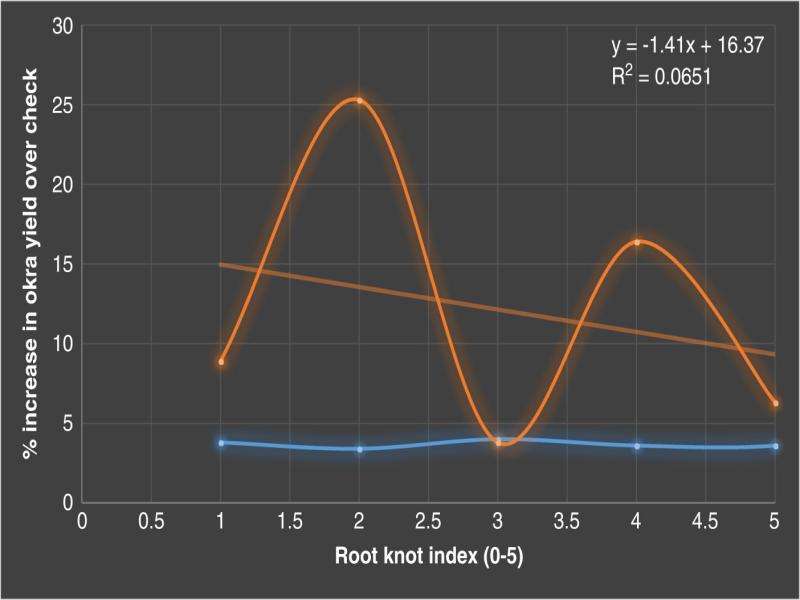
Figure 1:
Relationship between number of galls and percentage increase in okra yield over check (2017-2018).
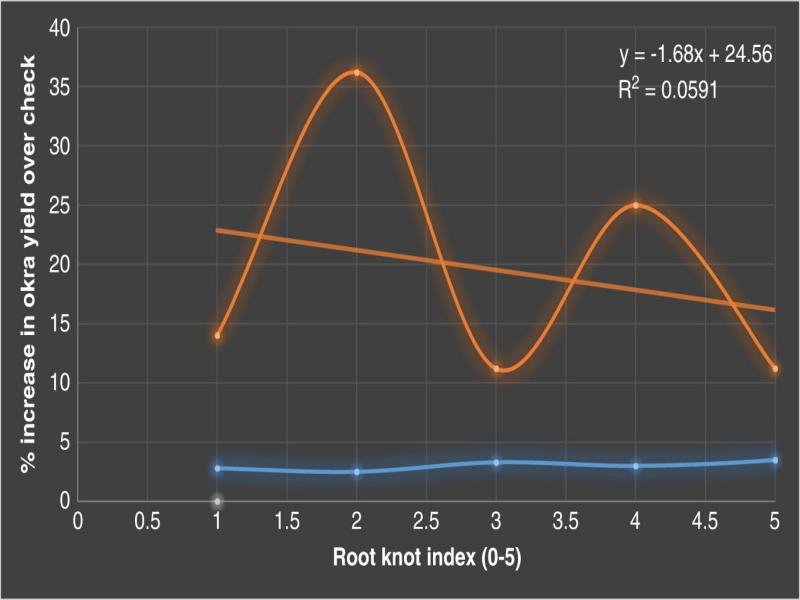
Figure 2:
Relationship between number of galls and percentage increase in okra yield over check (2018-2019).