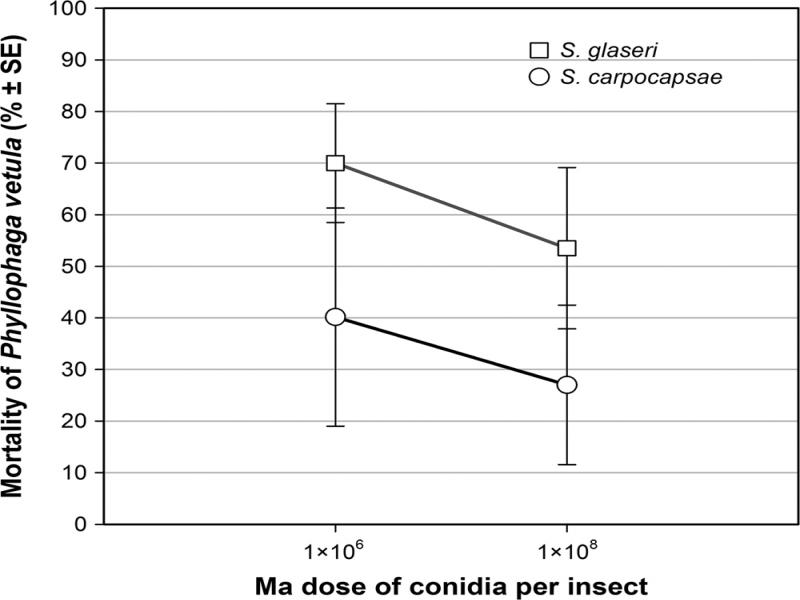
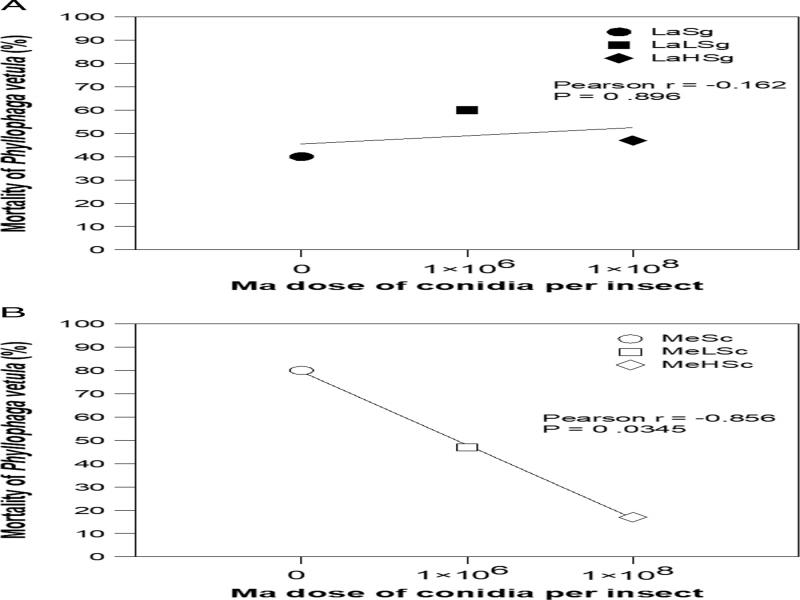
White grubs of Phyllophaga spp. (Coleoptera: Scarabaeidae) are the principal soil-living pests in corn production (Zea mays), affecting seed quality and yield (Jackson and Klein, 2006). In corn fields of the central valleys of Oaxaca, Mexico, one of the most abundant species is P. vetula (Horn), which causes yield loses up to 50% depending on plant stand losses (Ruiz-Vega et al., 2003). In Central Mexico, a yield loss of 500 to 1,400 kg.ha−1 is expected (Villalobos, 1992). However, the use of chemical pesticides for the control of white grubs is causing increased resistance of this insect pest and has resulted in negative effects on the environment and human health, which make necessary the development of effective biological control products with low impact on the environment and human health (Cory and Franklin, 2012; Chandel et al., 2019; Karabörklü et al., 2018).
The combined application of entomopathogenic fungi (EPF) and entomopathogenic nematodes (EPN) through a formulated product is an alternative solution that is being tested to improve the effectiveness of the microbial pesticides used in integrated pest management programs (Wakil et al., 2017). It is believed that by the action mode of EPF, their previous application on the insect hosts increases their susceptibility to EPN infection (Ansari et al., 2008; Shaurub et al., 2016). However, in combination with nematophagous fungi, a reduction in the EPN and EPF activity has been reported (Bueno-Pallero et al., 2018).
The first challenge in the development of these products is to get a combination of entomopathogenic agents (EAs) that favor a synergist or additive interaction in order to achieve an effective control because biological, environmental, and management factors influence the performance of EAs.
The separate application of the entomopathogens Metarhizium spp., Heterorhabditis spp., and Steinernema spp. usually shows a good percentage of control over Phyllophaga spp., an edaphic pest that feeds on roots, decreases the yield and quality of the corn-crop Zea mays (Jackson and Klein, 2006; Gassmann and Clifton, 2017), but in Mexico Phyllophaga spp. is usually controlled with broad-spectrum chemical insecticides such as carburofan and heptachlor (Ruiz-Vega et al., 2003).
S. glaseri (NJ-43 strain) is a nematode of greater effectiveness than S. carpocapsae (All strain) against some species of Phyllophaga spp. (Ruiz-Vega et al., 2003; Girón-Pablo et al., 2015; Cortés-Martínez et al., 2017), while S. carpocapsae had an intermediate performance because it required four days to control 50% of the larvae when applied at doses of 200 IJs (Ruiz-Vega et al., 2003). The fungus M. anisopliae (HI-019) is more effective than Bauveria bassiana, killing up to 86% of P. vetula larvae treated with 1 × 10⁸ conidia.mL−1 after 12 days post-inoculation (Pérez et al., 2016).
In laboratory, additive interactions have been observed between H. megidis and B. bassiana, and between H. bacteriophora and B. bassiana or M. anisopliae in most of the combinations applied on Cyclocephala lurida (Coleoptera: Scarabaeidae). However, the combined effect was not significantly different for simultaneous applications of nematodes or fungi or carried out at different times (Wu et al., 2014). In a study in laboratory and greenhouse conditions, where the interaction between four EPN and two EPFs was evaluated, synergies were found between nematode species applied after the fungi at different times, while the separate application of B. bassiana and M. anisopliae did not reduce the population of third-stage larvae of Cyclocephala lurida Bland (Martínez-Hernández et al., 2015).
Except for a few studies, the effect of the combined application of certain species such as Metarhizium spp. and Steinernema spp. on Phyllophaga spp. is still little explored and could result in a synergistic or additive effect with better effectiveness than applied separately. Therefore, the aim of this work was to evaluate the effect of separate and combined application of the fungus M. anisopliae and the nematode S. glaseri or S. carpocapsae on the mortality of P. vetula and to determine its type of interaction in a four-day deferred application between EAs.
Materials and methods
P. vetula larvae
Larvae of P. vetula were collected from two different corn-crop fields in the village of Cuilapam de Guerrero, Oaxaca, Mexico (17° 00´ N, 96° 46´ W, 1596 masl) in July, 2019. The presence of larvae in the earlier stages of growth of corn plants (Zea mays) and the appearance of visible damage in the plants were the criteria for selecting the sampling site. Each larva was collected manually from a 0 to 20 soil depth and confined individually in a 50 mL cylindrical plastic container that was filled with sterilized agricultural soil from the collection site and a slice of carrot as feed. In laboratory, the P. vetula larvae were classified by their size as medium (1.8 cm < Me < 2.5 cm) or as large (2.5 cm < La ≥ 3.2 cm) and kept at room temperature (23 ± 6°C). During a week, insects were observed in order to separate the dead, injured, or infected larvae.
Entomopathogenic agents
The EPF used was M. anisopliae M1cog strain (Ma) Access GenBank KR998522 (Metchnikoff) Sorokin (1883), which was isolated from Spodoptera frugiperda, was provided by the “Laboratorio de Bioinsecticidas of CIIDIR IPN Unidad Sinaloa.” The nematodes Steinernema carpocapsae All strain (Sc) Access GenBank CM016762.1 (Weiser, 1955) and Steinernema glaseri NJ-43 strain (Sg) Access GenBank AF122015.1 (Steiner, 1929) are from the collection of the “Laboratorio de Nematodos Entomopatógenos of CIIDIR IPN Unidad Oaxaca,” which was initiated with nematode species donated by the EPN Laboratory of the University of California, Davis. The nematodes were reproduced using third-instar larvae of the wax moth Galleria mellonella (Kaya and Stock, 1997) and stored at 12°C for 15 days before use.
Infectivity assay
Infectivity, defined as the proportion of dead insects after being exposed to entomopathogens (Ricci et al., 1996), was tested every seven days from the moment of application of Ma. Eight observation periods were completed, i.e., for a total of 56 days. The assay arena was a 100 mL cylindrical container filled with loamy-sand soil and a larva of size Me or La. P. vetula larvae were inoculated first with Ma in high (H) or low (L) doses, 1 × 10⁸ and 1 × 10⁶ spores/insect, respectively. Four days later, the nematodes Sg or Sc were applied at a dose of 250 IJs/insect (20 IJs/cm−1) on the surface of the arena. This apparently large amount was applied to ensure infection because the larvae were already buried into the soil. The dilution procedure proposed by Stock and Goodrich-Blair (2012) was followed to estimate the IJ’s concentration.
Insect mortality was determined when the larvae did not move when stimulated with a dissecting needle. To confirm the cause of death, each cadaver presenting signs of infection was transferred to a petri dish lined with a filter paper disc (90 mm in diameter, Whatman No. 1) and incubated at 23 ± 2°C until the appearance of spores of Ma (indicative of fungal infection) or the emergence of IJs (indicative of infection by nematodes) happened.
Experimental design and treatments
To evaluate the effect of the application of fungus Ma and the nematodes Sc and Sg on the mortality of P. vetula, two sizes of larvae were inoculated in a multifactorial experiment 23, where the factors were: (i) size of the larva (Me or La), (ii) dose of Ma (H or L), and (iii) species of EPN (Sc or Sg). The eight resulting treatments were: LaHSc, LaHSg, LaLSc, LaLSg, MeHSc, MeHSg, MeLSc, and MeLSg. One larva of size Me or La was placed in each of 15 containers filled with field-capacity moist agricultural soil per treatment to determine insect mortality, including the control treatment. The experiment was conducted twice. The treatments LaH, LaSg, MeL, and MeSc were included to evaluate the type of interaction on the LaHSg and MeLSc treatments and the effect of increasing the dose of Ma in larvae of size Me or La.
Determination of the interaction between M. anisopliae and nematodes on P. vetula
The type of interaction (synergistic or antagonistic) between EPF and EPN was determined in the combined treatment LaHSg considering LaH and LaSg effects, whereas for the treatment MeLSc, the effects of MeL and MeSc were considered. The expected mortality E m in the combined application was estimated using the formula E m = M n + M f (1−M n ), where M n and M f are the mortality percentage observed for nematodes and fungi inoculated separately, respectively. Then, the test was carried out with the estimated value of observed mortality M n+f in combined applications and compared with the value in tables of for 1 degree of freedom, with p < 0.05. According to the criterion established, if it is fulfilled that , the interaction is additive, or it is synergistic/additive if that criterion is not met. Then, if the difference between M n+f and E m has a positive or negative value, it is considered that there is a synergistic or antagonistic interaction, respectively (Mcvay et al., 1977).
Statistical analysis of data
The accumulated mortality per treatment after 56 days was used to estimate the mortality percentage, i.e. the number of dead larvae in proportion to the number of larvae that was used. The data were transformed into ranges to satisfy the normality criteria. The effect of the factors of insect size, dose of Ma and EPN species on mortality percentage was determined by using a factorial analysis of variance (ANOVA) and applying the Tukey test (p < 0.05). Also, a Pearson correlation analysis was performed to determine the relationship between increasing doses of Ma before the application of Sg or Sc and the mortality percentage of larvae of size Me or La (p < 0.05). All analyzes were performed on SigmaPlot® 12 (Systat Software, Inc., San José, CA, USA).
Results
Interaction between fungi and EPN on P. vetula larvae
The average mortality percentage of larvae of two sizes (Me and La) of P. vetula by the application of the fungus Ma in two doses (H or L) and the nematodes Sc and Sg during a 56 days period is presented in Figure 1. In treatments with only one entomopathogen, the highest larvae mortality was observed with MeSc (80 ± 11.5%) and no mortality was recorded in the LaH or MeL treatments. In combination treatments, the highest mortality was achieved in MeLSg (80 ± 11.5%) and the lower mortality was observed when the MeHSc (27 ± 17%) and LaHSc (27 ± 13%) treatments were applied. No larval mortality was observed in the untreated control (data not shown).
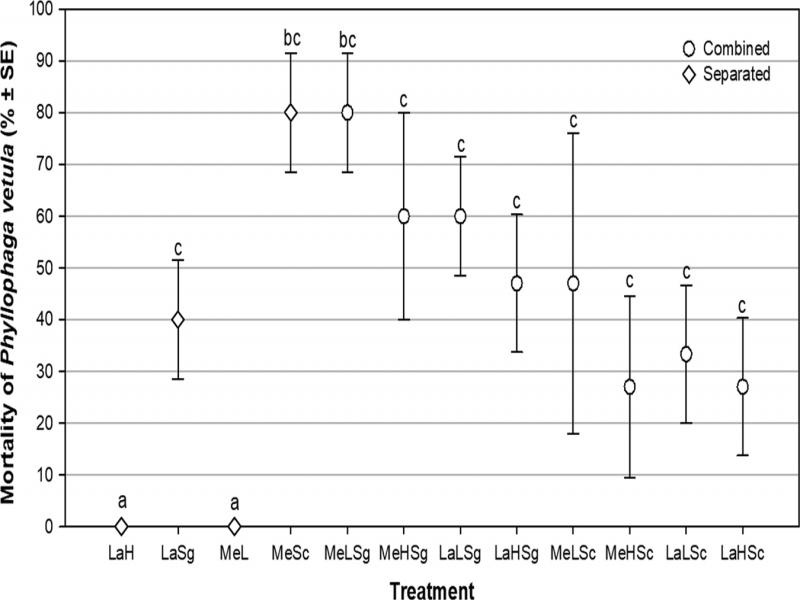
Figure 1:
Mortality of medium (Me) or large (La) Phyllophaga vetula larvae due to the separate or combined application of Metarhizium anisopliae (M1cog) at two doses (H = 1 × 10⁸ or L = 1 × 10⁶ spores/insect) and 250 IJs of Steinernema glaseri (Sg) or Steinernema carpocapsae (Sc). SE, standard error.
The statistical comparison of all treatments with respect to the control shows that only six treatments (Table 1) were statistically different (p < 0.05). In the combined treatments, the larger difference was observed with the MeLSg treatment (p = 0.002), followed by the MeHSg treatment (p = 0.047) and the LaLSg and LaHSg ones. In the uncombined treatments, MeSc was the one with the greatest control difference (p = 0.002), while LaSg showed the minimum mortality difference. Five of the six better treatments applied included Sg.
Table 1.
Results of the ANOVA analysis of means of each treatment compared with the untreated control (one degree of freedom).
| Treatment | Mortality of Phyllophaga vetula (% ± SD) | p-value (ANOVA) |
|---|---|---|
| LaHSg | 47 ± 13.3 | 0.031 |
| LaLSg | 60 ± 11.5 | 0.009 |
| MeHSg | 60 ± 20 | 0.047 |
| MeLSg | 80 ± 11.5 | 0.002 |
| LaSg | 40 ± 11.5 | 0.034 |
| LaHSc | 27 ± 13.3 | 0.116 |
| LaLSc | 33.3 ± 13.3 | 0.086 |
| MeHSc | 27 ± 17.6 | 0.219 |
| MeLSc | 47 ± 29 | 0.185 |
| MeSc | 80 ± 11.5 | 0.002 |
| LaH | 0 | 0 |
| MeL | 0 | 0 |