
Chinese Elms (Ulmus parvifolia Jacq.: Ulmaceae: Rosales) are valued for their tough lumber, resistance to some elm pests and pathogens (Mittempergher and Santini, 2004; Bosu and Wagner, 2007), and as hardy, urban ornamentals. Native to East and Southeast Asia, U. parvifolia has an extensive cultivation history that resulted in many recognized cultivars (e.g., Santamour and Bentz, 1995). In 2019, samples of soil and roots were collected from potted plants of U. parvifolia cvs. Allee (Fig. 1A, B) and Drake (Fig. 1A), in Lake County, FL and submitted for nematode certification at the Florida Department of Agriculture and Consumer Services, Division of Plant Industry, Gainesville, FL (FDACS-DPI). Initially, nematodes were extracted from soil and roots, and species identification performed using FDACS-DPI’s standard protocol for identifying Meloidogyne enterolobii Yang and Eisenback, 1981, a COI-based qPCR assay (Kiewnick et al., 2015; Braun-Kiewnick et al., 2016) with slight modifications (Moore et al., 2020).
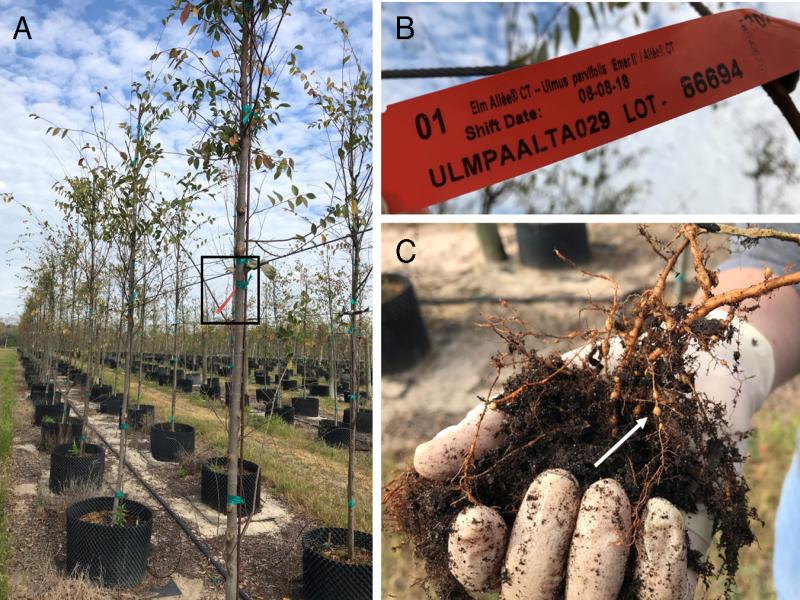
Figure 1:
(A) Rows of Chinese Elm, Ulmus parvifolia Jacq. cvs. Allee and Drake in Lake County, Florida. Black square highlights the Allee cultivar tag; (B) Ulmus parvifolia cv. Allee tag; (C) Root galls on Ulmus parvifolia cv. Allee. White arrow indicates the distinctive round galls commonly produced by Meloidogyne enterolobii Yang and Eisenback, 1981.
These initial screening tests revealed the presence of M. enterolobii in some, but not all, soil samples collected from U. parvifolia. To determine whether U. parvifolia is indeed a host of Meloidogyne species including M. enterolobii, rather than weeds growing together in the pots with these elms, additional soil and root samples (n = 3) were collected directly from the rhizosphere of U. parvifolia. These samples were designated with internal FDACS-DPI sample identifiers N20-110, N20-113 (both from U. parvifolia cv. Allee), and N20-115 (from U. parvifolia cv. Drake). Round galls, resembling those commonly induced by M. enterolobii, were observed on secondary and tertiary roots of U. parvifolia cv. Allee in one of the samples (Fig. 1C), whereas in the other U. parvifolia samples, the root galls were less rounded and more like those induced by other Meloidogyne spp.
Meloidogyne species were identified using two qPCR assays (Kiewnick et al., 2015; Braun-Kiewnick et al., 2016), isozyme analyses, morphology of the perineal patterns, and concatenated NADH5/COXII sequences (Table 1). DNA was extracted from second-stage juveniles (J2) obtained from single egg masses on each root sample using the Qiagen DNeasy Blood and Tissue Kit (Qiagen®, Hilden, Germany) and used for qPCR, conventional PCR, and sequencing. The cytochrome c oxidase subunit I (COI) and intergenic spacer 2 (IGS2) qPCR assays were repeated with DNA from J2 extracted directly from the roots of each cultivar. Standard PCRs targeted NADH-ubiquinone oxidoreductase chain 5 (NADH5) and cytochrome c oxidase subunit II (COXII) using the primers NAD5F2/NADH5R1 and COX2F/COX2R, respectively, and thermocycle conditions described by Janssen et al. (2016). Purified PCR products were sequenced bidirectionally on an Applied Biosystems SeqStudio platform with BigDye Terminator v. 3.1 cycle sequencing chemistry (Applied Biosystems, Foster City, California).
Table 1.
Diagnostic tests used to identify Meloidogyne species extracted from Ulmus parvifolia roots.
| Meloidogyne isolate | Plant cultivar | COI qPCR | IGS2 qPCR | Isozyme analyses | Perineal pattern | NADH5/COXII barcodes |
|---|---|---|---|---|---|---|
| N20-110-2B | U. parvifolia cv. Allee | M. enterolobii | M. enterolobii | M. enterolobii (n = 26)a | M. enterolobii (n = 17)a | M. enterolobii |
| N20-110-3B | U. parvifolia cv. Allee | M. enterolobii | M. enterolobii | M. enterolobii (n = 26)a | M. enterolobii (n = 17)a | M. enterolobii |
| N20-110-6B | U. parvifolia cv. Allee | M. enterolobii | M. enterolobii | M. enterolobii (n = 26)a | M. enterolobii (n = 17)a | M. enterolobii |
| N20-113-1B | U. parvifolia cv. Allee | Undetermined | Undetermined | M. javanica (n = 26)a | M. javanica (n = 11)a | M. javanica |
| N20-113-14B | U. parvifolia cv. Allee | Undetermined | Undetermined | M. javanica (n = 26)a | M. javanica (n = 11)a | M. javanica |
| N20-113-18B | U. parvifolia cv. Allee | Undetermined | Undetermined | M. javanica (n = 26)a | M. javanica (n = 11)a | M. javanica |
| N20-115-1A | U. parvifolia cv. Drake | Undetermined | Undetermined | M. javanica (n = 13)a | M. javanica (n = 13)a | M. javanica |
| N20-115-6A | U. parvifolia cv. Drake | Undetermined | Undetermined | M. javanica (n = 13)a | M. javanica (n = 13)a | M. javanica |
| N20-115-10A | U. parvifolia cv. Drake | Undetermined | Undetermined | M. javanica (n = 13)a | M. javanica (n = 13)a | M. javanica |
| N20-115-16B | U. parvifolia cv. Drake | Undetermined | Undetermined | M. javanica (n = 13)a | M. javanica (n = 13)a | M. javanica |
| N20-115-1B | U. parvifolia cv. Drake | Undetermined | Undetermined | M. arenaria (n = 13)a | M. arenaria (n = 13)a | M. arenaria + M. sp. n. 1 T585 |
| N20-115-2B | U. parvifolia cv. Drake | Undetermined | Undetermined | M. arenaria (n = 13)a | M. arenaria (n = 13)a | M. arenaria + M. sp. n. 1 T585 |
| N20-115-3B | U. parvifolia cv. Drake | Undetermined | Undetermined | M. arenaria (n = 13)a | M. arenaria (n = 13)a | M. arenaria + M. sp. n. 1 T585 |