Tomato plants are among the world’s most cultivated crops and they are cultivated by both smallholder and commercial farmers in the Kingdom of Eswatini (FAO, 2012). Tomatoes are targeted by a vast number of insect pests and diseases including bacterial wilt (Ralstonia solanacearum), fusarium wilt (Fusarium oxysporum) and tomato leaf miner, Tuta absoluta (Lepidoptera: Gelechiidae). Tomato leaf miner is one of the most consequential lepidopteran pests that affect tomato plants (Husin, 2017). Silva et al. (1998) reported that T. absoluta is a limiting factor for tomato production throughout the world, resulting in 70% losses in most tomato growing areas. The insect pest is able to attack fresh tomatoes and those grown for processing (Desneux et al., 2011). The newly introduced lepidopteran pest from South America has high reproduction potential; capable of producing 10 to 12 generations per year under the favorable conditions (Derbalah et al., 2012). With such high reproduction potential, they are likely to undergo genetic changes (mutation) which in turn leads to the development of pesticide resistant populations (Husin, 2017).
Tomatoes are attacked by T. absoluta at any developmental stage and the primary method for managing T. absoluta involves the use of synthetic insecticides (Tropea et al., 2012). The use of synthetic chemicals is not only detrimental to the environment and human health, but has other serious disadvantages, including reduced profits due to high insecticides cost, destruction of natural enemy populations, build-up of insecticide residue on the tomatoes and insect resistance (Lietti et al., 2005; Husin, 2017). The efficiency of chemical control on T. absoluta infestations has been reported to be poor due to the entophytic habit of the larvae, which are protected in the leaf mesophyll or inside fruits (Mallia, 2009; Terzidis et al., 2014). Herbert et al. (2001) reported that higher levels of resistance to Abamectin, Aartap and Permethrin were correlated with greater use of these compounds by tomato growers in Brazil. The finding suggested that the variation in insecticide use in Brazil resulted in variation in the susceptibility of T. absoluta (Herbert et al., 2001).
The use of environmentally sound insect pest management strategies is important to minimum use of insecticides in tomato fields. Environmentally friendly strategies include cultural control (e.g. crop rotation, selective removal and destruction of infested plant materials), and the use of natural enemies (parasitoids, predators and entomopathogens) (Husin, 2017). Entomopathogenic nematodes (EPNs) are good alternatives to synthetic insecticides, are soil-dwelling organisms that attack insect pests that live in, on, or near the soil surface and can be used effectively to control important insect pests (Adams and Nguyen, 2002). EPNs in the families Steinernematidae and Heterorhabditidae do not affect non-target species, do not leave residues (Georgis et al., 2006) and are essential biocontrol agents used for controlling insect pests (Grewal and Georgis, 1999).
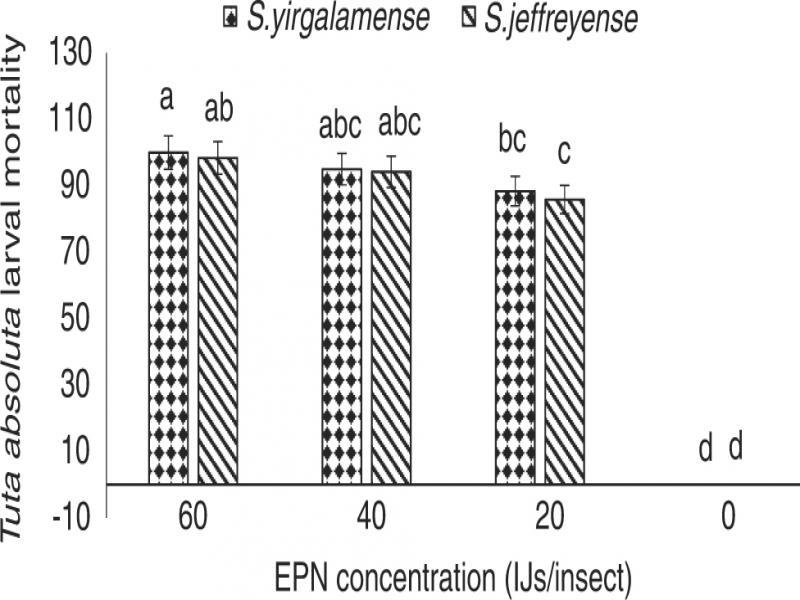
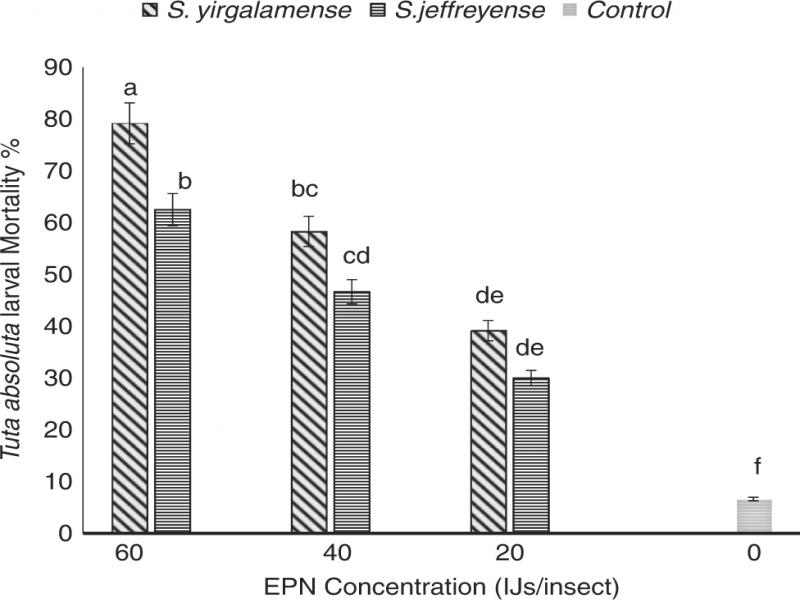
These EPNs are capable of penetrating and killing their hosts within 24–48 h of nematode invasion, which is caused by their mutualistic relationship with bacteria and of the genera Photorhabdus and Xenorhabdus that are carried in the intestine of Heterorhabditidae and Steinernematidae, respectively (Akhurst and Boemare, 1990; Husin, 2017). EPNs were reported to control T. absoluta but the use of sub-tropical EPN species is not yet known to farmers in the Kingdom of Eswatini. In this study, we tested the virulence of two sub-tropical EPN species on T. absoluta larvae.
Materials and methods
Source of insects
Tuta absoluta larvae were collected from infested tomato fields around Mankayane (26 °44’58”S 31°02’56”E), kept in Perspex boxes measuring 15 × 20 cm and transported to the Entomology laboratory, Faculty of Agriculture, University of Eswatini. Tuta absoluta was mass-reared in rearing cages (50 × 50 × 50 cm) (Vermandel, Hulst, The Netherlands) on tomato plants at 25 ± 2 °C, 65 ± 5% RH, with a 16:8 L:D photoperiod. Rearing cages (60 × 60 × 90 cm) (Vermandel) with tomato plants on pots were used to mass-rear adult T. absoluta and were allowed to lay eggs for 48 h. The tomato plants with eggs were transferred back to the other rearing cages measuring 50 × 50 × 50 cm. After hatching, larvae were allowed to feed on potted tomato plants at ad libitum. Data on the developmental time and morphological descriptions was used to separate between the four T. absoluta instars (Cuthbertson et al., 2013; Vargas, 1970). Last instar larvae were then harvested by means of opening the mines and picking the larvae. Tenebrio molitor (Coleoptera: Tenebrionidae) (mealworm) larvae, used for culturing nematodes, were reared on a diet comprised of wheat bran, as reported by Van Zyl and Malan (2013).
Source of nematodes
Two laboratory reared EPN species, Steinernema yirgalemense Nguyen, Tesfamariam, Gozel, Gaugler & Adams 2004 and S. jeffreyense Malan, Knoetze & Tiedt 2015 were sourced from the EPN collection of the Nematology Laboratory, Department of Conservation Ecology and Entomology, Stellenbosch University, South Africa. The IJ rearing and harvesting procedures were carried out according to the methods presented by Kaya and Stock (1997), using mealworm larvae kept at room temperature (±25°C). The IJs were harvested from the White trap during the first week of emergence, stored horizontally using 500-ml vented culture flasks, and used within one month after harvesting. The culture flasks were shaken on a weekly basis, to increase the amount of aeration, and the survival of the IJs, during storage. The origin of the two EPN species used in the study is indicated in Table 1.
Table 1.
List and characteristics of the Steinernema species used in the study.
| Species name | Strain | Habitat | Locality | GenBank accession number | Length of IJ (µm) | Body width of IJ (µm) | Reference |
|---|---|---|---|---|---|---|---|
| S. yirgalemense | 157-C | Citrus orchard | Friedenheim, Mpumalanga | EU625295 | 685 (570–740) | 29 (24–33) | Malan et al. (2011) |
| S. jeffreyense | J194 | Guava tree | Jeffrey’s Bay, Eastern Cape | KC897093 | 924 (784–1043) | 35 (23–43) | Malan et al. (2016) |