Steinernema feltiae (Nematoda: Rhabditidae) is a soil dwelling entomopathogenic nematode (EPN) that can exploit a wide range of insect hosts. The third-stage infective juvenile (IJ) locate insect hosts, enter their natural openings (mouth, anus or spiracles), and release symbiotic bacteria of the species Xenorhabdus bovienii, carried in their guts, into the host hemolymph causing septicemia and the death of the insect within 24–48 hr. The nematodes feed upon the proliferating bacteria and degraded host body tissues, producing two or more new generations within the insect cadaver before emerging into the soil as IJs in search of a new host. The potential of nematode of this genus for the control of several pest species has been demonstrated in Lepidoptera (Radhakrishnan et al., 2017), Coleoptera (Gulcu et al., 2019), Diptera (Chergui et al., 2019), among others. However, biotic factors such as antagonist organisms, abiotic factors, such as soil texture, moisture, temperature and content of organic matter (OM), and others, such as IJ concentration, application method and distance from the host, also affect the effectivity of the IJ (Choo and Kaya, 1991; Shapiro et al., 2000; Sharma et al., 2011; Griffin, 2015).
Regarding IJ concentration, many studies have focused on this factor for the control of different pest species (ranging from 0.1−1 × 10⁶ IJ m−2); however, adequate IJ concentration for different EPN species in various soil types is poorly understood. For example, to achieve a similar mortality level of Phthorimaea operculella (Lepidoptera: Gelechiidae) larvae, it was necessary to apply 500 IJ in sandy soil and 2,000 IJ in loam soil of either Steinernema carpocapsae or Heterorhabditis bacteriophora (Hassani-Kakhki et al., 2013). This is important to consider in commercial EPN applications, as an excessive or deficient IJ number applied may increase the costs unnecessarily or result in an inefficient control of the target pest.
In relation to soil texture, this factor affects dispersal (Kapranas et al., 2017), infectivity (Choo and Kaya, 1991; Toledo et al., 2009) and persistence (Shapiro et al., 2000; Koppenhöfer and Fuzy, 2006) of EPNs, which generally move and disperse better in light-textured soils (Hassani-Kakhki et al., 2013). For instance, H. bacteriophora, S. carpocapsae and Steinernema glaseri dispersed significantly more in sandy loam than in loam or silty clay loam (Portillo-Aguilar et al., 1999). Furthermore, this may vary with EPNs species and isolate, as in a study by Campos-Herrera and Gutiérrez (2014), where infection dynamics varied among 14 different populations of S. feltiae in the same soil texture. Besides, Campos-Herrera and Gutiérrez (2009) observed that heavy soils negatively affected the virulence of the Rioja isolate of S. feltiae on larvae of Spodoptera littoralis (Lepidoptera: Noctuidae), as an increase content of clay from 5 to 14%, caused an increase in the LC90 (to kill 90% of larvae in two days) from 220 to 4,178 IJs/cm2. Therefore, knowledge about soil requirements of an EPN species/isolate is critical to optimizing their performance as biological control agents in the field.
In addition, OM improves soil structure, lowering bulk density, increasing the available space through the distribution of aggregates and pore size, thus OM content and soil compaction may influence EPNs infection patterns (Kapranas et al., 2017), and persistence in the soil (Shapiro and Lewis, 1999). While several studies have shown the benefits of soil OM on soil inhabitants in general (Hoitink and Boehm, 1999; Davey et al., 2019), few have focused on EPN performance (Kapranas et al., 2017). For instance, Herren et al. (2018) observed higher survival and virulence of S. feltiae on larvae of Galleria mellonella (Lepidoptera: Pyralidae) in soils with added mature compost. Some authors propose that the compost could be used as a carrier for EPN application in the field (Herren et al., 2018; Georgis et al., 2006) as it could protect them against UV radiation, extreme temperatures and facilitate contact between EPNs and their insect hosts (Georgis et al., 2006). Therefore, texture, OM and IJ concentration are factors to consider for optimizing EPN activity, and they should be evaluated for different species.
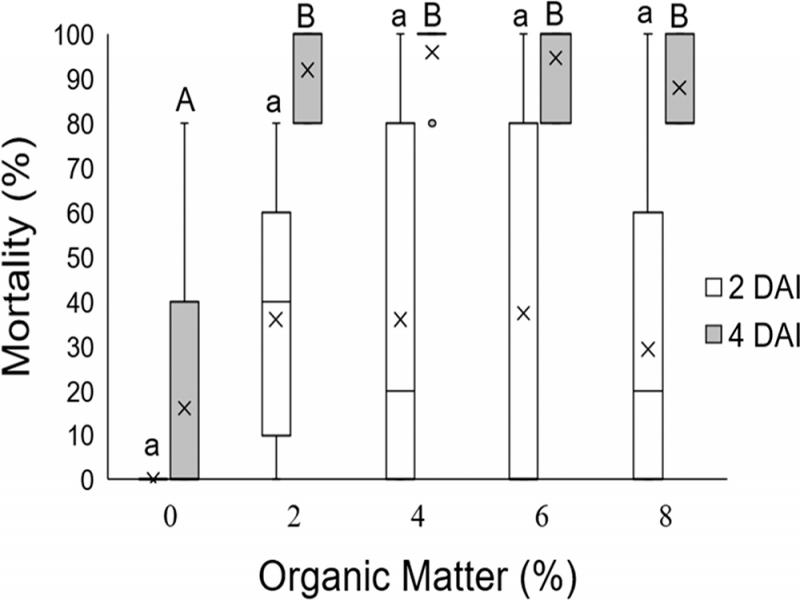
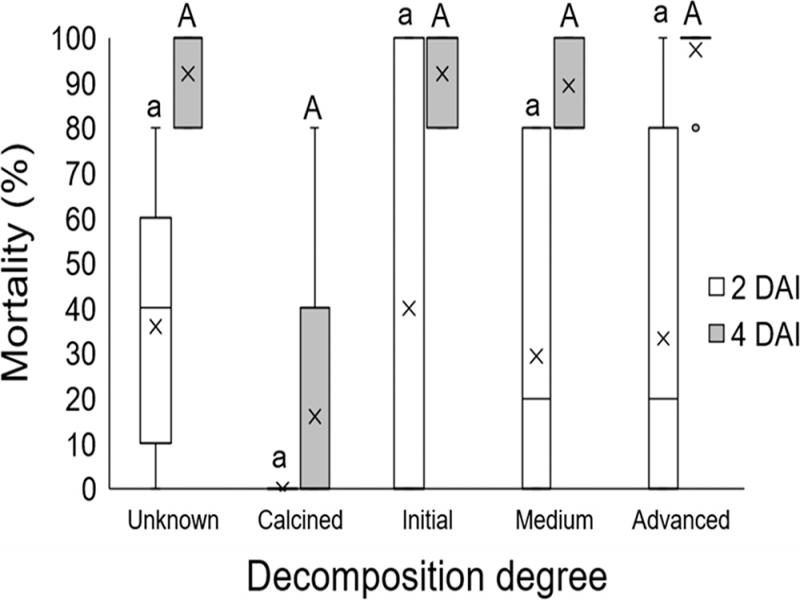
The native Chilean EPN S. feltiae isolate Lican Ray (LR) was successfully evaluated, under laboratory and semifield conditions, for the control of foliage pests like the diamond back moth, Plutella xylostella (Lepidoptera: Plutellidae) (Reyes, 2018; Nuñez, 2017) and the bagrada bug, Bagrada hilaris (Hemiptera: Pentatomidae) (unpublished data). Also on soil pests, such as the potato cutworm Agrotis deprivata (Syn. A. bilitura) (Lepidoptera: Noctuidae) (Burgos, 2017; Quezada, 2018) and larvae of Naupactus xanthographus (Coleoptera: Curculionidae) (unpublished data). Considering the great potential of S. feltiae LR for the control of these and other pests, the objectives of this work were: to evaluate the infectivity of this isolate on G. mellonella larvae at three IJ concentrations in clay, loam and sandy loam soils; to assess the IJ capacity to disperse (horizontally and vertically), reach and kill G. mellonella larvae in these soils; and to determine the effect of different OM concentrations and different degrees of decomposition on the dispersion of IJs in loam soil.
Materials and methods
IJs of S. feltiae LR were cultured at 25 ± 0.1°C using last larval instars of G. mellonella (Kaya and Stock, 1997), and IJs were stored at 8°C in tissue culture flasks with distilled water for less than five days before their use.
Three different soils were used in the experiments. Sandy loam and clay soils were obtained from Pichidegua town, located in the Libertador Bernardo O´Higgins Region, Chile. Loam soil was obtained from Universidad de Chile’s experimental field located at La Pintana, in the Metropolitan Region, Santiago, Chile.
The clay soil was sieved, and all soils were sterilized in metallic cans using the water bath method at 90°C for 2 hr, and then physical and chemical parameters of the soil samples were determined in the Laboratory of Soil from Universidad de Chile (Table 1). The samples were moistened up to field capacity and stored in closed plastic containers at 25 ± 2°C for up to 48 hr before use.
Table 1.
Physical properties of the soils used.
| Volumetric water content (%) | Texture (%) | |||||
|---|---|---|---|---|---|---|
| Textural classes | FC | PWP | AWC | S | C | Si |
| Clay | 39.0 | 19.0 | 20.0 | 19.0 | 52.0 | 19.0 |
| Sandy loam | 18.0 | 8.9 | 9.1 | 69.2 | 8.6 | 22.2 |
| Loam | 22.0 | 14.0 | 8.0 | 38.8 | 20.8 | 40.4 |
| Content (%) | Content (ppm) | ||||
|---|---|---|---|---|---|
| OM decomposition degree | OM | Organic carbon | Total nitrogen | Nitrate | Ammonium |
| Initial | 85 | 49.7 | 2.66 | 147 | 142 |
| Medium | 18 | 10.5 | 1.26 | 495 | 28 |
| Advanced | 18 | 10.5 | 0.98 | 335 | 18 |