The genome encodes the entire inheritance messages of living organisms, serving as the foundation for biological, cellular, and molecular processes that are essential for development and reproduction. Knowledge of genomes advances the understanding of complex gene networks and assists in the engineering of crops and biological control agents for trait improvement (Bolger et al., 2014; Lu et al., 2016; Rodríguez-Leal et al., 2017). Research efforts to date have largely focused on model species and laboratory strains. Recently, however, the rapid progress of high-throughput sequencing and computational algorithms have begun to enable sequencing of field-collected species and strains (Wang et al., 2018; Wu et al., 2018; Kingan et al., 2019), which could be divergent from their laboratory-maintained congeners due to the lack of artificial selections (Palková, 2004; Barriere and Felix, 2005). Scrutinizing these wild populations and species might shed light on genetic changes during both domestication processes and natural selection, paving the way for better biodiversity conservation, trait selection, and targeted breeding (Fuentes-Pardo and Ruzzante, 2017; Wang et al., 2018; Wu et al., 2018).
The entomopathogenic nematode Steinernema feltiae is widely applied to control insect pests, such as scarab larvae, fungus gnats, and lepidopteran larvae (Toba et al., 1983; Jess and Bingham, 2004; Lacey et al., 2006; Lacey and Georgis, 2012). As an obligate parasite, S. feltiae relies on the toxin produced by its symbiotic bacterium Xenorhabdus bovienii to kill insect hosts, which the nematodes then consume. The tripartite of bacterium–nematode–insect presents an interesting model to examine the mutualistic relationship between nematodes and symbiotic bacteria, as well as insect immune responses (Goodrich-Blair, 2007; Castillo et al., 2011). Dillman et al. (2015) published the first draft genome of S. feltiae, offering a comprehensive resource for understanding the evolution of parasitism genes. The strain SN used by Dillman et al. (2015) has long been maintained under laboratory conditions. Under such conditions, organisms could undergo significant changes in genome structure, gene copy numbers as well as accumulating mutations that are associated with adaptation to artificial conditions (Farslow et al., 2015; Sterken et al., 2015).
Here, we report a genome assembly and annotation for S. felitae NW a naturally occurring entomopathogenic nematode strain, which was shown to be effective in causing mortality of insect hosts (unpubl. data). Entomopathogens that coevolve with their local insect hosts could exhibit higher efficacy on killing insect pests than commercial strains (Noosidum et al., 2010). Thus, a genomic resource from a field-collected entomopathogenic strain could offer valuable insights into local adaptation as well as trait improvement for this broadly applied biopesticide.
Materials and methods
Nematode strain
S. feltiae strain NW was collected using trap insect technique with modification (see Kaya and Stock, 1997) from a potato field near Patterson, WA under organic management. Specifically, a trap consisted of 10 wax moth, Galleria mellonella, larvae (Nature’s Way, Ross, OH) in a sealed mesh bag was buried 15 cm deep in the soil, and the trap was retrieved 48 hr later. Nematodes were extracted from dead larvae using White traps (White, 1927). A week later, infective juveniles (IJs) were collected and kept at 12°C. To reduce heterozygosity, 20 IJs were used to establish an inbred colony. These IJs were used to infect a single wax moth, and seven days after infection, IJs were recovered using a White trap (White, 1927). Approximately 200 emerged IJs were used to infect 10 wax moths for two more times. Emerged IJs were washed three times in sterilized tap water and stored in −80°C until DNA purification.
DNA purification
Approximately 10,000 IJs were thawed and frozen twice. High molecular weight genomic DNA was extracted using a phenol chloroform protocol described in the study of Donn et al. (2008). The DNA pellet was re-suspended in 100 µl 10 mM Tris-Cl (pH 8.5) buffer. Washington State University’s Genomic Core Facility (Pullman, WA) performed library preparation and sequencing. Three batches of sequencing with different chemistries were conducted: XL-XL, P4-C2, and P5-C3. In total, 42 SMRT cells (24 cells of XL chemistry, 7 cells of P4-C2 chemistry, and 11 cells of P5-C3 chemistry) were included in the sequencing.
Read filtering and genome assembly
We used bash5tool.py algorithm in the SMRT analysis pipeline (v2.3) to extract subreads from all 42 SMRT cells with minReadScore set to 0.75. Subreads were used for genome assembly. We tested two genome assembly programs initially: Canu (v1.3; Koren et al., 2017) and Celera (v8.3rc2; Myers et al., 2000). For both assemblers, we started with the default setting. Canu outperformed Celera in running time and memory use. Canu also generated an assembly with fewer contigs and greater N50. Thus, we picked Canu for further fine-tuning to improve assembly quality. For the final assembly, we used sprai (v0.9.9.18, http://zombie.cb.k.u-tokyo.ac.jp/sprai) to correct errors for the subreads, and we imported corrected reads into Canu to perform de novo assembly.
Quality control
Once we obtained an assembly with the best continuity and lowest number of contigs, we removed contigs that had low read support (<20 reads). The read coverage information was indicated in Canu (v1.3; Koren et al., 2017). Often, contigs with low read support were highly fragmented and not informative in building gene models during the annotation process. Next, we polished the assembly by first aligning raw PacBio-h5 files to the assembly using the program pbalign following consensus calling using Quiver (SMRT analysis pipeline (v2.3)). Finally, we queried each contig in the assembly to genome sequences of the endosymbiont X. bovienii (GenBank assembly accession: GCA_000027225.1) using BLASTN (Altschul et al., 1990). Contigs showed homology to any sequence of X. bovienii with bit score >200 were removed in the assembly.
Genome alignment
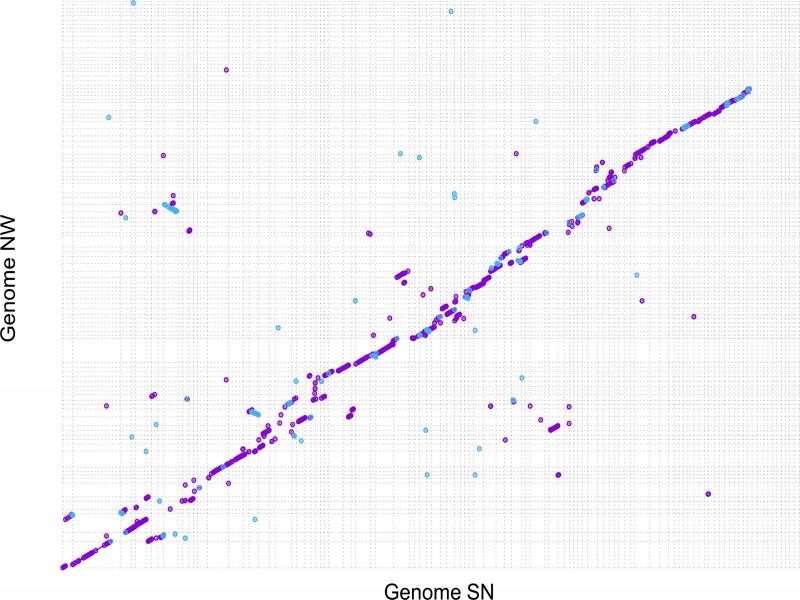
MUMmer (v4.09; Marçais et al., 2018) was used to align our assembly to the genome assembly of SN. Program dnadiff in MUMmer was used to summarize the comparative analysis of the two genomes. Program nucmer provided a 1-to-1 and all-vs-all comparisons of the two genomes, and this analysis was limited to the 100 longest contigs/scaffolds to minimize noise.
Genome annotation and evaluation
Because the genome assembly of strain NW seemed to be divergent from the previously published genome of strain SN, we annotated this genome to present as an alternative resource for the research community. To do this, we modeled and identified potential repeat region of the S. feltiae NW genome based on a repeat library kindly provided by WormBase using RepeatModeler (v1.0.11, http://www.repeatmasker.org/RepeatModeler/). After that, we used RepeatMasker (v4.0.9; Smit et al., 2013-2015) to soft mask the genome. Two RNA-seq data sets (BioProjects accession numbers PRJNA488495 and PRJNA283145, Chang et al., 2019), were aligned to the NW genome assembly using program HISAT2 (v2.1.0; Kim et al., 2015) with the default setting. The resulting bam files from HISAT2 were used as RNA-seq evidence to train gene models in BRAKER2 (Hoff et al., 2015). The generated annotation file in GFF3 format from BRAKER2, along with the protein FASTA file of strain SN (Dillman et al., 2015), were incorporated into the program MAKER (v2.31.10; Cantarel et al., 2008) to synthesize gene models. BUSCO (v3.02; Waterhouse et al., 2017) was used to evaluate the completeness of the genome based on a set of universal single-copy orthologs across Nematoda.
Data archiving
The whole genome assembly was archived in NCBI with WGS accession number MQUG00000000. PacBio subreads were deposited in SRA under BioProject PRJNA353610. Genome in GFF3/GTF format along with predicted mRNA, CDs, and protein sequences were deposited in WormBase ParaSite and will be available from release 15 and forward.
Results
PacBio sequencing of strain NW
In total, 7,166,944 reads (read length ranging from 500 bp to 39,605 bp, median=1,429 bp, mean=1,681 bp) were generated from 42 SMRT cells across three chemistries. Reads generated in our study were sufficient to cover the genome 145-fold, assuming the genome size of 82 Mb as previously described (Dillman et al., 2015). Such high coverage would adequately overcome the high error rate often associated with long reads generated from PacBio platforms (Rhoads and Au, 2015).
De novo assembly
The final assembly used in the downstream analysis was generated in Canu (Koren et al., 2017) with an error rate=0.03, and raw reads covered the genome assembly 99-fold. After removing contigs that were likely contaminated with X. bovienii, and contigs with low coverage support (<20 reads), the final assembly contained 4,876 contigs with N50 (contigs) of 60,433 bp. The assembled genome size of NW is significantly larger (47%) than SN with noticeable improvement regarding the number of contigs and continuity (N50, Table 1). In addition, our assembly of NW contained no ‘gaps’ (i.e., unknown sequences between two contigs of which order and orientation are known; Clum, 2018) in comparison to numerous gaps totaling 2,769,616 bp in the SN genome; this would facilitate annotation of the genome (e.g., Dallery et al., 2017).
Table 1.
Summary of the genome assembly of strain NW in comparison to strain SN.
| Strain NW | Strain SN | |
|---|---|---|
| Assembly | ||
| Total bases (bp) | 121,603,260 | 82,627,153 |
| No. of scaffolds | na | 5,839 |
| Scaffold N50 | na | 47,851 |
| No. of contigs | 4,678 | 59,024 |
| Contig N50 | 60,433 | 3,650 |
| No. of gaps (bp) | 0 | 2,769,616 |
| Longest scaffolds (bp) | 1,315,981 | 1,446,875 |
| No. of predicted genes | 32,304 | 36,434 |
| Total no. of amino acids | 12,632,601 | 12,195,137 |
| BUSCO assessment | ||
| Complete BUSCOs | 87.27% | 84.32% |
| Complete single copy | 76.68% | 80.55% |
| Complete duplicated copy | 10.59% | 3.77% |
| Fragmented | 7.33% | 8.15% |
| Missing | 5.40% | 7.54% |
| Alignment | ||
| Aligned Seqs | 4,279 (91.47%) | 5,418 (92.79%) |
| Aligned Bases | 92,999,444 (76.48%) | 74,444,081 (90.10%) |
| 1-to-1 | 49,949 | 49,949 |
| Total length (1-to-1) | 72,468,269 | 72,538,432 |
| Avg. identity (1-to-1) | 97.07 | 97.07 |
| M-to-M | 133,667 | 133,667 |
| Total length (M-to-M) | 106,859,791 | 106,997,101 |
| Avg. identity (M-to-M) | 95.69 | 95.69 |
| Genomic variation | ||
| Breakpoints | 261,902 | 252,282 |
| Relocations | 8,456 | 5,231 |
| Translocations | 13,595 | 16,494 |
| Inversions | 1,411 | 1,952 |
| Insertions | 105,325 | 74,670 |
| Total SNPs | 907,706 | 907,706 |