
Table 1.
List of 28S ribosomal RNA gene partial sequences (D2–D3 segment) of Hirschmaniella and outgroup species used for phylogenetic analysis.
| Species | Accession No. | Location |
|---|---|---|
| H. dicksoni n. sp. | KY773577 | Florida |
| Hirschmanniella sp. | EU620464 | South Africa |
| Hirschmanniella sp. | KY794704 | Iran |
| Hirschmanniella sp. | JX261958 | Iran |
| Hirschmanniella sp. | EU620465 | South Africa |
| H. diversa | JX144359 | Japan |
| H. santarosae | EF029859 | California |
| H. pomponiensis | DQ077795 | California |
| H. kuazuna | EU620466 | South Africa |
| H. kuazuna | EU620467 | South Africa |
| H. loofi | EU620468 | Belgium |
| H. loofi | EU620469 | Belgium |
| H. mucronata | KF201167 | The Philippines |
| H. mucronata | KP179327 | Cambodia |
| H. mucronata | KP179333 | Cambodia |
| H. mucronata | KY424320 | China |
| H. mucronata | MK241938 | Indonesia |
| Hirschmanniella sp. Yuma | EF029861 | Arizona |
| H. belli | EF029860 | California |
| H. oryzae | JX291142 | Myanmar |
| H. oryzae | KF201165 | The Philippines |
| Hirschmanniella sp. | DQ328686 | Vietnam |
| Hirschmanniella sp | KP671713 | Belgium |
| Pratylenchus vulnus | JX047010 | USA |
Table 2.
List of 18S ribosomal RNA gene partial sequences (ITS rRNA) of Hirschmaniella and outgroup species used for phylogenetic analysis.
| Species | Accession No. | Location |
|---|---|---|
| H. dicksoni n. sp. | KY773578 | Florida |
| H. mucronata | KP179328 | Belgium |
| H. mucronata | KF201166 | The Philippines |
| H. mucronata | DQ309589 | Taiwan |
| H. mucronata | KP179329 | Belgium |
| H. mucronata | KJ923642 | China |
| H. mucronata | KP179331 | Belgium |
| H. loofi | EU620472 | South Africa |
| H. loofi | EU620473 | South Africa |
| H. kuazuna | EU620471 | South Africa |
| H. kuazuna | EU620470 | South Africa |
| H. oryzae | KF201164 | The Philippines |
| H. oryzae | KF201163 | The Philippines |
| H. oryzae | DQ309588 | Taiwan |
| Pratylenchus bolivianus | FR692329 | Italy |
Table 3.
Morphometrics of Hirschmanniella dicksoni n. sp.
| Female | Male | ||
|---|---|---|---|
| Character | Holotype | Paratypes | Paratype |
| n | – | 19 | 20 |
| L | 1,906 | 1714 ± 152 | 1506 ± 143 |
| (1,582–1,929) | (1,235–1,772) | ||
| a | 61 | 59 ± 4.9 | 60 ± 6.3 |
| (50–69) | (47–72) | ||
| b | 11 | 11 ± 1.1 | 9.6 ± 0.9 |
| (10–14) | (8.6–11.3) | ||
| b′ | 4.1 | 4.2 ± 0.4 | 4.3 ± 0.4 |
| (3.8–4.8) | (3.8–5.1) | ||
| c | 13 | 14 ± 0.9 | 15 ± 1.5 |
| (13–15) | (13–18) | ||
| c′ | 6.7 | 6.2 ± 0.5 | 6.2 ± 0.8 |
| (5.1–6.7) | (4.8–7.2) | ||
| G1 | 22 | 23 ± 2.3 | – |
| (20–26) | |||
| G2 | 20 | 20 ± 1.8 | – |
| (17–24) | |||
| T | – | – | 37 ± 5 |
| (29–45) | |||
| V | 55 | 53 ± 1.7 | – |
| (50–56) | – | ||
| M | 51 | 52 ± 1.7 | 54 ± 1.9 |
| (51–55) | (51–57) | ||
| o | 23 | 22 ± 2.2 | 21 ± 2.9 |
| (19–27) | (17–27) | ||
| DGO | 4.5 | 4.3 ± 0.4 | 4 ± 0.6 |
| (3.8–5.1) | (3.3–5.1) | ||
| Lip region diameter | 10 | 10 ± 0.7 | 9.9 ± 0.4 |
| (9.1–11.2) | (9.2–11) | ||
| Lip region height | 3.7 | 4.1 ± 0.3 | 4.3 ± 0.3 |
| (3.7–4.8) | (4.0–5.1) | ||
| Stylet length | 19 | 20 ± 0.6 | 19 ± 0.5 |
| (19–21) | (18–20) | ||
| Conus length | 9.8 | 10 ± 0.5 | 10 ± 0.4 |
| (9.7–11) | (9.6–11) | ||
| Shaft length | 9.5 | 9.3 ± 0.4 | 8.7 ± 0.4 |
| (8.6–9.9) | (8.2–9.6) | ||
| Stylet knob height | 3 | 2.7 ± 0.4 | 2.7 ± 0.2 |
| (2–3.4) | (2.4–3.2) | ||
| Stylet knob width | 4.6 | 4.5 ± 0.4 | 4.3 ± 0.5 |
| (3.8–5.3) | (3.4–5.0) | ||
| Procorpus length | 80 | 63 ± 13.8 | 70 ± 7.2 |
| (50–87) | (54–80) | ||
| Median bulb length | 17 | 17 ± 1.4 | 16 ± 1.3 |
| (15–20) | (14–18) | ||
| Median bulb diam. | 13 | 12 ± 0.8 | 11 ± 1.4 |
| (11–13) | (7.5–13) | ||
| Median bulb valve length | 5.8 | 5 ± 0.7 | 4.7 ± 0.7 |
| (3.5–6.3) | (3.8–6) | ||
| Median bulb valve width | 3.6 | 2.9 ± 0.4 | 2.9 ± 0.5 |
| (2.3–3.6) | (2.1–3.6) | ||
| Anterior end to oesophageal-intestinal junction | 177 | 154 ± 12 | 158 ± 13 |
| (142–177) | (129–179) | ||
| Anterior end to excretory (EP) pore | 146 | 133 ± 7 | 119 ± 11 |
| (124–146) | (87–134) | ||
| EP pore to oesophageal-intestinal junction | 31 | 25 ± 4.3 | 39 ± 8.9 |
| (20–32) | (24–50) | ||
| Metacorpus valve from anterior end | 89 | 85 ± 4.1 | 80 ± 4.7 |
| (80–94) | (72–87) | ||
| Nerve ring from anterior end | 116 | 113 ± 5 | 102 ± 10 |
| (105–122) | (73–114) | ||
| Oesophageal gland overlap | 294 | 257 ± 34 | 193 ± 23 |
| (204–311) | (150–223) | ||
| Oesophagus length | 470 | 411 ± 38 | 351 ± 30 |
| (330–470) | (303–392) | ||
| Max body length | 31 | 29 ± 1.6 | 26 ± 3.1 |
| (26–31) | (21–30) | ||
| Length from phasmids to terminus | 32 | 29 ± 2 | 32 ± 2.9 |
| (25–32) | (27–35) | ||
| Tail length | 149 | 125 ± 11 | 102 ± 11 |
| (103–149) | (84–119) | ||
| Anal body width | 22 | 20 ± 1 | 17 ± 1.8 |
| (18–22) | (15–20) | ||
| From cloaca to anterior most part of testis | – | 559 ± 92 | |
| (420–708) | |||
| Vulva to anterior end | 1045 | 912 ± 90 | – |
| (803–1056) | |||
| Anterior genital branch | 420 | 391 ± 57 | – |
| (305–472) | |||
| Posterior genital branch | 385 | 333 ± 39 | – |
| (289–433) | |||
| Ant. Spermatheca length | 26 | 28 ± 4.2 | – |
| (20–35) | |||
| Ant. Spermatheca diam | 15 | 16 ± 2.6 | – |
| (9.3–19) | |||
| Post. Spermatheca length | 24 | 24 ± 3.9 | – |
| (17–30) | |||
| Post. Spermatheca diam | 14 | 14 ± 2 | – |
| (8.9–17) | |||
| Bursa | – | – | 70 ± 15 |
| (45–94) | |||
| Cloaca to anterior tip of bursa | – | – | 25 ± 5.8 |
| (15–33) | |||
| Cloaca to posterior tip of bursa | – | – | 45 ± 9.5 |
| (27–61) | |||
| Gubernaculum | – | – | 8.9 ± 1.1 |
| (7.4–11) | |||
| Spicules | – | – | 25 ± 2.9 |
| (19–30) | |||
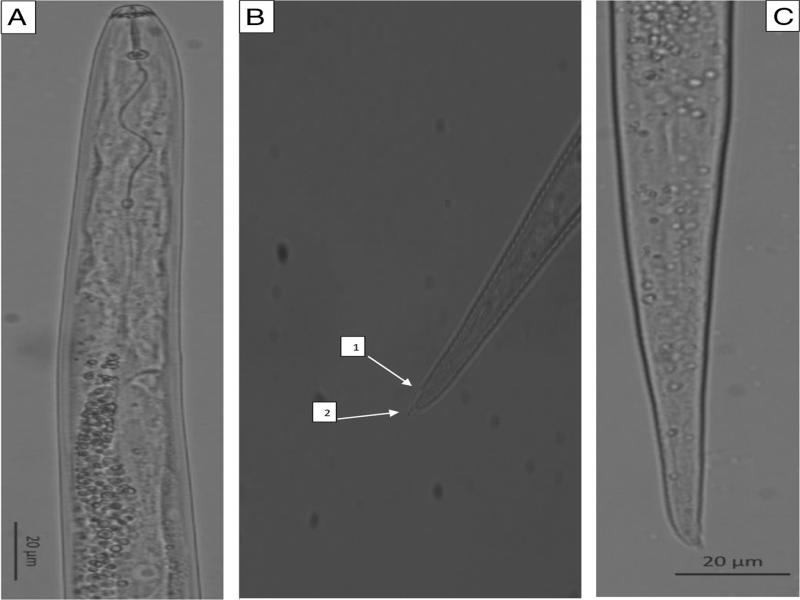
Figure 1:
Hirschmanniella dicksoni n. sp. female: (A) Anterior region; (B) tail region (arrow 1: subterminal notch, arrow 2: ventral projection); (C) tail region. Scale bars in A, B, C = 20 µm.
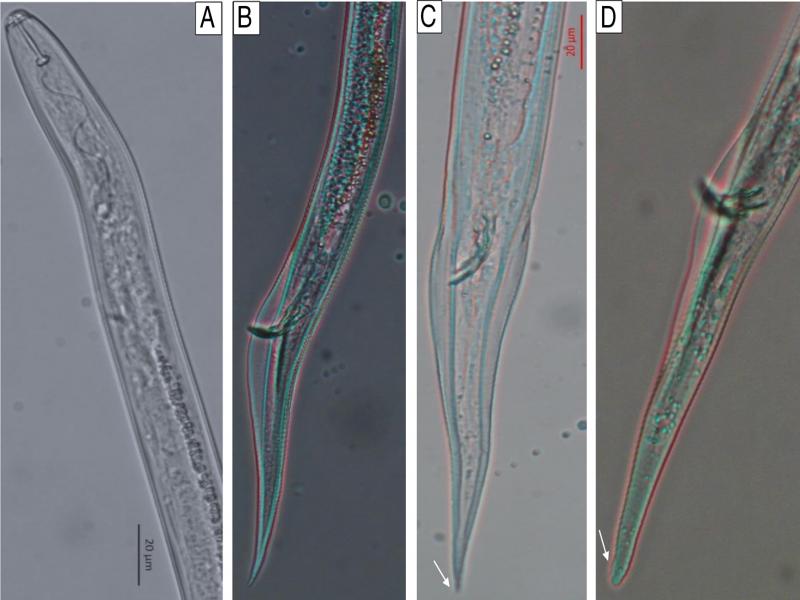
Figure 2:
Hirschmanniella dicksoni n. sp. male: (A) Anterior region; (B, C, D) tail region (arrows: pointed and round tail terminus). Scale bars in A, B, C, D = 20 µm.
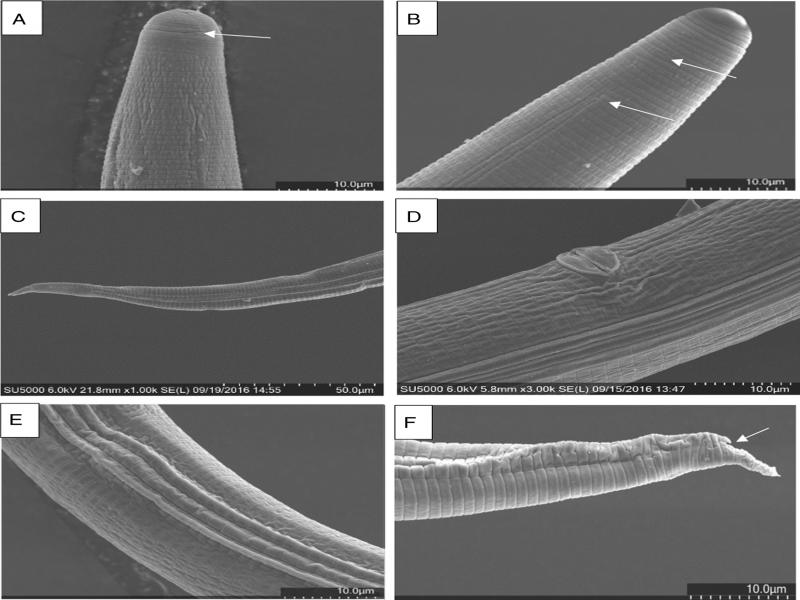
Figure 3:
SEM photomicrographs of Hirschmanniella dicksoni n. sp. female: (A) Lip region (arrow: incomplete lip annules); (B) lateral field in anterior region (arrows: incomplete annules; rings and incisures on the beginning on lateral field); (C) posterior region; (D) vulva and lateral fields; (E) lateral field in middle body region showing incomplete aerolations; (F) tail region with subterminal notch (arrow: subterminal notch).
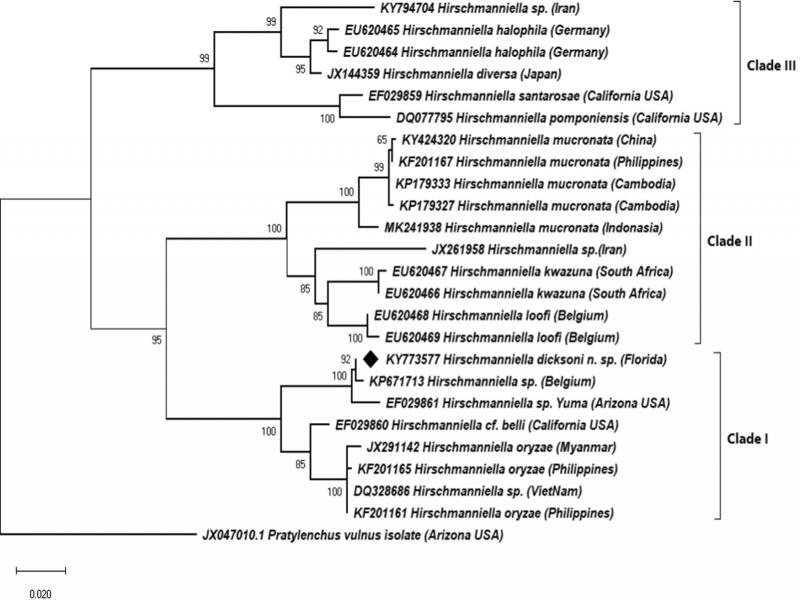
Figure 4:
Phylogenetic relationship based on D2–D3 expansion segments of 28S rRNA gene sequences within the genus Hirschmanniella. The evolutionary history was inferred by using the maximum likelihood method and Kimura 2-parameter model. The tree with the highest log likelihood (−3,442.77) is shown. The percentage of trees in which the associated taxa clustered together is shown next to the branches. A discrete Gamma distribution was used to model evolutionary rate differences among sites (5 categories (+G, parameter = 0.3519)). The tree is drawn to scale, with branch lengths measured in the number of substitutions per site. This analysis involved 25 nucleotide sequences. There were a total of 795 positions in the final data set. Accession preceded by ♦ is a new sequence.
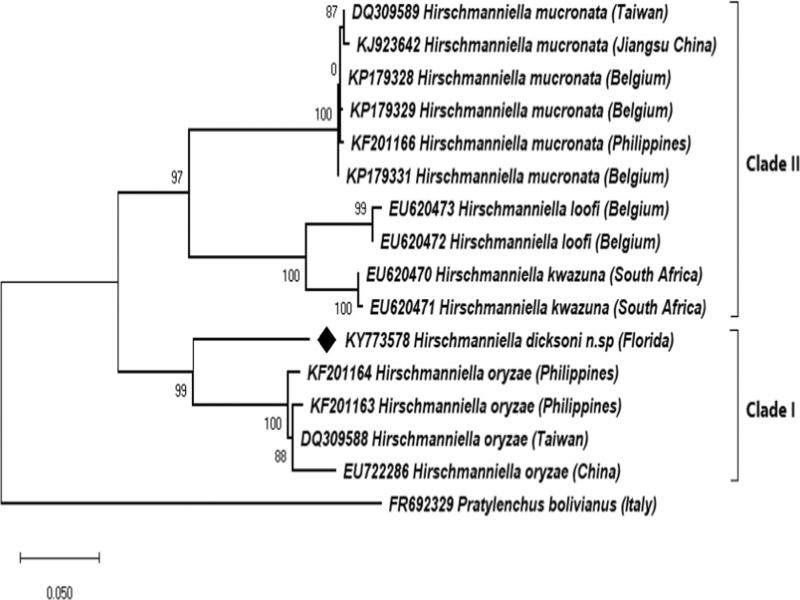
Figure 5:
Phylogenetic relationship based on ITS rRNA sequences within the genus Hirschmanniella. The evolutionary history was inferred by using the maximum likelihood method and Tamura 3-parameter model. The tree with the highest log likelihood (−4,485.75) is shown. The percentage of trees in which the associated taxa clustered together is shown next to the branches. A discrete Gamma distribution was used to model evolutionary rate differences among sites (5 categories (+G, parameter = 0.9061)). The tree is drawn to scale, with branch lengths measured in the number of substitutions per site. This analysis involved 16 nucleotide sequences. There were a total of 1,486 positions in the final data set. Accession preceded by ♦ is a new sequence.