The potato cyst nematode (PCN) Globodera pallida (Stone, 1972) is a potato pest of economic importance worldwide. Plant resistance is the most efficient way to reduce crop damage and reproduction of this nematode. In contrast to Globodera rostochiensis (Wollenweber, 1923) which is effectively controlled using resistant potato cultivars, there is a lack of cultivars with stable resistance to G. pallida pathotypes. Nevertheless, using plant resistance in an integrated pest management system remains the most viable way to keep nematode densities below the damage threshold. European populations of G. pallida are highly heterogeneous (Turner et al., 1983; Turner and Fleming, 2002; Dalton et al., 2013; Rigney et al., 2017) mainly consisting of pathotype 2 and 3 (Pa2/3). As a consequence, no single resistance gene is able to confer full resistance against all European populations of G. pallida Pa2/3 (Dalton et al., 2013). The potato cultivars available to the growers have been introgressed with resistance derived from species such as Solanum vernei (Gpa1 and Gpa5), S. tuberosum spp. andigena (H1 and Gpa2), and S. spegazzinii (Gpa) among others (Bakker et al., 2006; Dalamu et al., 2012). These genes confer pathotype-specific resistance and they differ in their mode of action.
Infestation of potato plants by G. pallida occurs soon after the hatching of second-stage juveniles (J2s), a process that is initiated by chemical stimuli present in the potato root exudate. The exudate is continuously produced by actively growing potato roots and diffuses in the rhizosphere where it comes into contact with nematode cysts. Hatched J2s then locate young host roots and penetrate near the root tip. They move intracellularly towards the pericycle and use a stylet to pierce the cell walls and inject salivary secretions containing growth regulators into the host cells. These regulators function by modifying the host cells into a feeding structure known as syncytium that ensures continuous nourishment of the developing nematode (Moens et al., 2018).
The presence of the invasive juveniles in the roots of resistant hosts trigger a cascade of immune responses that thwart further development of the nematode. Potato cultivars having different resistance gene(s) respond differently to PCN infestation. Sometimes, the J2s may fail to initiate a syncytium and therefore exit the root of resistant hosts or die within the root. In other cases, development of the nematode in the host root may be arrested or there may be a shift in sex ratio in favor of males (Trudgill, 1967; Rice et al., 1985; Schouten, 1993; Bakker et al., 2006; Williamson and Kumar, 2006; Smant et al., 2018). For instance, the H1 gene which confers resistance to pathotype Ro1 and Ro4 of G. rostochiensis triggers a hypersensitive reaction characterized by necrosis and death of cortical cells surrounding the invading nematode (Rice et al., 1985; Bakker et al., 2006; Smant et al., 2018). This is followed by the formation of a syncytial complex which restricts the development of the syncytium resulting in poorly formed feeding cells. The invading J2s are deprived of adequate food leading to the formation of more males than females since sex in PCN is epigenetically determined (Trudgill, 1967; Schouten, 1993; Bakker et al., 2006). In plants having GPa2 genes, syncytia may be formed, but proliferation is arrested within a few days. The cells surrounding the syncytium become necrotic leading to the degeneration of the feeding structure. In this case, females are formed but their development is arrested and they fail to develop eggs (Bakker et al., 2006).
When cultivars carrying similar resistance genes are grown repeatedly for several generations, they impose strong selection pressure which increases the frequency of virulent individuals within a nematode population (Turner, 1990; Turner and Fleming, 2002). There are reports for Germany and the Netherlands about G. pallida populations with the new virulence type due to overuse of potato cultivars carrying quantitative resistance genes (Niere et al., 2014). Resistance breaking has been reported in other important plant parasitic nematodes such as Meloidogyne incognita overcoming the Mi gene in tomatoes (Kaloshian et al., 1996).
Change of virulence of G. pallida populations has been studied in controlled experiments (Turner et al., 1983; Turner, 1990; Beniers et al., 1995; Schouten and Beniers, 1997; Turner and Fleming, 2002; Beniers et al., 2019). In this case, isolates with increased virulence were artificially selected from avirulent populations reared on hosts carrying quantitative resistance genes (Schouten and Beniers, 1997; Castagnone-Sereno et al., 2007; Fournet et al., 2013). Schouten and Beniers (1997) multiplied G. pallida Pa3 on resistant cultivar ‘Karakter’ and they noted a significant increase in virulence after three generations on the same cultivar. Turner et al. (1983) detected a change in virulence of G. pallida after five generations of reproduction on PCN resistant S. vernei hybrids while in a study carried out by Fournet et al. (2013) it took the nematode eight years to completely overcome host resistance.
Change of virulence of a population as a result of selection on a resistant cultivar is often associated with a fitness cost (Thrall, 2003). This is a penalty that comes in form of reduction in pathogenic aggressiveness in a susceptible host or a compromise on another trait (Vera Cruz et al., 2000). This has been confirmed with bacteria (Ferenci, 2016; Peyraud et al., 2016), some fungi (Montarry et al., 2010), viruses (Jenner et al., 2002), and some plant parasitic nematodes. For instance, Castagnone-Sereno et al. (2007) found that Meloidogyne incognita selected on tomato carrying the Mi resistance gene had a lower fitness on susceptible hosts. In contrast, no compromise in fitness of G. pallida despite several generations of selection on resistant cultivars was reported by Turner (1990). Beniers et al. (1995) reported that increase in virulence of G. pallida is associated with increased fitness on a susceptible host. This was confirmed by Fournet et al. (2016), when they studied the life history traits of a G. pallida lineage that had been selected on resistant potato cultivars. They found that the lineage formed bigger cysts with more eggs on the susceptible cultivar and hatched faster compared to the unselected lineages. No such study has been done with G. pallida populations selected in the field.
Recently, Niere et al. (2014) reported a new virulence type of G. pallida in populations obtained during field monitoring in the Emsland region of Lower Saxony, Germany. This new virulence type, herein referred to as population Oberlangen, was able to reproduce on starch potato varieties carrying resistance genes against pathotypes Pa2/3. Oberlangen is an example of selection by continued cultivation of resistant potato cultivars against G. pallida Pa2/3. However, there is little information regarding this population and other virulent field populations from the same region.
In this study, the Oberlangen population was selected for further testing and characterization using G. pallida Chavornay (EPPO, 2006) as a reference population. This study aimed at comparing the development, virulence, and fitness of Globodera pallida Oberlangen to the G. pallida Chavornay and to assess various life history traits associated with change in virulence.
Materials and methods
Nematode populations
Globodera pallida Oberlangen and G. pallida Chavornay were used in the study. The origin of Oberlangen are potato fields in Emsland region of Lower Saxony, Germany (Niere et al., 2014) while Chavornay, which is the official reference population used in testing potato cultivars for resistance against G. pallida Pa3 (EPPO, 2006), was obtained from the JKI-Braunschweig-Germany. The two populations were maintained on susceptible cv. ‘Desiree’ in JKI-Braunschweig. Prior to the study, the populations were reproduced and subsequently stored at 4°C for a minimum period of six months to break diapause.
Plant material
Potato cultivars with different levels of resistance to G. pallida Pa2/3 (JKI, 2017) were used in this study. The cultivars ‘Laura’, ‘Albatros,’ and ‘Belana’ lack resistance to G. pallida, but they are highly resistant to G. rostochiensis Ro1/4. Potato cultivar ‘Ribera’ has a partial resistance to G. pallida (score = 6), but the source of resistance could not be established. The cultivars, ‘Amado’, ‘Amanda,’ and ‘Seresta’ are rated high in their resistance to G. pallida. The three cultivars carry several resistance genes largely from Solanum vernei and S. tuberosum ssp. andigena (Hutten and Berloo, 2001; van Berloo et al., 2007). The source of resistance in ‘Euroviva’ and ‘Eurotonda’ is assumed to come from S. vernei, but this information is not publicly available. Potato cultivar ‘Desiree’ lacks resistance to PCN and therefore it was used as the reference cultivar. The potato tubers were pre-germinated in the dark at room temperature before transferring the sprouting tubers into a well-lit room for shoot hardening.
Hatching assay
Cysts of both G. pallida populations Oberlangen and Chavornay were incubated in potato root diffusate (PRD), Zinc Chloride (ZnCl2), or tap water (H2O). The hatched J2s were counted weekly for a period of eight weeks. PRD was obtained from the susceptible potato cv. ‘Desiree’ grown in the glasshouse for a period of three weeks. The plants were uprooted and roots cleaned in running water to remove adhering soil and placed in a beaker with the roots suspended in 250 ml tap water. The setup was left in the dark overnight (Rawsthorne and Brodie, 1986). Thereafter, the root diffusate was filtered using filter paper (Macherey-Nagel GmBh & Co. KG). Collected PRD was diluted by adding equal volume of water and stored at 4°C for a short period prior to use, fresh PRD was continuously produced for the entire period of the experiment. A standard concentration of 3 mM of ZnCl2 (Greet, 1974) was used alongside PRD and tap water.
Hatching assays were conducted using batches of 20 cysts from the same reproduction cycle using four replications per treatment. Hatching was done in tubes measuring 15 mm in diameter and 60 mm height with a 100 µm sieve fixed at the bottom to hold the cyst, but allow movement of hatched juveniles into the hatching media. Hatching tubes containing cysts were placed into 15 ml Falcon tubes filled with hatching medium. Cysts were soaked in tap water for a week before they were transferred into the hatching media and incubated in the dark at room temperature. The hatched juveniles collected at the bottom of the tubes were counted weekly and the hatching media renewed. Hatching was monitored over a period of eight weeks after which the cysts were crushed and the number of unhatched eggs determined.
Development of Oberlangen and Chavornay in potato roots
The development of Globodera pallida Oberlangen in the roots of susceptible cv. ‘Desiree’ and resistant cv. ‘Seresta’ was studied and compared with the reference population G. pallida Chavornay. Eye-plugs were scooped from pre-sprouted tubers using a melon baller and planted in 192 ml pots containing loess soil enriched with slow release fertiliser ((Osmocote Exact Standard®) 15% N, 9% P2O5,12% K2O, and 2% MgO) at a rate of 1.5 g (kg soil)−1 (Müller and Rumpenhorst, 2000; Mwangi et al., 2019). In total, 120 pots containing either cv. ‘Desiree’ or cv. ‘Seresta’ were inoculated with hatched J2s of Oberlangen or Chavornay, respectively. To obtain inoculum, nematode cysts were put on a 250 µm plastic sieve placed on a funnel with a tube clamped at the bottom. The cysts were soaked in water for one week after which the water was replaced with PRD produced as described above. The setup was left in the dark at room temperature to induce hatching. After seven days, hatched juveniles were enumerated and used for inoculation. Inoculation was done 14 days after planting. In total, 60 pots with cv. ‘Desiree’ and 60 ‘Seresta’ plants were inoculated with J2s of either Oberlangen or Chavornay population. For inoculation, two-30 mm deep holes were made in the moist soil using a plastic rod and approximately 600 J2s were dispensed equally into the two holes using a pipette and the holes carefully covered with soil. Pots were completely randomized in a metal box and placed on the glasshouse bench. Plants were watered as required throughout the experiment. Glasshouse temperatures were set at 18 ± 2°C. Soil and air temperature were recorded hourly using a Testo® 175T3 (Testo Ltd, UK) temperature logger.
Seven days post inoculation (DPI), and weekly thereafter, four pots from each treatment were randomly picked and used to assess the development of nematodes in the roots. Plants were removed from the pot and the soil clinging to the roots carefully collected for the extraction of J2s and males. Roots were then rinsed in running water and the entire root system stained with acid fuchsin (Byrd et al., 1983). Stained nematodes were visually examined under the Nikon® SMZ1270 stereo microscope and nematodes at different stages of development recorded. Male nematodes were extracted from the soil using the centrifugation flotation method (EPPO, 2013).
Assessing the virulence of Oberlangen and Chavornay
The reproduction of G. pallida Oberlangen and Chavornay was assessed on the 10 potato cultivars listed above. For each of the cultivars, small-sized tubers were planted in 1,000 ml pots using loess soil as a substrate. Upon emergence, (approx. 2 weeks after planting) five pots each were inoculated with 5 eggs and J2s per ml soil (EPPO, 2006) of either Oberlangen or Chavornay. Inoculum was prepared by soaking cysts in water and crushing them to free eggs and J2s (Seinhorst and Den-Ouden, 1966). The eggs and J2s in the suspension were counted and adjusted to achieve an estimated number of 500 eggs and J2s ml−1. The egg and J2s suspension was dispersed into four 30 mm deep holes made into the substrate to achieve the initial density (Pi) of 5 eggs and J2s per ml soil. The holes were then carefully covered with soil and the pots randomized on the glasshouse bench. The air and soil temperatures were recorded throughout the experiment as described above.
In total, 12 weeks after inoculation, the experiment was terminated and cysts extracted from each pot by washing the soil through a 250 µm bucket sieve (Mwangi et al., 2019). Cysts and plant debris retained in the sieve were collected on filter paper and the content dried at 35°C for 3 days. Cysts were then separated from the plant debris using acetone (van Bezooijen, 2006) and counted under a stereo microscope. To determine the final nematode population (Pf) and the reproduction factor (Rf), all the extracted cysts per pot were crushed and the average number of eggs per cyst estimated. All the experiments were repeated once.
Estimating the size of the cysts and the number of eggs per cyst
The size of the cysts of G. pallida Oberlangen and Chavornay extracted from the susceptible cv. ‘Desiree’ and resistant cv. ‘Seresta’ were measured using a Nikon® SMZ18 Stereo Zoom Microscope. Measurements were taken of 40 randomly picked cysts per population and cultivar. In addition to measuring the diameter, the cyst content was also determined in batches of 10 cysts replicated 10 times, to estimate the mean number of eggs and J2s per cyst (Seinhorst and Den-Ouden, 1966; van Bezooijen, 2006).
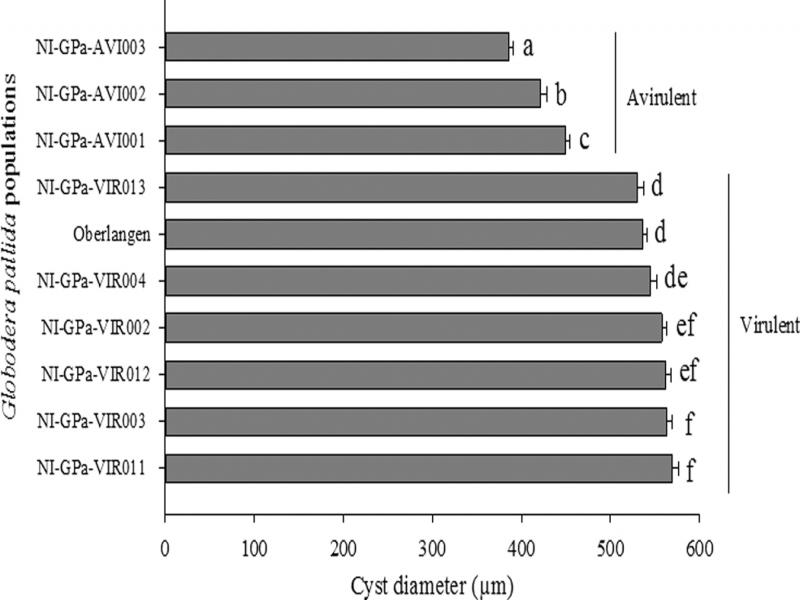
The size of the cysts of six other virulent populations (NI-Gpa-VIR002, NI-Gpa-VIR003, NI-Gpa-VIR004, NI-Gpa-VIR011, NI-Gpa-VIR012, and NI-Gpa-VIR013) and three avirulent populations (NI-Gpa-AVI001, NI-Gpa-AVI002, and NI-Gpa-AVI003) was determined as described above. These populations had been obtained at different time period during field monitoring in the Emsland region of Lower Saxony-Germany and their virulence determined (S. Kruessel, LWK-Niedersachsen, pers. comm.). However, unlike Oberlangen, they were not reproduced in the glasshouse prior to the study.
Estimating the size of J2s and males
The males of G. pallida Oberlangen and Chavornay recovered from the susceptible cv. ‘Desiree’ and resistant cv. ‘Seresta’ were measured. Male nematodes were handpicked from a water suspension and mounted on a microscopic slide with a drop of water. A cover slip was carefully placed on the drop of water containing nematodes and the slide placed briefly on a hot plate at 60°C to relax the nematode. Measurements were taken from 40 males per treatment using Nikon® SMZ18 Stereo Zoom Microscope. To measure the J2s, cysts recovered from the susceptible cv. ‘Desiree’ and resistant cv. ‘Seresta’ used in the development study above were placed in PRD to induce hatching. J2s were then handpicked and temporary slides prepared as above. Measurements were taken of 40 J2s per treatment.
Data analysis
The reproduction factor (Rf) of the nematodes was determined by dividing the final nematode population (Pf) by the initial population (Pi). The relative susceptibility (Rs) of the tested potato cultivars and their levels of resistance to Oberlangen and Chavornay were determined as described in the EPPO (2006) using cv. ‘Desiree’ as a susceptible reference control. Data were tested for normality using Shapiro test while Levene’s test was used to assess the homogeneity of variance. Analysis of variance was done for data on size of cysts, J2s and males as well as the mean number of eggs per cyst. Means that were significantly different (P ≤ 0.05) were separated using Tukey’s HSD test. There was no significant difference (P > 0.05) between two experiments testing the virulence of G. pallida Oberlangen and Chavornay. Therefore, data from the two experiments were pooled prior to analysis. T-test was used to compare the mean number of cysts per cultivar between Oberlangen and Chavornay. Kruskal–Wallis test was used to compare mean number of cysts per cultivar within each of the two populations as well as comparing the cyst diameter of the virulent and avirulent populations. Means that were significantly different at P ≤ 0.05 were separated using Kruskal Post Hoc test. All statistical analyses were done using R-software version 3.6.0 (R Foundation for statistics computing) and data were plotted using SigmaPlot® 13.0.
Results
Hatching assays
The number of hatched juveniles of Globodera pallida Oberlangen and G. pallida Chavornay over 8 weeks was greater in PRD (P < 0.05) than in ZnCl2 and the control (Fig. 1). Except for the control, the percentage of hatched juveniles in PRD was significantly greater for Chavornay compared to Oberlangen between week 1 and 4 (P < 0.05). After 8 weeks, the proportion of hatched juveniles was higher in Chavornay with 67.78% compared to Oberlangen with 62.80%. Hatching in H2O was lower than in PRD and ZnCl2 for both populations.
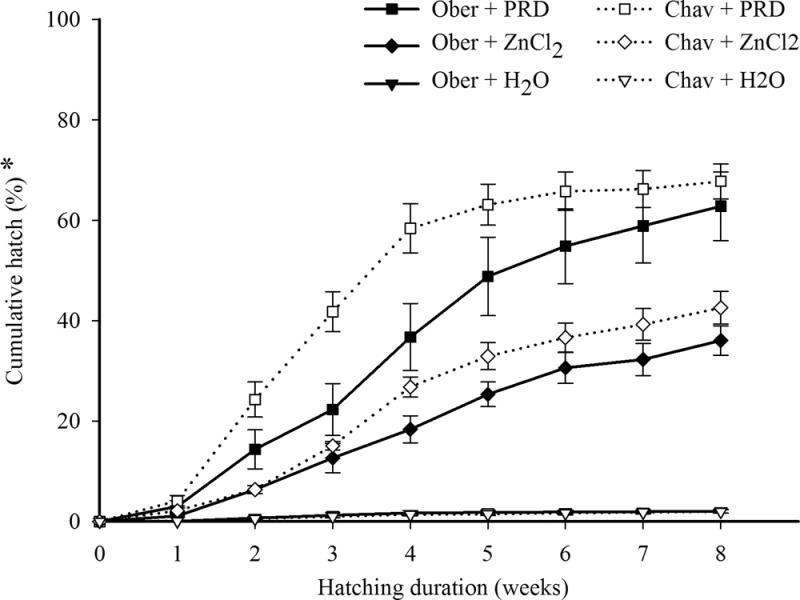
Figure 1:
Cumulative percentage hatch of Globodera pallida Oberlangen (Ober) and Chavornay (Chav) in potato root diffusate (PRD), Zinc Chloride (ZnCl2), and water (H2O) over a period of eight weeks. The error bars represent the standard error of the mean.
Development of Oberlangen and Chavornay in potato roots
In both experiments, invasive juveniles of the two nematode populations were found in similar numbers at 7 DPI in the roots of the susceptible and resistant cultivars (Fig. 2). However, in the first experiment, the average number of J2s that penetrated the host within seven days was higher with 141 ± 20 J2s per root system, compared to the second experiment with 81 ± 10 J2s per root system. The number of J2s in the roots decreased significantly during the first three samplings. At 14 and 21 DPI, the number of Oberlangen and Chavornay J2s in the resistant cv. were higher (P < 0.05) than in the roots of the susceptible cv. in experiment one (Fig. 2). In the second experiment, J2s of Oberlangen were still found in roots of cv. ‘Seresta’ at 35 DPI while only few J2s were detectable in ‘Desiree’ roots. The number of Chavornay J2s molting into the progressive stages in cv. ‘Seresta’ was lower compared to Oberlangen (unpubl. data).
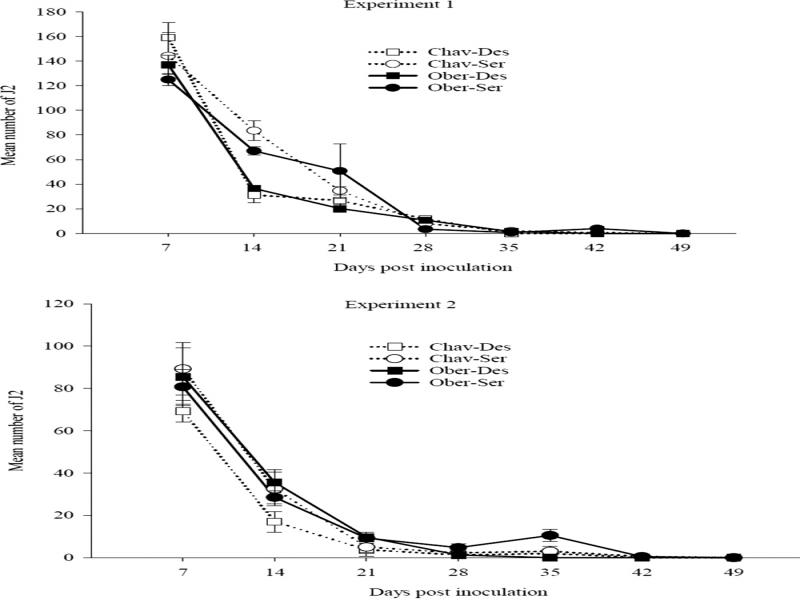
Figure 2:
Number of second-stage juveniles (J2s) of Globodera pallida Oberlangen (Ober) and Chavornay (Chav) in the roots of the susceptible cv. ‘Desiree’ (Des) and resistant cv. ‘Seresta’ (Ser) potato cultivars 49 days after inoculation. Four plants (n = 4) of each nematode-cultivar combination were sampled and J2s enumerated at different days post inoculation in experiments 1 and 2. The vertical bars represent the standard error of the mean.
Male nematodes were detected in the roots of ‘Desiree’ and ‘Seresta’ at 21 DPI in both experiments (Fig. 3). There was no significant difference in the number of males of the two populations recovered from the roots of the resistant cultivar ‘Seresta’. However, for ‘Desiree’, Chavornay produced more males than Oberlangen. Subsequently, the number of males recovered from the soil increased significantly reaching the climax at 35 DPI. In the first experiment, the number of males recovered on the resistant cv. between 21 and 56 DPI was significantly higher (P < 0.05) compared to the susceptible cultivar. In the second experiment, Oberlangen had a higher number of males on the resistant cultivar (P < 0.01) compared to Chavornay (Fig. 3). On the susceptible variety, the number of males remained low in both experiments. The trend remained the same until 56 DPI when males were rarely detected in the soil.
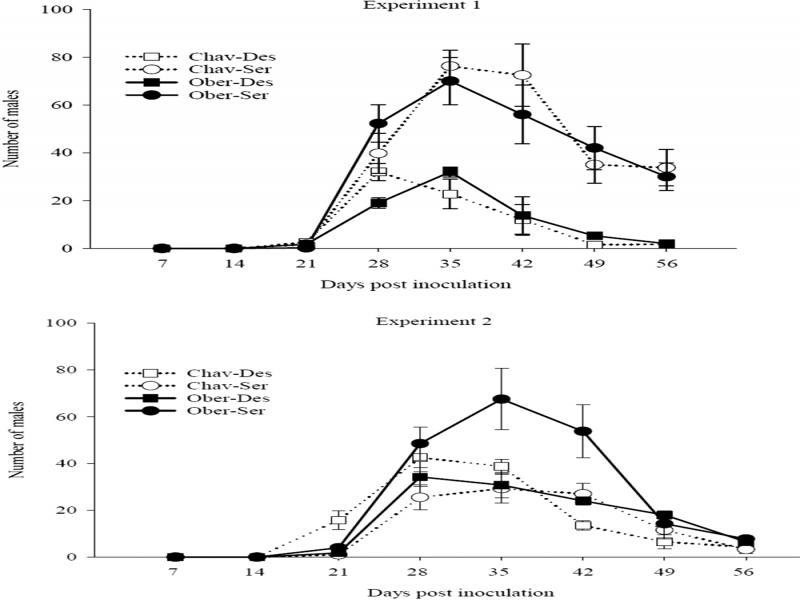
Figure 3:
Numbers of male nematodes of Globodera pallida Oberlangen (Ober) and Chavornay (Chav) in the roots and soils of the susceptible cv. ‘Desiree’ (Des) and the resistant cv. ‘Seresta’ (Ser) potato cultivars 56 days after inoculation. Four plants (n = 4) in each treatment were sampled and the males enumerated at different days post inoculation in experiments 1 and 2. The vertical bars represent the standard error of the mean.
The first young female nematode was recorded in plant roots at 21 DPI in both experiments (Fig. 4). The number of females of the two populations in the roots of ‘Desiree’ and ‘Seresta’ differed significantly throughout the experiment (P < 0.05). Between 21 and 42 DPI, there was an increase in the number of females on the susceptible cultivar. However, on the resistant cultivar, females were found in plants inoculated with Oberlangen, but rarely in the roots of cv. ‘Seresta’ for Chavornay. There was a higher number of Oberlangen females on cv. ‘Desiree’ compared to Chavornay in the second experiment (Fig. 4). However, the mean number of females of the two populations did not differ in both experiments. The first brown cyst was recorded at 42 DPI on the susceptible cultivar and at 49 DPI on the resistant cultivar, respectively (unpubl. data). During the first experiment, nearly all females had turned brown 56 DPI and in the second experiment one week later. There was no difference in the duration taken by the two populations to complete the life cycle although Oberlangen females exhibited a prolonged white stage compared to Chavornay.
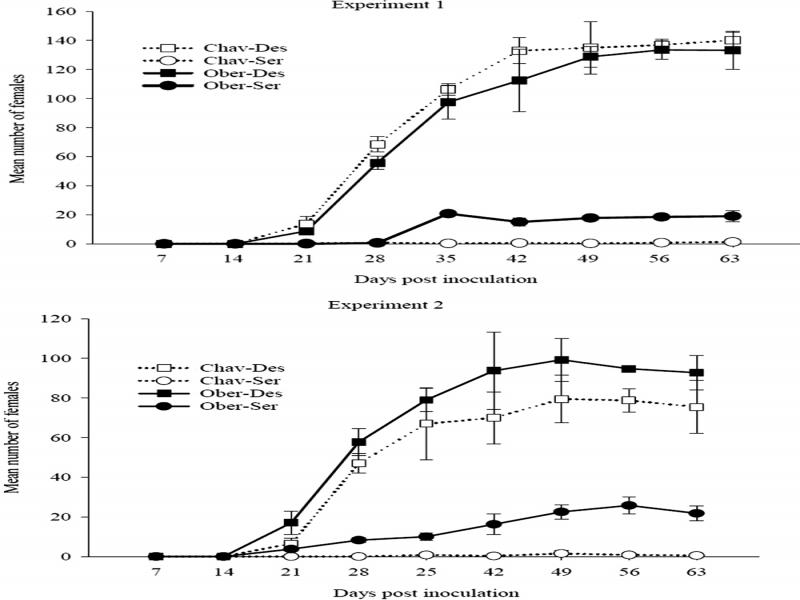
Figure 4:
Numbers of females of Globodera pallida Oberlangen (Ober) and Chavornay (Chav) on the roots of the susceptible cv. ‘Desiree’ (Des) and the resistant cv. ‘Seresta’ (Ser) potato cultivars. Four plants (n = 4) in each treatment were sampled and females enumerated at different days post inoculation in experiments 1 and 2. The vertical bars represent the standard error of the mean.
Assessing the virulence of Oberlangen and Chavornay
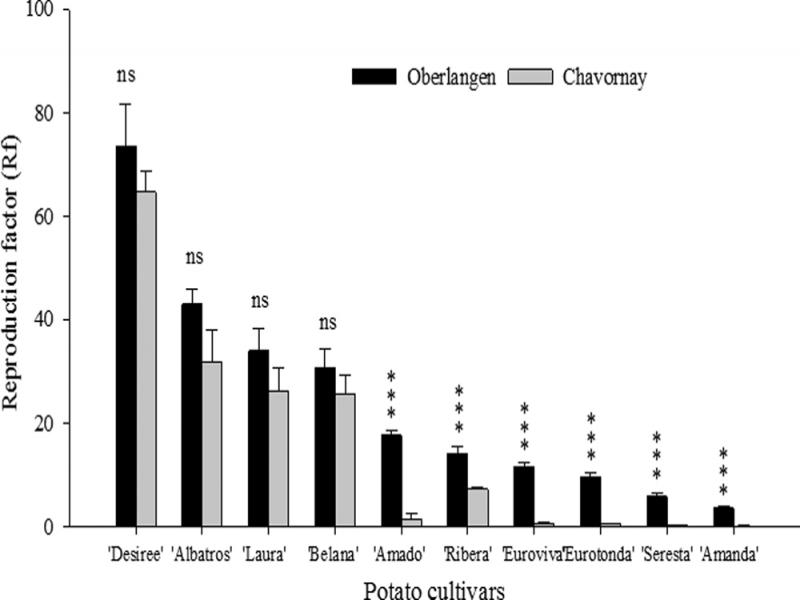
The reproduction of Globodera pallida Oberlangen and Chavornay was highest on susceptible cv. ‘Desiree’ (Table 1). The mean number of cysts on the susceptible cv. was not different between the two nematode populations (P > 0.05). This cultivar was therefore used as the standard susceptible control and the mean number of cysts recovered from it was used in the calculation of relative susceptibility of the tested potato varieties. The number of Oberlangen cysts as well as the Chavornay cysts extracted from the tested potato cultivars varied significantly ((P < 0.01) Table 1). Except for ‘Desiree,’ ‘Albatros,’ ‘Laura,’ and ‘Belana’, Oberlangen produced significantly more cysts than Chavornay. ‘Albatros’ and ‘Laura’ potato cultivars were highly susceptible to the Oberlangen population with Rs of 69.0 and 63.3%, respectively. In contrast, the rest of the cultivars had Rs values of 50% and below, but only ‘Amanda’ was below 10%. Potato cv. ‘Albatros’ and ‘Laura’ were highly susceptible to Chavornay with Rs of 63.2 and 53.3%, respectively. In contrast, ‘Eurotonda,’ ‘Seresta,’ and ‘Amanda’ had Rs of 1% or less. Overall, the Pf of Oberlangen was higher in all the cultivars tested. In some cultivars Pf surpassed that of Chavornay over 20 fold (Table 1).
Table 1.
Effect of selected potato cultivars on the number of cysts per pot and percentage relative susceptibility (Rs) 12 weeks after inoculation with 5 eggs and second-stage juveniles of Globodera pallida populations Oberlangen and Chavornay per ml soil.
| Oberlangen | Chavornay | ||||
|---|---|---|---|---|---|
| Cultivars | No. cystsa | Rs | No. cystsa | Rs | Ratiob |
| ‘Desiree’ | 1,298.5 ± 111.3 a | 100 | 1,158.6 ± 51.6 a | 100 | 1.1 |
| ‘Albatros’ | 896.3 ± 39.3 b | 69.0 | 732.6 ± 77.6 b | 63.2 | 1.2 |
| ‘Laura’ | 822.4 ± 70.9 b | 63.3 | 617.8 ± 65.3 b | 53.3 | 1.3 |
| ‘Belana’ | 590.3 ± 60.1 c | 45.5 | 452.5 ± 32.8 e | 39.1 | 1.3 |
| ‘Amado’ | 382.1 ± 22.7 d | 29.4 | 39.3 ± 4.8 d | 3.4 | 9.7 |
| ‘Ribera’ | 308.3 ± 25.3 e | 23.7 | 176.3 ± 16.8 f | 15.2 | 1.8 |
| ‘Euroviva’ | 277.3 ± 17.8 ef | 21.4 | 16.1 ± 2.7 fg | 1.4 | 17.2 |
| ‘Eurotonda’ | 238.6 ± 20.8 f | 18.4 | 11.9 ± 2.7 fh | 1.0 | 20.1 |
| ‘Seresta’ | 137.6 ± 15.4 g | 10.6 | 6.6 ± 1.8 gh | 0.6 | 20.8 |
| ‘Amanda’ | 89.3 ± 10.0 g | 6.9 | 4.9 ± 1.2 h | 0.4 | 18.3 |
| Treatment | Cyst size (µm)a | Eggs/cystb | J2 Size (µm) | Male size (mm) |
|---|---|---|---|---|
| Chavornay-‘Desiree’ | 547.6 ± 5.6 ac | 355.9 ± 20.9 a | 472.9 ± 4.3 | 1.18 ± 19.6 ab |
| Oberlangen-‘Desiree’ | 535.8 ± 4.9 ab | 339.1 ± 11.6 ab | 466.8 ± 2.9 | 1.23 ± 16.8 a |
| Oberlangen-‘Seresta’ | 518.4 ± 5.6 b | 284.5 ± 18.3 b | 463.8 ± 3.9 | 1.21 ± 15.6 a |
| Chavornay-‘Seresta’ | nd | nd | nd | 1.14 ± 14.3 b |
| P-value | P < 0.05 | P < 0.05 | P < 0.05 | P < 0.05 |