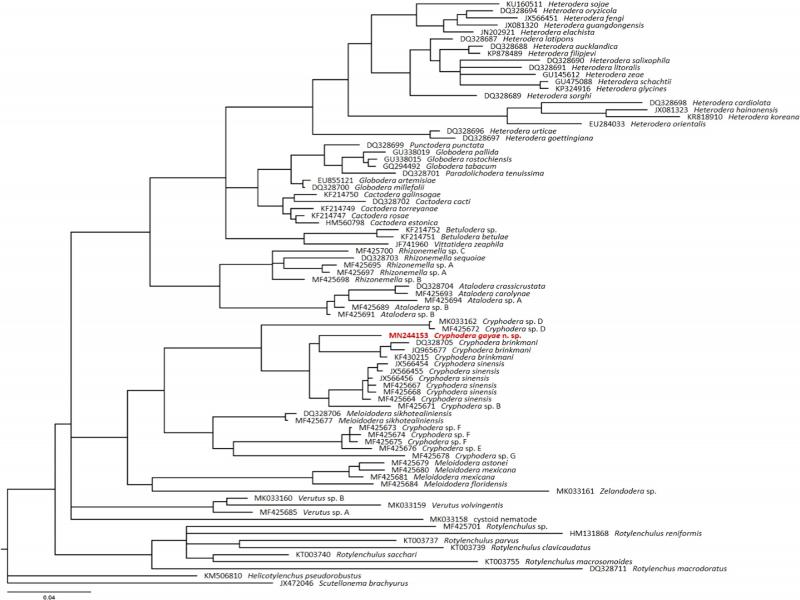
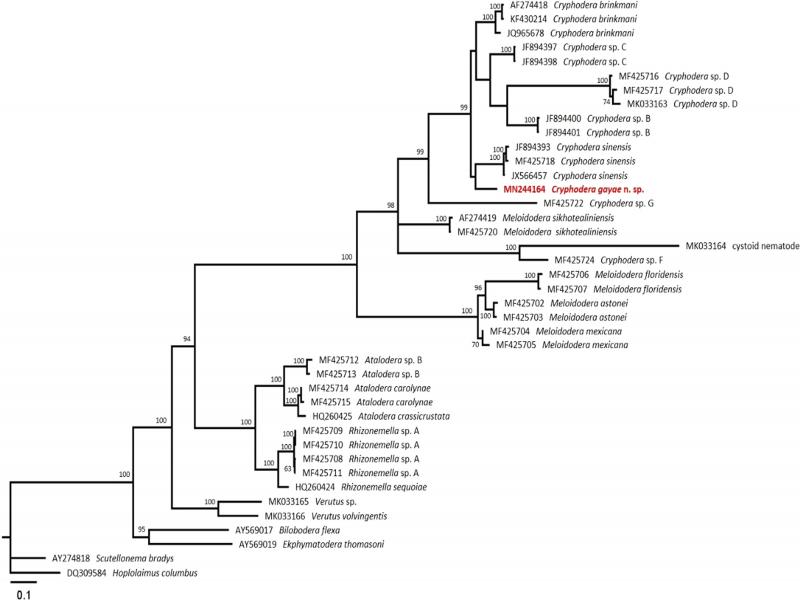
Cryphodera (Colbran, 1966) is a thick-cuticled non-cyst forming nematodes in the group of Heteroderinae. There are seven species of Cryphodera, all parasitic to various species of trees; they are C. brinkmani (Karssen and Van Aelst, 1999), C. coxi, C. nothophagi, C. podocarpi (Wouts, 1973), C. eucalypti (Colbran, 1966), C. kalesari (Bajaj et al., 1989) and C. sinensis (Zhuo et al., 2014). During a survey of plant-parasitic nematodes in Korea, a new species of the non-cyst forming nematode was found from crapemyrtle (Lagerstroemia indica) root. Comparative morphological, morphometric and molecular studies of the nematode revealed that it differed from other Cryphodera species. The new species is described and illustrated herein as Cryphodera gayae n. sp.
Material and methods
Nematode isolation
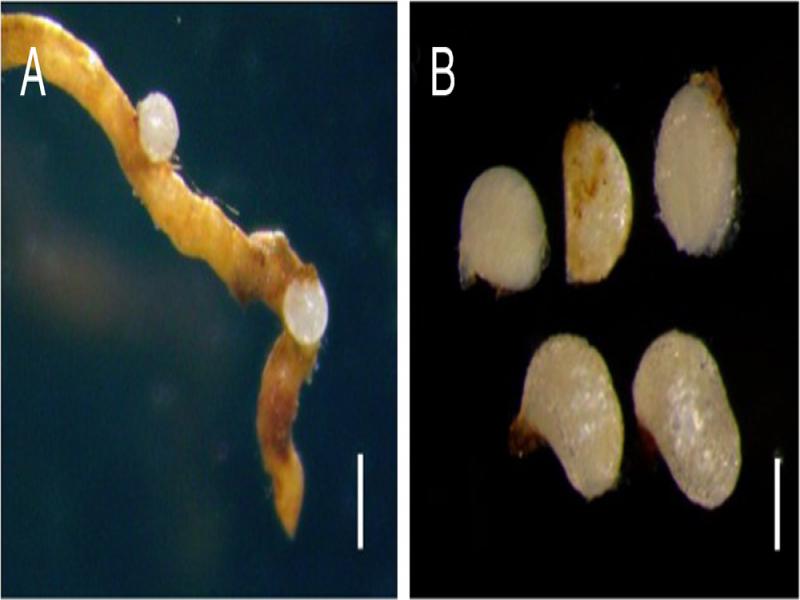
Cryphodera gayae n. sp. was collected from crapemyrtle roots at Gaya (N35°42′45.2′′, E128°17′30.9), Gyeongsangbuk-do, Korea. Females were hand-picked from roots using forceps. Juveniles (J2) were separated from soil by the modified Baermann funnel method or released from crushed females (Southey, 1986).
Morphological study
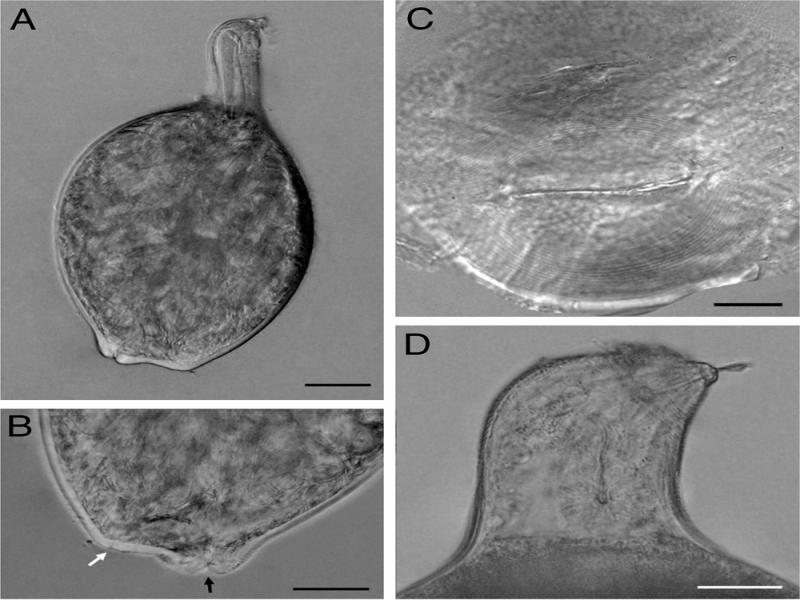
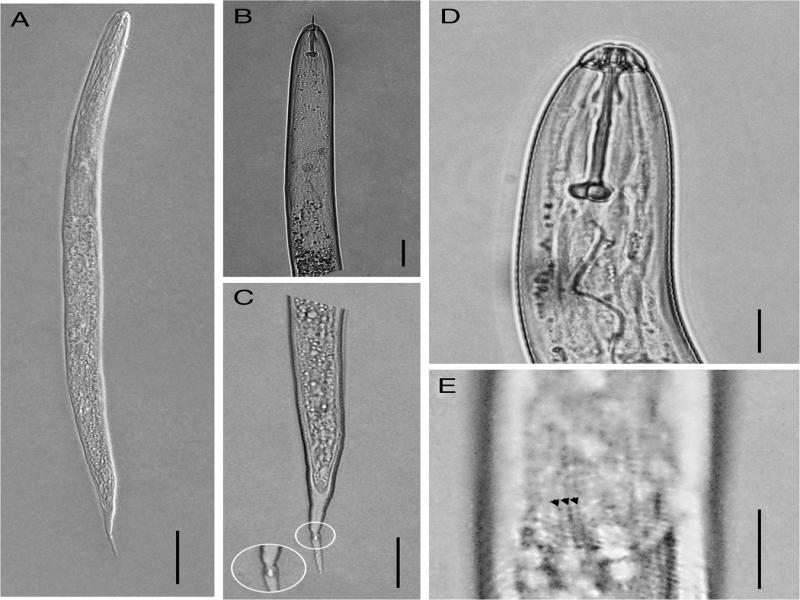
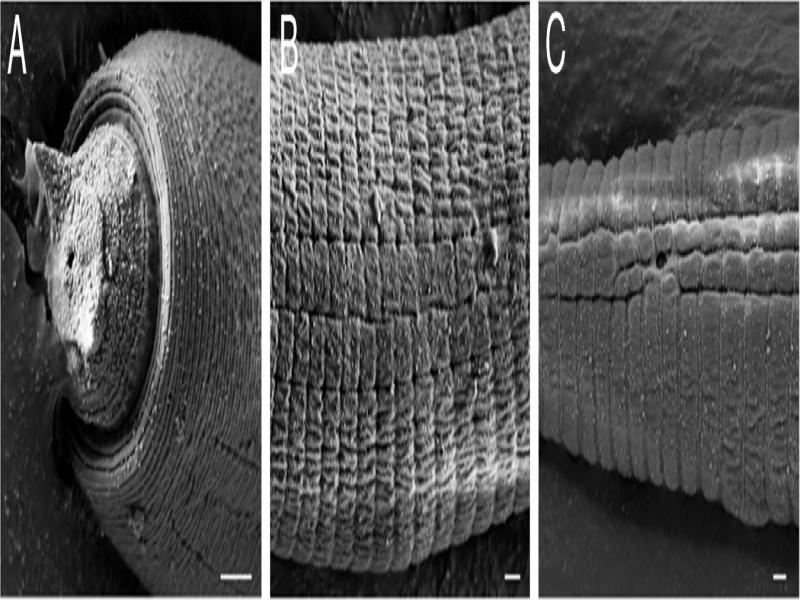
Females and juveniles were killed and fixed by addition of 80°C FG 4:1 fixative (Southey, 1986). Nematodes were fixed for at least 24 hr and, then, processed according to the Seinhorst method (Cid Del Prado Vera and Subbotin, 2012). For light microscopic observations, specimens were mounted on Cobb slides and sealed with a paraffin ring and glycerin (Cobb, 1917). Nematodes were observed, measured and photographed with the aid of a compound microscope (BX53, Olympus) equipped with microscope digital camera (DP73, Olympus). For SEM study, nematodes were dehydrated through an ethanol series ranging from 20% through 100%, with specimens left at each step for about 1 day (Cid Del Prado Vera et al., 2012). Subsequently, the specimens were critical point-dried and mounted on studs in suitable position arrangements. Nematodes were coated with gold palladium (SC7620; Polaron) and observed under a scanning electron microscope (Jeol JSM-6390) at 10 kV.
Molecular study
For molecular analysis, DNA was extracted with DNeasy Blood and Tissue Kit (Qiagen Inc., Valencia, CA). Two rRNA fragments, i.e. the LSU D2–D3 and ITS regions, were amplified. Primers for D2–D3 segments amplification were D2A (5′-ACAAGTACCGTGAGGGAAAGTTG-3′) and D3B (5′-TCGGAAGGAACCAGCTACTA-3′). Primers for ITS amplification were TW81 (5′-GTTTCCGTAGGTGAACCTGC-3′) and AB28 (5′-ATATGCTTAAGTTCAGCGGGT-3′). Detailed protocols of polymerase chain reaction (PCR) are as follows: after an initial 5-min denaturation step at 94°C, a 40-cycle amplification (94°C for 1 min, 56°C (D2–D3 segments) to 58°C (ITS region) for 1 min, and 72°C for 2 min) was conducted. The final extension step continued for 10 min at 72°C. In order to confirm the successful amplification of DNA by PCR, electrophoresis was performed using 0.5 × TAE buffer on 1% agarose gel. The PCR product was subsequently purified with a PCR Purification Kit (Qiagen Inc.). The amplicons were cloned in pGEM-T Easy Vector System (Promega), and the resultant plasmid DNA was isolated with a Plasmid Midiprep System (Promega). Both strands of the PCR amplicons were cycle-sequenced with an ABI PRISM BigDye Terminator version 1.1 Cycle Sequencing Kit and electrophoresed in each direction on an ABI Prism ABI 377 Genetic Analyzer (PE Applied Biosystems). The newly obtained sequences were submitted to the GenBank database under accession numbers MN244153 and MN244164.
Phylogenetic study
For phylogenetic analyses, the sequences of C. gayae n. sp. were compared with GenBank nematode sequences using the BLASTn homology search program. The closest sequences were selected for phylogenetic analyses. Outgroup taxa for each data set were chosen according to previous molecular phylogenetic analyses of cyst and non-cyst forming nematodes (Zhuo et al., 2014; Van den Berg et al., 2016; Subbotin et al., 2017, 2018). The newly obtained and published sequences for each gene were aligned using ClustalW (Thompson et al., 1994) with default parameters. Sequence alignments were manually edited using BioEdit (Hall, 1999). The alignment quality was examined visually and optimized manually by adjusting the ambiguous nucleotide positions. Models of base substitution were evaluated using MODELTEST 3.7 (Huelsenbeck and Ronquist, 2001) combined with PAUP 4.0 (Swofford, 2003). The Akaike-supported model, the base frequency, the proportion of invariable sites and the gamma distribution shape parameters and substitution rates in the AIC were then used in phylogenetic analyses. Bayesian analysis was performed to confirm the tree topology for each gene separately using MrBayes 3.2.7 (Ronquist et al., 2012) running the chain for 2.0 × 10⁶ generations and setting the “burn-in” at 2,500. The Markov Chain Monte Carlo method was used within a Bayesian framework to estimate the posterior probabilities of the phylogenetic trees (Larget and Simon, 1999) and generated a 50% majority-rule consensus tree. Posterior probabilities are given on appropriate clades. Trees were visualized using TreeView (Page, 1996).
Results and discussion
Systematics
Cryphodera gayae n. sp.
Table 1.
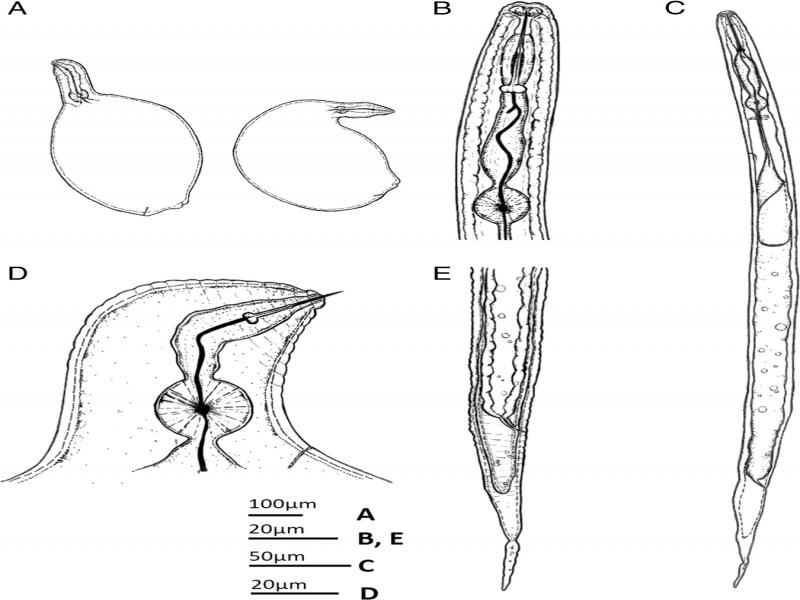
Morphometric measurements of Cryphodera gayae n. sp.
| Paratype | |||||||||
|---|---|---|---|---|---|---|---|---|---|
| Stage | Character | Holotype | Range (min.–max.) | Mean ± SD | |||||
| Female | |||||||||
| n | 10 | ||||||||
| L (including neck) | 462.7 | 363.1–544.6 | 471.5 ± 53.8 | ||||||
| L (excluding neck) | 380.3 | 430.6–255.5 | 367.8 ± 51.4 | ||||||
| W (width) | 286.5 | 166.6–329.1 | 259.3 ± 46.2 | ||||||
| Neck | 82.5 | 77.2–164.8 | 103.6 ± 26.9 | ||||||
| L (inc. neck)/W ratio | 1.6 | 1.6–2.2 | 1.8 ± 0.2 | ||||||
| Stylet length | 30.7 | 28.2–31.9 | 30.1 ± 1.0 | ||||||
| Anterior end to median bulb | 65.0 | 53.9–93.7 | 70.3 ± 14.7 | ||||||
| Length of medium bulb | 28.3 | 22.6–31.9 | 25.9 ± 2.9 | ||||||
| Width of medium bulb | 25.2 | 20.6–29.9 | 24.3 ± 3.2 | ||||||
| Vulva-nus distance | 46.9 | 35.8–51.6 | 44.7 ± 4.3 | ||||||
| Vulval slit length | – | 51.9–54.1 | 52.6 ± 1.3 | ||||||
| Excretory pore from anterior end | 80.1 | 72.6–124.5 | 92.4 ± 17.5 | ||||||
| Second stage (J2) | |||||||||
| n | 20 | ||||||||
| L (body length) | 469.1 | 424.2–525.9 | 482.8 ± 28.5 | ||||||
| a (L/body diam.) | 22.7 | 18.5–22.7 | 20.1 ± 1.4 | ||||||
| b (L/esophago-intestinal valve) | 3.9 | 3.4–4.4 | 3.9 ± 0.3 | ||||||
| b′ (L/end of esophageal) | 2.7 | 2.2–3.0 | 2.7 ± 0.2 | ||||||
| c (L/tail length) | 7.2 | 6.2–7.4 | 7.0 ± 0.3 | ||||||
| c′ (tail length/tail diam.) | 4.4 | 3.3–5.0 | 4.2 ± 0.4 | ||||||
| Stylet length | 29.8 | 26.8–31.3 | 29.3 ± 1.2 | ||||||
| Tail length | 64.8 | 59.6–76.7 | 69.4 ± 4.4 | ||||||
| Max. body diam. | 20.6 | 20.3–28.3 | 24.1 ± 2.5 | ||||||
| Hyaline length | 39.0 | 31.7–47.8 | 38.4 ± 3.9 | ||||||
| Excretory pore from anterior end | 111.93 | 101.43–132.66 | 118.6 ± 8.9 | ||||||
| Egg | |||||||||
| n | 10 | ||||||||
| L | 92.8–144.2 | 114.1 ± 15.1 | |||||||
| W | 31.4–39.7 | 36.1 ± 2.8 | |||||||
| L/W ratio | 2.9–3.9 | 3.2 ± 0.3 | |||||||
| C. gayae n. sp. | C. sinensis | C. eucalypti | C. kalesari | C. brinkmani | C. podocarpi | C. nothophagi | C. coxi | ||
|---|---|---|---|---|---|---|---|---|---|
| Present study | Zhuo et al. (2014) | Colbran (1966) | Wouts (1973) | Bajaj et al. (1989) | Karssen and Van Aelst (1999) | Wouts (1973) | Wouts (1973) | Wouts (1973) | |
| Body length (L) | 471.5 ± 53.8 (363.1–544.6) | 460.9 ± 53.1 (362.9–526.8) | 400–636 | 353 (286–428) | 311 ± 21 (272–353) | 450 ± 52 (384–544) | 393 (300–473) | 341 (261–423) | 331 (218–455) |
| Body diameter | 259.3 ± 46.2 (166.6–329.1) | 240.1 ± 51.6 (172.4–314.0) | 201–274 | 210 (147–290) | 205.5 ± 51 (112–288) | 238 ± 35 (160–339) | 276 (217–335) | 226 (148–305) | 184 (116–369) |
| Number of lip annulus | – | – | – | 1 | 2–3 | – | 2 | 2 more or less | 2 more or less |
| Vulval slit length | 52.6 ± 1.3 (51.9–54.1) | 51.3 ± 6.8 (42.8–58.3) | 45 (44–49) | – | 35 | 51 ± 3.8 (44–60) | – | – | – |
| Anus-vulva profile | Flat to concave | Distinctly concave | Flat to concave | Concave | Distinctly concave | Flat to concave | Flat | Flat | Flat |
| C. gayae n. sp. | C. sinensis | C. eucalypti | C. kalesari | C. brinkmani | C. podocarpi | C. nothophagi | C. coxi | ||
|---|---|---|---|---|---|---|---|---|---|
| Present study | Zhuo et al. (2014) | Colbran (1966) | Wouts (1973) | Bajaj et al. (1989) | Karssen and Van Aelst (1999) | Wouts (1973) | Wouts (1973) | Wouts (1973) | |
| Body length (L) | 482.8 ± 28.5 (424.2–525.9) | 435.2 ± 25.4 (388.8–474.5) | 379–461 | 428 ± 6 | 383 ± 19 (353–424) | 393 ± 23 (450–541) | 525 ± 5 | 450 ± 4 | 457 ± 4 |
| a = L/max. width | 20.1 ± 1.4 (18.5–22.7) | 22.6 ± 1.5 (19.4–25.9) | 22.0–26.0 | 24.8 ± 0.6 | 22 ± 1.5 (18–26) | 23.2 ± 1.3 (20.3–24.6) | 27.2 ± 0.5 | 24.5 ± 0.3 | 25.3 ± 0.4 |
| b = L/esophageal length | 3.9 ± 0.3 (3.4–4.4) | 3.9 ± 0.2 (3.7–4.4) | 3.5-4.8 | 3.7 ± 0.06 | 3.84 ± 0.38 (3.2–5.0) | – | 3.8 ± 0.06 | 3.7 ± 0.05 | 3.7 ± 0.04 |
| c = L/tail length | 7.0 ± 0.3 (6.2–7.4) | 7.8 ± 0.5 (6.4–8.6) | 7.9–9.8 | 8.3 ± 0.15 | 8.4 ± 1.2 (7–13) | 7.1 ± 0.4 (6.4–7.8) | 7.7 ± 0.07 | 8.2 ± 0.08 | 8.5 ± 0.08 |
| Number of lip annuli | 4 | 3 | 3 | 3 | 3 | 4 | 5 | 4 | 4 |
| Stylet length | 29.3 ± 1.2 (26.8–31.3) | 29.1 ± 0.8 (28.0–31.0) | – a | 32.9 ± 0.3 (31–35) | 26.5 ± 1 (24–29) | 33.3 ± 1.0 (31.6–35.4) | 38.7 ± 0.4 | 33.9 ± 0.2 | 34.4 ± 0.2 |
| Stylet knobs | Flat posteriorly | Project distinctly anteriorly | Concave | Flat or pointing slightly anteriorly | Flat to concave | Concave | Pointing distinctly anteriorly | Flat anteriorly | Pointing slightly anteriorly |
| DGO | 4.6 ± 0.9 (3.3–6.1) | 5.4 ± 0.7 (4.5–6.5) | 4.3–5.0 | 5.5 ± 0.17 | 3–4 | 5.8 ± 0.6 (4.4–7.0) | 6.0 ± 0.26 | 5.6 ± 0.17 | 6.1 ± 0.28 |
| Number of lateral line | 3 | 3 | 3 | 3 | 3 | 3 | 3 | 3 (occasionally 4)b | 3 |
| Tail length | 69.4 ± 4.4 (59.6–76.7) | 56.0 ± 3.2 (52.0–65.0) | – | 46.5 ± 6 (27–54) | 46.5 ± 6 (27–54) | 69.7 ± 4.4 (61.3–76.5) | 68.9 ± 0.1 | 55.3 ± 0.8 | 53.7 ± 0.8 |
| Hyaline portion of tail | 38.4 ± 3.9 (31.7–47.8) | 28.3 ± 2.3 (24.5–35.0) | – | 21.5 ± 2.5 (18–26) | 21.5 ± 2.5 (18–26) | 37.2 ± 3.6 (30.3–42.3) | 36.0 ± 0.1 | 30.1 ± 0.7 | 30.6 ± 0.5 |
| Tail terminus | Sharp point with constriction at the middle of hyaline | Point with mucro-like tip | Buntly rounded | Narrow rounded | Narrow rounded | Point with mucro-like tip | Narrow rounded | Narrow rounded | Narrow rounded |