Worldwide, alfalfa (Medicago sativa L.), a flowering plant belonging to the family Fabaceae, is cultivated as a forage crop (Tucak et al., 2008). It is the most important forage crop in Iran due to its superior feeding value for cattle, which is the main meat/protein food source (Tucak et al., 2008). The genus Medicago comprises many species, with up to 23 being cultivated in Iran (Ghanavati et al., 2007).
A wide range of plant-parasitic nematodes have been associated with alfalfa crops in various countries, such as the USA (Gray and Griffin, 1994), South Africa (Kleynhans et al., 1996) and others (Abivardi and Sharafeh, 1973; Sturhan and Brzeski, 1991). Moreover, nematodes such as Aphelenchoides ritzemabosi and Ditylenchus dipsaci are major pests of the foliar parts of alfalfa (Gray et al., 1994; Milano de Tomasel and McIntyre, 2001), whereas Meloidogyne spp. and Pratylenchus spp. in particular infect roots of this genus and cause substantial yield losses (Hafez and Sundararaj, 2009). In Idaho (USA), D. dipsaci infections inflicted reduction in total yield of alfalfa ranging from 6 to 13% (Hafez, 1998). This author also reported yield reductions of between approximately 0.3 and 6% in the same study as a result of parasitism by M. hapla. Ditylenchus dipsaci is considered the most damaging plant-parasitic nematode that parasitize alfalfa in Iran (Kheiri, 1972; Abivardi and Sharafeh, 1973). Ditylenchus dipsaci was the main cause of yield loss in alfalfa fields in the Khafr County, with stunted and infected plants being visible as patches of poor growth within the field (Kheiri, 1972; Abivardi and Sharafeh, 1973). Worldwide, nematode pests associated with roots of alfalfa include Meloidogyne spp., Xiphinema spp., Pratylenchus spp. and Helicotylenchus spp. (Hassanzadeh et al., 2004, Westerdahl and Frate, 2007; McCord, 2012). These nematode genera are also dominant in alfalfa fields in Iran.
Soil nematode communities represent superior biological tools for evaluating soil quality and plant health in terrestrial ecosystems (Wang et al., 2009; Pen-Mouratov et al., 2010). Nematode biodiversity in different soil habitats had been studied widely (Potter and McKeown, 2003; Biederman and Boutton, 2009; Zhang et al., 2012) as a crucial research component that gives an indication of soil quality (Bongers, 1990; Yeates, 2003; Neher et al., 2005). The latter is important for sustainable agriculture and also constitutes one of the main aims of an ecological study. Alfalfa is the main food source of domestic animals in the Kerman Province of Iran, which is in return the main income source of producers. Understanding distribution of most dominant plant-parasitic nematodes on alfalfa in Iran would provide better crop protection recommendations to alfalfa growers in Kerman Province, the main alfalfa production area, of Iran.
Hence, the aim of this investigation was to determine the biodiversity, prominence and seasonal population fluctuations of plant-parasitic tylenchids that occur in soil of alfalfa plants in this province and to identify whether relationships exist between selected soil properties and nematode population densities.
Materials and methods
Soil sampling
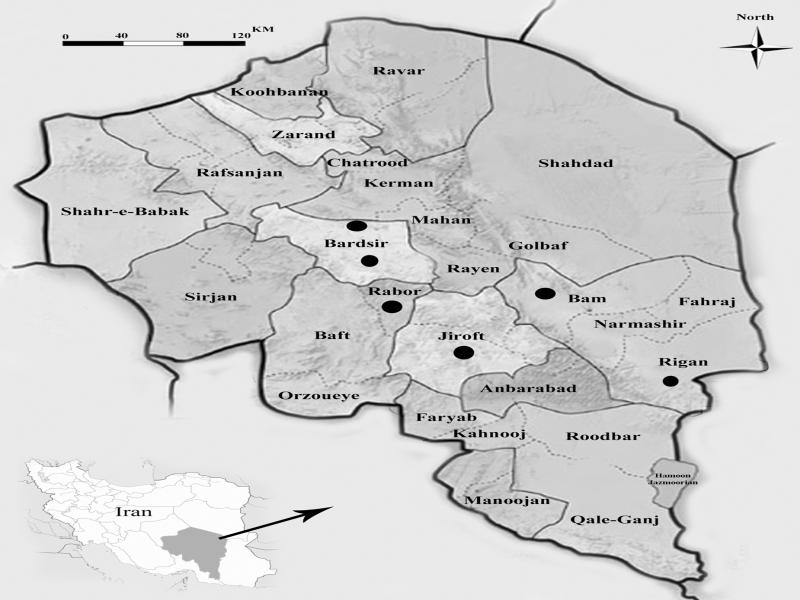
Five alfalfa fields in each of five counties, namely, Bam, Jiroft, Bardsir, Rabor and Rigan, were sampled for the presence of plant-parasitic nematodes during 2013 and 2014. Selection of the counties was based on the alfalfa production area of the province (Fig. 1; Table 1). Soil samples were collected four times during the year, namely, in October (Autumn), March (Winter), June (Spring) and August (Summer). In each field in each county, five discrete sub-samples were collected from each of five independent, 10 m × 10 m plots, representing five replicates and randomly chosen per field. The five sub-samples taken per field per plot were added together, mixed and one homogenized composite sample (representing one replicate) per plot ultimately obtained, totaling five replicates per field. In total, 500 samples (five composite samples per field × five fields × four seasons) were analyzed for nematode counts and identification. After removing the aboveground plant debris, soil samples were collected from the soil of alfalfa plants using a soil core with a 5-cm-diameter opening (Zhang et al., 2012).
Table 1.
List of the localities sampled in the Kerman Province of Iran for the presence of nematodes, physical and chemical characteristics of the soils as well as rainfall and temperature data.
| Chemical soil characteristics | Temperature (°C) for the sampling period | ||||||||||||||
|---|---|---|---|---|---|---|---|---|---|---|---|---|---|---|---|
| County | GPS coordinates | pH | EC (mhos/cm) | Soil type | Mean rainfall (mm) for the study period | Minimum | Maximum | ||||||||
| Bam | N29°06′22″; E58°21′25″ | 7.53 ± 0.06 | 1.74 ± 0.2 | Sandy | 74 | 17 | 29 | ||||||||
| Bardsir | N29°55′39″; E56°34′20″ | 7.59 ± 0.08 | 2.97 ± 0.7 | Sandy-loam | 148 | 3 | 26 | ||||||||
| Jiroft | N28°40′41″; E 57°44′26″ | 7.53 ± 0.02 | 1.64 ± 0.06 | Sandy-loam | 155 | 17 | 33 | ||||||||
| Rabor | N29°17′28″; E56°54′47″ | 7.51 ± 0.03 | 2.04 ± 0.08 | Sandy-loam | 243 | 1 | 24 | ||||||||
| Rigan | N28°38′58″; E59°1′15″ | 7.59 ± 0.05 | 1.86 ± 0.04 | Sandy | 55 | 19 | 34 | ||||||||
| Source | Type III sum of squares | df | Mean square | F | Sig. | ||||||||||
|---|---|---|---|---|---|---|---|---|---|---|---|---|---|---|---|
| Corrected model | 596,437.917a | 19 | 31,391.469 | 423.827 | 0.000 | ||||||||||
| Intercept | 3827,900.417 | 1 | 3827,900.417 | 51,681.824 | 0.000 | ||||||||||
| Location | 45,860.167 | 4 | 11,465.042 | 154.794 | 0.000 | ||||||||||
| Season | 166,211.917 | 3 | 55,403.972 | 748.028 | 0.000 | ||||||||||
| Location × Season | 384,365.833 | 12 | 32,030.486 | 432.455 | 0.000 | ||||||||||
| Error | 2,962.667 | 40 | 74.067 | ||||||||||||
| Total | 4427,301.000 | 60 | |||||||||||||
| Corrected Total | 599,400.583 | 59 | |||||||||||||
| Bam | Rabor | Rigan | Bardsir | Jiroft | |||||||||||
|---|---|---|---|---|---|---|---|---|---|---|---|---|---|---|---|
| Species | PV | MPD | FO (%) | PV | MPD | FO (%) | PV | MPD | FO (%) | PV | MPD | FO (%) | PV | MPD | FO (%) |
| Ditylenchus spp.a | |||||||||||||||
| Season 1 | 43 | 48 | 80 | 30 | 30 | 100 | 60 | 60 | 100 | 19 | 21 | 83 | 366 | 366 | 100 |
| Season 2 | 94 | 94 | 100 | 103 | 103 | 100 | 120 | 120 | 100 | 59 | 65 | 83 | 344 | 344 | 100 |
| Season 3 | 83 | 93 | 80 | 53 | 53 | 100 | 137 | 137 | 100 | 95 | 95 | 100 | 107 | 107 | 100 |
| Season 4 | 71 | 79 | 80 | 72 | 72 | 100 | 36 | 36 | 100 | 76 | 76 | 100 | 8 | 11 | 50 |
| H. pseudorobustus | |||||||||||||||
| Season 1 | 29 | 32 | 80 | 16 | 18 | 75 | 29 | 32 | 80 | 64 | 64 | 100 | 2 | 3 | 25 |
| Season 2 | 40 | 64 | 40 | 29 | 29 | 100 | 21 | 27 | 60 | 81 | 81 | 100 | 2 | 3 | 25 |
| Season 3 | 2 | 4 | 20 | 31 | 31 | 100 | 60 | 78 | 60 | 59 | 84 | 50 | 3 | 4 | 50 |
| Season 4 | 7 | 11 | 40 | 33 | 38 | 75 | 1 | 3 | 20 | 3 | 5 | 33 | 3 | 4 | 50 |
| P. neglectus | |||||||||||||||
| Season 1 | 1 | 3 | 20 | 4 | 5 | 75 | 23 | 36 | 40 | 18 | 25 | 50 | 0 | 0 | 0 |
| Season 2 | 5 | 8 | 40 | 31 | 36 | 75 | 4 | 7 | 40 | 17 | 24 | 50 | 0 | 0 | 0 |
| Season 3 | 0 | 0 | 0 | 4 | 6 | 50 | 2 | 4 | 20 | 4 | 6 | 50 | 0 | 0 | 0 |
| Season 4 | 0 | 0 | 0 | 78 | 90 | 75 | 0 | 0 | 0 | 109 | 120 | 83 | 0 | 0 | 0 |
| M. javanica | |||||||||||||||
| Season 1 | 0 | 0 | 0 | 0 | 0 | 0 | 0 | 0 | 0 | 0 | 0 | 0 | 0 | 0 | 0 |
| Season 2 | 25 | 40 | 40 | 0 | 0 | 0 | 0 | 0 | 0 | 0 | 0 | 0 | 0 | 0 | 0 |
| Season 3 | 13 | 30 | 20 | 0 | 0 | 0 | 0 | 0 | 0 | 0 | 0 | 0 | 34 | 68 | 25 |
| Season 4 | 13 | 30 | 20 | 3 | 6 | 25 | 0 | 0 | 0 | 0 | 0 | 0 | 0 | 0 | 0 |
| M. brevidens | |||||||||||||||
| Season 1 | 0 | 0 | 0 | 0 | 0 | 0 | 3 | 5 | 40 | 10 | 25 | 16 | 4 | 7 | 25 |
| Season 2 | 15 | 35 | 20 | 120 | 120 | 100 | 3 | 4 | 40 | 10 | 25 | 16 | 4 | 7 | 25 |
| Season 3 | 0 | 0 | 0 | 4 | 7 | 25 | 1 | 3 | 20 | 10 | 25 | 16 | 2 | 4 | 25 |
| Season 4 | 2 | 5 | 20 | 2 | 4 | 25 | 0 | 0 | 0 | 10 | 25 | 16 | 0 | 0 | 0 |
| A. globigerus | |||||||||||||||
| Season 1 | 5 | 6 | 60 | 0 | 0 | 0 | 0 | 0 | 0 | 0.5 | 1 | 16 | 2 | 3 | 25 |
| Season 2 | 0 | 0 | 0 | 0 | 0 | 0 | 0 | 0 | 0 | 4 | 6 | 33 | 2 | 3 | 25 |
| Season 3 | 0 | 0 | 0 | 0 | 0 | 0 | 0 | 0 | 0 | 40 | 69 | 33 | 0 | 0 | 0 |
| Season 4 | 0 | 0 | 0 | 0 | 0 | 0 | 0 | 0 | 0 | 11 | 20 | 33 | 0 | 0 | 0 |
| Aphelenchoides sp. | |||||||||||||||
| Season 1 | 1 | 1 | 80 | 7 | 7 | 100 | 3 | 4 | 60 | 1 | 1 | 83 | 1 | 2 | 50 |
| Season 2 | 11 | 12 | 80 | 4 | 4 | 100 | 1 | 2 | 60 | 1 | 1 | 83 | 1 | 2 | 50 |
| Season 3 | 4 | 4 | 80 | 7 | 7 | 100 | 15 | 15 | 100 | 12 | 14 | 83 | 2 | 3 | 75 |
| Season 4 | 4 | 4 | 80 | 5 | 5 | 100 | 7 | 8 | 80 | 5 | 7 | 50 | 13 | 13 | 100 |
| Paratylenchus sp. | |||||||||||||||
| Season 1 | 0.5 | 1 | 20 | 4 | 5 | 75 | 13 | 17 | 60 | 0 | 0 | 0 | 0 | 0 | 0 |
| Season 2 | 0 | 0 | 0 | 28 | 40 | 50 | 3 | 5 | 40 | 0 | 0 | 0 | 0 | 0 | 0 |
| Season 3 | 0 | 0 | 0 | 0 | 0 | 0 | 1 | 3 | 20 | 0 | 0 | 0 | 0 | 0 | 0 |
| Season 4 | 0 | 0 | 0 | 0 | 0 | 0 | 0 | 0 | 0 | 1 | 2 | 16 | 0 | 0 | 0 |
| S. rugosus | |||||||||||||||
| Season 1 | 0 | 0 | 0 | 0 | 0 | 0 | 0 | 0 | 0 | 0 | 0 | 0 | 0 | 0 | 0 |
| Season 2 | 6 | 14 | 20 | 0 | 0 | 0 | 4 | 6 | 40 | 0 | 0 | 0 | 0 | 0 | 0 |
| Season 3 | 21 | 27 | 60 | 0 | 0 | 0 | 3 | 6 | 20 | 0 | 0 | 0 | 0 | 0 | 0 |
| Season 4 | 3 | 7 | 20 | 0 | 0 | 0 | 0 | 0 | 0 | 0 | 0 | 0 | 0 | 0 | 0 |
| N. minor | |||||||||||||||
| Season 1 | 5 | 6 | 60 | 0 | 0 | 0 | 0 | 0 | 0 | 0 | 0 | 0 | 0 | 0 | 0 |
| Season 2 | 0 | 0 | 0 | 0 | 0 | 0 | 0 | 0 | 0 | 0 | 0 | 0 | 0 | 0 | 0 |
| Season 3 | 1 | 2 | 20 | 0 | 0 | 0 | 0 | 0 | 0 | 0 | 0 | 0 | 0 | 0 | 0 |
| Season 4 | 0 | 0 | 0 | 0 | 0 | 0 | 10 | 23 | 20 | 0.5 | 1 | 16 | 0 | 0 | 0 |
| Rotylenchus sp. | |||||||||||||||
| Season 1 | 0.5 | 1 | 20 | 0 | 0 | 0 | 0 | 0 | 0 | 0 | 0 | 0 | 0 | 0 | 0 |
| Season 2 | 2 | 3 | 40 | 0 | 0 | 0 | 0 | 0 | 0 | 0 | 0 | 0 | 0 | 0 | 0 |
| Season 3 | 1 | 2 | 20 | 0 | 0 | 0 | 0 | 0 | 0 | 0 | 0 | 0 | 0 | 0 | 0 |
| Season 4 | 0 | 0 | 0 | 0 | 0 | 0 | 0 | 0 | 0 | 0 | 0 | 0 | 0 | 0 | 0 |
| Nematode species | Prominence value (PV) | Mean population density (MPD) | Frequency of occurrence (FO: %) | ||||||||||
|---|---|---|---|---|---|---|---|---|---|---|---|---|---|
| Ditylenchus spp. | 89 | 93 | 92 | ||||||||||
| Helicotylenchus pseudorobustus | 18 | 24 | 59 | ||||||||||
| Pratylenchus neglectus | 18 | 30 | 34 | ||||||||||
| Meloidogyne javanica | 10 | 41 | 6 | ||||||||||
| Merlinius brevidens | 8 | 18 | 21 | ||||||||||
| Amplimerlinius globigerus | 6 | 18 | 12 | ||||||||||
| Aphelenchoides sp. | 4 | 6 | 41 | ||||||||||
| Paratylenchus sp. | 3 | 8 | 16 | ||||||||||
| Scutylenchus rugosus | 3 | 12 | 7 | ||||||||||
| Nanidorus minor | 2 | 6 | 11 | ||||||||||
| Rotylenchus sp. | 1 | 3 | 7 |
| County | Shannon index (H’) | Evenness index | |||||||||||
|---|---|---|---|---|---|---|---|---|---|---|---|---|---|
| Bam | 2.4 ± 0.02 | 0.83 ± 0.02 | |||||||||||
| Bardsir | 2.2 ± 0.03 | 0.73 ± 0.03 | |||||||||||
| Jiroft | 1.0 ± 0.01 | 0.58 ± 0.01 | |||||||||||
| Rabor | 2.1 ± 0.02 | 0.74 ± 0.02 | |||||||||||
| Rigan | 2.1 ± 0.02 | 0.71 ± 0.02 |
| Helicoty-lenchus | Dityle-nchus | Amplim-erlinius | Pratyle-nchus | Aphelen-choides | Rotyle-nchus | Nani-dorus | Paratyl-enchus | Scutyle-nchus | Merli-nius | Meloid-ogyne | pH | EC | |
|---|---|---|---|---|---|---|---|---|---|---|---|---|---|
| Helicotylenchus | 1 | −0.334 | 0.838 | 0.764 | 0.941* | 0.111 | −0.156 | −0.101 | −0.045 | −0.114 | −0.528 | 0.1 | 0.885* |
| Ditylenchus | −0.334 | 1 | 0.122 | −0.318 | −0.113 | −0.689 | 0.212 | −0.638 | −0.341 | −0.58 | 0.259 | 0.282 | −0.06 |
| Amplimerlinius | 0.838 | 0.122 | 1 | 0.783 | 0.872 | 0 | −0.388 | −0.355 | −0.295 | −0.15 | −0.361 | 0.236 | 0.972** |
| Pratylenchus | 0.764 | −0.318 | 0.783 | 1 | 0.799 | 0.276 | −0.584 | 0.294 | −0.501 | 0.426 | −0.674 | 0.44 | 0.902* |
| Aphelenchoides | 0.941* | −0.113 | 0.872 | 0.799 | 1 | −0.159 | −0.067 | −0.069 | −0.349 | −0.171 | −0.7 | 0.411 | 0.917* |
| Rotylenchus | 0.111 | −0.689 | 0 | 0.276 | −0.159 | 1 | −0.747 | 0.274 | 0.433 | 0.703 | 0.287 | −0.571 | 0.083 |
| Nanidorus | −0.156 | 0.212 | −0.388 | −0.584 | −0.067 | −0.747 | 1 | −0.143 | 0.139 | −0.706 | −0.104 | 0.097 | −0.435 |
| Paratylenchus | −0.101 | −0.638 | −0.355 | 0.294 | −0.069 | 0.274 | −0.143 | 1 | −0.359 | 0.781 | −0.568 | 0.398 | −0.128 |
| Scutylenchus | −0.045 | −0.341 | −0.295 | −0.501 | −0.349 | 0.433 | 0.139 | −0.359 | 1 | −0.253 | 0.688 | −0.964** | −0.368 |
| Merlinius | −0.114 | −0.58 | −0.15 | 0.426 | −0.171 | 0.703 | −0.706 | 0.781 | −0.235 | 1 | −0.194 | 0.108 | 0.027 |
| Meloidogyne | −0.528 | 0.259 | −0.361 | −0.674 | −0.7 | 0.287 | −0.104 | −0.568 | 0.688 | −0.194 | 1 | −0.802 | −0.522 |
| pH | 0.1 | 0.282 | 0.236 | 0.44 | 0.411 | −0.571 | 0.097 | 0.398 | −0.964** | 0.108 | −0.802 | 1 | 0.322 |
| EC (mhos/cm) | 0.885* | −0.06 | 0.972** | 0.902* | 0.917* | 0.083 | −0.435 | −0.128 | −0.368 | 0.027 | −0.522 | 0.322 | 1 |