One of the most popular flowers in Japan is chrysanthemum (Chrysanthemum morifolium Ramat.), that is used on ornamental purposes in many occasions especially for new year’s and religious ceremonies, and even recognized as an edible plant in Japan. The total production of chrysanthemum in Japan in 2016 was 68bn yen (ca. $620m), which consisted one-third of the total cut-flower production and was the number one product of all the cut-flower categories (Statistics by the Japanese Ministry of Agriculture, Forestry and Fishery: http://www.maff.go.jp/j/tokei/kouhyou/hana_sangyo/). Chrysanthemum is damaged by many soil-borne pathogens including fungi, bacteria, and virus at each growth stage from the nursery bed to the field. Several plant-parasitic nematode species were also reported as important pathogens against chrysanthemum. Aphelenchoides ritzemabosi and Pratylenchus penetrans are well-known plant-parasitic nematode species that infest chrysanthemum (Goffart, 1930; Hesling and Wallace, 1961; Kobayashi, 1968). Other plant-parasitic nematodes suppressing chrysanthemum growth are Meloidogyne incognita (Hague, 1972), Pratylenchus psudocoffeae (Mizukubo, 1992), and Pratylenchus kumamotoensis (Mizukubo et al., 2007). The latest mentioned Pratylenchus spp. have been added to the list of parasitic nematodes on chrysanthemum more recently. While A. ritzemabosi penetrates into stems, leaves, and buds, and may be the primary cause of crinkled deformation and discoloration of the leaves on chrysanthemum, Pratylenchus spp. and Meloidogyne spp. enter into roots and cause root lesions resulting in stunting, yellowing of plant shoots, and galling on roots (Kobayashi, 1995). Paratylenchus spp. were also reported from chrysanthemum fields in Japan (Yamamoto and Toida, 1995; Iwahori et al., 2008), though damage to the crop has not been studied, yet. Of those plant-parasitic nematodes, Pratylenchus spp. are considered to be the most harmful (Yamamoto and Toida, 1995) in Japan. Since the beautiful appearance of the chrysanthemum flower is obviously important for the successful business in the flower market, the market value of chrysanthemum depends on height, flower size, the number of flowers, and color of leaves. Plant damage caused by plant-parasitic nematodes is crucial, even though plants may not wither or die by such damage.
In Okinawa (in a subtropical region, 1,600 km southwest of Tokyo), where chrysanthemum is one of the most important agricultural products, P. penetrans and P. kumamotoensis are known to inhabit in many chrysanthemum growing areas (Iwahori et al., 2008) and Pratylenchus may cause chronic damage to chrysanthemum (Kobayashi, 1995). Chemical treatments including nematicides, such as fosthiazate, are popular means to control nematode damage in Okinawa, however, nematode diagnosis in a chrysanthemum field is not quick and easy. Koyama et al. (2016) reported a low cost and high-throughput approach to quantify Pratylenchus spp. with the real-time PCR method by using pre-existing NEG primer for P. penetrans (Sato et al., 2007), and by developing other species-specific real-time PCR primer sets for P. pseudocoffeae and P. kumamotoensis. Those primer sets together with the one for M. incognita (Toyota et al., 2008) covered most widely known nematode species threating chrysanthemum cultivation in Okinawa. In some chrysanthemum fields, however, farmers struggled with symptoms of soil-borne pathogens which may not be the ones they faced before, according to our survey, and a quick and easy approach to diagnose the pathogen and to predict potential damage of chrysanthemum is in great demand. Furthermore, this study developed (lysate) calibration curves using DNA samples extracted from single nematodes, since developing lysate calibration curves may be a quicker approach than developing soil calibration curves. Though it may be ideal that each real-time PCR protocol contains specific calibration curves developed using DNA samples extracted from soil, developing soil calibration curve may require cumbersome process such as finding soil without the target nematode and inoculating the known number of the target nematode.
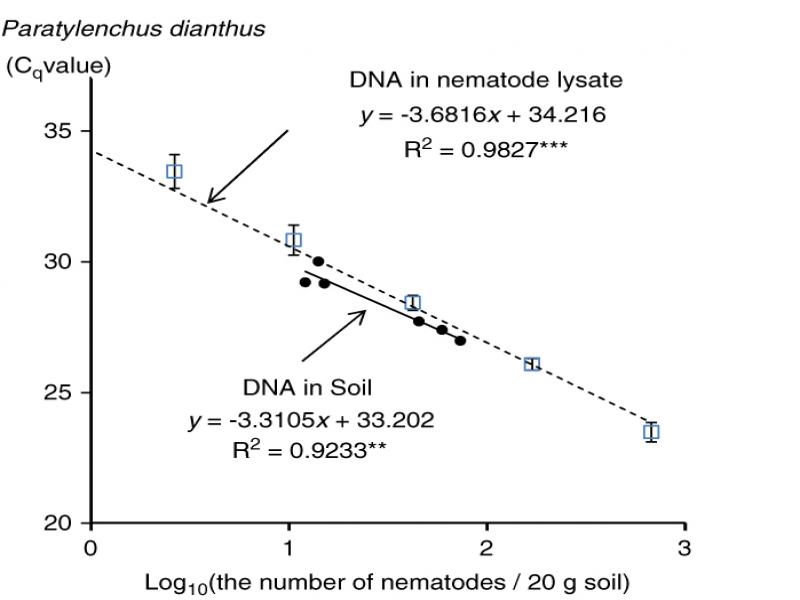
Our hypothesis was that plant-parasitic nematodes might be a potential threat on chrysanthemum. We further hypothesized that a real-time PCR method might be a strong diagnostic tool for assessing target plant-parasitic nematodes at low cost and high-throughput. To test these hypotheses, we analyzed plant-parasitic nematode species in six Okinawa’s chrysanthemum fields, in which plants did not grow well due to unknown reasons, and conducted pot experiments for testing Paratylenchus dianthus as a potential growth inhibitor of chrysanthemum seedlings. We then developed a real-time PCR method for diagnosing P. dianthus by testing specificity using in silico tools (e.g. BLAST) and by confirming PCR efficiency comparing the real-time PCR estimation of target nematodes with their counts by the conventional microscopic method. This study further aimed to test usefulness of a simplified approach to develop standard curves of nematode-species specific primer sets using serially diluted DNA extracted from individual nematodes.
Materials and methods
Soil sampling
Soil samples used were collected at Ch01, Ch02 and Ch03 from Uruma, Ch04, Ch05, Ch06 and Ch12 from Yomitan in the mainland Okinawa, Japan. Soil was collected from each field at 0 to 25 cm depth and at or around a base of post-harvest chrysanthemum plants with a spade, passed through a 5 mm aperture sieve and kept at room temperature until use. For Experiment 1 (a nematode survey), 1.5 kg of soil of each sampling site (Ch01–Ch06) was well mixed independently for further analysis. For Experiment 2, the soil samples (ca. 10 kg each) from each site (Ch04: the same timing of the soil collection for Experiment 1 in 2017; Ch05 and Ch12 in 2018) were also well mixed individually for the pot experiments.
Nematode extraction from soil
Nematodes were extracted in triplicate from 20 g subsamples of the soil samples from each field using the Baermann funnel nematode extraction method (room temperature, 72 hr) followed by the sugar-flotation nematode extraction method (Jenkins, 1964; Kawanobe et al., 2014).
DNA extraction from a single nematode
DNA was extracted following Iwahori et al. (2000) with minor modifications. A single nematode crushed with a sterilized filter paper chip (1×1 mm) was placed into a 200 µl Eppendorf tube containing 10 µl lysis buffer (10 mmol/liter Tris-HCl (pH 8.0), 0.1 mmol/liter EDTA, 10 g/liter of IGEPAL® CA-630 (nonionic detergent; MP Biomedicals, Solon, OH), 100 µg/ml Proteinase K). After 1 hr in −85°C, the sample was thawed and incubated at 65°C for 1 hr to degrade the nematode’s body, and at 98°C for 10 min to inactivate proteinase K, and was then used as the DNA template (Kawanobe et al., 2015).
DNA extraction from soil
DNA from soil was extracted following Kawanobe et al. (2015) with minor modification (10 g soil in duplicate were homogenized in a 15-ml Falcon tube with two stainless steel balls (3/8 inch in diam.) using FastPrep 24 (MP Biomedicals, Irvine, CA) at 4.5 m/sec for 60 sec twice, instead of in a ball mill (MM400, Retsch, Germany) for 2 min at a frequency of 20/sec in the original method). In the preliminary experiment, soil samples processed with FastPrep 24 showed equivalent results obtained with MM400 under the real-time PCR analysis (data not shown). The DNA solutions dissolved in 100 µl Tris-EDTA buffer (10 mmol/liter Tris-HCl, 1 mmol/liter EDTA, pH 8.0) were diluted 10-folds with RNase-free water and used for real-time PCR assay.
Real-time PCR protocol
Real-time PCR assays were performed with a Step One Real-Time PCR System (Life Technologies, Tokyo, Japan). Final sample volumes of 10 µl contained 5 µl of Fast SYBR Green Master Mix (Life Technologies, Tokyo, Japan), 0.4 µmol/liter of each primer, 2.2 µl of RNase-free water, and 2 µl of template DNA. The manufacturer’s recommended conditions were used with slight modifications (95°C for 10 sec, 40 cycles of (95°C for 5 sec, and 62°C for 20 sec), and melting curve profiles were generated). A negative control was prepared with RNase-free water instead of the DNA template, and a positive control (a DNA template extracted from each target nematode) was also included.
Real-time PCR primer sets
Real-time PCR assays were conducted using a primer set “Pdia” newly developed for P. dianthus, NEG (NEGf (5′- ATT CCG TCC GTG GTT GCT ATG-3′) and NEGr (5′-GCC GAG TGA TCC ACC GAT AAG-3′); Sato et al., 2007) for P. penetrans, Pkuma (PkumaF (5′-CGT GAA ACC GAT GAG ATG GAA AC-3′) and PkumaR (5′-CAA TGG GAG TGC GGA TGA ATA C-3′); Koyama et al., 2016) for P. kumamotoensis, and RKN (RKNf (5′-GCT GGT GTC TAA GTG TTG CTG ATA C-3′) and RKNr (5′-GAG CCT AGT GAT CCA CCG ATA AG-3′); Toyota et al., 2008) for M. incognita.
Nematode survey in chrysanthemum fields in Okinawa (Experiment 1)
Nematode surveys were conducted in six chrysanthemum fields in April (Ch01–Ch05) and September (Ch06) 2017. All the fields were possibly damaged by plant-parasitic nematodes after examination by field specialists, yet, the nematode species in the fields were not known. The nematodes were classified under a stereo-microscope (SZX10, Olympus, Tokyo, Japan) based on their morphological characters and using a real-time PCR method for P. penetrans, P. kumamotoensis, and M. incognita. Pin-nematodes (Paratylenchus sp.) found in this study were identified as P. dianthus based on DNA sequence data (Accession numbers: LC462227-LC462228) of the ITS regions. For obtaining sequence data, DNA templates extracted from single pin-nematodes were amplified following Kawanobe et al. (2014) with slight modifications (a PCR primer set: TW81 (Joyce et al., 1994: 5′-GTT TCC GTA GGT GAA CCT GC-3′); rDNA26S (Vrain et al., 1992: 5′-TTT CAC TCG CCG TTA CTA AGG-3′)). The amplified PCR products were sequenced by a commercial sequencing service provider (FASMAC, Japan).
Pot experiments (Experiment 2)
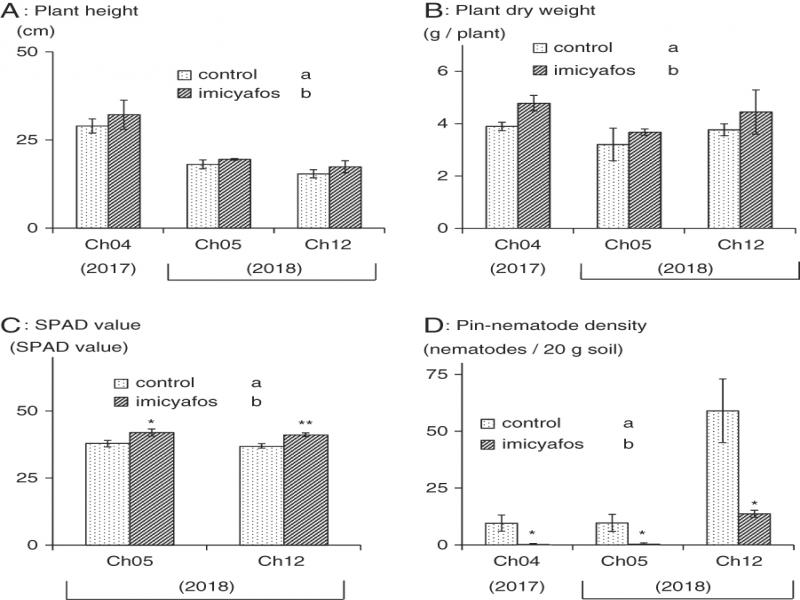
Chrysanthemum seedlings (cv. Okinootome, one of the commonly grown cultivars in Okinawa) of ca. 5 cm height with four leaves were used for pot experiments in 2017 and 2018. In total, 18 seedlings were used for each pot experiment. A subsample (1.2 kg) of each soil (Ch04 collected in April 2017, and Ch05 and Ch12 collected in April 2018) was put into a plastic pot (15 cm upper diameter; 10 cm bottom diameter; 15 cm height) together with imicyafos (0.35 g of Nemakick in a granular form (corresponding to its conventional dosage of 200 kg/ha), Agro-Kanesho, Tokyo, Japan, 1.5% a.i.) and 3.5 g chemical fertilizer (corresponding to N-P-K: 132-70-133 kg/ha, Kasei888, Omiya Green Service, Saitama, Japan). Pots without imicyafos were also prepared as non-treated controls. Experimental pots were prepared for each treatment in triplicates. Three chrysanthemum seedlings were transplanted to each pot and placed in the open air and watered when necessary during the two-month growth period.
After two-month growth in both 2017 and 2018 experiments, plant height of each seedling was measured. Then, the above-ground parts of seedlings were cut and dried at 70°C for longer than 72 hr, and plant dry weight (biomass) was measured after cooling down in a tightly sealed plastic bag. After removing the seedlings, the soil remaining in each pot was passed through a 5 mm aperture sieve and mixed well. Nematodes were extracted and counted based on their morphological character under a stereo-microscope (SZX10). For the pot experiments in 2018, single-photon avalanche diode (SPAD) values were also measured for leaves (the 6th to the 8th leaves from top) of each seedling using a SPAD meter (SPAD-502, Konica Minolta, Tokyo, Japan).
Development of a real-time PCR primer set and calibration curves (Experiment 3)
A specific primer set (Pdia, Table 1) was designed based on the ITS region of rRNA gene sequences of P. dianthus. Sequence comparisons were performed to design a specific primer set using the sequence data (comparisons with different taxonomic relationships within the same family and with plant-parasitic nematode species frequently detected in Okinawa, Table 1) collected from GenBank (http://www.ncbi.nlm.nih.gov/).
Table 1.
Comparison of the sequences in the positions of the specific primer set for Paratylenchus dianthus (Pdia) with different taxonomic relationships.
| Sequence (5′ → 3′) | ||||||||||
|---|---|---|---|---|---|---|---|---|---|---|
| Nematode species for sequence comparison (accession no.) | Forward | Reverse | ||||||||
| PdiaF/R | TGACTG---TCG--AAGGCATAGTGGTAGA | CGGCACCTAGAGCAA---GGTACTCA | ||||||||
| The genus Paratylenchus | ||||||||||
| Paratylenchus aquaticus (KF242278) | ..G ...CCG .-.--.G.CGT .- .C.A .... | .......C.AGC.-----........ | ||||||||
| P. guangzhouensis (KT725626) | ..G...ACAAT.--....GT.-........ | .......AC-.-.T----........ | ||||||||
| P. hamatus (KF242258) | ......CGT.TT--.......T........ | .......AGT....C---........ | ||||||||
| P. lepidus (EF126178) | ......TG-.T.--.CA..G.T........ | ..........C....---........ | ||||||||
| P. leptos (KR270605) | ..G...-CG.T.--...CGT.-AC.TG.TT | .......AC-T-.C----........ | ||||||||
| P. minutus (EF126180) | ..T...TG-.G.--.C.....T........ | ........C.C..T.---...G.... | ||||||||
| P. nanjingensis (KM366103) | ..G..TGCAGT.--...CGT.-.......- | ........C-C-.T----........ | ||||||||
| P. nanus (KY468906) | ......CGT.TT--.......T........ | .......AGT.T..C---........ | ||||||||
| P. rostrocaudatus (KR270604) | ..G...-CG.T.--...CGT.-AC.AG..T | .......AC--..T----........ | ||||||||
| The same subfamily Paratylenchinae | ||||||||||
| Gracilacus bilineata (EU247525) | ..G...ACAAT.--...CGT.-........ | .......AC-.-.T----........ | ||||||||
| G. aculenta (EU247526) | ..G..TGCAAT .--...CGT .- .......- | ........C-T-.T----........ | ||||||||
| The other subfamily Tylenchulinae | ||||||||||
| Meloidoderita kirjanovae (DQ768427) | ..G...C TGA-.--.... GT .-CC.AC. .G | ..A....A..T-.T----...GT... | ||||||||
| Plant-parasitic nematode species frequently detected in Okinawa, Japan | ||||||||||
| Ditylenchus destructor (KX181647) | ..G...---.-..TG.A.G.A.AC....CG | .......A.-...C.----.TG.... | ||||||||
| Helicotylenchus dihystera (LC030373) | ..G...---C- ..TG..A .GAC.C.AC ..G | ....G.AACAT..T---C..CG.... | ||||||||
| Hoplolaimus columbus (AB933480) | ..G...---C-..TG..ATGAC.C.....G | ....T.TCTAC---.---C.AG.... | ||||||||
| Meloidogyne arenaria (LC030354) | ..G...---.ATATGT ..TGACA..... .G | ....-.TC.-CTT..---.AGG.... | ||||||||
| M. incognita (KY985255) | ..G...---.ATATGT ..TGACA. .....G | ....-...CACTT..---.AGG.... | ||||||||
| M. javanica (AY438555) | ..G...---.ATATGT..TGACA... ...G | ....-.TC.-CTT..---.AGG.... | ||||||||
| Mesocriconema xenoplax (FN433851) | ..G...---C..-TG.T.TG.T.-C.A.... | ......-.-...TCC---........ | ||||||||
| Pratylenchus coffeae (FJ712906) | ..G...---.G- ATG..A ..AC.. .....G | ....C.TGG..CT..TTG C.GG.... | ||||||||
| P. kumamotoensis (LC030317) | ..G...---.A-ATG.....ACAC.....G | ..T.C.AC--.T.T.---..GG.... | ||||||||
| P. pseudocoffeae (LC030337) | ..G...---.G-ATG.....AT.C.....G | ..T.C.AC .C.CA.TA AAT.GG.... | ||||||||
| P. penetrans (LC030333) | ..GT..---- .TATC..A.. A.CG.TAG .. | ....C.....-...---TT.GG.... | ||||||||
| P. zeae (KY424187) | ..GT..---.-..TG....GACA......G | ....-..GT-...CGT--.-GG.... | ||||||||
| Rotylenchulus reniformis (AY335191) | ..G...---.-..TG..A..AC.C.....G | ....G..A.ACCAG----..CG.... | ||||||||
| Tylenchorhynchus annulatus (MG430283) | ..G...---.-..TG..ATGAC.C.....G | ....-..C...-...---C.GG.... | ||||||||
| T. leviterminalis (AB933474) | ..G...---.-..TG..ATG AC.C.....G | .A ..-..A.-..AC.-- CA.GG..AT | ||||||||
| T. zeae (J461599) | ..G...---.G-ATG..ATGAC.C.....G | .. ..C..-...-..---GCAGG.... | ||||||||
| Microscopic method | Real-time PCR estimation | |||||||||
|---|---|---|---|---|---|---|---|---|---|---|
| Samplea | Nematode species | Primer and calibration curveb | ||||||||
| NEGc | Pkumad | Pdiae | RKNf | |||||||
| Pratylenchus penetrans | P. kumamo- toensis | Paratylenchus dianthus | Meloidogyne sp. | Soil | Lysate | Lysate | Soil | Lysate | Lysate | |
| Ch01 | 151 | nd | nd | nd | 151 | 110 | nd | nd | nd | nd |
| Ch02 | nd | 7 | 10 | nd | nd | nd | 8 | 30 | 40 | nd |
| Ch03 | nd | 22 | 47 | nd | nd | nd | 42 | 219 | 240 | nd |
| Ch04 | nd | nd | 119 | nd | nd | nd | nd | 595 | 589 | nd |
| Ch05 | nd | nd | 38 | nd | nd | nd | nd | 324 | 341 | nd |
| Ch06 | nd | nd | nd | 315 | nd | nd | nd | 13 | 19 | 731 |
| Calibration curve | ||||
|---|---|---|---|---|
| Nematode species | Primer set | Typea | Equation | Reference |
| Pratylenchus penetrans | NEG | Soil | y = −3.1449x + 34.834 (R 2 = 0.97***) | Kawanobe et al. (2015) |
| Lysate | y = −3.3664x + 34.858 (R 2 = 0.9019***) | |||
| P. kumamotoensis | Pkuma | Lysate | y = −3.2173x + 34.178 (R² = 0.9987***) | Koyama et al. (2016) |
| Meloidogyne incognita | RKN | Lysate | y = −3.4585x + 33.798 (R² = 0.9985***) | This study |