
Table 1.
Taxa sampled for Xiphinema species and sequences from NCBI used in this study.
| Species | Sampling code | Locality | Host-plant | D2 to D3 | ITS1 | CoxI |
|---|---|---|---|---|---|---|
| 1. X. histriae | QUECAZ a | Arroyo Frio, Cazorla, Cazorla, Jaén province, Spain | Portuguese oak | MK801302 | MK801298 | MK796911 |
| MK801303 | ||||||
| NAVSAP | Navas de San Pedro, Cazorla, Jaén province, Spain | Black pine | MK801304 | MK801299 | MK796912 | |
| MK801305 | ||||||
| 2. X. lapidosum | JAO132 | Aroche, Huelva province, Spain | Cultivated olive | MK801306 | MK801300 | MK796913 |
| MK801307 | MK796914 | |||||
| MK796915 | ||||||
| 3. X. andalusiense | 419b | Andujar, Jaén province, Spain | Wild olive | KX244886 | – | – |
| AR108 | Villaviciosa, Córdoba province, Spain | Wild olive | – | – | KY816595 | |
| 4. X. abrantinum | CAN223 | Portugal | – | AY601625 | – | – |
| 5. X. aceri | M13 | Maragheh city, Iran | Wild rose | – | EU477385 | – |
| 6. X. adenohystherum | –b | Bollullos par del Condado, Huelva province, Spain | Grapevine | GU725075 | GU725063 | – |
| AR086 | Prado del Rey, Cádiz province, Spain | Wild olive | – | – | KY816590 | |
| 7. X. baetica | H001 | Hinojos, Huelva province, Spain | Stone pine | KC567169 | – | – |
| LOMAS | Hinojos, Huelva province, Spain | Stone pine | – | – | KY816596 | |
| 8. X. bakeri | CD947 | Olympic Peninsula, Washington, USA | Unknown | KF292276 | – | – |
| CD852 | Point Reyes, Marin county, California, USA | Unknown | – | – | KF292305 | |
| 9. X. barense | CNR1 | Brindisi province, Italy | Wild olive | KM199691 | – | – |
| its1IAS | Brindisi province, Italy | Wild olive | – | KM199693 | – | |
| itsLUC | Brindisi province, Italy | Wild olive | – | KM199694 | – | |
| 10. X. basiri | EU126 | San Jose, Cuba | – | AY601630 | – | – |
| 11. X. belmontense | MOUB | Merza, Coruna, Spain | Pedunculate oak | KC567172 | – | – |
| MOUCH | Merza, Pontevedra province, Spain | Chestnut | – | – | KY816598 | |
| 12. X. brasiliense | SZX1305 | Shenzhen, Guangdong province, China | Resam | KP793050 | – | – |
| 13. X. cadavalense | ST77 | Espiel, Córdoba province, Spain | Cultivated olive | KX244900 | – | KY816599 |
| 14. X. castilloi | – | Gilan province, Iran | Ash | KF446655 | – | – |
| 15. X. celtiense | AR83 | Penaflor, Sevilla province, Spain | Wild olive | KX244889 | KX244926 | – |
| AR82 | Adamuz, Córdoba province, Spain | Wild olive | – | KX244927 | KY816601 | |
| 16. X. chambersi | 1,602 | Jekyll Island, Georgia, USA | Oak | KU680967 | – | – |
| 3,357 | Jekyll Island, Georgia, USA | Oak | – | – | KU764419 | |
| 17. X. cohni | AR16 | Sanlucar de Barrameda, Cádiz province, Spain | Wild olive | KX244901 | KX244933 | – |
| J126-2 | El Puerto de Santa Maria, Cádiz, Spain | Stone pine | – | KC567159 | – | |
| J0126 | El Puerto de Santa Maria, Cádiz, Spain | Grapevine | – | – | KY816602 | |
| 18. X. conurum | ST45 | Uleila del Campo, Almería province, Spain | Cultivated olive | KX244902 | – | – |
| ST45V | Sorbas, Almería province, Spain | Cultivated olive | – | – | KY816603 | |
| 19. X. costaricense | ACC61 | La Suiza de Turrialba, Cartago province, Costa Rica | Sugarcane | KX931059 | – | – |
| ACC46 | Santa Rosa, Limon province, Costa Rica | Cocoa | – | – | KY816605 | |
| 20. X. coxi | GG10 | Glynn County, Georgia, USA | – | AY601631 | – | – |
| 21. X. coxi europaeum | AR92 | Alcolea, Córdoba province, Spain | Wild olive | KX244903 | – | – |
| AR020 | Hinojos, Huelva province, Spain | Wild olive | – | – | KY816606 | |
| 22. X. cretense | OLI40 | Hersonisos province, Greece | Olive | KJ802879 | KJ802895 | – |
| AR039 | Hersonisos province, Greece | Wild olive | – | – | KY816608 | |
| 23. X. dentatum | – | Silnicna, Czech Republic | Hornbeam, Norway maple | EU781538 | – | EU781537 |
| 24. X. diversicaudatum | KOS | Klucovec, Slovakia | Unknown | JQ780367 | – | – |
| AUS | Marchegg, Austria | Unknown | – | – | GU222423 | |
| 25. X. elongatum | CD426 | Brisbane, Australia | Grasses | MF510431 | – | MF510426 |
| 26. X. gersoni | H0059 | Almonte, Huelva province, Spain | Eucalyptus | KC567180 | – | KY816610 |
| 27. X. globosum | – | Alcalá de los Gazules, Cádiz Province, southern Spain | Unknown | GU549474 | – | – |
| 28. X. granatum | Xmar1 | Markazi province, Iran | Pomegranate | JQ240273 | – | – |
| 29. X. hangzhouense | – | Hangzhou, Zhejiang province, China | Bull Bay | MF538772 | – | MF706262 |
| 30. X. herakliense | OLE18 | Agiofarago, Crete Island, Greece | Wild olive | KM586349 | – | KY816613 |
| OLE17 | Agiofarago, Crete Island, Greece | Wild olive | – | KM586355 | – | |
| OLE16 | Agiofarago, Crete Island, Greece | Wild olive | – | KM586354 | – | |
| 31. X. hispanum | – | Andújar, Jaén province, Spain | Estepa blanca | GU725074 | GU725061 | – |
| 00419 | Andújar, Jaén province, Spain | Wild olive | – | – | KY816614 | |
| 32. X. hispidum | AR004 | Medina Sidonia, Cádiz province, Spain | Wild olive | KX244906 | – | – |
| Xhi426 | Bollullos par del Condado, Huelva province, Spain | Grapevine | – | HM921367 | – | |
| H026b | Rociana par del Condado, Huelva province, Spain | Grapevine | – | – | KY816616 | |
| 33. X. hunaniense | CD2465 | Thailand | – | MF510432 | – | MF510427 |
| 34. X. ifacolum | AE90 | Kalutara province, Sri Lanka | Grasses | MH012181 | – | MH013396 |
| 35. X. index | XinTre | Trexenta, Cagliari province, Italy | Grapevine | HM921406 | – | HM921388 |
| 36. X. ingens | Ps | Kermanshah province, Iran | Unknown | KJ956388 | – | – |
| 37. X. insigne | CD1238 | Fresno County, California, USA | Grasses | MF510430 | – | MF510425 |
| 38. X. iranicum | M46 | Maragheh city, Iran | wild rose | – | EU477386 | – |
| 39. X. israeliae | OLI34 | Voutes province, Greece | Olive | KJ802886 | – | – |
| OLI13 | Roufas province, Greece | Olive | – | KJ802896 | – | |
| AR013 | Roufas province, Greece | Wild olive | – | – | KY816618 | |
| 40. X. italiae | AR91 | Puerto Real, Cádiz province, Spain | Wild olive | KX244912 | KX244937 | – |
| XIP12 | Sbiba, Kasserine province, Tunisia | Cultivated olive | – | KX062698 | – | |
| APUL | Bari, Bari province, Italy | Grapevine | – | – | KY816623 | |
| 41. X. iznajarense | JAO25 | Iznajar, Córdoba province, Spain | Cultivated olive | KX244892 | KX244928 | KY816624 |
| KX244929 | ||||||
| 42. X. japonicum | JH-2017 | Japan | Arhat pine | – | – | KY628214 |
| 43. X. krugi | CD1827 | Matapalo, Puntaneras province, Costa Rica | Rubber Plant | KX931063 | – | – |
| ACC13 | Santa Gertrudis, Alajuela province, Costa Rica | Sugarcane | – | – | KY816626 | |
| 44. X. lupini | H050 | Hinojos, Huelva, Spain | Grapevine | KC567183 | – | – |
| 388GD | Bollullos par del Condado, Huelva, Spain | Grapevine | – | – | KY816630 | |
| 45. X. macroacanthum | individual 70 | Adriatic Sea coast, Italy | Olive | HF546081 | – | – |
| ITAL | Bridisi province, Italy | Cultivated olive | – | – | KY816631 | |
| 46. X. macrodora | JAO6 | La Granjuela, Córdoba province, Spain | Cultivated olive | KU171041 | – | – |
| AR097 | Santa Mª de Trassierra, Córdoba province, Spain | Wild olive | – | – | KY816632 | |
| 47. X. meridianum | XMP11 | Sbitla, Kasserine province, Tunisia | Cultivated olive | KX062679 | – | – |
| 11R16 | Sbitla, Kasserine province, Tunisia | Common buckthorn | – | – | KY816635 | |
| 48. X. mengibarense | OC3C4 | Mengibar, Jaén province, Spain | Cultivated olive | KX244895 | – | – |
| O3V05 | Mengibar, Jaén province, Spain | Cultivated olive | – | – | KY816634 | |
| 49. X. naturale | N1 | Fort Pierce, Florida, USA | Oak | DQ299515 | – | – |
| 50. X. nuragicum | JAO36 | Casarabonela, Malaga province, Spain | Wild olive | KX244913 | – | – |
| RONDA | Ronda, Malaga province, Spain | Abete di Spagna | – | GU725059 | – | |
| AR113 | Alcolea, Córdoba province, Spain | Wild olive | – | – | KY816640 | |
| 51. X. oleae | AR35 | Tarifa, Cádiz province, Spain | Wild olive | KU171038 | – | – |
| 52. X. parachambersi | – | Japan | Cape jasmine, Spindle | MG786445 | – | – |
| 53. X. paradentatum | 17-82 | Tara Mountain, Serbia | Meadow | LT883658 | – | – |
| 54. X. poasense | AJ74 | San Carlos, Alajuela province, Costa Rica | Eucalyptus, Cypress and Fountain grass | MF461347 | – | – |
| AP99 | San Carlos, Alajuela province, Costa Rica | – | – | MF461335 | ||
| 55. X. pseudocoxi | AR95 | Alcaracejos, Córdoba province, Spain | Wild olive | KX244915 | – | KY816643 |
| 56. X. pyrenaicum | PYRDJ | Cahors, Midi-Pyrenees, France | Grapevine | GU725073 | GU725060 | – |
| 57. X. radicicola | V1273 | Chu’momray, Viet Nam | – | AY601622 | – | – |
| 58. X. robbinsi Topotype | TypPop | Goshayesh village, East Azarbaijan, Iran | Common buckthorn | MH744579 | – | – |
| 59. X. robbinsi Tunisia | 12R28 | Sbitla, Kasserine province, Tunisia | Cultivated olive | KX062683 | – | KY816647 |
| 60. X. savanicola | CAN72 | Dakar, Senegal | – | AY601620 | – | – |
| 61. X. setariae | AC009 | Pueblo Nuevo de Duacarí, Limón, Costa Rica | Banana | KX931066 | – | KY816648 |
| 62. X. sphaerocephalum | AR73 | Castillo de Locubín, Jaén province, Spain | Wild olive | KX244917 | – | – |
| AR63 | Coto Ríos, Jaén province, Spain | Oak | – | GU725062 | – | |
| AR063 | Coto Ríos, Jaén province, Spain | Wild olive | – | – | KY816649 | |
| 63. X. tica | ACC81 | Sabanillas, San Jose province, Costa Rica | Coffeae | KY623491 | – | – |
| ACC32 | Lagunilla, Guanacaste province, Costa Rica | Soursop | – | – | KY623501 | |
| 64. X. turcicum | ST149 | Prado del Rey, Cádiz province, Spain | Cultivated olive | KX244919 | – | – |
| ST149 | San José del Valle, Cádiz province, Spain | Wild olive | – | – | KY816650 | |
| 65. X. turdetanense | J212 | Sanlucar de Barrameda, Cádiz Province, Spain | Stone pine | KC567186 | – | – |
| AR015 | Sanlucar de Barrameda, Cádiz Province, Spain | Wild olive | – | – | KY816651 | |
| 66. X. vuittenezi | – | Slany, Czech Republic | Apple | EF614266 | – | EF614265 |
| – | Rhein Valley, Germany | – | – | AJ437028 | – | |
| population O | Romania | Grapevine | – | HG329722 | – | |
| 67. X. zagrosense | Yasooj | Zagros Mountains, Iran | Grass | JN153101 | – | – |
Table 2.
Comparative morphometrics of females and males of Xiphinema histriae (Lamberti et al., 1993a, 1993b) from different localities. All measurements are in µm and in the form: mean ± sd (range)a.
| Locality/host-plant | Arroyo Frío, Cazorla Jaén, Spain, Portuguese oak | Nava de San Pedro, Cazorla Jaén, Spain, pine | Paratypes, (Lamberti et al., 1993a) Gorizia, Italy, Vitis sp. | (Lamberti et al., 1993b) Trieste, Italy, Vitis sp. | ||||||
|---|---|---|---|---|---|---|---|---|---|---|
| Characters/ratiosb | Females | J2 | J3 | J4 | Females | Male | Females | Males | Females | Male |
| n | 20 | 5 | 3 | 3 | 11 | 1 | 5 | 3 | 4 | 1 |
| Lb | 4,959.0 ± 253.7 (4,477.0–5,455.0) | 1,715.0 ± 83.9 (1,583.0–1,795.0) | 2,629.0 ± 271.4 (2,409.0–2,932.0) | 4,000.0 ± 300.7 (3,659.0–4,227.0) | 4,762.4 ± 322.4 (4,364.0–5,364.0) | 4,773.0 | 4.3 ± 0.19 (4.0–4.5) | 4.2 ± 0.21 (4.0–4.3) | 4.2 (4.1–4.5) | 4.5 |
| a | 77.6 ± 5.4 (68.2–86.4) | 41.5 ± 4.0 (37.7–46.7) | 57.4 ± 2.7 (54.8–60.2) | 68.2 ± 1.4 (67.1–69.7) | 73.0 ± 3.9 (67.1–79.2) | 68.2 | 67.9 ± 2.2 (64.1–69.4) | 65.9 ± 0.8 (65.4–66.5) | 68.4 (61.0–78.1) | 78.8 |
| b | 8.7 ± 0.6 (7.4–10.2) | 4.3 ± 0.4 (3.7–4.7) | 5.8 ± 0.5 (5.4–6.3) | 7.1 ± 0.1 (7.1–7.3) | 8.9 ± 0.8 (8.1–10.6) | 7.6 | 8.3 ± 0.5 (7.7–9.0) | 8.0 ± 0.4 (7.7–8.3) | 8.1 (7.3–9.3) | 9.1 |
| c | 111.4 ± 8.4 (98.4–130.2) | 32.6 ± 1.5 (31.0–34.5) | 45.3 ± 4.4 (40.4–48.9) | 73.8 ± 3.4 (71.0–77.6) | 114.1 ± 7.7 (99.7–128.1) | 116.4 | 103.7 ± 8.5 (96.6–117.8) | 82.5 ± 4.9 (79.0–86.0) | 100.0 (86.0–108.2) | 103.4 |
| c' | 1.0 ± 0.1 (0.8–1.1) | 1.8 ± 0.1 (1.7–2.0) | 1.9 ± 0.2 (1.8–2.1) | 1.3 ± 0.1 (1.2–1.4) | 1.0 ± 0.05 (0.9–1.0) | 0.9 | 0.9 ± 0.04 (0.9–1.0) | 1.0 ± 0.7 (1.0–1.1) | 1.0 (0.9–1.2) | 1.0 |
| V or T (%) | 53.8 ± 1.5 (51.5–57.0) | – | – | – | 53.7 ± 1.5 (52.0–57.5) | 36.7 | 44.5 ± 0.5 (44.0–45.0) | – | 44.0 (42.0–46.0) | – |
| Odontostyle | 144.1 ± 4.2 (135.5–151.5) | 81.6 ± 3.8 (77.5–86.5) | 95.5 ± 3.5 (93.0–99.5) | 116.7 ± 5.5 (111.0–122.0) | 142.3 ± 6.6 (132.5–150.5) | 133.5 | 148.5 ± 4.9 (142.9–156.5) | 147.3 ± 1.2 (146.5–148.2) | 151.9 (140.0–156.5) | 132.3 |
| Odontophore | 89.4 ± 2.7 (85.0–95.0) | 59.8 ± 2.0 (56.5–61.5) | 65.5 ± 2.6 (64.0–68.5) | 79.0 ± 2.6 (76.0–81.0) | 85.9 ± 4.5 (80.5–93.0) | 88.0 | 86.7 ± 2.3 (83.5–89.4) | 89.4 | 86.4 (69.4–92.9) | 74.7 |
| Total stylet | 233.5 ± 6.4 (223.5–245.0) | 141.4 ± 4.9 (134.0–146.5) | 161.0 ± 6.1 (157.0–168.0) | 195.7 ± 7.8 (187.0–202.0) | 228.2 ± 8.7 (213.5–241.0) | 221.5 | – | – | – | – |
| Replacement Odontostyle | – | 100.7 ± 3.1 (95.5–104.0) | 123.0 ± 0.9 (122.0–123.5) | 143.0 ± 5.7 (136.5–147.0) | – | – | – | – | – | – |
| Lip width | 15.4 ± 0.9 (14.0–17) | 10.4 ± 0.2 (10.0–10.5) | 11.8 ± 0.3 (11.5–12.0) | 13.8 ± 0.4 (13.5–14.0) | 15.9 ± 0.6 (14.5–16.5) | 15.5 | 15.0 ± 0.3 (14.7–15.3) | 15.0 | 14.0 | 13.5 |
| Oa–guiding ring | 128.0 ± 6.8 (116.0–139.0) | 75.4 ± 2.4 (71.5–78.0) | 88.0 ± 8.9 (78.0–95.0) | 109.7 ± 15.5 (93.5–124.5) | 117.9 ± 7.4 (108.5–129.5) | 126.5 | 136.4 ± 6.1 (129.4–144.7) | 135.0 ± 7.1 (130.0–140.0) | 137.0 (117.1–145.9) | 123.5 |
| Tail length | 45.3 ± 3.1 (40.5–50.0) | 52.6 ± 1.8 (50.5–54.5) | 58.2 ± 6.0 (51.5–63.0) | 54.2 ± 2.5 (51.5–56.5) | 41.8 ± 2.0 (38.5–44.5) | 41.0 | 41.4 ± 2.3 (38.2–43.5) | 50.0 | 42.6 (38.8–51.2) | 43.5 |
| J | 16.0 ± 1.8 (13.0–19.5) | 16.2 ± 2.9 (12.5–20.5) | 17.3 ± 2.8 (15.5–20.5) | 18.0 ± 1.3 (16.5–19.0) | 17.3 ± 2.8 (13.5–23.5) | 5.0 | 13.4 ± 0.8 (12.9–14.7) | 14.4 ± 0.4 (14.1–14.7) | 16.3 (14.1–18.2) | 9.4 |
| Spicules | – | – | – | – | – | 74.0 | – | 84.0 ± 2.1 (82.3–85.2) | – | 82.0 |
| Lateral accessory piece | – | – | – | – | – | 21.0 | – | – | – | – |
| Suppl. 1-anus | – | – | – | – | – | 24.5 | – | – | – | – |
1 Note: aMeasurements are in µm and in the form: mean ± standard deviation (range); ba = body length/maximum body width; b = body length/pharyngeal length; c = body length/tail length; c’ = tail length/body width at anus; V = (distance from anterior end to vulva/body length)×100; T = (distance from cloacal aperture to anterior end of testis/body length)×100; J = hyaline tail region length.
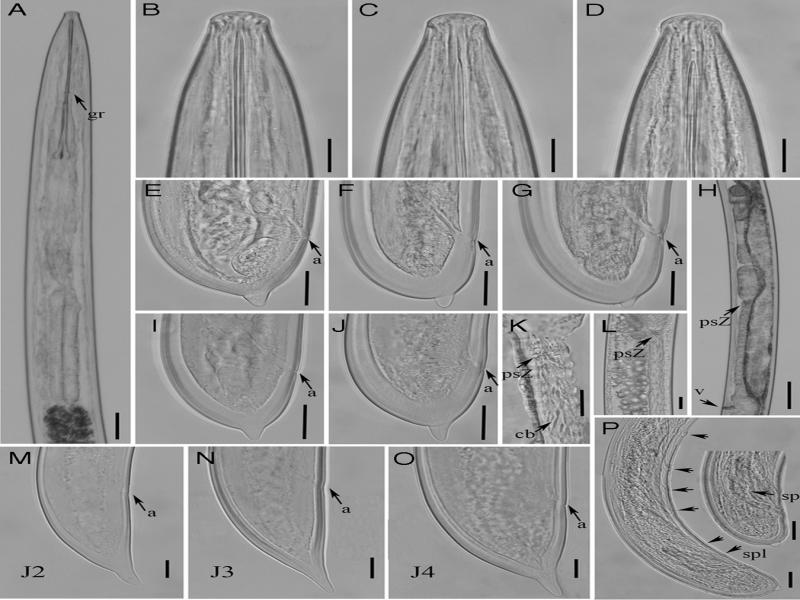
Figure 1.
Light micrographs of Xiphinema histriae (Lamberti et al., 1993a, 1993b). Females: A, Pharynx; B to D, Lip regions; E to G, I, J, Tail region; H, Gonad; K, L, Details of pseudo-Z-organ; Juveniles: M to O, Tail region of 2nd, 3rd and 4th stage juveniles; Males: P, Tail region of male. Abbreviations: a, anus; cb, crystalloid bodies; gr, guiding ring; psZ, pseudo-Z-organ; sp, spicule; spl, supplements; v, vulva. (Scale bars: A = 40 μm; B-D = 15 μm; E–G, I, J = 20 μm; H = 65 μm; K = 10 μm; L = 20 μm; M–O = 10 μm; P = 20 μm.)
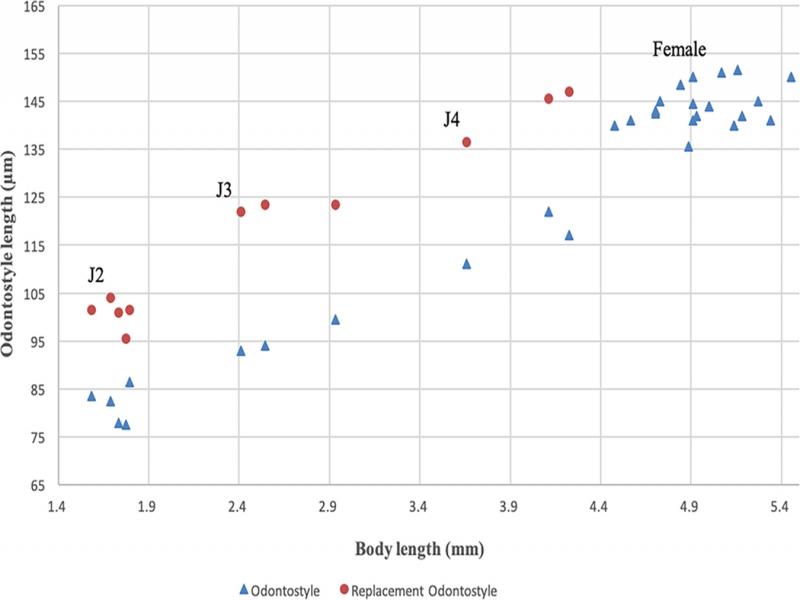
Figure 2:
Relationship of body length to length of functional and replacement odontostyle (▴=Odontostyle and •=Replacement odontostyle); length in three developmental stages and mature females of Xiphinema histriae.
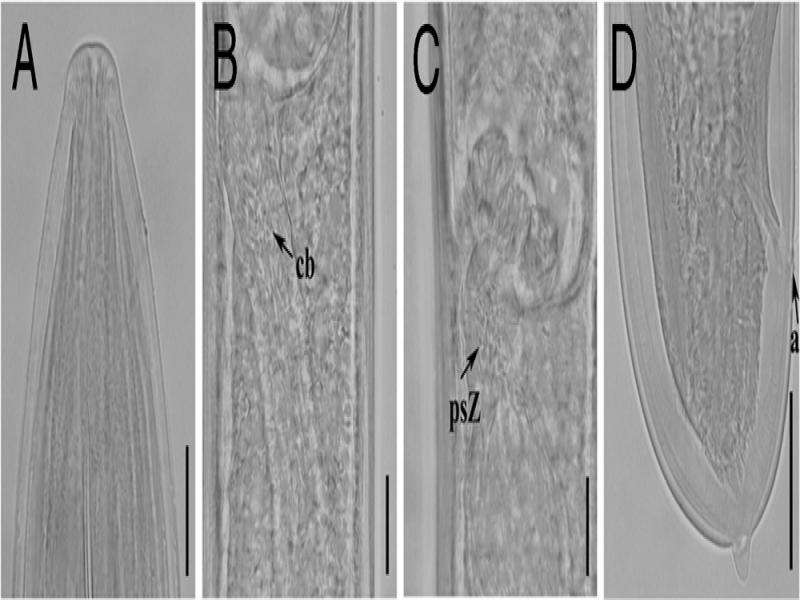
Figure 3.
Light micrographs of Xiphinema histriae paratypes (Lamberti et al., 1993a, 1993b). Female: A, Lip region; B, C, Details of pseudo-Z-organ; D, Tail region. Abbreviations: a, anus; cb, crystalloid bodies; psZ, pseudo-Z-organ. (Scale bars: A = 15 μm; B, C = 10 μm; D = 20 μm.)
Table 3.
Morphometrics of Xiphinema lapidosum (Roca and Bravo, 1993) from cultivated olive at Aroche (Huelva, Spain). All measurements are in µm and in the form: mean ± s.d. (range)a.
| Roca and Bravo (1993) Quinta do Rogelo, Silves, Faro, Portugal/broad-beans and peas | |||||||
|---|---|---|---|---|---|---|---|
| Characters/ratios | Females | Males | J2 | J3 | J4 | Females | Males |
| n | 10 | 5 | 2 | 5 | 7 | 14 | 7 |
| Lb | 4,600 ± 271.5 (4,250–5,023) | 4,618 ± 415.4 (4,091–4,977) | (1,689–1,773) | 2,292 ± 270.7 (2,068–2,704) | 3,101 ± 178.9 (2,864–3,318) | 4,300 ± 344 (3,700–4,600) | 4,300 ± 310 (3,900–4,800) |
| a | 71.5 ± 4.9 (64.9–75.5) | 70.9 ± 6.7 (63.4–79.6) | (57.3–59.1) | 63.4 ± 3.5 (59.6–68.5) | 67.0 ± 6.3 (59.3–77.6) | 80.0 ± 5.3 (70.4–88.2) | 85.0 ± 6.5 (75.5–95.5) |
| b | 9.8 ± 0.6 (8.8–10.9) | 10.9 ± 1.5 (9.1–12.3) | 4.5 | 6.9 ± 0.9 (6.1–7.8) | 7.4 ± 0.6 (6.4–8.1) | 9.5 ± 0.8 (7.8–10.7) | 9.0 ± 0.85 (7.5–10.0) |
| c | 113.2 ± 8.2 (98.8–123.6) | 118.4 ± 9 (109–129.8) | (23.2–24.0) | 40.5 ± 5.5 (35.3–49.2) | 67.7 ± 4.3 (62.9–74.5) | 110.0 ± 12.16 (92.0–132.0) | 113.2 ± 9.73 (101.5–130.0) |
| c' | 0.9 ± 0.07 (0.8–1.0) | 0.9 ± 0.08 (0.8–1.0) | (3.1–3.4) | 2.2 ± 0.2 (2.0–2.5) | 1.3 ± 0.1 (1.2–1.5) | 1.04 ± 0.07 (0.92–1.13) | 0.99 ± 0.07 (0.92–1.09) |
| V or T (%) | 46.0 ± 2.8 (40.6–51.0) | 50.3 ± 5.6 (45.2–56.3) | – | – | – | 43.4 ± 1.28 (41.0–46.0) | – |
| Odontostyle | 133.0 ± 2.5 (128.5–136.5) | 133.3 ± 5.5 (127.0–139.0) | (75.5–87.0) | 94.6 ± 3.8 (90.5–100.0) | 115.6 ± 2.8 (111.5–120.0) | 134.5 ± 3.71 (124.5–139.5) | 136.0 ± 3.88 (130.5–142.5) |
| Replacement odontostyle | – | – | 100.0 | 116.1 ± 5.5 (109.5–124.0) | 136.6 ± 4.7 (129.0–142.0) | – | – |
| Odontophore | 82.4 ± 4.6 (72.0–88.5) | 78.0 ± 3.9 (73.0–83.5) | (53.0–55.5) | 58.2 ± 3.5 (54.0–63.0) | 70.9 ± 3.1 (66.5–76.0) | 71.5 ± 1.39 (69.0–73.5) | 71.5 ± 2.67 (67.5–74.5) |
| Lip region width | 14.6 ± 0.5 (14.0–15.5) | 14.7 ± 0.8 (13.5–15.5) | 10.0 | 11.5 ± 0.6 (10.5–12.0) | 12.6 ± 1.3 (10.5–14.0) | 15.0 ± 0.60 (14.0–16.0) | 15.0 ± 0.31 (14.5–15.5) |
| Oral aperture-guiding ring | 122.5 ± 6.9 (111.5–135.0) | 117.9 ± 3.0 (113.0–120.5) | (65.0–73.0) | 81.5 ± 4.2 (76.5–86.0) | 98.2 ± 7.3 (84.0–106.0) | 116.5 ± 7.03 (97.5–127.5) | 121.5 ± 5.94 (115.5–130.5) |
| Tail length | 40.8 ± 2.8 (36.5–44.0) | 39.0 ± 2.0 (36.5–42.0) | (70.5–76.5) | 57.0 ± 3.5 (51.5–59.5) | 46.5 ± 3.1 (43.0–52.0) | 39.0 ± 2.04 (34.0–41.0) | 38.5 ± 2.77 (35.4–43.0) |
| Hyaline tail | 11.2 ± 1.5 (9.5–14.0) | 9.3 ± 1.4 (7.5–10.5) | 14.5 | 13.7 ± 3.4 (9.0–18.5) | 13.3 ± 0.8 (12.0–14.0) | 11.5 ± 1.8 (9.0–15.5) | 11.0 ± 1.59 (8.5–13.0) |
| Spicules | – | 66.2 ± 3.1 (63.0–71.0) | – | – | – | – | 64.5 ± 3.02 (60.0–68.0) |
| Lateral accessory piece | – | 18.0 ± 1.5 (16.5–19.5) | – | – | – | – | 15.5 ± 1.55 (13.5–18.0) |
1 Note: aMeasurements are in µm and in the form: mean ± standard deviation (range); ba = body length/maximum body width; b = body length/pharyngeal length; c = body length/tail length; c’ = tail length/body width at anus; V = (distance from anterior end to vulva/body length)×100; T = (distance from cloacal aperture to anterior end of testis/body length)×100; J = hyaline tail region length.
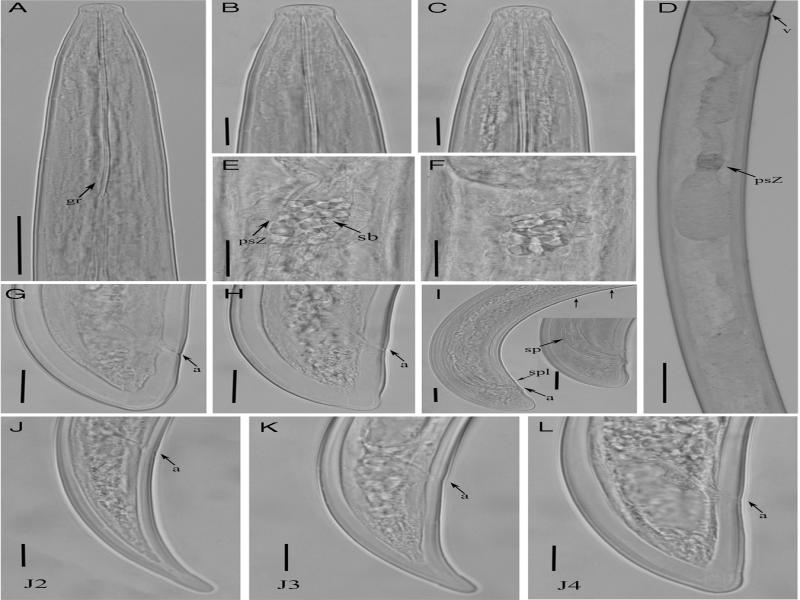
Figure 4:
Light micrographs of Xiphinema lapidosum (Roca and Bravo, 1993). Females: A, Pharynx; B to C, Lip regions; D, Gonad; E, F, Details of pseudo-Z-organ; G, H, Tail regions; Males: I, Tail region of male; Juveniles: J to L, Tail region of 2nd, 3rd and 4th stage juveniles. Abbreviations: a, anus; gr, guiding ring; psZ, pseudo-Z-organ; sb, sclerotized bodies; sp, spicule; spl, supplements; v, vulva. (Scale bars: A = 40 μm; B, C = 15 μm; D = 65 μm; E–I = 20 μm; J–L = 10 μm.)
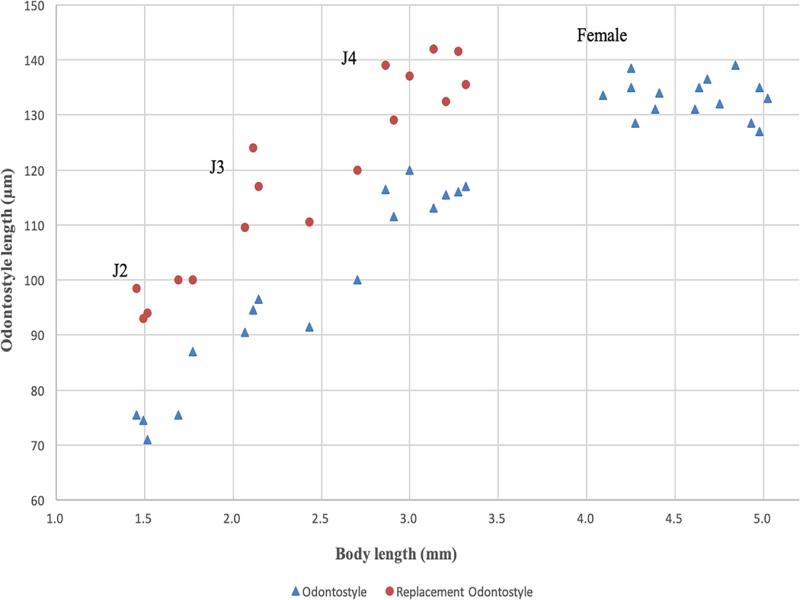
Figure 5:
Relationship of body length to length of functional and replacement odontostyle (▴= Odontostyle and •= Replacement odontostyle); length in three developmental stages and mature females of Xiphinema lapidosum.
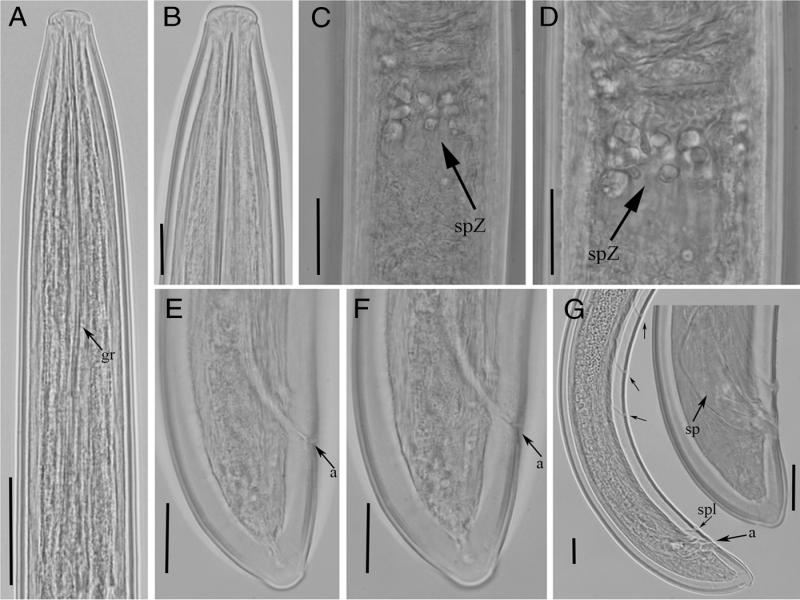
Figure 6:
Light micrographs of Xiphinema lapidosum paratypes (Roca and Bravo, 1993). Female: A, Pharynx; B, Lip region; C, D, Details of pseudo-Z-organ; E, F, Tail regions; Males: G, Tail region of male. Abbreviations: a, anus; gr, guiding ring; psZ, pseudo-Z-organ; sp, spicule; spl, supplements. (Scale bars: A = 40 μm; B = 15 μm; C-G = 20 μm.)
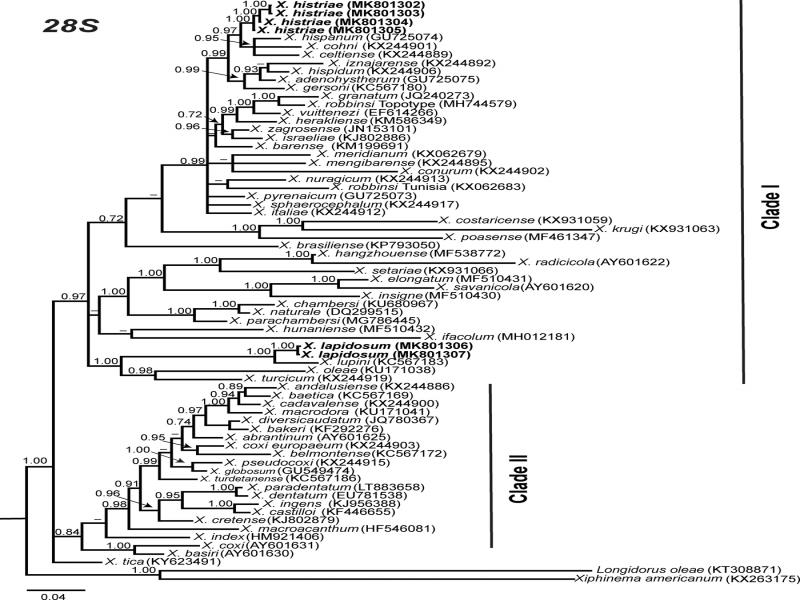
Figure 7:
Phylogenetic relationships within the Xiphinema non-americanum group complex. Bayesian 50% majority rule consensus tree as inferred from D2 to D3 expansion segments of 28S rRNA sequence alignment under the general time-reversible model of sequence evolution with correction for invariable sites and a gamma-shaped distribution (GTR + I + G) (lnL = 11,543.7822; AIC = 23,383.5644; freq A = 0.2502; freq C = 0.2298; freq G = 0.2995; freq T = 0.2205; R(a) = 0.9908; R(b) = 2.7656; R(c) = 2.4778; R(d) = 0.4894; R(e) = 4.2554; R(f) = 1.0000). Posterior probabilities greater than 0.70 are given for appropriate clades. Newly obtained sequences in this study are shown in bold. Scale bar = expected changes per site.
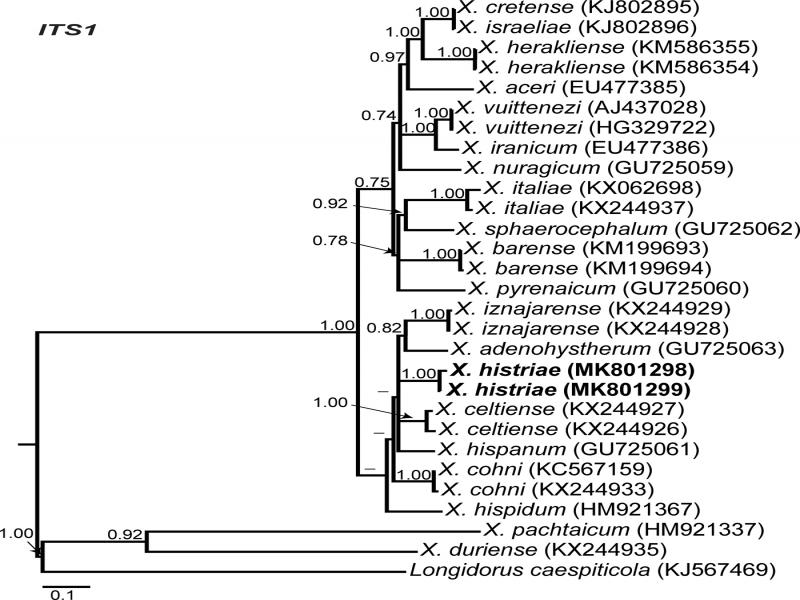
Figure 8:
Phylogenetic relationships within the Xiphinema non-americanum group complex. Bayesian 50% majority rule consensus tree as inferred from ITS1 rRNA gene sequence alignment under the general time-reversible model of sequence evolution with correction for invariable sites and a gamma-shaped distribution (GTR + I + G) (lnL = 6,024.1284; AIC = 12,068.2568; freq A = 0.2316; freq C = 0.2224; freq G = 0.3009; freq T = 0.2451; R(a) = 0.7019; R(b) = 4.6043; R(c) = 2.0272; R(d) = 0.6248; R(e) = 7.4428; R(f) = 1.0000). Posterior probabilities greater than 0.70 are given for appropriate clades. Newly obtained sequences in this study are shown in bold. Scale bar = expected changes per site.
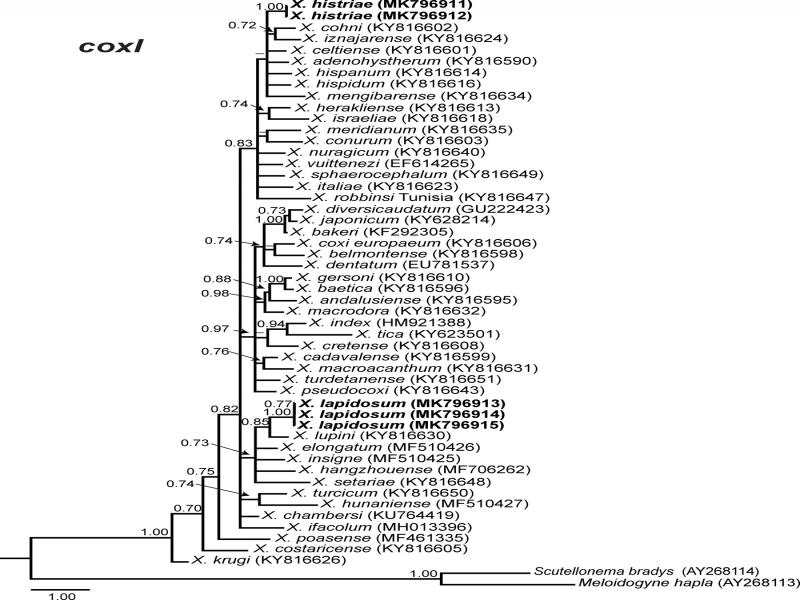
Figure 9:
Phylogenetic relationships within the Xiphinema non-americanum group complex. Bayesian 50% majority rule consensus tree as inferred from partial cytochrome c oxidase subunit I (CoxI) gene sequence alignment under the general time-reversible model of sequence evolution with correction for invariable sites and a gamma-shaped distribution (GTR + I + G), (lnL = 8,561.5874; AIC = 17,347.1747; freq A = 0.3687; freq C = 0.1301; freq G = 0.1382; freq T = 0.3630; R(a) = 3.3231; R(b) = 22.8405; R(c) = 2.0144; R(d) = 10.5400; R(e) = 75.4228; R(f) = 1.0000). Posterior probabilities greater than 0.70 are given for appropriate clades. Newly obtained sequences in this study are shown in bold. Scale bar = expected changes per site.